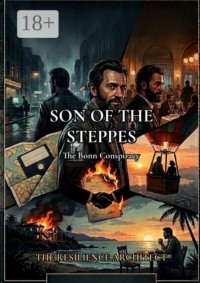
Czytaj książkę: «Son of the Steppes: The Bonn Conspiracy»
© Architect The Resilience, 2026
ISBN 978-5-0070-0423-7
Created with Ridero smart publishing system
Chapter 1: The Dead Knot
A Berlin evening in 1984 was drowning in a gray haze and the lights of sparse advertising signs. A heavy scent of ozone hung over the city — a storm was approaching. The Architect stood in the shadows of an abandoned brick warehouse in the Kreuzberg district. Fifty meters away, three angular Wartburg sedans sat motionless. The Stasi snatch squad was operating according to a classic pattern: total sector blockade, silent encirclement, and a «pincer» maneuver.
In his breast pocket, the floppy disk burned against his skin. Locked within that thin piece of magnetic plastic was the truth unearthed two weeks ago in Bonn. The voice of an American general and the insidious whisper of «The Old Man» — the handler of the entire network — still echoed in the Architect’s head: «Ideology is a commodity for the masses. You and I, we deal in real business. At the very top in Moscow and Berlin, they appreciate comfort, too.»
For a hereditary Cossack, whose sense of honor was woven into his character at a genetic level, this trading floor in the upper echelons of power had become a personal challenge.
«Lead, this is Two. Subject is in the square. Commencing,» the radio rasped.
The Architect took a deep breath, slowing his pulse to forty beats per minute. The state of *morok* — a mystical trance — enveloped him, turning him into a motionless blur among the brick shadows. He slipped into an open manhole a split second before flashlight beams sliced through the gloom where he had just stood.
Below, in the city’s concrete bowels, it smelled of dampness and old iron. The water reached his knees, reflecting the dim glow of technical lamps. The Architect moved with the «wolf’s gait» — silent, rolling from heel to toe. The echo of the pursuit already thundered in the tunnel behind him. Three operatives in heavy gear, the clatter of bolts. They thought they were driving a beast to the slaughter.
The Architect stopped at a main sluice gate. He needed to vanish in a way that would leave the System with no doubt of his death. He jerked the wheel of a release valve and immediately jammed it. A massive hydraulic hammer-blow echoed through the confined space like a thunderclap, mimicking a dam breach.
«The flood! The sluice is blown! Get out!» he bellowed, using the «brazen voice» technique that strikes directly at the instincts.
Smoke grenades hurled toward the enemy created a dense mist in the flashlight beams, which the operatives mistook for a wall of rushing water. Panic proved stronger than orders. The snatch squad scrambled for the ladders, abandoning gear in the murky water. A minute later, the hatch clanged shut above, cutting them off from their «deceased» target.
In the ensuing silence, the Architect pulled an old greatcoat from his duffel bag. He let a few drops of blood from a cut on his palm fall onto the collar — for genetic forensics. A heavy bundle stuffed with concrete shards crashed into the genuine churning torrent of the central drain. The water greedily snatched up the «body» and swept it toward the treatment plant’s turbines.
He moved carefully toward secret exit «C-7.» Now, he was truly autonomous. He had no country, no orders. Only his will remained.
Chapter 2: Cache «Zero»
In 1984, the Berlin Wall was not merely concrete; it was a living organism of sensors, seismic vibrators, and electromagnetic fields. For an ordinary defector, it was a death sentence. For the Architect, it was a set of physical frequencies that could be deceived. Using morok and his knowledge of blind spots in the security system, he crossed the death strip in Sector Charlie at the very peak of the thunderstorm. A lightning bolt momentarily blinded the automated systems — all the time needed for a shadow to slip into the West.
An abandoned brick factory in Kreuzberg greeted him with the scent of old dust and crushed stone. To the city, this building was dead, but for the Son of the Steppes, it had become a fortress. A professional does not seek comfort; he seeks security, stealth, and resources.
The Architecture of Survival
The Architect ignored the upper floors — they were traps, exposed to optical surveillance. He descended into the technical basement, into the former pump room. In place of a door was a breach in the wall, obstructed by old pallets and rusted rebar. From the outside, it appeared to be a natural collapse. To enter, one had to shift one specific brick, releasing a hidden latch.
He lined the basement windows at ground level from the inside with a double layer of black construction film, camouflaging them with debris. From the outside — utter darkness; inside — the ability to work. Instead of expensive electronics, the Architect applied a Cossack «secret»: a hair-thin fishing line was stretched ten centimeters above the floor on the approaches to the basement. At its ends were empty tin cans with a couple of nuts inside. A quiet but distinct sound that only a sleeping professional would hear. He covered the path to the lair with fine crushed glass beneath a layer of dust. Passing through silently was impossible.
The Autonomous Hub
Daily life obeyed the strict logic of autonomy. Sleep — on a podium of wooden crates covered with styrofoam for thermal insulation. Water — collected condensate and rainwater passed through a charcoal filter made of sand and crushed activated carbon. Power — an old car battery connected to a portable Grundig radio. This was his only window into the world of the airwaves.
The floppy disk did not sit on a table. It rested inside the casing of a broken cash register, wrapped in foil to protect it from electromagnetic scanning. Five inches of plastic that had turned him into a ghost.
The Night Before the Strike
The Architect lay down on the podium, placing his duffel bag under his head. His knife in its sheath rested along his thigh — his hand would find the hilt faster than his eyes could open. He closed his eyelids, using the «blank screen» technique. Thoughts of «The Old Man’s» betrayal and the conspiracy in the highest echelons of the GDR and USSR dissolved. Only the rhythm of the city remained. The hum of the U-Bahn, a distant police siren, the rustle of rats in the ventilation.
In this symphony of sounds, any foreign tone — the creak of a sole or a whisper — would act as a detonator.
Tomorrow, he would have to alter his appearance, gather resources, and begin the hunt for those who believed him dead. But for now — only a deep reset of the combat unit. The Son of the Steppes had gone to ground to gather the rage needed for the strike.
Chapter 3: The Rhythm of the Road
The morning in Kreuzberg smelled of dampness and old brick. The Architect began his transformation. A professional does not merely disguise himself; he changes his very essence.
1. Shedding the Skin
From his cache, he pulled out old, greasy jeans and a stretched sweater made of coarse wool. A few holes burned by cigarettes, a couple of machine-oil stains — and the man in the mirror was no longer a deep-cover intelligence officer, but a derelict drifter, one of thousands of «lost souls» flooding West Berlin.
The Architect rubbed road dust mixed with charcoal into his skin, emphasizing the wrinkles. He tousled his hair, securing the chaos with ordinary soap. His gaze — unfocused, empty. If a patrol looked at him, they would see only another victim of the system, not a threat.
Action: He sewed the floppy disk into the false bottom of an old canvas bag, lining it with a layer of foil and thin felt. He didn’t need to study it. The content of the files — names, accounts, dates of arms and narcotics shipments — had been burned into his memory back in Bonn. The disk was merely physical evidence, his «death warrant» for the traitors.
2. The «Freedom» Den
He headed for a squat on the outskirts of the district — a dilapidated commune inhabited by hippies, punks, and those who rejected all boundaries. Here, amidst clouds of incense and cheap tobacco, politics was a hollow sound.
The Architect sat in a corner, slowly chewing on a piece of stale bread. No one asked questions. In this world, a stranger is just another traveler. He bought a fresh newspaper at the entrance. A brief note on the back page confirmed it: the search for the «drowned» sewage worker in the East Sector had been called off.