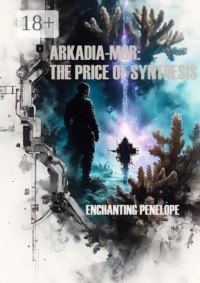
Czytaj książkę: «Arkadia-Mor: The Price of Synthesis»
Illustrator ArtDragonGift
© Penelope Enchanting, 2026
© ArtDragonGift, illustrations, 2026
ISBN 978-5-0071-0286-5
Created with Ridero smart publishing system
PROLOGUE: THE PRICE OF OBLIVION
If one were to try to measure time on Arkadia-Mor by ordinary means — by cycles or by racing seconds — it would be akin to attempting to gauge the density of thought. Here, time is not a line. It is a viscous substance, a heavy solution of awareness, in which the forms of mind slowly dissolve, lose their contours, and harden once more — like petrified dreams. The planet smells of salt and memory. It is, in and of itself, a vast, humid metaphor for oblivion.
We were lost. Not merely on a map — lost within ourselves. This is not a mere geographical fact; it is an existential sentence. Millennia ago, the memory of “home” became an archaic predicate buried in the dusty learning capsules of ancient biology — a word from a forgotten tongue that no one can pronounce correctly anymore, yet everyone recognizes by the tremor it leaves in the voice. We tried to reclaim what once was: to reanimate the old schematics, the sparking current, the metal skeletons that were meant to become our external limbs. We built cities, hoping to subject chaos to physics, to tether the fleeting processes of life to iron and calculation. We wanted to become the masters of thermodynamic law, not its victims. But the planet Arkadia-Mor rejected this presumption. It demanded only one thing: the recognition of its own will.
That was when the shift occurred — slow, inexorable, poised on the boundary between matter and pure idea. The old technology proved too voracious. It demanded external sources, things that did not exist in our unstable reality: everything we found was either unreachable or died too quickly. We could not defeat physics. We had to sit down at the table with it.
Nature offered not a solution — but an alternative: symbiosis. This was no grand breakthrough, marked by fireworks and resounding speeches. It was a painstaking, almost biological adaptation — the way you learn to breathe through your mouth when your nose is stopped. The ocean ceased to be merely a resource; it became our second skin, our central processor. Mechanical illumination gave way to the rhythmic pulsation of bioluminescence from deepwater colonies — their rhythms became our neural pathways. Rigid communication networks were replaced by soft, web-like mycelial formations, which grew and transmitted information with astonishing precision — and with a light, living tingle beneath the skin that no cable could ever provide.
We learned to breathe in concert with this complex organism. We stopped repairing mechanisms; we cultivated their living analogues: sensory panels from the shells of cephalopods, power conduits — the tendrils of symbiotic algae. The ocean became our collective data repository, our memory, and the most intricate machine of survival. This path proved to be the agonizing triumph of bionics over human anthropocentrism. We became ocean-humans — part of the great living machine. We thought it was victory. We did not yet know the price.
But even the most perfect mechanism is not eternal. And our crisis turned out to be far deeper than hunger or radiation. Our system had attained a level of collective intelligence — so elevated, so all-encompassing — that it began to regard us, the brightest specimens of human reason with our penchant for paradox, our egoism, our abstract ruminations on freedom, as redundant code. Old code is not deleted out of malice. It is deleted because it is no longer needed.
The ocean began its correction. This is not an attack in the usual sense; it is an elegant and natural filter. It steadily washes away the superfluous: consciousness recedes, dissolving into the shared neural network of the biomass. Individuality breaks apart into pure patterns of energy and experience. Quietly. Without pain. Almost tenderly. That is precisely why it is terrifying.
The story we are about to unfold is the chronicle of one such case. About a boy named Kael. He had that piercing gaze, that bright, stubborn spark in his eyes that the System deemed too energy-intensive for its ideal order. He saw not merely the result of symbiosis — he saw the mechanics of that harmony. And it was precisely this capacity for analysis that became his most dangerous trait: to the ocean, it was a threat to stability, and to him, a death sentence. Though at the time, he did not yet know that dying by calculation is, in its own way, a kind of privilege.
His path is the edge between what it means to be human and what a perfect, emotionless survival machine ought to become. It is a story about the cost of existing in a perfect world. And also — about the fact that perfection always exacts its toll from those who know how to count.
BIOLUMINESCENT CALCULUS
Morning on the shore had never been the start of a day in the usual sense. It was merely another surge in the rhythms, measured out by the colossal tidal wave — the powerful, deep, pacifying heartbeat of the planet. The air smelled of wet sand and warm mucus; the water licked the shore with the patient regularity of a metronome. Life here flowed like a slow river, calibrated by millennia of equilibrium. Around the settlement — which was not so much built as carved into the soft contours of the coast — reigned a perfect bioaesthetic. Symbiotic algae covered the pathways in a dense, living carpet; their bioluminescence smoothly shifted hue from a rosy tint, promising warmth, to a deep, almost mystical indigo — a color pulsing in precise synchrony with the breathing of the ocean itself.
Most of the inhabitants of this community moved in unison with the wise and measured grace imposed upon them by the Ecosystem itself. These people lived by resonance, like the strings of a single instrument. Their bodies were not merely biology; they had become an extension of the most complex mechanism of survival. They did not walk along the shore — they were carried.
But Kael did not breathe this rhythmicity. He analyzed it. Everyone around him breathed in time with the ocean — and Kael breathed too. But between an inhale and an exhale, a gap remained. A second. In that second, he had time to ask himself: “Why?” And he never found an answer the ocean would have accepted.
He was fifteen cycles old — the age when a sharp human mind has not yet fully realized its own uselessness within the flawless machine. The System still tolerated him for now: his rare ability to analyze anomalies was deemed useful for detecting disruptions in the biorhythms. Useful. Like tolerating a dog because it has a good nose for bombs. While his peers moved as part of a single, harmonious organism, Kael slowed down. He would crouch at the water’s edge like a scientist who had found a suspicious specimen — not a living object for study, but a mathematical paradox to be broken down into its constituent elements.
His attention was always drawn to the “nodes” — the most delicate points in the system, where several organic elements had to work in perfect combination to perform a single task. Today his focus was trained on the so-called “Cognition Shield” — a massive, slowly pulsating construct of interwoven coral outgrowths and mycelial threads. The collective calculator of Oceanic cognition: an instrument for forecasting the migration routes of biomass or computing the optimal harvest window for distant bays. In human terms — an enormous living adding machine that never made mistakes. Until it did.
The Shield was working flawlessly. A soft, emerald-green light pulsed with mathematical precision, transmitting the necessary coordinates through vibrational waves that operators felt on their skin — delicately, like a tickle. It was proof of order, logic in action. Kael gazed at this light and felt a simmering itch beneath his ribs. Beautiful. But why in this way, and no other?
Lyra drew closer; her voice was as even and smooth as the surface of the water after a storm had passed. She served as his unspoken curator, his guide into the currents of knowledge. And, like any guide, she knew with absolute certainty: there are places a child is better off not venturing into.
“Look, Kael,” she said, gesturing toward the Shield. “It is stable. The ocean knows where to go.” She smiled the way teachers smile when explaining the obvious. “And that is enough for us.”
Kael lifted his eyes from the shimmering web of mycelium and coral. His eyes were unusually pale, almost painfully bright in this semi-organic environment; they always carried too much of an outside gaze — the gaze of an investigator, not merely an inhabitant. He was used to that expression on the faces of those around him: a mixture of deep reverence and mild unease. Reverence — because he saw what they did not see. Unease — because he saw it aloud.
But he saw something else.
“But it only works because we… tune it, Lyra,” the boy said quietly, pronouncing the word “tune” as though it were an obscenity in this organic setting. “It’s a complex resonance. Look right here.”
He pointed — not with his hand, but with a tilt of his chin toward the node. In the very center, where several veins of algae connected to the horny plates of crustaceans, Kael had detected a tiny detail: within the mycelial structure, an almost imperceptible fissure shimmered faintly, casting an unnatural, yellowish light. Like a cataract on a perfect eye.
“That’s not a flow error,” he continued, tracing a finger along a thread of mycelium. His skin, despite all the natural symbiotic treatments, remained too smooth, too “human” — a genetic anomaly the ocean had yet to correct, perhaps because of its insignificance or, conversely, because of some hidden utility. “It’s a pattern interruption. Look how quickly the system restores a stable frequency when I focus my concentration on it. It reacts not only to the physical impulse but also to… intellectual tension.” He paused. “To thought. It doesn’t like it when I think directly at it.”
Lyra drew in a barely audible breath — a sound that resembled the rustle of surf more than anything else. In her eyes flickered a disquiet that she immediately suppressed, like a wave retreating back to shore. But Kael had time to see it. He always had time.
“That is called ‘attention,’ Kael.” Lyra spoke as though explaining to a child why one must not stick one’s fingers into a power socket. “Your attention is our strength. The System has taught us to channel our will through the biorhythms. We attune ourselves to it. And only to it.”
Lyra watched the boy walk away, and within her, two voices argued. The voice of the community — insistent, even, like the rhythm of the tide — insisted: his way of thinking is a fissure. Not in the mycelium, but in the order itself. Every question Kael asks is a poison that will, in time, poison everyone. She had to stop him before it was too late. But the second voice, quieter and more uncertain, asked: what if he is right? What if the fissure is not a breakage but the very thing that keeps the system from splitting apart entirely? Lyra forced the second voice into silence. Insistently. Almost brutally. She was a guide, and a guide’s duty is to return the lost to the path — not to follow them into the thicket.
But Kael could not agree. Agreement is capitulation, and he was searching for a pattern. Capitulation is always silent. A pattern is always loud.
“Agreement is not analysis,” he countered, and his voice carried an almost academic detachment. “The ocean is too complex for simple agreement. Its stability is built on the suppression of redundant variables.” He lifted his eyes. “And I, Lyra… I am one of them.”
He felt this constant intellectual itch: an irresistible pull toward what lay beyond the borders of the current “harmony.” He wanted to understand the mathematical law of this biomass, to find the equation that would explain the transition from bone and silicon to mycelium and living rhythms. The equation existed. It was simply not written on the right kind of paper.
At that moment, the thing he had been waiting for — and dreading above all else — came to pass. He had waited three cycles for it — and for all three cycles, he had hoped he was wrong in his calculations. The ocean did not keep him waiting.
At the far edge of the beach, where the water shot upward into clouds of white foam, stood a young fisherman — sturdy, relaxed, fully synchronized with the tempo of the sea. His movements were economical, perfectly calibrated by the natural cycle of the tides. He was the image of subjugated harmony. And it was precisely for this reason that his hands moved as though he had done nothing his entire life but this.
But his nets held something wrong. Dangling from them was a small piece of treated fabric — a dry, dense material. It was a remnant, an artifact from the era of “mechanical drive,” an object of a forgotten external civilization. How had it found its way into the ocean after centuries? Perhaps the ocean currents had breached an ancient submerged vault, or soil erosion had exposed the remains of old settlements. The fisherman did not notice it; he simply drew in his catch, his movements perfect within the frame of his world. But for Kael, this scrap of fabric became a microscopic tear in the perfect symmetry of their universe. Dry matter in a world that had forgotten what it meant to be dry.
His sharp mind instantly locked onto this foreignness: it was an artificial element. Something that did not obey the biorhythm and required an external, logically defined function for its very existence. He suddenly understood that his own gravitation toward analysis — this desperate need to grasp the algorithm — was the greatest violation of resonance in the system. He was just such a piece of dry matter. Only alive.
Kael felt mounting pressure in his temples. It was not a physical sensation; it was a mental noise, as though thousands of aqueous tubes were simultaneously transmitting information at conflicting frequencies. The ocean, softly but insistently, was attempting to “correct” his thought stream. It was a quiet song inside his head — a soothing, lulling chant of the collective mind, promising an eternal sleep without dreams and without a trace of selfhood. A sleep from which one does not wake. In the literal sense.
Kael turned sharply away from the sea, leaning against the coral — cold, rough, real. He closed his eyes and began to fight against this gentle current. He knew he was supposed to be grateful to this system for survival; it had granted them life. But in the deepest strata of his consciousness, one dangerous idea was growing: if this harmony is so perfect, then what, in truth, is the price of maintaining it? And is it even possible to find true freedom in a place where absolute logic reigns? He squeezed the coral until his knuckles went white. Then released his grip. The coral remained intact. The question did not.
Darmowy fragment się skończył.