
0+

O książce
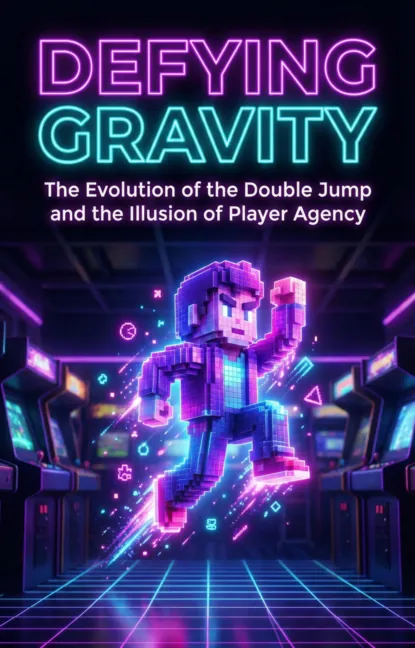
In the strict realm of physics, jumping while already airborne is a fundamental impossibility. Yet, in the world of video games, the «double jump» is one of the most beloved, ubiquitous, and essential mechanics ever programmed. It fundamentally breaks the rules of reality to maximize human enjoyment.
The origin of the double jump wasn't born out of a desire for realism, but as a clever programming workaround to fix stiff, unforgiving controls in early arcade platformers. By granting the player a secondary burst of vertical momentum in mid-air, game designers essentially provided a mechanical «undo» button. It eliminated the frustration of missed leaps and offered an unparalleled sense of kinetic freedom.
This deep dive into game design history traces the evolution of mid-air mechanics. We explore how breaking gravity rewired level design architecture, forcing developers to build vertical spaces that rewarded exploration rather than just horizontal progression.
For gamers and designers alike, understanding this mechanic reveals the core philosophy of interactive media. Discover how prioritizing intuitive satisfaction over strict physical logic created the perfect illusion of absolute player control.