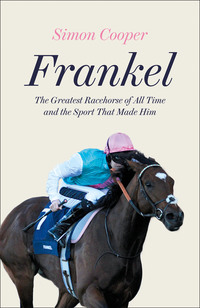
Czytaj książkę: «Frankel»

Copyright
William Collins
An imprint of HarperCollinsPublishers
1 London Bridge Street
London SE1 9GF
WilliamCollinsBooks.com
This eBook first published in Great Britain by William Collins in 2020
Copyright © Simon Cooper 2020
Images © individual copyright holders
Race card © Racing Post
Cover image © CARL COURT/Stringer/Getty Images
Simon Cooper asserts the moral right to be identified as the author of this work
A catalogue record for this book is available from the British Library
All rights reserved under International and Pan-American Copyright Conventions. By payment of the required fees, you have been granted the non-exclusive, non-transferable right to access and read the text of this e-book on-screen. No part of this text may be reproduced, transmitted, down-loaded, decompiled, reverse engineered, or stored in or introduced into any information storage and retrieval system, in any form or by any means, whether electronic or mechanical, now known or hereinafter invented, without the express written permission of HarperCollins.
Source ISBN: 9780008307035
Ebook Edition © August 2020 ISBN: 9780008307059
Version: 2020-06-02
Dedication
Mum
Sorry I didn’t finish in time.
Epigraph
‘And Allah took a handful of southerly wind,
blew His breath over it, and created the horse.’
Bedouin legend
Contents
1 Cover
2 Title Page
3 Copyright
4 Dedication
5 Epigraph
6 Contents
7 Prologue
8 1 Genetic alchemy
9 2 A certain kindness
10 3 Creation day
11 4 Day 343
12 5 More Irish than English
13 6 The Pick
14 7 In training for training
15 8 A horse by a very special name
16 9 Warren Place
17 10 Getting into his head
18 11 The 6.35 at Newmarket
19 12 Intensive training
20 13 Economical with the actualité
21 14 Winter dreaming
22 15 Leading from the front
23 16 Arise Sir Henry
24 17 Duel on the Downs
25 18 The high-stakes gamble
26 19 Hidden dips
27 20 Flying the standard
28 21 Always summer
29 22 The end of days
30 Epilogue
31 The Newmarket 11
32 Keeneland to fenland
33 A six-figure loss
34 Last man standing
35 The worst Derby runner ever?
36 Up in the air
37 A 99 per cent write-down
38 The cruellest cut
39 All-weather man
40 Pinhooked
41 Scandal
42 Shadow man
43 Acknowledgements
44 The Frankel File
45 Pedigree
46 Race record
47 Timeline
48 Awards
49 Frankel by numbers
50 Picture Section
51 Bibliography
52 Index
53 About the Author
54 About the Publisher
LandmarksCoverFrontmatterStart of ContentBackmatter
List of Pagesiiiivvviixixiixiiixiv12345678910111213141516171819202122232425262728293031333435363738394041424344454647484950515253545556575859616263646566676869707172737475777879808182838485868789909192939495969799100101102103104105106107108109111112113114115116117118119120121122123124125126127128129130131132133134135136137138139140141142143144145146147148149151152153154155156157158159160161162163164165167168169170171172173175176177178179180181182183184185186187188189190191192193194195196197198199201202203204205206207209210211212213214215217218219220221222223225226227228229230231232233234235236237238239240241242243244245246247248249250251252253254255256257258259260261263264265267268269270271272273274275276277278279280281282283284285286287288289290291292293294295296297298299300301302303304305306307308309310311312313314315316317318319320321322323324325326327328329330331333338334339340341342343344345346347348349350351352353354
Prologue
In horse racing, greatness is defined by speed. Being the second fastest counts for little. You have to win. And win. And keep on winning until every challenger of your generation is put to the sword. Such a thing so rarely happens that most people pass through life without the privilege of seeing such an animal. Occasionally a contender will arrive, burning up the turf until the dream of greatness is shattered in defeat; that precious cloak of invincibility torn to shreds by another.
On a rainy Suffolk evening, did our locally trained bay colt have any idea that he was about to embark on that path to the ultimate in racing greatness? To become the one against which all horses of the past, present and future would be judged and likely fall short. Let’s face it, he probably didn’t.
In truth, despite the remote possibility of such a thing, he had a whisper of a chance; he was bred if not to be great then at least to be fast. But that counts for only so much. Hundreds of thoroughbred racehorses debut each season with bloodlines as good as our horse. But breeding will only take you so far; the rest lies deep within, far beyond human intervention.
If you’d been a casual observer among the thousands gathered at Newmarket races on 13 August 2010, the third race of the night didn’t promise very much. In fact, it was a meeting far removed from the highest rank, designed more to draw a big holiday crowd than for quality racing. It was one of those humdrum, unregarded workaday fixtures which are the bread and butter of horse racing around the globe – excepting one horse.
You probably didn’t bother to go to the paddock after the second race to watch the horses parade for the next; few did. What was meant to be a balmy summer evening had turned cold with squally-soon-to-become-heavy rain. Trainers, jockeys, stable hands and officials were all scurrying around truncating the preliminaries to the shortest possible duration. The lawns in front of the stands were pretty well deserted; the crowds were jammed inside. A few hardy types sheltered under umbrellas to be close to the horses, but in truth they were few and far between. After all, this was just a minor race with a dozen horses, eight of which had never raced before and the remaining four had hardly set the world alight, without a win between them.
For our horse, this was to be his racecourse debut; he was one of that eight. But was he the special one? Maybe. There was a buzz about him. He’d lit up the training gallops. Been the gossip of this racing town. He’d been named in honour of one of the greatest trainers of modern times. Expectations were high. A sick man, his trainer, was being rejuvenated just by his very being. But this was a wretched night; his stable hand had even lost his shoe in the quagmire leading up to the start. If it all went wrong, there were at least excuses to hand.
By the time you’d extracted yourself from the bar, placed a bet and found a vantage point in the stands, the horses would have been long gone, gathered at the start a mile away. Without high-powered binoculars they would have been nothing more than a wet smudge on the otherwise empty horizon of Newmarket Heath that doubles as a racecourse. With binoculars you’d have seen jockeys hating the rain, crouched over their horses, keeping them calm with a circling routine. Had you been at the start, you would have heard the starter’s assistant complete the roll call as the handlers stepped forward to lead each horse in turn into the designated compartment of the starting stalls. A moment later, the loading complete, the gates of the stalls would spring open. The race was on.
Did our horse lead from pillar to post, leaving all others struggling in his wake, the rain-sodden crowd gasping in awe at his performance? I’d like to tell you yes, but it wasn’t really that way. In a race that lasts less than two minutes – this was just a mile – a quick getaway helps. But our young blood blew it. Months of training counted for nothing as this critical moment vanished in a trice. He was closer to last than first with half the race run. Had you placed a bet on him – he was the favourite, after all – you might have had reason to worry. But really you need not have done. Our horse was a cut above the rest. He knew it. And you, too, would know it soon.
He had been trained to run this way. He was headstrong. A horse who knew his mind but was prone to run too fast, too soon. His trainer, the best of the best, saw this in him so taught him the value of patience. The waiting game. Cruising behind the others until the moment was right. And that is how this race has become a part of horse-racing history.
In the wet gloom, as the track rose towards the finishing line, the jockey eased our horse out from behind the pack to make his run. There was nothing hurried. Really, there was nothing to doubt. He drew level with the leaders, kept time with them for a few strides as if to make some point before pulling away with ease as the winning post flashed by. Whether you were a seasoned racing professional or a once-a-year punter, our horse would have caught the eye. ‘Impressive’, you’d have said. ‘Very impressive.’ And you’d have logged the name of our horse in that part of your brain reserved for something out of the ordinary.
One hundred and three seconds on from the start, the horse drawn in stall ten had passed the winning post ahead of the rest. That was to become something of a habit as Frankel was now, despite the apparent inauspiciousness of the occasion, on his way to becoming the greatest racehorse to ever live.

1
Genetic alchemy
Yesterday I met Frankel who crept up on me all of a sudden. One moment I was deep in conversation and the next I sensed a presence behind me. Maybe someone said something along the lines of ‘here’s the man’. In truth, I don’t recall precisely but when I turned around there he was: the greatest racehorse that has ever strode out on God’s turf.
As I wended my way across the Cambridge fens, which in turn gave way to the ordered horse paddocks that surround Newmarket, I tried not to elevate this meeting to something of a semi-religious experience. An audience with the Pope. A pilgrimage to a Tibetan mountaintop to meet the Dalai Lama. It seemed the wrong side of sane to equate a horse on such a level.
And indeed that is true. But rarely in life does one ever get to meet the truly great. They are the stuff of legends. Stories passed down through generations. The prism of time only giving us a hint of what the truth may have been. But here was I doing that very thing. A chance to look, see and touch. Make a judgement all of my own. To burn into my memory a horse that will likely never, ever exist again.
You’d barely give Frankel’s home a second glance if you drove past. Yes, the sweeping turn to the entrance looks immaculate, but the redbrick walls are low and the signs discreet. Beyond the gates that swing open to acknowledge your arrival, the scene that greets you appears to be anything other than a horse stud farm.
The smooth tarmac gives way to immaculately raked gravel that scrunches under my tyres. In the absence of signs, a kindly gardener points me in the right direction, curving me around the tall copper beech that was hiding the offices. Well, these are not offices in the absolute sense of the word, but rather the most magnificent country house, known as Banstead Manor Stud, that people just happen to work in. It is the European headquarters of the world-famous racing and breeding operation, Juddmonte, owned by His Highness Prince Khalid bin Abdullah bin Abdulrahman Al Saud, known universally across racing as Mr Khalid Abdullah, befitting his privacy and pursuit of excellence. I honestly don’t know if Juddmonte’s Banstead Manor was designed by the British architect Sir Edwin Lutyens, but it has all the heritage. Long, horizontal, thin red bricks delineated by perfectly trowelled lime mortar. Tall, slender chimneys, artworks in their own right. Narrow windows that mimic the first Elizabethan age. I’m ushered into a rather grand room which is full of Frankel memorabilia; even the mints are wrapped in his racing colours. Among the paintings and prints is a faded handwritten letter from a son to his mother in old-fashioned copperplate script. It seems Frankel is not the only one to achieve world fame to have lived at Banstead Manor; this was the childhood home of Winston Churchill.
I’m met by Shane Horan who is introduced to me with a job title I’ve never heard spoken of before, but that speaks more to my ignorance in these matters than the title itself: Nominations Manager. He is, it transpires, responsible for which mares are chosen each season (requests to mate with Frankel are significantly oversubscribed). We sit down in what I guess would once have been the drawing room, with furniture as comfortable today as it would have been back when this was a grand home. Reclining on the sofa, I have a glorious view across a York stone terrace, striped lawns, and between the house and yet another copper beech, a statue of a full-sized horse on a Portland stone plinth. I hazard a guess that it might just be Frankel. I am correct.
I pull out my pad and start to ask Shane a few questions, but we both know that really I am being polite. Seeing Frankel is the thing. The answers will come later. We are just playing for time. Soon Shane looks at his watch, stands up, and beckons me to follow. ‘We’ll just catch him on the way back.’ It is shortly before 3 pm but I’m none the wiser as to where Frankel has been or where he is going. I don’t like to ask, as the assumption seems to be that I should know.
My other assumption was that I’ll need a pair of wellington boots to tramp around, or at least make my way to the stud yard. Shane gives me a quizzical look when I ask whether I should change footwear. I’ll take that as a no. The walk to the stables is both short and perfection. Another striped lawn gently slopes away from the house. A small lake gurgles as a pulsing fountain spouts water. The yew hedges are geometrically precise. Gertrude Jekyll, Lutyens’ landscape gardener of choice, would most definitely have approved of the splendid herbaceous borders, the flock of colours rising from low at the front to tall at the back. Less than a hundred yards from the house, Shane swings open a small gate and beyond the shiny, black-painted tubular steel of the estate fencing is more striped lawn, specimen trees, soft pale shingle pathways and three turreted stable blocks.
Disabuse yourself that this is any ordinary stable block; if there was a star rating for horse accommodation this would be seven star plus a bit more. The original building, that houses just two horses, repeats the brickwork of the house, with dark-wood stained stable doors at either side adorned with solid brass catches and bolts. In the centre a corbelled arch leads to a white-painted door, slightly knocked and careworn by daily stud life, with the tack and feed store beyond. The slate roof is topped by two jaunty looking turrets, which serve as ventilation shafts, each of which is capped by what you might easily mistake for a black pointed witch’s hat. The shafts, a sort of forerunner to air conditioning, were by all accounts originally installed by army engineers who were billeted in the stables during World War II, and the style has been replicated with the three later stable blocks, perfect facsimiles both, with housing for eight stallions in total. This is, and has been for the past six years, Frankel’s home.
There is most definitely a sense of theatre leading up to meeting the equine who is often termed, with no sense of anything other than the truth, the wonder horse. In turn, I am shown stallions Bated Breath, Kingman and Oasis Dream who are led out of their respective stalls for my perusal. Privileged though I am to see them, I do feel a bit of a fraud. If you are a keen follower of horse racing, and breeding in particular, those names will leap from the page. For me, just starting my equine genetic education, they are simply the most beautiful specimens in the prime of life, living in the most splendid surroundings. In time I’ll piece it all together, but for now, without wishing to diminish them in any way, they are the amuse-bouche.
As I turned to see Frankel for the first time, he was most definitely different to the others but perhaps not quite as I imagined. While the first three had variously danced on their toes, squiggled their ears, held heads high, eyes darting to every person and chewing on the brass chain that connects leading rein to head collar, along came Frankel, head bowed down. There was no fuss. No ceremony. I would say he sauntered up to me, but that suggests a levity of demeanour which is not him at all. He moved with considered purpose. Each stride was for a reason, delivering one foot in front of the other with an economy of effort. Pausing at the required spot as if to say, I’m not going to move further unless it is absolutely necessary. But don’t mistake this for laziness. Here was a horse who was alert to everything and everybody around him.
He took to my scratching at the white star on his forehead in good part. Just patting him on the neck seemed rather inadequate; too small and fleeting a gesture to connect with this great beast. He kept his head slightly bowed as we went eye-to-eye. I slid my hand down the front of his face, tracing the line of his blaze, the white hairs that narrow then widen again just as the coat gives way to the soft, dark skin of the muzzle. Warm breath gently exhaled from his nostrils, the steady beat of breathing pacing out the comfortable moments between us. There was a slight damp odour in the air, but not unpleasant. Oats and hay maybe? As I jiggled my fingers around his wet mouth, we ended up playing a little game as he twisted his lips as if to capture a stray piece of my hand. Until, quite suddenly, without breaking eye contact, he nudged my hand away. The game was over.
For Rob Bowley, his stallion man, had just produced the most enormous carrot. However potentially tasty my fingers might have been, carrots were clearly a known quantity in Frankel’s life. It is fair to say, he was not a tidy eater. As he bit, crunched and chewed his way through this industrial-sized vegetable, a pool of carrot juice and orange-coloured pulp, certainly enough to fulfil one of your five-a-day, gathered at his feet. So intent on eating, he didn’t seem to notice the brief arrival of the stud cat George who sidled over to sniff, then reject, a possible windfall. That said, George and Frankel go back a long while, as the cat arrived at Banstead just a month before the horse, though the pedigree of the latter was considerably more certain than that of the former. George just appeared from nowhere, the grey tabby taking up residence without so much as a by-your-leave. Despite much asking around the village nobody ever claimed him so, as the Frankel express has thrilled ever faster, George had been along for the ride, elbowing his way into photoshoots and among film crews. I’m not sure Frankel liked sharing the limelight, for he studiously ignored George, as all the while I stood at his head he kept me fixed in his gaze, those dark brown eyes giving nothing away.
And that is what I recall most about my first meeting with Frankel. Not his impressive frame. Not his beautiful home. But his eyes. They followed the unknown quantity, in this case me, everywhere. Rob, Shane and all the other Banstead people – Frankel had locked them away deep inside that head of his. But of the new, he was curious. Something to be sized up, evaluated and considered. As Frankel was wheeled away and he gave me one last sidelong glance, it was hard not to come to the conclusion that he had been judging me more than I had been judging him. It was an odd and slightly perplexing sensation. He is, after all, only a horse but I felt I had undergone some sort of benediction.
Once Frankel was gone everyone definitely relaxed – now that is odd – as the conversation turned to his daily regime. The question in my mind was soon answered without me ever having to ask it – Frankel was on the way back from his 3 pm covering. Or to put it in layman’s terms, a mating with one of the 150 or so mares that would be visiting with him from mid-February (breeders with some sense of humour commence the season the day after St Valentine’s Day) until mid-June. If you are starting to do the maths to conclude that is a lot of covers in not a lot of time, you’d be right. Plus you have to account for some multiple covers of the same mare to ensure success. So, at the moment of my mid-afternoon meeting, Frankel was only just past the halfway point in his day with 7 am, 3 pm and 9 pm appointments in his daily diary. Great genes are in great demand.
Today Frankel is ten and has spent the greater part of his adult life at Banstead Manor Stud in Suffolk. Indeed, this was where he was born, but his story really starts 400 miles due west in another horse county of another horse country. County Tipperary in Ireland.
There is a fine motorway that takes you from Cork in the direction of Dublin. It’s very twenty-first century with wide lanes and tolls; maybe it is the latter that discourages traffic because it seemed very empty to me. But the moment you turn off to follow the signs to Fethard, you are in old Ireland. The lanes are narrow. The stone walls in need of repair. Topped with hedges interspersed with ragged barbed-wire fencing. You would never call the rural architecture that plots your journey beautiful. The grey, squat, rectangular bungalows are built with practicality rather than beauty in mind, often juxtaposed by the adjacent farmyards that seem to have been forever falling down awaiting a wave of gentrification that may never arrive.
And pretty soon you are in Fethard. The roads are potholed. Shops are boarded up. This seems like a bit of Ireland still awaiting the arrival of the Celtic tiger. But you can’t help but smile at the sign on the wall outside the bar: McCarthy’s est. 1840. Publican. Restaurant. Undertaker. One of Ireland’s oldest unchanged pubs. If that doesn’t arrest the progress of a hungry traveller nothing will, though the slight carbolic smell that hangs over the town is disconcerting. Here is a place where peat is still burned as the fuel of choice.
On, through and out the other side of Fethard and suddenly twenty-first-century Ireland seems to be back, but with a twist of rural chic. Instead of just driving down a road you appear to be driving down an avenue. The verges are trimmed. The hedges cut box-straight, lined on the field side with gradually maturing trees planted perfectly parallel to the road, and beyond that post and rail fences delineating paddocks. Even the farm gates are a cut above your usual rural offering, with sweeping turn-ins and fancy stone pillars. Helpful signs direct you off the road to such-and-such farm or so-and-so stud. Occasionally, you catch a glimpse of a group of mares and their foals.
If Banstead Manor was the last word in understated stud luxury, then Coolmore Stud is something very different. That is not to say it is not smart; witness the mile-and-a-half ‘avenue’ approach which has brought me to their door, the entrance more akin to a small European palace than a working stud farm. But it is unashamedly commercial. In the world of breeding, it is rivalled only, at least in numerical terms, by Godolphin, the name that covers the racing and breeding interests of Sheikh Mohammed and the famous all-blue Godolphin racing colours.
The scale and spread of Coolmore is, in every sense of the word, awesome. As I was driven around (covering 7,000 acres, you don’t walk) I have to confess to frequently suffering from information overload. It really is quite something to take in, but here are the salient facts of how it has become what it is today. Coolmore is owned by the Magnier family, but its origins lie with Battle of Britain fighter pilot Tim Vigors who, having been demobbed from the Royal Air Force, came to Ireland to work as a bloodstock auctioneer then agent, and inherited Coolmore, which was at the time just 350 acres. It was here he set about establishing the stud in 1968.
At that time, seven miles away across the fields at Ballydoyle, Vincent O’Brien was hitting the prime of his flat training career, along with jockey Lester Piggott, with a string of great horses. Sir Ivor, Nijinsky, Roberto, and The Minstrel come immediately to mind. If those names don’t mean much to you, don’t worry. It is possibly just enough to know that they were Derby winners all, the most prestigious race on the planet, in a ten-year purple patch that ran from the same year Vigors set up shop. And this success initially came within the partnership of Vigors, O’Brien and football pools magnate (a huge UK national gambling pastime until it was first decimated by the National Lottery and then put out of its misery by the internet), Robert Sangster.
But Coolmore wasn’t just a breeder, it was a buyer of bloodstock, in the early years supplementing European bloodlines with North American horses, especially the offspring of Canadian sire Northern Dancer who just happens to be Frankel’s great-grandfather. You might now have a clue where this is all going. At the time, Coolmore was not the only one to recognise the value of this particular sire, leading to epic showdowns in the sales ring as it went head-to-head with the Arab buyers in the bloodstock boom of the 1980s. This resulted in the first eight-figure sum ever paid for a horse when a yearling, who was subsequently named Snaafi Dancer, sold in 1983 for $10.2 million ($25.1 million in today’s money), bought by Sheikh Mohammed. If you are assuming he went on to do great things, you’ll be disappointed. Sent into training in England, this colt was considered too slow to even race, and attempts to harvest the genes of his father failed; in two years at stud, with all sorts of fertility problems, he sired just four offspring, three of which won minor races. It is said that he ended his days eating grass in a Florida paddock.
Not to be outdone, the Coolmore syndicate went higher still two years later, paying $13.1 million ($29.8 million adjusted in real terms) for the son of Nijinsky (who himself was the son of Northern Dancer), making him the most expensive yearling ever sold at public auction. This story had a slightly happier ending as Seattle Dancer, as he was named, without ever being considered a world beater, won some good races for Vincent O’Brien and competed against some of the best. He retired to become a Coolmore stallion standing in the USA, Ireland, Japan and finally Germany until his death in 2007 at twenty-three years of age.
So evolved this powerful triumvirate: Sangster provided the cash, Coolmore the raw material and O’Brien the training expertise. It is a model that many have copied since, admittedly rarely with this scale of success. Three decades on, the essential template persists, though with some subtle changes. John Magnier is now the sole owner of Coolmore. As the son-in-law of Vincent O’Brien, and previously a successful fourth-generation National Hunt breeder at the nearby Castlehyde Stud, Magnier has over time bought the interests of Vigors, O’Brien and Sangster. However, the connection with Ballydoyle remains, where Aidan O’Brien took over in 1996 following the retirement of Vincent in 1994 (the two are not related), training the Coolmore homebreds and purchases.
During the writing of this book, you may not be surprised to learn that I visited all manner of horse farms, studs, stables and training yards across countries and continents. And the one thing I will always take away from them all is an immense feeling of calm. Away from the hustle and bustle of the racecourse, horses lead the most perfectly ordered lives. Everything, wherever possible, is refined down to routine and peacefulness. When you pass through the gates of any horse establishment, the world as most people know it is left behind. Time exists at the pace that suits the horses. The animals come first. People come second. Once the daily chores are over, the horses settled and the stable hands departed for breakfast or a well-deserved afternoon nap, human activity is supplanted by stillness. Horse heads hang over the stable doors quietly, watching very little. If you happen to pass through the yard, you might hear the grating grind from somewhere deep inside a dim-lit stall as a mouthful of hay is chewed as much for its properties as a calming balm as for its food value. Or the slurping sucking of water through tightened lips. Occasionally, a steel-shod hoof scrapes against a concrete floor or bangs against the wooden door, drawing disapproving glances from the neighbours. But that is about it. The biggest excitement might be a flock of doves whistling by or the stable cat on patrol.
Somehow, I think that is what draws people into the horse business and captures their hearts forever. There is a wonderful other-worldliness about caring for these highly-bred thoroughbreds who are, once you strip away the speed and contest of the racing, calm, benign and content.
I say all this because you might expect Coolmore, with its giant scale and financial heft, to be anything other than this. At the height of the breeding season, in addition to the fifteen resident stallions, there will be in the region of 900 resident mares. Just under half will be there with a foal, while the others will be in foal, at some stage from conception to pre-birth, or there being readied for one of the stallions. They are attended by a huge team: nine vets, three farriers – you can imagine how this list goes on. It even includes an acupuncturist. In all, 380 staff work at Coolmore, and that takes no account of the US operation in Kentucky and the Australian stud in the Hunter Valley.
But big really does, in this case at least, mean beautiful. As far as the eye can see, life is dedicated to the horses; railed paddocks and green pastures. In the far distance, the ridged peaks of the Galtees, Ireland’s highest inland mountain range, provide shelter from the worst of the weather, ensuring a temperate climate. For Coolmore, along with the myriad of horse studs and farms, from the one-man bands to the truly huge, are all clustered around the Rock of Cashel in Tipperary because of nature not man. We might have named this the Golden Vale, but it was the Ice Age that gave us the right to call it that, leaving behind as it did a land of limestone from which grows the most perfect turf.
You don’t need to see it to know it – just walk on it. It might not feel like the soft lawns of Banstead Manor. In fact, it slightly scrunches underfoot as the aroma of wild thyme, basil and marjoram is released by your footfalls. It is said that a square metre of this calcareous grassland contains forty species of native flowering plants, which along with the butterflies, insects, curlews and skylarks, thrive with the chalky soil. And for growing foals and broody mares, what could be better than picking at calcium-rich grass?
Coolmore is not ordered in the sense that the paddocks are in regimented lines. Nor are the connecting roads Roman straight. Each stable yard is not a cookie-cutter creation of the next. I assume this is because Coolmore has evolved over four decades. And for that, it has a certain charm. Humpbacked stone bridges cross little limestone streams. Wiggly lines of mature horse chestnut trees and hawthorn bushes decorate the landscape. Ponds have gathered in low-lying ground. The buildings range from spartan utility to perfectly formed yards in quiet, out-of-the-way corners. As you travel around, I’d be tempted to say everywhere you look there are horses. But that is not altogether true.
For of all the things I didn’t expect to see at Coolmore were cattle; there are more white, large-muscled Charolais, black Aberdeen Angus and the white and brown Simmental beef animals than you might imagine, all mixed in with the mares and foals, sharing the same paddocks and grass. That said, there does seem to be a certain demarcation within each enclosure, with a small herd of cattle, maybe six or eight in all, and a similar numbered harras of horses. Without any suggestion of animosity, they appear to be keeping to very separate groups. So you might wonder, as did I, if they don’t offer any companionship why they are there at all? For surely it can’t be economic; the cattle, even if they run to a few hundred in number across the stud, can’t be worth in aggregate more than a single mare or foal. The answer lies in land management. Horses are horribly fussy eaters of pasture. Look at a field grazed by cattle or sheep and it will be lawn-like; evenly cropped. But a horse paddock will be an unsightly patchwork of the tightly eaten, the almost bare, rank looking tall grass and thrusting weeds. Cattle on the other hand eat it all, keeping the grass both healthy and fertile.
After shock of the incongruity, the cattle soon become part of the scenery; it is really the groups of foals and mares that draw the eye. If you thought the idyll Anna Sewell describes in the opening chapter of Black Beauty was fantasy, think again: ‘While I was young I lived upon my mother’s milk, as I could not eat grass. In the daytime I ran by her side, and at night I lay down close by her.’ This picture-book tale of contented mothers, in the bloom of maternity, letting long-legged foals suckle, idly wafting tails to disperse the first few flies of spring, actually exists. The groups of six or eight are loosely circled both for companionship and out of some long-inherited knowledge that they are safer when in together. Occasionally, a brave foal wanders to the periphery, but a single look or a low snort will draw it back into the fold. The foals are mostly still young – a few days to a few months – and their coats raggedy, with clumps of hair, in contrast to the smooth sheen of the mothers. In time that will change. For now the world offers the sort of great adventures only a young foal would appreciate within the confines of a paddock: fluttering butterflies, buzzing bees and overly bold crows who strut from one fresh horse hoof divot to the next in search of newly exposed worms.
As with Banstead Manor, my trip to Coolmore is part research, part reveal; that moment when I’m presented with the thing I have come to see. Leaving the paddocks, mares and foals, you cross into what might best be described as the inner sanctum. The holy of holies. The place where this story really begins: at the stable of a horse called Galileo, Frankel’s father.
As you approach, the security is discreet but impressive. Twenty-four-hour-a-day guards monitor every arrival and departure. Cameras look upon you. Gates glide open. There is something a little James Bond about it all as the driveway welcomes you, lined with statues of the Coolmore greats. It might seem a little over the top, but behind these gates lie assets. Though they may be in horseflesh form, that is indeed what they are: as valuable as currency, diamonds or works of art, demanding the same level of protection. You think I’m exaggerating? You’ll see.
If, as a horse, you ever had the chance to determine your own paternity, you’d likely choose Galileo. He is the supreme stallion of his generation. In recent history, he might only have been bettered by his father Sadler’s Wells. In the future, he might be bettered by his son Frankel. But I suspect you, along with most others, would be happy to pick him as your father for now. As part of the Northern Dancer dynasty (you recall he was Sadler’s Wells’s father) Galileo was born to be great, but as you might also recall from the auction duds, this does not always turn out to be so. But in his particular case, genetics came up trumps. In a short but explosive career, he was the horse that carried nearly all before him. He raced just once as a two-year-old, slaughtering a field of his contemporaries right at the butt end of the season by fourteen lengths. This began a run of six consecutive wins that continued into the following year when he won the Derby, Irish Derby and King George VI & Queen Elizabeth Stakes. In Europe, as a three-year-old, it is difficult to win a trio of races any better than that, but when he tried to make it seven in a row he tasted his first defeat in the Irish Champion Stakes at Leopardstown before heading to the United States for the Breeders’ Cup Classic, the most valuable race of his life. But whether it was the travelling or racing on the dirt surface for the first time, Galileo’s racing career closed on its 364th day when he came sixth and was retired to stud. That has turned out to be a very wise decision.
My first meeting with Galileo is altogether more friendly than with his famous son. Maybe that’s just a reflection of age; the young buck versus the sage old man. For at just past twenty years of age, Galileo is getting on a bit these days. Perhaps he has mellowed. His groom Noel Stapleton tells me he is incredibly laid back and easy to handle. No quirks. No oddities. Just a particular love of having his teeth and gums rubbed. He arrives in the yard wearing an anonymous green, waterproof horse blanket, with piped red edging. It is early April. The days are still chilly and damp. The trees still bare. Galileo likes to keep dry and warm. It is hardly a big ask for one so valuable.
As Noel goes to strip off the blanket, I feel tempted to say don’t bother. Let the old man be. But Galileo seems up for the inspection. Clearly he doesn’t know how little I know as he pricks his ears, looks me in the eye and nods his head in my direction as if by way of greeting. I keep silent as this amazing stallion is exposed, because I know I really want to see Galileo in the raw. Measure him in my mind against his son. Or maybe I should be measuring the son against the father?
My immediate thought is that Galileo is a bigger horse than Frankel, even though they both stand a shade over 16 hands high. That is, translated into more normal measurement, 65 inches (a hand is 4 inches, an ancient measure based on the breadth of a male hand) taken from the ground beside front leg to the top of the withers, the ridge between the shoulder blades. But the size thing is a marginal difference, for in many respects they are so much the same, though the son is more muscled than the father, but again like demeanour that might just be as much about age as physique. True, Frankel has four white socks (well, that’s what it says on his passport, but really it is three and a half because one is a rather indistinct sock) and his father just the one. Otherwise they are both bays, coats a reddish-brown colour with black mane, tail, insides of the ears and lower legs from just above the knees. Both have those distinctive white stars on their foreheads, though it is Galileo that has the most pronounced, with a more obvious blaze.
As with Frankel, I have the insistent urge to do more than just rub my hand along the horse that had sired not only the greatest racehorse ever but a plethora of other champions. Being petted and handled is almost in the DNA of thoroughbreds; from the very first day of birth it is something they become accustomed to. In fact, they almost expect it. Good horse handlers make a point of it. It becomes a conditioned response for both horse and human. So I take Noel’s tip and rub Galileo’s gums. It is true, he really does like it. And like many a horse he revels in the attention, though what he thinks of the meaningless babble of words I mutter, I do not know. But he takes it all in good part. It has happened thousands of times before, and will, God willing, happen thousands of times again. But, and we have to be realistic, he is coming towards the end of a truly epic life at stud.
Winning two Derbies is an impressive achievement by any measure, but if we are being truthful Galileo would only just make it into the list of the top one hundred racehorses of all time. His short burst of a racing career, allied with that famous bloodline, would suggest at the outset solid and successful years at stud. But horse genes are a peculiar thing.
We will be back to see Galileo again, but for now let us savour where he stands just past his twentieth birthday. As we all know, Frankel is his most famous son, but even if you took him out of the equation, Galileo would still reign as the supreme stallion. Since he first came to Coolmore in 2001, he has sired 2,743 foals, 2,089 of which reached the racecourse winning 3,868 races all over the world, amassing total prize money of £177,088,490.* And as I stood beside him on that greyish April day, he didn’t seem to have any inclination to stop. In the previous season, he had been the leading sire in Great Britain and Ireland, eclipsing his nearest rival (the title is determined by racecourse earnings, in this case £13,663,938) by a factor of three. His roster of great sons and daughters, many of them now successful at stud themselves, would take up more pages than this book has to spare; his stud record (i.e. every significant race his children have won or been placed in) on the Coolmore website runs to fifty-seven pages. Suffice to say, there is barely a major race anywhere on the globe that the Galileo progeny haven’t won, in many cases more than once, including three Derby winners, winners of all five of the English Classics and in one year the first three home in continental Europe’s premier race, the Prix de l’Arc de Triomphe.
All this, as you might imagine, comes at a price. If you visited that same Coolmore website to see exactly how much you will have to pay, you are going to be disappointed: the stud fee for the current year is marked as private. But the rumour is €600,000. That is to say, over half a million pounds to have your already valuable mare mated with Galileo. And you will not be the only one. Galileo will ‘cover’, as they like to call it in the business, around 150 mares in the breeding season. Forget your Cristiano Ronaldos, LeBron James, Lionel Messis, Roger Federers and Lewis Hamiltons of this world, for Galileo leaves them puffing in his wake. With an annual income of close to £80 million (some of his progeny have been foal shares), he has been one of the highest earning and most valuable sporting athletes on the planet in recent times. And if you think your cheque book will be enough to guarantee visiting rights, think again. Each year over three hundred applications are made for the available places.
But when I see Galileo, do these figures tumble through my mind? Not a bit of it. All I see is a horse completely at ease with himself and with people who love him for what he is. A truly magical creature, the equine incarnation of genetic alchemy, who continues to sow the seeds to an ever-growing dynasty. And who knows, maybe another Frankel?
* Foals’ figure to 2017. Other figures to 2016.
2
A certain kindness
Another Frankel? What are the chances? Realistically speaking, infinitesimally slim, but maybe even more slim than we might ever imagine, even though the thoroughbred you see striding out on the racecourse is very much the product of man.
As a nation we started riding horses in the seventh century; up to then horses were beasts of burden carrying loads, pulling carts or, in the time of Boudicca, war horses powering chariots. By the early 600s, it was considered a matter of status to appear on horseback, with the riders largely confined to those of the first rank of a society still adjusting itself after the departure of the Romans. Wind forward three centuries and the first mention of racehorses appears, called at the time ‘running horses’, and were so well regarded that Athelstan, the tenth-century king of England, passed a law prohibiting their export. However, the owners were not blind to the benefits of new bloodlines and started importing stallions from the continent, a process that was inevitably accelerated a century later in the aftermath of the Battle of Hastings and the arrival of William the Conqueror from France.
So the sport of racing evolved, largely under the patronage of royalty, noblemen and the well-to-do. But it wasn’t always smooth. Oliver Cromwell banned racing in England, dissolving the Royal Stud at Tutbury, disposing of both Charles I and his 140 horses, though the latter were sold, meeting a better fate than their master. Happily the restoration of the monarchy in 1660 marked the restoration of horse racing, for in the new king Charles II the English had an enthusiast for the sport. He hosted races at his park at Windsor before establishing Newmarket as the place to be devoted to horse racing, running his own horses and putting up prize money with silver trophies. With this royal imprimatur, racing as we know it today was on its way and the emergence of the thoroughbred as a specific breed of horse was just around the corner.
The word thoroughbred is not unique to horses; it is often used to refer to somebody or something of outstanding quality. However, in the context of horses, with the T capitalised, it denotes a very particular hybrid of the breed. The Thoroughbred has a specific genetic make-up, with all the unique characteristics of agility and speed that flow from that. It has been bred for a singular purpose – racing – which sets it apart from other horses, in the same way that say the Shetland pony or the Shire horse have become deft at the tasks for which they have been bred over the centuries. However, while the Shetland is a product of island isolation, the Thoroughbred came about due to a very different set of circumstances, both at the same time deliberate and accidental.
The deliberate was the arrival of three stallions from the Middle East over a period of forty years from the 1690s, imported to breed with the native mares to produce ‘bigger, tougher, stouter and faster racehorses’ as Binns and Morris, authors of the definitive book Thoroughbred Breeding, succinctly put it. The accidental is how Byerley Turk, the first of those three, arrived in England to take up his stud duties. You might imagine that a party was dispatched to the Arabian Desert to track down nomadic Bedouin tribes. In a windswept tent, among ever-shifting dunes the adventurers would, over sweetened tea, parlay gold or some such into horseflesh before making the long and arduous journey home with this newly prized stallion. It would be quite the adventure; reminiscent of Indiana Jones. But the truth even out-Hollywoods Hollywood.
The Turk, as he tends to be known for reasons that will become apparent, was foaled in the Balkans in 1679 and, as the story goes, was adopted by a near-penniless groom who saw in him great potential and the chance to escape to make a new life for the both of them. So, having trained this young horse in the art of warfare, the pair made their way to Constantinople (now Istanbul), the capital of the Ottoman Empire, where they joined the Turkish cavalry. By way of the Siege of Vienna, the Turk, along with his groom, ended up in June 1686 as a military charger protecting the Hungarian capital of Buda (now Budapest), a Turkish conquest since the sixteenth century, in yet another siege. The odds against their side, the Turks, winning were slim: they numbered 7,000 soldiers with the massed ranks of the European army, including the British, somewhere close to 100,000. By the end of the summer, Buda had fallen and the Turk along with his groom were captured by a group of English aristocrats who brought them back to England.
At this point, we don’t exactly know how the dark brown colt came into the ownership of Captain Robert Byerley. Some say he purchased him in London; others that he was himself at the Siege of Buda. But regardless, the Turk’s fighting days were far from over. Byerley was a professional soldier with a horse to match. The two were in service together, and when the time came he rode his war horse to Ireland in opposition to the Jacobites. But it wasn’t all skirmishes and battles. They stopped along the way to win a contest at Downpatrick Races, before the pair went to war one last time at the Battle of the Boyne. And it is only at this point that the Byerley Turk truly becomes part of our story, because whether it was out of sentimentality or a recognition that he was something special, Captain Byerley retired his stallion to stud. And over the next eleven years, the Byerley Turk, a horse of decidedly Arabian appearance but otherwise unknown pedigree, stood in northern England to head the bloodstock revolution.
But for all the importance of the Byerley Turk, who was followed to English studs by the Darley Arabian in 1704 and the Godolphin Arabian in 1729, there was no great plan as such. It just so happens that a few of the great and the good of English society took it into their heads that by mixing the Middle Eastern bloodline with the native stock, they would produce a better racehorse. There was no overarching genetic science to suggest it would work – that explanation was some centuries away. It was simply a notion of an idea. But it was an idea of astonishing perceptiveness, for within the space of a few decades they had bred what was termed the ‘enhanced English racehorse’; and with a further nod to Middle Eastern heritage, the Middle Eastern word Thoroughbred was adopted to define this new breed of equine that was by the 1750s being exported to North America, Europe and around the globe. The international bloodstock business is older than you might suppose.
So, if you took the trouble to trace back Frankel’s family tree for the thirty or forty generations to those pioneering days of the early eighteenth century, you would find in his pedigree at least one of those three Arabian stallions. And Frankel is not alone. For it is a remarkable fact that every single Thoroughbred racehorse you see alive today is a blood relative of at least one of those three foundation sires. It is odd to think had a stray bullet hit the Turk on a distant battlefield, in a time far removed from ours today, all this might never have come to be.
The Port of Holyhead does not look much like a hub of the international bloodstock trade. Arrivals from across the Irish Sea are greeted by a sign that welcomes them to the Isle of Anglesey, with the next prominent landmark the Lidl supermarket. Those departing from this northwest outpost of Wales probably don’t feel inclined to shed a tear. It is not a place to linger. Swathes of tarmac. Chain link fencing. Custom sheds. Signs pointing you in every direction. Passport control. All bathed in the halogen orange glow from the array of tall lights that suck yet more life out of an already depressing scene. Huge juggernauts wait in line, their engines humming away as their drivers, experts in long waits, fiddle with their phones or doze. And among the lines of freight are horses. Lots of horses. For this is the primary (and shortest) route along which thousands of racehorses, from valuable stallions in their prime to newly born foals just a few days old, will pass each year between the UK and Ireland.
Sometimes they are easy to spot; the Coolmore transporters are giant billboards. The commercial horse movers have sleek wagons and the livery to announce their trade. There are maybe a dozen or more horses on board each lorry, plus accompanying grooms. But oftentimes the horse boxes are so discreet that you would barely recognise them as such. White lorries, not much bigger than a box van, with little to identify the cargo of two inside. And a Juddmonte lorry, on a bleak February evening awaiting the night ferry, was a six-year-old mare called Kind with her first foal, a bay colt who had been born at Banstead Stud just nineteen days earlier. As the lorry mounted the ramp into the oily aura of the cargo deck, the foal might have felt some trepidation. The swaying of the boat. The shouted instructions. The echoing roar of diesel engines that reverberate in the hugeness of the hold, booming for one last time before falling silent. The banging and clanking is alarming even to those who understand such things, as the stevedores haul chains to lock down the chassis to the steel floor. A winter Irish Sea is rarely calm.
I’d like to think Kind was a good mother to her young foal on that journey, reassuring him as each new day brought new things to learn and experience. Though I can’t be sure, I’m fairly confident I’m right.
I’ve met Kind, who is sweet and kind. The last time I saw her, she was with her newly arrived filly. The pair were in one of the stalls in the American-style barn at Coolmore while Kind underwent acupuncture. The past years have not always been easy for Kind. After five consecutive foals, she had a barren year when she did not conceive, then had another live foal who raced as Proconsul, then slipped (that is to say, aborted), then was barren again, then slipped the next two seasons to finally produce in her seventeenth year the filly foal that I met.
As the stable hand held her head and the acupuncturist did her work, the leggy foal wandered out of the gaze of her mother to join me at the half-opened door, curious at the new arrival. As she nuzzled her head into my chest, I stroked her young hair, which was clumpy rather than smooth, more like soft wool to the touch. Looking over, I saw mother turn her head away from watching the pin woman to check on her foal and check me out. It was kindness exemplified. For in that nanosecond, you could see in those brown eyes concern, care and then contentment all in a flash of maternal assessment. She’s definitely a good mother.
You probably know, or at least have gathered, that Kind is Frankel’s mother. In many ways, I feel a bit mean not starting out by telling you about Kind first but it seems that, at least in terms of headline grabs and eye-watering valuations, it is the sires that win out. But not everyone feels that way. There are plenty in the bloodstock world who value the female line above the male. In fact, it is no accident that the Arabs sold stallions to the avaricious English. They did then, and do now, hold on to their fillies. The truth is that sires get star billing through sheer weight of numbers. Even the most fecund mare will likely not produce more than a dozen or fourteen foals in her lifetime; as we have seen, for a leading sire the number can run into thousands. Whichever way you cut it, for good or ill, the odds are weighted in favour of the guys, and the sheer familiarity of their names, so frequently repeated in race cards and race reports, reinforces any stallion brand. So, let me tell you about Kind.
She was born in Ireland, bred by Frankel’s owner Prince Khalid who still owns her today. Her father was a great stallion called Danehill, also bred by Prince Khalid. Her mother was the daughter of a Derby winner and her great-grandfather was Northern Dancer, that bloodline so coveted by Coolmore. If all these various names become something of a blur, I understand; it is maybe enough to know that Kind, and so in turn Frankel, had great parentage. Her racing career, it is probably fair to say, was successful without being stellar. Like her famous son she raced at two, three and four, notching up a run of five consecutive wins in her middle year and with one further win in her last. She was retired to Banstead Manor that summer to become a broodmare, and it was to be there rather than on the racecourse that her destiny truly lay.
She arrived at her new home at what was to be the perfect time in her life for her new calling. Though as a filly she would have been sexually mature at two, ready to breed in a wild herd, at four coming up to five she was now fully developed. And that is important for there is little point rushing these things – a healthy, well-looked-after mare will be able, accidents and difficulties aside, to produce a foal every year into her early twenties.
Her new life would have been both similar and different to that of being in training. The stables are not so different, laid out in rectangular blocks amid which the daily routine of a horse yard – feeding, grooming and light exercise – ticks on by. But the testosterone-charged young colts are absent. The highs and lows of racing success that inevitably both fire up and disappoint the stable staff are no longer present. In fact, it is noticeable that everyone is generally a generation older. They’ve done their time in the cauldron of a racing yard or come straight into the stud industry, opting for a life where the results of what you do today will be measured in the years to come rather than in the months or weeks. You sense they know they are the guardians of the future. Doing something that takes a certain care and patience.
For Kind, she has been ridden for the last time; nobody will ever sit on her back again. Nor will a bit part her mouth or a bridle be placed on her head. No saddle girths tightened around her middle. The farrier will remove her shoes; she will remain unshod until the day she dies. Gradually, she will lose the musculature of a fit racehorse as her frame fills out a little. More rounded. More feminine. Gallops are replaced with paddock life. It is, in a beautiful place, with people who care for your every need, about as perfect a life as you might imagine.
Arriving from the racecourse, Ed Murrell, then the Banstead Manor stud groom (now assistant stud manager), describes her as a ‘slab of a horse’, weighing in at a racing-fit 550 kg. Out of context that figure doesn’t mean much, but if you consider that Frankel was not much heavier, you’ll understand what a tremendously strong filly she is. It sounds a little unkind when Ed adds that she has a ‘massive behind’, but it is a statement of what Kind was: a sprinter. A mare endowed with exceptional acceleration and speed, powered by those ‘massive’ rear quarters that made her such a potent force in races of under a mile. There is not much subtlety about sprinting. Tactics are not the thing. Break fast from the stalls. Keep out of trouble. Cruise at speed in the middle section and then fire up that equine body for all it is worth once the winning post looms. In the shortest of the sprint races held in the UK and Ireland of five furlongs (five-eighths of a mile), it will all be over in sixty seconds. In understanding Frankel, you need to know how important the speed genes of Kind were. It is vital to the tale.
Darmowy fragment się skończył.