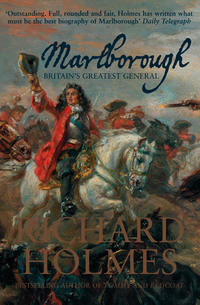
Czytaj książkę: «Marlborough: Britain’s Greatest General»

MARLBOROUGH

England’s Fragile Genius
RICHARD HOLMES

DEDICATION
I am so entirely yours, that if I might have all the world given me, I could not be happy but in your love.
The Hague, 20 April 1703/Ropley, 20 February 2008
EPIGRAPH
Our horsemen had now the better of the fight; but soon we beheld fresh bodies of horsemen, hastening to the relief of their half-defeated squadrons. Marlborough was at the head of this reserve of cavalry … I can still see him as, undaunted and serene, he rode forward amid the cheers of his troops, shouting ‘Corporal John’, the name they had given their hero; he was surrounded by his staff, evidently receiving his commands. I fell on his men with my whole regiment; he narrowly escaped being made prisoner – oh! That heaven was so unpropitious to France – but he was extricated, and my troopers were compelled to retreat.
COLONEL GERALD O’CONNOR, commanding anIrish regiment in French service, Ramillies, 1706
This is a world that is subject to frequent revolutions
SARAH DUCHESS OF MARLBOROUGH
CONTENTS
COVER
TITLE PAGE
DEDICATION
EPIGRAPH
THE CHURCHILLS
INTRODUCTION: Portrait of an Age
Marlborough and the Weight of History
Portraits in a Gallery
Century of Revolution
Influence and Interest
Whig and Tory
1. Young Cavalier
Faithful but Unfortunate
The King Comes Home in Peace Again
The Army of Charles II
Court and Garrison
To the Tuck of Drum
My Lady Castlemaine
The Dutch War
The Imminent Deadly Breach
The Handsome Englishman
2. From Court to Coup
Love and Colonel Churchill
Politics, Foreign and Domestic
Domestic Bliss, Public Prosperity
Monmouth’s Rebellion
Uneasy Lies the Head
3. The Protestant Wind
Settling the Crown
Little Victory
Court and Country
Irish Interlude
Fall and Rise
4. A Full Gale of Favour
Gentlemen of the Staff
First Campaign
Empty Elevation
The 1703 Campaign
5. High Germany
Forging a Strategy
The Scarlet Caterpillar
Being Strongly Entrenched: The Schellenberg
The Harrowing of Bavaria
A Glorious Victory: Blenheim
6. The Lines of Brabant
Ripples of Victory
Hark Now the Drums Beat up Again
Happy and Glorious: Ramillies
7. The Equipoise of Fortune
Favourites, Bishops and the Union
A Sterile Campaign
Politics and Plans
The Campaign of 1708
The Devil Must have Carried Them: Oudenarde
In the Galley
8. Decline, Fall and Resurrection
Failed Peace, Thwarted Ambition
A Very Murdering Battle: Malplaquet
Failed Peace and Falling Government
Last Campaigns
Dismissed the Service
Exile and Return
NOTES
SELECT BIBLIOGRAPHY
INDEX
ABOUT THE AUTHOR
AUTHOR’S NOTE
PRAISE
OTHER WORKS
COPYRIGHT
ABOUT THE PUBLISHER
THE CHURCHILLS

INTRODUCTION
Portrait of an Age
Marlborough and the Weight of History
Some will tell you that John Churchill, 1st Duke of Marlborough, was Britain’s greatest ever general. John Keegan and Andrew Wheatcroft, two wise judges, affirmed that:
There was no talent for war which he did not possess. He had imagination and command of detail to plan a grand strategy: he was an able generalissimo of allied armies, always ready to flatter a foreign ruler for some political advantage. His capacity for innovation really lay off the battlefield … But his greatest strength lay in his attention to the economic underpinning of the war, and in his concern for the morale and welfare of his men … In this combination of military virtues Marlborough’s greatness nestled, but most of all in his understanding that the army was precious and that its value resided in the officers and men who made it up.1
Winston S. Churchill concluded his six-volume biography of his distinguished ancestor by declaring:
He had consolidated all that England had gained by the Revolution of 1688 and the achievements of William III. By his invincible genius in war and his scarcely less admirable qualities of wisdom and management he had completed that glorious process that carried England from her dependency upon France under Charles II to ten years’ leadership of Europe … He had proved himself the ‘good Englishman’ he aspired to be, and History may declare that if he had had more power his country would have had more strength and happiness, and Europe a surer progress.2
Another assessment added private virtue to public achievement to make Marlborough the very model of the Christian soldier:
He was by nature pure and temperate, kind and brave. He had supreme genius, personal beauty, and the art of pleasing. He was born to shine in courts, and understood the graces of life to perfection. He met with glory and ingratitude, infamy and fame. So, moving splendidly through a splendid world, he saw more fully to the share of most men, of human nature and the human lot.
He was honourable in his public life because he was also honourable in his private life. He was kind and chivalrous abroad, because he was kind and chivalrous at heart, and in his own home, and to his best beloved. He had a deep, strong faith, which never failed him.3
Marlborough’s contemporary, Archdeacon William Coxe, concluded his three-volume biography, which still repays study, with the lapidary declaration that he was simply: ‘THE GREATEST GENERAL AND … THE GREATEST MINISTER that our country, or any other, has produced.’4
In his multi-volume history of the British army published in 1910, Sir John Fortescue, never a man to shy from a harsh verdict when he thought it justified, wrote of how Marlborough’s
transcendent ability as a general, a statesman, a diplomatist and an administrator, guided not only England but Europe through the War of Spanish Succession, and delivered them safe for a whole generation from the craft and ambition of France …
Regarding him as a general, his fame is assured as one of the greatest captains of all time; and it would not become a civilian to add a word to the eulogy of great soldiers who alone can comprehend the full measure of his greatness.5
Fortescue wrote that Marlborough, like Wellington,
was endowed with a strong common sense that in itself amounted to genius, and possessed in the most trying moments a serenity and calm that was almost miraculous … With such a temperament there was a bond of humanity between him and his men that was lacking in Wellington. Great as Wellington was, the Iron Duke’s army could never have nicknamed him the Old Corporal.6
Elsewhere, citing an approving comment in the papers of an officer in Marlborough’s army, Fortescue mused: ‘What modern decoration (save the Victoria Cross) could compare to a word of hearty praise from Corporal John himself?’7
However, it was hard even for Fortescue to ignore the fact that Marlborough had detractors during his lifetime, though he maintained that the duke’s ‘fall was brought about by a faction, and his fame has remained ever since prey to the tender mercies of a faction’.8 Some of Marlborough’s warmest admirers acknowledge that there was indeed another side to the man. Although Charles Spencer, like Winston S. Churchill, has some of Marlborough’s blood in his veins, he is a wise enough historian to admit that:
It is difficult to understand Marlborough the man. He was enigmatic, focussed, and brilliant. He was also avaricious and – as we know from his correspondence with the Jacobites – capable of double-dealing. However, his men adored him, and they knew his incomparable military worth: they were proud to point out that he never lost a battle, or failed to take a city that he besieged.9
Marlborough’s abandonment of James II (who had befriended him and raised him to the peerage) in 1688 was a move so significant that one historian has called it ‘Lord Churchill’s coup’. It led G.K. Chesterton to accuse him of the vilest of betrayals: ‘Churchill, as if to add something ideal to his imitation of Iscariot, went to James with wanton professions of love and loyalty, went forth in arms as if to defend the country from invasion, and then calmly handed over the country to the invader.’10 Marlborough lived on the margins of treason. He never regarded the verdict of 1688 as final, and remained in touch with the Jacobite court for the rest of his life, a process assisted by the fact that one of James’s illegitimate sons, James FitzJames, Duke of Berwick, was both Marlborough’s nephew and a marshal of France.
Although the circumstances of his upbringing go far towards explaining his notorious cupidity, Marlborough was given to a rapacity remarkable even in a rapacious age, amassing offices which made him one of the richest men in the land. While we must accept stories about his tight-fistedness with caution, for they were circulated by his detractors to damage his reputation, the tale that, after an evening’s gaming in Bath, he borrowed the money for a sedan chair but then walked home regardless may indeed be well-founded. Yet he spent enormous sums on building Blenheim Palace, which still glares out in chilly splendour as his lasting memorial. Though most of the practical work of supervising its construction was left to his wife, who demonstrated that high temper rarely makes a successful contribution to labour relations on a building site, the concept was his, and his pressing on with its construction at a time of crisis in the nation’s history showed that selective blindness which sometimes afflicts the great.
Many of Marlborough’s advocates argue that, great though his achievements were, he would have been even more successful had he not been ‘hampered by the intransigence of the Dutch field-deputies, incompetent civilians attached to the Duke’s staff whose agreement in any project had to be obtained before it could proceed’.11 There is a strongly nationalistic element in much that is written about Marlborough, and in this instance it is worth recalling that an Allied military defeat in Flanders risked having far more effect upon the Dutch than upon the English, conveniently insulated from the armies of Louis XIV by Shakespeare’s ‘moat defensive’. When Marlborough clashed with the Dutch, as he did from time to time, he was not always right and they were not always wrong, and there were times when he avoided the complicating longueurs of coalition politics by outright deception.
One of the pleasures of the research for this book is that it took me back to G.M. Trevelyan’s incomparable trilogy on the reign of Queen Anne. If earnest modern scholars have unearthed evidence which changes some of Trevelyan’s findings, few have his ability to bring an age to life. He concluded his assessment of Marlborough’s personality by speculating that:
Perhaps the secret of Marlborough’s character is that there is no secret. Abnormal only in his genius, he may have been guided by motives very much like those that sway commoner folk. He loved his wife, with her witty talk and her masterful temper, which he was man enough to hold in check without quarrelling. He loved his country; he was attached to her religion and free institutions. He loved money, in which he was not singular. He loved, as every true man must, to use his peculiar talents to their full; and as in his case they required a vast field for their full exercise, he was therefore ambitious. Last, but not least, he loved his fellow men, if scrupulous humaneness and consideration for others are signs of loving one’s fellows. He was the prince of courtesy.12
In all this, though, Trevelyan recognised that he was taking issue with his distinguished uncle, whose surname he bore as his own middle name. Thomas Babington Macaulay was a poet (who, if he had never written another word, would surely be remembered for his account of Horatius holding that bridge), politician and the dominant British historian in the mid-Victorian era. Macaulay, argued Trevelyan, ‘adopted his unfavourable reading of Marlborough’s motives and character straight from Swift and the Tory pamphleteers of the latter part of Anne’s reign’. Yet he was
less often misled by traditional Whig views than by his own overconfident, lucid mentality, which always saw things in black and white, but never in grey … He instinctively desired to make Marlborough’s genius stand out bright against the background of his villainy.13
The villainy, maintained Macaulay, was certainly dark enough. Marlborough was wholly immoral. He ‘owed his rise to his sister’s shame’, and was then ‘kept by the most profane, impious and shameless of harlots’, Barbara Villiers, Countess of Castlemaine. He was woefully ignorant, and ‘could not spell the most common words in his own language’. His avarice knew no bounds, and ‘though he drew a large allowance under pretence of keeping a public table, he never asked an officer to dinner’. And he was, quite simply, a traitor, rendering ‘wicked and shameful service to the Jacobite cause’ by leaking information of a 1694 expedition against Brest so that its troops were slaughtered and its commander, a personal rival, was slain.14
This is not the moment to deal with Macaulay’s charges in detail, although it is clear that the documents he used to formulate some of them do, in themselves, demonstrate their own falsehood, thereby making Churchill’s accusation of ‘liar’ more appropriate than Trevelyan’s defence of his forebear as an honest historian misled by his emotions and his sources. ‘Lord Macaulay is not to be trusted either to narrate facts accurately, to state facts truly, or to answer the judgement of history with impartiality,’ wrote a barrister who applied his forensic skills to Macaulay’s methods, and it is impossible for a modern historian to disagree.15
Even though Macaulay erred in his attacks on Marlborough, it is already evident that there is much more to the man than stout hagiography can possibly acknowledge. We might avoid at least part of the problem by concentrating on the military aspects of his career, and by passing rapidly over his early life to see him emerge, full-fledged, as captain general of the English army in the Low Countries. Indeed, David Chandler, one the most gifted historians to write about Marlborough in recent times, sidestepped the issue in his Marlborough as a Military Commander by considering the duke in his role as a general, although there are few men less suited to the description ‘simple soldier’.16 To consider Marlborough purely as a general is as misleading as it would be to see, say, Paul McCartney as only a classical composer, Alexander Borodin as just a chemist, or Winston S. Churchill as a simple historian.
Part of my task, then, is to get as close as I can to the man that Churchill loved to call ‘Duke John’. However, almost like hunted game that knows its tracks will be followed, Marlborough himself made my task no easier. Although the shelves of the British Library groan beneath the weight of the Blenheim Papers, with thousands of letters showing him in a variety of lights, as husband, lover, courtier, politician, alliance manager, diplomat, commander-in-chief, prosecutor, defendant and even interior designer, he rarely let his mask slip. Wellington is the general to whom he is most often compared, and is the only other British commander who has ever exercised command on sufficient scale, for long enough and in varied enough circumstances for him also to be considered a truly great general. Yet despite his notorious secretiveness, in his later years Wellington was always prepared to unburden himself to friends or diarists. There was generally an answer to those questions that began, ‘Tell me, Duke …’ and the Wellington of old age tells us, across the nuts and port, about the commander of his youth and middle years. It is just possible that Marlborough might have done the same had he enjoyed a long retirement, marching slowly to meet a slothful death. But even then I doubt it: he was too mindful of those necessary treasons of his early life, too well aware that he had been all things to most men, to let us inside his mind.
Many of my sources will be familiar to those who know the period. I have made extensive use of the duke’s own words, going back to the originals in the British Library when I have had to, but also availing myself of Sir George Murray’s five-volume edition of Marlborough’s dispatches and Henry L. Snyder’s three volumes of the Marlborough – Godolphin correspondence. Both Marlborough’s quartermaster general (chief of staff by modern standards), William Cadogan, and his private secretary, Adam de Cardonnel, have left papers which throw useful light on the way that Marlborough’s headquarters worked. Viscount Chelsea, heir to the present Earl Cadogan, recently discovered some of his ancestor’s papers, and through his kindness I am, I believe, the second historian to consult them. They show just how much routine work Marlborough entrusted to Cadogan, and give early grounds for suspecting that even if command is, in a legal and spiritual sense, indivisible, it is harder than we once thought to see just where Marlborough ended and Cadogan began.
Marlborough’s own hold on political power would scarcely have been possible without his wife’s intimate relationship with Queen Anne. Sarah Marlborough is rarely much further away from these pages than she was from her husband’s thoughts. I have not only used her correspondence, but a good deal of her self-justifying pamphleteering, much of it produced with the aid of collaborators like Bishop Gilbert Burnet, who generally strove to be objective, and her man of affairs, Arthur Maynwaring, who did not. While no assessment of the politics of the age could be complete without taking the duchess’s views into account, her words require more caveats than most. Here she is on the subject of Queen Anne, with whom she had once enjoyed a friendship so very close that some writers have detected lesbianism.
Queen Anne had a person and appearance not at all ungraceful, till she grew exceeding gross and corpulent. There was something of majesty in her look, but mixed with a sullen and constant frown, that plainly betrayed a gloomy soul, and a cloudiness of disposition within. She seemed to inherit a good deal of her father’s moroseness, which naturally produced in her the same sort of stubborn positiveness in many cases … as well as the same sort of bigotry in religion.
Her memory was exceeding great, almost to wonder, and … she could, whenever she pleased, forget what others would have thought themselves obliged by truth and honour to remember, and remember all such things as others would think it an happiness to forget. Indeed she chose to retain in it very little besides ceremonies and customs of courts … so that her conversation, which otherwise might have been enlivened by so great a memory, was only made more empty and trifling but is chiefly turning upon fashions and rules of precedence, or observations upon the weather, or some such poor topics, without any variety of entertainment.17
There are two points of which I have no doubt whatsoever. The first is that the Marlboroughs’ relationship, despite its stormy moments, was a genuine love-match. The second is that if there is indeed an afterlife I must look out for squalls soon after crossing the bar, for Sarah was as jealous of her lord’s memory as of her own historical reputation.
No student of the period can be unaware of the fact that there are far fewer letter-writers and diarists on hand to describe the War of Spanish Succession than there would be, a century later, to tell us about the Peninsular War. However, there are certainly enough to get us in amongst the powder-smoke. That dour Cameronian Lieutenant Colonel Blackader complains of the army’s profanity; Captain Richard Parker takes pride in watching his own Irish soldiers beat their countrymen in French service at Malplaquet; Corporal Matthew Bishop assures us, not once but several times, that Marlborough could not have won the war without him; and Brigadier General Richard Kane warns us of the perils of premature surrender – and the dangers of too resolute a defence.
John Wilson, the ‘old Flanderkin Sergeant’, recalls attacking the Schellenberg with his front-rank men clutching fascines ‘in order to break the enemy’s shot in advancing’.18 Private John Marshall Deane of the 1st Foot Guards recalls that at the same action, ‘being strongly entrenched they killed and mortified abundance of our men both officers and soldiers’.19 Chaplain Josias Sandby maintained a useful journal of the Blenheim campaign, often attributed to Marlborough’s chaplain-general Francis Hare. Chaplain Samuel Noyes wrote assiduously to his bishop, hoping no doubt that civil preferment might follow military accomplishment.20
On the French side, the Duke of Berwick, illegitimate son of James II by Marlborough’s sister Arabella Churchill and probably the most competent of the later Stuarts, published a set of memoirs before he was killed in action. Colonel François de la Colonie commanded a Bavarian grenadier battalion composed of French deserters, and escaped from the storming of the Schellenberg with his coat scorched by musket-fire and his long riding-boots jettisoned to run the better. The Count de Mérode-Westerloo, in the perplexing way of the age a Flemish nobleman but a loyal officer in the army of Louis XIV, tells us what it was like to wake up at Blenheim to see the Allies advancing steadily on the French camp but to find everyone else asleep. Marshal Camille de Tallard, the French commander that day, has left us his own account of the action. He told the French minister of war that he had had a bad campaign plan foisted upon him, and found it impossible to get on with his allies: ‘it is a fine lesson that we should only have one man commanding an army, and that it is a great misfortune to have to deal with a prince of the humour of M. the Elector of Bavaria …’ Having been traduced by his senior colleagues, Tallard tells us that he was then let down by his men: ‘The bulk of the cavalry did badly, I say very badly, for they did not break a single enemy squadron.’21 Sadly, his subordinates did not share his view. Another of those accounts whose writer lamented that his own courage and prescience were not matched elsewhere concluded: ‘You know, Sir, better than me whose fault this is.’22
‘Captain’ Peter Drake served in the Spanish, Dutch, English and French armies, often joining one without having completed the tiresome formalities which might properly have accompanied his discharge from another. He was wounded at Malplaquet while serving with the Maison du Roi, the French Household Cavalry, and tells us how he owed his life to the duke’s humanitarian intervention at the close of that terrible day.
Sicco van Goslinga’s Mémoires relatifs à la Guerre de Succession show just how unwise it is to follow the prevailing contemporary English view of the Dutch as dour and unhelpful, any more than the Dutch view of the English as dirty and drunken, as necessarily correct. Goslinga, let it be said, is no more inherently trustworthy than any other witness. No contemporary, however influential, had more than a limited view of events. All tended to supplement what they could themselves remember (which might not in itself be accurate) with what they heard from others, who were themselves rarely fully informed. And most, in the way of things, had likes and dislikes which might reflect nothing more than the imponderables of human emotion. However, Goslinga was in the Allied army but not of it, and in regular contact with Marlborough but never dependent on his goodwill for advancement. He saw Marlborough in his depths as well as at his heights: riding out with him to his outposts in the small hours when it seemed certain that the French had trapped him, or sharing the duke’s riding-cloak when both lay down to snatch some sleep after a long and successful pursuit.
Goslinga gives us a pen-picture which at last begins to catch some of the light and shade of Marlborough.
Here is his portrait, as far as I am able to paint it. I do not speak of his fortune, nor of the manner in which he began to make it: his conduct towards his great benefactor and his first benefactress are things well known, and add nothing to the matter in hand. He was born a gentleman: his stature was above average and was one of the finest one might see: he had a perfectly beautiful face, with two fine and sparkling eyes of an admirable colour, a pink and white complexion which a woman might envy, and fine teeth … He had much spirit … very clear and solid judgment, swift and deep penetration, knowing his people well and able to distinguish real merit from false; speaking well and agreeably even in French, which he actually spoke with poor grammar but with a harmonious tone of voice.
On the other hand, Goslinga found him
capable of profound, even the most dangerous deception, which he covers by manners and expressions which seem to express the utmost frankness: he has a boundless ambition, and the most sordid avarice, which influences all his conduct: if he has courage, which he doubtless has, whatever his enemies say, he has certainly not got the firmness of character which makes the real hero … He did not know much about military discipline, and gave free rein to the soldier, who committed frightful disorders. He also knew little of the detail of the profession, less than was proper for a commander-in-chief. Here are the weaknesses which, however, do not detract from the rare talents of this really great man.23
Some of Goslinga’s words find answering echoes elsewhere. The two great English diarists of the age, Samuel Pepys and John Evelyn, both had a view of Marlborough. Pepys, ‘sole counsellor’ to the newly ennobled George Legge, Lord Dartmouth, on his 1683 fact-finding trip to the English garrison of Tangier, chatted with his master about John Churchill, as he then was. Dartmouth:
tells me of the Duke of York’s kindness to him and how Churchill was made what he is by my Lord Rochester, only to lessen him; and that all he knows Churchill rewards himself by, is his lying with their wives, which he says is not certain as to my ladies Rochester and Sunderland.24
This was the sort of salacious gossip that Pepys loved, and in part Dartmouth’s words no doubt reflect the suspicion of one fast-rising man for another. Yet there were persistent rumours that Churchill turned his remarkable physical attractiveness to his advantage, and he is certainly not the first British commander to profit from being big and bonny; nor, no doubt, will he be the last.
In 1702, well before Marlborough had won his greatest victories, John Evelyn complained of the ‘excess of honour conferred by the Queen on the Earl of Marlborough, by making him a Knight of the Garter, and a Duke, for the success of but one campaign’, but added: ‘He is a very handsome person, well-spoken and affable, and supports his want of acquired knowledge by keeping good company.’25 In February 1705, just a year before his death, Evelyn visited Lord Godolphin.
I went to wait on my Lord Treasurer, where was the victorious Duke of Marlborough, who came to me and took me by the hand with extraordinary familiarity and civility, as formerly he was used to do, without any alteration of his good nature. He had a most rich George in a Sardonyx set with diamonds of very great value, for the rest, very plain.* I had not seen him for some years, and believed he might have forgotten me.26
This is a telling anecdote. Marlborough’s social accomplishments were legendary, and his ability to remember old acquaintances did much to help him. The Earl of Ailesbury remembered that when he was a Jacobite exile and Marlborough was the queen’s captain general and Allied commander-in-chief, the duke gave him dinner at his own ‘little table’ at headquarters, and held his hand for part of the meal, although (and here is another penetrating insight) he ensured that their clasped hands were hidden under a napkin.
Portraits in a Gallery
We can get much closer to our quarry in words than we ever can in pictures. Portraits often deceive, and it is perhaps in the early eighteenth century that the deception is most complete. There are the great men of the age, with well-scrubbed pink-and-white faces, staring complacently at their world from beneath full-bottomed wigs, lips pursed in the half-smile of those who know that life has treated them well. The peruke’s soft curls and the snowy lace of a jabot tumble onto a coat whose stuff and hue betokens the wearer’s status: a cleric’s black broadcloth, a merchant’s prosperous blue or plum, or a soldier’s martial red. Peers often wear the ermine of their House, with a coronet denoting their rank (six silver balls on a plain silver gilt circlet for a baron, and on to the chased coronet with its eight strawberry leaves for a duke) dangling from the noble fingers or tossed onto a table just within the picture’s frame. In their portraits generals appear in the armour they would never have worn on the battlefield, sometimes with a plumed helmet, as useless then as a general’s ivory-hilted dress sword is today, standing in for a peer’s coronet.
Women are plump-faced, opulent of bust and shoulders, and usually portrayed with their heads tilted ever so slightly to the right to allow the artist to throw some shadow beneath a soft jawline. Children are rarely allowed much in the way of childhood. Once boys had been breeched, at the age of four or five, they appeared as miniature adults. Johann Baptiste Clostermann’s huge family portrait of the Marlboroughs, painted in about 1694, shows the parents and their five children against theatrical drapes. John, later Marquess of Blandford, their eldest son, is stepping up onto the dais, looking back at the artist and gesturing proudly towards his elegant family. He was nine years old at the time.
A year later Nicholas de Largillière painted James II’s only legitimate son, James Francis Edward Stuart (‘the Old Pretender’) and his sister Louisa Maria Theresa. Although the young prince was only seven and his sister just three, both are dressed for court: James is wearing long coat, lace jabot and silk stockings, and Louisa has a dress with a train and the tall fontange headdress. William Henry, Duke of Gloucester, was the only one of Queen Anne’s many children to live beyond infancy, and was regarded by many as the heir most likely to prevent the restoration of his uncle James II. In 1699 Sir Godfrey Kneller painted him as a warrior prince, with a soldier’s cuirass: the boy was ten years old and had just a year to live.
There is enough symbolism to keep costume historians busily engaged for years. Gentlemen advertise their status by wearing swords, the slim, straight-bladed small sword in town and the stubbier hunting sword in the country. Races at Newmarket, then the only major national meeting, were an exception, for folk of all classes met on equal terms, turning out ‘suitable to the humour and design of the place for horse sports’, with nobody wearing swords. Spurs were important even if there was no evidence of a horse, for they showed that although the sitter might not be riding at the time, he could vault into the saddle at a moment’s notice. Not for nothing did the Latin inscriptions on gentry’s tombstones style a knight as equitus and a gentleman as armiger. In Charles II’s time red shoe-heels – a fashion borrowed, like so much else, from France – suggested noble rank, and the fashion spread so that officers of the Restoration army were as identifiable by their bright heels as their great-grandsons were to be by their epaulettes. The greatest officers of state, like the lord treasurer and secretary of state, carried thin white staffs of office. Sidney, Earl Godolphin, had his made short enough to be carried in a sedan chair, while the Earl of Rochester had his, of the longer variety, carried by a bareheaded footman to allay any doubts about the distinction of his chair’s occupant.
A portrait of Sarah, Duchess of Marlborough painted in about 1700 had a gold key added to its waist in 1702. In the interim Sarah had become keeper of the privy purse to the new queen, Anne, and the key confirms the status that her expression already suggests: she is a woman whose beauty is matched, at last, by her wealth and influence. And so pigment is splashed across canvas. Mouths curve like cupid’s bow, dogs stare admiringly at masters, steeds curvet without apparent inconvenience to riders, and occasionally, like extras in a drama, lesser mortals gather slain game or ply musket and bayonet amidst the background smoke.
None of this is a great deal of help to historians. Even court artists in England, it is true, could rarely disguise that bulbous blue-eyed, faintly irascible expression that characterised the Hanoverians, any more than their colleagues in Vienna could do much with the Hapsburg jaw. However, artists seldom get us beyond polite generalities. Portraits of Prince Eugène of Savoy-Carignan, Marlborough’s great collaborator, give no real sense that he was widely regarded as one of the ugliest men of his age, and almost always had his mouth slightly open. Louis XIV, for all his sneer of cold command, was five feet five inches tall, a full five inches taller than Charles I but an inch and a half shorter than William of Orange – who was four inches shorter than his wife Mary. William himself was, if you will forgive the phrase, no oil painting: he was thin and somewhat hunchbacked, and his face, already striving to accommodate a prominent nose, was heavily pockmarked.
While artists were happy enough to use their skills to reflect status and lineage and to hint at accomplishments and aspirations, in the main they present us with a great number of plump-faced, well-to-do gentlemen in wigs, accompanied by ladies perhaps too generously built for modern taste. Charles II’s mistresses were generally Junoesque but pretty, while James II’s were as substantial, but so very, very plain that Charles quipped that they had been imposed upon his brother by his confessor as a penance. Sir Peter Lely’s portraits, however, make them look so alike that even contemporaries complained:
Sir Peter Lely when he had painted the Duchess of Cleveland’s picture, he put something of Cleveland’s face as her languishing eyes into every picture, so that all his pictures had an air of one another, and the eyes were sleepy alike. So that Mr Walker the painter said Lely’s pictures were all brothers and sisters.27
Century of Revolution
At one level, the barrier that portraiture interposes between us and Marlborough’s age is a useful corrective. Philip Guedalla, whose books did so much to arouse my passion for history, wrote of the world ‘spinning down the long groove of the eighteenth century’. How wrong he was. The world does not, so to speak, change step as a new century appears, and there is rarely a well-oiled hinge between one epoch and another. Marlborough was in many ways a creature of the seventeenth century, profoundly marked by his family’s experience of the Civil War. But his thoughts and character were forming at just the time that the spiritual and political convictions that had made the war possible were changing. Christianity, as Christopher Wren’s light and airy churches testify, was becoming more rational and less constricting. The execution of Charles I on the one hand, and the Restoration of his son on the other, left both royalists and radicals aware that God’s favour could prove all too transient. Science was fast becoming secularised, and a series of major discoveries, starting with Harvey’s work on the circulation of the blood and continuing with the ideas of Newton, Boyle and Hooke, began to replace old mysteries with new rationalism.
This science, however, had yet to transform the economy. Marlborough died while his country was experiencing the first birth-pangs of the Industrial Revolution. The road system he knew would have been familiar to his Tudor ancestors: York and Exeter were still over three days’ travel from London. John Evelyn’s house at Wotton, near Guildford in Surrey, was twenty-six miles from London but was ‘so securely placed as if it were 100’. The first turnpike (essentially a toll road) was established in 1663, and there were only seven turnpikes by 1700: the great explosion did not come till after 1750. The intrepid Celia Fiennes reported in 1698 that her route around England ‘was in many places full of holes, though it is served by a bar at which passengers pay a penny a horse to the maintaining of the way’. John Byng, writing a century later, mused:
I am just old enough to remember turnpike roads, few and bad; and when travelling was slow, difficult and, in carriages, dangerous … In the days of bad roads the country could not be stripped of its timber or despoiled of its honesty, cheapness, ancient customs and civility; every gentleman, then, was bowed to with reverence, and ‘A good morning to you, master. Good evening. Good journey to you, sir,’ were always presented; with every old-fashioned wish, and compliment of the season …
Even till lately, there were hollow ways from Grays Inn Lane to Kentish Town, and a long deep water to be waded through from Mother red-Caps in the road to Highgate. All the Hertfordshire roads were deep ravines.28
The first breaths of the wind of change could already be felt. The swash and buckle of Restoration drama was light years away from the masques of the early part of the century. The witty and elegant essays of Joseph Addison and Richard Steele are, suggests one editor, like old silver, whose fashion is still well regarded even if its weight is negligible.29 Political thought was also changing fast. In 1690 John Locke affirmed that ‘All men are naturally in a state of perfect freedom to order their actions and dispose of their possessions and persons as they think fit without asking the leave or depending upon the will of any man.’ Locke could get away with this in Britain, but these were dangerous ideas elsewhere: the Enlightenment was still two generations away, and few contemporary European monarchs would have tolerated such words.
For some historians the Glorious Revolution of 1688, which saw James II replaced by William and Mary, is the real turning point, although it accomplished less than many contemporaries hoped. For others, though, the real break comes with the Hanoverian succession, which brought George I bloodlessly to the throne in 1714, even though Jacobitism was to remain a threat until the defeat of Charles Edward Stuart, James’s grandson the ‘Young Pretender’, in 1745–46. Were our focus here European rather than more narrowly British then we might see the 1713 Treaty of Utrecht, which ended the War of Spanish Succession, and with it the more extravagant ambitions of Louis XIV, as a sharp bend in history’s long and rutted road.
It is not my purpose to answer the undergraduate question as to whether the seventeenth century really ended in 1688 or 1714. Suffice it to say, though, that the most important years of Marlborough’s active career lay between these dates, and that he lived through a period of quite extraordinary change and uncertainty. This was much more the case with the military profession than most biographers acknowledge. He was commissioned into an army which, with its pikes, matchlock muskets and lobster-tail helmets, would not have surprised Oliver Cromwell, and he died as captain general of a force whose infantry had made its reputation with those measured volleys that Wellington so admired.
What is history to us was an unknown and challenging future to John Churchill; even to begin to grasp him we must break from what some historians call ‘presentism’, the inability to see anything save through the lens of the present moment. None of the events of 1688–1714 was predestined. A more adroit James II might have retained the kingdom bequeathed to him by his more supple brother; the ‘Protestant Wind’ of 1688 might so easily have blown up into a Catholic gale; the cannonball which grazed William III at the Boyne in 1690 might have killed him just as surely as another ball decapitated the very capable Jacobite commander, the marquis de St Ruth, at the deciding moment at the battle of Aughrim the following year.
There were no certainties for a man like John Churchill. He was stripped of all his offices twice in his career, imprisoned in the Tower on the first occasion and effectively exiled on the second. He ran the risk of the battlefield death that snatched so many of his comrades and opponents: at Ramillies a cannonball took the head off his equerry as he held the duke’s stirrup for him to mount a fresh charger. He lived in a world where disease was rife and today’s hero was tomorrow’s corpse. Smallpox was no respecter of persons: King William lost his parents and his wife to the disease, and it carried off Queen Anne’s only surviving son the Duke of Gloucester and Marlborough’s own heir the Marquess of Blandford. Indeed, of the five children in that carefully posed Clostermann painting of Marlborough’s family only two lived beyond their twenties. We must judge Marlborough in the light of his times, not our own, and a biographer’s first task must be to sketch out the background to the portrait he is painting.
There are indeed moments when the immediacy of the spoken word strips away the years. The Reverend Andrew Paschall, rector of the Somerset village of Chedzoy, tells us how, when the rebel Duke of Monmouth’s men were first detected in their night attack on the royal army’s bivouac at Sedgemoor in 1686, a trooper of the Horse Guards galloped
full speed to the camp, calls with all imaginable earnestness, 20 times at least, ‘Beat your drums, the enemy is come. For the Lord’s sake beat your drums.’ He then rode back with the like speed the way he had come … Now the drums beat, the drummers running to it, even barefoot for haste. All fly to arms.30
Yet there are as many times when the period seems more ancient than modern. It is easy to forget how deep the iron of Charles I’s execution had entered into the royalist soul. On 17 September 1661 (with young John Churchill still unbreeched) John Evelyn wrote:
Scot, Scroope, Cook and Jones, suffered for reward of their iniquities at Charing Cross, in sight of the place where they put to death their natural Prince, and in the presence of the King his son who they also sought to kill. I saw not their execution, but met their quarters mangled and cut and reeking as they were brought from the gallows in baskets on the hurdle. Oh the miraculous providence of God!31
Male traitors were hanged, drawn and quartered, a gruesome process that involved being dragged through the streets on a hurdle, partially strangled, and then castrated and disembowelled. The victim’s guts were ‘burnt before his face’ before he was beheaded and quartered. By 1745 the executioner would customarily leave his victim hanging long enough for him to be unconscious, but as late as 1715 some men were ‘bowelled alive and seeing’. The victim’s quarters, duly pickled for longevity, were stuck up at suitable points to ensure that the message was widely distributed. When Captain-Lieutenant Sir Thomas Armstrong of the Life Guards was executed as a traitor in 1683 one of his quarters was sent off to Stafford, where he had been Member of Parliament. The monarch might, by exercise of his prerogative, remit the punishment to beheading or simple hanging. At the time of the Popish Plot (1678–81), William, Lord Russell, had argued that the king did not have it in his power to show such leniency, and when he himself was convicted of treason in 1683 he bravely made no personal appeal for clemency. He was granted the favour of the axe, although the executioner botched his job.
Female traitors, whether they were guilty of high treason towards the monarch or petty treason – an act against what was perceived as being the natural order of things, like the murder of a husband or employer – were burnt at the stake. This too might be commuted to beheading (as it was for Alice Lisle, executed in the square at Winchester in 1685), or the executioner might be privately ordered by the sheriff to stab or strangle his victim before the fire took hold. The devout and philanthropic Elizabeth Gaunt, convicted of harbouring rebels after Monmouth’s rebellion in 1685, probably has the dreadful distinction of being the last woman in Britain to be burnt alive by judicial process. She met her end with exemplary courage, but the spectacle was profoundly shocking even to spectators used to brutality. Gilbert Burnet wrote that ‘Penn, the Quaker, told me, he saw her die. She laid the straw about her for burning her speedily, and behaved herself in such a manner, that all the spectators melted in tears.’32
There was a widespread feeling that such savagery went against the spirit of the age, and James II’s inability to understand this was not least amongst the causes of his failure as a monarch. It also ran squarely against what seemed to be natural justice. Lord Grey of Wark, who had commanded Monmouth’s cavalry with towering ineptitude, bought his life for a full confession, the surrender of large parts of his estates, and the promise to give evidence against other prominent members of the rebellion. When he testified against Lord Delamere, arraigned before his peers on 16 January 1686, he proved such a poor witness that Delamere got off. The first peer to give his verdict that day was John, Lord Churchill, the junior baron present, who announced: ‘Not Guilty, upon my honour.’
The barbarity of gallows, pyre, block and pillory sits uncomfortably alongside the poetry of John Dryden or the witty dramas of Aphra Behn. It was there in the background when Steele sketched out that genial baronet, Sir Roger de Coverly.
He is now in his Fifty sixth year, cheerful, gay and hearty, keeps a good House both in Town and Country; a great Lover of Mankind; but there is such a mirthful Cast in his Behaviour, that he is rather beloved than esteemed: His Tenants grow rich, his Servants look satisfied, all the young Women profess Love to him, and the young Men are glad of his Company: When he comes into a House he calls the Servants by their Names, and talks all the way up Stairs to a Visit. I must not omit that Sir ROGER is a Justice of the Quorum; that he fills a chair at a Quarter-Sessions with great abilities, and three months ago gain’d universal Applause by explaining a Passage in the Game-Act.33
The Game Act of 1670 limited the right to kill game to those owning property worth £100 a year, perhaps half of one per cent of the population, and was rigidly enforced by justices of the peace like Sir Roger, whose helpful legal explanations might have escaped a defendant who stood to lose the skin off his back if convicted. But it was wholly consistent with the spirit of the age that Sir Roger spent his morning in vigorous pursuit of a hare, only, at the very end, to scoop up his exhausted quarry and release it in his park, where it joined ‘several of these Prisoners of Wars’, for he ‘could not find it in his heart to murder a Creature that had given him so much Diversion’.34
Sir Roger ‘fought a Duel upon his first coming to town’, and there too he was in good company. While Richard Brinsley Sheridan was later to write of ‘sharps and snaps’, in our period the flintlock pistol (‘snap’) had not yet come of age as a duelling weapon, although Major General William Stewart and Captain Thomas Bellew agreed to use pistols when they met in 1700 because both had wounded right hands. Gentlemen usually went at one another with their small swords, either in the relatively formal circumstance of a duel, or the wholly casual surroundings of coffee house, club or street.
Affairs of honour swept up all those who thought, however flimsy the grounds, that they might have honour to defend. Peter Drake rubbed along at the very bottom end of gentility, and when he kept the Queen’s Arms tavern near St Clement Danes he ‘provided bob-wigs, blue aprons, etc, proper for the business of a vintner; these I wore at home, but could not yet leave off the tie-wig and sword when I went abroad’.35 He duelled whenever the mood took him. Scarcely had he reached Holland, with the first of his many regiments, in 1689, than he had cross words with ‘one Butler, who was a quartermaster in a regiment of Dutch horse … I ran him in the sword arm, and he ran me through the left breast, and so we parted, to take care of ourselves.’36
Nearer the top end of the social scale, the most celebrated duel of the age saw the Whig Lord Mohun, a reformed rake who had already twice been tried by his peers for murder, and the Tory grandee the Duke of Hamilton (who had sired an illegitimate child on Marlborough’s own bastard daughter), just appointed ambassador to Versailles, meet in Hyde Park early on the morning of 12 November 1712. Mohun and Hamilton rushed at one another ‘like wild beasts, not fencing or parrying’. Mohun, run through the chest, was killed on the spot, but he lashed out as he fell and the tip of his small sword opened a vein in Hamilton’s arm, leaving him bleeding to death. Their seconds, Major General Macartney (recently dismissed the service for toasting damnation to the new Tory ministry) for Mohun, and Colonel John Hamilton for the duke, had not let time hang heavy on their hands, and were at it too: Hamilton was pinked in the lower leg. Hamilton later claimed that he was holding his wounded principal when Mohun ran up and stabbed the prostrate man, and although the evidence was uncorroborated, Macartney wisely fled abroad. He reappeared after the accession of George I, stood his trial at the King’s Bench, and was acquitted.
Officers, with their keen sense of honour and arms conveniently to hand, were always ready to lug out, though the British army never reached the quarrelsome pinnacle of its French opponents. De la Colonie fought his first duel when still a cadet, but his opponent, a lieutenant and assistant adjutant of the Régiment de Navarre, summoned help by yelling ‘À moi, Navarre,’ and thus unsportingly turning private squabble into public riot. Peter Drake, then serving in a French regiment, was with ‘thirteen friends and bottle companions’ when a dispute arose between two of them. They decided on a mass duel, and as they were walking to a suitable ground Lieutenant de la Salle, observing that the numbers were uneven, cheerfully joined the smaller group. For a moment there was a chance of reconciliation, but de la Salle observed that the wine was drawn and they must drink it.
The fight began, every man tilting at his opponent, and the two principals engaged; and in a short time killed each other. There was another lost on the part for which I fought, and some wounded on both sides; and I had the good fortune to wound and disarm Monsieur de la Salle.37
British officers, though, were no slouches. In 1692, when Lord Berkeley’s regiment of dragoons was quartered in Louvain a convivial evening at Captain Edward Mortimer’s lodgings was interrupted by the drunken arrival of Captain Thomas Lloyd, who had recently left the regiment in disgrace. As the officers walked out across the marketplace, Lloyd blamed Major Giles Spencer for his misfortunes: both men drew, and Lloyd was wounded in the thigh, dying soon afterwards. Spencer was court-martialled, and acquitted on the grounds of self-defence. Two years later, despite the fact that the Allied army was marching flat-out to stop the French from crossing the Scheldt near Oudenarde, Sandy Dundas found time to kill Cornet Conway of Lord Polwarth’s Regiment.
In 1699 the foppish young Conway Seymour met Captain George Kirke of the Royal Horse Guards in Hyde Park, and high words were exchanged. Seymour was stabbed in the neck, and seemed likely to recover when he embarked on a debauch which made him vomit, reopening the wound and causing an infection which killed him. Kirke was convicted of manslaughter and ‘burned in the hand’, branded with a hot iron, a punishment made rather less damaging if one could afford to pay to have the iron dipped in cold water first. He was temporarily suspended from his commission, but went on to be promoted.38 In 1711 the Duke of Argyll, a member of the anti-Marlborough faction, heard from ‘a penny post letter sent him from an unknown hand’ that Colonel Court of the foot guards had refused to drink his health, saying, ‘Damn him he would not drink the health of a man that changed sides.’ When the matter was put to the good colonel he confessed that he had been in drink at the time and had no idea at all what he might have said, but would not deny His Grace satisfaction: ‘They fought in Hyde Park, and the Duke disarmed him, and there’s an end of the business.’
In 1708 it was said by Ensign Hugh Shaw that the Master of Sinclair, captain-lieutenant in Colonel Preston’s Regiment, ‘had bowed himself towards the ground for a considerable time altogether’ in the hard-fought little battle of Wynendaele. Captain Alexander Shaw, the ensign’s older brother, took his sibling’s side, but Sinclair killed them both, allegedly by hitting Alexander over the head with a concealed stick before wounding him mortally, and then going on to pistol young Hugh ‘before he had time to put himself in a posture of defence’.39 The case caused serious difficulties, for Sir John Shaw, brother of the two dead men, petitioned the queen, demanding the death penalty, while John Sinclair, eldest son of a Scots peer, was not without clout of his own. The solution was typical of the age. Sinclair was convicted by court-martial on one count of murder, but miraculously escaped from custody. On 26 May 1709 Marlborough wrote to Lord Raby, then ambassador to Berlin.
This will be delivered to Y[our].E[xcellency]. by the Master of St Clair … who having had the misfortune to kill two brothers of Sir John Shaw the last campaign in Flanders, for one of which being tried and condemned by a court martial, he has found means to get away, and must now seek employment elsewhere. If Y.E. will please to take him under your protection and recommend him to your court, I shall take it as a particular favour … 40
Influence and Interest
Influence, that glutinous, omnipresent lubricant that the age called ‘interest’, was never far away, and we cannot hope to understand the period without analysing it. It had a number of components. There was a strong strain of two-way obligation laced with self-interest, with tenants supporting their landlords, officers their colonels, and the heads of families striving to provide for distant relatives. Most contemporaries thought that the process was wholly proper, and the tomb of Elizabeth Bate, widow of the Reverend Richard Bate, who died in 1751 at the age of seventy-four, proudly announced that:
She was honourably descended
And by means of her Alliance to
The illustrious family of Stanhope
She had the merit to obtain
For her husband and children
Twelve several employments
In Church and State.41
Yet even contemporaries, well aware of how the system operated, sometimes thought that it went too far. In 1722 a news-sheet lambasted Robert Walpole, the first man to be widely regarded as prime minister.
First Lord of the Treasury, Mr Walpole. Chancellor of the Exchequer, Mr Walpole. Clerk of the Pells, Mr Walpole’s son. Customs of London, second son of Mr Walpole … Secretary of the Treasury, Mr Walpole’s brother. Secretary to Ireland, Mr Walpole’s brother. Secretary to the Postmaster-General, Mr Walpole’s brother in law.42
Many posts, lucrative in themselves, brought with them the right to appoint to other posts, and there was a palpable pull-through as interest groups prospered, and its distressing reverse as the fall of powerful patrons sent misfortune knocking on down the line. In 1718 Sir Christopher Wren lost his post as surveyor general as part of a wider redistribution of spoils. Sir John Vanbrugh would not accept the office ‘out of tenderness to Sir Christopher Wren’, so it went instead to an incompetent nonentity, William Benson.43
Sarah Marlborough often repeated that her cousin Abigail Hill, who was to supplant her in the queen’s affections, had been raised from nothing by her deployment of interest. Abigail was the daughter of a City merchant ‘by a sister of my father’, and as soon as Sarah heard that she was in want she sent her ten guineas. When the Duke of Gloucester died Sarah got her £200 a year out of the queen’s privy purse, and secured a place in the customs for her son. She recommended Abigail’s brother Jack – ‘a tall boy, whom I clothed … and put to school at St Albans’ – to the Duke of Marlborough.
And although my Lord always said that Jack Hill was good for nothing yet to oblige me he made him his aide de camp, and afterwards gave him a regiment. But it was his sister’s interest that raised him to be a general, and to command in that memorable [Sarahese for deeply unsuccessful] expedition to Quebec: I had no share in doing him these honours.44
As Sarah’s interest waned, Abigail’s waxed. In 1710 Lord Raby told his brother Peter that ‘Lord Powlett has complemented Brigadier Masham [Abigail’s husband] by having him chose a member in a borough he controls.’ It seems likely that Sam Masham sensibly chose himself, for he became MP for Ilchester at about this time, though the grateful Tories soon ensured that he had the peerage that his wife’s new interest demanded.
With Sarah deprived of all her offices she had no interest, and she always respected the few who stood by her in these chilly times. Lady Scarborough wrote to her on 5 November 1711, after Sarah had been succeeded as keeper of the queen’s privy purse by the Duchess of Somerset. Sarah annotated the missive: ‘A very kind letter when I had lost my interest. This is a very great deal for her to say, for she had a great friendship with the Duchess of Somerset …’45 Lady Hervey, ‘who has been a slave to the Duchess of Marlborough’, was roundly told by the Duchess of Montagu that she was a fool to waste her time on someone who had no interest.
Lady Hervey in return in a whole company of ladies told her that might be, but she was honest and had lain with nobody but her own Lord. Her Grace had lain with the Duke of Grafton, and the marshal, so they call Lord Villars … The Duchess of Montagu made no reply, but O Lord my Lady is in a passion … 46
Those with interest, however small, were besieged by those who sought favours. In the army, colonels of regiments were essentially proprietors who ran their regiments at a profit, receiving a grant from the government for arms, clothing and equipment and generally spending rather less than the allowance for these items and pocketing the difference. Like many other offices, military and civil, colonelcies were sold by private treaty or bestowed by a grateful government or a commander-in-chief anxious to line his pocket or reinforce his own interest. In September 1700 Lord Raby reported that: ‘Lord Portmore has done one good thing for himself, he has sold his regiment for £6000 to Kirk his lieutenant colonel, of a stranger he could have had £7000, as Lord Trelawney told me.’47
In 1710 the three disgraced officers Meredith, Honeywood and Macartney were allowed to sell their regiments for half their market value, and Lord Orrery, a political ally of the Duke of Argyll’s, was to have Meredith’s at a knockdown price, having first sold his own for its full value. Honeywood came close to being let off ‘as a young man that might be drawn in … He and Macartney are to sell for £2500 and Meredith for £3500 which he can well afford as he can sell his own [regiment] for more money.’48
In 1711 Lord Raby decided to seek an ensign’s commission (in the ungrammatical idiom of the age, ‘to ask a colours’) for his schoolboy son George from Colonel Bellew.
I did design before he went into Ireland to ask a colours for him [George]. He very kindly told me he was to have a regiment, and that when I asked that he would put the Duke of Ormonde [then captain general, who had to ratify the agreement] in mind and desire it might be in his regiment, which was a great favour, for he might be set down for a colonel that would make interest against him … If the regiment is broke [disbanded] the year after it is raised, the half pay will keep the boy at school and save me the charge I am now at.49
The monarch was the fountain of all interest, and those who could sipped direct from the fountainhead. Thomas Bruce, Earl of Ailesbury, was a well-placed courtier under the later Stuarts and a well-connected exile in the Low Countries after 1688. He recalled that Charles II rarely had time to himself in the jumbled hothouse of Whitehall, but after getting ready for bed,
according to custom he went to ease himself, and he stayed long generally, he being there free from company, and loved to discourse, nobody having entrance but the lord and the groom of the bedchamber in waiting, and I desired him to bestow a colours in the Guards on a relative of mine.
‘Trouble me not with trifles,’ said the king. ‘The Colonel will be glad to oblige you therein.’50 Ailesbury later seems to have repeated the request on behalf of another relative, this time asking ‘a colours for him in the Royal Scottish Regiment of Dumbarton’.51 The earl was very fond of Charles, who ‘knew men better than any that hath reigned over us, and when he gave himself time to think, no man ever judged better of men and things’.52 But being lord of the bedchamber had its disadvantages, for he and the duty groom slept on truckle beds by the king’s door, and the monarch’s affection for the little spaniels that now bear his name meant that ‘a dozen dogs came into our beds’.53
On 16–19 July 1693 the London Gazette, a news-sheet with official information on its front page and announcements and advertisements on the back, told its readers of
a small liver coloured Spanish bitch lost from the King’s lodgings, on the 11th instant, with a little white on her breast and a little white on the tops of her hind feet. Whoever brings her to Mr Chiffinch’s lodgings at the King’s Back Stairs, or to the King’s Dog-Keeper in Whitehall, shall be well rewarded for their pains.
William Chiffinch had succeeded his brother Thomas as one of the pages of the king’s bedchamber and keeper of the king’s closet. The page posts were worth about £80 a year in pay and board, with another £47 for livery, fees worth £17 a year and an assortment of tips (‘vails’) worth perhaps another £120. These lucrative appointments were wholly in the interest of the groom of the stole, and they themselves brought interest of their own.
Will Chiffinch was the only man allowed to enter the king’s closet unbidden. His wife received £1,200 a year for showing selected ladies up to the king’s quarters, and Will acted as royal informer, organising drinking parties for those who sought access to the king, recording their conversation while himself remaining studiously sober thanks to a concoction called ‘Dr Goddard’s drops’. He also became surveyor of the king’s pictures, had a fine art collection of his own, and sat to the painter John Riley, whose portrait shows a hard, canny face, with smile and frown folded away for easy interchange. Chiffinch’s daughter Barbara married the Earl of Jersey, and is nine times removed great-grandmother to Princes William and Harry: interest indeed.
As groom of the king’s bedchamber from 1662, Baptist May – always Bab May to his friends – was one step up the court ladder from Will Chiffinch, and no less indispensable. Son of an influential royalist gentleman, he had been in exile with the Duke of York in the Low Countries during the interregnum, and received lucrative offices after the Restoration. May entertained the king and his close friends in his lodgings in Whitehall and St James’s, and was allowed more liberties with Charles than most men. In November 1667 the lord chancellor, the Earl of Clarendon, was unseated by a court conspiracy. Samuel Pepys tells us that: ‘As soon as Secretary Morrice brought the great seal from my Lord Chancellor, Bab May fell upon his knees and ketched the king about the legs and joyed him, and said that this was the first time he could call him king of England, being freed from this great man.’54 May was on very good terms with Barbara Villiers, the most powerful of Charles II’s mistresses, and in 1665 it was probably her influence that secured him the post of keeper of the privy purse, upon which she immediately made substantial demands. He received ‘several parcels of ground in Pall Mall Fields for building thereon a square of thirteen or fourteen good houses’. May became an MP, and his work on Charles II’s divorce, a measure abandoned by the king at the last moment, brought him the appointment of ranger of Windsor Great Park. With money rolling in from a variety of sources, May was able to indulge his tastes for art and the breeding of racehorses. Although he fell from favour after Charles’s death, May sensed the way the wind was blowing, and in 1695 received £1,000 for his ‘loyalty’ to William of Orange. This affable old rogue is remembered today by Babmaes Street, a short dogleg kicking down from Jermyn Street towards St James’s Square.55
On James II’s last hurried visit to Whitehall before he fled to France in 1688, the Earl of Mulgrave, lord chamberlain, rightly fearing that this particular fountain would shortly be shut off, asked the king to make him a marquess. ‘Good God! What a time you take to ask a thing of that nature,’ said James. ‘I am just arrived and am all in disorder.’ He added that he did not have a secretary to hand, but the ever-helpful earl replied that he had already made out the warrant himself, and a simple signature would do the business. It was, though, too much for the harassed monarch.56 When Queen Mary died in 1694 her sister Princess Anne, James II’s younger daughter, seemed assured of the succession, and Sarah Marlborough saw how her popularity rocketed overnight. Suddenly ‘clouds of people’ came to pay their respects. This
sudden alteration … occasioned the half-witted Lord Carnarvon to say one night to the princess, as he stood close by her, in the hall, I hope your Highness will remember that I came to visit you, when none of this company did; which caused a great deal of mirth.57
The Stuarts created peers as they chose, and had three distinct peerages – of England, Ireland and Scotland – to pick from.58 James I ennobled a number of good-looking young men, and Charles II usually had a peerage to hand for his mistresses and their offspring. Although Nell Gwyn (‘pretty, witty Nell’ to the admiring Mr Pepys) was never ennobled, it was said that she held Charles Beauclerk, the elder of her two sons by the king, out of the window when the monarch visited her, lamenting that the infant had no peerage. ‘God save the Earl of Burford!’ shouted the happy father. James FitzJames, James II’s son by Marlborough’s sister Arabella, was created Duke of Berwick at the age of seventeen in 1687, and, already a major general in Emperor Leopold’s service, was given his own regiment of infantry and in February 1688 was made colonel of the Blues, replacing Aubrey de Vere, Earl of Oxford, who as lord lieutenant of his county had refused James’s order to appoint Roman Catholics to public offices, saying: ‘I will stand by Your Majesty against all enemies to the last drop of my blood. But this is a matter of conscience and I cannot comply.’59
Louis de Duras, marquis de Blanquefort in the French peerage, came to England in the retinue of James, Duke of York, and was given an English peerage as Baron Duras in 1693. He inherited his father-in-law’s earldom by special remainder, becoming Earl of Feversham. He was colonel of the King’s Troop of Life Guards, and commander-in-chief for the campaigns of 1685 and 1688. He was a nephew of the great Marshal Turenne, and fought under his command in the Dutch War. William gave many of his Dutch followers English or Irish peerages, leading Ailesbury to complain that: ‘Dutch Lords come in so thick, and the crown not being limited, it is a melancholy prospect for us English peers.’60 To avoid creating irritation amongst English peers, monarchs created Irish peerages to reward those for whom an English peerage might have been considered more than they merited. ‘In the seventeenth and eighteenth centuries,’ write Mark Bence-Jones and Hugh Montgomery-Massingberd, ‘Irish peerages were frequently conferred on English, Welsh or Scots magnates who were not considered to have merited peerages of England or Great Britain; even though they may have had no family connection with Ireland at all.’61
The redoubtable John ‘Salamander’ Cutts, so called because he loved to be where the enemy’s fire was hottest, was created Baron Cutts of Gowran in the peerage of Ireland in 1690, and the Huguenot general Henri de Massue, marquis de Ruvigny, was made Viscount Galway in the Irish peerage in 1696. He had the misfortune to be badly beaten by Berwick at the battle of Almanza in 1707, and the mismatch between his name and his title has induced one writer to surmise that there were in fact two generals in command, the marquis de Ruvigny and his colleague Viscount Galway.62 Summoned to the bar of the English House of Lords to explain his defeat, Galway argued that his halting English and physical infirmities (he had lost a hand in one battle and been cut across the head in another) meant that he could not really explain himself, and the House allowed him to reply in writing.
Some men reached the House of Lords by sheer merit. John Somers was an Oxford-educated lawyer who was one of the counsel for the seven bishops tried before the King’s Bench in 1688 for petitioning James II against his Declaration of Indulgence, helped draft the Declaration of Rights, and rose through the ranks of the government’s law officers to become lord chancellor as Baron Somers in 1697. Charles Montagu was a Cambridge man who produced a little light poetry before establishing himself as the financial wizard of his age, initiating the national debt, setting up the Bank of England and overseeing a wholesale recoinage in 1695, though he had to raise window tax to pay for it. He was shoved upstairs into the Lords as Baron Halifax when the Tories came to power in 1699, and became an earl, and effectively prime minister, after the accession of George I.
Others rose without visible trace (it is good to note some continuity between this age and our own), often because there was interest to be repaid. Sarah Marlborough maintained that she had only personally asked Anne to create one peer, the result of a long personal obligation, but that she had failed in a subsequent attempt to get Lord Hervey promoted to an earldom. In January 1712 the queen was persuaded to create peers to overcome the Whigs in the Lords. The Tories enjoyed a comfortable majority in the Commons but were defeated in the Lords, and it seemed likely that the government would fall. But the lord treasurer, Robert Harley (whose audibly Welsh background had not prevented him from becoming Earl of Oxford and Mortimer in 1711), and the queen had agreed to create a dozen peers, amongst them the husband of the queen’s favourite (and Harley’s cousin) Abigail Masham, as well as Harley’s son-in-law and another of his cousins. One of the secretaries of state told the queen that although the creation was certainly legal, he ‘very much doubted the expediency, for I feared it would have a very ill effect in the House of Lords and no good one in the kingdom’.
Lord Wharton waspishly asked the new peers, when they took their seats, whether, like a jury, they voted by their foreman. Most had adopted grand territorial titles, apparently confusing the Italian-born Duchess of Shrewsbury. ‘Madam,’ she said to the pious Lady Oxford, ‘I and my Lord are so weary of talking politics. What are you and your Lord?’ Lady Oxford dourly replied that ‘she knew no Lord but the Lord Jehovah’. ‘O dear! Madam, who is that?’ enquired the duchess innocently. ‘I believe ’tis one of the new titles, for I never heard of him before.’63
We should not be surprised that the House of Lords grew steadily in size. In 1687 there were twenty-six lords spiritual (archbishops and bishops) and 154 lords temporal at Westminster. By 1714 this had risen to 171 lords temporal and sixteen representative Scots lords, elected by their peers. There was a substantial inflation at the upper end of the peerage, with the record number of forty-four dukedoms in 1726. Degrees in the peerage were a matter of very real concern. The Tory leader Henry St John, ennobled as Viscount Bolingbroke in 1712, regarded the appointment as a slap in the face, for he believed himself entitled to an earldom, like his ally Robert Harley. Earls usually had one or two subsidiary titles, the senior of which was borne as a courtesy title by their eldest son, and their daughters were styled ‘Lady’. Sidney Godolphin’s granddaughter, who became Duchess of Leeds, cheerfully signed a letter with all her family titles: ‘I am, dear sister, affectionately yours, M Leeds, Carmarthen, Danby, Latimer, Dumblin, Osborne.’64
The last words of Anne Hyde, James II’s first wife, were: ‘Duke, Duke, death is terrible, death is very terrible.’ An outraged duke, whose wife had tapped him gently with a fan, sharply observed that his first duchess had never taken such a shocking liberty, although ‘she was a Percy’.65 Peers’ brothers assiduously made use of their siblings’ titles. In 1704 Captain John Campbell wrote to his brother to say that he had survived Blenheim:
My Lord the post is going this minute so I have no time to write to Willie Primrose’s brother [Viscount Primrose] but I beg that your Lordship will be so kind as to tell him that his brother is wounded and without money.
He moved on to become a major in Hepburn’s Regiment in the Dutch service, and survived both ‘a very critical time’ at Ramillies and ‘cruel work’ at the siege of Lille, but eventually complained that promotion was too slow: ‘There is no man of my quality in the island of Britain that hath served so long as captain and major (which is now fourteen years) as I have.’
John Campbell’s luck ran out at Malplaquet. His elder brother James, who commanded the Scots Greys with great distinction that day, wrote to tell their brother that:
Colonel Hepburn’s [Regiment] is all cut to pieces the colonel and lieutenant colonel is killed our brother John is shot through the arm I have seen him this day, his surgeons have very good hopes of him and he is very hearty …
Despite the rush of claims on his interest produced by heavy casualties amongst senior officers, Marlborough ensured that John received the colonelcy of Tullibardine’s Regiment, left vacant by Tullibardine’s death at Malplaquet, but he died of his wound. James saw him buried in the Capuchin cloister in Brussels: seventy grenadiers with blazing torches followed him to the grave. ‘It is such a great loss that we cannot enough regret,’ wrote James. ‘This is a prodigious loss to your lordship and me to lose such a brother and comrade I do assure you that he is regretted by every one that knew him.’66
William Cadogan, told that he was to be ennobled for his service against the Jacobites in 1715, at once wrote to Marlborough, his patron, to ‘beg leave to return my most humble thanks for your great goodness in being pleased to approve of the good success I have endeavoured to render here, and your Grace’s representing them so very favourably to his Majesty’. He hoped to style his barony after ‘Cadogan, near Wrexham on the borders of Wales’, and, reminding Marlborough that he had no son, hoped that the title would be allowed to pass sideways to his brother. ‘I humbly beg pardon for mentioning it,’ he concluded, ‘and entreat your Grace would consider it no more than if I had not.’67 He was next elevated to an earldom in 1716, after distinguished diplomatic service in Europe, as ‘Earl of Cadogan, in Denbighshire, Viscount of Caversham in Oxfordshire; and Baron Oakley, in Buckinghamshire’.68 The barony did indeed pass on to his brother Charles, and the earldom, with the new viscountcy of Chelsea added, was later revived for his descendants.
Interest was at its most viscid at election time. The House of Commons had 513 Members before union with Scotland in 1707 added forty-five Scots Members, bringing the total to 558, ‘knights of the shire’ for rural areas and burgesses for the boroughs. Throughout our period the franchise was limited, in the forty English counties, to ‘forty shilling freeholders’, and in the boroughs to men meeting the appropriate local qualification. For instance, there were ‘corporation boroughs’, where the corporation – maybe as few as thirteen men or as many as fifty-four – could vote; ‘freeman boroughs’ where all freemen – like London’s 8,000 liverymen – could vote; and ‘burgage boroughs’ where the franchise was attached to particular parcels of land, leaving Old Sarum in Wiltshire with just ten voters in 1705. Perhaps one man in seven had the vote. There was no secret ballot; most constituencies returned two Members, and many would-be MPs stood for several constituencies at once to allow a greater chance of success. It was to take the Industrial Revolution and the burgeoning of manufacturing centres to render the whole system palpably absurd, with great cities unrepresented while some tiny boroughs, villages then and now, glibly returned their two Members.
There were many ‘pocket boroughs’, where the electors were so dependent on a major landowner as to be effectively in his pocket, and ‘rotten boroughs’ where electors cheerfully sold themselves to the highest bidder. Although the high-minded occasionally inveighed against the system, there was no real pressure for change, certainly not from the electors themselves, who stood to gain good dinners and full pockets by its survival. In 1716 the electors of Marlborough sent a flowery petition to Parliament, attacking the Septennial Act and unsuccessfully arguing that triennial Parliaments were ‘the greatest security to the preservation of liberty’.
The Earl of Ailesbury’s family was Scots by origin and owned land in Bedfordshire, but it had a substantial interest in the Wiltshire constituencies of Marlborough, Great Bedwyn and Ludgershall. With the earl in exile in the Low Countries his son, Lord Bruce, presided over the family’s borough-mongering. In November 1701 the economist Charles Davenant, who had already represented the pocket borough of Great Bedwyn, told Bruce that seeking election at Ampthill, also within the family’s sphere of influence but less securely in its pocket, would require personal effort and financial outlay: it was therefore too risky for him.
I received the packet from Ampthill, and the letters from there have quite made me lay aside the thought of standing there. Besides, the electors are generally such a corrupt pack of rogues that it is a chance an honest gentleman should represent them. I hope I have done my country so much service that some friend or other will bring me into this Parliament.69
In April 1705 Bruce’s agent warned him that there was dirty work afoot at Great Bedwyn, where ‘three or four score of the voters have received £5 each and have engaged to serve Pollexfen whose agents gave £5 to the women under pretence of their spinning five pounds of wool at 20 shillings a pound’. The night before the election the Whig agents got sixteen of the electors blind drunk, and the candidates’ servants kept them under guard until they were frogmarched to the hustings to cast their ballots.
Seven months later the agent wrote to say that another of the Bruce family’s bastions was under attack:
I was yesterday at Marlborough and find the [Whig] Duke [of Somerset’s] agents very lavish in their expenses and offers. Williams is about paying £30 debts for Solomon Clarke, and almost as much for Flurry Bowshire, so they are wavering. Persons are at work to counterplot them.
When Lord Bruce asked who this Mr Bowshire might be, his agent answered: ‘Flurry Bowshire is he with one eye, and jealous, it is said, of his wife.’ Happily, Solomon Clarke, offered £20 and a job as porter by the duke’s agent, had turned him down, ‘and vowed he would not serve him if he would give him the castle and the barton farm’.70
Although candidates and their agents did what they could to make bribery less obvious, elections were regularly overturned when disappointed candidates petitioned the Commons, although, oddly enough, the outcome of the challenge often reflected the political balance of the House. Even ‘legitimate’ expenses might raise a modern eyebrow. The Tory magnate Sir Edward Seymour was a Member for the city of Exeter in 1688–89. Before the vote he gave the electors a good dinner of the roast beef of old England, ‘two pieces of rib-beef weighing 96lb at 3d per lb – £1 4s 6d’. After it he distributed ‘25 bottles of sherry … 11 bottles and one pint of canary … 11 bottles of claret …’ Of the total drinks bill of £3.8s.4d, a mere fourpence was spent on ale.71
There was much more to electioneering than simple bribery, for family influence and local allegiances ran strong. Edward Seymour was a prominent figure in the West Country, colonel of the Devon militia, and men spoke of his ‘Western Empire’. The Tories certainly had it their own way in Cornwall. The county’s sturdy gentry families like the Grenvilles, Slannings and Trevanions had raised some of the very best royalist infantry in the Civil War, and in William’s last Parliament only half a dozen of the county’s forty-four MPs were whiggish. In Devonshire, however, religious dissent was strong, and the Whigs enjoyed the support of the powerful Russell family.
But the Bishop of Exeter was Sir Jonathan Trelawney, baronet, a local magnate in his own right. He was one of the seven bishops tried for their opposition to James II, but one of the two of this number who were prepared to swear allegiance to William and Mary. He was a Tory by upbringing and conviction, and used his power-base to increase his interest. In 1703 he reminded the Tory Earl of Nottingham, one of the two secretaries of state, that he had secured the election of eleven Tory Members, but nothing had so far been done to relieve his ‘numerous family from the burdens of a poor bishopric’. Wondrous to relate, Trelawney soon found himself promoted to the rich see of Winchester, and appointed prelate to the Order of the Garter.
That ‘vigorous and attractive debauchee’, the Whig leader Thomas, Lord Wharton, had, in contrast, a puritan and parliamentarian background, ‘but he owed his scepticism, his engaging manners and his loose morals to the Restoration society in which he had been brought up’. Jonathan Swift, churchman and Tory pamphleteer, hated him ‘like a toad’, but could not help admiring the way in which Wharton, when vigorously assailed by yet another pamphlet, would tell Swift that he had been ‘damnably mauled’ by it, but then chat with him as if nothing really mattered. The Tories made repeated attempts to see him off in a duel, but he disarmed their swordsmen one after another, and always spared their lives.
A contemporary gives us a pen-picture of Wharton wielding interest just as deftly as he did his small sword. He recommended two candidates of his own persuasion for the borough of High Wycombe, only to find that:
Some of the staunch Churchmen invited two of their own party to oppose them and money was spent on both sides … They found my Lord Wharton was got there before them and was going up and down the town with his friends to secure votes on their side. The [Tory] gentleman with his two candidates and a very few followers marched on one side of the street; my Lord Wharton’s candidates and a great company on the other. The gentleman, not being known to my Lord or the townsman, joined with his Lordship’s men to make discoveries, and was by when my Lord, entering a shoemaker’s shop, asked where Dick was? The good woman said her husband was gone two or three miles off with some shoes, but his Lordship need not fear him, she would keep him right. ‘I know that,’ says my Lord, ‘but I want to see Dick and drink a glass with him.’ The wife was very sorry Dick was out of the way. ‘Well,’ says his Lordship, ‘how does all thy children? Molly is a brave girl I warrant by this time.’ ‘Yes, I thank you,’ says the woman. And his Lordship continued: ‘Is not Jemmy breeched yet?’
It was all too much for the principal Tory, who ‘crossed over to his friends and cried: “E’en take your horse and begone; whoever has my Lord Wharton on his side has enough for this election.” ’72
Whig and Tory
Discussion of the importance of interest has already slid us deep into politics. Political parties as we understand them did not yet exist: there were no formally appointed party leaders, central offices, manifestos, whips or lists of approved candidates. Yet there were most certainly political groupings, and a rancour between them so intense that a Victorian editor of Sarah Marlborough’s papers warned his readers that ‘It is almost impossible to conceive the bitter hatred which they bear to each other, and the atrocious libels against their leaders which the press sent every day into the world.’73 I was taught history at a time when Sir Lewis Namier’s views on the politics of the age were very much current. He stressed the importance of connections – groupings based on family or interest – rather than party as we would now understand it. Recent research, especially the painstaking work carried out for the monumental History of Parliament project (whose House of Commons 1690–1715 has proved invaluable), now suggests that party was a good deal more important than Namier believed.
So what did Marlborough and his contemporaries understand by parties? As the historian Tim Harris has so brilliantly demonstrated, the political legacy of the Restoration was a complex one. For a start, it was different in England, Ireland and Scotland, for these three kingdoms were united only in the person of the monarch, and presented distinct problems of their own. In England, with whose politics Marlborough was most intimately concerned, there were two broad groups, each composed of men of similar political persuasions but subject to wide internal disagreement.
On the one hand the Whigs (dubbed ‘the party of movement’ by our Victorian editor, who saw them as the ancestors of the radicals of his own age) had welcomed the return of Charles II but emphasised that he had been called back by Parliament, and believed that the monarch should rule according to law. The Whigs were the least homogeneous of the parties, for they were an alliance of nonconformist churchmen at one end of the spectrum, and grandees at the other, their most notable figures known as the ‘Lords of the Junto’ in the first decade of the eighteenth century.* The more astute Whig leaders, like Lord Wharton, recognised that if they were to succeed it would be by a political organisation which their rivals lacked. On the other hand the Tories applauded the restoration of a monarch sanctified by God, and although most of them expected him to obey the law, they believed that there were times when he could use his royal prerogative to override it. Some High Tories went further, arguing that he held his throne by divine right and was accountable only to God, and not to man.
Supporters of the established Church, with its bishops and prayer book, tended to the Tory view. Presbyterians and the descendants of the Civil War puritans hoped to see the Church of England reformed before they could work within it. They agreed with the Anglicans in their dislike of separatist sects, but they were generally whiggish in sympathy. Both parties found their views easily misrepresented by opponents, and the pamphleteering of the age, unshackled by the removal of censorship in 1695, left no stone unhurled when it came to blackguarding opponents: the Tories were Popish and autocratic, seeking to turn England into Louis XIV’s France, while the Whigs were nonconformist republicans who would bring back the dark days of the interregnum.
In addition to declared Whigs and Tories, there were always some ‘Queen’s Servants’, who were inclined to support the government of the day. These were often numerous enough to swing the balance of the Commons, and Marlborough and Godolphin could scarcely have survived without the support of these gentlemen, most of whom were moderate Tories by persuasion. Service officers were often MPs: over the period 1660–1715 the Commons never had fewer than between 12 and 18 per cent of its members in the army or the navy. James II’s tendency to reward the political opposition of officers by removing their commissions meant that, in his reign and immediately after it, most officer MPs tended to be Tories. By 1702, though, most of them, like generals William Cadogan, George Macartney and Francis Palmes, were Whigs. John Webb, the victor of Wynendaele, was a Tory, and his fellow Tories made much of the fact that he had allegedly received scant recognition for his victory. In his private correspondence Marlborough professed disdain for party politics so often that one believes him. Given a choice, he would probably have been a moderate Tory, while Sarah, never one for half-measures, saw all Tories as closet Jacobites, and lost no opportunity to tell Queen Anne of the danger they posed. Whatever else united John and Sarah, it was certainly not politics.
There is no simple political map of the England of Marlborough’s day. Country squires like Sir Roger de Coverly were proverbially Tory, and the Spectator’s engaging sketches of the good-natured baronet show a man who behaved, in his own little kingdom, much as a benevolent monarch might act on a bigger stage. The parish clergy, whose comfortable liaison with the squirearchy produced the squarson, that hybrid of squire and parson who was more comfortable on his hunter than in his pulpit, were usually Tory, though Low Church bishops often tilted the political balance in the Lords in favour of the Whigs.
The City of London, so important to Parliament’s success during the Civil War, was firmly Whig. What Trevelyan called ‘the middling classes of society … rich merchants, small shopkeepers, freehold yeomen, artisans and craftsmen’ were whiggish, as were those, like younger sons and merchants trading overseas, who found ‘antique custom and privilege’ more hindrance than help.74 There were great noble houses on both sides, sometimes as much because of traditional rivalries and an eye for the main chance as because of genuine political conviction, and in terms of ‘wantonness, unbelief and faction’ there was little to choose between the High Tory Henry St John, champion of the bishops, and the Whig Lord Wharton, mainstay of the dissenters.75 Indeed, our earnest Victorian believed that it was all about interest: ‘The leading men of all parties aimed chiefly at getting into high places.’ Nor should we discount the way that the terms ‘Whig’ and ‘Tory’ became tribal markings, with the smoky little loyalties of club, coffee house and hunting field holding men together, like a covey of partridges in the same patch of stubble.
There was political movement too. During the last four years of his reign, in the early 1680s, Charles II managed to appeal to opinion in the wider political nation ‘out of doors’, reaching out past the Whigs in Parliament to find a solid majority of royalists in the country at large, encouraging meetings and addresses which undercut the Whigs’ claim to be speaking for the people. In contrast, Whig grandees like Wharton recognised that their own party, an essentially disparate alliance, could only hope to win if it emphasised its agreement on the key issues of the day: religious toleration for all Protestants; war with France; union with Scotland; and the Hanoverian succession. Although the Tories constituted a ‘solid phalanx’ based on the Church and landed interest, they were divided on all these issues.
The fact that the war was financed largely by a land tax of four shillings in the pound meant that however much Sir Roger and his cronies revelled in the spectacle of the French, widely regarded as England’s natural enemies, getting a good drubbing, they became increasingly concerned that their own broad acres were paying for it. It was easy enough to put this out of their minds ‘while Marlborough and Galway beat/The French and Spaniards every day’. But as the Allies’ early successes were followed by disaster in Spain and apparent stalemate in the Low Countries, so the Tories became increasingly sure that the war was neither in the nation’s interest, nor – perhaps more to the point – in their own.
Ruling the country actually involved a good deal more than securing a majority in Parliament, for what Tim Harris calls the ‘social history of politics’ reveals that, in order to make its writ run, any government needed to control
peers, gentry and merchants at the top level who served as Lord Lieutenants [of counties], deputy Lieutenants, grand jurors, JPs, mayors and common councilmen, down to the men of lesser social standing who served as petty jurors, militiamen, tax assessors, churchwardens, overseers, vestrymen, constables and other parish and ward officers.76
In this context Sir Roger’s neighbour, hacking into the county town with his spaniel at his side, was scarcely less important than the baronet himself. He was
a Yeoman of about an hundred Pounds a year, an honest man: He is just within the Game-Act, and qualified to kill an Hare or a Pheasant … He would be a good neighbour if he did not destroy so many partridges: in short, he is a very sensible man; shoots flying; and has been several Times Foreman of the Petty-Jury.77
Successive governments used their interest to try to ensure a favourable balance of power locally, in particular by removing those justices of the peace – in default of a paid bureaucracy the keystones of local administration – who were known to oppose their policy. This straightforward spoils system found supporters at both political extremes, but the majority, like Queen Anne herself, correctly feared that it caused local instability and increased political rancour. It is always as well to remember that while Marlborough’s England could be threatened, cajoled and bribed, it could not be coerced, and that solid and unremarkable truth, however elusive it might have seemed in Whitehall, underlies the febrile politics of the period.
* The George referred to here was the Riband Badge of the Order of the Garter, with a central depiction of St George killing the dragon, usually cut in cameo in hard stone, encircled by large rose-cut brilliants, usually diamonds. Sardonyx is a form of onyx in which white alternates with cornelian.
* They included Somers, Montagu (Halifax), Wharton and Russell (Orford). The word ‘Junto’ is derived from the Spanish junta.
1
Young Cavalier
Faithful but Unfortunate
It was 26 May 1650. Charles I had been beheaded on a scaffold outside the Banqueting House in Whitehall only sixteen months before, and England was a republic. True, it was not a very happy republic. The House of Commons, summoned by Charles in 1640, had long ago lost its royalists, had more recently been stripped of its Presbyterian Members, and was now too obviously the mere rump of its former self. The House of Lords had been abolished. There was no sense of political equilibrium. On the one hand there were complaints that those ‘persons of condition’ upon whom so much of the practical exercise of local government depended had simply withdrawn from active participation in it. On the other, although the army had put down Leveller mutinies in the spring of 1649, there were many who thought that England was nothing like republican enough.
These were uncertain times for everyone, and downright difficult ones for those who had demonstrably been on the wrong side in the recent Civil War. Fate chose this unpropitious moment to provide a son for a West Country gentleman called Winston Churchill, sometime captain of horse in the king’s army, and his wife Elizabeth. They named him John, for his paternal grandfather.
Winston and Elizabeth had married across the jagged political divide of the 1640s. John Churchill the elder was a prosperous lawyer, a member of the Middle Temple, and Deputy Registrar of Chancery before the Civil War, who had bought an estate at Newton Montacute in the parish of Wootton Glanville, near Sherborne in Dorset. Aged about sixty, he was too old to be in arms, but like Robert Browning’s ‘Kentish Sir Byng’ he ‘stood for his king/bidding the cropheaded Parliament swing’ and served as one of Charles’s commissioners. When he came to terms with the victorious parliamentarians he pleaded that he had broken his allegiance to the king in November 1645, after the decisive battle of Naseby but before the surrender of Oxford, the royalist capital, in May the following year. He was fined £440 in addition to the £400 he had already paid, and having thus ‘compounded’ with the victors he was allowed to keep his estate.
John Churchill had not simply bought his way into the gentry with money made in law, but had wed wisely too. In 1618 he married Sarah, daughter of a Gloucestershire knight, Sir Henry Winston, in the City church of St Stephen’s Walbrook, and the couple’s son Winston was born in 1620. Winston had been a student at St John’s College Oxford and, like his father, was destined for a career in the law, for he joined Lincoln’s Inn in January 1637. The Civil War changed his life. He joined the royalist army on the outbreak of war in 1642, and was the storybook cavalier: an early portrait shows a self-confident young man with luxuriant shoulder-length hair and a bright doublet with slashed sleeves, and, typically, he became a captain of cavalry.1 Captain Churchill has left us no account of his service, but a brother officer, Captain Richard Atkyns of Prince Maurice’s Regiment, a Gloucestershire gentleman whose background was much like Churchill’s, remembered how the King’s Horse, threadbare West Country regiments riding up from Devizes and a fresh brigade hurtling down from Oxford, between them beat Sir William Waller’s cavalry on Roundway Down on 13 July 1643. The royalists called it ‘Runaway Down’, as well they might, for they broke the roundhead horse and sent some of them tumbling to ruin down the steep western edge of the down.
I cannot better compare the figure of both armies than to the map of the fight at sea, between the English and the Spanish Armada … for though they were above twice our numbers; they being six deep, in close order and we but three deep, and open (by reason of our sudden charge) we were without them at both ends … No men ever charged better than ours did that day, especially the Oxford horse, for ours were tired and scattered, yet those that were there did their best.2
Winston Churchill’s parliamentarian accusers maintained that he was still in the field against them in December 1645, and in the winter of 1649 he was duly charged with ‘delinquency’. He fought a stiff rearguard action, trying both to haul in money owed him by others and to delay the government’s case against him, no doubt hoping that if it eventually went against him he would have some money for the fine. He could delay the evil day but not avoid it, and on 29 April 1651 the Commissioners for Compounding ordered that:
Winston Churchill of Wootton Glanville in the county of Dorset, gent. do pay as a fine for his delinquence the sum of four hundred and four score pounds; whereof four hundred and forty-six pounds eighteen shillings is to be paid into the Treasury at Goldsmith’s Hall, and the thirty-three pounds two shillings received already by our treasurer Mr Dawson of Sir Henry Rosewell in part of the money owing by him to John Churchill, father of the said Winston, is hereby allowed of us in part of the said four hundred and four score pounds.3
Although the fine was severe enough for a gentleman worth £160 a year, he had paid it by the end of 1651. However, he could not afford to house his family, and we know that he was on bad terms with his stepmother, whom his father had married in 1643, for there was eventually to be an acrimonious squabble over John Churchill’s will.4 Instead, he turned to his mother-in-law, Eleanor, Lady Drake, widow of a Devonshire gentleman, Sir John Drake of Ashe, and daughter of John, Lord Boteler of Bramfield. The Drakes were a substantial Devonshire gentry family, with connections by marriage to the Cornish Grenvilles, and were of the same tribe, though a different branch, as the Elizabethan seaman Sir Francis Drake. Indeed, one of the Musbury Drakes, from whom Sir John Drake descended, had knocked down Sir Francis for daring to use the armorial wyvern that he believed to be his by right.5
Lady Drake lived at Ashe House, a substantial Elizabethan E-shaped building in the parish of Musbury, on the right of the main road winding south from Axminster. She was ‘of good affection’ to the Parliament, had ‘animated her tenants in seven adjoining parishes’ to its cause, and her son John was serving with its forces. She feared a royalist descent upon Ashe and asked the local parliamentarian garrison of Lyme to send troops. They duly arrived, but before they could fortify the place a royalist force under John, Lord Poulett, leader of the Somerset royalists, arrived and took the house. Poulett’s men fired the chapel and an adjoining wing, and ‘stripped the good lady, who, almost naked and without shoe to her foot but what she afterwards begged, fled to Lyme for her safety’.6
No sooner had Eleanor Drake arrived at Lyme than it was besieged by Prince Maurice, one the king’s nephews and brother of the better-known Rupert. The royalists hoped for help from a fleet commanded, in the topsy-turvy way of the loyalties of the day, by the grandson of Lady Drake’s sister, James Ley, Earl of Marlborough. The earl remained in the Channel Islands, and the siege was raised when the Earl of Essex’s main parliamentarian army arrived in the West Country in 1644, enabling Lady Drake to get to London where, on 28 September, she was allocated the house of Sir Thomas Reynell, a gentleman then in arms for the king. When he came to terms with Parliament and compounded for his house in 1646 he accused Lady Drake of wrecking the place in search of concealed treasure, but she continued to live there for some time, herself pursuing compensation from Lord Poulett for the substantial damage his men had inflicted on her own house. In the spring of 1648 she was awarded £1,500, but £500 of this was still owing in July 1650, possibly because Poulett himself had died in 1649.
We cannot be wholly certain of Eleanor Drake’s residence at this time. There is an argument that Ashe House had been too badly damaged to be habitable, and that in consequence she moved to her son John Drake’s house at Great Trill, in the parish of Axminster. The question is anything but academic. As Winston Churchill was living with his mother-in-law, Ashe House and Great Trill vie for the honour of being the birthplace of the future Duke of Marlborough. However, the parish register of St Michael’s church Musbury tells those who can penetrate its spidery scrawl: ‘John the son of Mr Winston Churchill, born the 26th day of May 1650,’ and the majority of scholars, including Archdeacon Coxe, whose life overlapped the duke’s, agree that it was indeed in Ashe House that John Churchill first saw the light of day.7
Winston and Elizabeth Churchill had at least nine children. Four sons, Winston (b.1649), Henry, Jasper and Mountjoy, died in infancy or youth. Theobald, born in Dublin in 1662, took holy orders and died in 1685. The remaining four children, Arabella (1647–1730), John, the subject of this book (1650–1722), George (1653–1710) and Charles (1656–1714) all enjoyed careers which abutted on their better-known brother’s, and we will hear from them later.8 The circumstances of John Churchill’s childhood are largely surmise, for he himself tells us nothing of it. The anonymous author of The Lives of the Two Illustrious Generals, published in 1713, assures us that:
He was born in the time of the grand rebellion, when his father siding with the royal party against the usurpers, was under many pressures, which were common to such as adhered to the king. Yet, notwithstanding the devastations and plunderings, and other nefarious practices which were daily committed by the licentious soldiery, no care was omitted on the part of his tender parents for a liberal and gentle education. For he was no sooner out of the hands of women than he was given into those of a sequestered clergyman, who made it his first concern to instil sound principles of religion into him, and that the seeds of humane literature might take deeper root, and he from a just knowledge of the omnipotence of the creator, might have a true sense of the dependence of the creature.9
Things were certainly not easy for the king’s supporters. In 1656 an abortive royalist rising in the south was led by Colonel John Penruddock, who surprised the judges at Salisbury and got as far as South Molton in Devon before he was surrounded and captured. This encouraged Oliver Cromwell, searching fruitlessly for some enduring constitution, to divide England and Wales up into twelve military districts, each under a major general charged with enforcing not only security but also laws against drunkenness and sexual licence. The rule of the major generals was paid for by a ‘decimation tax’ of 10 per cent on royalists. Although the troops of horse who enforced the central government’s will on the regions were sometimes brutal, they were generally ‘honest and efficient’. There was little of the plundering and devastation that our anonymous author complains of, and certainly no licentiousness from these psalm-singing bigots whose efforts did so much to instil in contemporaries a deep hatred of military rule and a suspicion of standing armies.
While Cromwell’s Protectorate fumbled on in its quest for a settlement, Winston Churchill – called to the bar in 1652, though he made no use of it and did not keep term – remained at Ashe, living in the part of the house left unburned by Lord Poulett’s men, in an atmosphere redolent of old dogs and young children, painfully aware that he had backed the wrong horse. He busied himself with the family genealogy, discovering, at least to his own satisfaction, an ancestor who had come over with William the Conqueror, and edging gingerly past the decided possibility that his great-great-great-grandfather had been a blacksmith who had married his employer’s widow. Sarah Marlborough was forthright about all this, and in 1736 commented on Thomas Lediard’s biography of her husband that:
This history takes a great deal of pains to make the Duke of Marlborough’s lineage very ancient. This may be true for aught I know; but it is no matter whether it be true or not in my opinion, for I value nobody for another’s merit.10
There was, sadly, no denying either the fact that the Drakes were a more substantial family, or that without Lady Drake’s generosity Winston Churchill would have no roof over his head. We simply cannot be sure what all this meant in terms of the relationship between Winston Churchill, his growing family and his mother-in-law: young John was certainly proud enough of the Drake connection to take the title of his own earldom from that of Eleanor’s sister’s royalist husband.11 However, he was brought up in a household that demonstrated all too clearly the consequences of being on the losing side and having neither money nor influence: in this respect the child was father to the man.
The King Comes Home in Peace Again
Oliver Cromwell, almost broken by the agonising death of his favourite daughter, died in September 1658, leaving not the stable settlement he had so craved, but a shifting and unstable coalition headed, at least in name, by his son Richard. In an air of worsening political breakdown General George Monck, commander of the army in Scotland but a Devonian by ancestry, who had served the king until his capture in 1646, marched southwards, reaching London in February 1660. He dissolved Parliament, no less than the reinstated Rump of the Long Parliament which had met before the Civil War, and issued writs for another, for which royalists would be allowed to vote. Monck now began to receive letters written to him by the exiled Charles II, but there was still no certainty that the monarchy would be restored.
The Declaration of Breda, issued by Charles on 4 April, made known the conditions on which he would accept restoration to his father’s throne. He proposed to take ‘possession of that right which God and nature hath made our due’, guaranteed a general pardon to all who returned to ‘the loyalty and obedience of good subjects’, apart from those specifically excepted by Parliament, and promised a free Parliament and ‘liberty to tender consciences, and that no man shall be disquieted or called in question for differences of opinion in matters of religion which do not disturb the peace of the kingdom’. The army would receive arrears of pay, and there was an attempt to reassure landowners, great and small, by affirming that grants and purchases of estates made ‘in the continued distractions of so many years and so many and great revolutions’ would be determined by Parliament.12
The declaration and accompanying letters were received by the new ‘Convention’ Parliament, which declared the monarchy restored, and Charles duly returned to the royal palace of Whitehall on 29 May 1660, his thirtieth birthday. ‘All the world in a merry mood,’ wrote Samuel Pepys, ‘because of the king’s coming.’13 John Evelyn was even more elated.
I stood in the Strand and beheld it, and blessed God. And all this was done without one drop of blood shed, and by that very army which rebelled against him; but it was the Lord’s doing, for such a Restoration was never mentioned in any history ancient or modern, since the return of the Jews from their Babylonish captivity; nor so joyful a day and so bright ever seen in this nation, this happening when to expect or effect it was past all human policy.14
The vast quantity of scholarly work produced since Samuel Rawson Gardiner wrote on the subject over a century ago has not diluted the fundamental truth of his assertion that: ‘The majority of political Englishmen … thought that Charles II ought to be their king.’15 The issues which were to bedevil the whole of John Churchill’s career were not about monarchy as opposed to republicanism, but about the nature of that monarchy. In this sense the Declaration of Breda was a carefully drafted compromise. It spoke of the authority conferred on Charles by ‘God and nature’, but recognised that much of the implementation of that authority was a matter for Parliament.
In the short term, though, the Restoration changed the fortunes of the Churchill family at a stroke. A gleeful Winston immediately published Divi Britannici: Being a remark upon the lives of all the kings of this isle, a joyfully uncritical celebration of monarchy. He was elected MP for Weymouth in 1661, sitting for that constituency in the ‘Cavalier Parliament’ which lasted till 1679, and going on to represent Lyme from 1685 until his death in 1688. Winston enjoyed the patronage of Sir Henry Bennet (Lord Arlington from 1663), also an Oxford man and a Civil War royalist. He had taken a sword-cut across the face (an occupational hazard for a cavalryman, and precisely the reason why sensible folk, roundhead or cavalier, wore a lobster-tail pot with a sliding noseguard) in a skirmish near Andover in 1644, and habitually wore a black plaster which concealed the wound but, in so doing, advertised its recipient’s loyalty. Arlington accompanied the royal family in exile, where he became secretary to James, Duke of York, and after the Restoration he went on to be a major political figure, not least because of his ability to select (and, so some averred, sample in advance) ladies who might meet his master’s generous tastes.
We do not know what brought Arlington and Churchill together, but we can make an educated guess. They had overlapped at Oxford, though they were in different colleges, and they both fought in the south-west, so it is just possible to think of a friendship forged in an Oxford ale-house and continued through the hack-and-gallop affair at Andover; and Arlington was anxious to build up his own client base in the West Country. Thanks to Arlington’s patronage, in 1661 Winston Churchill became a commissioner of the Court of Claims and Explanations (Ireland), a body charged with reviewing the redistribution of land in Ireland during the Civil War and the Protectorate. In 1664 he became junior clerk comptroller to the Board of Green Cloth, a committee taking its name from the baize-covered table at which its members sat, which audited the expenses of the royal household and exercised administrative jurisdiction within royal palaces. On 12 June 1681, for example, with a proper regard for interior economy, the board ordered that: ‘The Maids of Honour should have cherry tarts instead of gooseberry tarts, it being observed that cherries are three pence a pound.’ In 1664 Winston was knighted, and he had already been authorised to add an augmentation to his cherished coat of arms, ‘for his service to the late king as captain of horse, and for his present loyalty as a member of this House of Commons’. His arms bore the motto Fiel pero desdichado, ‘Faithful but Unfortunate’.
Winston might more accurately have described himself as faithful but busy. In 1662 he departed for Ireland, where young John attended the Dublin Free Grammar School. He returned to England in 1664, and it seems safe to surmise that John came with him, to become one of the 153 scholars at St Paul’s School. It is certain that Sir Winston bought a house in the capital, for Sarah Marlborough later recalled John showing her the family home in the City of London. The early records of St Paul’s School were destroyed in 1666, during the Great Fire, but a copy of Vegetius’ De Re Militari, with an annotation certifying that it was from that book that ‘John Churchill, scholar of this school, afterwards the celebrated Duke of Marlborough, first learnt the elements of the art of war’, survived.
Winston S. Churchill wondered how ‘our hero was able to extract various modern sunbeams from this ancient cucumber’.16 However, Professor Philip Sabin has recently suggested that military history might indeed be the most important legacy of the ancient world. While Vegetius’ first two books are perhaps of little value to succeeding ages, his third, in which he sums up Roman strategy, tactics and logistics, has been hailed as ‘the foundation of military learning for every European commander from William the Silent to Frederick the Great’. He emphasised the importance of seeking information to dispel the fog of war, while at the same time concealing one’s own strength and plans. Vegetius dealt with the principles of war fought for limited objectives, by no means an inapt comparison with the wars of the early eighteenth century. ‘Consult with many on proper measures to be taken, but communicate the plans you intend to put in execution to few, and those only of most assured fidelity,’ he suggested. ‘Or better,’ he added, ‘trust no one but yourself.’17 There could scarcely be a better description of John Churchill’s approach to generalship.
In 1665, with John still at school, his sister Arabella was appointed a maid of honour to the Duchess of York, wife of the king’s brother James. Given the close relationship between York and Arlington, and the latter’s role as royal pander, what followed soon afterwards should come as no surprise. Winston called on the fashionable portraitist Sir Peter Lely, and at some time in the very early 1660s Lely painted his eldest son Winston and his daughter Arabella in neo-classical dress. At this time Arabella was perhaps fourteen years old, and her remorselessly flat-chested portrait gives little hint that she was soon to prove irresistibly attractive to the Duke of York.
In 1659 James had contracted a secret marriage to Anne Hyde, daughter of Charles II’s adviser Edward Hyde, who as Earl of Clarendon was to dominate politics in the period 1660–66. Of the children she bore him only two, Mary (b.1662) and Anne (b.1665), survived infancy. The marriage was formalised in London in 1660, but James’s eyes and hands were for ever wandering, and he embarked on a series of affairs. In 1665 the gossipy Pepys identified a lady who ‘is said to have given the Duke of York a clap upon his first coming over’; the following year the eager duke was said to be ‘desperately in love with Mrs Stewart’, and on Easter Day 1669 Pepys, now frankly alarmed rather than merely gossipy, complained that the royal lecher ‘did eye my wife mightily’.18 We might style James gourmand rather than gourmet, and his taste in ladies, like his religion, was Catholic. Catherine Sedley, one of his mistresses, confessed that: ‘We are none of us handsome, and if we had wit, he has not enough to discover it.’19
Arabella Churchill was described by one contemporary as having a face of no more than ordinary feminine beauty, which made her a good deal more attractive than many of James’s ladies, but a very pretty figure. We are told that the ducal party was riding to a greyhound meet near York when Arabella’s horse bolted. She fell, and the Duke of York found her unconscious and dishevelled: the fact that underwear was not in general use at the time may well have increased the joy of his discovery. Arabella bore James at least four children, Henrietta FitzJames (b.1667), James FitzJames, later Duke of Berwick (b.1670) and, after Anne Hyde’s death in 1671 and James’s marriage to Mary of Modena in 1673, Henry FitzJames, later Duke of Albemarle (b.1673), and Arabella FitzJames (b.1674).
Lord Macaulay, whiskery jowls quivering, thundered that the complaisant John Churchill stood dishonoured by his sister’s behaviour, though Sarah Marlborough acidly wondered quite what ‘he could do when a boy at school to prevent the infamy of his sister’. Sir Winston could do little, even if he had the inclination to make the attempt, because in 1665 he was sent back to Ireland, leaving his family behind in London. At about this time John went to court as page to the Duke of York, and in 1667 he begged his patron for an ensign’s commission in the foot guards, which was duly granted on 14 September that year. There was no formal uniform for army officers at this time, but the guards, like the rest of the infantry, wore red, and young John would have turned out in a knee-length red coat with broad blue turned-back cuffs and a good deal of gold lace. It would have taken rare perception to have guessed just how much lustre he would bring to coats like that and the men who wore them.
The Army of Charles II
The army that John Churchill joined was the product of an uneasy union between George Monck’s regiments, which represented the New Model Army, instrument of parliamentarian victory in the Civil War, and the force of exiled royalists maintained by Charles in the Low Countries. In 1660 Monck, now the well-pensioned Duke of Albemarle in reward for his services, began the disbandment of his troops as their arrears of pay were met, and by Christmas that year only two regiments of this remarkable army remained: his own foot, the ‘Coldstream Regiment’, and his own regiment of horse. A force of around 6,000 foot and six hundred horse was maintained in Dunkirk, consisting partly of ex-parliamentarian soldiers and partly of royalists, including Lord Wentworth’s regiment of foot guards.
It soon became clear to Charles that he could not afford to maintain Dunkirk, and in 1662 he sold it to France. Some of the troops went to the North African city of Tangier, which had come to the crown as part of the dowry of Charles’s queen, Catherine of Braganza. Others went off to fight in Portugal, and still others were disbanded in Dunkirk or joined the French army as mercenaries: Lord Wentworth’s guards returned to England in 1662, and were amalgamated with Colonel John Russell’s 1st Foot Guards in 1665.
Charles did not share the widespread mistrust of standing armies, and Gilbert Burnet maintains that lord chancellor Clarendon agreed that such a force was needed to protect the king from riots and risings.
And there was great talk of a design, as soon as the army were disbanded, to raise a force that should be so chosen and modelled that the King might depend upon it; and that it should be so considerable, that there might be no reason to apprehend tumults any more.20
However, the Earl of Southampton, the lord treasurer, feared that while the New Model’s men had been ‘sober and religious’ the king’s would perforce be brutal and licentious, and the probable instrument of royal despotism. One of Samuel Pepys’s drinking companions certainly agreed with him:
They go with their belts and swords, swearing and cursing, and stealing – running into people’s houses, by force oftentimes, to carry away something. And this is the difference between the temper of one and the other.21
Charles’s army was small – 6,000 strong at its peak – and it would have been a wise man who predicted that it would eventually grow into a force of European stature. There were many who argued, throughout his reign and beyond it, that the Trained Bands of the City of London and the county militias, their officers appointed by local potentates and their men selected by ballot from lists provided by parish constables, were sufficient guarantee of domestic security. On 1 January 1661, however, a small armed group of no more than fifty Fifth Monarchy men under ‘Venner the cooper’ seized the north gate of St Paul’s. A plucky watchman cried out that he was for King Charles. They replied that they were for King Jesus, and piously shot him through the head. Venner’s men went on to beat both a detachment of musketeers sent across from the guard on the Royal Exchange, and the lord mayor’s own troop of City militia, before making off to Highgate. Running short of food, they returned to the City on the fourth. It took the king’s Life Guard and ‘all the City Regiments’ to subdue them: ten were taken and twenty killed. Thomas Venner was wounded, but lived long enough for rope and bowelling knife.
Charles had already raised a regiment of foot guards commanded by John Russell, one of the Duke of Bedford’s grandsons and a steadfast Civil War royalist. The king had brought a Life Guard of horse across with him in 1660, but it had subsequently been reduced in size and the residue sent to Dunkirk. As a consequence of Venner’s rising the officers and men of Albemarle’s Coldstream regiment of foot were disbanded (thus meeting the letter of the agreement that specified that the old army was to disappear) and then immediately re-enlisted. In 1684 a royal ruling made this ‘new’ regiment junior to Russell’s 1st Foot Guards, but the Coldstreamers made clear their disapproval by adopting the motto Nulli Secundus, second to none. Members of the 1st Foot Guards helpfully translated this as ‘second to one’ or ‘better than nothing’.22 The Life Guards were brought back from Dunkirk and augmented into three troops – the King’s, the Duke of York’s and the Lord General’s, with a Scots troop raised soon afterwards. At the same time Aubrey de Vere, Earl of Oxford, raised a regiment of horse, properly the Royal Regiment of Horse Guards but known, from the colour of their uniforms, as the ‘Oxford Blues’. This was based on a parliamentarian regiment, brought up to strength with royalist volunteers.
This process gave Charles II guards, both horse and foot, and with them came the realistic prospect of preserving order in the capital and escorting the monarch when he travelled in the country. There were also a number of isolated non-regimented garrison companies in key strongholds like Portsmouth, Dover and Hull, all now commanded by officers of suitable royalist credentials. Although the small standing armies of each of Charles’s kingdoms were theoretically separate, ‘In practice,’ as John Childs tells us, ‘all three were interdependent and formed part of the same large whole. Soldiers from Scotland and Ireland were raised to serve on the English establishment whenever forces were needed for foreign service.’23
Charles expanded his army beyond this tiny kernel for two reasons. Firstly, there were the demands of his foreign policy, and as John Churchill was to find himself swept up in the wars that this provoked, we need to grasp its essentials. The treaty of 1661, which established the conditions for Charles’s marriage to the Portuguese Princess Catherine of Braganza, brought England the North African city of Tangier, intermittently under siege by the Moors, and it required garrisoning. Amongst troops raised for this dangerous task was the Queen’s Foot, which went on to become the 2nd of Foot, the Queen’s Royal Regiment, whose paschal lamb badge can still be found on the buttons of its lineal descendant, the Princess of Wales’s Royal Regiment. A brigade of one regiment of cavalry and two of infantry also served in Portugal itself in 1662–68.
Then there were forces needed for war on the Continent. A dominating influence across the whole of John Churchill’s active career was the desire of the French monarch Louis XIV to extend the borders of France and secure influence across a wider Europe. However, for much of Charles’s reign the government pursued a pro-French policy. This undoubtedly reflected Charles’s personal inclination. His mother Henrietta Maria was French, his sister Henriette-Anne was married to the Duke of Orléans, and his personal religious beliefs drew him strongly towards Catholicism. In 1670 the secret Treaty of Dover, pushed on by some of Charles’s advisers (including Winston Churchill’s patron Lord Arlington, who had succeeded the fallen Clarendon), provided for an alliance between Britain and France. Charles affirmed that he was ‘convinced of the truth of the Roman Catholic religion and resolved to declare it and reconcile himself with the Church of Rome as soon as the welfare of his kingdom will permit’. Louis XIV would send 6,000 soldiers to help him against any recalcitrant subjects, and would provide Charles with £140,000, half payable in advance of his declaration. Amongst the treaty’s other clauses was one which bound the two kings to declare war on the States-General of the United Provinces, and others which determined the arrangements for this war – including a generous annual subsidy for the British. Henriette d’Orléans visited her brother in 1670 and persuaded him to defer his declaration of Catholicity until after the war had begun.
In fact Charles did not need much convincing, for, with that finely-tuned survival instinct which his brother so signally lacked, he recognised that such a pronouncement would be profoundly unpopular, and he was reconciled to the Roman Catholic Church only on his deathbed. A bogus treaty, which excluded the awkward clause committing Charles to Catholicism, was signed in December by five of his ministers – Clifford, Arlington, Buckingham, Ashley Cooper and Lauderdale – whose initials conveniently made up the word cabal, or conspiracy, giving us some indication of what many of their contemporaries thought of them and their policy.24
As a consequence of this policy, a brigade of infantry served alongside the French army against the Dutch in 1672–78. It included the Earl of Dumbarton’s Scots Regiment, which was to become the Royal Scots, the 1st of Foot, and the senior line infantry regiment in the British army, rejoicing in the nickname ‘Pontius Pilate’s bodyguard’.* There was also the Duke of Monmouth’s Royal English Regiment, an Irish regiment under Sir George Hamilton (replaced, when he was killed at Saverne in 1676, by Colonel Thomas Dongan), assorted cavalry, and further infantry battalions which were broken up, on their arrival in France, to reinforce existing units. We shall see more of this brigade later.25
The government’s policy of war against the Dutch in alliance with the French was not popular, not least because many Englishmen regarded the Dutch as good fellow-Protestants who were, into the bargain, the doughtiest of adversaries at sea. England pulled out of the Third Dutch War in 1674, and with the fall of the cabal soon afterwards the Earl of Danby, the king’s new chief minister, gradually redefined foreign policy so as to align England with Holland and against France. Charles was uneasy about the arrangement, but his sister Henriette’s untimely death removed what might have proved an insuperable obstacle. In 1677 the Dutch stadholder William of Orange, fast emerging as the chief obstacle to Louis’ ambitions, married the Duke of York’s daughter Mary. The jocular Charles was on hand to help the happy couple to their bridal bed, and as he drew the curtains around it he improved the tender moment with his expert advice: ‘Now, nephew, to your work! Hey! St George for England!’26
On 31 December 1677 England signed a treaty with the Dutch, agreeing to work towards a general peace on the basis of French surrender of key fortresses in the Low Countries, to recall British troops from French service, and to send men to fight alongside the Dutch and their allies the Spanish, who were, through most of the period covered by this book, de jure rulers of the Spanish Netherlands, that broad and often contested strip of territory between France and Holland. A further treaty was not ratified by the English, and Charles then characteristically attempted to avoid both breaking his agreement with France and actually entering the war on the other side. Eventually, in 1678, a force of almost 18,000 men was ready, part of it composed of regiments recalled from French service, and part from regiments newly raised for the war. The force was disbanded in 1679 without having been in action, but the experience of getting it to Flanders, sustaining it in the theatre of operations and bringing it back to England was useful for the future. In addition to this expeditionary force, genuinely part of the British army, there were also British troops, including a high proportion of Scots, in Dutch service too.
We can already discern, from the very beginning of John Churchill’s career, the second reason for Charles’s expansion of his army. He was besieged by Civil War royalists, many of them awash with extended families, who sought places for themselves and their adherents as a reward for past services and, by unspoken implication, a guarantee of future loyalty. Although in 1661 Parliament had undertaken to raise £60,000 to pay former officers of the royalist armies, there was precious little available for those who had served as junior officers. John Gwyn had been a captain in the Civil War and then a lieutenant in the royalist army in Flanders before the Restoration. After it he found himself on half-pay in Dunkirk, in a garrison full of ex-parliamentarians, and with two of his ‘familiar associates’ decided to visit the governor and offer to serve as private soldiers. At that stage infantry regiments contained both pikemen and musketeers, and a gentleman would naturally prefer, as Shakespeare had put it, to ‘trail the puissant pike’.
Then I went with them to the Governor, as he was marching at the head of fifteen hundred men, and told him they were officers of His Majesty’s Regiment of Guards, gentlemen, and brave fellows; and that they and myself would own it an honour to take our pikes upon our shoulders, and wait upon him that day. He returned as many grateful expressions unto us, as if it had been the highest obligation that was ever put upon him, and he would not take us from our command.27
By the time Gwyn wrote his memoirs, though, he was serving as a gentleman trooper in the King’s Troop of Life Guards, then commanded by the Duke of Monmouth. Although a trooper in the Life Guards received four shillings a day, compared to the 2s.6d paid to a trooper in a line cavalry regiment, it is clear that Gwyn hoped for promotion, and that the prefatory letters opening his memoirs were (apparently fruitless) pleas for assistance. He told Charles II that he had ‘faithfully spent my prime years in your service’, and evidently hoped for more than a billet in the Life Guards. There were thousands of John Gwyns in the England of the 1660s (one contemporary survey identified 5,353 former officers), all clamouring for jobs, and the expansion of the army could gratify at least some of them.
Much as they might have resented the comparison, army officers had at least something in common with the keeper of Newgate prison, for their offices, like his, were generally bought and sold. Indeed, one historian has suggested that the purchase of commissions ‘operated to its greatest extent’ in the Restoration army.28 Any appointment or promotion required royal permission, and an officer either joining for the first time or being promoted paid a set fee to the secretary at war and negotiated the price payable to the officer he replaced. Commissions in units raised for short conflicts like the 1677–78 expedition were cheap but a poor long-term investment, while, at the other extreme, colonelcies of well-established regiments were hugely expensive. Charles gave Colonel John Russell £5,100 for the 1st Foot Guards in 1672, and then presented the regiment to one of his illegitimate brood, the Duke of Grafton, who had no military experience at all but rather enjoyed being a colonel.
The rules governing the purchase of commissions changed from time to time, and in 1684 the whole practice was outlawed, but with or without official approval it clinked cheerfully on. There was no reason why young men needed to understand their profession before buying their way into it: some young officers could not ‘relieve a guard without arousing the merry glee of spectators’. Moreover, there were many gentlemen ‘whom nothing but captaincies would contest’, thus leaving a residue of subalterns who frequently saw ignorant men buy their way in above them. One of the disappointed tells us that:
the subaltern … let him be never so diligent, faithful and industrious; nay never so successful too; and although he has spent so much of his own money in carrying arms … or in small posts, as would have bought a company; yet if he has not the ready – he must be sure to find one that has put over his head; and too often one that neither is, nor ever will make a soldier.29
However, the system, such as it was, was in a state of evolution, and during John Churchill’s career there were attempts to prevent the worst abuses: for instance, the commissioning of youths and children was theoretically banned in 1705. Churchill, as we shall see, had his own firm views on the subject, and it was at least in part thanks to his efforts that, between the reigns of Charles II and George I, a career in the army came increasingly to offer genuine professional advancement rather than sporadic achievement based on money and patronage, inflated by wartime promotion but imperilled by peacetime reductions. Yet throughout the period many officers, especially those in the most recently raised regiments, which would be the first to go on the outbreak of peace, were uncomfortably aware that the spectre of compulsory retirement on half-pay always beckoned:
This week we shine in scarlet and in gold
The next, the cloak is pawned, the watch is sold.
Darmowy fragment się skończył.