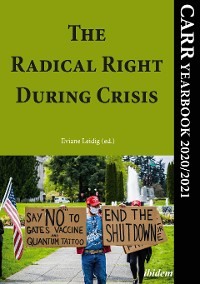
Czytaj książkę: «The Radical Right During Crisis»
ibidem-Press, Stuttgart
Contents
Preface
Authoritarianism Revisited
The Psychology of a Fascist Leader: Hitler’s “Blond Beast” Reinhard Heydrich
Hegel and Fascism
The ‘Silent Majority’: Populist Cliché or Warning?
How Fascists Have Used Panics to Consolidate Power
Can the Radical Right’s Reductionist Narrative Withstand Real-World Complexity?
Alternative Epistemologies of the Radical Right: How Grand Narratives and the Quest for Truth Offer Recognition and a Sense of Belonging
Radical Right Voters and Democratic Support
Nationalism and Memory
Grieving Greater Hungary: Trianon, Orbán, and the Hungarian Radical Right
An “Ambivalent Day”: How the AfD Attempts to Re-frame the 8th May as Day to Commemorate German Victimhood
Putin’s Amendments to Russia’s Constitution Sparks Debate About Russian Nationalism
Eco-fascism “Proper”: The Curious Case of Greenline Front
Terrorism and Political Violence
A New Wave of Right-Wing Terrorism
Germany’s Terrorist Attack: Migrant Communities Have Lost Trust
Far-Right Terrorism is Global, But Coverage is Not: Hindu Nationalist Violence in India
In Germany, Anti-semitism on Social Media Can Be Linked to Offline Violence
Does Norway Have a Neo-Nazi Terrorist Problem?
Canada Filed the First Incel Terrorism Charge. How Do We Combat This Threat?
The COVID-19 Pandemic
COVID-19 Could Be a Harbinger of Authoritarianism
Anti-government Ideology in the Times of COVID-19
The Radical Right is Weaponizing COVID-19 Online
Under Lockdown, Germany’s PEGIDA Goes to YouTube
Europe’s Far-Right Fails to Capitalize on COVID-19
Quo Vadis, Europe? Coping with Old and New Crises
COVID-19 Will Have Long-lasting Consequences for International Migration
How COVID and Syria Conspiracies Introduce Fascism to the Left: The Red-Brown Media Spectrum
QAnon: A Conspiracy for Our Time
Black Lives Matter, Policing, and Military Presence
I Predict a Riot: An Analysis of White Supremacist Propaganda in the Wake of the George Floyd Murder
“Get in the Bin!” The Far-Right “Guarding” British Monuments
Contemporary Tensions Between Blacks and Jews in America: July Fireworks and Why They Matter
Is America Edging Toward a “Racial Holy War”?
Nuancing “Chan-Culture”: /K/ and the Visual Culture of Weapons Boards
The Other Epidemic: White Supremacists in Law Enforcement
No Bargain: Why Don’t Bad Cops Get Fired? The Power of Police Unions
‘Press the Reset Button’: Right-Wing Extremism in Germany’s Military
Investigating the Radical Right’s Presence in the Canadian Military
Alt-Tech
The Social Media Platform That Welcomes QAnon with Open Arms
The Transnationalization of White Supremacist Discourse: The Hundred-Handers and the It’s Okay to Be White Campaign
Networked Hate: White Supremacist Activity on Telegram
Why Do Hate Groups and Terrorists Love Telegram?
Ideology, Intellectuals, and Metapolitics
Did a French Far-Right Thinker Predict 2020?
Why Did Heidegger Emerge as the Central Philosopher of the Far-Right?
Sweden Heading Towards “Academic Freedom” as Battlefield of the Radical Right
Why is the Brazilian Right Afraid of Pablo Freire?
The Right’s War on Science & Experts Escalates Amid COVID-19
What WhatsApp Conversations Reveal About the Far-Right’s Ideology
Racist Occultism in the UK: Behind the Order of Nine Angles (O9A)
Sexuality and Gender
The New Man and Fascism
Incels: Alienated Men and Violence in the Digital Age
The Proud Boys Are Standing By
Marching On, But Not Together: The Georgian Far Right versus Guram Kashia
The “Rainbow Nation” is Not Immune to Anti-gender Activism: Attacks on Queer Bodies and Knowledge in South Africa
Turning Family Into a Political Weapon
Islamophobia in Sri Lanka, or the Sterilization Obsession
The Radical Right is Exploiting a Swedish Teen’s Murder
New Voter Strongholds
When Ethnic Minorities Vote for Right-Wing Populism
In Bed with the Far Right in Thuringia: A Watershed Moment for Muslim CDU supporters?
The German AfD Makes Appeals to Russian-Germans
The Radical Right in Turmoil
Disunity within the Ranks? Party Expulsions in the European Radical Right: 2000-2020
Is Italian Right-Wing Populism in Decline?
The Dusk after the Dawn: Fall of a Greek Neo-Nazi Party
Countering the Radical Right
Collecting Hate: The Ethics of Archiving and Researching on the Radical and Far-Right
The Many Faces of the Radical Right and How to Counter Their Threat: CARR’s Report “Faces” of the Radical Right
Treating “White Men” as a New “Suspect Community” is Not the Answer
Tackling Online Radicalisation at Its Offline Roots
Moving Away from Islamist Extremism: Assessing Counter Narrative Responses to the Far-Right Online
How to Counter Radical Right Narratives Head on
Can Anything Be Done Against Radical Right Misinformation?
The Effects of Censoring the Far-Right Online
Is Antifa the Answer to Today’s Fascism?
Remembering Kevin Coogan
How to Laugh Away the Far-Right: Lessons from Germany
CARR 2020 Bibliography
Preface
To say that 2020 was a memorable year would be an understatement. While the COVID-19 pandemic overshadowed all else and would quickly have a lasting impact on our daily lives, other events related to the radical right soon surfaced.
The year started off with tragedy as a shooter in Hanau, Germany opened fire targeting Turkish “immigrants” (although in reality German citizens). Driven by racist and misogynist conspiracy theories, the terrorist uploaded a manifesto and YouTube video shortly before carrying out the attack. Only a few days later, riots broke out in New Delhi, India, as Hindu nationalist mobs descended onto Muslim neighbourhoods in brazen acts of violence that left dozens dead and hundreds injured. The riots were incited by far right politicians who equated protesters—of a newly passed bill that discriminates citizenship based on religion—as anti-national and worthy targets of murder.
Soon after the World Health Organization declared COVID-19 a global pandemic in March, we witnessed radical right leaders enact sweeping authoritarian powers, weaponizing upon societal instability to bolster their agendas. Viktor Orbán’s Fidesz party in Hungary passed legislation that would allow the prime minister to rule by decree indefinitely, thus further contributing to erosion of democracy. Meanwhile, Russia’s constitutional referendum outcome secured Vladimir Putin power in office until 2036. Other radical right world leaders who later tested positive for COVID-19, such as Donald Trump and Jair Bolsonaro, continued to promote falsehoods steeped in anti-science and anti-expert claims. Fear of democratic backsliding became entrenched as panic surrounding the coronavirus spiked across the world.
While anti-mask protests gained strongholds in North America and Europe, another social movement started taking to the streets. The gruesome murder of George Floyd in Minneapolis, Minnesota mobilized a summer of Black Lives Matter protests in the U.S. and those in international solidarity. Championing the call for police reform, however, soon faced backlash from far right counter-protestors. Militia groups such as the self-described Boogaloo Bois, and male supremacist organizations like the Proud Boys, began roaming the streets intimidating BLM protestors, at times with direct violence. Coupled with mounting unemployment levels and economic hardship as a consequence of the pandemic, and social media disinformation circulating at unprecedented rates, 2020 witnessed the height of political polarization.
Meanwhile, the Canadian government charged a young man with the first ever designated case of an “incel” attack. Although terrorist attacks have been carried out by self-described incels in the past, the recognition of this hateful, violent misogynistic ideology as a motivation for murder added weight to an increasing area of national security concern. Growing incel online communities is not the only digital network with deadly offline effects that rose to prominence last year. Soon enough, QAnon began appearing in media headlines. This conspiracy theory, which dates back to 2017 on the imageboard 4chan, advocates that a secret cabal of Satan-worshipping cannibalistic pedophiles, most of whom are prominent politicians from the Democratic Party, are running a global child sex-trafficking ring. This group of elites are supposedly plotting against Donald Trump, who is heroically defending against their pursuits. Information concerning new developments are released in small increments by an anonymous user who goes by the name “Q”, a person claiming to have high-level security clearance in the American government with access to classified information.
The rise in popularity of QAnon adherents coalesced with their increasing visibility at Trump rallies and rapid sharing of disinformation on social media in the buildup to the U.S. presidential election. Although American in origin, the QAnon movement spread to other countries, including the UK, France, Germany, and Japan. Combined with false narratives concerning the development and distribution of the COVID-19 vaccine and a summer of social unrest, many feared impending violence in the run-up to election day. Such violence was delayed, however, until the beginning of 2021 when a mob stormed the U.S. Capitol following incitement to violence by the president. After months of claiming election fraud and failure to concede to Democratic challenger Joe Biden, Trump galvanized this group of insurrectionists in a final display before leaving office.
In spite of these worrying developments, particularly concerning the role of far right actors, 2020 was a year that also witnessed positive events. A nationwide law that would prohibit abortion in Poland was delayed implementation after large scale protests, delivering a major blow to the ruling right-wing Law and Justice (PiS) party and narrowly re-elected President Andrezj Duda. The end of the year also saw activists celebrating Argentina’s passage of legalizing abortion, a massive step that may influence a domino effect in the region. Both of these advances gives hope towards expanding women’s reproductive rights in the future.
In Greece, the trial of the openly neo-Nazi party Golden Dawn with the court ruling its role as a criminal organization, was met with widespread jubilation. Although this does not signal the end of the far right in Greece, the verdict provides much needed vindication to victims and their families. It further sends a pivotal message concerning the importance of justice in upholding the rule of law. Meanwhile, Belarusians protested for free and fair elections in the face of authoritarianism. Although ongoing, the demand for democracy in Belarus remains strong. And despite acts of state-sponsored violence, a youth-led movement in Nigeria against police brutality and human rights abuses has been likened to once-in-a-generation change.
Finally, a Biden-Harris administration achieved through the peaceful transfer of power signals a benchmark of liberal democracy. The administration has already dedicated efforts towards reviewing and assessing domestic violent extremism as a serious threat to public safety. While some criticism can, and should, be levied against this approach, it is a welcome step in the right direction towards countering the far right.
This Yearbook features contributions by academic, practitioner, and policy Fellows at the Centre for Analysis of the Radical Right (CARR), providing a holistic overview of radical right activity in 2020 in relation to global events. CARR was established in 2018 and is chaired by a group of researchers: Professor Matthew Feldman, Dr William Allchorn, Professor Cynthia Miller-Idriss, Dr Archie Henderson, Professor Tamir Bar-On, Dr Eviane Leidig, Bàrbara Molas, and Augusta Dell’Omo. Special thanks to Pragya Rai and James Hardy for their assistance in compiling this Yearbook
The following entries comprise only a small amount of the hundreds of blog posts written by our Fellows as part of the CARR Insight Blog (radicalrightanalysis.com). The increased visibility and readership of these blog posts are in great part due to CARR’s media partners where several of these posts were first published by openDemocracy, Fair Observer, and Rantt Media. An additional thanks goes to Walid Houri, Anna Pivovarchuk, and Ahmed Baba, for their editorial cooperation and dedication.
The Yearbook begins by returning to a recurrent theme—exploring how studies of authoritarianism and fascism can offer insight into explaining developments today—before turning to radical right nationalist imaginaries and memory reconstruction. It then switches to an empirical focus, analysing terrorist events in 2020 not only enacted by the perpetrator and their broader ecosystems of radicalization, but also detailing those harmed in the process and offering counter-terrorism recommendations.
Of course, it would be remiss to avoid reflections of radical right responses during the pandemic, discussed extensively in the following section of the Yearbook. Succeeding this are important assessments of the relationship between the radical right and Black Lives Matter, policing, and military presence. Technology has been especially crucial in radical right communication, recruitment, radicalization, and mobilization in these contexts, which is examined in the next section.
The Yearbook then situates the ideological and intellectual undercurrents of the radical right, often targeting left-wing academia and scientific experts. Added to this list of “enemies” is an effort towards controlling sexuality, reproduction, and gender norms, which is explored by several authors.
Penultimately, the Yearbook compares both the strengths and weaknesses of the radical right in 2020 with respect to political parties. New voter strongholds are identified, as well as areas of decline in radical right support and acceptance. Lastly, it concludes by exploring a wide array of approaches to countering the radical right, including much needed online and offline solutions.
This comprehensive and timely edited volume maps the radical right in 2020 with the aim of disseminating essential knowledge of this phenomenon to a broad audience of scholars, educators, practitioners, policymakers, security services, journalists, and the general public. We hope that the analysis provided by these leading experts will aid towards a more nuanced understanding of the radical right and effective counter responses in challenging this threat to democracy.
Dr Eviane Leidig
Oslo, Norway
January 2021
Authoritarianism Revisited
The Psychology of a Fascist Leader: Hitler’s “Blond Beast” Reinhard Heydrich
Chris Webb
Reinhardt Heydrich was born in Halle, Germany, a provincial town in Prussian Saxony, on 7 March 1904. He was the son of a Dresden music teacher who had founded the First Halle Conservatory for Music, Theatre and Teaching. Heydrich joined the Freikorps in 1919 and was strongly influenced in his early years by the racial fanaticism of Völkisch circles. On 30 March 1922, he entered the Reichsmarine in Kiel, serving for a time under Wilhelm Canaris, who nurtured his taste for naval intelligence work. In 1931, Heydrich was forced to resign from the navy by Admiral Raeder for ‘conduct unbecoming to an officer and a gentleman’, after compromising the virtue of a shipyard director’s daughter.1
In July 1931, he joined the Nazi Party and then the Schutzstaffel (SS), attracting the attention of Heinrich Himmler and he rose rapidly through the ranks. He was appointed SS-Sturmbannführer on 25 December 1931, then SS-Standartenführer and Chief of the SD (Security Service) in July 1932. Heydrich was promoted to SS-Brigadeführer on 21 March 1933 and, in reward for his murderous services during the Ernst Rohm Purge (later dubbed “The Night of the Long Knives”), he became an SS-Obergruppenführer on 1 July 1934. Around the time he became a SS-Sturmbannführer, the dropped the “t” from his Christian name, and henceforth was known as Reinhard. Heydrich was tall, slim, blond-haired, with slanting, deep-set blue eyes. He possessed a military bearing and ice-cool hardness, which seemed to epitomise the “Nordic-Aryan type” of Nazi mythology. His athleticism—he was a first-class fencer, an excellent horseman and a skilled pilot—allied to his talent as a violinist and his orderly, disciplined exterior impressed Himmler, who selected him as his right-hand man.
As Himmler’s assistant in securing control of the Munich and then Bavarian police after the Nazis seizure of power, Heydrich assured the successful co-ordination of the political police in the other German Landser during 1933-34. Heydrich soon negotiated his way to becoming Chief of the Berlin Gestapo and by 1936 was given command of the security police throughout the Reich. An able technician of power, ruthless, cold and calculating, without any compunction in carrying out the most inhuman measures, Heydrich made himself indispensable to the masters of the Third Reich. Yet the arrogant facade disguised a deeply split personality, a neurotic temperament and pathological self-hatred which found its outlet in a boundless greed for power, morbid suspiciousness and exhibitionism. A sense of “racial” inadequacy, the gnawing uncertainty caused by his suspected half-Jewish origins—utilised for blackmail purposes by his rivals for power, though never established as a fact. All this added to his built-in sense of inferiority.
As head of the Sicherheitspolizei (SiPo), the unified, centralised, militarised and Nazified security police, Heydrich reacted with pitiless harshness in dealing with so-called “enemies of the State”. His cynicism and contempt for human beings led him to exploit the basest instincts—sadism, envy, intolerance—in weaving his gigantic spider’s web of police surveillance in the Third Reich. He filed extensive dossiers not only on enemies of the Party, but also on his rivals and colleagues, using the police apparatus to set his opponents at each other’s throats. Scientific studies of the modus operandi of potential enemies of the State, like Marxists, Jews, Freemasons, Liberal Republicans, religious and cultural groups, went hand-in-hand with arrests, torture and murder of those who stood in the way of the totalitarian police apparatus.
The “Blond Beast” who controlled the sole intelligence service of the Party after 1935, specialised in devious methods of blackmail alongside the weapons of open terror and persecution. Heydrich’s hand was most probably in the Tukhachevsky Affair, which led to the purge of the top Red Army generals in the Soviet Union. He also fabricated the scandalous intrigue among his peers, which brought down the leading German generals, including Werner von Blomberg and Werner von Fritsch in 1938. His proclivity for “dirty tricks” was again in evidence when he masterminded the fake attack on the Gleiwitz radio transmitter station, which provided Hitler’s excuse for invading Poland on 1 September 1939. In the same year, Heydrich was appointed head of the Reich Main Security Office (RSHA) which incorporated the Gestapo, the criminal police and the Sicherheitsdienst des Reichsführers-SS (or SD). A gigantic political machine for centralising and transmitting information to all corners of the Third Reich, which gave Heydrich the opportunity to perfect the techniques of secret police power.
The most satanic consequence of this accumulation of power was revealed in Heydrich’s implementation of the order for the wholesale extermination of European Jewry. Already before the war, Heydrich had concentrated the management of Jewish affairs in his hands, though in 1938 the emphasis was still on a policy of forced emigration. One of the instigators of the Krystal Nacht (Crystal Night) pogrom of November 1938, Heydrich had sent Adolf Eichmann to Vienna to organise a “Centre for Jewish Emigration” and, impressed by his success, had created a similar centre in Berlin.
After the conquest of Poland, Heydrich ordered the concentration of Polish Jews in ghetto’s and the appointment of Jewish councils, using a characteristically perfidious tactic of forcing the Jewish communities to “collaborate” in their own destruction. With Eichmann’s help, he organised the mass deportations of Jews from annexed parts of Poland, Germany and Austria to the territory of the General-Gouvernement. In his directive of 21 September 1939, Heydrich distinguished, however, between the “final aim”, requiring longer periods of time and the stages required or achieving it. On 31 July 1941, following the invasion of the Soviet Union, in the first six weeks of the campaign Heydrich had, with typical bravado, flown with the Luftwaffe, Goering commissioned Heydrich to carry out a ‘total solution of the Jewish question in those territories of Europe which are under German influence’. Both the terms Gesamtlosung (Total Solution) and Endlosung (Final Solution) were used in the document to Heydrich and he was delegated to take responsibility for all the necessary organisational, administrative and financial measures to achieve that terrible, murderous end. His Einsatzgruppen, which had already killed tens of thousands of Poles and Jews with the co-operation of the German Army, were to murder hundreds of thousands of Russian and Polish Jews as well as Soviet officials.
To co-ordinate the action of various government and Party agencies, Heydrich convened the Wannsee Conference in a Berlin suburb on 20 January 1942 to discuss the ways and means of implementing the “Final Solution of the European Jewish Question”. In the circumlocutory language used to disguise the policy of mass murder, which he had a considerable part in devising. Heydrich described how Jews capable of work ‘are brought to these areas in the eastern occupied territories and employed in road building, in which task undoubtedly a large part will fall out through natural diminution’. In other words, they would be sent to their death through hunger, exhaustion or disease and, where required, by murder squads. The surviving remnant would be given appropriate “treatment” as they represented a “natural selection,” constituting the “germ-cell” of a new Jewish development should they be allowed to go free. Having laid the groundwork for the “Final Solution”, Heydrich left his Berlin headquarters to assume the post of Deputy Reich Protector of Bohemia and Moravia on 23 September 1941. Taking up residence in Prague, Heydrich adopted “the policy of the whip and the sugar”, speeding up repression and ordering mass executions while attempting to win over the workers and peasants by improving social conditions. Overestimating his success in “pacifying” the Czechs, Heydrich abandoned normal security precautions and drove about in an open car without armed escort.
On 27 May 1942, he was gravely wounded by two Free Czech agents, Josef Gabcik and Jan Kubis, who were trained in England and parachuted into Czechoslovakia, who opened fire on his car and when one of their guns jammed threw a grenade into the vehicle. The assassins were discovered, along with other members of the Resistance group, sheltering in the St. Cyril and Methodius church in Prague. On 18 June 1942, after a pitched battle with scores of SS troops, Josef Gabcik killed himself in the crypt, while Jan Kubis was fatally wounded and later died in hospital.
On 4 June 1942, Heydrich died at 4:30AM from blood poisoning and four days after his death, about 1,000 Jews left Prague in a single train, which was designated “AaH” (Attentat auf Heydrich, or Assassination of Heydrich) in “honour” of Heydrich’s death. This transport was officially destined for Ujazdów in the Lublin district, Poland, but was gassed at the Bełżec death camp. The members of Odilo Globocnik’s resettlement staff henceforward dedicated the murder programme to Heydrich’s memory under the code name “Einsatz Reinhardt”.2
Heydrich’s body was transported from Prague by special train to Berlin and his funeral on 9 June 1942 was the grandest of any funeral ceremony conducted during the history of the Third Reich, held in the Mosaic Hall of the Reich’s Chancellery on Vos-Strasse. Following the funeral oration delivered by Hitler, the coffin was transported through the streets of Berlin on a gun carriage towed by a half-track to a simple grave in Invaliden cemetery. As Heydrich was being buried Hitler ordered the complete destruction of the little Bohemian village of Lidice as retaliation for the assassination of Heydrich on 9 June 1942, under the command of SS-Hauptsturmführer Max Rostock.
This was originally published on the Holocaust History Society website.
Chris Webb is a Senior Fellow at CARR and founder of the Holocaust Historical Society.
1 Robert S. Wistrich, Who’s Who in Nazi Germany (London: Routledge, 1995).
2 Gerald Reitlinger, The Final Solution (London: Vallentine, Mitchell & Co., 1968).
Hegel and Fascism
Henry Mead
In his 1945 work The Open Society and its Enemies, Karl Popper famously attacked what he saw as the intellectual roots of fascism. Tracing a lineage from Plato to its modern progenitors, he asserted that ‘Hegel’s hysterical historicism was the fertiliser from which totalitarianism was grown’.1 Popper’s chapter on “Hegel and the New Tribalism” includes a long list of charges, questioning Hegel’s motives as an employee of the Prussian State, his style and knowing use of ‘imbecile fancies’, and his contributions to what Popper termed “historicism”, nationalism, and finally to modern totalitarianism.
Popper, historicism and Hegel’s critics
For Popper, the term “historicism” referred to the notion of a fixed path running through history, a pattern predetermined that would progress inexorably to a telos. In his view, Hegel had inherited the Platonic fixation on forms via the immanent essentialism of Aristotle. In his phenomenology, his elision of subject and object, and contraries of all sorts, involved a dangerous absolution of all moral or epistemological distinction. According to Popper, the theodicy presented in Hegel’s philosophy of history was ruthless in its optimism, relegating suffering and moral evil to necessary way-stations on a path towards the absolute.
In Popper’s account, Hegel’s “historicism” combines the Aristotelean notion of entelechy with the German Romantic nationalism of Herder and Fichte; one of its results, in a later generation, was fascism. In this view, the myth of the nation was justification of the emergent state, an embodiment of the absolute that naturally requires enemies and warfare in its formation. Aggressive actions were exempt, in their providential status, from moral censure. Such processes, moreover, were precipitated by certain Great Men, also above morality in their unknowing enactment of historical will, and worthy of celebration for their heroic life and exploits. Popper sceptically recounts Hegel’s plan of history culminating, following periods of Oriental despotism and Classical democracy, in the “German Age”. With the Reformation at the threshold, modernity finds its apogee in Prussian statism. As Bertrand Russell wrote, also in 1945, ‘It is odd that a process which is represented as cosmic should all have taken place on our planet, and most of it near the Mediterranean’.2 Popper was, however, less ironic than condemnatory: in Popper’s opinion, Hegel’s idea of the state as the manifestation of the Absolute spirit subordinated individuals within civil society to its will and authority. All these aspects seemed to Popper to lay the foundations of modern totalitarianism.
Such an attack by the Austrian-born Popper had a great influence in the English-speaking world, consolidated by similar commentaries by Russell and Isaiah Berlin; for many in Britain and America, Hegel’s reputation after World War II was at its lowest ebb.3 It is worth noting, however, that attacks on Hegel on ideological grounds began well before this nadir—as Kirk Willis has shown, foreboding commentaries regarding the geopolitical outcomes of Hegel’s thought are traceable back into the 19th century. As early as 1838, the British and Foreign Review described Prussian ministers as being ‘filled with Hegelian casuistry’; comments in the intellectual press on Hegel’s conservatism continued through the 1840s and 50s.4 Bismarck’s expansionist policies cemented this wariness: a piece in the Contemporary Review of 1899, for example, noted that Bismarck merely ‘carried out the general ideas of one of the greatest philosophers of the counter-Revolution—Hegel’.5
Intimations of militarism came to a head during the Great War: by 1915, the reaction in Britain led to the forced resignation of the Lord Chancellor, Richard Burdon Haldane, an Idealist philosopher, owing to suspicions over his “Germanophilia”.6 Baron von Hugel’s The German Soul (1916) linked Hegelianism with the ‘barbarous excesses of the German mentality now at work’,7 as did John Dewey, in German Philosophy and Politics (1916). George Santayana went further in Egotism in German Philosophy (1915), which blamed the “egoism” of German thought from Kant onwards for German aggression: ‘a spirit of uncompromising self-assertion and metaphysical conceit which the German nation is now reducing to action’.8 In 1917, Leonard Hobhouse identified Hegel’s ‘metaphysical theory of the state’ for state militarism as a direct cause of the Great War.9
Neo-Hegelianism and its fascist influence
The history of fascism begins in the same period. While the philosophical pre-history of Nazism owes much to the German intellectual context, there is no doubt that Hegelianism also contributed to the first, non-German forms of Fascism, perhaps most conspicuously in the adaptation of Idealism in Italy, notably by Giovanni Gentile. Gentile managed to connect Hegel to Mussolini’s project within a new system he named “actualism”. By emphasising the corporative element in Hegel’s Philosophy of the Right (1821), Gentile could provide a rationale for Mussolini’s state and leadership. As recounted by A. James Gregor, ‘Gentile’s Actualism gave every appearance of being capable of providing a synthesizing philosophical rationale for emerging Fascism’. By 1918, Gentile could foresee:
a revolutionary “new state” that would be the expression of the “fully rational and concrete” national will of Italians in their collectivity. In that “revolutionary state,” politics and morality, parochial and national interests, would combine in such a fashion that individuals would fully identify themselves with its actions. That new state would be a spiritual reality in which all would find their place.10
There was then a neo-Hegelian lineage leading into the new ideological category of “Fascism”; not just for Gentile, but for various intellectuals of Mussolini’s Italy, adaptations of Hegel provided a logic for the reconciliation of the individual, the industrial communities, and the state under Fascist rule. As Gregor goes on, ‘the community—as the state—that served as the grounds of individuation for the individual was not a construction that was inter homines, between members of the community, but an immanent reality that arose out of members themselves. It was interiore homine…The community was understood to be at the core of the individual’.11 Italian fascism thus provided a practicable model for a totalitarian regime based on a Hegelian tradition as the Nazi movement reached its maturity in the 1930s.
And yet between his death and the present day, with a notable peak among the British Idealists the late 19th century, Hegel’s works have been cited frequently by progressive thinkers in Britain and across Europe.12 Benedetto Croce, who developed his neo-Hegelianism in collaboration with Gentile, rejected his friend’s fascist ideology in the 1920s. Then, of course, there was the burgeoning Marxist movement, in which Hegel’s legacy took a radically different form.
The Germanophobic reaction to Idealism were clearly of its time: the French generation that attended Alexandre Kojeve’s lectures on Hegel in the 1930s led the shift to a new existential reading; and Walter Kaufmann’s comprehensive defence of Hegel against Popper’s charges in The Hegel Myth and its Method (1959) marked the changing tide of opinion.13 In Britain, Charles Taylor, Berlin’s student, presented a major study that would shape post-war readings of Hegel and dispel the cruder charges of earlier writers; and by 1989 Francis Fukuyama had made Kojeve’s account the basis of his pronouncement of a post-Cold War “End of History”. Despite these developments, necessarily foreshortened here, the earlier suspicions of Anglophone readers remain noteworthy. The tensions and overlaps between forms of liberal, socialist, and fascist teleology are clear in the legacy of Hegelianism up to the present day.
Dr Henry Mead is a Senior Fellow at CARR and research fellow at the University of Tallinn. Research for this chapter was supported by a European Research Council Starting Grant (TAU17149) “Between the Times: Embattled Temporalities and Political Imagination in Interwar Europe”.
1 Karl Popper, The Open Society and Its Enemies, vol II. The High Tide of Prophecy, Hegel, Marx, and the Aftermath (London: Routledge, 1945), 270.
2 Bertrand Russell, A History of Western Philosophy (London: George Allen, 1946), 735.
3 See Isaiah Berlin, “Historical Inevitability,” (1953), in Liberty, the Collected Essays of Isaiah Berlin, ed. H. Hardy (Oxford: Oxford University Press, 2008).
4 Kirk Willis, “The Introduction and Critical Reception of Hegelian Thought in Britain 1830-1900”, Victorian Studies 32 no. 1 (1988): 87-111, 103-4.
5 Willis, “Introduction,” 104.
6 Andrew Vincent, “German Philosophy and British Public Policy: Richard Burdon Haldane in Theory and Practice”, Journal of the History of Ideas 68 no. 1 (2007): 157-179.
7 Willis, “Introduction”, 8.
8 Willis, “Introduction”, 7.
9 Leonard Hobhouse, The Metaphysical Theory of the State (London: George Allen, 1918).
10 A. James Gregor, Mussolini’s Intellectuals: Fascist Social and Political Thought (Princeton: Princeton University Press, 2005), 86.
11 Gregor, Mussolini’s Intellectuals, 114.
12 See Lisa Herzog, ed., Hegel’s Thought in Europe: Currents, Crosscurrents and Undercurrents (Basingstoke: Palgrave Macmillan, 2013).
13 Walter Kaufmann, From Shakespeare to Existentialism: Studies in Poetry, Religion, and Philosophy (Boston: Beacon Press, 1959), 88-119.
The ‘Silent Majority’: Populist Cliché or Warning?
Aristotle Kallis
In the run-up to the EU referendum in Britain in June 2016, at a time when the Remain vote was apparently enjoying a modest but clear advantage, one of the numerous opinion polls focused on public attitudes to immigration and on how this might affect the popular vote.1 When asked to assess immigrants’ contribution to British economy, responses were split evenly between those acknowledging immigrants’ contribution to the economy and those questioning it. Yet very strong affirmative majorities were recorded by the same poll in response to questions about Britain being “overcrowded”, about the need to “significantly” restrict immigration through tighter border controls, to limit migrants’ access to public services, and so on. When interviewees were asked to identify the one issue that could sway their vote in the referendum, respondents singled out immigration by a spectacular margin. Unfortunately, we know too well how this played out.
As the history of opinion polling shows, such social majorities can however be mercurial and hard to gauge. Societies typically host a wide spectrum of views on any given issue and, while it may be relatively easier to talk of “extremes”, the mainstream-as-majority view is often very hard to ascertain or deduce.2 Opinion polls go some way towards capturing the mood of society in a more focused, issue-specific format but they can also be misleading: their results hinge on the way the question is framed, the moment when or the medium through which it is asked, and the group that is sampled. Such parameters may all skew the findings,3 in some cases deliberately or as in most cases unintentionally. Thus, to talk of “social majorities”—or the general will of a population—is very often a wishful projection or and educated guess with a very limited shelf life indeed.
Part of the problem is that social majorities do not always have a voice or a desire to speak loudly enough to be captured by the radar of public mood. Noisy minorities4 can easily skew impressions as much as boisterous leaders claiming that they bespeak the “real” majority view.
Meanwhile, the existence of social taboos about the public expression of particular views in any society may lead to tactical form of public self-censorship—a divergence between the private and publicly expressed views of the individual. ‘Regimes of truth’, Foucault perceptively argued,5 always produce ‘subjugated knowledges’—views and voices that have been de-legitimised and suppressed by a hegemonic discourse seeking to regulate knowledge and therefore public discourse itself.
When Nixon, for example, invoked the “silent majority” as the source of his popular mandate6 and Vice President Agnew spoke of a small “liberal elite” as the exclusive source of “truth” in their contemporary America,7 the elected presidential duo effectively questioned all sorts of orthodoxies about the country’s “mainstream” society. The trope of the “silent majority” lay claim to a social majority that has been ignored, misrepresented by biased media, effectively silenced, and forgotten. It sounds anti-elitist and liberating, mixing lofty principles such as freedom and democracy with the call for radical change. For decades it and its various by-products like the “real people” and so on8 have become the discursive staple of right-wing populists across the world,9 uniting the language of very different figures such as Geert Wilders, Marine Le Pen and, more recently, the Tea Party and of course Donald Trump.10 It has also become a favourite electoral stratagem for mainstream political campaigns, such as Vote Leave for the 2016 EU membership referendum in the UK or a series of elections in the 2000s fought by Nicolas Sarkozy as either incumbent or aspiring president.
The populist “silent majority” trope has been repeatedly exposed as a cynical misnomer11 and disparaged by mainstream media and academic research.12 It may be exactly that of course. Populist forces have rarely reached the status of expressing the views of an enduring social majority. It is also easy to mistake noise for public support, although this is an argument that cuts both ways. However, those who take solace in arguing that populists are propelled by angry—and thus vocal—minorities may be drawing a false sense of security from this comforting illusion. Flimsy electoral results cannot be treated as the sole or most authentic expression of public political views. Voter dealignment from mainstream parties is typically, and misleadingly, lagging behind attitudinal shifts with regard to key political and social issues. In other words, majorities can be, and very often are, less politically progressive or socially/culturally conformist than either their voting behaviour or public opinions may suggest or indicate.
Here’s the thing: the social “mainstream” is a far, far broader patchwork canopy than liberal and/or progressive opinion can comfortably profess. Mainstream acceptability is delineated by widely shared thresholds of acceptability on either side. Like taboos, these thresholds entail particular attitudinal and behavioural jumps that mark the boundaries of political legitimacy and “truth”. It is against these categorical extremes, Uwe Backes argued, that any “majority society” reflects its supposed normality.13 Yet, relative silence or lack of voting majorities is not sufficient assurance of robust adherence to the mainstream, let alone of positive or moderate approval for its lofty normative declarations. Supported by rooted and robust Foucauldian “regimes of truth”, as argued above, normative mainstream discourses are powerful enough projections to effectively conceal opposition and drown out public expressions of resentment. Whether, however, relative silence can be taken as tacit or passive approval is another matter.
To take a recent example, polls conducted during the Black Lives Matter mobilisation in the US in 2020 have encouragingly revealed significant increases in public support against institutionalised racism.14 Yet, they also typically show ongoing opposition to taking down symbols of the country’s imperialist and segregationist past. Supporting anti-racism when asked does not mean actively opposing racism.15 Protests, especially when they turn violent, can be divisive, pitting ideological support against the (always powerful) “law-and-order” agenda. To declare support for racism publicly remains a very strong taboo; but to invoke “public order”16 or national identity as under threat by such protests is also a powerful existential tool that adds that all-important conditional “but” to potential declarations of support for a cause.
The search for a political “mainstream” is messy, often self-contradictory, fickle, and difficult to access in sufficiently high resolution. It is more reflective of a continuum of more or less acceptable views than of a stable positive majority. For a politician or movement to claim unique and/or privileged access on the supposed “real” mainstream’s behalf is duplicitous hyperbole. But to trust either election results or opinion polls as the more accurate trace of “mainstream” pulse is to put just a bit too much faith on the question asked as well as on the validity of the answers publicly given. The populist claim to give voice to silent majorities is more akin to a call for public insurrection by supposed underdogs against certain existing social and political taboos– and a promise of long-overdue redress.17 Seen from this perspective, it may be easier to comprehend why the populist trope has worked to shock electoral effect too often in recent years; and why it is a mistake to simply brush it aside as a misnomer or as a loud, manipulative social media fad. It is also just a bit closer to an uncomfortable truth that we may wish to admit and act upon: the “mainstream” as a bundle of diverse social majorities (or in electoral parlance, “voting coalitions”) is generally less progressive and more erratic than often assumed.18 Populists may not be supported by “silent majorities”, but their transgressive arguments speak to, legitimise, and then normalise a number of “subjugated knowledges” that have the power to transform the complexion of the “mainstream”.19
Dr Aristotle Kallis is a Senior Fellow at CARR and professor of modern and contemporary history at Keele University.
1 “Recent Polls on Immigration, Public Opinion & Voting: MW 361”, Migration Watch UK, last modified April 7, 2016, https://www.migrationwatchuk.org/briefing-paper/361/recent-polls-on-immigration
2 Aristotle Kallis, “When Fascism Became Mainstream: The Challenge of Extremism in Times of Crisis”, Fascism 4 no. 1 (2015): 1–24.
3 Roch Dunin-Wasowicz, “Long read | Are opinion polls biased towards Leave?”, LSE Blogs, October 29, 2019, https://blogs.lse.ac.uk/brexit/2019/10/29/long-read-are-opinion-polls-pro-leave-biased/
4 Lars Rensmann, “The Noisy Counter-Revolution: Understanding the Cultural Conditions and Dynamics of Populist Politics in Europe in the Digital Age”, Politics and Governance 5 no. 4 (2017): 123-35.
5 Daniele Lorenzini, “What is a ‘Regime of Truth’?”, Le Foucaldien 1 no. 1 (2015), 1.
6 Sarah Thelen, “Mobilizing a Majority: Nixon's ‘Silent Majority’ Speech and the Domestic Debate over Vietnam”, Journal of American Studies 51 no. 3 (2017): 887–914.
7 Jerald Podair, Zach Messitte and Charles Holden, “The Man Who Pioneered Trumpism”, Washington Post, November 15, 2018, https://www.washingtonpost.com/outlook/2018/11/15/man-who-pioneered-trumpism/.
8 John Keane, “We the People: The Charms and Contradictions of Populism”, The Conversation, November 2, 2016, https://theconversation.com/we-the-people-the-charms-and-contradictions-of-populism-63769.
9 Desirée Schmuck and Michael Hameleers, “Closer to the People: A Comparative Content Analysis of Populist Communication on Social Networking Sites in Pre- and Post-Election Periods”, Information, Communication & Society 23 no. 10 (2020): 1531-48.
10 Mark Mardell, “The Netherlands’ Populist Moment?”, BBC News, February 13, 2017, https://www.bbc.co.uk/news/world-europe-38956740; Megan Galbreath, “An Analysis of Donald Trump and Marine Le Pen”, Harvard International Review 38 no. 3 (2017): 7-9.
11 Harry Enten, “Silent Majorities Are a Misnomer”, CNN, June 6, 2020, https://edition.cnn.com/2020/06/06/politics/trump-silent-majority-analysis/index.html.
12 Cas Mudde, “Populists Aren’t a Silent Majority—They’re Just a Loud Minority”, Guardian, September 6, 2018, https://www.theguardian.com/commentisfree/2018/sep/06/populists-silent-majority-loud-minority.
13 Uwe Backes, “Meaning and Forms of Political Extremism in Past and Present”, Central European Political Studies Review IX no. 4 (2007): 242-62.
14 “Poll Shows Strong Public Support for BLM Protests”, Hope not Hate, June 26, 2020, https://www.hopenothate.org.uk/2020/06/26/poll-shows-strong-public-support-for-blm-protests/.
15 David Smith, “Nine Out of 10 Americans Say Racism and Police Brutality Are Problems, Poll Finds”, Guardian, July 8, 2020, https://www.theguardian.com/us-news/2020/jul/08/americans-racism-police-brutality-problems-poll.
16 Charles M Blow, “‘Law and Order’ for ‘Blacks and Hippies’”, New York Times, June 21, 2020, https://www.nytimes.com/2020/06/21/opinion/trump-police-reform.html.
17 Ruth Wodak, The Politics of Fear: What Right-Wing Populist Discourses Mean (London: SAGE, 2015), Ch. 1.
18 Francesco Duina, “The Uncomfortable Truths About Populism”, LSE Blogs, June 5, 2020, https://blogs.lse.ac.uk/europpblog/2020/06/05/the-uncomfortable-truths-about-populism/.
19 Julian Göpffarth, “Why We Shouldn’t Call the Far Right an Unpopular Minority”, Fair Observer, September 14, 2018, https://www.fairobserver.com/region/europe/far-right-populist-parties-sweden-democrats-afd-europe-politics-news-analysis-19001/.
How Fascists Have Used Panics to Consolidate Power
Roland Clark
Sometimes it is okay to panic. Or at least, some situations demand radical solutions. But when you are up to your eyeballs in judgement against your neighbour for hoarding toilet paper or the government for jeopardising your children’s future to sell another barrel of oil, keep in mind that, in interwar Europe at least, fascist politics emerged out of a climate of panic and constant talk of crises. Benito Mussolini rode to power on the claim that anarchist and communist violence was out of the government’s control. The massacres of the White Terror in Hungary relied on fears that communists and Jews posed a genuine threat to law and order. Adolf Hitler staged the famous Beer Hall Putsch in the midst of a state of emergency in Bavaria, then used the Reichstag fire of 1933 to end civil liberties and suppress his enemies. Oswald Mosley launched the British Union of Fascists with one speech after another about the dire circumstances British workers found themselves in at the end of the Great Depression. Engelbert Dollfuss shut down Austria’s government in 1933 by over-exaggerating a political stalemate that gave him an excuse to attack the Social Democratic Party and launch the Austrian Civil War. Cries about judicial corruption in the case of the embezzler Alexandre Stavisky brought the right-wing Leagues out onto the streets of Paris in February 1934, bringing down Édouard Daladier’s government and almost resulting in a coup d’état.
In his influential 1972 book Folk Devils and Moral Panics, the sociologist Stanley Cohen analysed what he called “moral panics”.1 These happen, he said, when the media irresponsibly exaggerates a social problem, demanding radical solutions that are often not even relevant to the problem at hand, and then exacerbates the problem by causing people to over-react to it. His book studied fights on the beaches of Brighton one summer that broke out between two youth subcultures: the Mods and the Rockers. But moral panics are far from being something only for the history books. Panics about refugees and asylum seekers, teenage pregnancy, youth gangs, terrorism, sexual deviants, and stock prices generally work in the same way. The so-called “yellow journalism” of the tabloid press was in full swing by the interwar period, and talk about crises was not just something done by the radical right. But whereas the mainstream liberal press spoke about threats to the proper functioning of the social order, the radical right used the language of warfare and religion to portray corruption scandals or economic disasters as existential threats to the nation. Reporting only those facts which would generate the greatest possible emotional responses, right-wing newspapers and speakers whipped up an atmosphere of fear that helped people feel justified in taking radical steps to protect their communities. In normal times, perhaps it would be abhorrent to ban Jews from public swimming pools, but if Jews were known carriers of disease and parasites then that would be a different matter. Just think of the children!
Especially in its early years, it was not always clear what set fascists apart from the other political options on offer. There was certainly something left-wing about parts of their ideology, but at the same time they managed to gain the support of prominent members of the aristocracy. They talked about nationalism, but so did almost every other political party of the day. They called themselves a party of the future, but few were eager to recreate the societies that had produced the Great War. One thing that fascists did do exceedingly well though, was to make people panic. On street corners, in lecture halls, and in their newspapers, fascists worked hard to transform people’s fears—some of which were legitimate, others not—into full-blown moral panics. Moreover, fascists never pointed out problems that they believed could be fixed with a couple of band-aids and a nice cup of tea. Every problem mentioned by the radical right had to be a life-or-death issue that could only be resolved by an almost apocalyptic transformation; restoring order through revolution and democracy through authoritarianism. The fact that fascism emerged from moral panics should never be a reason not to take responsible, decisive action in the face of serious social problems, but as insipid as it seems today when printed on coffee mugs and internet memes, perhaps one of the most profoundly anti-fascist things anyone ever said was: ‘Keep calm and carry on!’.
Dr Roland Clark is a Senior Fellow at CARR and senior lecturer in history at the University of Liverpool.
1 Stanley Cohen, Folk Devils and Moral Panics (London: Routledge, [1972] 2011).
Can the Radical Right’s Reductionist Narrative Withstand Real-World Complexity?
Alan Waring
There is a general recognition that major problems and issues of our world, including understanding them and their causes, and proposing remedies and coping strategies, are rarely simple in nature. Complexity theory and the long history of systems science, as exemplified by the work of such authorities as von Bertalanffy,1 Parsons, Ackoff, Checkland2 and others, have demonstrated this truism conclusively. Nevertheless, systems science has always recognized that reductionism also has an important role in conceptualization, theory development, methodology, analysis, problem/issue elicitation, and design of practical interventions.3 However, that role is meant to be a controlled and targeted one, to be used judiciously only when appropriate to a particular topic or juncture within a larger and more holistic strategy, and not to be used as the exclusive quick-fix approach to all “problem solving”. Regrettably, there is abundant evidence that radical right leaders, ideologues, politicians, administrations, opinion-formers and others have an overwhelming tendency to promulgate, often dogmatically and even ruthlessly, simple analyses and solutions to complex real-world issues. Unsurprisingly, these rarely work and often make things far worse.
Characteristics and fallacies of radical right reductionism
The radical right exhibits reductionist thinking and narratives in two main ways: 1) trivializing or minimizing the nature and impact of particular risks (and sometimes maximizing them), contrary to known science or factual evidence, and 2) over-simplifying specific problems or issues, or inventing false and unscientific cause-effect explanations for them. The apparent motives for why the radical right engages in such egregious manipulation and fakery centre on four processes, which they believe will bring their cause political and populist benefits:
1) Authoritarian revisionism
The radical right indulges in the erasure from their narrative of inconvenient or unwelcome facts from the accepted knowledge base of history and science. For example, protagonists pretend that the vast body of knowledge on the complexity of problems and issues relating to society, science, economics, health, social reforms, human rights, foreign relations, and governance in general, as developed over the past half century, is irrelevant, or is fake science, or never even existed. The radical right policies, narratives and actions of the Trump administration provide stark in extremis examples of such revisionism on many fronts and in various forms.
The radical right seeks to regress to the “simple truths and values” of an imaginary past world of the 1960s and earlier, when relatively simple mechanistic, biological or economic “explanations” provided a comforting illusion of order, certainty, neatly stacked “problems-and-solutions”, and simplistic salvation models and “programs” for correcting deviations from their dogma and their assertions of what constitutes the correct normative order. Critiques,4 of the “fallacy of predetermination” and other reductionist fallacies, and critiques5 of the poor predictability of non-holistic programmatic change, have no currency in the radical right world, since these expose their inherent flaws.
Examples of radical right salvation “cure-alls” range from Trump’s Mexican wall and Orbán’s anti-Muslim border controls, to the palingenetic ultranationalist ethno-religious and political cleansing demanded by the extreme right, to radical right advocacy of, or sympathy with, discredited eugenics theories of inferiority of certain races. As allegedly inferior races will be an unacceptable drain on society and the economy, eugenics advocates argue that they should be “dealt with” (echoing the Nazi Rassenhygiene laws and Eugen Fischer’s infamous Aktion T4 extermination program in Hitler’s Germany). For example, Prime Minister Boris Johnson refused to apologize for, or dismiss, a policy adviser who suggested publicly that discriminatory policies based on eugenics were warranted.6
Complexity theory regards real-world problems and issues as “messes”, i.e. systems of problems that defy resolution simply by picking off component problems one-by-one or even in groups, because in doing so the “mess” simply adapts itself and survives in a modified and unresolved form. Messes require the systemic whole to be tackled holistically. Despite the overwhelming trend over the past fourty-five years among governments, policy research groups, and academia towards adopting holistic approaches, the radical right have persisted with their reductionist and revisionist worldview. For example, as I’ve noted,7 some of the radical right (e.g. Reisman) seriously argue for reintroduction of minimalist social, employment and environmental policies similar to those of Victorian times, and the wholesale removal of protective legislation for work people. Nevertheless, because radical right propaganda overall offers a seductive “salvation” model, as the 21st century has progressed, radical right salvation ideas have gained widespread populist support among weary and fearful societies demanding “solutions”. Moreover, there has also been a resurgence of reductionist theories and arguments in some areas of academia, e.g., recent scientific papers that airbrush out the body of knowledge on complexity and advocate rehashed reductionist theories on scientific management and salvationist programmatic change models from the 1960s.
2) Manipulation of risk perceptions
US President Trump’s persistent official policy was to deny that climate change exists or, if it does, then it is neither human-created nor a major threat to the world.8 That policy implies a belief that there is no systemic cause-effect relationship between human activity, global warming/climate change, and extreme weather events. Therefore, no special preventative measures or contingency planning are required, and existing emergency response provisions are adequate since extreme weather events will remain rare, unpredictable, and non-catastrophic. In radical right terms, the “problem” and its risks are thereby reduced to zero, as they do not exist. The motive behind Trump’s extraordinary “wishful thinking” position is open to conjecture.
As another example, in radical right terms, MMR (measles, mumps, rubella) is reduced to a set of allegedly relatively minor health threats whereas [quoting discredited quack science from a struck-off physician] MMR vaccine is falsely cited as a major cause of autism in children. The underlying justification appears to emanate from the radical right’s fear of removal of the freedom of parental choice coupled with a belief that scientists who support vaccination (i.e., the vast majority, authorities such as the CDC, WHO, etc.) are part of a left-wing conspiracy to undermine conservative governance and the economy. Radical right supporters are heavily represented among anti-vax supporters, who include Trump. In February 2020, he also contradicted the CDC and WHO on the seriousness of the coronavirus threat, dismissing the scale of the threat as a “hoax” and claiming that his media enemies were using false coronavirus stories as a weapon to undermine him politically. Subsequently, he has persistently sought to “talk down” the COVID-19 threat to public health and has strongly advocated removal of the lockdown restrictions while the pandemic was still raging and before safe to do so, apparently on economic grounds, a belief that health experts were exaggerating the risks, and to avoid damage to his re-election chances.
While the radical right artificially deflates some risks, it also inflates others. For example, Trump has persistently inflated the incidence and risk of violent criminality among immigrants (whether legal or illegal) from Mexico, contrary to the known facts. He has also similarly falsely inflated the risk of terrorism from Muslim immigrants and visitors to the US.
3) Confirmation Bias in Propaganda
The radical right exhibits a strong preference for any evidence, opinion, or assertion which they believe strengthens their case. While not unique in seeking to present their best case, the radical right stand out in the relentless and aggressive way they disseminate their propaganda by all forms of media, especially online and social media. Radical right leaders, politicians, ideologues, opinion formers, commentators, and supportive journalists selectively include in their narratives only those items and assertions that tend to confirm and support radical right objectives and, conversely, exclude any material that contradicts or challenges radical right ideology or that casts the radical right in a poor light.
Thus, for example, the recent sudden increases in MMR cases (including deaths) officially attributed to anti-vax campaigns supported by the radical right will be ignored, while stories of populist support for the anti-vax position will receive favourable publicity. Stories of heroism of firefighters and emergency services workers in the conflagrations in California and Australia will dominate the narratives of radical right administrations and their supporters, while climate change (if mentioned at all) will be vehemently denied as a primary causal factor in the fires. Viktor Orbán will boast of a huge success in his “Hungary for Hungarians only” policy in the way his massive border fencing and strict controls have stopped the alleged Muslim takeover of the country, while ignoring the fact that historically Hungary has only ever had a miniscule Muslim population—a classic false proposition to evoke fear in the native population followed by their relief when the (non-existent) threat is neutralized. If the non-existent Muslim hordes have not entered the country, then populists believe that clearly Orbán’s policy was correct and effective!
4) Mendacity and amoral calculation
Radical right leaders and supporters persistently lie in order to advance their political ideology, persuade the public of their righteousness, and to cover up their own bad conduct. For example, according to the Washington Post,9 by October 2019 President Trump had made 13,435 false or misleading statements since taking office. By 10 December 2019, that number had risen to 15,413.10 While it may be anticipated that all politicians “stretch the truth” to their advantage, and some brazenly lie from time to time, the scale of Trump’s mendacity is exceptional and unprecedented. Trump, his administration and the radical right establishment have turned amoral calculation, lying, and dissemination of false facts and fake news into a central plank of official policy rather than just used as an ad hoc convenience.
Radical right reductionism has played well to a populist audience looking for some kind of salvation from perceived problems and threats. The radical right has been skilful in weaving into its narrative an artful rhetoric and imagery concerning problems and threats that are in some cases real but mixed up with far more that are exaggerated or invented. Playing on populist fears, the radical right then proposes itself and its policies as their only salvation. This populist support, based on psychological dependence, may work for a time if the promise of salvation seems plausible and realistic. However, ultimately support is likely to wane as enacted radical right policies fail in the face of real-world complexity.
Dr Alan Waring is a Policy and Practitioner Fellow at CARR and adjunct professor at the Centre for Risk and Decision Sciences (CERIDES) at the European University Cyprus.
1 Ludwig von Bertalanffy, “The History and Status of General Systems Theory,” Academy of Management Journal 15 no. 4 (1972): 407-26.
2 Peter Checkland, Systems Thinking, Systems Practice: Includes a 30-year Retrospective (Chichester, UK: John Wiley & Sons, 1999).
3 Alan Waring, Practical Systems Thinking (Aldershot, UK: Thomson/Cengage, 1996), 62-4.
4 Henry Mintzberg, The Rise and Fall of Strategic Planning: Reconceiving Roles for Planning, Plans, Planners (New York: Free Press, 1994); Henry Mintzberg, “Rethinking Strategic Planning, Part 1: Pitfalls and Fallacies,” Long Range Planning 27 no. 3 (1994): 12-21.
5 Michael Beer, Russell Eisenstat, and Bert Spector, “Why Change Programs Don’t Produce Change,” Harvard Business Review 68 no. 6 (1990): 158-166.
6 “Andrew Sabisky, No 10 Adviser Resigns Over Alleged Race Comments,” BBC News, February 18, 2020, https://www.bbc.co.uk/news/uk-politics-51538493.
7 Alan Waring, “The Five Pillars of Occupational Safety and Health in a Climate of Authoritarian Socio-political Climates,” Safety Science 117 (2019): 152-63.
8 Alan Waring, “The Alt-Right, Environmental Issues, and Global Warming,” in The New Authoritarianism Vol 1: A Risk Analysis of the US Alt-Right Phenomenon, ed. A. Waring (Stuttgart: Ibidem Verlag, 2018), 273-301.
9 Glenn Kessler, Salvador Rizzo and Meg Kelly, “President Trump Has Made False or Misleading Statements Over Days,” The Washington Post, October 14, 2019, https://www.washingtonpost.com/politics/2019/10/14/president-trump-has-made-false-or-misleading-claims-over-days/.
10 Nancy LeTourneau, “The Magnitude of Trump’s Lies,” The Washington Monthly, December 12, 2019, https://washingtonmonthly.com/2019/12/17/the-magnitude-of-trumps-lies/.
Alternative Epistemologies of the Radical Right: How Grand Narratives and the Quest for Truth Offer Recognition and a Sense of Belonging
Mario Peucker
In early 2019, during ethnographic fieldwork on radical right movements in Australia, I attended a far-right rally against allegedly “African gang crimes” in Melbourne. I spoke to a young man in his twenties about his reasons for taking part in the protest. In response he alluded that the problem was much bigger than the criminal behaviour of some African kids, but he was reluctant to explain his ominous insinuations: ‘I can’t tell you. You have to find out yourself. You just have to read the right things’. He appeared very proud of having found the “right” sources and discovered the truth independently and on his own accord. The truth needed to be earned, he seemed to believe, it can’t simply be passed on. There was a sense of superiority in his words as he had travelled this arduous path towards his “red pill” enlightenment, and he was now sending me on my own journey to discover this truth.
This experience stayed with me, but I was unable to make deeper sense of it until, almost one year later, I interviewed a group of people who had participated in anti-Islam protests and other far-right rallies for several years. During our conversation they also spoke at length about their long way of “educating themselves” and “doing their own research” gradually leading them to what they considered the truth. They were convinced that a secretive globalist cabal directly controls local council and governments to “break” society and implement the New World Order (NWO). Such NWO claims are among the most popular conspiratorial myths within radical right milieus in Australia and globally. In general, and also within this specific group, they serve as a grand narrative that ties a range of beliefs around mostly unrelated issue—from immigration, Islam and anti-Semitism (absent in my interviews) to socialism, climate change, gender identity, vaccination, and government actions—into a seemingly coherent system.
Leaving aside the sometimes obscure and contradictory nature of the arguments put forward by the people in this group, what became clear is that their personal quest for the truth was a process with complex psychological and social implications. Again, there was this strong sense of pride in their claimed capacity to look behind “fake news” in mainstream media and deliberate indoctrination attempts by the government and its education system. Although they all shared the same convictions around NWO, none of the interviewed individuals wanted to appear as if they had simply adopted the views of others (not even of those in their own group). Instead, they all insisted on having done their own independent “research”, and they simply arrived at the same truth from different angles, which was further proof that their convictions were true. They felt empowered and a sense of recognition and self-worth as a result of their personal quest, but these processes have also strengthened their collective identity and belonging to a community (in-group) with supposedly superior knowledge.
The vast literature on (radical) political and social movements1 and violent extremism2 has highlighted that such psychological and social factor are often pivot in explaining the appeal of far-right ideologies and groups. The analysis of these interviews underscores this and demonstrates the interplay between these factors and the specific ideological narratives. The people in this group have found recognition, respect, and social connectedness through their radical right activism and their pursuit of the truth.
There were also other social dynamics at play. Whilst emphasizing their individual autodidactic efforts, the interviewed individuals also stated that, once they have done their own research, they would come together and share with each other. This was described by one person as ‘ripple effect’, and another one stated:
As we learned more, we developed…and we all come back together, it’s about networking too. We all share. [Person X] may find out more information to do with Islam and Christians, [person Z] may find out something about Communism…we all learn from each other.
Through these processes of information sharing and mutual exchange of personal experiences, they “often find common ground”. This is how initially unrelated fears and concerns around issues such as Islam, vaccination, and marriage equality are continuously solidified, expanded, and successively bundled together under a coherent grand narrative—in this case, the conspiracy myth of the NWO. The accounts of several members of this group highlighted these processes: ‘When we first came together it was just about Islam, but it is about so much more now’.
This process of “doing my own research” and sharing it within a group of likeminded others, as well as the outcome of these processes, i.e., the belief in an ideological meta-narrative that identifies a secrete global elite and their “puppets” in government as being responsible for all social ills, form an alternative system of knowledge. Similar to dogmatic interpretation of religious belief systems, it offers morally charged, simplistic answers to highly complex questions. This quasi-religious epistemology, whilst rooted in a combination of ultra-nationalistic and aggressively anti-egalitarian tropes, draws heavily on conspiratorial thinking. It is positioned in explicit opposition to the established “mainstream” epistemology, based on reason, science and provable facts, and controlled by the very same elites allegedly responsible for the demise of society. As such, this conspiracy theory-driven knowledge system reinforces boundaries between in-group and out-group, whereby strengthening internal solidarity and belonging and discrediting the others who are considered to be part of the establishment: local councils, governments, universities, and mainstream media. Any attempt by these “elite” agencies to challenge the in-group’s convictions, for instance through rational arguments or counternarratives, may backfire as it can be regarded as a deliberate manipulation attempt by the out-group and hence ‘perpetuate the original conspiracy theories’, as Holbrook recently argued.3
The alternative epistemologies within the radical right are powerful and difficult to refute from outside, also because they often serve a deeper psychological purpose for the individual. They offer something that people who feel disenfranchised may seek and feel they deserve but society has denied them: a sense of recognition, control and power in a social environment, both locally and globally, that is complexly interconnected, constantly changing and characterised by uncertainty and ambiguity.
Dr Mario Peucker is a Senior Fellow at CARR and senior research fellow at the Institute for Sustainable Industries and Liveable Cities at Victoria University, Melbourne.
1 James M. Jasper, “Emotions and Social Movements: Twenty Years of Theory and Research,” Annual Review of Sociology 37, no. 1 (2011): 285-303.
2 Hedieh Mirahmadi, “Building Resilience against Violent Extremism: A Community-Based Approach,” The ANNALS of the American Academy of Political and Social Science 668, no. 1 (2016): 129-44; Matteo Vergani, Muhammad Iqbal, Ekin Ilbahar and Greg Barton, “The Three Ps of Radicalization: Push, Pull and Personal. A Systematic Scoping Review of the Scientific Evidence about Radicalization Into Violent Extremism,” Studies in Conflict & Terrorism 43, no. 10 (2020): 854-85.
3 Donald Holbrook, “The Challenge of Conspiracy Theories for Strategic Communications,” The RUSI Journal 165, no. 1 (2020): 26-36.
Radical Right Voters and Democratic Support
Nicolas Bichay
The rise of radical right parties is considered by many to be one of the largest modern threats to liberal democracy.1 There is a strong pattern of populist and radical leaders eroding constraints on the executive,2 diminishing press freedom,3 and harming the quality of elections to benefit themselves.4
But what about these parties’ voters? Do radical right voters exhibit overtly anti-democratic rhetoric? In other words, do voters of radical right parties knowingly hold and agree with anti-democratic attitudes? Or, rather, do they support these parties for other ideological reasons, while disagreeing with their anti-democratic tendencies?
On the one hand, it may simply be the case that voters support a radical right party for their policy proposals, for example their attention to immigration, the global economy, and promise of removing corrupt elites from government that, in their mind, other mainstream parties ignore. In such cases, cognitive dissidence may play a role in their determination that such parties are not really a threat to democracy and claims to the contrary are simply “fake news”. Or perhaps voters do believe these claims yet dub them a “necessary evil” worth the cost to restore the country to its “rightful place”.
On the other hand, there is a possibility that voters acknowledge the harms to democracy caused by the party they support and agree with these anti-democratic positions. The rhetoric of these parties is often categorized as anti-pluralist,5 with both voters and candidates believing that their party is the only one capable of solving the nation’s current problems. Thus, voters may be interpreting this situation as one which necessitates removing any limitations to the party’s rule. This scenario surely constitutes the more dangerous situation.
Public opinion data
For all the work done examining the relationship between the radical right and democracy, this important aspect of voter opinion still remains unclear. In fact, recent work has suggested that radical right voters are actually more supportive of democracy than their centrist counterparts,6 further complicating the issue. However, there is some anecdotal evidence that voters may indeed knowingly hold anti-democratic views. For example, the 2017 referendum that greatly consolidated executive power7 in Turkey held very high support from voters of the ruling populist right Justice and Development Party (90%), while maintaining overwhelming opposition from supporters of all other parties.8
To gain more insight on this important question, I analysed public opinion data from the European Value Survey (EVS). The EVS is a large-scale public opinion survey that has been conducted every nine years in Europe since 1981. It asks several questions with regard to democratic support on topics ranging from the importance of free and fair elections to the appropriateness of the military seizing power. I used these questions as a way to measure democratic support amongst respondents. Following Rooduijn et al.’s classification of what constitutes a radical right party,9 I outline the differences in opinion on democracy between EVS respondents who supported a radical right party, compared to supporters of all other parties below.
| Question | Non-Radical-Right Support | Radical-Right Support |
| Having a democratic political system is “very good” | 60% | 45% |
| Having a strong leader who doesn’t bother with elections or parliament is “very good” | 6% | 7% |
| Free and fair elections are an “essential characteristic of democracy” | 61% | 58% |
| Having the army rule the country is “very bad” | 65% | 46% |
| The army takes over when government is incompetent is an “essential characteristic of democracy” | 5% | 9% |
It seems evident from EVS survey data that, at least in some cases, radical right voters tend to hold more anti-democratic views. Overall, radical right voters are 25% less likely to classify a democratic system as “very good”, vis-à-vis their non-radical right counterparts. Digging deeper, in many cases, the results point to radical right voters seemingly approving an authoritarian consolidation of power and ignoring checks and balances, while simultaneously maintaining support for free and fair elections. For example, while radical right voters were nearly as likely to maintain the essentiality of free and fair elections compared to other voters, they were much less likely to decry military coups and rule.
This variation in voter preferences mirrors rhetoric of radical right leaders themselves. Much of the radical right electoral rhetoric focuses on taking power away from the corrupt elite and rightfully returning it to the masses.10 Rarely do radical leaders openly advocate removing people from the decision-making process. Rather, they are more concerned with removing constraints to their ruling, once democratically elected. Take again, for example, President Recep Tayyip Erdoğan’s actions in Turkey. Considered as leading to a breakdown of liberal democracy, his constitutional changes dramatically increased the power of the executive and abolished the office of prime minister. Still, these changes did little to affect voting rights in Turkey (and were even enacted via a popular referendum).
Given the above, it appears that not only are radical right voters aware of their anti-democratic predispositions, but these predispositions seem to mirror the traits observed in party leader rhetoric. They are more likely to support the idea of eroding constraints on their rule, yet at the same time are no more willing to castigate the importance of free and fair elections. This may seem a subtle difference but is an important one. When radical right parties demonstrate values counter to democracy, their voters believe them to be a necessary process of which they will benefit.11 As such, they stand for policies that give the party they support more power, at the expense of democracy. When it comes to seizing their own power, however, in the form of fairly run elections, they seem to remain opposed.
Nicolas Bichay is a Doctoral Fellow at CARR and doctoral candidate in political science at Michigan State University.
1 Andrea Kendall-Taylor and Erica Frantz, “How Democracies Fall Apart,” Foreign Affairs, December 5, 2016, https://www.foreignaffairs.com/articles/2016-12-05/how-democracies-fall-apart.
2 Christian Houle and Paul D. Kenny, “The Political and Economic Consequences of Populist Rule in Latin America,” Government and Opposition 53, no. 2 (2016): 256-87.
3 Kareem Shaheen, “Turkish Journalists Accuse Erdoğan of Media Witch-hunt,” The Guardian, May 2, 2016, https://www.theguardian.com/world/2016/may/02/turkish-journalists-accuse-erdogan-of-media-witch-hunt.
4 “Although Parliamentary Elections in Hungary Offered Voters a Diverse Choice, Ruling Party Enjoyed Undue Advantage, Say International Observers,” Organization for Economic Cooperation and Development, April 7, 2014, https://www.oscepa.org/documents/election-observation/election-observation-statements/hungary/press-releases-12/2152-2014-parliamenary/file.
5 Jan-Werner Müller, What Is Populism? (Philadelphia: University of Pennsylvania Press, 2016).
6 David Adler, “Centrists Are the Most Hostile to Democracy, Not Extremists,” The New York Times, May 23, 2018, https://www.nytimes.com/interactive/2018/05/23/opinion/international-world/centrists-democracy.html?mtrref=t.co&gwh=9094043E46C8EA5E9225B9B7F3611AE3&gwt=regi&assetType=REGIWALL.
7 “Turkey Referendum Grants President Erdogan Sweeping New Powers,” BBC News, April 16, 2017, https://www.bbc.com/news/world-europe-39617700.
8 Evren Doganc, “Turkish Referendum,” Ipsos, April 20, 2017, https://www.ipsos.com/en/turkish-referendum.
9 Matthijs Rooduijn et al., “The PopuList: An Overview of Populist, Far Right, Far Left and Eurosceptic Parties in Europe,” 2019, https://popu-list.org.
10 Müller, What Is Populism?.
11 Müller, What Is Populism?.
Nationalism and Memory
Grieving Greater Hungary: Trianon, Orbán, and the Hungarian Radical Right
Katherine Kondor
In the Hungarian collective memory, few events evoke as much emotion as the Treaty of Trianon. Referring to the peace treaty signed at the Grand Trianon Palace at Versailles on 4 June 1920, this treaty meant that Hungary lost about two-thirds of its territories. The end of the First World War marked the end of the Austro-Hungarian empire, meaning the federalisation of both Austria and Hungary. With this came the Trianon peace treaty, where Hungary lost most of its national minorities: Slovaks, Romanians, Croats, and Serbs, among others. This treaty meant families were divided along national borders,1 and many ethnic Hungarians now found themselves members of other nation-states. Parts of Northern Hungary went to the Slovaks and Czechs, the South went to the Serbs, Croatians, and Slovenians, and Transylvania became part of Romania. 1941-42 briefly saw a reversal of the treaty and reinstatement of lands as, under the Hungarian regent Admiral Miklós Horthy, Hungary fought on the side of Nazi Germany.
In the 1930s, the extreme right began to centre around Ferenc Szálasi, leader of the newly formed Party for National Will; the party was characterised by militant anti-Semitism and irredentism, specifically seeking to reunite the Hungarian people of the Carpathian Basin under Hungarian leadership. Later, Szálasi’s ideas of “Hungarism” and the reversal of the Trianon treaty became central to the Hungarian radical right, most specifically to the new Hungarian National Socialist Party and later to the infamous Arrow Cross Party and Hungarist Movement. Their ideas were a mix of anti-Semitism and fascism, believing that powers such as Great Britain, France, the United States, and the Soviet Union should be dissolved, and Hungarians (along with Latin, German, Slavic, and Islamic nations) should become the leading world race.
These ideas of Hungarism and the reformation of “Greater Hungary” are now central to Hungary’s radical right. “Greater Hungary” is recognised in the form of an idea, with the concept symbolising the reunification of all ethnic Hungarians. It can also be represented physically by the image of present day Hungary set within the pre-Trianon borders of the country, which often appears as a form of pan-Hungarism on decals, jewellery, and clothing. In another incarnation, it appears as a common chant used by radical right groups—“Vesszen Trianon!” (“Down with Trianon!”).
Viktor Orbán and his government have also been often accused of revisionist approaches. Indeed, the Fidesz government instituted the opportunity for Hungarian citizenship2 to all Hungarians living outside of the nation-state’s borders; those ethnic Hungarians granted citizenship from Romania, Ukraine, and Serbia have meant a large electoral boost for Orbán’s Fidesz. Additionally, Fidesz have altered the national curriculum3 to be “more patriotic”, replaced the EU flag4 on the Hungarian parliament building with that of the Szeklers (a Hungarian-speaking ethnic group in Transylvania), openly support autonomy for the Szeklerlands in Transylvania,5 regularly speak at the annual Bálványos Summer Free University and summer camp in the Szeklerlands, and have been financing6 Hungarian-language media,7 football clubs, and churches in Transylvania.
Orbán’s gestures towards the Transylvanian-Hungarian and Szekler minorities have not gone unnoticed by the Romanian government, incidentaly led by their very own (Ludovic) Orban, who reacted in 2020 by declaring 4 June a national holiday8 in Romania. Indeed, the Szeklerlands have become the centre of Orbán’s irredentist crusade, although he himself stated that he is not seeking to reunite all of the lost Hungarian lands.9 One must wonder, then, what his motives are beyond simple ethno-nationalism.
4 June is memorialised annually by the Hungarian government, with the day being commemorated as the Day of National Unity in 2010. Indeed, Trianon is such a crucial part of the Hungarian collective memory that a rock opera was created about it in 2018.10 2020, however, brings particularly special meaning in its centennial anniversary of the treaty; so much so, in fact, that the Hungarian government commissioned a memorial monument in front of the parliament in Budapest in April 2019 to be finished for the centennial anniversary (which it was not).11 Called the “National Unity Memorial”, the subterranean monument features the names of the nearly 13,000 settlements Hungary lost to Trianon.
Outside of the Hungarian parliament, the treaty is memorialised and mourned by the radical right; indeed, 4 June is one of the biggest days of the year for these organisations. In 2020, there is increased anger surrounding Trianon related to the treaty being originally signed for 100 years: a notional expiration date due for the 2020 anniversary. For the centennial, even COVID-19 could not stop the protests and memorials. 5 June saw the annual protest march (the article features a video about the march, with interviews in Hungarian) organised by the Sixty-Four Counties Youth Movement,12 a radical right youth organisation centred around the reversal of the treaty. The organisation was founded by the leader of the new Our Homeland Movement political party, who also spoke at the event. Videos of the protest show organisation members, various people young and old, and families with children in attendance.
Several radical right organisations made statements in honour of the anniversary. The Hungarian Defence Movement, which portrays itself as a community and family-oriented volunteer organisation, had a week-long commemoration visiting various Trianon memorials around Hungary. The radical right rock band Kárpátia wrote a song for the occasion. Some have voiced a victimisation and portrayal as Trianon as a Hungarian genocide, as did the extremist Outlaw Army organisation who stated, ‘they sentenced us to death, yet we’re still alive’.13 Légió Hungária, a newer Hungarian white power organisation, created a video to commemorate Trianon 100 stating that, ‘Our message on the 100th anniversary of Trianon must be that Hungarian identity and Hungarian land will be kept Hungarian, where for one thousand years Hungarians have been born and Hungarians determined the culture. One thousand years from now should be the same’.14 These organisations have frequently spoken out about ethnic Hungarians across the borders, with the Sixty-Four Counties Youth Movement even having branches in the Szeklerlands.
Such a parallel between the Hungarian radical right and Hungarian government’s rhetoric is nothing if not cause for concern. It is also questionable as to what the continued tension between Hungary and Romania will mean for the future of the region. At any rate, Orbán’s not-so-subtle nod to Hungarism and Admiral Horthy are worthy of Europe’s attention as the country slips further into its “illiberal turn”.
Dr Katherine Kondor is a Senior Fellow at CARR and research associate on the “Illiberal Turn” project at Loughborough University.
1 “VARIOUS: Ethnic Hungarians Remember How Their Families Were Divided by the Trianon Peace Treaty of 1920,” Reuters, June 7, 2010, https://reuters.screenocean.com/record/478169.
2 Lucie Szymanowska, “The iImplementation of the Hungarian Citizenship Law,” OSW, February 2, 2011, https://www.osw.waw.pl/en/publikacje/analyses/2011-02-02/implementation-hungarian-citizenship-law.
3 Edit Inotai, “Democracy Digest: Hungary’s Curriculum cCusade,” Balkan Insight, February 7, 2020, https://balkaninsight.com/2020/02/07/democracy-digest-hungarys-curriculum-crusade/.
4 Csaba Tóth, “President of Hungarian Parliament Orders Removal of EU Flag,” Budapest Beacon, November 17, 2014, https://budapestbeacon.com/president-hungarian-parliament-orders-removal-eu-flag/.
5 For example: Stefano Bottoni, “Szeklerland as the New Crimea?,” Visegrad Insight, May 16, 2014, https://visegradinsight.eu/szeklerland-as-a-new-crimea1652014/; Cristian Gherasim, “Bucharest and Budapest in ‘Autonomy’ Region Row,” EU Observer, May 4, 2020, https://euobserver.com/political/148232.
6 Akos Keller-Alant, “Living Like in Hungary: Orban Bankrolling Romania ‘Ethnic Parallelism’,” Balkan Insight, January 30, 2020, https://balkaninsight.com/2020/01/30/living-like-in-hungary-orban-bankrolling-romania-ethnic-parallelism/.
7 Craig Turp-Balazs, “New Report Reveals Hungary’s Creeping Influence on Transylvania Media Market,” Emerging Europe, July 18, 2019, https://emerging-europe.com/news/new-report-reveals-hungarys-creeping-influence-on-transylvania-media-market/.
8 “Hungarian Press Roundup: Romania Declares Trianon Day a National Holiday,” Hungary Today, May 21, 2020, https://hungarytoday.hu/hungarian-press-romania-trianon-day/.
9 Gergely Nyilas, “Orbán Szerint Emlékezni Kell, De Trianonozni Nem,” Index, January 9, 2020, https://index.hu/belfold/2020/01/09/orban_viktor_sajtotajekoztato_karmelita_kolostor_orbaninfo/orban_szerint_emlekezni_kell_de_trianonozni_nem/.
10 Shaun Walker, “Hungarian Nationalist Rock Opera to Retell 1920s Grievances,” The Guardian, June 22, 2018, https://www.theguardian.com/world/2018/jun/22/hungarian-nationalist-rock-opera-to-retell-1920s-grievances.
11 Nick Thorpe, “The 100-year Wound That Hungary Cannot Forget,” BBC News, June 3, 2020, https://www.bbc.com/news/world-europe-52903721.
12 Gabriella Dohi, ““Vesszen Trianon!”—így tüntetett a szélsőjobb a száz éve megkötött békeszerződés ellen,” Atlatszo, June 6, 2020, https://video.atlatszo.hu/2020/06/06/vesszen-trianon-igy-tuntetett-a-szelsojobb-a-szaz-eve-megkotott-bekeszerzodes-ellen/.
13 “A Betyársereg üzenete: Ennél őszintébben nem lehet… VESSZEN TRIANON!,” Betyársereg, June 4, 2020, http://betyarsereg.hu/a-betyarsereg-uzenete-ennel-oszintebben-nem-lehet-vesszen-trianon/.
14 “Trianon100—VIDEÓ,” Légió Hungária, June 4, 2020, https://legiohungaria.org/145-trianon100-video.
An “Ambivalent Day”: How the AfD Attempts to Re-frame the 8th May as Day to Commemorate German Victimhood
Sophie Schmalenberger
What was planned as a full state ceremony to commemorate the 75th anniversary of the end of the Second World War in Europe became a smaller and “lonely” ceremony due to the COVID-19 situation. Keeping a due distance, President Steinmeier and chancellor Merkel came together on 8 May 2020 to lay down a wreath in memory of the victims of war and Nazi tyranny in the heart of a locked-down Berlin.1 In a speech, Steinmeier warned of the ‘temptation of new nationalisms’ and stressed that there was ‘no end to remembering’.2 The AfD, as key mobiliser of such dangerous nationalism, however, used the anniversary to challenge the dominant interpretation of 8 May as marking the liberation from Nazism by coining it as a day that should commemorate German victims. Namely, Nazi supporters as well as bystanders for whom 8 May and its aftermath meant suffering rather than liberation.
This became apparent during the debate on whether 8 May should be made a public holiday in Germany to commemorate the liberation of Europe and Germany from the Nazis as suggested by the chair of the German Auschwitz Committee Esther Bejarano in an open letter3 to Steinmeier and Merkel. The idea quickly gained support and was soon commented on by the honorary chair of the AfD, Alexander Gauland, who claimed that 8 May was no cause for celebration but an ‘ambivalent day’.4 ‘A day of liberation for those in the concentration camps, but a day of absolute defeat for Germans, implying the loss of German territories and possibilities’. Gauland’s statement sparked criticism from the Central Council of Jews in Germany and various politicians.5 Nevertheless, he successfully managed to make a narrative of German victimhood a salient part of the discourse surrounding the 2020 Second World War commemorations, thus challenging the dominant narrative of historical guilt as a corner stone of modern Germany’s self-conception.
A milestone for the modern German perspective on World War Two is the speech by former President Richard von Weizsäcker on 8 May 1985 in the Bundestag. Weizsäcker claimed that German´s had ‘not been defeated but liberated by the Allies from the inhuman system of Nazi tyranny’.6 While this statement is historically wrong, it became the dominant framing of 8 May 1945 in German memory culture: while hardly experienced as liberating by Germans at the time, in hindsight it gave Germany the opportunity to become better version of itself. Namely, through coming to terms with its dark past, embracing “Never again!” as a central “lesson learned”7 from it, and adopting the identity of a reformed perpetrator. This, however, did not strictly exclude elements of German victimhood or innocence. The liberation narrative invites to attribute historical guilt to the Führer Adolf Hitler and leading Nazis while negating or minimizing the individual guilt of the “average German” and particularly of one’s family members.8 Narratives of innocence and victimhood9 have thus not been the sole focus of, but present within post-Holocaust German memory culture, as is, for example, apparent in the 2013 TV drama Unsere Mütter, unsere Väter (Generation War), a portrayal of Nazi bystanders containing narratives of (passive) guilt, innocence, and moral redemption.10 On occasion of the 75th anniversary of the end of the Second World War, the AfD attempted to make those the key frame for interpreting Germany’s 20th century history.
This becomes even more explicit when examining further AfD statements around the above mentioned debate. Claiming to put forward a balanced account of history, all these contributions indeed aim to highlight German victims and losses connected to 8 May 1945 and urge to remember ‘our mothers and fathers […] who were victims of the biggest crime against humanity in history’.11 In such narrative, a main focus is put on those Germans who were expelled from former Third Reich territory, in what is labelled as the ‘biggest history of expulsion in the history of humankind’.12 This is achieved by showing video material of and stressing family histories of expulsion,13 emphasizing the ‘loss of the homeland of Eastern Germans’14 and mourning ‘irretrievably lost’ cities like Königsberg (Kaliningrad) and Danzig (Gdansk) as former hubs of German culture and history.15 Also, the victimization of millions of raped women and girls and German prisoners of war with mainly Soviet troops as perpetrators is mentioned.16 Here, the AfD mobilizes elements of deflected guilt, as well as narratives of victimhood and innocence that exist within, but are not articulated prominently in official post-Holocaust German memory and public commemoration.
To defy accusations of right-wing extremism, AfD actors formally acknowledge the victims of the Holocaust and guilt of some Germans. They stress, however, that Germans were not a people of perpetrators as many had not even voted for Hitler.17 Attempting to furthermore normalize their positions, they relate their interpretations of history to statements of recognized post-war politicians such as Theodor Heuss, who referred to 8 May as ‘most questionable and tragic paradox in [German] history’.18
Finally, the AfD constructs connections between past and present. Here, Georg Pazderski, head of the AfD fraction in the Berlin state parliament, points out that 8 May brought a new dictatorship, the German Democratic Republic (GDR), upon parts of the German people.19 He then stresses that nowadays, socialists are again gaining dominance in Germany, referring to the Left party as the legal successor of the GDR’s governing party SED together with its ‘leftist-green allies’, the Green party and the Social Democrats. He accuses them of not sincerely remembering the victims, but of misusing commemoration to defame conservative positions and the AfD. His lesson learned from 8 May and its aftermath is ‘Never again Socialism, be it left or right’.20
Moreover, Stephan Protschka, AfD MP in the Bundestag, frames the NS rule as a ‘socialist tyranny’.21 By stating that the loss of freedom of opinion and criminalization of the opposition ‘can still happen today’,22 he alludes to the surveillance of parts of the AfD by the Office for the Protection of the Constitution,23 thus implicitly comparing the Nazi dictatorship with the current administration. An equivalence between Nazi Germany and the Merkel government is constructed even more explicitly by AfD Bavaria, claiming that not 8 May, but ‘Merkel stepping down from office would be a real day of liberation’.24
This attempt to re-frame history on occasion of 8 May is part of a central AfD strategy: to offer an alternative German self-conception that does not deny but relativize the importance of the Holocaust; that demands less reflection on German guilt, instead allowing for patriotism. An interpretation of history that does not see the return of fascism as major danger for modern Germany, but warns against the dominance of what is framed as a socialist-green mainstream. An alternative national self-understanding, thus, that serves as the legitimizing backbone for the AfD’s radical right populist political positions.
Sophie Schmalenberger is a Doctoral Fellow at CARR and doctoral candidate in global studies at Aarhus University.
1 Elisabeth Schuhmacher, “German President Marks ‘Lonely’ World War II 75th anniversary,” Deutsche Welle, May 8, 2020, https://www.dw.com/en/german-president-marks-lonely-world-war-ii-75th-anniversary/a-53368453.
2 Frank-Walter Steinmeier, Federal President Frank-Walter Steinmeier on the 75th anniversary of the liberation from National Socialism and the end of the Second World War in Europe at the Central Memorial of the Federal Republic of Germany to the Victims of War and Tyranny (Neue Wache), May 8, 2020, https://www.bundespraesident.de/SharedDocs/Downloads/DE/Reden/2020/05/200508-75-Jahre-Ende-WKII-Englisch.pdf?__blob=publicationFile.
3 Esther Bajarano, Offener Brief an die Regierenden und alle Menschen, die aus der Geschichte lernen wollen., January 26, 2020, https://www.auschwitz-komitee.de/offener-brief-an-die-regierenden-und-alle-menschen-die-aus-der-geschichte-lernen-wollen/.
4 Jan Sternberg, “Gauland gegen Feiertag am 8. Mai: ‘Es war auch ein Tag der absoluten Niederlage’,” Redaktionsnetzwerk Deutschland, May 8, 2020, https://www.rnd.de/politik/feiertag-am-8-mai-darum-ist-alexander-gauland-afd-dagegen-DGQCKQIZ5RDVJKY27ZASXC27XI.html.
5 “Gauland provoziert mit Aussagen zum 8. Mai,” Jüdische Allgemeine, May 6, 2020, https://www.juedische-allgemeine.de/politik/gauland-provoziert-mit-aussagen-zum-8-mai/.
6 Richard von Weizsäcker, Rede zur Gedenkveranstaltung im Plenarsaal des Deutschen Bundestages zum 40. Jahrestag des Endes des Zweiten Weltkrieges in Europa, May 8, 1985, https://www.bundespraesident.de/SharedDocs/Reden/DE/Richard-von-Weizsaecker/Reden/1985/05/19850508_Rede.html.
7 Bernhard Forchtner, Lessons from the Past? Memory, Narrativity and Subjectivity (London: Palgrave Macmillan, 2016).
8 Harald Welzer, Sabine Moller and Karoline Tschuggnall, Opa war kein Nazi. Nationalsozialismus und Holocaust im Familiengedächtnis (Frankfurt am Main: Fischer, 2014).
9 Samuel Salzborn, Kollektive Unschuld. Die Abwehr Der Shoah Im Deutschen Erinnern (Leipzig: Hentrich & Hentrich, 2020).
10 Wulf Kansteiner, “Fantasies of Innocence: The Holocaust Bystander as German Television Star,” in Völkermord zur Prime-Time: der Holocaust im Fernsehen, eds. J. Keilbach, B. Rasky and J. Starek (Wien: New Academic Press: 2019), 23-45.
11 Stephan Protschka, “8. Mai: (K)ein Grund zum Feiern?”, YouTube video, 2:50, posted on May 7, 2020, https://www.youtube.com/watch?v=HSvqtx5Kh8w&feature=youtu.be.
12 Protschka, “8. Mai”.
13 Stephan Protschka, “8. Mai: (K)ein Grund zum Feiern?,” AfD Kompakt, May 8, 2020, https://afdkompakt.de/2020/05/08/stephan-protschka-8-mai-kein-grund-zum-feiern/
14 Felix Krautkrämer, “Gauland: Der 8. Mai ist kein Freudentag,” Junge Freiheit, May 7, 2020, https://jungefreiheit.de/debatte/interview/2020/gauland-der-8-mai-ist-kein-freudentag/.
15 Krautkrämer, “Gauland”.
16 AfD Fraktion Brandenburg, “Der 8. Mai 1945 war das Ende des zweiten Weltkrieges in #Europa,” Facebook, May 8, 2020, https://www.facebook.com/afdfraktion/photos/a.1482727218676-491/2641414492807752/?type=3&theater.
17 Krautkrämer, “Gauland”.
18 Georg Pazderski, “Bundespräsident #Heuss fand einst bis heute gültige Worte: „Im Grunde genommen bleibt dieser 8.5.1945 die tragischste und fragwürdigste Paradoxie für jeden von uns,” Facebook, May 8, 2020, https://www.facebook.com/Pazderski.Georg/videos/582273155724817.
19 Pazderski, “Bundespräsident”.
20 Pazderski, “Bundespräsident”.
21 Protschka, “8. Mai”.
22 Protschka, “8. Mai”.
23 Sophie Schmalenberger, “‘Long live freedom!’: How the AfD presents itself as Defender of the German Basic Law,” CARR Insight Blog, April 18, 2020, https://www.radicalrightanalysis.com/2020/04/18/long-live-freedom-how-the-afd-presents-itself-as-defender-of-the-german-basic-law/.
24 AfD Bayern (@AfD_Bayern), “Nicht der 8. Mai—Merkels endgültiger Rückzug aus der Politik wird einst als Tag der Befreiung in die Geschichtsbücher eingehen,” Twitter, May 8, 2020. This Tweet was deleted by the AfD Bavaria (@AfD_Bayern) but has been captured by the author.
Putin’s Amendments to Russia’s Constitution Sparks Debate About Russian Nationalism
Valery Engel
On many occasions, Russian President Vladimir Putin has called for the adoption of new amendments to the Russian Constitution. Putin has usually referenced several reasons why the head of state would want to change the basic law of the country, which is only twenty-seven years old. This is the desire to expand the powers of the Duma (parliament), and limit the tenure of the presidency to two terms without the fateful word “in a row”, which allowed Putin to be elected four times, to ensure the immunity of former presidents and establish the priority of the constitution of the Russian Federation over international law.
The gossip behind all this activity is Putin’s desire to remain at the helm of the state after 2024, moving to the Chairperson of the Parliament, and recently, his former adviser Vladislav Surkov1 said that after the adoption of the amendments Putin’s presidential terms must be reset and he has to get a new opportunity to run again (this statement was quickly disavowed by Kremlin, but in the end of the campaign this amendment appeared in the collection).
By the president’s decision, a working group was formed2 to prepare proposals for amending the constitution. This is not to say that the idea of updating the constitution caused a stir among the population of the country. Until recently, only professional politicians, state media and individual bloggers showed interest in the amendments. The authorities doubt that it will be able to ensure a decent turnout at the referendum. In connection with that, Putin proposed to make the vote on a weekday and declare this date a day off.
This process would continue to be quite routine, taking place within the framework of existing domestic political realities, if there had not been for the discussion on social networks about the need to fix in the text of the constitution the “state-forming role” of the Russian national majority. This discussion quickly went beyond the internet.
A debate About Russian ethno-nationalism
A number of authors of the very opposite political orientation took part in it. ‘With each passing day, discussions about the special status of (ethnic) Russians in the constitution, the state-forming role of one people are gaining momentum. At first, this was perceived as the destiny of marginals, then it went to the first buttons of TV channels and to the Duma tribune’, writes on his Facebook page a well-known Russian political scientist, associate professor of foreign regional studies and foreign policy at Russian Humanitarian University, Sergey Markedonov.3
There are incomparably more nationalists than was thought. The Kremlin’s harsh repressions against right-wing radicals in the recent years destroyed their political and organizational structure, but did not destroy nationalist ideology, whose popularity among the intellectuals was above expectations. ‘We are dealing with a strange situation’, says one of the supporters of the “Russian amendments”, Doctor of History Artem Ermakov, 4 ‘the vast majority of the population of our country continues to identify themselves as Russians, but this is not enshrined in any legal document. Except, probably, all-Russian census, which regularly confirms this result. The majority of the population declares that it is Russian, but absolutely nothing follows from this. Even our country is called “Russia” only in brackets, because “Russian Federation”—then its more formal name “Russia”—it’s like a tribute to some traditions’.
He is echoed by the well-known pro-communist politician of the late Soviet Union, member of the Supreme Council of the time of M. Gorbachev, and now the opposition public figure Viktor Alksnis: ‘For the last hundred years the Russian people were remembered at the official level only in the year of trials’, he writes. ‘Yes, there was a famous toast of Stalin for the Russian people. Yes, films were made, books were published, songs were written in which Russian history and Russian people were present, their exploits were sung. But at the official level, the Russian people were absent, they were not there’. Alksnis, an ethnic Latvian living in Moscow, believes that ‘Russia is primarily RUSSIAN RUSSIA and Russia is the RUSSIAN STATE’. He indignantly condemned well-known people in the country: Russians of Armenian descent such as film director Karen Shakhnazarov and political scientist Gevorg Mirzoyan, who spoke out in a popular TV talk show against ethno-amendments. They called them ‘outright discrimination and dividing the peoples of Russia into first grade and second’.5
Oddly enough, he is echoed by a well-known Russian liberal, minister of economics in the Yeltsin government, Andrei Nechaev,6 co-chair of the opposite “Civil Initiative” Party. ‘Accidentally I turned on (TV show) Russia 1’, he writes on Facebook, ‘and there are Shakhnazarov, Kurginyan, Zhirinovsky and Elena Yampolskaya led by Solovyov [all ethnic Armenians or Jews—author’s note] teaching us Russian patriotism’. When asked by the author what he didn’t like the most—the ethnic origin of the speakers or the fact that they taught the audience patriotism, he replied, ‘both’.
Ordinary people are not far behind them. Denis Titov,7 referring to the author of this article, writes: ‘All post-Soviet peoples received their nation-states, in many national republics of the Russian Federation the titular peoples are spelled out in local constitutions, even when they are constituting a minority. Only Russians should not be given anything. Russians should not have their own State, they will tolerate. Oh well’.
However, the idea of creating a Russian autonomous republic in the central part of the country, where most ethnic Russians live, is unpopular among supporters of ethno-amendments. Their opinion was expressed by someone Ilya Maslyukov,8 who lives in Estonia, but who positions himself as an ethnic Russian. ‘Nobody is going to create a separate Russian republic’, he writes. ‘It (Russia) was already created by many of land collectors, from Ermak and Dezhnev to Khabarov and Krasheninnikov, and many other people. So, it turns out that all equal peoples live inside of the one big Russian republic. Many of them (equal peoples) asked themselves to protect their interests. And who didn’t ask ….. Mother History has already forgotten about them. So, everyone is equal. Therefore, Russians should be mentioned (in the text of constitution)’. True, Ilya does not know the answer to the question of whether Tatars, Chechens, and, for example, Circassians, who were conquered by Russian tsars in different periods of history, would agree with his idea.
But in any case, we see that this category of people understands that Russia is not the Soviet Union, this is the Russian republic, but to enclose the territory within itself is the height of the absurd. Therefore, the requirement to single out an ethnic majority in the constitution is the desire to simply affirm its leading role among other peoples of the country. The idea is not new: ‘we are all Russians (French, Germans, Spaniards, etc.), just of different ethnic, religious and cultural backgrounds’. It lies at the heart of the European constitutional tradition, which is undergoing serious trials today.
In Russia, the popularity of this idea indicates the disappointment of a significant part of the population in the idea of the multi-ethnic “Russian Nation”, which was actively promoted in the corridors of the Kremlin by Russian Academy of Science’s Valery Tishkov.9 The idea is absolutely logical, it is based on the factor of multi-ethnicity of the Russian population and the principle of soil, a common territory that brings together hundreds of peoples and ethnic groups living in Russia. But the authors did not take into account that, in addition to the common territory and historical destinies of the modern nation, common values are necessary today, on the basis of which unification occurs. In multi-ethnic countries, these can be supra-ethnic values only.10
But ideologists of the modern Russian nation-building theory deny this, and with them, the power denies this too. Consequently, there remains one group of values that can unite, if not the whole nation, then at least part of it, as is happening in most European countries. It is about the language, culture, and traditions of the ethnic majority. These are simple values, attractive not only to representatives of this ethnic majority but also to a certain part of minorities. The European model of the nation is built on this basis, and this model is laid in the foundation of the European constitutional tradition.
The European point of view on the formation of a nation in Russia was expressed in social networks by the well-known defender of the rights of the Russian-speaking population in Ukraine, Stanislav Byshok, who believes that the construction of the Russian nation is possible only on the basis of Russian culture.11 At the same time, Byshok understands the limitations of his theory, since at least 20% of the population of Russia does not consider this value as unifying one within the framework of a big country. He argues that his ‘thought is not that Russian culture has such power that it can hold everyone and everything. The question is that there is no other holding factor. Within the framework of tough totalitarianism, it could be combined by force and ideology’. ‘When the power became less, and ideology showed its worthlessness, the design fell apart. Ideology ended, and Russian culture remained. Together with the Russians,” he writes.
In actuality, the politically active community was divided into two parts. One part believes that the Russian ethnic majority must be mentioned in the constitution of Russia as the “state-forming people”. The second one does not agree with it, because they see this as a risk for a multinational country. Part of the representatives of the second group, represented by the author of the concept of the Russian nation, Valery Tishkov, believes that it is necessary to mention the multi-ethnic Russian people in the constitution.12 Supporters of the amendments turned out to be in the lead, because, apparently, they unexpectedly received support … in the Kremlin. What will this mean for Russia’s domestic policy?
The policy ramifications of the amendment
As the political scientist Sergei Markedonov13 rightly emphasizes in his blog, supporters of ethno-amendments find almost ‘a complete lack of rational motivation’, because it is not clear what practical tasks are addressed by the entry in the basic law on ethnic Russian majority. And everyone understands that this largely symbolic step is the first stage and the second should follow it. But what should be the second step, so far, not even the nationalists understand. As one of them, a researcher at the Irkutsk Museum of the Decembrists,14 Vsevolod Naparte,15 said at a round table, ‘we understand that this step should be taken because we need to start somewhere, but what will be our second step? Regarding the second step, no one can say anything definite, although it is much more important’.
However, in order to answer this question, it is necessary to analyse the history of post-Soviet nationalist reforms in the post-Soviet space. In many of the former Soviet republics, these reforms began in the last years of the USSR: by the emergence of social movements for the preservation and development of the native language of the titular nations, and ended thirty years later by the destruction of the remnants of the federal structure, by the ban on education in the languages of national minorities, and by non-citizenship for those who were called “illegal emigrants of the Soviet period”. I admit that Russian constitutional nationalism will be more inventive, but the trends will still remain the same.
Moreover, no one calculates the possible consequences. ‘We are scolding Georgia and Ukraine (and rightly) for ethnicizing of their politics, but aren’t we preparing ourselves the same with our own ethno-amendments?’, Sergey Markedonov asks on Facebook.16 He continues: ‘What percentage of Abkhazians is in Georgia and (percentage) of Karabakh Armenians in Azerbaijan? Miserable! And they have the problems for a years! In our country, from Siberia to the Caucasus, there are a lot of autochthonous peoples who don’t know another homeland! We’ll we write about them in the list (in the constitution) or in a separate application? Why are the multinational people so bad? Not an ideal formula, but it is about civil and political loyalty, which is higher than the principle of blood. And it holds us together, but is not shared!’.
It is impossible to say better, but we should have in mind one more thing. The definition of an ethnic majority as state-forming people in the country’s basic law will mark the fact that Russia de jure will join the European constitutional tradition. Or, in other words, of the tradition of European constitutional nationalism, when norms included to the constitution put ethnic minorities in an unequal position.17
In this regard, it makes sense to consider the example of France. The country denies in principle the existence of ethnic, including autochthonous, minorities and even refuses because of it to join the Council of Europe Framework Convention for the Protection of National Minorities. For officials in Paris, in France there lives French people of different origins. This definition is the ideal one for many moderate Russian nationalists. Even the French secret service cannot find out the ethnic and religious origin of the people they are interested in. The maximum that they can obtain is the information about where the object of observation or its ancestors came from (if they are or were immigrants) to the country. In reality, ethnic minorities make up at least 10% of the population in France, but officially they do not exist. And if not, then there is nothing to protect the rights of what does not exist, in particular, secondary schools or religious schools for minorities are not needed, programs to support their cultural identity are not needed too. Integration programs in France are accelerated assimilation programs and nothing more. As a result, the vacuum was quickly filled with radical ideas, and France still holds the first place in terms of terror in Europe. Approximately 28% of Muslim emigrants living in the country of third or fourth generation do not like the idea “we are all French”, enthusiastically accepted by local liberals at one time.18 They still want to maintain their identity, and Islamists radicals, in conditions of self-elimination of the state, provide them with their own ways for this.
In Russia, the situation is even more complicated. These are not just hundreds of small autochthonous peoples, originally living in the territory of a large country. This is including the people living compactly on its national outskirts. And the problems that can arise on an interethnic basis can very quickly transform into the problem of maintaining the unity of the state. This already happened in the 1990s and it is unlikely that any of the Russians want to repeat that situation.
Throughout the post-Soviet years, Russia has been balancing between the supra-ethnic model of the nation-state, which was adopted in the USSR and which exists today in several other countries, and the outdated European model, which implies the creation of a nation based on the traditions of the ethnic majority.19 The fact that discussion about Russian ethno-amendments resumed today not only in social networks, but also at the level of power, is another argument in favour of the fact that the country has not made its choice in thirty years.
Does anyone have doubts that the Russian people and Russian culture are systemically important in Russia? No, just like there is no doubt about the meaning of the English language and British colonization in the US. But there it does not occur to anyone to fix in the US constitution the role of ethnic Britons as a state-forming ethnos. The role of the Russian people is noted in the Strategy of State Inter-Ethnic Policy of the Russian Federation until 2025,20 a fundamental document reflecting the state’s policy in the field of interethnic relations. It says: ‘Russia was created as a unity of peoples, as a state, whose backbone core has historically been the Russian people. The civilizational identity of Russia and the Russian nation, as a civil community, is based on the preservation of the Russian cultural dominance, the bearers of which are all the peoples of the Russian Federation, formed not only ethnic Russians, but also incorporating the culture of all the peoples of Russia’.
What would this really mean?
In a document such as the Strategy of State Inter-Ethnic Policy, such wording is quite possible. But to declare the ethnic Russians like a state-forming people in the constitution means to take a certain position on the model of the nation-state in Russia for many years to come, it means to announce to the whole world that the rest of the peoples historically living next to the Russians such as Tatars, Bashkirs, Chechens, Ossetians, etc. are not state-forming ones. This in itself is absurd: any indigenous people of any country can be state-forming. Take him out of the ethnocultural palette of the nation and it will be another country. Is it possible to imagine Britain without the Welsh, or Italy without the Tyrolean Germans, and Germany without the Frisians and Serbs? Similarly, it is impossible to imagine Russia without Tatars or Kalmyks. Will these Russian autochthonous minorities agree with their new status? Or will they also want to become a small state-forming people on the territory of their republics with all the ensuing consequences for the ethnic Russians and other non-titular nations?
It should also be remembered that the constitution is always oriented not to the ethnic, linguistic, or religious groups, but towards citizens. It is called upon to ensure social cohesion and unity of the political nation. Issues of blood (ethnicity), language, religion in such a situation are unifying factors only when there is full public consensus. Otherwise, this is not about unity, but about what separates the inhabitants of the same country. There are more than enough examples from Latvia and Estonia to India, Pakistan, and Israel. In Russia, there is consensus on the issue of the state language—it is owned by an absolute number of citizens. On the question of the state-forming people, there is no commonality of views. The RuNet already now, at the stage of discussion, has overflowed with accusations of each other of “dislike of the Russian people”: Russophobia, on the one hand, and chauvinism, on the other.
Fixing in the constitution the state-forming status of ethnic Russians, Russia will follow the path of many European nations that are experiencing today not just a migration crisis, but a crisis of a nation-state, when an outdated model of a nation conflicts with the objective realities of the modern global world and the expectations of minorities.21 For Russia, given the above features, that can be the path to the big problems in the inter-ethnic policy.
To quote Sergey Markedonov once again: ‘Ethnicization of politics is dangerous! Yes, today amendments about the firsts among equals can easily pass! But! But! They become a “sleeping danger” in order to wake up in moments of a crisis. Or we so believe in our monumental stability that we unlearned look at things openly and without blinkers? And lastly, Russia stood out positively against the background of other post-Soviet republics by the absence of a nation-wide ethnocracy. But to ethnicized the policy by our own hands?!’.22
As a result, the authorities tried to find a middle ground between the two antagonistic groups. An amendment was introduced in Duma on 2 March 2020, which, according to the authorities, was to be a compromise. P. 1, Art. 68 it is worded as follows: ‘The state language of the Russian Federation throughout its territory is the Russian language as the language of a state-forming people that is part of the multinational union of equal peoples of the Russian Federation’.
The amendment does not indicate what kind of people it is referring to. According to this wording, any people of Russia can claim this role, since, as already mentioned, the Russian language for all the peoples of the country is either native (as, for example, for Russian, Russian Ukrainians, Jews, Belarusians, etc.), or the second language of communication. Given that the preamble of the constitution speaks only about the multinational people of the Russian Federation, there will be no legal definition of a nation in the constitution. According to the authors’ intention, the calculation was probably that everyone would think up independently what people in Russia are the first among equals.
But in fact, both sides remained dissatisfied, and this is already evident from the new ongoing discussions in social media networks. Nationalists are unhappy that the Russian people are not mentioned anywhere. Proponents of the concept of a multinational people are unhappy with the mention of a certain state-forming people, the definition of which is not given. The idea suggests a corresponding bill, which, of course, will not add to social cohesion. In addition, both the one and the other group are unhappy with the vague wording.
The last question arises: why do the Russian authorities create these problems? Do they not delve into the essence of the problem or are they going in a fit of populism in accordance to a dangerous social trend? Do they not see the danger of a revival on this basis of the right-wing radicalism that they just destroyed as a political force just a year ago? If it is so, that is a mistake. It is worse if it was the result of a search for momentary solutions to current issues, such as ensuring a high turnout at the pan-Russian vote on new amendments to the constitution.
A high level of the constitutional referendum attendance is just needed for the Russian officials and governmental functions. The turnout should be large, as required by President Putin, and the “necessary amendments” should be adopted by an overwhelming majority.23
Meanwhile, as the Russian newspaper Vedomosti writes, ‘to ensure the attendance of more than 50% and to guarantee majority voting for the right option, it is necessary to carry out gigantic mobilization work comparable to preparations for the presidential elections, which they are beginning to prepare for in less than three months. In addition, mobilizing people for ordinary elections is much easier than leading them to the polls of some strange vote on the issue of the many amendments to the constitution—a little-known document among the masses and therefore not very respected’.24
Under these conditions, to propose voting in the batch vote for the “ethnic amendments” is to ensure the appearance of a huge mass of overt and covert, moderate and radical nationalists, for whom the referendum will take on a completely different meaning. They do not just come by themselves only, they campaign their relatives, neighbours, and acquaintances. These can be additional millions of motivated voters, because more than 60% of the population, according to recent polls, are more or less influenced by nationalist views. Even in spite of the half-hearted decision and the absence in the draft the definition of a state-forming people, this article may be attractive to many of them.25
But I am afraid that because of this amendment a new global problem in Russian interethnic relations will be created. The new people in the new leadership of the country in five to ten years will try to solve it later. Will be this problem solved? And at what cost?
Dr Valery Engel is a Senior Fellow at CARR and president of the European Center for Democracy Development.
1 Владислав Сурков, “Сурков допустил обнуление президентских сроков после изменения Конституции,” Интерфакс, February 26, 2020, https://www.interfax.ru/russia/696694.
2 “Образована рабочая группа по подготовке предложений о внесении поправок в Конституцию,” Президент России, January 15, 2020, http://kremlin.ru/events/president/news/62589.
3 Sergey Markedonov, Facebook, February 11, 2020, https://www.facebook.com/sergey.markedonov/posts/3499721313433707.
4 “Конституция и русский вопрос,” Интеллектуальная среда, February 24, 2020, http://irksreda.ru/2020/02/24/%D0%BA%D0%BE%D0%BD%D1%81%D1%82%D0%B8%D1%82%D1%83%D1%86%D0%B8%D1%8F-%D0%B8-%D1%80%D1%83%D1%81%D1%81%D0%BA%D0%B8%D0%B9-%D0%B2%D0%BE%D0%BF%D1%80%D0%BE%D1%81/.
5 Виктор Имантович Алкснис, Facebook, February 12, 2020, https://www.facebook.com/VAlksnis/posts/2623318054579179?comment_id=2623327227911595.
6 Андрей Нечаев, Facebook, February 16, 2020, https://www.facebook.com/aanechaev/posts/10213494676636262?comment_id=10213497264620960&reply_comment_id=10213501807134520.
7 Valery Engel, Facebook, February 11, 2020, https://www.facebook.com/valery.engel/posts/10218377070551057?comment_id=10218390158238241.
8 Русский Дискуссионный Клуб, Мстислав Русаков, Facebook, February 28, 2020, https://www.facebook.com/groups/1434087526804344/permalink/2544738099072609/?comment_id=2544873805725705.
9 Wikipedia, “Valery Tishkov”, https://en.wikipedia.org/wiki/Valery_Tishkov.
10 Valery Engel, “Russia Needs a New National Idea”, Fair Observer, November 5, 2019, https://www.fairobserver.com/region/europe/putin-russia-national-idea-democracy-news-16251/
11 Валерий Тишков, Facebook, February 18, 2020, https://www.facebook.com/ValeryTishkovRAN/posts/2696774080441929?comment_id=2696779307108073.
12 Валерий Тишков, Facebook, February 18, 2020.
13 Sergey Markedonov, Facebook, February 11, 2020.
14 Wikipedia, “Decembrist revolt”, https://en.wikipedia.org/wiki/Decembrist_revolt.
15 “Конституция и русский вопрос,” Интеллектуальная среда, February 24, 2020.
16 Sergey Markedonov, Facebook, February 11, 2020.
17 H. B. Еремина and C. Середенко, “Конституционный национализм в современной Европе: новый уровень угроз,” Социодинамика 3 (2014): 1–42, https://nbpublish.com/library_read_article.php?id=11170.
18 Tylor Cowen, “Europe's Muslims Are More Integrated Than You Think,” Bloomberg, September 7, 2017, https://www.bloomberg.com/opinion/articles/2017-09-07/europe-s-muslims-are-more-integrated-than-you-think
19 Valery Engel, “Can Multiculturalism Triumph in Europe?”, Fair Observer, March 11, 2019, https://www.fairobserver.com/region/europe/democracy-radicalism-integration-europe-news-14412/
20 Указ Президента РФ от 19.12.2012 N 1666 (ред. от 06.12.2018) “О Стратегии государственной национальной политики Российской Федерации на период до 2025 года,” https://www.consultant.ru/cons/cgi/online.cgi?req=doc&base=LAW&n=312941&fld=134&dst=100017,0&rnd=0.8950725120114815#05636092251999416
21 Engel, “Can Multiculturalism Triumph in Europe?”.
22 Markedonov, Facebook.
23 “С кем станцует Путин, чтобы заманить россиян на очередные перевыборы себя,” Свободная пресса, February 18, 2020, https://19rus.info/index.php/vlast-i-politika/item/120604-s-kem-stantsuet-putin-chtoby-zamanit-rossiyan-na-ocherednye-perevybory-sebya.
24 Федор Крашенинников, “Зачем Путину голосование по поправкам в Конституцию,” Ведомости, January 29, 2020, https://www.vedomosti.ru/opinion/columns/2020/01/29/821687-zachem-putinu.
25 Валерий Энгель, “Консерватизм-Патриотизм-Державность или что объединяет россиян. 20 лет программному тезису о российской нации,” Гражданская нация, https://www.ru.civic-nation.org/publikatsii/20-let-programmnomu-tezisu-o-rossiyskoy-natsii/.
Eco-fascism “Proper”: The Curious Case of Greenline Front
Bernhard Forchtner and Balša Lubarda
Eco-fascism, mostly associated with the “green wing” in historical National Socialism1 and neo-Malthusian authoritarians of the 1960s/70s, is an iridescent concept that signifies the preoccupation of extreme right actors with environmentalist concerns. As such, it is also a highly loaded term, used both academically and as a slur. The term has recently attracted particular attention due to manifestos linked to radical right terrorist attacks in Christchurch and El Paso.2 Indeed, the Christchurch shooter appears to identify himself as an ‘Ethno-nationalist Eco-fascist’, calling for ‘Ethnic autonomy for all peoples with a focus on the preservation of nature, and the natural order’.
However, eco-fascism is in fact a fringe phenomenon which has had a lasting political impact neither on mainstream politics nor on the politics of the radical right. Given this, it seems that eco-fascism should not dominate our understanding of the wider radical right’s relationship with nature.3 Indeed, this relationship is multifaceted due to the array of radical right actors who engage in it: from anti-liberal actors to outright anti-democratic ones.4 While the former might simply celebrate “the beauty” of national landscapes and the symbolic tie between land and people, as well as the land’s economic significance for “the people”, eco-fascists undoubtedly belong to the latter. Accordingly, they also claim that race and racial survival are intrinsically linked to this Volk’s natural environment and its despoliation. Specific arguments resulting from such a stance include, for example, warnings against overpopulation and opposition to immigration from poorer countries with (on average) lower environmental footprints. Illustratively, the Christchurch terrorist’s manifesto claims: ‘Europeans are one of the groups that are not overpopulating the world. The invaders are the ones over-populating the world. Kill the invaders, kill the overpopulation and by doing so save the environment’.
It is against this background that eco-fascism still warrants attention. This means that by studying eco-fascists it is possible to understand particularities associated with radical right articulations of the natural environment. In order to grasp this contemporary, 21st century eco-fascism, this brief article looks at one of the most notorious eco-fascist actors, the recently defunct Greenline Front (GLF).
Eco-fascist ideas and practices
GLF is an international network which originated in Eastern Europe, with chapters in a variety of countries such as Argentina, Belarus, Chile, Germany, Italy, Poland, Russia, Serbia, Spain, and Switzerland. Operating as a loose network, GLF is held together by a shared ideological programme as well as a common “branding”.
The latter is visible in their appropriation of the life rune and/or the Black Sun as their logotypes,5 through which GLF’s chapters have been recognizable at marches and other offline activities, as well as in their online communication. In addition, such branding points straight to the group’s ideological core which is concisely visible on their international webpage.6
The webpage offers not only several posts conveying an (eco-)fascist message, but also a mission statement which serves as an exemplary formulation of the eco-fascist doctrine. According to it, GLF is a nationalist movement rejecting anthropocentrism and monotheism. By asserting the importance of Blood and Soil (‘Earth’s being not just a lifeless piece of stone, but the Mother of every creature alive, mother of humanity’),7 GLF accentuates the naturalistic-organicistic imaginary of beings rooted in the nation’s soil. This includes asserting the importance of intergenerational continuity and a bond with nature, a bond which should not be overstretched as a condemnation of overpopulation, as the group’s 10-points manifesto makes clear.8 Building on these sentiments, GLF presents itself as the “ecological alternative” to profit-seeking individualism and materialism, and also incorporates animal ethics through veganism and calls for animal liberation.9 Furthermore, the content posted on GLF page outlets makes references to Pentti Linkola, the recently deceased Finnish eco-fascist deep ecologist;10 the American National Socialist author William Pierce;11 Hitler’s Priestess12 Savitri Devi;13 and to notable Nazis such as Walther Darré14 or Alwin Seifert, who is referred to as the “First German Environmentalist”.15 As a matter of fact, the German racial policies of the 1930s are described as ‘the attempt to resurface the Weltanschauung of the ancient Germanic people’.16 Consequently, GLF rejects democracy (the “religion of death”) and embraces violence as an indispensable part of the struggle for restoring an imagined equilibrium in and with nature.
And yet, GLF has not only proclaimed the need to restore such an imagined equilibrium but has also frequently report relevant activism, what Zbyněk Tarant refers to as far-right “eco-activism” or “eco-actions”.17 For example, GLF’s chapters have repeatedly reported on clean-ups18 as well as suggested to build a bird feeder19 and to raise oak trees,20 thus putting an emphasis on direct action and hands-on experience well-established in radical right activism. These illustrative examples are taken from the German variant which also illustrates shifting levels of (public) activism: for instance, its vk.com channel, opened in 2016 but left untouched since 2017.21 The variant has recently returned to Twitter and made available a webpage, although both are seemingly deserted again.22 Indeed, GLF’s eco-fascist “unique selling point” and raison d’être might not be enough to stabilize such groupuscules23 in the medium—and long-run—as is also visible in one of their Polish interviewee’s words: ‘Greenline Front died of “natural causes”, people didn’t do anything’.
The short-lived case of GLF may be emblematic of eco-fascist and radical right cells, sentenced to atomized and disjointed activism and operating remotely from most radical right organizations. However, the case of GLF raises at least two issues worth considering about the relationship between the radical right and ecologism. First, although many radical right actors have taken a contrarian position when it comes to anthropogenic climate change,24 the current relevance of environmental issues has let some of these actors to show increasing interest in the environment. While this is not necessarily congruent with eco-fascism, elements such as purity of the national land and rootedness of an essentialised collective may also be found in more subtle forms of radical right ideology. Thus, studying “proper” eco-fascism might sharpen our awareness of related, though different, articulations of nature protection across the radical right spectrum.
Second, even though GLF did not permeate into mainstream environmental networks and might not even attract significant support within the radical right, its grassroots activism keeps alive a fascist tradition of ecological thought and practice. Moreover, this ecological moment points to the importance of critically examining environmentalist framing. That is, GLF and eco-fascism at large question our understanding of environmentalism and ecologism as framing done by mainstream and left-wing environmentalists too might unconsciously reproduce potentially troubling notions of eco-organicism and an imagined equilibrium in and with nature, resulting in exclusionary politics.
Dr Bernhard Forchtner is a Senior Fellow at CARR and associate professor of media and communication at the University of Leicester.
Balša Lubarda is a Doctoral Fellow at CARR and doctoral candidate in environmental sciences and policy at the Central European University.
1 Peter Staudenmaier, “Fascist Ecology: The ‘Green Wing’ of the Nazi Party and its Historical Antecedents,” in Ecofascism Revisited: Lessons from the German Experience, eds. J. Biehl and P. Staudenmaier (Porsgrunn: New Compass Press, 2011), 13-42.
2 Bernhard Forchtner, “Eco-fascism: Justifications of Terrorist Violence in the Christchurch Mosque Shooting and the El Paso Shooting,” openDemocracy, August 13, 2019, https://www.opendemocracy.net/en/countering-radical-right/eco-fascism-justifications-terrorist-violence-christchurch-mosque-shooting-and-el-paso-shooting/.
3 Balša Lubarda, “Beyond Ecofascism? Far Right Ecologism (FRE) as a Framework for Future Inquiries,” Environmental Values 29, no. 6 (2020): 713-32.
4 Bernhard Forchtner, ed., The Far Right and the Environment. Politics, Discourse and Communication (Oxon: Routledge, 2019).
5 Greenline Front Ukraine, vk, January 11, 2021, 9:10 a.m., https://vk.com/greenline_kyiv?z=photo-74403565_341755028%2Falbum-74403565_0%2Frev. On the life rune as a symbol, see “Life Rune,” Anti-Defamation League, https://www.adl.org/education/references/hate-symbols/life-rune.
6 “Home,” Greenline Front International Blog, https://greenlinefront.blogspot.com/.
7 “Für Blut Und Boden,” Greenline Front International Blog, http://greenlinefront.blogspot.com/2016/08/fur-blut-und-boden.html.
8 “Manifesto: 10 points,” Greenline Front International Blog, https://greenlinefront.blogspot.com/2016/07/glf-manifesto-10-points_4.html.
9 “Leonardo da Vinci’s Ethical Vegetarianism,” Greenline Front International Blog, http://greenlinefront.blogspot.com/2016/09/leonardo-da-vinci-ethical-vegetarianism.html
10 “Democracy: The Religion of Death—Pentti Linkola,” Greenline Front International Blog, http://greenlinefront.blogspot.com/2016/08/democracy-religion-of-death.html.
11 “William Pierce—‘Who are we?’,” Greenline Front International Blog, https://greenlinefront.blogspot.com/2016/07/william-pierce-who-are-we_44.html.
12 Nicholas Goodrick-Clarke, Hitler's Priestess: Savitri Devi, the Hindu-Aryan Myth, and Neo-Nazism (New York: New York University Press, 1998).
13 “The Religion of the Strong by Savitri Devi,” Greenline Front International Blog, https://greenlinefront.blogspot.com/2016/07/the-religion-of-strong-by-savitri-devi.html.
14 “Walter Darré and the ‘Lebensgesetzliche Anbauweise’,” Greenline Front International Blog, https://greenlinefront.blogspot.com/2016/07/walter-darre-and-ebensgesetzliche.html.
15 “Alwin Seifert: First German Environmentalist,” Greenline Front International Blog, http://greenlinefront.blogspot.com/2016/08/alwin-seifert.html
16 “The Law of Blood,” Greenline Front International Blog, http://greenlinefront.blogspot.com/2016/10/the-law-of-blood.html
17 Zbyněk Tarant, “Is Brown the New Green? The Environmental Discourse of the Czech Far Right,” in The Far Right and the Environment. Politics, Discourse and Communication, ed. B. Forchtner (Oxon: Routledge, 2019), 201-15.
18 Greenlinefrontde (Greenline Front Germany), “Erste Müllsammlungsaktion,” June 18, 2019, https://greenlinefrontde.wordpress.com/2019/06/19/erste-mullsammlungsaktionen/.
19 Greenlinefront Deutschland, “Vogelfutterhäuser selber bauen,” vk, October 6, 2016, 1:00 p.m., https://m.vk.com/wall-123638406_49.
20 Greenlinefront Deutschland, “Operation Eichenwald,” vk, January 6, 2017, 11:33 a.m., https://m.vk.com/wall-123638406_65.
21 Greenlinefront Deutschland, https://vk.com/public123638406.
22 Greenlinefront Deutschland (@greenlinefront), https://twitter.com/greenlinefront?s=20; Greenline Front Deutschland, https://greenlinefrontde.wordpress.com/.
23 Roger Griffin, “From Slime Mould to Rhizome: An Introduction to the Groupuscular right,” Patterns of Prejudice 37, no. 1 (2003): 27-50.
24 Bernhard Forchtner, “Climate Change and the Far Right,” WIREs Climate Change, 2019, https://doi.org/10.1002/wcc.604.
Terrorism and Political Violence
A New Wave of Right-Wing Terrorism
Reem Ahmed and Maik Fielitz
In June 2020, two right-wing extremists faced trial in Frankfurt, Germany, suspected of assassinating the CDU politician Walter Lübcke at his home in June 2019. Lübcke, who openly supported Chancellor Angela Merkel’s liberal border policy at the height of the “refugee crisis” in 2015, has been a symbol of hate within far-right circles and was vilified as a ‘traitor against the people’ (Volksverräter). As the first assassination of a politician at the hands of right-wing extremists in post-war Germany, this case brings together two key elements of transnational far-right narratives; namely, that 1) the state has fallen into the hands of the “enemies” who are facilitating 2) apocalyptic scenarios of the ‘death of the people’ (Volkstod) by welcoming migrants into the country.
A series of non-fatal attacks against politicians and arson attacks against refugee centres over the last years1 have prompted German authorities to take the right-wing threat more seriously; this includes measures such as the Network Enforcement Act (NetzDG) and 89 concrete measures to combat right-wing extremism.2 However, these measures do not adequately address the global characteristics of the recent wave of right-wing terrorism. Hence, while the suspects on trial for Lübcke’s murder have a long neo-Nazi past, there is a risk that future attacks will emerge from a new type of perpetrator rooted in radical online milieus—as seen in the cases of Halle and Hanau. Based on a recently published chapter for the German Peace Report,3 below we summarise our findings on the transnational threat of right-wing terrorism and its digital underpinnings, and conclude with some recommendations.
The narratives of right-wing terrorism
International right-wing terrorism has a long history with apparent peaks in the 1970s and 1980s. In recent years, the number of right-wing terrorist attacks has increased significantly in Europe, North America, Australia, and New Zealand. Figures from 2019 show that in Western Europe, Germany continues to be the country with the highest rate of fatal and non-fatal right-wing terrorist attacks.4 Today, the majority of fatal attacks are carried out by lone actors, however militant groups still gather for violent actions, often coordinated via messenger apps and social media. While the right-wing terrorist groups of the 1970s and 1980s are only understandable in the context of the Cold War, violence emerging from today’s extreme right is focused on migration, driven by the belief that the native population is supposedly being “replaced”.
Online, such conspiracies are articulated in the form of “white genocide”, and “The Great Replacement”, as well as “ethnic conversion” (Umvolkung) and the above-mentioned “Volkstod”. These ideas are not only based on the narrative that society faces a threat from “violent” foreigners, but also that mainstream “cultural Marxist” politicians are responsible for “inviting” in refugees. These narratives have their origins in fascism, and they are not only propagated by militant right-wing extremists, but also radical right-wing parties.5 It is precisely the mutual reinforcement of facing a perceived existential threat, coupled with the conspiratorial narrative of a culpable establishment, that serves to legitimise violence and empower individuals to act upon this “threat”. Thus, even if such acts are committed by lone actors, they take place in the context of open hostility towards minorities, “elites”, “old parties”, and democratic procedures.
From radical milieus to terrorist subcultures
Right-wing terrorists are often linked to radical milieus from which they receive not only ideological, but also infrastructural and organisational support. These support structures are integral to traditional forms of (right-wing) terrorism. However, some of the most recent perpetrators of right-wing terrorist attacks did not rely on group logistics or specific networks to carry out their actions. Although the individuals who committed the attacks were not integrated into far-right organisational structures and could therefore not expect any support from them, they still conformed to extremist subcultures that follow their own norms and values. For example, the perpetrators of both the Christchurch and Halle attacks in March and October 2019, respectively, uploaded so-called manifestos online, which contained many references to relevant Chan communities, demonstrating that they saw themselves as part of a transnational virtual subculture of white supremacists.
With these performative online actions, perpetrators consciously address a transnational audience, formulating their ideological set pieces in such a way that transcends national borders and languages and can be understood by a far-right audience “in the know”. Thus, this digitally mediated form of right-wing terrorism can no longer be understood in the absence of the wider transnational context. In particular, image-based forums such as 4Chan and 8kun (previously 8Chan) are used by the extreme right not only as a space for inspiring new lone actor terrorists, but also as a means to express their ideology with humorous and ironic discourses, thereby making it increasingly difficult to distinguish between organised action and individual acts of provocation.
Trivialising mass violence
Far-right actors are deliberately calling on their followers to post content in ironic formats in order to forge new virtual alliances, and to incorporate far-right themes into the public debate. Within this context, meme culture is an important tool used by the extreme right to imply that what they say should not be taken seriously and that their rhetoric is “harmless” or “just for laughs”, despite the fact that the memes often display overtly racist overtones. Memes are used as a way to appeal to a younger audience and trivialise or even glorify right-wing violence.6
One key tactic here is to reach out to the wider spectrum of the far-right sub-movements; that is, individuals who do not necessarily fall under the extreme end of the spectrum, but who may hold anti-immigration sentiments, support radical right-wing populist parties and politicians, and/or believe that freedom of expression is threatened by a culture of “political correctness”. Amongst the extreme right, these sub-movements are referred to as the “normies”; the far-right view such individuals as potential target audiences that can be radicalised through exploiting the above grievances.
Grasping the intangible
In terms of long-term prospects, it is important to place more attention on the cultural practices of the radical online milieus from which right-wing extremists emerge. Above all, this requires familiarity with transnational online cultures of the far-right; namely, their codes, ironic references, language, and frames. Corresponding clues could then be matched with more conspicuous features that point to the planning of violent acts. Such nuances and sub-text can be difficult to identify, and therefore stronger analytical capacity within and across tech companies is important. Whilst hashes may help to identify certain images, an additional level of human content moderation is vital to decipher these codes.
Although action against incitement and threatening behaviour is important in order to prevent potential acts of violence, it is also worth emphasising that extremist violence is not a consequence of hate speech alone. Whilst myths concerning the perceived threat of foreigners and the culpable establishment do not explicitly call for hatred and violence, they do play a significant role in legitimising violence. Espousing these narratives is not a criminal offence, however extreme right-wing actors are fully adept at spreading and amplifying such myths and conspiracy theories across social media. The problem lies not in individual content and posts, but rather the complex extremist networks that disseminate such narratives and infiltrate mainstream discussions and platforms with swarm tactics.7 Thus, knowledge-sharing and collaboration between larger and smaller tech firms is required, as the latter have less resources at their disposal and extremists are more likely to exploit such platforms.
Reem Ahmed is a researcher at the Institute for Peace Research and Security Policy and doctoral candidate at the University of Hamburg.
Maik Fielitz is a Doctoral Fellow at CARR and a researcher at the Jena Institute for Democracy.
1 Katrin Bennhold and Melissa Eddy, “‘Politics of Hate’ Takes a Toll in Germany Well Beyond Immigrants,” New York Times, February 23, 2020, https://www.nytimes.com/2020/02/21/world/europe/germany-mayors-far-right.html.
2 German Federal Government, “A Clear Signal in the Fight Against Right-Wing Extremism and Racism,” Press and Information Office of the Federal Government, November 25, 2020, https://www.bundesregierung.de/breg-en/news/cabinet-right-wing-extremism-1820094.
3 Reem Ahmed et al., “Transnationale Sicherheitsrisiken: Eine Neue Welle Des Rechts-terrorismus,” in Friedensgutachten 2020: Im Schatten der Pandemie: letzte Chance für Europa, ed. BICC et al. (Bielefeld: transcript Verlag, 2020), 139–57.
4 Jacob Aasland Ravndal et al., RTV Trend Report 2020: Right-Wing Terrorism and Violence in Western Europe, 1990—2019 (Oslo: Center for Research on Extremism, 2020), https://www.sv.uio.no/c-rex/english/groups/rtv-dataset/rtv_trend_report_2020.pdf.
5 Ivo Oliviera, “AfD Deputy Leader Says Angela Merkel is a ‘Dictator’,”, Politico, June 5, 2016, https://www.politico.eu/article/alexander-gauland-afd-deputy-leader-says-angela-merkel-is-a-dictator-migrants-far-right/.
6 Maik Fielitz and Reem Ahmed, It’s Not Funny Anymore. Far-Right Extremists’ Use of Humour (European Commission: Radicalization Awareness Network, 2021).
7 Bharath Ganesh, “The Ungovernability of Digital Hate Culture,” Journal for International Affairs, December 19, 2018, https://jia.sipa.columbia.edu/ungovernability-digital-hate-culture.
Germany’s Terrorist Attack: Migrant Communities Have Lost Trust
Barbara Manthe
The racist attack in Hanau on 19 February 2020 has left Germany with the question of whether the problem of radical right terrorism has been wrongly addressed so far. After the murder of Walter Lübcke in June 2019 and the anti-Semitic attack in Halle in October the same year, the Hanau attack was the third fatal crime in just nine months. The series of attacks seems to be an expression of a radicalised right-wing terrorist milieu that inspires perpetrators like the attacker of Hanau to their deeds.
Some observations
The assaults were very targeted and aimed to hit a specific target or victim group: A politician known for his pro refugee policy, such as Lübcke, the planned attack at the synagogue in Halle, and against shisha bars in Hanau, which are publicly identified as immigrant places. These targets are highly symbolic and are directed against very specific population groups. Thus, in most cases, right-wing terrorist attacks are by no means directed “against everyone” or committed randomly, but correspond to the specific radical right logic of the perpetrators. In all three cases there is no doubt about the mindset of the suspected perpetrators, which was, among others: racist, nationalist, anti-Semitic or misogynist.
The perpetrators in Halle and Hanau were obviously inspired by attacks in other countries. The use of social media, the writing of a legitimizing manifesto, and the modus operandi—to commit the act by shooting the victims in public—has been a recurrent practice over the last ten years, for example in Breivik's murders in Norway in 2011 or the massacre in Christchurch, New Zealand in 2019.
However, there have also been acts of radical right terrorism in German history that have great similarities with the crime in Hanau: in June 1982, for example, the neo-Nazi Helmut Oxner entered a Nuremberg discotheque, which was known for that many African Americans and other immigrants were regular guests. He shot two African Americans in the disco and then another Egyptian in the street. Three other people were injured.1 Similar to the killings in the shisha bars, Oxner specifically sought out a place where he knew his victims were.
The media debates about the attack in Hanau are politically charged. Radical right hatred, violence and terrorism are often addressed by many journalists and the attack is identified as a political crime. The fact that this is worth mentioning is shown by a look at other crimes, such as the massacre on the Olympia Shopping Centre in Munich in July 2016, when an 18-year-old murdered nine people for racist motives.2 This radical right terrorist attack gave rise to years of struggle over whether or not it should be considered politically motivated.
The reactions of high-ranking politicians, on the other hand, leave no concrete indications as to how the challenge of radical right terrorism can be addressed in the long term. On the one hand, action should be taken more consistently about toxic migration debates as well as radical right agitation on the Internet, on the streets and in parliaments. On the other hand, the covert structures of militant neo-Nazis, where strategies of armed struggle are discussed and weapons are procured, also pose a serious problem.
Whenever radical right terrorism was very strong in the Federal Republic of Germany, such hidden structures existed, even if not every perpetrator had direct contact with them. But they are one of the biggest nurse cells for radical right terrorism. The ban of Combat 18 in January 2020, for example, came years too late according to many observers.3
The debate also includes disturbing statements by decision-makers, which are unlikely to strengthen the confidence of those concerned in state and political institutions. Sigmar Gabriel, former SPD federal chairman and former vice-chancellor, served a clear whataboutism when he tweeted a few hours after the Hanau attack:
The enemy of #Democracy stands on the right: It cannot be denied that left-wing chaotic people are beating up policemen, setting cars and garbage cans on fire and repeatedly causing high property damage. All bad enough and not to be trivialized. #hanau4
Even though Sigmar pointed out the danger of radical right violence in the following tweet, the dominant reference to damage to property by leftists was enormously irritating.
However, the attitude of Hans-Georg Maaßen, who was president of the domestic intelligence service from 2012 to 2018, appears particularly problematic. Recently he has positioned himself clearly on the far right; after the crime in Hanau he tweeted:
Socialist logic: perpetrators are always on the right, victims always on the left. You don't have to deal with Stalin, Mao, Pol Pot, Ulbricht... because they were Nazis. The catch is, in this thinking, they are themselves right-wing. Antifa=Nazis.
Even if Maaßen claimed that the tweet was not related to Hanau, the timing of the tweet alone, its polarizing language, and its openly political statement is unsettling.5
The confidence of German first-, second-, or third-generation immigrants in state institutions fighting radical right violence has been lastingly disrupted since the discovery of the NSU in 2011, not least because in recent years radical right networks in the police, the armed forces and intelligence services have repeatedly been exposed.6
What is clearly lacking here is a transparent and in-depth examination of these structures and the disclosure and criminal prosecution of the people behind them. Even though there is a lot of attention on the attack in Hanau, the reactions of many politicians seem quite distant and detached. Real sadness and consternation were more likely to be felt during the solidarity rallies that took place throughout Germany after the attack. Above all, the Kurdish community mourned, because many of the victims were of Kurdish origin or descent.7
In many statements people say they are stunned, angry and afraid, but also there is a feeling of insecurity and loss of confidence in state protection: who will protect us from the right-wing terrorists is a much-expressed question. And this is actually the central and most urgent question to which politics, security authorities, and society do not provide an answer.
Dr Barbara Manthe was a Senior Fellow at CARR and is research associate in history at the University of Bielefeld.
1 “Lebende Zeitbomben,” Der Spiegel, no. 27 (1982): 32-5.
2 “Munich Mourns Victims of Mass Shooting at Olympia Mall,” Deutsche Welle, July 23, 2016, https://www.dw.com/en/munich-mourns-victims-of-mass-shooting-at-olympia-mall/a-19423341.
3 “Germany Bans Combat 18 as Police Raid Neo-Nazi Group,” BBC News, January 23, 2020, https://www.bbc.com/news/world-europe-51219274.
4 Sigmar Gabriel (@sigmargabriel), Twitter, February 20, 2020, 11:27 a.m., https://twiter.com/sigmargabriel/status/1230438894174375937?ref_src=twsrc%5Egoogle%7Ctwcamp%5Eserp%7Ctwgr%5Etweet.
5 “Ärger über Maaßen-Tweet - Maaßen: Keine Reaktion auf Hanau,” Die Welt, February 20, 2020, https://www.welt.de/regionales/hessen/article206008585/Aerger-ueber-Maassen-Tweet-Maassen-Keine-Reaktion-auf-Hanau.html.
6 “Hannibals Schattennetzwerk,” https://taz.de/Schwerpunkt-Hannibals-Schattennetzwerk/!t5549502/.
7 Juri Auel, “Die Opfer des rechten Terrors,” Sueddeutsche Zeitung, February 21, 2020, https://www.sueddeutsche.de/politik/hanau-opfer-1.4807089.
Far-Right Terrorism is Global, But Coverage is Not: Hindu Nationalist Violence in India
Eviane Leidig
February 2020 brought news of a tragic event in Germany with a right-wing terrorist attack in the city of Hanau. Much media coverage and scholarly commentary has been devoted towards focusing on the motives of the perpetrator and in particular, highlighting that the shooter uploaded a video onto YouTube shortly before the incident took place.
The role of social media in furthering online radicalization has been heavily documented in the wake of a number of horrific right-wing extremist attacks, notably with the livestreamed Christchurch and El Paso terror attacks, as well as the Bærum mosque and Halle synagogue shootings last year. From mainstream websites to fringe forums such as the Chansphere, the Internet has played a significant role in the dissemination and mobilisation of far-right extremism.
Yet, there exists a stark double standard when it comes to media representation of far-right terror attacks.
Hindu nationalist terrorism
In early February 2020, there was a far-right terrorist shooting1 at Jamia Millia Islamia (JMI) University in New Delhi, India. The perpetrator broadcast the attack live on Facebook, shouting Hindu nationalist slogans whilst opening fire. Significantly, the perpetrator targeted a crowd that had gathered to the mark the seventy-second anniversary of Gandhi’s assassination. Gandhi was murdered by a Hindu nationalist who believed Gandhi to be too “secular” and accommodating to India’s Muslims. Gandhi’s murderer was additionally a member of the paramilitary Hindu nationalist organisation, the Rashtriya Swayamsevak Sangh (RSS), which advocates for an ethno-nationalist Hindu state.
Today, the governing party of India is the Bharatiya Janata Party (BJP), the political arm of the RSS. Prior to the attack at JMI, BJP politicians have incited violence towards Muslims at public election rallies, with phrases such as ‘Shoot the traitors of India’. Some BJP politicians have taken even more extreme stances, for instance Yogi Adityanath, whom Amnesty International has described2 as espousing ‘hateful rhetoric that incites discrimination and hostility against minority groups, particularly Muslims’.
This should all be understood in context of the fact that the shooter had developed an extensive social media network, primarily through Facebook and WhatsApp groups, with Hindu nationalist organisations and individuals. Such actors have openly advocated for violence, including through popular YouTube vlogs, against Muslims and the political left, which they deem as “anti-national”. Indeed, shortly before carrying out the attack, the shooter posted a series of messages on Facebook, including mention of ‘Shaheen Bagh, game over’ (Shaheen Bagh refers to a Muslim-inhabited neighbourhood in Delhi that is home to a sit-in protest against the government’s new citizenship law, i.e. Citizenship Amendment Act). The shooter was clearly inspired by gaming terminology, of which several researchers have noted the connection3 between gamification and the nature of right-wing extremist attacks.
Hindu nationalists, like their far-right contemporaries in the West, have been early adopters of the Internet. As early as the 1990s, Hindu nationalist organisations extensively used websites and chat forums4 to spread their ideology and recruit followers—including those in the diaspora living in Western countries and employed within the tech industry. Today, the BJP and its network of affiliates oversee an army of keyboard warriors, called “Internet Hindus”5 or “Cyber Hindus”, who promote Hindu nationalist ideology whilst distributing Islamophobic content online.
This can have deadly offline effects, as the rise of cow vigilante violence—or Hindu nationalists that target persons, mostly Muslims, who are cow traders—has steadily increased since the BJP took office in 2014. Perpetrators of “cow protection” vigilantism extensively rely on WhatsApp6 to communicate and spread rumours, a tool that is highly effective for its end-to-end encryption technology. Unfortunately, efforts to combat misinformation on WhatsApp groups have failed since most Indian users have dated hardware that does not support software updates, such as limits on forwarded messages.
A double standard in far-right extremism
So why are such incidents as the one above not covered in international media to the same extent as far-right terror attacks in Europe and North America?
Primarily, it is largely unknown that there is a Hindu nationalist government in India, let alone that Hindu nationalism is a far-right ideology. Yet, Hindu nationalism has its ideological origins with Fascist Italy and Nazi Germany, which makes it especially well suited in the far-right family. The contemporary Indian and European far right have found common ground in their shared ideological agenda7 steeped in xenophobia and Islamophobia.
Further, far-right violence is largely confined to India’s borders, and as such, it is predominately seen as a domestic issue. Unlike Islamist terrorism, for example, it is not prioritised as a national security concern to Western countries. Relatedly, India is considered an ally to Western countries, and this provides immunity from criticism. Prime Minister Modi—who had joined the RSS at the age of nine and quickly rose through the ranks to become the face of the BJP in the 2014 election—is internationally recognised for his selfies with Mark Zuckerberg, not as the politician who until recently, was banned from the US, UK, and several European countries for his administration’s complicity in the 2002 Gujarat riots.8
Overall, we need to recognize that right-wing extremism is a global phenomenon and that such ideas and narratives do not operate in isolation, but rather compose of expansive transnational activity. Importantly, this means that we must broaden our definition of the far right to include cases in the Global South, or else risk the growing threat of the far right worldwide.
This post was originally published on the Global Network on Extremism & Technology Insights blog.
Dr Eviane Leidig is Head of Policy at CARR and postdoctoral affiliate at the Center for Research on Extremism at the University of Oslo.
1 Soma Basu, “Jamia Millia Shooting: Making of a Hindutva Terrorist,” The Diplomat, February 3, 2020, https://thediplomat.com/2020/02/jamia-millia-shootout-making-of-a-hindutva-terrorist/.
2 Sarah Wildman, “India’s Prime Minister Just Selected an Anti-Muslim Firebrand to Lead Its Largest State,” Vox, March 20, 2017, https://www.vox.com/world/2017/3/20/14982146/modi-india-muslim-yogi-adityanath-incitement.
3 Linda Schlegel, “Points, Rankings & Raiding the Sorcerer’s Dungeon: Top-down and Bottom-up Gamification of Radicalisation and Extremist Violence,” Global Network on Extremism & Technology Insights, February 17, 2020, https://gnet-research.org/2020/02/17/points-rankings-raiding-the-sorcerers-dungeon-top-down-and-bottom-up-gamification-of-radicalization-and-extremist-violence/.
4 Ingrid Therwath, “Cyber-Hindutva: Hindu Nationalism, the Diaspora and the Web,” Social Science Information 51 no. 4 (2012): 551-77.
5 Sriram Mohan, “Locating the ‘Internet Hindu’ Political Speech and Performance in Indian Cyberspace,” Television & New Media 16, no. 4 (2015): 339-45.
6 Nadim Asrar, “In India, WhatsApp Stirs Up Deadly Rumours,” Al Jazeera, July 17, 2018, https://www.aljazeera.com/features/2018/7/17/in-india-whatsapp-stirs-up-deadly-rumours.
7 Eviane Leidig, “The Far-Right is Going Global,” Foreign Policy, January 21, 2020, https://foreignpolicy.com/2020/01/21/india-kashmir-modi-eu-hindu-nationalists-rss-the-far-right-is-going-global/
8 “Timeline of the Riots in Modi’s Gujarat,” New York Times, August 19, 2015, https://www.nytimes.com/interactive/2014/04/06/world/asia/modi-gujarat-riots-timeline.html#/#time287_8514
In Germany, Anti-semitism on Social Media Can Be Linked to Offline Violence
Monika Hübscher
On 8 September 2020, the tenth day of the Halle trial, several Jewish survivors gave their remarkable testimonies of the horrific crime.1 The crime took place on 9 October 2019 on Yom Kippur, the holiest day in the Jewish calendar. Stephan B. killed two people and injured many more in a terror attack targeting the Jewish community in Halle, Germany.2 Among the testimonies, one survivor pointed out German domestic intelligence and police’s inability to deal with social media and the gaming community that surrounded the attack.3
Stephan B., so it appears, had radicalized himself online and had published several files that included a live stream on Twitch, and on the imageboard Meguca shortly before his attack. The documents that he uploaded demonstrate a worldview of ‘extermination antisemitism’ (Vernichtungsantisemitismus) interconnected with misogyny, racism, Islamophobia, and incitement. ‘Go in and kill everything’, he wrote in bold letters.
Even though Stephan B. is a native German, he spoke mostly English during the live stream. He also wrote his documents in English. This attests to his connections to global radical online communities and the alt-right, with a particular receptiveness to the gaming and manga community, rather than to traditional German right-wing extremist networks.
The global dissemination of hate by malicious actors with the help of social networks and its potential effects offline are issues that antisemitism scholars have begun to pay attention to, but research remains insufficient. Current examples from Germany show how urgently policymakers, practitioners, and other pertinent actors depend on such research to find appropriate restrictions and create mechanisms to combat antisemitism on networks like Facebook, Twitter, Instagram, YouTube, and TikTok.
Already in 2008, Andre Oboler noted that, with the support of social media, antisemitism had reached a new quality.4 Today, antisemitism on social media can be found in all languages, is algorithm-driven, and can be weaponized in troll attacks or through social bots, for example. Indeed, antisemitic content can be disseminated on an unprecedented scale, cost-free, and in fun shapes like GIFs and memes or social media posts.
In his 2013 report, Oboler contrasts the different forms in which antisemitism appears on the platform with Facebook’s insufficient strategies to combat it.5 Recently, Facebook made headlines for having failed to take down profiles and groups of the radical right-wing conspiracy,6 QAnon,7 on which viral antisemitic content had been posted frequently for years. Still, relatively new platforms like the video-sharing social network TikTok also have rampant antisemitism issues.
A recent study by Gabriel Weiman and Natali Masri focuses on TikTok, whose main audience is children and youth.8 The study identifies how radical right-wing extremists use social platforms to disseminate and normalize their ideologies—including antisemitism, Holocaust denial, xenophobia, homophobia, and misogyny—on a large scale, specifically tailored towards youth.9
The ongoing COVID-19 pandemic has also become a conduit of antisemitic expression. Examples include memes that show the anti-Jewish “The Happy Merchant” as a virus; posts that refer to the coronavirus as the ‘Jew flu’; or QAnon’s conspiracy myth that Bill Gates is a Jew who secretly wants to implant microchips in people receiving a COVID-19 vaccination.
In Germany, the antisemitic content from social media platforms has informed the protests on the streets in which COVID-19 deniers and protestors against COVID-19 restrictions merged with right-wing extremists.10 The demonstrators not only walked towards the German Reichstag with Reichsbürger (Reich citizen) and Imperial flags, both symbols of the German radical right, but also trivialized the Holocaust by wearing the yellow star badge from the Nazi era, in protest against the restrictions. Connections to global right-wing extremist ideology such as QAnon was visible among the demonstrators in Berlin.
In Germany, antisemitism even on social media can be prosecuted as a hate crime. To avoid detection, whether by AI or content moderation, users employ simple techniques: instead of writing Rothschild or Rubinstein, names linked to the stereotype of the rich and powerful Jews, they just write “-schild” or “-stein”. The insinuation is subtle but still understandable.

Screenshot from Twitter by the author
Translation:
A: Whose bread I eat whose song I sing. These people get donations from companies. Or as is the Arabic proverb: Do not spit into the fountain from which you drink.
B: Thank you for this informative insight. Are they coincidentally donors whose names end with -schild or -stein?
Another form of transformation of antisemitism on social media is by its deplatforming. A study by Richard Rogers shows how social media networks are deplatforming malicious actors in their effort to combat hate speech.11 An infamous example of deplatforming is the former vegan chef and social media personality Attila Hildmann from Germany.
Hildmann used social media, such as Instagram and Facebook, extensively before being banned due to his increased radical right content. From social media, Hildmann has moved to the instant messenger Telegram, where he has over 84,000 followers. He frequently posts antisemitic content referencing QAnon. He also posted that the German chancellor Angela Merkel is the leader of a Zionist regime that aims to destroy the German race, that the Holocaust didn’t happen, and that Jews and Zionists are parasites and subhuman.12
Hildmann was also one of the main actors at the above mentioned demonstration in Berlin. He was arrested at the Russian embassy, where he asked Putin through loudspeakers to liberate the Germans from what he perceived as the current German dictatorship.13
These examples offer a glimpse into the issue of antisemitism at a time when digital communication seems to be exploding and social media has a particularly large influence on societal discourse. Since the emergence of social media, antisemitic incidents and radical right-wing actors using the platforms to advance their agendas have been a growing concern. Until now, scholarly attention to the problem has been surprisingly sparse, however. The danger that antisemitic hate speech poses and the numerous violent offline incidents that have been linked to antisemitic content on social media platforms beg for a comprehensive academic and political intervention.
Monika Hübscher is a Doctoral Fellow at CARR and doctoral candidate in German and European studies at Haifa University.
1 Ben Night, “German Synagogue Attacker Trial Reveals Police Failure,” Deutsche Welle, September 9, 2020, https://www.dw.com/en/german-synagogue-attack-trial-reveals-police-failures/a-54870086.
2 “Germany: Halle Suspect Confesses to Yom Kippur Shooting,” Deutsche Welle, October 11, 2020, https://www.dw.com/en/germany-halle-suspect-confesses-to-yom-kippur-shooting/a-50791324.
3 Valentin Hacken (@valentinhacken_), Twitter, September 8, 2020, 11:36 a.m., https://twitter.com/valentinhacken_/status/1303266013551767553.
4 Andre Oboler, “Online Antisemitism 2.0. ‘Social Antisemitism’ on the ‘Social Web’,” Jerusalem Center for Public Affairs no. 67 (2008), https://jcpa.org/article/online-antisemitism-2-0-social-antisemitism-on-the-social-web/.
5 Andre Oboler, “Recognizing Hate Speech: Antisemitism on Facebook,” Andre Oboler, March 21, 2013, http://www.oboler.com/?p=1557.
6 Craig Timberg and Elizabeth Dwoskin, “As QAnon Grew, Facebook and Twitter Missed Years of Warning Signs About the Conspiracy Theory’s Violent Nature,” The Washington Post, October 3, 2020, https://www.washingtonpost.com/technology/2020/10/01/facebook-qanon-conspiracies-trump/.
7 Julia DeCook, “QAnon Has Gone from Fringe Conspiracy to Full-Blown Cult,” CARR Insight Blog, September 14, 2020, https://www.radicalrightanalysis.com/2020/09/14/1-3-2/.
8 ILTV—Israel News, “Anti-Semitism on Social Media—Professor Gabi Weimann,” YouTube video, posted July 23, 2020, https://www.youtube.com/watch?v=N5kv91AgQWY.
9 Gabriel Weimann and Natalie Masri, “Research Note: Spreading Hate on TikTok,” Studies in Conflict & Terrorism (2020): 1-14.
10 Pascale Davies, “Germany Slams Attempt to Storm Reichstag After COVID-19 Protest,” Euronews, August 30, 2020, https://www.euronews.com/2020/08/29/thousands-of-anti-corona-protesters-flood-berlin.
11 Richard Rogers, “Deplatforming: Following Extreme Internet Celebrities to Telegram and Alternative Social Media,” European Journal of Communication 35, no. 3 (2020): 213–29.
12 Celia Jean, “Germany’s Antisemitism Czar Calls to Investigate German Celebrity Chef,” Jerusalem Post, July 25, 2020, https://www.jpost.com/diaspora/antisemitism/germanys-antisemitism-czar-calls-to-investigate-german-celebrity-chef-636301.
13 Davies, “Germany Slams Attempt to Storm Reichstag after COVID-19 protest”.
Does Norway Have a Neo-Nazi Terrorist Problem?
Mette Wiggen
A young man, Philip Manshaus, who carried out the terror attack in Norway on 10 August 2019 was sentenced to twenty-one years “preventative detention”. He was charged with killing his stepsister, Johanne Ihle-Hansen, and an act of terrorism for attacking the Al Noor mosque in Bærum, Norway. At the trial, he showed no remorse, noting that he wished he had done more damage and regretted not having planned the attack better. He had in fact turned up the day before Eid-ul-Adhah to an empty mosque and was tackled and stopped by Mohammad Rafiq and Mohammed Iqbal Javed, the only people there. The prosecutor, Johan Øverberg, said Manshaus had proven to be an extremely dangerous man. There was a racist motive behind the murder: his stepsister had been adopted from China, and the attempted attack of the mosque itself had racial overtones. As noted by the German international broadcaster, Deutsche Welle: ‘in his concluding remarks, the attacker said he expected to be convicted and given a long sentence, “but I would like to point out to the judges that they are accomplices to the ongoing genocide of the European people”’.1
Over the last year the picture of how Manshaus became radicalised has become clearer; he seems to have acted alone and as other right-wing ‘lone wolves’ became radicalised online. He was a great admirer of Brenton Tarrant, who carried out the terror attack on two mosques in Christchurch, New Zealand on 15 March 2019 and killed fifty-one worshippers, and of another right-wing extremist, Anders Behring Brevik, who killed seventy-seven (mostly young) people in and near Oslo, Norway on 22 July 2011. There is no evidence he was part of a larger network but Manshaus had met with high ranking members of the neo-Nazi organisation, the Nordic Resistance Movement (NRM), in a café in Oslo a month before the attack and asked to join the organisation.2 The journalist and author of Nynazister blant oss (Neo-Nazis Among Us), Harald S. Klungtveit, argues the main reason Manshaus wasn’t a member by the time of the attack was not because the NRM didn’t want him, but because of delays in NRM’s membership system as well as internal conflicts and a split of the organisation.3
Luckily, Manshaus’ plans to kill Muslims during prayer were a failure, with him appearing on the wrong day and being apprehended by the only two men who were in the mosque who managed to stop him and contact the police. It took the police a long time to turn up, which looked like a repeat of the police’s reaction to the phone calls about Breivik and has now led to an investigation of the matter by an expert committee.4 The delay has been interpreted as racial profiling according to some, there are also other calls for Bærum police force to be investigated on accounts of racism.5 The Norwegian security service’s (PST) investigation of the police’s delay and behaviour in the Manshaus case was delayed because of the coronavirus pandemic and regretfully the report wasn’t ready at the time of Manshaus’ court case.6
More information has revealed since the trial. Notably, that Manshaus increased his online activities dramatically after he came back from a college gap year in May 2018. He had spent the academic year 2017-2018 at a liberal residential craft school, named Fosen Folkehøgskole, on a peninsula in the picturesque Trondheim fjord. The college’s ethos is about living sustainably and teaches sailing, boat building, farming, self-sufficiency, and organic living. It has a reputation of being a leftist, alternative utopic paradise. The school’s ambitious aim is to ‘guide the world in a more environmentally friendly direction’.7
Manshaus subsequently attended the stream that teaches sustainable living and self-sufficiency. The school is a very tightly knit community with activities and trips on the weekends. Students who knew Manshaus said they had noticed how he had changed during his stay at the college and they had begun to fear that someone would get killed soon: either Manshaus or somebody else. They said he expressed more and more radical views and became increasingly religious (Christian). His head teacher, Arnhild Finne, stated they had little reason to believe that he had been radicalised there but regrets not having acted on a tip from a concerned student and notified the police.8
Fosen Folkehøgskole is not exactly a place you would expect to find a future extreme right-wing terrorist, and police reports from his internet activity show Manshaus’ interest in the radical right, neo-Nazism, and terror grew rapidly in the spring 2019 after he had left the school. He had downloaded a PDF version of Siege by the American neo-Nazi James Mason, but his reading was broad and included the right-wing psychology professor and professional contrarian, Jordan Peterson, as well as Anders Behring Breivik’s manifesto. Manshaus seemed more interested in the “alt-right” than neo-Nazism and terror attacks.
More than anybody, Manshaus seemed obsessed with Brenton Tarrant who carried out the terror attack on the mosque in Christchurch, New Zealand. In Manshaus’ notes, the police found a detailed terror plan that was lifted directly from Brenton Tarrant´s manifesto and also happened to be influenced by Breivik. The Norwegian police had Manshaus under observation for a while and his old friends described him as having become radicalised.9 Especially from the summer of 2018, he had become awkward and difficult to socialise with because of his views and as a result he spent more and more time on his own.
In court the police presented their analysis of Manshaus’ activities in the last two years: activities that led to him becoming a Nazi, an anti-Semite, and a terrorist. He had searched for and visited Internet sites with key words such as “Nazi”, “nigger”, “Jew”, “genocide”, “Breivik”, “Holocaust”, “NRM”, “4Chan” and “8Chan”. Manshaus had showed an interest in 4Chan since his mid-teens but his engagement intensified in 2018. In court, he complained that anyone interested in something deviant in relation to the Holocaust or immigration was being subject to a “witch hunt”. Moreover, he had also tried to convince friends of conspiracy theories and Holocaust denial. Furthermore, he had expressed hatred of Jewish people and showed an interest in the school shootings in the US and Finland. He was also fascinated by alt-right Internet culture and had written about race and religion in his diaries and of a ‘psychological war against my people’. The security services say his relation to reality had started to show signs of radicalisation in 2018. Philip Manshaus’ internet activity escalated after the Christchurch attack when he also started searching for weapons for sale and avidly read the bible to find viewpoints against racial mixing. He had also read the racist ideologue David Lane who had been imprisoned a third of his life for murder of a Jewish journalist and used Lane’s “14 words” in court (i.e., “We must secure the existence of our race and a future for White children”).10
In the wake of Breivik’s (successful) and Manshaus’s (failed) attacks, Norwegian society and the security services have their work cut out. There is a relatively small number of neo-Nazi groups and individuals in Norway but, left radicalised by the Internet and international events, they are more likely to carry out violent attacks than before. Klungtveit says neo-Nazism is no longer taboo among the younger generation, but that it is an international phenomenon.11 In Norway, the media, in the name of “freedom of speech”, is facilitating agency and a space for radical right to voices to be heard, helping to normalise them and therefore ultimately make such attacks more likely in the future.
Dr Mette Wiggen is a Senior Fellow at CARR and lecturer in politics and international studies at the University of Leeds.
1 “Norway: Mosque Attacker Sentenced to 21 Years ‘Preventative detention’,” Deutsche Welle, August 12, 2019, https://www.dw.com/en/norway-mosque-attacker-sentenced-to-21-years-preventive-detention/a-53771965.
2 Mette Wiggen, “The Nordic Resistance Movement”, CARR Insight Blog, March 24, 2020, https://www.radicalrightanalysis.com/2020/03/24/the-nordic-resistance-movement/.
3 Harald S. Klungtveit, Nynazister Blant Oss: På Innsiden av Den Nye Høyreekstremismen (Oslo: Kagge Forlag, 2020).
4 Alf Bjarne Johnsen and Morten S. Hopperstad, “Gransker PST’s Tipshåndtering før Moske-Angrepet,” VG, February 19, 2020, https://www.vg.no/nyheter/innenriks/i/Jo4pyj/gransker-psts-tipshaandtering-foer-moske-angrepet.
5 Dag Herbjørnsrud, “Slik Feilet Bærum-Politiet i Rulleskisaken”, Utrop, May 5, 2020, https://www.utrop.no/plenum/ytringer/216129/.
6 Fouad Acharki, Martin W. H. Zondag, and Victoria Wilden, “Manshaus-Saken—Svært Uheldig at Politi-og PST-Gransking Ikke er Klar,” NRK, May 6, 2020, https://www.nrk.no/osloogviken/gransking-av-politiet-og-pst-koronautsatt-1.15001569Deleayed case
7 Fosen Folk School—Norway’s organic folk school, https://www.fosen.fhs.no/en/.
8 Amanda Nordhagen Walnum, “Rektor: -Ønsker at Vi Varslet Videre,” Dagbladet, August 14, 2019, https://www.dagbladet.no/nyheter/rektor---onsker-at-vi-varslet-videre/71485857.
9 Oda Ording, “Venninne Møtte Manshaus Ett År Før Angrepet: - En Dommedagsfølelse,” VG, May 15, 2020, https://www.vg.no/nyheter/innenriks/i/70rzpw/venninne-moette-manshaus-ett-aar-foer-angrepet-en-dommedagsfoelelse.
10 Jon Færseth, “David Lane og de 14 Ordene,” Fri Tanke, May 7, 2020, https://fritanke.no/david-lane-og-de-14-ordene/19.11429
11 Klungteveit, Nynazister Blant Oss.
Canada Filed the First Incel Terrorism Charge. How Do We Combat This Threat?
Cristina Ariza
In May 2020, the police uncovered evidence that the attacker who killed a woman and injured another at an erotic massage parlour in Canada in February 2020 was inspired by incel ideology.1 Since this revelation the attack has been treated as terrorism, making it the first time that terrorism charges are being applied in Canada to a suspect not inspired by Islamist extremism.
Incels are short for “involuntary celibates”, a loosely organized network of men that blame women for refusing to engage in sexual relationships with them. Incels believe there are three main groups in society: the alphas, referred to as “Stacys” and “Chads”, who are deemed the most attractive women and men; the betas, or “normies”, who are average-looking; and the incels, who are portrayed as undesirable to women and are therefore denied sex.2
The movement has not always been violent or misogynistic. One former incel told Vox about how he used to engage in online chats in the 2000s to ask for advice from female users about how to talk to women.3 But in the last couple of years, the movement has embraced clear sexism and misogyny, sometimes culminating in acts of violence.4
Terrorism and violence: how much of a risk does incel ideology pose?
February 2020 did not mark the first time that incels have targeted Canada. In 2018, a man drove his van into pedestrians at a busy street in Toronto, later telling police that he belonged to an ‘incel rebellion’, but he failed to be charged with terrorism.5 The teenager who attacked the massage parlour knew about the Toronto attacker, but also about other key incel figures like Elliot Rodger. Rodger, who killed six people and injured fourteen at a California university campus before committing suicide in 2014, is probably the most well-known figure in the incel movement, to the point that experts have likened his position within the incel community to Anders Breivik’s regarding the wider radical right.6 He too, as Breivik, wrote a manifesto entitled “My Twisted World” in which he vowed revenge against women at sororities for refusing to have sex with him.7
There have been other similar attacks in Oregon (2015), New Mexico (2017), and Florida (2018 and 2019), leaving up to fifty dead in North America.8 Incels have been a target of arrests too: just earlier this year a man was arrested in California for harassing two girls online who had rejected his sexual advances.9 Terrorism experts Bruce Hoffman and Jacob Ware have warned that the terrorist threat from incels is very real and that it poses specific challenges to security forces, as attackers tend to plot alone and often do not belong to organized groups.10 Likewise, most of these conversations have moved to darker webs and less-policed sites like encrypted chat platform Telegram and gamer site Discord.11
In a sense, the incel movement is the ultimate expression of the decentralized nature of the wider radical right, down to the way the discourse is often driven by memes, jokes and “shitposting” on online forums and message boards. Therefore, banning or targeting a specific group is unlikely to yield success. As such, we require a multifaceted response that understands the nature of the incel threat and how it relates to the dynamics of the global radical right movement.
The difficulty of fighting diffuse ideologies: incels and the radical right
The manosphere—the umbrella term that brings together all misogynistic movements—includes not only incels, but men’s rights activists, “pick up artists”, and the so-called movement “Men Going Their Own Way (MGTOW)”, the latter of whom intentionally avoids contact with women.
The Hanau shooter, who in his manifesto said that he had a very high standard for choosing women and that he avoided entering into relationships with them because they were a “temptation”, was initially labeled an incel, although he was later better described as belonging to the MGTOW movement.12 Several experts on the subject of misogyny and the far-right have argued persuasively that labelling every misogynistic violent attack as incel only muddies the discussion about the consequences of misogyny as a whole.13
Even then, some voices have challenged that the Hanau shooter fit neatly into the MGTOW category, as he was also displaying strong paranoia and white supremacy sentiment.14 This debate over the different strands of the manosphere and how the borders between categories can be diffuse is illustrative of the wider difficulty in determining what is “radical right” or “white supremacy” and how that interlinks with other ideologies. Scholars Bruce Hoffman and Jacob Ware have noted how incel ideology is getting interwoven with typical white supremacist ideology, which can be emboldening for members of the incel movement.15 This can go on both directions, as several memes incorporating incel language and depicting terrorists like the Christchurch shooting as “Chads” made the rounds in online radical right forums in the aftermath of attacks last year.16
Aside from the porous borders between different strands in the radical right, other variables can further add to the confusion on what constitutes radical right ideology. There was a heated debate after the Hanau shooting on whether the mental illness aspect of the case disqualified it as a terrorist incident, which experts such as Cynthia Miller-Idriss found problematic for risking glossing over how people are being radicalized and the role of white supremacy ideology in this process.17
Many differing, and often contradictory, extremist movements are covered under the term “radical right”. From the manosphere to accelerationists, through anti-government patriot militias and anti-Muslim protest movements all the way to Russian ultranationalists and Satanic-inspired neo-Nazis; it is not always clear-cut that these movements share a common ideological ground. As such, the battle against a diffuse threat with no clear leaders and high levels of infighting ends up being reactive and fails to keep up with how the threat develops.
Yet, seeing as how the incel threat continues to wreak havoc, it is imperative that we start to understand more about how terrorism materializes in the radical right, including what ideological trends are connected to acts of violence, how do strands relate to each other, and how attackers radicalize and mobilize for action.
Cristina Ariza is a Policy and Practitioner Fellow at CARR and an analyst at the Tony Blair Institute for Global Change.
1 Stewart Bell, Andrew Russell and Catherine McDonald, “Deadly Attack at Toronto Erotic Spa Was Incel Terrorism, Police Allege,” Global News, May 19, 2020, https://globalnews.ca/news/6910670/toronto-spa-terrorism-incel/.
2 Joana Cook, “Incels,” Global Network on Extremism & Technology Insights, January 20, 2020, https://gnet-research.org/2020/01/20/incels/.
3 Zack Beauchamp, “Our Incel Problem,” Vox, April 23, 2020, https://www.vox.com/the-highlight/2019/4/16/18287446/incel-definition-reddit.
4 Beauchamp, “Our Incel Problem”.
5 Bell, Russell and McDonald, “Deadly Attack at Toronto Erotic Spa Was Incel Terrorism, Police Allege”.
6 Colin Clarke and Lilianna Turner, “The ‘Incel’ Ideology Continues to Build a Strong Following in the Online ‘Manosphere’,” Global Network on Extremism & Technology Insights, April 22, 2020, https://gnet-research.org/2020/04/22/the-incel-ideology-continues-to-build-a-strong-following-in-the-online-manosphere/.
7 “Elliot Rodger: How Misogynist Killer Became ‘Incel hero’,” BBC News, April, 25, 2018, https://www.bbc.co.uk/news/world-us-canada-43892189.
8 Bruce Hoffman and Jacob Ware, “Incels: America’s Newest Domestic Terrorism Threat,” Lawfare, January 12, 2020, https://www.lawfareblog.com/incels-americas-newest-domestic-terrorism-threat.
9 Bell, Russell and McDonald, “Deadly Attack at Toronto Erotic Spa Was Incel Terrorism, Police Allege”.
10 Hoffman and Ware, “Incels: America’s Newest Domestic Terrorism Threat”.
11 Hoffman and Ware, “Incels: America’s Newest Domestic Terrorism Threat”.
12 “Far-Right Terrorist Attack Puts Germany on Edge,” The Cipher Brief, 2020, https://www.thecipherbrief.com/column_article/far-right-terrorist-attack-puts-germany-on-edge
13 Greta Jasser, Megan Kelly, and Ann-Kathrin Rothermel, Male Supremacism and the Hanau Terrorist Attack: Between Online Misogyny and Far-Right Violence (The Hague, Netherlands: International Centre for Counter-Terrorism, 2020), https://icct.nl/publication/male-supremacism-and-the-hanau-terrorist-attack-between-online-misogyny-and-far-right-violence/
14 Jasser, Kelly, and Rothermel, “Male Supremacism and the Hanau Terrorist Attack”.
15 Hoffman and Ware, “Incels: America’s Newest Domestic Terrorism Threat”.
16 Ashley Mattheis, “Manifesto Memes: The Radical Right’s New Dangerous Visual Rhetorics,” openDemocracy, September 16, 2019, https://www.opendemocracy.net/en/countering-radical-right/manifesto-memes-the-radical-rights-new-dangerous-visual-rhetorics/.
17 Cynthia Miller-Idriss, “Stop Calling Far-Right Terrorists ‘Crazy’,” Politico, February 20, 2020, https://www.politico.eu/article/stop-calling-far-right-terrorists-crazy/.
The COVID-19 Pandemic
COVID-19 Could Be a Harbinger of Authoritarianism
Dan Stone
In his televised 9 April Easter message, the Catholic Church’s spokesperson for the Archdiocese of Bucharest, Father Francisc Dobos, said that the disciples of Jesus ‘feared the Jews, and here in the bracket we should read: feared the virus’.1 It is hardly surprising that anti-Semites have revived one of their favourite, oldest tropes: the association of Jews with disease, both as carriers of disease, deliberate infectors of other groups and, in the most extreme versions, Jews as a disease. As I have noted previously, this language shifts from metaphor to reality all too easily.2
It is true that movements such as PEGIDA in Germany have embarrassed themselves by their response to the COVID-19 crisis; as CARR Fellow Sabine Volk shows, they remain fixated on migrants rather than safeguarding the people they supposedly represent.3 The same is true of right-wing populists in power. Hans-Georg Betz, another CARR Fellow, powerfully argues that the response of populist leaders, especially Trump, Johnson and, most notably, Bolsonaro, exposes the vacuous nature of the populists’ worldview.4 That is quite true: Trump and Bolsonaro blaming the Chinese, with Trump referring to the virus as a “hoax”; Johnson’s programme of “getting Brexit done” now looking irrelevant when it is obvious that the world faces a challenge that does not respect national borders and which demands international cooperation and a reliance on much-derided experts. Yet, whatever idiocy the coronavirus crisis has exposed in the populists’ slogans of national independence, anti-immigration, and disregard for science, the scope for entrenched and institutionalised right-wing populist parties to exploit the crisis remains strong. It is not the radical right movements which do not hold power that we should fear; it is the “mainstream” which does that presents the real threat today.
In the US, Trump has already hinted at delaying the election this autumn. This is a highly unlikely scenario but provides cover for seemingly less extreme measures to slip through. Trump’s announcement, for example, that the president rather than the state governors has the power to decide when lockdown measures will be eased, could have proved highly contentious, possibly even leading to legal action. Even if he performed a remarkable volte-face just one day later, to many Americans his assertion will not have seemed unreasonable.5 His position, however, represents an arrogation of power to the office of president that oversteps constitutional norms. No wonder commentators have been led to remark that the US has a president, not a king.
The most glaring case of opportunist authoritarianism, however, is Hungary. It has long been obvious that Viktor Orbán’s Fidesz was driving Hungary down the road to what Orbán calls “illiberal democracy”, with measures to close the Central European University on the specious grounds that it was not accredited in Hungary, and gradually restricting press and judicial freedoms. The COVID-19 crisis has come at a useful moment for Orbán, when his party has suffered its first serious defeats in ten major cities. The rushed introduction of the new law, “On Protecting against the Coronavirus”, has been called ‘a brazen attempt to establish an undisguised dictatorship’ by the Hungarian Spectrum.6 In that piece and in another by CARR Fellow Vinicius Bivar in Fair Observer, the law, which grants Orbán the right to rule by decree, has been called an “enabling law”.7 This is a stark reference to Adolf Hitler’s so-called “Enabling Law”—the Law to Remedy the State of Emergency of Volk and Reich of 24 March 1933—which gave Hitler the power to rule by decree and thus brought about the end of parliamentary democracy in Germany.
The comparison is instructive, although it is not without dangers. On the one hand, making comparisons such as these makes it easy for the Fidesz spokespersons to scoff at the absurdity of suggesting that Orbán’s government could have anything in common with one of the most reviled and criminal regimes in history. Yet, in March 1933, the Third Reich was not yet a warmongering, genocidal regime, other than in an incipient way (by which I mean that genocidal fantasies had always been present in Nazi thinking, even if there was no blueprint for war and genocide). The comparison is meaningful insofar as we can see that the Orbán government is slowly chipping away at the norms of liberal democracy, attempting to quash opposition, and using this crisis in the way that the Nazis used the Reichstag fire, that is, to criminalise critics, or at least to attempt to do so. And while it might be harsh to compare the EU’s failure of nerve when faced with Hungary’s deviation from its rules to appeasement, in fact both rest(ed) on an inability to face up to the true nature of the regimes in question. That is why the EU is being urged, for example by Márta Pardavi, co-chair of the Hungarian Helsinki Committee, ‘to wake up and take action if it wants to prevent the virus of authoritarianism from infecting other countries’.8 Orbán is not Hitler, Fidesz is not the NSDAP—that comparison is absurd. But if he has his way, Orbán will be sure to use the COVID-19 crisis as the harbinger of authoritarianism, dressed up as defending “the people” but ushering in poverty for millions of Hungarians and more deeply-entrenched cronyism for the apparat.
The COVID-19 crisis, as with previous strains of coronavirus, has been brought about by human action. The desire to return to “normality”, which is a basic and hardly surprising response, is inadequate insofar as it was “normality” which caused this virus to appear and to spread in the first place. One of the things that needs to change is that the human race’s need to be fed has to be addressed in a more rational way, with the hugely unequal distribution of resources across the world being addressed as a matter of urgency. What will also need to be addressed with no less urgency is the temptation for demagogues to respond by blaming certain groups for causing the virus, a stance which easily slips into rhetoric in which particular groups of people are themselves figured as a kind of virus. The emergence of fascism in the wake of World War One and the flu epidemic which followed it should be a warning. If the economic downturn which is likely to follow the lockdown is not to lead to a twenty-first century form of fascism, then the voices of scientific experts need to be heeded and governments across the world need to work together to alleviate the hurt being inflicted on millions—possibly billions—of people who will be left unable to maintain a basic standard of living. Man cannot live by bread alone, said Brecht, especially when he has none.
Dr Dan Stone is a Senior Fellow at CARR and professor of modern history at Royal Holloway, University of London.
1 Cnaan Liphshiz, “Senior Romanian Priest Compares Jews to Coronavirus in Easter Greeting,” Jerusalem Post, April 13, 2020, https://www.jpost.com/Diaspora/Antisemitism/Senior-Romanian-priest-compares-Jews-to-coronavirus-in-Easter-greeting-624482.
2 Dan Stone, “Trump Needs to Stop Speaking Like a 20th-Century Fascist,” Rantt, August 9, 2019, https://rantt.com/holocaust-historian-trump-needs-to-stop-speaking-like-a-20th-century-fascist.
3 Sabine Volk, “Germany—Is the Covid-19 Pandemic Weakening the Far Right?,” CARR Insight Blog, April 7, 2020, https://www.radicalrightanalysis.com/2020/04/07/Germany-is-the-covid-19-pandemic-weakening-the-far-right/.
4 Hans-Georg Betz, “Coronavirus-19’s Victims—Populism,” CARR Insight Blog, April 5, 2020, https://www.radicalrightanalysis.com/2020/04/05/coronavirus-19s-victims-populism/.
5 Ben Gittleson and Jordyn Phelps, “Trump’s Stunning Reversal on ‘Total’ Authority Claim over Governors,” ABC News, April 15, 2020, https://abcnews.go.com/Politics/trumps-stunning-reversal-total-authority-claim-governors-analysis/story?id=70160951.
6 “Plenty of Noise on the Western Front, But Will Action Follow?,” Hungarian Spectrum, April 3, 2020, https://hungarianspectrum.org/2020/04/03/plenty-of-noise-on-the-western-front-but-will-action-follow/.
7 Vinicius Bivar, “Will the Coronavirus Crisis Bring Down Hungary’s Failing Democracy?,” Fair Observer, April 14, 2020, https://www.fairobserver.com/region/europe/vinicius-bivar-hungary-coronavirus-emergency-law-viktor-orban-democracy-news-19722/?utm_source=newsletter&utm_medium=email&utm_campaign=April+15%2C+2020.
8 “What Should the EU Do About Hungary?,” Politico, April 14, 2020, https://www.politico.eu/article/what-should-the-eu-do-about-hungary-coronavirus-viktor-orban/?fbclid=IwAR03yMO2npKfTkOVftRCMgNL-IX0BWYo_0HkDbL8sUlr4ARb-6IjpL00ps.
Anti-government Ideology in the Times of COVID-19
Jaclyn Fox
By mid-April 2020, protests against government-imposed lockdowns began springing up across the United States. At their centre was a pronounced distrust of the government and push-back against perceived intrusion of personal freedoms. However, as these anti-government protesters spoke out against federal and state level interventions, they simultaneously elevated the actions of the individual at the centre—President Donald Trump. Here, I explore the peculiar intersection between anti-government ideology and support for President Trump over the course of the COVID-19 pandemic. Specifically, I map the changing responses of the Oath Keepers1 to government intervention against their consistent narrative of deep-state actors utilizing COVID-19 to undermine Trump.2
Initial stages of the COVID-19 crisis: Anti-government for increased intervention?
Although classified as an anti-government group,3 the beginning of the COVID-19 crisis paradoxically saw Oath Keepers calling for increased government intervention at the state and federal levels.4 Indeed, Oath Keeper leadership supported shelter-in-place efforts as well as a complete shut-down of commercial air traffic (domestic and international), mass transportation, the closing of schools, and the suspending of public events.5 Further, they viewed lack of intervention as detrimental to US citizens, chastising Trump for not taking such actions as pre-emptively suspending air travel.

Not only did the Oath Keepers implore their members to self-quarantine, but they also called upon state governors to make these regulations official—declaring pandemics and requesting assistance from both state and national sources, including the US military.6 This latter step is particularly interesting for a group suspicious of federal government intervention. However, Oath Keeper leaders noted that participation by the military would allow Trump to be guided in pandemic decision-making by military personnel as opposed to “career bureaucrats”7—global elites viewed with deep suspicion by the Oath Keepers—perhaps explaining their military support.

The government’s lack of response early on was cast as a malicious project of concealment by those in power. Specifically, Oath Keepers argued that it was part of a deep-state plot to undermine Trump. Although Trump was the actor publicly downplaying COVID-19, the Oath Keepers did not place the blame on him personally. Rather, they suggested Trump was ignoring the severity of the crisis due to the “terrible advice” he was receiving from deep state8 forces including the CDC and other globalists.
Early statements from the Oath Keepers’ leadership on their official website and Twitter feeds suggested that COVID-19 was a dangerous virus whose severity was beyond that which was being shared with the general public.9 Leaders supported medical professionals10 in their assessment of the crisis and called for government intervention11 at the state and federal level. Furthermore, they cited Trump’s inaction as proof of a deep state conspiracy in which the globalist elites were misleading Trump into downplaying the severity of the virus.
Mid-way through: the reality of COVID-19 sets in
By the end of March/beginning of April 2020, Oath Keepers spokespersons shifted from a call for increasing intervention to blasting the overreach of government officials. They viewed the globalist elites as opportunists, using the crisis to encroach upon the Second Amendment12 right to bear arms13 and First Amendment14 freedom of assembly.15 Although spokespersons had called for a ban on large assemblies16 in previous articles, the act of prolonged government intervention appeared to spark intense backlash.
Additionally, Oath Keepers leaders were suspicious of elites’ economic aims: suggesting required vaccinations and the disparagement of hydroxychloroquine17 for treating COVID-1918 were ways in which the globalists could make money in the treatment of COVID-19.

Oath Keeper spokespersons noted a seeming prioritization of “globalist” aims over national freedoms in intervention efforts, pointing to an early hesitation to close international air traffic but a speedy move towards domestic lock-down.

At the onset of COVID-19, the perceived conspiracy revolved around deep-state officials downplaying the virus, encouraging Trump not to take direct action. Over time, however, the conspiracy evolved into profound overreach, accusing globalists of using the virus as a means to strip individuals of their liberty. Interestingly, Trump was not blamed directly for this overreach; rather, Oath Keeper officials queried why Trump was allowing the globalists to continue to surround him especially when his own base was against it.

Overall, Oath Keeper leadership’s understanding of the COVID-19 crisis morphed from a purposeful inaction by elites to their capitalization on the crisis by taking away personal liberties, gun rights, painting Trump in a negative light, and benefitting economically.
Past the peak: where do we go from here?
By mid-April 2020 public messaging by the Oath Keepers became a call for followers to fight back against perceived government intrusion. Although spokespersons were not arguing that the virus did not exist, they repeated Trump’s statement about the cure being worse than the virus, viewing the situation as the deep state making inroads in taking over individual liberty.


They praised local government officials who disagreed19 with federal and state mandates regarding social distancing, advertised for lockdown protests, and spoke out against social media figures20 censoring lockdown protest events.


Moreover, they disparaged local actors who implemented lockdown orders as puppets for globalist elites.

While this is in line with anti-government ideology overall, it is curiously pro-Trump. That is, when Trump did not act strongly enough in the face of COVID-19, this was perceived not as his inadequacy but rather as a complot by deep-state actors feeding him bad information about the virus’s banality. Similarly, when Trump supported increased government regulation (maligned by Oath Keepers) this was again not due to Trump’s mal intent but rather yet another deep-state plot to strip individuals of personal freedoms.
Although Trump is not blamed per se there are calls for him to intercede on behalf of citizens by removing the “deep-state elites” and changing the regulations he “let happen”—a passive framing as opposed to was actively seen as creating.


In the face of changing “facts”, the narrative remains consistent
In sum, throughout ideological contradictions and changing perception of events on the ground, the consistent thread within Oath Keepers messaging is that Trump’s positive actions– i.e., those consistent with the ideology of Oath Keepers—are a result of his personal attitudes and behaviours, while his negative actions are the consequence of deep-state plots to undermine him. Overall, Trump is praised as being the only US president not to take advantage of a crisis to centralize power21 but rather to de-regulate and de-centralize as response. While the future of COVID-19 remains uncertain, an Oath Keeper re-tweet from the end of April 2020 summarizes one individual’s views:

Jaclyn Fox is a Doctoral Fellow at CARR and doctoral candidate in international relations at American University, Washington, D.C.
1 “Oath Keepers,” Southern Poverty Law Center, https://www.splcenter.org/fighting-hate/extremist-files/group/oath-keepers.
2 At the time of publication, the Oath Keepers website was de-platformed by its server provider. The group states that they intend to re-build the website, however, the articles referenced below are not currently hosted online. Citations and URLs were accurate at time of initial writing (May 2020).
3 “Oath Keepers”.
4 Stewart Rhodes, “Oath Keepers Emergency Open Letter to the State Governors on Fighting the Coronavirus,” Oath Keepers, March 11, 2020, https://oathkeepers.org/2020/03/oath-keepers-open-letter-to-the-state-governors-on-fighting-the-coronavirus/.
5 Rhodes.
6 Rhodes.
7 Rhodes.
8 Stewart Rhodes, “Oath Keepers Coronavirus Warning and Advice on How to Protect Yourself,” Oath Keepers, March 5, 2020, https://oathkeepers.org/2020/03/oath-keepers-coronavirus-warning-and-advice-on-how-to-protect-yourself/.
9 Stewart Rhodes, “Coronavirus Is AIRBORNE! You Are Not Being Told the Full Truth,” Oath Keepers, March 12, 2020, https://oathkeepers.org/2020/03/coronavirus-is-airborne-you-are-not-being-told-the-full-truth/.
10 Nancy Oakley, “Doctor’s Blunt Speech About COVID-19 Hits Home,” Oath Keepers, March 23, 2020, https://oathkeepers.org/2020/03/doctors-blunt-speech-about-covid-19-hits-home/.
11 Rhodes, “Oath Keepers Emergency Open Letter to the State Governors on Fighting the Coronavirus.”
12 Nancy Oakley, “Gun Control End Game—Bloomberg Groups Launch Campaign to Close Gun Stores,” Oath Keepers, April 6, 2020, https://oathkeepers.org/2020/04/gun-control-end-game-bloomberg-groups-launch-campaign-to-close-gun-stores/.
13 Nancy Oakley, “Too Bad You Couldn’t Get a Gun to Protect Yourself,” Oath Keepers, March 24, 2020, https://oathkeepers.org/2020/03/too-bad-you-couldnt-get-a-gun-to-protect-yourself/.
14 Nancy Oakley, “Facebook Shuts Down ‘Open New Jersey’ Protest Page for ‘Promoting Crime,’” Oath Keepers, April 20, 2020, https://oathkeepers.org/2020/04/facebook-shuts-down-open-new-jersey-protest-page-for-promoting-crime/.
15 Nancy Oakley, “Mark Zuckerberg: Lockdown Protests Are ‘Misinformation,’ Facebook Will Ban Organizers,” Oath Keepers, April 20, 2020, https://oathkeepers.org/2020/04/mark-zuckerberg-lockdown-protests-are-misinformation-facebook-will-ban-organizers/.
16 Rhodes, “Oath Keepers Emergency Open Letter to the State Governors on Fighting the Coronavirus.”
17 Nancy Oakley, “Dr. Graves Slams Dr. Fauci & Attack on Liberty Amid COVID19,” Oath Keepers, April 23, 2020, https://oathkeepers.org/2020/04/dr-graves-slams-dr-fauci-attack-on-liberty-amid-covid19/.
18 Nancy Oakley, “Detroit Rep Says Hydroxychloroquine, Trump Helped Save Her Life,” Oath Keepers, April 8, 2020, https://oathkeepers.org/2020/04/detroit-rep-says-hydroxychloroquine-trump-helped-save-her-life/.
19 Nancy Oakley, “Sheriff: I Won’t Assist in Destruction of Businesses or People’s Constitutional Rights,” Oath Keepers, April 20, 2020, https://oathkeepers.org/2020/04/sheriff-i-wont-assist-in-destruction-of-businesses-or-peoples-constitutional-rights/.
20 Oakley, “Mark Zuckerberg.”
21 Nancy Oakley, “Trump Rewrites the Book on Emergencies,” Oath Keepers, April 21, 2020, https://oathkeepers.org/2020/04/trump-rewrites-the-book-on-emergencies/.
The Radical Right is Weaponizing COVID-19 Online
Bethan Johnson
Within the first five months of 2020, COVID-19 spread across every populated continent and infected more than two million people, and estimates predict the infections and deaths of millions more. More than just a tragic outbreak of an infectious disease, COVID-19 has proven to be something of a social and political Rorschach Test.
Before movement restrictions came into effect, in multiple cities in the UK, for example, several Britons were arrested on suspicion of racially aggravated assault, beating and attacking members of the East Asian community, these representing just the horrible tip of an iceberg that includes unreported crimes and other forms of race-based discrimination against members of the East Asian diaspora in the UK.1
Beyond even these responses are those of the extreme radical right. On the one hand, reports have emerged from the US about the foiled attempt to literally weaponise COVID-19 by a neo-Nazi group.2 On the other is the rhetorical weaponising of COVID-19 online. From mainstream websites including YouTube and Twitter, to more specialist platforms such as Gab and Wire, extreme content has been flooding in about COVID-19, using it as a topical mechanism for reiterating racist and anti-state narratives essential to extremist ideologies. We can know that this is happening by simply believing what known members of the extreme right-wing are saying about their take on COVID-19, statements about ‘how we use this story’,3 or admissions that ‘it does look like the kind of event that’ll benefit people like ourselves’.4
Much of the content, for example, blames the outbreak on Chinese food standards and practices.5 This line of thinking is then expanded to more general commentary on the perceived brutality of Chinese food practices as compared to those in western or “white” countries, an argument still further broadened to present the nature of western standards and values as antithetical to “foreign” ones.6
Those, meanwhile, unwilling to draw links between COVID-19 and its origins in China or Chinese culture are accused of pushing a “PC” (political correctness) or an anti-white agenda, with one YouTube channel stating: ‘Just as the globalist left is indifferent to the suffering of white children in order to keep their diversity nightmare alive, so are they indifferent to the consequences for global health of not telling the truth about non-white cultures. It’s typical leftist madness, but this time it’s deadly leftist madness’.7
Given travel’s role in COVID-19’s global transmission, commentators also extrapolate that homogenous nation-states with hard borders would prevent crises such as this (or those in the future, they also warn), or otherwise link/blame migrants and non-white communities, multiculturalism, or current thinking on borders and diversity with the virus.8 The triggering of closed borders, meanwhile, is described as a positive for society, as well as a victory of nationalists. ‘We have to frankly be shameless as in using the coronavirus as a reason to advocate against mass immigration’, far-right YouTuber Millennial Woes explained in an AMA (Ask Me Anything).9
These strands combine to create a harmful meta-narrative for the extreme right, feeding into all the parts of human nature that seek to explain that which we do not understand or cannot control.10 The content gives audiences people and policies to blame—in the form of non-white people and pro-immigration politicians—and actions to take, i.e., to embrace extremist ideas and join an extreme right-wing group that will fight to end the globalised multicultural order.
The narrative is proving troublingly popular. Beyond positive responses to extremists’ content on COVID-19, a basic analysis of the number of views of videos about COVID-19 often have as many if not more views (often in the thousands or tens of thousands) than videos posted on other topics previously, or those posted around the same time that are not about COVID-19.
The issue of the rapid consumption of extremist content speaks to the other serious threat this pandemic poses to the fabric of our society. Isolation and social distancing not only grant those already radicalised more time to connect with one another, to plan and prepare propaganda or future attacks, they also allow new people to be indoctrinated as they consume easy to access extremist content online, with COVID-19 content as their gateway.
While not all those who encounter COVID-19-related extremist pieces will take the next step along the path of radicalisation, some will. Given all that we do not know about COVID-19 and all that we fear, people’s concerns leave them vulnerable to internalising racists’ messages about the inferiority of non-white cultures and the threat of multiculturalism to western lives. Experientially, radicalisation online appears to be most true with young people, whose knowledge of the internet, desire for answers, and continuing journey of self-discovery combine to leave them most amenable to radical content, a reality that extremist groups cater to online.
Meanwhile, by closing schools and essentially halting community interactions, we necessarily have had to cut off a critical element in combating the spread and acceptance of racist messages: a robust, real-life counter-narrative to racist rhetoric. Isolated at home, people are not so able to have stereotypical narratives or caricatures exposed as divorced from reality, to see the richness we gain from living in a diverse society. In these unsettling weeks ahead, there are things to be done to prevent radicalisation during our time of social distancing. Social media platforms need to monitor content not only for false medical information, but for radical racist content.
But we too, as individuals, need to be critical consumers and disseminators of news. We should think about how we pass our time in isolation, particularly if there are young people in our homes, to prevent ourselves from being caught up in hate-filled narratives and sucked into the rabbit-hole of extremist content online. With concerns about a global pandemic, adding to it worries about racism and radicalisation may feel too much to bear. However, this is something we have to consider and be vigilant against, as we are also at a critical moment in the long-term psychological health of our nation.
Dr Bethan Johnson is a Doctoral Fellow at CARR and a researcher in history at the University of Cambridge.
1 “Coronavirus: Teens Arrested Over ‘Racially Aggravated’ Attack,” BBC News, March 6, 2020, https://www.bbc.com/news/uk-england-london-51771355; “Coronavirus: Arrests After ‘Racist Attack’ in Southampton,” BBC News, March 21, 2020, https://www.bbc.com/news/uk-england-hampshire-51988868.
2 Hunter Walker and Jana Winter, “Federal Law Enforcement Document Reveals White Supremacists Discussed Using Coronavirus as a Bioweapon,” Yahoo! News, March 21, 2020, https://news.yahoo.com/federal-law-enforcement-document-reveals-white-supremacists-discussed-using-coronavirus-as-a-bioweapon-212031308.html.
3 Millennial Woes, “AMA Clip: Pandemic, Self-Isolation, Globalisation,” YouTube video, 12:14, posted March 18, March 2020, https://www.youtube.com/watch?v=yDcvS7aOe90.
4 Morgoth’s Review, “A Virus for the Viral Age (With Keith Woods),” YouTube video, 14:39, posted March 14, 2020, https://www.youtube.com/watch?v=H7MOuAf4wlw.
5 Way of the World, “The Deadly Virus of Globalism,” YouTube video, 10:17, posted February 2, 2020, https://www.youtube.com/watch?v=RfEsPAkr0Sc; Morgoth’s Review, “A Virus For The Viral Age (With Keith Woods),” YouTube video; “Video no longer available,” YouTube video, https://www.youtube.com/watch?v=22MuxIOUXWY&feature=emb_logo.
6 Way of the World, “The Deadly Virus of Globalism,” YouTube video; “Video no longer available,” YouTube video, https://www.youtube.com/watch?v=22MuxIOUXWY&feature=emb_logo.
7 Way of the World, “The Deadly Virus of Globalism,” YouTube video.
8 Way of the World, “The Deadly Virus of Globalism,” YouTube video; Account now suspended, tweet from @NationalistTV.
9 Millennial Woes, “AMA Clip: Pandemic, Self-Isolation, Globalisation”.
10 “Video no longer available,” YouTube video, https://www.youtube.com/watch?v=22MuxIOUXWY&feature=emb_logo; “Video no longer available,” YouTube video, https://www.youtube.com/watch?v=Y96pzlQJPEs&feature=emb_logo; @AmyMek, tweets now no longer available; Richard B. Spencer, “Radix Live: Bernie’s Bust,” Periscope, https://www.pscp.tv/w/1LyxBNRjBQzxN.
Under Lockdown, Germany’s PEGIDA Goes to YouTube
Sabine Volk
On a Monday evening in early April 2020, around 1,000 users are waiting for a YouTube livestream, hosted by Lutz Bachmann, co-founder of the Dresden-based protest movement Patriotic Europeans against the Islamization of the Occident (PEGIDA). For the second time already, Bachmann’s YouTube channel “LUTZiges”—a pun of his given name and the German word lustig (funny)—invites to a “virtual evening march”.
Protest in times of coronavirus
Since October 2014, PEGIDA had been mobilizing against the “Islamization” of Europe, the political “elites”, and the established media.1 On a weekly basis, PEGIDA organizers and supporters demonstrated in Dresden. They marched through the city centre and gave speeches with xenophobic and anti-elitist content on some of the most iconic squares. The marches, always scheduled on Mondays, aimed to re-perform the “Monday demonstrations” which toppled the GDR regime in the fall of 1989.2
Over the years, participant numbers consolidated at around 1,500 supporters per demonstration. In February 2020, numbers peaked again at 3,000 or so during the 200th march of PEGIDA, marked by the visit of Björn Höcke, a high-ranking politician of Germany’s far-right party Alternative for Germany (AfD).3
In the spring of 2020, when countries all around the world shut down public life as a reaction to the COVID-19 pandemic, it first seemed as if the lockdown would finally disrupt PEGIDA’s protest ritual. Indeed, the demonstration planned for Monday, 16 March 2020, was cancelled due to the ban of association in public.4 Yet, the group quickly adapted and took up “virtual evening marches” as a new form of protest.
The protest ritual continues
Based on ethnographic observation of the first two YouTube broadcasts, PEGIDA aims to make its online version as similar as possible to its street events by following the offline format and procedures. The livestreams started with PEGIDA’s anthem, featured several speeches, and ended with the performance of the German national anthem. Even the march still played a role—in the form of a high-speed display of a video of the march during PEGIDA’s 200th event. Throughout the YouTube events, the organizers kept their well-studied roles: Wolfgang Taufkirch as serious host, Lutz Bachmann as funny moderator, and Siegfried (“Siggi”) Däbritz as bad boy.
Similarly, the invitees were more than familiar. Some of the best-known figures of the German speaking far-right scene livestreamed or sent video messages from their living rooms to address PEGIDA supporters, including Michael Stürzenberger (activist and blogger from Munich), Christoph Berndt (activist and AfD politician from Brandenburg), Heiko Hessenkemper (AfD politician from Saxony), and Martin Sellner (cover boy of the Austrian Identitarian movement). All four are recurrent guests of PEGIDA, in particular at special occasions such as the organization’s anniversaries or Christmas editions.5
The speeches featured the usual topics. Importantly, however, PEGIDA’s key frames were now adapted to the lockdown. First, PEGIDA criticized the politics of the COVID-19 pandemic in Germany. They denounced the restrictions to public life, rejecting the cutting back on civil rights such as the freedom of association. Organizers yet again drew parallels between the current state of German democracy and the dictatorships of the German Democratic Republic (GDR) and the Third Reich. Second, the speakers also continued to discriminate against people of immigrant and Muslim background, accusing them of not respecting the restrictions to public life—in contrast to the allegedly socially responsible PEGIDA supporters. Third, the speakers praised the movement and its supporters for constituting not only Germany’s economic backbone, but also for being the guardian of civil liberties and Europe-wide leader in peaceful protest politics in times of crisis.
The issue with social media
Nevertheless, the online adaption differs in many ways from the well-established protest ritual. The YouTube events ran much less smoothly than real-life PEGIDA marches. The use of the technology seemed unprofessional and confusing, namely because the organizers repeatedly had trouble coordinating the image and sound of up to five simultaneous speakers. ‘I am approaching the age of 50’, said Bachmann in apology.
Moreover, nobody knows the audience(s) of the livestreamed performances. Whereas the setting of the street demonstrations was quite straightforward—PEGIDA organizers and supporters on one side, counter-demonstrators on the other, and the police in between and surrounding the two—there was very little certainty about PEGIDA’s virtual company. Indeed, it is impossible to find out if the YouTube followers were more or less the same as those who joined the street protest. YouTube’s chat function also provided only limited insight: many chat participants seemed to be regulars, greeting other spectators as well as the organizers, commenting on the content of the speeches, and sharing their own political views. Most viewers, however, did not use the chat.
Ritualistic performance has its limits
For a long time, both interested observers and PEGIDA’s political opponents have been wondering why the movement survived even though many of its demands have found a parliamentary arm in the AfD. There is a good argument to make that PEGIDA has mainly endured due to the ritualization of its protest politics.6 Indeed, the street events constituted repetitive, highly standardized, and symbolically loaded performances in front of a physical audience which marked a shift from one state of being into another one; in PEGIDA’s reading: from ordinary citizens to political activists, revolutionaries, true democrats.
Specifically, the marches through the historically reconstructed centre of Dresden, passing some of its most picturesque buildings as well as small groups of noisy counter-demonstrators, were able to create feelings of positive identification and of power: notably the power to induce political change “like in 1989”. This ritualized format seemed to be able to keep constant mobilization levels over an extended amount of time.
Do the “social distancing” measures thus doom PEGIDA to decline? Probably not. Admittedly, the online events can hardly generate the same collective emotions and identity as they lack the communal performative element of taking to the streets. Yet, a new virtual ritual in PEGIDA’s protest politics might be underway. Considering the organization’s history of ritualized performance, it seems that the group will continue to mobilize in times of lockdown.
Sabine Volk is a Doctoral Fellow at CARR and a doctoral candidate at the Institute for European Studies at Jagiellonian University. This research is part of a project that has received funding from the European Union’s Horizon 2020 Research and Innovation programme, “Delayed transformational fatigue in Central and Eastern Europe: Responding to the rise of illiberalism/populism” (FATIGUE), under grant agreement No. 765224.
1 Hans Vorländer, Maik Herold and Steven Schäller, PEGIDA and New Right-Wing Populism in Germany (Basingstoke: Palgrave Macmillan, 2018); Manès Weisskircher and Lars Erik Berntzen, “Remaining on the Streets. Anti-Islamic PEGIDA Mobilization and Its Relationship to Far-Right Party Politics,” in Radical Right “Movement Parties” in Europe, ed. M. Caiani and O. Císař (London: Routledge, 2019), 114–30.
2 Mara Bierbach, “How East Germans Peacefully Brought the GDR Regime Down,” Deutsche Welle, October 8, 2019, https://www.dw.com/en/how-east-germans-peacefully-brought-the-gdr-regime-down/a-50743302.
3 “Tausende protestieren gegen Höcke und Pegida,” February 17, 2020, https://www.sueddeutsche.de/politik/pegida-hoecke-dresden-protest-1.4802562.
4 Sabine Volk, “Germany: Is the COVID-19 Pandemic Weakening the Far Right?,” openDemocracy, March 30, 2020, https://www.opendemocracy.net/en/countering-radical-right/germany-covid-19- pandemic-weakening-far-right/.
5 Sabine Volk, “‘Silent Night, Holy Night’? The Populist Performance of Neo-Traditionalism and Classical Masculinity in PEGIDA’s Christmas Celebration,” Populism Europe, December 17, 2019, https://populism-europe.com/silent-night-holy-night-the-populist-performance-of-neo-traditionalism-and-classical-masculinity-in-pegidas-christmas-celebration/.
6 Irene Greuer, “Politologe über Pegida: Ein Ritual der zornigen alten Männer,” Deutschlandfunk, August 23, 2018, https://www.deutschlandfunk.de/politologe-ueber-pegida-ein-ritual-der-zornigen-alten.862.de.html?dram:article_id=426271.
Europe’s Far-Right Fails to Capitalize on COVID-19
Jean-Yves Camus
Europe’s radical right parties have quickly understood the benefit they can derive from criticizing their respective governments in managing the COVID-19 health crisis. Their communication focuses on three main areas. First, they question the animal origin of the epidemic through the use of several conspiracy theories. Second comes the criticism of globalization presented as the root cause of the pandemic. And, finally, they criticize the threats that lockdowns and other measures, such as the wearing of face masks, impose on the individual freedoms of European citizens.
The conspiratorial mindset of the European radical right is evident in the current COVID-19 moment. Like other extremist milieus, the idea of a hidden cause according to which any historical event occurs is prevalent. The search for mysterious reasons that the powerful media and political elites would like to hide from the people is never far away in the far-right diagnosis of the origins of the pandemic. In particular, as the origin of the virus is still disputed in public discourse, the pandemic is the ideal issue for those who are prone to such conspiratorial thinking.
Orwellian society
We shouldn’t get too carried away with ourselves here, however. Not all radical right actors have reacted to the pandemic with conspiracy theories.1 One of the most interesting issues is that some of them have reactivated the theme of the West having to fight communism, embodied no longer by the USSR but by China as a new bête noire. In April 2020 Swedish MEP Charlie Weimers, for example, accused China of using opacity and lies to downplay the scale of the epidemic, an attitude which he says stems from the command-and-control nature of communism itself.2
Other parties or figures on the European radical right have raised questions not only about the responsibility of the Chinese government for a late and inappropriate response to the pandemic, but also put forward the idea that the virus escaped from a virology laboratory in Wuhan. This theory, propagated in mid-April 2020 by Professor Luc Montagnier, the winner of the 2008 Nobel Prize for Medicine, was relayed3 in France by the elected representatives of the National Rally (RN), Julien Odoul, and Gilbert Collard. The RN, however, did not fully follow in the footsteps of Professor Montagnier and called for the creation of an international commission of inquiry into the origins of the epidemic.4
Added to this, the pandemic has allowed the European radical right to develop the notion that “elites” are using the health crisis to hasten in an authoritarian form of government. For example, Spain’s Vox MEP Jorge Buxadé accused President Pedro Sanchez’s left-wing government of authoritarianism when in June 2020, it withdrew from parliamentary control lockdown measures limiting freedom of movement5. The RN soon after, published “The Black Book of the Coronavirus: From the fiasco to the abyss”,6 a brochure criticizing the French government’s handling of the COVID-19 crisis, accused the authorities of using ‘guilt, infantilization and threats’ against the French people in order to enforce a lockdown.
Other more marginal movements, which do not have to worry about achieving political credibility, have protested in 2020 against outright “dictatorship”, such as the Italian fundamentalist neo-fascist and Catholic New Force party.7 In Hungary, the nationalist Jobbik party, which now seeks to defeat Viktor Orbán by allying itself, if necessary, with the centre-left opposition, decided to denounce government attacks on media freedom during the pandemic.8
The European radical right everywhere has fired bullets at incumbent governments, accusing them of failing to meet the challenges of dealing with the epidemic. In June 2020, Marine Le Pen, the leader of the National Rally, accused President Emmanuel Macron of ordering the state to lie and cover up the extent of the pandemic by giving the French people incomplete or false information in order to hide his incompetence.9 It was the only French political party to absolutely refuse any policy of national unity in response to the pandemic and to support the hydroxychloroquine-based treatment recommended by Professor Didier Raoult.
The Spanish Vox party also issued very strong words against the government, using such phrases as “criminal management”, “obscurantism”, “loss of all credibility”, and “insulting” (in respect to the people of Spain). The situation in Italy also prompted the far-right League party to attack the coalition formed by the Five Star Movement (M5S) and the centre-left Democratic Party. On the night of 29 April 2020, for example, the League’s leader Matteo Salvini showed his contempt of parliament by occupying the senate hemicycle10 with a dozen other elected officials to denounce economic restrictions, delayed aid to Italian citizens and small businesses, the limitations on freedom of movement and the side-lining of parliamentary powers by the Conte government.
But a poll carried out on 8 May 2020 shows that even if the League remains in the lead, with 26.7%, when it comes to voting intentions, its popularity has been declining since the start of the health crisis while another nationalist party, the Brothers of Italy, is credited with 14.1%—more than double of the 6.2% it won in the 2019 European elections.
No coherent response
Despite all this, the European radical right seems to have failed to develop coherent responses to the COVID-19 crisis. The speed with which the pandemic spread was unrelated to the limited migratory flows observed on the Greek island of Lesbos at the end of February 2020, thus depriving the radical right of the possibility of singling out immigration as the cause of the pandemic. Instead, in all European countries, the radical right put the blame on globalization.
Their idea, therefore, is that the pandemic was caused by globalization itself,11 which generates continuous flows of travel and international exchange, immigration notwithstanding. Globalization, they say, allows multinationals to make financial profits in times of crisis, while the poorest are hit hardest by unemployment and the overwhelmed national health systems. Thus, as a way of example, the Hungarian Mi Hazànk party writes: ‘We are happy to note that the government accepted our idea of a special solidarity tax on multinationals and banks’ and calls for a moratorium on debts and evictions.
For the European radical right, the health crisis was an opportunity to denounce the European Union, which leaves the competence over health policy to individual member states, and to underline the absolute necessity of returning control of the borders back to member states. As Thierry Baudet, the leader of the Dutch far-right Forum for Democracy, says ‘the Nation-State is the future’.12 During the COVID-19 crisis, European radical right parties, including the National Rally, have continued to reiterate that they were the first to have warned of the dangers of bringing “back home” potentially strategic industries such as pharma away from China and India.
The European radical right has failed for several other reasons as well. In Hungary and Poland, the conservative, illiberal right who are in power very quickly closed their borders, which led to the pandemic being contained. In addition, the governments of the most affected countries, Spain and Italy, have (belatedly) managed the crisis well, as had Germany, where the Alternative for Germany (AfD) party has dropped to its lowest levels in voting intentions since 2017.
To add insult to injury, the AfD is even faced with the birth of a single-issue party, Resistance 2020, that is even more conspiratorial than the AfD and lobbies for the complete rejection of all government-sponsored measures to fight the pandemic. At this point, Marine Le Pen’s popularity rating only rose by 3%, to 26% in May 2020. Were presidential elections set for 2022 held today, she would lose to the incumbent Emmanuel Macron by 45% against 55%—a sobering thought for theorists who suggest that extremism inevitably grows in a crisis.
Dr Jean-Yves Camus is a Senior Fellow at CARR and director of Observatoire des radicalités politiques, Fondation Jean-Jaurès.
1 Gary Buswell, “Covid-19 Conspiracy Theories Have Real World Consequences,” Fair Observer, June 18,2020, https://www.fairobserver.com/business/technology/gary-buswell-covid-19-conspiracy-theories-5g-celebrities-real-world-consequences-14222/.
2 “European Conservatives Call for Investigation into China,” New Europe, April 17, 2020, https://www.neweurope.eu/article/european-conservatives-call-for-investigation-into-china/.
3 “Le Prix Nobel du Complotisme,” Conspiracy Watch, April 19, 2020, https://www.conspiracywatch.info/le-prix-nobel-du-complotisme.html.
4 Annika Bruna, “Pour Combattre les Causes du Coronavirus, Exigeons une Commission d’Enquête Internationale Indépendante sur Son Origine,” Press release, May 6, 2020, https://rassemblementnational.fr/communiques/pour-combattre-les-causes-du-coronavirus-exigeons-une-commission-denquete-internationale-independante-sur-son-origine/.
5 Daniel Dombey, “Spain’s Parliament Votes to Extend Lockdown Powers,” Financial Times, May 6, 2020, https://www.ft.com/content/f4586bf4-3cf5-4272-a472-eee985bc3e34.
6 Rassemblement national, Le Livre noir du Coronavirus, (Paris, 2020), https://rassemblement-national15.fr/2020/07/telechargez-le-livre-noir-du-coronavirus.
7 “Italy: Police Halt Forza Nuova Members for Defying Lockdown in Rome,” Ruptly TV, April 20, 2020, https://www.ruptly.tv/en/videos/20200412-018-Italy-Police-halt-Forza-Nuova-members-for-defying-lockdown-in-Romehttps://www.ruptly.tv/en/videos/20200412-018-Italy-Police-halt-Forza-Nuova-members-for-defying-lockdown-in-Rome.
8 Koloman Brenner, “Jobbik Stands for Freedom of the Press,” Press release https://www.jobbik.com/jobbik_stands_for_the_freedom_of_the_press.
9 “Leader of French Far-Right Says Government Lied, Concealed COVID Railures,” Radio France Internationale, July 29, 2020, https://www.rfi.fr/en/france/20200729-leader-of-french-far-right-says-government-lied-concealed-covid-failures-marine-le-pen-macron.
10 Hannah Roberts, “Salvini Occupies Italian Parliament in Lockdown Protest,” Politico, April 30, 2020, https://www.politico.eu/article/matteo-salvini-coronavirus-occupies-italian-parliament-in-lockdown-protest/.
11 Hans-Georg Betz, “COVID-19 is a Wake-Up Call on the Shortcomings of Globalization,” Fair Observer, April 23, 2020, https://www.fairobserver.com/business/hans-georg-betz-covid-19-wake-up-call-globalization-supply-chains-disruption-trade-news-15141/.
12 Thierry Baudet, “The nation-state is the future, not the EU empire. The borders of nation states should be defined by referenda,” Twitter, October 1, 2017, 1:26 p.m., https://twiter.com/thierrybaudet/status/914451426159529985.
Darmowy fragment się skończył.