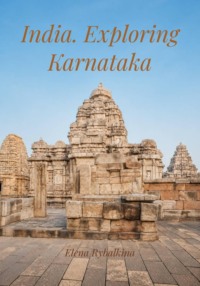
Czytaj książkę: «India. Exploring Karnataka»
Chapter 1
Preface
In recent years, people around the world, including in Russia, have been discovering yoga, and along with it, immersing themselves in mindfulness and religion. Hinduism is captivating young people, and India has become a favorite travel destination.
I was no exception and went to India in search of adventure, my true path and answers to my questions.
Over the course of three years, I visited many cities in different states of India and visited both well-known places and those that not every local resident knows about.
In this guide, I'll share with you what I consider to be the most picturesque places in the state of Karnataka, places that I believe are a must-see for all adventurers and souls yearning to embark on a spiritual path. By visiting these places, you'll experience a taste of India and fall forever in love with this ancient and sacred land.
The guidebook describes natural attractions, temples of various religions, and forts. Some of the places described may not be found in popular India guidebooks.
In writing this guide, I drew on historical facts, the stories of local and Russian-speaking guides, and, of course, my own experiences as a solo traveler, seeing everywhere, both permitted and prohibited, which allowed me to see things the average package tourist never sees. I should point out right away that this doesn't describe every sight in Karnataka, but only those I've personally visited and highly recommend.
P.S. You'll likely find typos in this book. I've decided to leave them in as a reminder that even the best travel experiences have minor imperfections.
Chapter 2
Preparing for the trip
What do you need to do to make your trip comfortable?
India differs significantly from European countries in terms of sanitary standards. Therefore, if you are concerned about contracting any infections, it is best to get vaccinated before traveling. Vaccinations are especially important against dysentery, hepatitis A and B, malaria, typhoid fever, and cholera.
Travel insurance is a must, especially if you're planning extreme activities or renting a bike. Honestly, in three years, I've never needed it thanks to a well-stocked first aid kit.
Your first aid kit should definitely contain antipyretics, painkillers, medications for intestinal disorders, adsorbents, anti-allergy medications, antiseptics, broad-spectrum antibiotics, and medications that you take on a regular basis.
In India, as in other Asian countries, it is not customary to use toilet paper, so take it with you if you want to save money and avoid wasting time searching for it in markets.
The sun in India is quite hot, so don't forget sunscreen.
Indian food is very spicy, and if your stomach isn't used to it, it's best to bring your own food—something like instant noodles. But this isn't necessary. If you do your research and don't limit yourself to the menu and ask questions of cafe and restaurant staff, you'll always find chicken broth, potatoes, and plain salad. And, of course, flatbreads.
Chapter 3
You've arrived. Where to go?
The majority of tourists arrive in India at Indira Gandhi International Airport in Delhi. Those traveling to the state of Goa, beloved since the hippie era, will arrive at Dabolim Airport or the new airport in Mopa.
After clearing customs and collecting your luggage, you'll need to obtain some local currency—rupees. The exchange rate at the airport isn't very favorable, but depending on your next destination, you may not be able to exchange currency elsewhere. Incidentally, you can also exchange rubles for rupees when departing from Moscow at Sheremetyevo Airport, Terminal C.
Where can I buy a SIM card? There are several mobile operators in India: Airtel, Idea, and Vodafone. In Karnataka's cities, SIM cards are rarely sold to tourists; it's best to arrange this at the airport. If you do decide to buy a SIM card in the city, you can buy them on the main street in Gokarna. Keep in mind the siesta period, from 1:00 PM to 4:00 PM.
Next, you need to decide how to get to the hotel. From the airport, you can take a taxi or public transportation. However, it's safer to book a transfer in advance.

1 Indira Gandhi Airport, Delhi
Chapter 4
Karnataka
India is a densely populated country, and its territory is divided into 28 states. In 2023, India's population reached 1,425,775,850.
The average package tourist begins their exploration of India with a trip through the Golden Triangle or a beach holiday in Goa. My exploration of India began in the state of Karnataka, located in southwest India.
The capital of Karnataka is Bangalore.
Karnataka is considered the cleanest state in India, but this does not negate the general rules of hygiene, such as hand washing and drinking only bottled water.
Karnataka has a subequatorial tropical monsoon climate. The rainy season begins from June to October. The best time to travel in Karnataka is from January to March.
Average temperature +27...+33.
The rainy season is best for visiting the waterfalls.
The language spoken in the state is Kannada, but almost everyone speaks English.
Chapter 5
Gokarna
Tourists most often travel to Gokarna from the state of Goa. You can get there by intercity bus from Margao. You can also take a train from Madgaon station near Margao. The bus journey takes about four hours, and the train takes two hours.
You can use taxi services.
Gokarna coordinates:14.5478586, 74.31884099999999.
There are many sacred cities in India, but Gokarna is the most sacred. According to legend, it was here that the great Hindu god of destruction, Shiva, was born from a cow's ear. The city is located on a peninsula shaped like a cow's ear, hence the name Gokarna. "Go" means "cow" and "karna" means "ear." The town's population is primarily composed of priests (Brahmins).
That's why the local population dresses in white or orange. Religious ceremonies held in Gokarna are believed to have special powers. Gokarna is a Hindu pilgrimage site. It is here in the waters
They perform ablutions in the Arabian Sea.
The city's main temple is Mahabaleshwar, where Hindus gather to worship the Shivalinga, which is over a million years old.
Foreigners are not allowed into this temple, but you can enter the grounds. A sacred white humped bull the size of an elephant lives at the entrance.
Several other temples are worthy of tourist attention: the Ganesha temple, the Naga (snake) temple, where they pray for the birth of children.
Hidden among the narrow streets of Gokarna lies the sacred lake of Koti Tirtha, believed to be filled with water from the Ganges. Brahmins perform ablutions here; it is believed that all sins are washed away.
The lake is deep, and a sign warns of this, stating that people drown here every year. There's also a sign warning of the presence of crocodiles. I didn't see one, and during our walk around the lake's perimeter, the crocodiles didn't eat a single Brahmin bathing. The remains of deceased relatives are also immersed in the tirtha after cremation.
Sacred places aren't just temples. In Gokarna, the "Ear of Shiva" cave is worth visiting.
The path to the cave from Main Beach is uphill, so it's best to bring plenty of water. Be careful along the way, as the entrance to the cave leads through bushes and it's easy to miss the sign.
The "Shiva's Ear" cave is as sacred as Gokarna itself, so it's never deserted. It's said that even at night, some people come here to spend the night. The cave is the very place where Shiva was born from that very same cow's ear.

The cave entrance is low and narrow, so we had to let some Hindus exit to enter. A small round opening above illuminates the cave with natural light.
Inside the cave there are some not very pleasant representatives of the fauna, namely huge cockroaches.
Coordinates:14°32'52.3" N 74°19'07.8" E

2 Gokarna. Automobile Street
Chapter 6
Murdeshwar
What's hidden inside the world's tallest Shiva statue?
The town with the strange name of Murdeshwar attracts visitors with its unique landmark – a temple complex containing the second largest statue of Shiva in the world.
A trip to Murdeshwar can be combined with a trip to Gokarna.
How to get there: You can get to Murdeshwar from Goa by train (it takes 3 hours 20 minutes) or by taxi.
Coordinates:14.094804, 74.488564.
You definitely won't get lost in Murdeshwar. The four-armed Shiva statue will gaze at you from every angle. To say the statue is large is an understatement. Its size amazes you long before you even approach it. Standing beneath its might, you feel dwarfed. This gigantic statue stands 37 meters tall.
Entrance is strictly barefoot, descending the scorching stone steps. Inside the statue is a cave museum dedicated to the Indian epic.
The life-size wax figures in the museum tell the ancient legend of the magical Atma Lingam, which the ten-headed king Ravana coveted after gaining Shiva's trust. As usual, legends must have a happy ending, so the stone was saved, but the evil king threw it to the ground in the town of Gokarna. The stone split into three pieces, and cities were formed where the fragments fell. One of them is Murdeshwar.
By the way, the Shiva statue's facial expression changes in different lighting. Take a closer look.
Around the statue of Shiva, you can see a beautiful park and huge sculptures of the sacred bull Nandi, a chariot with the gods Arjuna and Krishna, and a huge golden sun symbolizing the god, Surya.
Descending the steps, you'll find yourself at an equally significant and majestic site—the gopuram, the gate tower. Like the statue, the gopuram is the tallest, standing 75 meters high. Inside, the tower is equipped with elevators that take you to the very top, to the observation deck. The views from the top are worth the fifteen rupees entrance fee.
Once you go down, you can take your time and examine the life-size elephants standing at the entrance.
In a city located on the coast, it's impossible to miss the beach. Hundreds of boats are moored on one side of the shore. The city's residents primarily engage in fishing. The other part of the coast is a beach area, where Indians conduct a brisk trade no less eloquent than at the once-famous Cherkizon. This is the dirtiest part of the coast.
Hindus used to use banana leaves instead of plates for food, throwing them away afterward. These centuries-old traditions have become embedded in modern life, and now Hindus habitually throw anything that can't be consumed on the ground.
You can have lunch at the Naveen Beach Restaurant, which is located on the opposite side of the Gopuram on the coast.

3 Murdeshwar
Chapter 7
The Lost Kingdom of the Jains
Pepper Queen Chennabhairadevi not only built the Mirjan fort and ran a successful spice trade, but also professed Jainism, building many Jain basadis in Karnataka.
My curiosity and thirst for adventure left me no choice but to set out in search of the lost kingdom of the Jains. All that remains of the kingdom are ancient basadis and various artifacts dug up from the depths of the earth.
The entrance to the Chaturmukha Basadi isn't always open, and access is always left to the mercy of the universe. I was lucky: the temple doors were open. Nothing remains of the Jain kingdom after seven centuries. All that remains are the Basadi temple, a well, and a couple of outbuildings where archaeologists store discovered artifacts.
Chaturmukha translates as "four-faced," hence the temple's perfectly symmetrical structure and four entrances facing the Garbhagriha. The Garbhagriha features four free-standing sculptures of Tirthankaras, facing the four exits. The Tirthankaras symbolize the all-encompassing knowledge of the cosmos.
What is surprising is that the temple is built from carved granite rocks without any binding material - just stone on stone.
The Jains who lived here preached non-harm to any living creature. They observed strict asceticism: their elders died by abstaining from food. To avoid accidentally swallowing a fly, Jains wear face coverings. They walk the streets with a broom to avoid crushing any living creatures. A kind of ancient Greenpeace.
You can get to the temple from the town of Karkala by car or taxi.
Coordinates:14°13′43.4″N 74°39′53″E / 14.228722°N 74.66472°E / 14.228722; 74.66472

4 Chaturmukha basadi main entrance

5 Chaturmukha basadi from the end
Darmowy fragment się skończył.