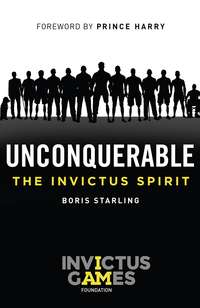
Czytaj książkę: «Unconquerable: The Invictus Spirit»

COPYRIGHT

HarperCollinsPublishers
1 London Bridge Street
London SE1 9GF
www.harpercollins.co.uk
First published by HarperCollinsPublishers 2017
FIRST EDITION
© Boris Starling 2017
Cover layout design by Claire Ward © HarperCollinsPublishers Ltd 2017
Cover photograph © Daily Mail 2014 (main image), © Shutterstock (wheelchair figure)
Plate-section photographs courtesy of the competitors, except where indicated
Boris Starling asserts the moral right to be identified as the author of this work
While every effort has been made to trace the owners of copyright material reproduced herein and secure permissions, the publishers would like to apologise for any omissions and will be pleased to incorporate missing acknowledgements in any future edition of this book.
A catalogue record of this book is available from the British Library
All rights reserved under International and Pan-American Copyright Conventions. By payment of the required fees, you have been granted the nonexclusive, non-transferable right to access and read the text of this e-book on screen. No part of this text may be reproduced, transmitted, downloaded, decompiled, reverse engineered, or stored in or introduced into any information storage retrieval system, in any form or by any means, whether electronic or mechanical, now known or hereinafter invented, without the express written permission of HarperCollins e-books.
Find out about HarperCollins and the environment at
www.harpercollins.co.uk/green
Source ISBN: 9780008240080
Ebook Edition © September 2017 ISBN: 9780008240103
Version: 2017-08-07
DEDICATION
For those who competed in London and Orlando, for those who are competing in Toronto, and for those who will compete in Sydney and beyond. You are an inspiration, each and every one of you. You are unconquered.
CONTENTS
Cover
Title Page
Copyright
Dedication
About the Invictus Games
Foreword by Prince Harry
Introduction
Acknowledgements
Invictus
Prologue: The Night Which Covers Me
1 Find Me Unafraid
2 This Place of Wrath and Tears
3 Bloody but Unbowed
4 How Charged with Punishments the Scroll
5 The Fell Clutch of Circumstance
6 Not Winced Nor Cried Aloud
7 My Unconquerable Soul
8 The Master of My Fate
Epilogue: The Captain of My Soul
Picture Section
About the Publisher
ABOUT THE INVICTUS GAMES
The Invictus Games are an international multisport event for WIS (wounded, injured and sick) Armed Services personnel and veterans. The Games use the power of sport to inspire recovery, support rehabilitation and increase awareness of the sacrifices made by those who serve.
The first Invictus Games took place in London on 10–14 September 2014. Thirteen nations were represented and 413 competitors took part: Afghanistan, Australia, Canada, Denmark, Estonia, France, Georgia, Germany, Italy, Netherlands, New Zealand, the United Kingdom and the United States. Competitions took place across nine adaptive sports: archery, athletics, indoor rowing, powerlifting, road cycling, sitting volleyball, swimming, wheelchair basketball and wheelchair rugby. The Presenting Partner, Jaguar Land Rover, also offered a driving challenge.
The inaugural Invictus Games have created the blueprint for inspiring many more ‘wounded warriors’ on their journey of recovery, and the success of the Games prompted the organisers to stage a follow-up. They know that hundreds more wounded warriors around the world could benefit from taking part in the Invictus Games. So they established the Invictus Games Foundation to develop and pursue the Invictus Games legacy and continue to make a difference to the lives of wounded, injured and sick Service personnel around the world.
There was not enough time to get one up and running in 2015, so the second Invictus Games took place in Orlando, Florida, on 8–12 May 2016. All the nations from 2014 participated again, plus Jordan. Wheelchair tennis was added to the roster of sports. Altogether 485 competitors took part.
The third Invictus Games are taking place in Toronto on 23–30 September 2017. Romania and Ukraine are competing for the first time, and golf has been added to the list of sports. More than 550 competitors are taking part.
The fourth Invictus Games will take place in Sydney on 20–27 October 2018.
FOREWORD BY PRINCE HARRY
This book gives an insight into the lives of servicemen and women who have been wounded or faced life-changing illness in the Armed Forces: what goes through their minds at the moment of injury; the effect this event has on their family and friends; the long and often painful road to recovery; where they find the strength and courage to keep fighting; and how they embrace a life that they had never imagined.
The stories of the men and women in this book are some of the most inspiring examples of courage and determination you will read anywhere. Not because they are superhuman; in fact, quite the opposite – they are normal people who have fought hard to overcome seemingly insurmountable challenges and come back stronger! I am extremely grateful to them for sharing their experiences so honestly. I am also delighted that they have been given this opportunity to tell their stories and, in doing so, inspire millions of people around the world by their example.
It is important to remember that this book highlights just a handful of stories from Invictus Games competitors who have experienced life-altering events. There are hundreds of other servicemen and women who showcase their Invictus spirit every day by overcoming injury and illness, reminding us what grit, determination, defiance and the will to succeed really mean.
This book recognises the amazing example set by our servicemen and women, their contribution to society and ultimately the sacrifices they are prepared to make for their country.
We can all draw strength from these breathtaking stories. The men and women who feature in this book, and the many others like them around the world, are a constant reminder that it is possible to overcome adversity, and that the impossible is possible if you have the will.
I am proud that the Invictus Games continue to change lives every day and am confident that you will be as moved and inspired by these stories as I have been.
Prince Harry
INTRODUCTION
When I started Unconquerable, my thinking was guided by two lines of belief. First, that the Invictus Games would be like the Olympics or Paralympics, where the medal table is both pride and curse and where lip service is paid to the importance of taking part while all the attention goes to those standing on the podium. Second, that there’d be a definite hierarchy within the WIS network. The wounded, those who’d lost limbs in battle, would, in a perverse way, be the glamour squad, the ones who’d suffered the most and whose very appearance would be a constant reminder of the sacrifices they’d made. Behind them would come the injured, and bringing up the rear would be the sick, because everybody gets sick now and then, don’t they?
I could hardly have been more wrong on both counts if I’d tried.
When you watch the Olympics and Paralympics, most of the pleasure you get is from watching people who are the very best in the world at what they do. Their backstories are usually irrelevant, though not always – the impact of, for instance, the German weightlifter Matthias Steiner’s gold medal at Beijing in 2008 is magnified severalfold when you know that his wife, Susann, had been killed in a car crash the year before and he’d promised her as she lay dying that he’d become champion in her memory.
Olympians and Paralympians dedicate their lives to those few minutes every four years, and are judged on the order in which they finish. Those who compete in the Invictus Games are very different. Who wins which medal is almost irrelevant. It’s not the finish line which counts, it’s the start line. Even to get to that start line after what these people have been through is a triumph in itself, a triumph made sweeter by the demands and joys of competition – the camaraderie, the challenge, the banter, the exploration of one’s limits.
And because everyone who competes has gone through some version of hell to get there, there is no comparing or grading of afflictions. More than one triple amputee told me that, yes, what they’d been through was horrific and, yes, day-to-day living could be very tricky, but there was also an acceptance of their situation and a determination to make the best of it. Their limbs weren’t going to grow back, but nor were they going to deteriorate still further. The worst had come and gone. Crack on.
Compare that to those undergoing prolonged cancer treatment or suffering the excruciating debilitations of post-traumatic stress disorder (PTSD). Less visible ailments, sure, but no less serious for that: in some ways more serious, with the uncertainty of what might happen in the future and the fluctuations in how they feel not just week to week but day to day and sometimes even hour to hour.
I didn’t know any of this at the start, but I learned pretty fast. I already knew that watching world-class athletes achieve greatness was inspiring. Now I learned that watching wounded warriors achieve greatness was more than inspiring. It was life-changing.
As a writer, you do some projects for love and some for money. Now and then, though very seldom, you get to work on something which is an absolute privilege. Writing Unconquerable was one of those rare, precious things. Every day I felt humbled by the extraordinary stories I was hearing and awestruck at the astonishing resilience of the human spirit.
I hope that when you read this book you see why.
Boris Starling, May 2017
ACKNOWLEDGEMENTS
Thank you to all those without whom this book could not have happened.
Those competitors who gave up their time over coffee, beer, Skype or e-mail to talk to me with such unflinching candour: Amy Baynes, Josh Boggi, Darlene Brown, Bart Couprie, Kai Cziesla, Seb David, Christine Gauthier, Mike Goody, Maurice Manuel, Stephan Moreau, Sarah Rudder, Maurillia Simpson, Fabio Tomasulo, Phil Thompson, Zoe Williams, Mary Wilson and Rahmon Zondervan.
The wonderful Cake Lady, Kath Ryan, for telling me her own unique story.
Sara Trott, for her insight into what life is like for friends and families.
At the Invictus Games Foundation, Dominic Reid, Julie Burley and Mickey Richards.
The staff of the Defence Medical Rehabilitation Centre at Headley Court, particularly Peter Haslam, Lt Col Rhodri Phillip, Kate Sherman, Mark Thoburn and Lt Col Gareth Thomas.
Hannah Lawton of the GB Rowing Team Paralympic Programme and all the other coaches and hopefuls at the Bath University training weekend, who tolerated me asking them questions when they had better things to do.
At HarperCollins, Liz Dawson for suggesting me for this project, Oliver Malcolm for agreeing with her, Emily Arbis for pulling everything together, and Simon Gerratt and Jane Donovan for eagle-eyed copy-editing.
At Caskie Mushens, Juliet Mushens and Nathalie Hallam.
At Kensington Palace, Kat McKeever and of course Prince Harry, whose passion for and eloquence about the Invictus Games cause comes from the heart and is awe-inspiring.
My parents, David and Judy Starling, and my in-laws, Jenie and Jeremy Wyatt.
And as always, my wife, Charlotte, and our children, Florence and Linus, the three captains of my soul.
INVICTUS
Out of the night which covers me,
Black as the pit from pole to pole,
I thank whatever gods may be
For my unconquerable soul.
In the fell clutch of circumstance
I have not winced nor cried aloud.
Under the bludgeoning of chance
My head is bloody, but unbowed.
Beyond this place of wrath and tears
Looms but the horror of the shade,
And yet the menace of the years
Finds, and shall find me, unafraid.
It matters not how strait the gate,
How charged with punishments the scroll,
I am the master of my fate:
I am the captain of my soul.
William Ernest Henley, 1875
PROLOGUE
THE NIGHT WHICH COVERS ME
1 March 2008
Five miles above the earth, the night inky-black outside, the young officer bit down hard on his anger.
The transport plane was full of blokes going home: tired, happy, relieved to have survived their tours in Afghanistan pretty much unscathed, at least on the outside. The officer wasn’t part of these men: he was a Second Lieutenant in the Household Cavalry and his men were still out in Afghanistan. He was going home not because he wanted to but because he’d been ordered to, and he wasn’t at all happy about it. He’d been in Afghanistan for 10 weeks and his tour was supposed to be 14. Ten weeks was easily long enough to get a campaign medal, but he didn’t much care about that: he cared about being with his men until the end.
He’d loved it out in Afghanistan. For the first time in his life he’d been treated as a normal bloke rather than anyone special. He’d trained hard and done his job well: patrolling the deserted bombed-out streets of Garmsir, southern Helmand Province, defending his position from Taliban mortar and machine-gun attacks, and calling in airstrikes on enemy positions. To the pilots who dropped 500lb bombs on the co-ordinates he gave them he was just ‘Widow Six Seven’, his callsign – they didn’t know his real name and they wouldn’t have cared if they had. It was the people back home who cared, not the men in theatre. He’d slept alongside those men in Hesco wire-mesh gabion bunkers and used the rounded ends of missile cases as shaving bowls with them. He was a good soldier and a good man – that was all that mattered to them.
There was only really one thing the officer hadn’t seen, and that was death or serious injury. Sure, he’d called in many medical evacuations for soldiers who’d been blown up by improvised explosive devices (IEDs) or shot in contact with Taliban fighters. Sometimes he’d said ‘op vampire’ when the casualty needed a lot of blood, and that always sent shivers down his spine. He’d lain in bed late at night and felt the place shaking from the downforce of a Chinook or a Black Hawk carrying the wounded, but he’d never seen someone killed or maimed.
Here, now, on the transport plane high above the Black Sea, he saw it.
The plane had been late leaving Kandahar Airfield because it had to wait for the coffin of a Danish soldier. Morten Krogh Jensen, just 21, had only been in Afghanistan three weeks. He’d been one of those people whom everyone had naturally liked: in a no-holds-barred team review of each soldier’s performance, Krogh had been the only one with nothing negative said about him whatsoever. Now his body was being repatriated to the seaside town of Frederikssund, where he’d helped his friends paint the hulls of boats in the harbour, where he’d convened groups to head for techno concerts in nearby Copenhagen, and where his family waited with an unfathomable hole in their lives.
Krogh’s coffin was kept out of sight, as were three British soldiers who’d been seriously wounded and were being taken back to Britain’s premier military hospital at Selly Oak in Birmingham. These soldiers were behind a curtain at the front of the plane, yet now and then the curtain blew open slightly and the young officer could see them. They were in a bad way: wrapped up in what looked like clingfilm and with bandages round the stumps of missing limbs. One of them was clutching a tiny bottle full of shrapnel removed from his skull. They were all in induced comas.
The young officer saw all this, as raw and visceral a face of war as could be. Too raw and visceral to be shown on the news, too raw and visceral for a public who didn’t, couldn’t, know the true cost of conflict unless they knew this. He hadn’t prepared himself, and the sight shocked and rattled him somewhere deep within himself. It certainly put his own frustrations into perspective.
The transport plane made its relentless way north-west, over the sleeping cities of Europe through which so much history had marched. It was daylight when the plane landed at Birmingham to unload the three wounded men, and mid-morning by the time it made the short hop back to RAF Brize Norton, where most people were disembarking. The young officer was 41st off the plane. No special treatment.
No special treatment, that was, until his feet stepped onto the tarmac. He may have been 41st off the plane, but he was still third in line to the throne, and numbers one and two were waiting for him. In Afghanistan he had been Second Lieutenant Wales. Now he was Prince Harry again.
He’d been pulled out for his own safety after details of his presence in Afghanistan had been made public. Once the news was out it was out, and so too was Harry.
He drove back to Windsor with his father, Prince Charles, and his brother, Prince William. The English countryside rolled past the windows, so much gentler and greener than the harsh browns of Afghanistan.
He thought about the men he’d seen behind that curtain. He wondered what he could do for them. There had to be something. But what? He had questions but no answers; he had a problem with no solution. But at least he was asking those questions. At least he recognised there was a problem.
Neither Prince Harry nor anyone else knew it at the time, but he had sown the first seeds of what would eventually blossom into the Invictus Games.
COMPETITOR PROFILE:
MAURICE MANUEL, DENMARK
Maurice Manuel speaks perfect English. That in itself isn’t unusual for a Dane, but in Maurice’s case his fluency comes from more than just education. His father was American – a Vietnam vet who did two tours of duty in that most agonising of wars and then decided to stay in Germany.
‘He was told it was a better life there than it would have been for a black army veteran back home at the time.’ A conflict which was becoming polarisingly unpopular and with the civil rights movement at its most fractious: whoever gave Manuel Snr that advice was probably spot on. So stay in Germany he did. He became a radiologist and married Maurice’s mother, a Danish lady.
The lure of the military burned strongly in Maurice, even though in Denmark soldiers weren’t so revered as they are in the United States or respected as much as they are in the United Kingdom. The majority of Danes opposed intervention in both Iraq and Afghanistan right from the start. When Maurice went out to serve in the Middle East, therefore, he knew he was doing so for a country at best ambivalent about his presence there.
Maurice did two tours in Iraq and four in Afghanistan. He was a military policeman for all but the last one, for which he studied Pashto, the official language of Afghanistan, so he could become a combat interpreter and help liaise between the Western forces and the Afghan National Army.
It was 14 December 2010 when his life changed. He doesn’t need to look the date up, he remembers it as easily as he would his own birthday.
‘It was a completely normal patrol. We were down there before sunrise, and I was in charge of the sound commander.’ A sound commander is, more technically, a ‘wide area mass notification system’: it can broadcast messages to be heard far away, and the operator can also programme in sound effects such as suppressive gunfire and helicopter rotors to give the impression of a larger military presence than actually existed.
‘I left it somewhere while we continued the patrol. When we’d finished, I went to get it. I saw it down the end of a path. I’d not gone 20 metres when I thought: “I don’t think this path’s been swept [for IEDs].” And that second, that very second, I stepped on one. There was dust everywhere. I was thrown backwards, I looked down, and I saw the bottom of my right fibia sticking out of my boot. I grabbed a tourniquet and wrapped it round my thigh as hard as I could.’
Some of his colleagues were a kilometre and a half away when the IED went off, and even at that distance they heard not just the explosion but Maurice’s shout of pain too. Not only did they have to go back and get him, but then take him out another 2km on a stretcher, as the Merlin medevac helicopter wouldn’t come in closer than that during a TIC (troops in contact) situation for fear that it too would be a target for attack.
The next seven or eight hours of Maurice’s life are just fragmentary memories through a haze of shock, morphine and ‘whatever heavier they gave me’. Now and then he woke for a few seconds to see lights in an operating theatre or surgeons leaning over him, the next moment he was out cold again. They kept him in Bastion for three days before flying him home the scenic route – Qatar, Germany, the UK and finally Denmark, where the surgeon told him he’d never be able to run again and he’d have to wear corrective shoes.
‘Let’s amputate,’ Maurice said.
But the surgeon refused. He thought it would be better to keep everything intact if possible. Reluctantly, Maurice agreed, and spent the next nine months in rehab, trying to build the damaged leg back up to some kind of strength again – ‘It was a fiasco from the get-go.’
Maurice did his research: he found medical papers online, he talked to a couple of US Rangers who’d sustained similar injuries. Then he went back to the surgeon and told him they’d tried rehab, it hadn’t worked, and now he was insisting on what he’d asked for at the start: he wanted to be a below-the-knee amputee. This time the surgeon had little choice but to agree.
‘I had the chop on 15 August 2011.’ Another date he doesn’t need to look up. ‘Three weeks later I was up and walking on a prosthetic. Two months after that I was running.’
The invitation to the 2014 Invictus Games came through the Soldier Project at the Danish Handicap Association, and Maurice didn’t need asking twice. He’d been a keen sprinter and basketballer before his injury, so he signed up for track and field, wheelchair basketball (where he was made captain and coach) and wheelchair rugby too.
It was a busy schedule for anyone, and made more so by the fact that one of his family members was unwell and he had to spend a lot of time caring for them. If it stressed him, he never let it show. He competed in the best traditions of both soldier and sportsman: no quarter asked nor given on the field of play, but generous in his praise and commiserations once the final whistle had been blown or the finish line crossed.
He won a silver in the javelin and three bronzes, in the 200m Men Ambulant IT1, the wheelchair basketball and the wheelchair rugby. But a greater prize than any of those was waiting. The organising committee saw his contribution on and off the field, saw his determination and integrity, and gave him the Land Rover Unconquerable Soul Award. Out of more than 400 competitors, Maurice had been deemed the one who most embodied the Invictus spirit.
He smiles when I remind him of this. ‘It was an honour beyond measure. Words can’t express how special that was. It still gives me goosebumps, even thinking about it.’ As for Prince Harry, ‘I can’t tell you how important it is that a person like him does this. He’s a prince, sure, but he’s an ordinary guy too. Thousands of people are so grateful to him.’
Two years later Maurice was back in Invictus Games action, this time in Orlando, Florida. This time he captained the wheelchair basketball team to victory over the Netherlands in the bronze medal match, and then went one better in wheelchair rugby with silver, losing to the USA in the final – much to the relief of then Vice President Joe Biden, whose pre-match pep talk to the American team had been along the lines of ‘I have to meet the Danish Prime Minister next week and I don’t want to have to wear an awkward smile’.
Five medals from two Games, then, but no golds. Not that Maurice minds. ‘It’s been an honour and a privilege to be here,’ he said after the wheelchair rugby final in Orlando. ‘Words can’t describe what it means. This is for physical disabilities and PTSD [post-traumatic stress disorder], it’s for proving to the world and ourselves that we can. Every single athlete here has risen to the occasion, there’s no doubt about that.’
None more so than Maurice, the Unconquerable Soul himself. He now plays professional wheelchair basketball in Florida for the Fort Lauderdale Sharks while studying for a Bachelor’s in Crisis Management at Everglades University. He does more with one leg than most people do with two. ‘If you can think it, you can do it,’ he says simply.
Before we end the Skype call, I tell him I have one more question. ‘Shoot,’ he says.
OK. On the ARSSE (Army Rumour Service) website, there’s quite a lot of chat from female contributors about how he’s so ‘easy on the eye’ and how they needed ‘a lie down after seeing him on the basketball court’. What does he think about being an Invictus Games sex symbol?
He throws back his head in laughter, flashing the whitest pair of teeth I’ve seen in a long while. ‘Get outta here!’
1
FIND ME UNAFRAID
The English market town of Salisbury can be a bleak place on a winter’s day. Four o’clock in the afternoon, the market traders are packing away whatever they’ve failed to sell beneath awnings flapping in the wind, people are hurrying from one place to another, coats zipped up to their necks and hands thrust deep in pockets. It doesn’t look like a place with one of the UK’s most important cathedrals, let alone somewhere so intimately connected with the world-famous Stonehenge, just up the road.
Josh Boggi has just returned from training in Mallorca. On such a grey day, and with the queue for the dentist so long he decided to abandon it altogether, he must be tempted to turn round and go straight back to the Balearics. We sit by the window of a coffee shop and he tells me his story.
His surname – soft ‘g’, to rhyme with ‘dodgy’, ‘podgy’ or ‘stodgy’, three adjectives which could hardly be less applicable to a man so decent, so fit and so dynamic – is Italian. His grandfather came over from Tuscany after World War Two with his siblings: seven brothers and one sister. They all opened restaurants in the East End of London, which in itself sounds like the pitch for a comedy film or family drama. Josh’s father served in the Royal Engineers for more than a decade, and for as long as he can remember Josh wanted to follow in his dad’s footsteps and become a sapper (a combat engineer who, among other things, lays roads, builds bridges and clears mines).
In January 2004, aged just 17, he signed up and underwent basic training – phase 1, general training, to a base level of military competence, and phase 2, specific training for the Engineers themselves. He was then selected for 9 Parachute Squadron, an airborne detachment of the corps with a history so long and distinguished that you can chart much of Britain’s wartime and post-war military history through its service records: the Dunkirk evacuations in 1940, the 1944 defence of the bridge at Arnhem, clearing the King David Hotel in Jerusalem after the 1946 Irgun bomb attack, the Falklands in 1982, rebuilding Rwandan infrastructure after the 1994 genocide, Bosnia and Kosovo in the 1990s, and of course three decades of the Troubles in Northern Ireland.
It was a history of which Josh was well aware. ‘The minute you put the uniform on you feel proud. Grown-up.’ He loved the British Army and everything it offered him. He’d always been a sporty kid, particularly keen on football (‘I was a goalie. All the nutters play there’) and ice hockey, the latter a craze sparked by seeing the Mighty Ducks movies. Now he could not only indulge his passion for sports and adrenalin but get paid for it too.
Every soldier who joins up itches for real combat, and there was plenty around for Josh. All British operations in Afghanistan went under the codename ‘Operation Herrick’, with each new order of battle receiving its own ordinal. Josh was first deployed as part of Herrick IV in 2006.
For six weeks nothing much happened. Then it all kicked off.
The 9 Squadron were sent in to Musa Qala, a dusty town in Helmand Province, to assist the Pathfinder platoon stationed there. The soldiers controlled a central compound of low cement and mud buildings surrounded by a 10ft wall, and a 10ft wall was nothing when the compound was surrounded by a maze of rubble-strewn buildings. Paradise for the Taliban militants using those buildings as cover and a nightmare for the men inside the compound, knowing they could be attacked from any direction and at any time.
Which is exactly what happened.
‘I was 19 years old,’ says Josh. ‘The moment the first bullet flew past my ear, it was like, “shit just got real”.’ Every time the British troops dropped one militant, another two would pop up. It was like a nightmare pitched at the exact intersection of the Alamo, Rorke’s Drift, a spaghetti western and a video game. The Pathfinders had been in Musa Qala some weeks already and were exhausted and jumpy, particularly at twilight – ‘the witching hour’, they called it – when they most expected the attacks to start again. They were running low on food, water and ammo, and they had no more batteries for their night vision devices. They needed resupply, but any kind of air support was out of the question: it was too easy for the Taliban to shoot down any helicopter which came near, and they’d all seen Black Hawk Down.
There was only one thing for it: a forced relief ground mission. A Danish squadron was on its way from Bastion, but it wasn’t as if the Taliban were going to wave them through with open arms. Josh’s men were tasked with clearing a way for the Danes, come hell or high water. It’s 60 miles from Bastion to Musa Qala, but it took 9 Squadron and the Danes five days to make the journey, and even then it needed fixed bayonet fighting and six 1,000lb bombs on Taliban positions before they could break into the compound itself.
Hell of an introduction to war.
It was Josh’s first tour of Afghanistan, but it wouldn’t be his last. He went on Herrick VIII in 2008 and again on Herrick XIII in 2010, when he was deployed to Forward Operating Base (FOB) Khar Nikah. On the last day of the year, New Year’s Eve, Josh was second-in-command of a search team sent out to clear a suspected Taliban compound. It was a patrol which, if not exactly routine, was hardly uncommon: get out, perform the task, get back in again. Simple enough.
But for Josh it all felt off, right from the start. Not by much – more a sense that the world had slightly tilted on its axis, that things were slightly out of alignment – but not by much was quite enough when it came to a place like Khar Nikah and the narrow margins between safety and danger, between life and death.
They went out of a different gate than usual.
Narrow margins.
The muezzin was calling the faithful to prayer at sunrise as always, but for once the ululations sounded menacing and ominous, sending a slow cold sweat crawling down Josh’s spine.
Narrow margins.
Josh concentrated on the basics. Tread in the footsteps of the bloke in front of you. Keep your distance. Keep your eyes open. Keep looking. Never get complacent, not for a second. A second is all it takes. No one on Herrick XIII underestimated the Taliban. They were very good fighters (certainly those blokes who’d served in Iraq as well rated them far more highly than the Iraqi insurgents), their predecessors had seen off everyone from the Soviet Army back through the British in Victorian times and beyond, and they could rely not just on each other but also on what the Westerners called ‘Tier Two’ – those who weren’t proper Taliban but helped them out with supplies, cover and so on.
The 9 Squadron liked to Grand National rather than mousehole: that is, they preferred to climb over walls rather than blast their way through them. Grand Nationalling was quicker, saved materiel and was less likely to advertise their presence. The problem with Grand Nationalling was that if the Taliban saw you doing it they’d shoot, and it was hard to shoot back when scrambling over a wall. So this time Josh’s men went the explosive route: two half-bar mines and in through the breach point. Each time they marked the safe area, where they’d swept for mines, with white lines either side.
Narrow margins.
Mine, prime, breach … Mine, prime, breach … Watch the white lines.
The day slightly off; that strange sense of foreboding.
Josh took a step to the side … Just one.
One was quite enough.
A beautiful cloudless day in the Golden State, warm enough for Sarah Rudder to be sitting outside by the pool even though it’s not yet mid-morning. An all-American scene for an all-American girl, even one who grew up a long way from California: in the northern English town of Chorley, Lancashire, to be precise, where she played for Chorley Ladies’ premier league soccer team and was top scorer for three seasons running. The Mia Hamm of Chorley? She laughs. ‘Exactly that!’
But her heart was always in America, and from the age of 12 even more specifically set on the US Marine Corps. She’d seen them performing a silent drill, a dizzyingly slick routine of weapon handling, spinning and tossing performed without a word – the weapons in question being rifles with fixed bayonets, which provide obvious incentives not to mess up the catches. What captivated young Sarah was not just the beauty of such split-second timing but everything that came with it: the endless practice to make perfect, the discipline and confidence to execute it so flawlessly when it mattered, the absolute trust you had to have in your comrades and they in you.
She enlisted in the Marines as soon as she was legally able, in 2000 at the age of 17. But it wasn’t plain sailing. She twisted an ankle so badly that she needed surgery, and on the way to hospital in Maryland for a post-operative check-up she was involved in a car crash which left her with a broken nose, ribs and scapula. But Marines are made of stern stuff, and Sarah was no exception. She was back in training as quickly as possible, and within a year was promoted from Private First Class to Lance Corporal.
Her promotion ceremony took place on a day as piercingly blue and bright as the one on which she’s telling me her story: a late summer’s day in Arlington County, at Marine Corps HQ, just opposite the Pentagon, 18-year-old Sarah, smart and proud in her dress uniform, her entire career ahead of her and the world at her feet. Friends and families in the audience, glowing as they choked back happy tears of pride.
An all-American day for the all-American girl.
A sudden roar so close and loud it made everyone jump. They were military people and they knew – they thought they knew – what that sound was: a ceremonial fly-by, a fighter jet opening up its throttles to make pure thunder. But fly-bys don’t tend to take place in the nation’s capital on a Tuesday morning.
A silver streak past their vision, an impact which shook their building like an earthquake, and then a fireball climbing high and fast in roiling clouds of orange and black. All in a matter of seconds before anyone knew what was happening.
It was 9.37 a.m. on 11 September 2001, and American Airlines 77 had just crashed into the Pentagon.
Newly promoted Lance Corporal Rudder and her colleagues swung into action. They sprinted across to the Pentagon and began performing basic triage on the injured: the walking wounded they sent to base corpsmen, the more serious they loaded onto tarp stretchers for the paramedics to take to hospital. Then they began to help the firefighters any and every way they could: bottled water for when they came out of the inferno gasping with thirst, new socks to replace the sweat-soaked ones inside their heavy boots.
Sarah did 12 hours’ duty at the Pentagon, another 12 on patrol at Marine HQ, and then back to the Pentagon, where she had to pick her way through the mountains of flags and flowers left there. Running on adrenalin, she didn’t sleep for three days straight. On the second day, when the building had been declared safe – or safe enough – she and her best friend, Ashley, joined the search and rescue team. They donned hazmat protective body suits and went inside, to the hideous twisted ruins, where the 757 had hit at a speed of more than 500mph. Their official mission was to locate and bring out ‘non-survivors’, a deliberately anodyne term which scarcely hints at the horrific sights Sarah and Ashley saw in there.
More than a decade and a half later, the California sun is not warm enough to keep her from shuddering as she remembers. ‘The smell. Urgh! God, that smell … The smell of death. We had to sleep with the windows and doors open to try and get rid of it. The clothes we were wearing, we burned them, but it didn’t do any good. The smell was still there in our skin.’
Even though her scapula was still healing, she’d taken her sling off – she couldn’t do any lifting with it on. She and Ashley loaded corpse after corpse onto stretchers and brought them out: these people had families, and Sarah wanted them to have someone to bury. She lost count of how many bodies they handled. While walking backwards with one of them, Sarah got her left ankle stuck in a concrete barrier, which then fell and crushed it. Somehow she worked herself free, and was glad to find the damage didn’t seem too bad. It wasn’t hurting too much, and nor was her scapula.
That night, back at Marine HQ, her foot was so swollen that she couldn’t get her boot off. And now the adrenalin was subsiding, her ankle was hurting, hurting really badly. Her scapula didn’t feel too flash either, but her ankle was worse. It would get better, though. Wouldn’t it?
It wouldn’t. And it wouldn’t be the end of her problems either. For Sarah Rudder, as for so many of her fellow countrymen in one way and another, 9/11 wasn’t an end to anything. It was just the beginning.
Stephan Moreau joined the Canadian Navy because of a drunken bet.
Well, in a manner of speaking. He’d been out with some friends in a bar and, after a few drinks, told them that he wanted to serve his country and was going to the recruiting centre first thing the next morning. They laughed it off at the time and probably didn’t even remember it the next morning. But Stephan did.
He wasn’t one of those guys who’d always wanted to be in the military, the kind who left high school one day and joined up the next. He was 27 when he walked into the recruiting centre that morning in 2000: old enough to have done things with his life he knew now weren’t for him, old enough to know what he really wanted.
He’d been brought up in Quebec City as the only child of a single mother, and sometimes the absence of a father grated – ‘My mom did a great job, but something was missing. She was working so much that I had to learn to be independent and deal with my own problems. My character was definitely shaped by having to look after myself.’
It was shaped by sports, too. Stephan enjoyed baseball and athletics, but like so many Canadian kids, his real passion was hockey. ‘It was hockey all the time. Outside rink in the winter after school and road hockey in the summer. I was shorter than most of the guys, but my speed and my feistiness made up for it.’
His hero, Calgary Flames winger Theoren ‘Theo’ Fleury, was cut from the same mould. At only 5’6” Fleury had been told repeatedly that he was too small for the big time, but his determination meant he ended up playing more than 1,000 games in the National Hockey League.
What job would allow Stephan to keep up his sport? Stephan’s uncle had been in the Air Force, and ‘he told me that 50 per cent of the time he was playing sports there! The military training was easy, especially boot camp. I was fit and I already had the discipline from playing hockey.’
He moved pretty much all the way across the country, from Quebec City in the east to Victoria in the west, and was stationed at CFB Esquimalt, Canada’s main Pacific Coast naval base. It was a great place to live: right by the ocean, where he had always found his peace.
He served as Leading Seaman and Naval Communicator on the HMCS Algonquin, a destroyer which had been built in 1973, the year of Stephan’s birth. The Canadian Armed Forces were busy after 9/11, and the Algonquin was no exception. Stephan patrolled the Gulf of Oman, checking out suspect vessels and boarding them, if necessary – ‘We were the first warship to intercept terrorists. I’ll always remember the buzz on the ship when we caught them.’
For those first four years on board the Algonquin, Stephan was happy: doing a job he loved and was good at, and feeling as though he was making a difference.
Then, in 2004, he was sent on a training exercise.
Those exercises were tough – three hours of sleep a night for three weeks, the dreaded red-hatted Sea Training Instructors waking everyone up in the middle of the night or making them start an exercise 20 minutes after going to sleep, that kind of thing – but of course that was the whole point of them. They were designed to test the sailors’ reactions and decision-making when they felt like zombies.
In case of fire, sailors were supposed to wear a rebreathing system called Chemox. Speed in getting the equipment on was vital, so this was one of the crucial drills they practised. The first four men to the zone were to start putting on firefighter uniforms, the next four there were to help them. Stephan was one of the second four, so he began helping his friend, Joe.
Chemox used canisters full of chemicals. Stephan slotted the canister into the apparatus. There was a flash and a bang, and suddenly the canister was alight and was spewing toxic fumes and black smoke and flames into Joe’s mouth and down into his lungs. He was screaming and Stephan and his colleagues were tearing the gear off him as fast as they could. But the apparatus was hard to undo, and in their desperation they got in each other’s way. Even so it only took a few seconds, but a few seconds is a long, long time when a man is yelling for his life.
‘It was screaming like I never heard before, it was awful.’
Joe was put on a helicopter and medevaced to hospital. Amazingly, given how horrific the incident had been, he recovered.
Stephan was not so lucky.
The vast shopping centre of Westfield Stratford City is almost empty at 9.30 in the morning. Most of its habitual clientele are either at work or still asleep. For Maurillia Simpson, 9.30 is the end of her day rather than the beginning. She works in the control room which ensures the security not just of the mall but also of the Olympic Park next door, and this week she’s on night shifts.
‘Simi’ – everyone calls her Simi – was born and brought up in San Fernando, Trinidad’s largest city, but for as long as she can remember she wanted to be in the British Army. There was no specific reason for this, no father in the services or anything like that – no father around at all for that matter, since Simi was brought up by her mum, a pre-school teacher, and her seamstress grandmother.
In 1985, the Queen came to San Fernando on an official visit. Simi was 10 years old at the time and her school was one of those chosen to line the route. Along came the Queen, smiling and waving the royal wave.
‘I was convinced she was waving at me!’ Simi says. ‘Absolutely convinced. So I shouted, “I’m going to live where you live one day!”, and the next thing I remember is this bang on the back of my neck from my teacher, trying to get me to shut up!’
Simi left home at 16 and went to Cascade, a suburb of Port-of-Spain, where she worked menial jobs and lodged with a family who became more or less her surrogate parents. She passed the exams for the Trinidad and Tobago Defence Force, but never got the call to begin training. But she was undaunted: those twin dreams of being in the British Army and living where the Queen lived still burned fiercely in her.
She landed at Heathrow on a freezing February day in 1999. ‘This shows you how green I was, since I was dressed in shorts, T-shirt and shades. I had no idea where England was. I thought it was another part of the Caribbean, a quick island hop away, just like home. Then I looked out of the window of the plane and there were all these people in thick coats and you could see their breath in the cold air. I refused to get off the plane! “This is not England,” I said. “Yes it is,” the crew said. I wanted just to stay in my seat till the plane turned round and went back to Trini again. But of course I couldn’t do that. Eventually the crew gave me about six spare blankets and I wrapped them all around me and shuffled into the terminal. I was staying with my auntie in Southall, and when I got there the first thing I said was, “Why didn’t you tell me?”
‘“Tell you what?”
‘“Tell me that this place is so darn cold.”
‘“I thought you knew!” she said. “It’s not exactly a secret.”’
The very next day Simi went to join the British Army, swaddled in as many layers as she could find in her aunt’s house. The nearest recruiting centre was miles away in Edgware, Barnet, but she found it, and by the time she returned to Southall that evening she had signed up to be a driver and communications specialist for the Royal Logistics Corps – contingent on passing basic training, of course.
She was 24 years old and this was her life’s dream. That evening, Simi was the happiest person in London.
It wouldn’t always be as easy, of course. ‘The culture of the Army was very hard,’ says Simi. ‘There are times when you have to defend who you are and where you’re from. When I joined I was the only black female in my regiment and I was older than the other NCOs [non-commissioned officers]. They couldn’t understand what I was doing there or why I wanted to be there.’
Perhaps paradoxically, things got better in combat zones, where there’s always a certain purity to life: there are only two types of people out there, the ones trying to kill you and the ones trying to keep you alive. Simi did three tours of Iraq with 2/8 Engineer Regiment, including the invasion in 2003 and the final troop withdrawal in 2009. She ‘felt a real purpose’ out there, particularly when it came to the humanitarian side of aid work and infrastructure reconstruction – water, electricity, schools, bridges. She was also an object of curiosity for many Iraqis, who had never seen a black woman before and ‘always wanted to touch my hair and my skin’.
And she had her fair share of near-misses too. One night she led a 12-vehicle resupply convoy to the Black Watch regiment near Amarah, south-eastern Iraq: ‘Black Watch were undercover, so you get to a certain distance and then they call you in on the radio. I saw a soldier come out. He must have been a sergeant major or a staff sergeant. He waved his hands, signalling us, so my commanding officer told me to verge off into the desert. After we’d gone a little way they came on the radio and told us to stop immediately and don’t move. He hadn’t been signalling for us to go that way – he was trying to tell us it was a literal minefield! My commanding officer said, “Private Simpson, put the tyres of the truck exactly where I tell you, just like you learned in training.” At that point I thought: “Why did I have that dream when I was seven years old?”’
But that was small beer compared to the moment in Basra on Simi’s second tour in 2007, when she saw two mortar shells flying towards her. She just about had time to shout ‘Incoming!’ before the mortars hit the wall next to her, bringing it down on top of her.
‘I didn’t know if I was dead or alive. I started to sing an old gospel song, “His Eye Is on the Sparrow”, the one my surrogate mum used to sing to me in Cascade. I was thinking of her, I was trying to say goodbye.’
Buried under the rubble, her songbird voice cracking through effort and fear, Simi forced the words out.
His eye was indeed on the sparrow, because even as she sang, Simi could hear voices, colleagues calling her name: ‘“Simi,” they were shouting, “we’re not going to leave you, we’re going to dig you out.”’
Having survived the worst that Iraq could throw at her, Simi figured – perhaps understandably – that her next deployment to Germany would be easier. She was sent there in 2010 before a tour to Afghanistan and threw herself into training: she was always efficient, always on time, never late.
Just for one day, she should have been late.
Just once wouldn’t have harmed. Just once might have saved her. She was coming back to base on her bicycle one night, bang on time as usual. Even a few seconds late would have changed everything.
She hardly saw him. Those mortars in Basra had taken an age to arrive in comparison. A local driver running a red light. No time for Simi to react. Just him and her, car and bike, and the squeal of tangled metal as they collided.
Fighting in Afghanistan is a seasonal affair. It eases off in the winter when the mountain passes are snowbound and ramps up again in the spring and summer. The latter, of course, brings its own problems to troops on the ground. The intense heat, well into three figures Fahrenheit, means soldiers have to carry vast amounts of water with them, and it can also play havoc with electronic equipment such as radios and microwave radar. Even tyre pressures have to be adjusted downwards to prevent blowouts.
By the time October 2008 came around, Mike Goody had been in the country for six months, watching the danger and the action rise with the heat and now begin to fall away slightly. He was deployed on Herrick VIII with the RAF Regiment’s 1 Squadron. Despite its name, the regiment comprises ground troops rather than pilots: it’s a specialist airfield defence corps whose members are known as ‘rock apes’ after a 1952 incident in Aden when one officer accidentally shot another after mistaking him for a hamadryas baboon, known locally as a ‘rock ape’.
The military ran in Mike’s blood. His father had served in Northern Ireland, and his godfather, Stanley Duff, who was so close to the family that Mike simply called him ‘Uncle Stanley’, had been the youngest RAF squadron leader in World War Two – ‘He was a great man in himself, kind to all, but to me he was more than a man could ever be. I owe this man more than I could ever wish or have to give. He was one of the main reasons that I joined the Royal Air Force myself, not as a pilot like he was but as a Regiment Gunner.’
And now here Mike was, on a day which though a few degrees down on the sledgehammer heat of high summer was still pretty hot. He was on patrol around Kandahar, where the airfield served as NATO’s main base in southern Afghanistan. Sometimes it seemed less a military installation and more a small town: the perimeter fence was 30km long, and inside it were almost 20,000 soldiers and civilians from a dozen different NATO countries.
The rock apes liked to go out in soft hats rather than hard helmets whenever they could, knowing that hearts and minds were easier to win over if you weren’t dressed too much like RoboCop. It was a fine line, and they knew that even with the best will in the world they would never be able to fully convince the locals that their presence here was welcome. Whenever a patrol left the airfield they would see a sudden rash of kites in the sky: the local children signalling to the Taliban that the infidel were on the move.
Warfare starts young in Afghanistan.
And always the gnawing danger of the IED. It was a constant game of cat and mouse. Every time the Western soldiers found a way to detect or disable the devices, the Taliban changed their tactics: from pressure pads to phone signals, from phone signals to laser beams. You never left the base without thinking about them, without scanning the road for them, without doing everything you could to find them before they found you. Signs of digging, suspicious debris, a mound in the dirt that looked too exact to be natural … You never stopped looking for those things.
And sometimes you could take every precaution imaginable and still find it wasn’t enough.
Mike’s patrol were a kilometre from camp, just far enough for anyone planting an IED to have been missed by the watchtowers standing sentinel on the airfield’s perimeter. The patrol knew – because they always tried to think like the enemy – that if they were going to bury an IED somewhere, this was exactly the kind of place they’d have chosen. So they stopped and scanned the ground with metal detectors.
But when an IED is right up close to a vehicle, a metal detector won’t work on it – it’ll be too busy detecting the 4.5 tons of armoured vehicle nearby.
They put away their detectors, climbed back in the vehicles and set off again, with Mike driving the lead vehicle.
Mike was driving the lead vehicle right over the bomb.
A Skype connection across 10,000 miles, 11 hours’ time difference and about three times that in temperature, and Darlene Brown from Brisbane laughs so readily and easily it feels as though she’s in the same room as me. She’s one of those people you can never imagine not liking.
Her dad had fought in Vietnam, a veteran of the famous Battle of Long Tan in 1966, when barely 100 Aussie soldiers holed up in a monsoon-lashed rubber plantation had defeated 1,500 Viet Cong. Darlene wanted to follow in his footsteps and sign up for the Army at 16, the earliest she was allowed, but he put his foot down: the Army, he said, was ‘no place for a lady’.
Two years later, by now old enough to do what she wanted whether or not he agreed, Darlene joined the Navy. It was 1999, and right from the start she loved Navy life – loved it so much, in fact, that she volunteered for extra sea deployments in place of shore service, an attitude greatly appreciated by her senior officers.
It wasn’t until much later that the effect of such a relentless schedule would become clear.
Darlene was assigned to the frigate HMAS Adelaide as a Communications and Information Systems Officer. In the aftermath of 9/11, when all eyes were on Afghanistan, the Adelaide’s concerns were closer to home. In October 2001, 100 nautical miles north of Christmas Island, it intercepted a vessel carrying more than 200 asylum seekers.
This wasn’t the first time a Navy ship had been called into action this way, and the illegal immigrant issue was controversial, especially with a federal election only a month away. ‘We decide who comes into this country and the circumstances in which they come,’ said Prime Minister John Howard, and it seemed most Aussies agreed with him.
Darmowy fragment się skończył.