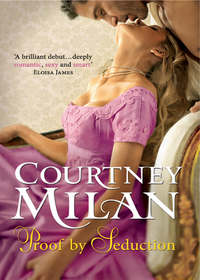
Czytaj książkę: «Proof by Seduction»

Praise for COURTNEY MILAN and Proof by Seduction
“One of the finest historical romances I’ve read in years.
I am now officially a Courtney Milan fangirl.”
—New York Times bestselling author Julia Quinn
“A brilliant debut … deeply romantic, sexy and smart.
I couldn’t put it down.”
—New York Times bestselling author Eloisa James
“With a tender, passionate romance, a touch of sly humour,
and a gruff and incredibly sexy hero, Courtney Milan’s Proof by Seduction is a delicious read from the first page all the way to the very satisfying ending. If you love historical romance you must read this book!” —Elizabeth Hoyt, USA TODAY bestselling author
“An extraordinary debut. Courtney Milan is a blazing new
talent in the romantic stratosphere. I couldn’t put this sparkling,
heartfelt, sizzling story down and I loved every minute
of it. Warm, witty, wonderful and wise, Proof by Seduction will steal your heart away.” —Anna Campbell, multiple-award-winning author of Tempt the Devil
Dear Reader,
I’ve always loved science. But as much as I love science, “love”—of the romantic variety—and “science” don’t often go together.
Perhaps that’s why, when I wrote a historical romance, I set myself the hardest task I could imagine. I chose as my hero a rigidly logical marquess, a scientist who retreated behind scientific proof, because he couldn’t make a formula out of love.
Gareth Carhart was going to be a hard nut to crack. He needed to learn that some things—squishy, unscientific concepts like “love” and “friendship”—are not susceptible to scientific proof. But how to do this?
Then I imagined my heroine. I knew she was going to shake the foundation of his world. Jenny Keeble needed to teach Gareth how to have fun—and, despite his best efforts, he wasn’t going to be able to resist her.
I hope you’ll have as much fun reading this book as I had writing it.
Courtney Milan
COURTNEY
MILAN
Proof by Seduction

www.millsandboon.co.uk
For Tessa and Amy. You believed in me. You pushed me.
You waved off every setback and squealed for joy when good
things happened. And when I most needed you in a dark,
dark time, you held my hand and kept me going.
ACKNOWLEDGEMENTS
Every book—especially a debut novel—owes a debt to an enormous number of people.
The is list is lengthy, but not exhaustive:
Tessa and Amy, for everything.
Franzeca Drouin saved me from innumerable errors more times than I can count. David Berry, Rupert Baker and Stephanie Clarke answered strange and nitpicky questions.
Amy Atwell, Jackie Barbosa, Anna Campbell, Lenora Bell, Darcy Burke, Diana Chung, Amanda Collins, Lacey Kaye, Lindsey Faber, Sara Lindsey, Terri Osborn, Elyssa Papa, Janice Rholetter, Erica Ridley, Maggie Robinson and Sherry Thomas all read pages at various points along the way and encouraged me. Kristin Nelson, my extraordinary agent, and Sara Megibow, her awesome assistant, made all my dreams come true, even the ones I was scared to dream.
Finally, thanks to the team at Harlequin Books, particularly my editor, Ann Leslie Tuttle, and Charles Griemsman, for believing in this book and doing such a beautiful job in launching it.
CHAPTER ONE
London, April, 1838
TWELVE YEARS SPENT PLYING HER TRADE had taught Jenny Keeble to leave no part of her carefully manufactured atmosphere to chance. The sandalwood smoke wafting from the brazier added a touch of the occult: not too cloying, yet unquestionably exotic. But it was by rote that she checked the cheap black cotton draped over her rickety table; routine alone compelled her to straighten her garishly colored wall hangings, purchased from Gypsies.
Every detail—the cobwebs she left undisturbed in the corner of the room, the gauze that draped her basement windows and filtered the sunlight into indirect haze—whispered that here magic worked and spirits conveyed sage advice.
It was precisely the effect Jenny should have desired.
So why did she wish she could abandon this costume? True, the virulently red-and-blue-striped skirt, paired with a green blouse, did nothing to flatter her looks. Layer upon heavy layer obscured her waist and puffed her out until she resembled nothing so much as a round, multihued melon. Her skin suffocated under a heavy covering of paint and kohl. But her disquiet ran deeper than the thick lacquers of cream and powder.
A sharp rat-tat-tat sounded at the door.
She’d worked twelve years for this. Twelve years of careful lies and half truths, spent cultivating clients. But there was no room for uncertainty in Jenny’s profession. She took a deep breath, and pushed Jenny Keeble’s doubts aside. In her place, she constructed the imperturbable edifice of Madame Esmerelda. A woman who could see anything. Who predicted everything. And who stopped at nothing.
With her lies firmly in place, Jenny opened the door.
Two men stood on her stoop. Ned, her favorite client, she’d expected. He was awkward and lanky, as only a youth just out of adolescence could be. A shock of light brown hair topped his young features. His lips curled in an open, welcoming smile. She would have greeted him easily, but today, another fellow stood behind Ned. The stranger was extraordinarily tall, even taller than Ned. He stood several feet back, his arms folded in stern disapproval.
“Madame Esmerelda,” Ned said. “I’m sorry I didn’t inform you I was bringing along a guest.”
Jenny peered behind Ned. The man’s coat was carelessly unbuttoned. Some tailor had poured hours into the exquisite fit of that garment. It was cut close enough to the body to show off the form, but loose enough to allow movement. His sandy-brown hair was tousled, his cravat tied in the simplest of knots. The details of his wardrobe bespoke an impatient arrogance, as if his appearance was little more than a bother, his attention reserved for weightier matters.
That attention shifted to Jenny now, and a shiver raced down her spine. With one predatorial sweep of his eyes, he took in Jenny’s costume from head to toe. She swallowed.
“Madame Esmerelda,” Ned said, “this is my cousin.”
A cold glimmer of irritation escaped the other man, and Ned expelled a feeble sigh.
“Yes, Blakely. May I present to you Madame Esmerelda.” The monotone introduction wasn’t even a question. “Madame, this is Blakely. That would be Gareth Carhart, Marquess of Blakely. Et cetera.”
A beat of apprehension pulsed through Jenny as she curtsied. Ned had spoken of his cousin before. Based on Ned’s descriptions, she’d imagined the marquess to be old and perhaps a little decrepit, obsessed with facts and figures. Ned’s cousin was supposed to be coldly distant, frighteningly uncivil, and so focused on his own scientific interests that he was unaware of the people around him.
But this man wasn’t distant; even standing a full yard away, her skin prickled in response to his presence. He wasn’t old; he was lean without being skinny, and his cheeks were shadowed by the stubble of a man in his prime. Most of all, there was nothing unfocused about him. She’d often thought Ned had the eyes of a terrier: warm, liquid and trusting. His cousin had those of a lion: tawny, ferocious and more than a little feral.
Jenny gave silent thanks she wasn’t a gazelle.
She turned and swept her arm in regal welcome. “Come in. Be seated.” The men trooped in, settling on chairs that creaked under their weight. Jenny remained standing.
“Ned, how can I assist you today?”
Ned beamed at her. “Well. Blakely and I have been arguing. He doesn’t think you can predict the future.”
Neither did Jenny. She resented sharing that belief.
“We’ve agreed—he’s going to use science to demonstrate the accuracy of your predictions.”
“Demonstrate? Scientifically?” The words whooshed out of her, as if she’d been prodded in the stomach. Jenny grasped the table in front of her for support. “Well. That would be …” Unlikely? Unfortunate? “That would be unobjectionable. How shall he proceed?”
Ned waved his hand at his cousin. “Well, go ahead, Blakely. Ask her something.”
Lord Blakely leaned back in his chair. Up until this moment, he had not spoken a single word; his eyes had traveled about the room, though. “You want me to ask her something?” He spoke slowly, drawing out each syllable with precision. “I consult logic, not old charlatans.”
Ned and Jenny spoke atop each other. “She’s no charlatan!” protested Ned.
But Jenny’s hands had flown to her hips for another reason entirely. “Thirty,” she protested, “is not old!”
Ned turned to her, his eyebrow lifting. A devastating silence cloaked the room. It was a measure of her own agitation that she’d forsaken Madame Esmerelda’s character already. Instead, she’d spoken as a woman.
And the marquess noticed. That tawny gaze flicked from her kerchiefed head down to the garish skirts obscuring her waist. His vision bored through every one of her layers. The appraisal was thoroughly masculine. A sudden tremulous awareness tickled Jenny’s palms.
And then he looked away. A queer quirk of his lips; the smallest exhalation, and like that, he dismissed her.
Jenny was no lady, no social match for Lord Blakely. She was not the sort who would inspire him to tip his hat if he passed her on the street. She should have been accustomed to such cursory dismissals. But beneath her skirts, she felt suddenly brittle, like a pile of dried-up potato parings, ready to blow away with one strong gust of wind. Her fingernails bit crescent moons into her hands.
Madame Esmerelda wouldn’t care about this man’s interest. Madame Esmerelda never let herself get angry. And so Jenny swallowed the lump in her throat and smiled mysteriously. “I am also not a charlatan.”
Lord Blakely raised an eyebrow. “That remains to be proven. As I have no desire to seek answers for myself, I believe Ned will question you.”
“I already have!” Ned gestured widely. “About everything. About life and death.”
Lord Blakely rolled his eyes. No doubt he’d taken Ned’s dramatic protest as youthful exaggeration. But Jenny knew it for the simple truth it was. Two years earlier, Ned had wandered into this room and asked the question that had changed both their lives: “Is there any reason I shouldn’t kill myself?”
At the time, Jenny had wanted to disclaim all responsibility. Her first impulse had been to distance herself from the boy, to say she wasn’t really able to see the future. But the question was not one a nineteen-year-old posed to a stranger because he was considering his options rationally. She’d known, even then, that the young man had asked because he was at his wits’ end.
So she’d lied. She told him she saw happiness in his future, that he had every reason to live. He’d believed her. And as time passed, he’d gradually moved past despair. Today, he stood in front of her almost confident.
It should have counted as a triumph of some kind, a good deed chalked up to Jenny’s account. But on that first day, she hadn’t just taken his despair. She’d taken his money, too. And since then, she and Ned had been bound together in this tangle of coin and deceit.
“Life and death?” Lord Blakely fingered the cheap fabric that loosely draped her chairs. “Then there should be no problem with my more prosaic proposal. I’m sure you are aware Ned must marry. Madame—Esmerelda, is it?—why don’t you tell me the name of the woman he should choose.”
Ned stiffened, and a chill went down Jenny’s spine. Advice hidden behind spiritual maundering was one thing. But she knew that Ned had resisted wedlock, and for good reasons. She had no intention of trapping him.
“The spirits have not chosen to reveal such details,” she responded smoothly.
The marquess pulled an end of lead pencil from his pocket and licked it. He bent over a notebook and scribbled a notation. “Can’t predict future with particularity.” He squinted at her. “This will be a damned short test of your abilities if you can do no better.”
Jenny’s fingers twitched in irritation. “I can say,” she said slowly, “in the cosmic sense of things, he will meet her soon.”
“There!” crowed Ned in triumph. “There’s your specifics.”
“Hmm.” Lord Blakely frowned over the words he’d transcribed. “The ‘cosmic sense’ being something along the lines of, the cosmos is ageless? No matter which girl Ned meets, I suppose you would say he met her ‘soon.’ Come, Ned. Isn’t she supposed to have arcane knowledge?”
Jenny pinched her lips together and turned away, her skirts swishing about her ankles. Blakely’s eyes followed her; but when she cast a glance at him over her shoulder, he looked away. “Of course, it is possible to give more specifics. In ancient days, soothsayers predicted the future by studying the entrails of small animals, such as pigeons or squirrels. I have been trained in those methods.”
A look of doubt crossed Lord Blakely’s face. “You’re going to slash open a bird?”
Jenny’s heart flopped at the prospect. She could no more disembowel a dove than she could earn an honest living. But what she needed now was a good show to distract the marquess.
“I’ll need to fetch the proper tools,” she said.
Jenny turned and ducked through the gauzy black curtains that shielded the details of her mundane living quarters from her clients. A sack, fresh from this morning’s shopping trip, sat on the tiny table in the back room. She picked it up and returned.
The two men watched her as she stepped back through a cloud of black cloth, her hands filled with burlap. She set the bag on the table before Ned.
“Ned,” she said, “it is your future which is at stake. That means your hand must be the instrument of doom. The contents of that bag? You will eviscerate it.”
Ned tilted his head and looked up. His liquid brown eyes pleaded with her.
Lord Blakely gaped. “You kept a small animal in a sack, just sitting about in the event it was needed? What kind of creature are you?”
Jenny raised one merciless eyebrow. “I was expecting the two of you.” And when Ned still hesitated, she sighed. “Ned, have I ever led you astray?”
Jenny’s admonition had the desired effect. Ned drew a deep breath and thrust his arm gingerly into the bag, his mouth puckered in distaste. The expression on his face flickered from queasy horror to confusion. From there, it flew headlong into outright bafflement. Shaking his head, he pulled his fist from the bag and turned his hand palm up.
For a long moment, the two men stared at the offending lump. It was brightly colored. It was round. It was—
“An orange?” Lord Blakely rubbed his forehead. “Not quite what I expected.” He scribbled another notation.
“We live in enlightened times,” Jenny murmured. “Now, you know what to do. Go ahead. Disembowel it.”
Ned turned the fruit in his hand. “I didn’t think oranges had bowels.”
Jenny let that one pass without comment.
Lord Blakely fished in his coat pockets and came up with a polished silver penknife. It was embossed with laurel leaves. Naturally; even his pens were bedecked with proof of his nobility. His lordship had no doubt chosen the design to emphasize how far above mere commoners he stood. The marquess held the weapon out, as formally as if he were passing a sword.
Soberly, Ned accepted it. He placed the sacrificial citrus on the table in front of him, and then with one careful incision, eviscerated it. He speared deep into its heart, his hands steady, and then cut it to pieces. Jenny allotted herself one short moment of wistful sorrow for her after-dinner treat gone awry as the juice ran everywhere.
“Enough.” She reached out and covered his hand mid-stab. “It’s dead now,” she explained gravely.
He pulled his hand away and nodded. Lord Blakely took back his knife and cleaned it with a handkerchief.
Jenny studied the corpse. It was orange. It was pulpy. It was going to be a mess to clean up. Most importantly, it gave her an excuse to sit and think of something mystical to say—the only reason for this exercise, really. Lord Blakely demanded particulars. But in Jenny’s profession, specifics were the enemy.
“What do you see?” asked Ned, his voice hushed.
“I see … I see … an elephant.”
“Elephant,” Lord Blakely repeated, as he transcribed her words. “I hope that isn’t the extent of your prediction. Unless, Ned, you plan to marry into the genus Loxodonta.”
Ned blinked. “Loxo-wha?”
“Comprised, among others, of pachyderms.”
Jenny ignored the byplay. “Ned, I am having difficulties forming the image of the woman you should marry in my mind. Tell me, how do you imagine your ideal woman?”
“Oh,” Ned said without the least hesitation, “she’s exactly like you. Except younger.”
Jenny swallowed uncomfortably. “Whatever do you mean? She’s clever? Witty?”
Ned scratched his chin in puzzlement. “No. I mean she’s dependable and honest.”
The mysterious smile slipped from Jenny’s lips for the barest instant, and she looked at him in appalled and flattered horror. If this was how Ned assessed character, he would end up married to a street thief in no time at all.
Lord Blakely’s hand froze above his paper. No doubt his thoughts mirrored hers.
“What?” Ned demanded. “What are you two staring at?”
“I,” said Lord Blakely, “am dependable. She is—”
“You,” retorted Ned, “are cold and calculating. I’ve known Madame Esmerelda for two full years. And in that time, she’s become more like family than anyone else. So don’t you dare talk about her in that tone of voice.”
Jenny’s vision blurred and her head swam. She had no experience with family; all she remembered was the unforgiving school where an unknown benefactor had paid her tuition. She’d known since she was a very small child that she stood alone against the world. That had brought her to this career—the sure knowledge that nobody would help her, and everyone would lie to her. Lying to them instead had only seemed fair play.
But with Ned’s words, a quiet wistfulness filled her. Family seemed the opposite of this lonely life, where even her friends had been won by falsehoods.
Ned wasn’t finished with his cousin. “You see me as some kind of tool, to be used when convenient. Well, I’m tired of it. Find your own wife. Get your own heirs. I’m not doing anything for you any longer.”
Jenny blinked back tears and looked at Ned again. His familiar, youthful features were granite. Beneath his bravado, she knew he feared his elder cousin. And yet he’d stood up to the man just now. For her.
She wasn’t Ned’s family. She wasn’t really his friend. And no matter what had transpired between them, she was still the fraud who bilked him of a few pounds in exchange for false platitudes. Now he was asking her to repay him with more lies.
Well. Jenny swallowed the lump of regret in her throat. If deceit was all she had, she would use it. But she hadn’t saved Ned’s life for his cousin’s convenience.
Lord Blakely straightened. His outraged glower—that cold and stubborn set of his lip—indicated he thought Ned was a mere utensil. That Lord Blakely was superior in intelligence and birth to everyone else in the room, and he would force their dim intellects to comprehend the fact.
He thought he was superior to his cousin? Well. She was going to make the marquess regret he’d ever asked for specifics.
“Ned, you recently received an invitation to a ball, did you not?”
He puckered his brow. “I did.”
“What sort of a ball?”
“Some damned fool crush of a coming-out, I think. No intention of going.”
The event sounded promising. There were sure to be many young women in attendance. Jenny could already taste her revenge on the tip of her tongue.
“You will go to this ball,” she pronounced. And then she swept her arms wide, encompassing the two men. “You will both go to this ball.”
Lord Blakely looked taken aback.
“I can see nothing of Ned’s wife in the orange. But at precisely ten o’clock and thirty-nine minutes, Lord Blakely, you will see the woman you will marry. And you will marry her, if you approach her in the manner I prescribe.”
The scrape of Lord Blakely’s pencil echoed loudly in the reigning silence. When he finished, he set the utensil down carefully.
“You wanted a scientific test, my lord.” Jenny placed her hands flat on the table in satisfaction. “You have one.”
And if the ball was as crowded as such things usually were, he would see dozens of women in every glance. He’d never be able to track them all. She imagined him trying to scribble all the names in his notebook, being forced by his own scientific methods to visit every lady, in order to fairly eliminate each one. He would be incredibly annoyed. And he’d never be able to prove her wrong, because who could say he had recorded every woman?
Ned’s mouth had fallen open. His hand slowly came up to hide a pleased smile. “There,” he said. “Is that specific enough for you?”
The marquess pursed his lips. “By whose clock?”
One potential excuse slipped from Jenny’s grasp. Not to worry; she had others.
“Your fob watch should do.”
“I have two that I wear from time to time.”
Jenny frowned. “But you inherited one from your father,” she guessed.
Lord Blakely nodded. “I must say, that is incredibly specific. For scientific purposes, can you explain how you got all of this from an elephant?”
Jenny widened her eyes in false innocence. “Why, Lord Blakely. The same way I got an elephant from an orange. The spirits delivered the scene as an image into my mind.”
He grimaced. She could not let her triumph show, and so she kept her expression as unchanging and mysterious as ever.
“So,” Ned said, turning to his cousin, “you agree, then?”
Lord Blakely blinked. “Agree to what?”
“When you find the girl in question and fall in love, you’ll agree Madame Esmerelda is not a charlatan.”
The marquess blinked again. “I’m not going to fall in love.” He spoke of that emotion in tones as wooden and unmoving as a dried-out horse trough.
“But if you did,” Ned insisted.
“If I did,” Lord Blakely said slowly, “I’d admit the question of her duplicity had not been scientifically proven.”
Ned cackled. “For you, that’s as good as an endorsement. That means, you’ll consult Madame Esmerelda yourself and leave me be.”
A longer pause. “Those are high stakes indeed. If this is to be a wager, what do you put up?”
“A thousand guineas,” Ned said immediately.
Jenny nearly choked. She’d thought herself unspeakably wealthy for the four hundred pounds she’d managed to scrimp and save and stash away. A thousand pounds was more money than she could imagine, and Ned tossed it about as if it were an apple core.
Lord Blakely waved an annoyed hand. “Money,” he said with a grimace. “What would either of us do with that paltry amount? No. You must risk something of real value. If you lose, you’ll not consult Madame Esmerelda or any other fortune-teller again.”
“Done,” said Ned with a grin. “She’s always right. I can’t possibly lose.”
Jenny couldn’t bring herself to look at him. Because Ned could do nothing but lose. What if he began to doubt Jenny’s long-ago assurances? What if he discovered that he owed his current happiness to the scant comfort of Jenny’s invention? And Jenny could not help but add one last, desperately selfish caveat: What if Ned learned the truth and disavowed this curious relationship between them? He would leave her, and Jenny would be alone.
Again.
She inhaled slowly, hoping the cool air would help her calm down. The two men would go to the ball. Lord Blakely would look around. For all she knew, he might even decide to marry a girl he saw. And once he rejected all the women whose names he’d recorded, she’d tell him he’d seen a different woman at the appointed time out of the corner of his eye.
The wager would become a nullity, and she wouldn’t have to see the fierce loyalty in Ned’s eyes turn to contempt. Jenny’s pulse slowed and her breath fell into an even rhythm.
Lord Blakely lounged back in his chair. “Something has just occurred to me.”
The devilish gleam in his eye froze Jenny’s blood. Whatever it was the dreadful man was about to say, she doubted he’d thought of it at that minute.
“What will stop her from claiming it was some other chit I was meant for? That I saw two girls at the designated time, and chose the wrong one?”
He’d seen through her. A chill prickled the ends of Jenny’s fingers.
Ned frowned. “I don’t know. I suppose if that happens, we’ll have to call the bet off.”
The marquess shook his head. “I have a better idea. Since Madame Esmerelda’s seen everything in the orange, she’ll be able to verify the girl’s identity immediately.”
He met her eyes and all Jenny’s thoughts—her worries for Ned, the loneliness that clutched her gut—were laid bare in the intensity of his gaze.
His lip quirked sardonically. “We’ll take her with us.”
CHAPTER TWO
GARETH CARHART, Marquess of Blakely, had allocated one hour to this endeavor. Fifteen minutes to travel to the fortune-teller’s lair, fifteen minutes to return home. Half an hour, he had supposed, would suffice to shred her lies like the insubstantial foolscap that they were.
“I can’t go.” Madame Esmerelda’s voice was soft and uncertain.
“Why ever not?” Ned turned to her, a look of genuine befuddlement spreading across his face. Gareth’s young cousin sat with his hands on his knees, his whole body canting toward the woman. And therein lay Gareth’s problem.
When Gareth had left England years before, Ned had been a child, whining and hanging on at every opportunity. Now, he was barely twenty-one—but still damnably vulnerable. And Ned believed every word that this woman spoke.
With Ned’s father dead, Gareth was the closest thing Ned had to a patriarch. Ned was his responsibility—and responsible marquesses did not let their young cousins fall into the clutches of fortune-tellers.
“I’m sure Madame Esmerelda had a perfectly legitimate reason not to come.” Gareth raised an eyebrow at the woman and dangled his bait. “I suspect she had another appointment at the same time.”
Let her agree. When she did, he would ask her to name the date of the ball. She wouldn’t be able to, despite her vaunted powers and he would end this foolish charade before it even began.
But she did not take the easy way he offered. Her nostrils flared, and she pressed her lips together. “You’re attempting to trick me, my lord.”
Gareth barely transformed his jerk of surprise into an arrogant chin-lift. “I assure you,” he said in his coldest tone, “I had no such intention.”
She rolled her eyes. “You want this to be a scientific test? Let it be a scientific test. But don’t set little verbal traps for me. And don’t ever lie to me. You intended precisely such a thing.”
Electricity prickled the hairs on his arms, and Gareth sat back, the silence pressing uncomfortably against his skin. Madame Esmerelda leaned toward him, her hands gripping her skirts. It had been a long while since anyone had spoken to him in that manner. He had lied to her. He had intended to trick her into playing her hand too soon. He just hadn’t expected her to notice.
“You’re trying to change the subject,” he accused her. “Why can you not go to the ball?”
“Because I wasn’t invited,” she snapped. And then she looked down. “And besides, I have nothing to wear.”
Ned gave a high crack of laughter.
And no wonder. It was such an absurdly ladylike thing to say. He glanced at her again. In that moment—a trick of the light, perhaps, or the way her lashes obscured her eyes—Gareth felt a jolt. Madame Esmerelda was not a lady, but she was most definitely a woman. A pretty one at that. She’d hidden her femininity beneath those unflattering layers of dark paint and the kerchief. Lies, those; just ones composed of fabric and powder instead of words. He wondered idly how far down her back that mass of hair would reach if it were not bound up. She lifted her chin and met his eyes.
Gareth didn’t believe in fortune-telling. He was a scientist; he’d devoted years to a naturalist’s expedition in Brazil. He’d only returned to England when his grandfather died, and responsibility required he take on the demands of the title. He had come here because responsibility also demanded that he free his cousin from Madame Esmerelda’s grasp. But he would take it as a matter of personal pride to strike a blow against the illogical superstition that this woman represented.
Her particular choice of lies, however, would take far longer than his allocated hour to disprove. He should have been annoyed. And yet he couldn’t intimidate Madame Esmerelda.
In the year since he’d been back in England, he hadn’t faced anything like a real challenge. Now he did. It was going to be extremely satisfying when he exposed her as the fraud that she was.
He relished the prospect of matching wits with her, of pulling the truth from her.
Gareth snapped his fingers. “The invitation,” he said, “I can fix. The clothing I can fix. I’m willing to do much in the name of science.”
“Oh, no. I couldn’t.” She looked away again. “Besides, I can’t accept—”
Disparate details collided in Gareth’s mind. The proper curtsy she had dropped. The educated precision of her intonation. Her reluctance to accept a gift of clothing from a man. These facts all added to one overwhelming conclusion: Madame Esmerelda had been educated as a gentlewoman. What on earth could have driven her to tell fortunes?
“Of course you can,” he insisted. “Madame Esmerelda, if this is to be a scientific test, I don’t believe you should lie to me, either.”
Some emotion flickered in her eyes. She shook her head—not a denial, but a swift, short shake, as if she were putting everything to rights. And when she met his gaze again, her face was smooth.
She had thought of something, Gareth realized. She saw a way out of the mess he had created for her.
He should have been disappointed.
Instead, he couldn’t wait to foil her plan.
IT DIDN’T TAKE LONG for Gareth to regret his eagerness. He hadn’t realized finding Madame Esmerelda appropriate attire would turn into an ordeal. But Ned had thought it necessary to take the woman to the modiste himself. And Gareth knew if Ned had a moment alone with the charlatan, she would find a way to turn his head inside out. Again.
Which is how Gareth found himself in his closed carriage the next afternoon, accompanied by his chattering cousin, a fraud and a growing headache.
“So,” Ned babbled, “we’re going to the ball next Thursday, and then we’ll meet Blakely’s wife. I should like to see him fall in love. I’m rather looking forward to it.”
Madame Esmerelda adjusted the kerchief on her head—red, this time—and slanted a careful look at Gareth. “Identify.”
“Identify?” Ned repeated. “What do you mean, identify?”
“We are going to identify the woman in question. I never said your cousin would meet her that day. In fact, the time for their meeting is not yet here.”
Gareth inhaled in trepidation. “Not yet here? How long will this take?”
The smile touched her eyes, if not her lips. “Oh, I couldn’t say. The time is not measured by years, but by tasks. Three of them.”
“Tasks?” repeated Ned, incredulously.
“Tasks?” Gareth said sharply. “You said nothing of tasks.”
“Oh? What did I say, I wonder?” She looked up at the roof of the carriage, innocently.
Gareth drew out his notebook and fumbled for the page. “At precisely ten o’clock and thirty-nine minutes, you will see the woman you are to marry if only you approach her in …” He faltered, and looked up.
That innocence had faded from her eyes. She’d known what she’d said. Baited him into this, no doubt, to make him look foolish.
“If only I approach her in the manner you prescribe,” he finished dully.
“Ah, yes. The manner I prescribe.” She smiled. “And I prescribe tasks.”
He’d thought himself so clever, trapping her into making an easily disprovable statement. All he had to do, he’d thought, was not marry a girl. He’d succeeded at not marrying women all his life. He’d been too confident, too sure he’d backed her into a corner.
He’d underestimated her. He’d been so intent on winning, on disproving her statement, that he’d not seen the exit she planned for herself.
He could walk away at any moment. But if he did, he’d leave her influence over Ned unabated.
“I never got tasks,” mumbled an aggrieved Ned.
“Of course not,” Madame Esmerelda soothed. “But you must think how monumental an undertaking it will be for your cousin to convince a woman to care for him. If I didn’t set him tasks, he’d use logic instead, and just think how that would work out. You don’t need tasks. Everyone likes you already.”
Gareth clenched his hand in suppressed fury and pushed his knuckles into the leather squabs. “And what,” he snapped, “is the first task? Mucking out stables? Killing lions? Or must I chop down an entire orchard of citrus trees?”
She tapped a finger against her lips. “It is a trifle premature to tell you. But I suppose it can’t hurt. You must carve an elephant out of a piece of ebony.”
“An elephant?” Gareth looked up at the roof. “Why is it always elephants?”
The coach slowed to a halt. The footman opened the door, and dust motes danced in the rays of sunshine in front of Madame Esmerelda. They made her look … well, mystical. Drat her.
“I am,” Madame Esmerelda said, “just a poor conduit for the spirits. As you will be a mere conduit for the elephant. You will give your future wife the elephant when first you meet.”
Her eyes danced, and she exited the conveyance. Gareth bit back a pained yelp.
No doubt he could find a way to present such a gift in a dignified manner. If she thought to make a fool of Lord Blakely, she was vastly mistaken. But maybe she intended to fight him to an impasse. If she made those tasks onerous enough, she doubtless thought he would walk away. And with her conditions unfulfilled, he would have no proof she was a fraud—and that meant his cousin would continue to see her. Unacceptable.
By the triumphant spring in her steps as she approached the shop, she thought so, too.
Gareth’s thoughts boiled as he entered the little shop. He paid little mind to Ned bothering Madame Esmerelda, whining about some irrelevant trifle. Bolts of colorful fabric decorated the front waiting room; they faded to dim gray in his mind. He didn’t even notice he was pacing the floor, scarcely saw when Madame Esmerelda was whisked away to the back room. He wanted to rip the fashion plates off the walls and shred the sample cards laid demurely out on the tables.
Gareth did not like losing. He would not be outdone by some fraud. He’d looked forward to the challenge when he thought he would vanquish her. The situation became far less entrancing when her victory was possible.
Tasks. He couldn’t let this continue.
He turned to Ned, who was fidgeting on the edge of his seat. “Ned,” he said.
The boy looked up attentively.
“Do you think Madame Esmerelda will need a shawl?”
“I suppose—”
“Go buy her one.” Gareth fumbled for a bank note and held it out.
Ned frowned, his fingers closing on the paper. “Why can’t the modiste just choose one? What I know about ladies’ shawls, I could fit—”
Gareth fixed Ned with his coldest look. “I think it would mean more to her if you chose it yourself. Don’t you?”
Ned offered a few more halfhearted protests. Easy enough to dismantle those; soon his cousin scurried out the front door.
The workroom door swung open, and one of the seamstresses popped out, her arms flowing with colored silks.
Gareth took a deep breath. This charade had gone on long enough. “Is Madame in a condition to receive me?”
She sniffed primly. “My lord. As you wish, my lord.”
But as soon as he ducked through the doorway the servant indicated, he halted. A half-mirror stood on the otherwise empty wall, and Gareth’s lungs contracted at the profile reflected in it. Rounded hip, and a swell of breast.
Madame Esmerelda wasn’t wearing a fashionable dress. She wasn’t wearing much of anything at all—nothing but a thin, worn chemise. The seamstress must have assumed he was the fortune-teller’s lover, or she’d never have sent him back here. His body moved of its own accord, turning toward her, like a plant tracking the path of the sun.
Christ. Underneath the colorful skirts, now lying in a discarded heap, Madame Esmerelda had a waist. She had a bosom. She had a damned remarkable bosom. From five yards away, he could see the hazy outline of her legs through worn muslin. He could even make out the dark nubs of her nipples. The curling ends of her hair fell all the way to the small of her back.
She wasn’t anything like the slender sylphs society favored. She was a Grecian fertility goddess, round and soft all over. And with her rosy lips frozen, half-open, she looked almost inviting.
Not that her invitation extended to him.
Gareth’s brain tumbled to a halt. What remained in his head was no rational thought, but simple greed. His mouth dried, and every muscle contracted in anticipation of the feast on display before him.
She stood, rooted in place, her eyes wide in horror. If she were a lady, he would have apologized profusely and left the room. Not that he could help his own reaction. It was more than just the sight of a beautiful, nearly naked woman that set his heart hammering. It was the way she’d challenged him, the way she’d undermined him. It had been years since anyone had out-thought him. And so what he felt was a sharp desire to possess her. To obtain her surrender in every way a woman could surrender to a man. It was lust, pure and simple.
But this woman was trying to make an idiot of Gareth and a dupe of his cousin. There was nothing pure or simple about her. And so he stuffed his physical response as best he could behind the safety of a cold, businesslike demeanor.
“Madame Esmerelda,” Gareth said, “you win. There will be no tasks. No elephants.”
Her eyes narrowed. “Get out.”
“One hundred guineas, if you tell Ned you’re a fraud and disappear from our lives.”
She inhaled and her chest expanded. She pointed to the door. “Get out now.”
“Think it through. I doubt you’ll be able to milk that much from him in your entire acquaintance. He’ll outgrow your advice soon enough. And you could live for years on the money.”
She took a deep breath, and those remarkable breasts shivered underneath the thin chemise. “I wouldn’t do it for a hundred—” she began.
Gareth covered his rising lust with a nonchalant shrug. “Two hundred.”
Her lip curled, and she shook her head in outrage. “Not for two thousand. Not for ten.”
“Oh?” He flicked an insultingly familiar glance down her chemise. “You’d do it for ten. But you’ll do it for two hundred.”
She started toward him, her fingers curved like claws. He deserved to be slapped, and more, for the insult his look had implied. If he was right, and the woman was gently bred, she’d not appreciate the aspersions he’d just cast on her character. But he couldn’t let her near him. He feared his own response if she came within arm’s length.
“Really, Madame. Once you dispose of your fabricated outrage, you’ll realize this is the best solution for everyone.”
Gareth inclined his head, all sardonic politesse, and stepped back through the opening. He eased the door into place behind him, and let the insolent sneer slide off his face.
He leaned against the wall, his breath ragged. The challenge between them had become more than a territorial war over Ned’s future. Now it was sensual.
Madame Esmerelda was extremely intelligent. She was devious. And if she had any idea how she affected him, she’d take advantage, unscrupulous creature that she was. And how idiotic that he wanted her to take that advantage. He wanted her to befuddle his wits until he lost all control and took her.
Gareth gripped his hands into fists. In his time in the jungles of Brazil, he’d cataloged close to a thousand insects. Now he let them march through his mind. Cockroaches. Poisonous, furry caterpillars. Maggots. He thought of every creeping thing ever to mar the face of the planet. He imagined them crawling about on his skin. And he didn’t stop until his ardor subsided and the memory of her body dissolved from his mind.
It took a lot of millipedes.
JENNY HADN’T REGAINED HER COMPOSURE by the time she fastened, with shaking hands, the final layer of Madame Esmerelda’s outrageous costume. Bad enough that this whole experiment had extended the lie of Madame Esmerelda far outside Jenny’s usual sphere of business. Worse still, she’d been made to endure the pricks and pokes of the contemptuous seamstress who’d assumed the worst of Jenny’s relationship with Lord Blakely.
But the crowning glory had been when the marquess had marched in on her as if he owned her body. He hadn’t even bothered to avert his eyes. She wasn’t sure which had been more insulting—the look he gave her, or his assumption that she’d be willing to abandon Ned if only he offered a high enough price.
Not since that first day, that first hour, had she been tempted by Ned’s money. She wouldn’t leave the poor boy to suffer under his cousin’s unemotional auspices.
Jenny stormed out into the front room, her loose hair tangled around her shoulders.
Lord Blakely leaned against a wall next to an unclothed dress form. His eyes snapped open as she slammed the door behind her. But she didn’t let him move. She jammed a finger into his chest and glared up at him.
“Just because you ignore everything around you except facts does not mean everyone else can be reduced to a number.”
He looked down at her, astonishment in his eyes. “What the devil?”
She poked his chest again. “There are some things in life for which there are no figures. You don’t comprehend what your cousin really needs or why he finds it necessary to speak with me. No matter what number you choose, you will never, ever be able to describe him. Not with a hundred guineas. Not with a thousand.”
“Very well.” He swallowed, focused on some spot on the ceiling. He didn’t even bother to meet her gaze. “I shan’t offer you bribes again.”
“That’s not enough. If it’s not money you enumerate, you’ll latch on to some other figure. The number of times I make an accurate prediction. The degree to which I specify what is to happen. Attach as many numbers as you like to my relationship with Ned, but they will not help you understand.”
She was Ned’s confidante. She’d be damned if she sold that role for mere money. She wouldn’t let Lord Blakely reduce her to that level.
The man drew himself up. “You can disparage figures all day long, but that’s what proof means. It means one has a factual basis for one’s assertions.”
“You call what you’re doing proof,” Jenny snapped. “But you prod and poke and pick. You have no interest in proving anything.”
“What do you know of scientific proof?”
“Oh, you’re the sort to pin insects to cards in order to study them. After several months spent perusing their desiccated carcasses, you’ll announce your triumphant discovery: all insects are dead! And you’ll delight in the ascendancy of scientific thought over human emotion.”
Lord Blakely cocked his head and looked at her, as if searching for some hidden meaning in her face. “I study animal behavior. It’s imperative I not kill the subjects of my inquiry. Dead macaws rarely flock.”
“There’s no need to murder the analogy by overextending it, atop your other crimes.”
His gaze slid down her body. “The only question in my mind was whether you believed your own lies or were actively attempting to defraud Ned. I suppose it is a compliment to you that I have decided you are too clever for the former.”
“Naturally. You don’t believe anything you cannot taste or touch.”
“I believe in Pythagoras’s theorem, and I can’t taste that. I believe there may be some truth to Lamarck’s theories on inheritance of traits. But no, I do not believe in fate or fortune-tellers.”
“Fate, fortune-telling—or feelings.” Jenny snapped her fingers in his face. “The important things in life cannot be bound like so much paper to form a monograph.”
The insouciant look on his face faded into cold steel. “A monograph?”
She inhaled, sharply. “Listen to yourself. You cite Lamarck instead of talking of your cousin’s future. I have never seen you laugh. I’ve never even seen you smile. No wonder Ned would rather listen to me. You’re a cold, unemotional automaton.”
“An automaton?” His shoulders jerked and he stiffened.
Jenny wasn’t done with him. “Just because you’re as dispassionate as sawdust and as brittle as old bone doesn’t mean everyone around you must ossify.”
“Ossify.” His nose flared and his chin lifted, as if parroting her syllables constituted some kind of brilliant argument. He looked down at his right hand, clenched into a fist in front of him. The muscles in his neck tensed. Jenny took a step back and wondered if she’d gone too far. Madame Esmerelda would never have let anger carry her away.
Then he looked up, and her doubts froze like so much lake water in winter. His eyes reflected some boreal wasteland, inhabited only by wind and a cold sweep of snow. Jenny felt the chill through every layer of Madame Esmerelda’s costume, and she shivered.
When he spoke, there was no emotion in his voice at all. “You should have taken the two hundred guineas. After that outburst, I shall enjoy proving you a fraud.”
BY THE TIME the carriage rumbled back to the Blakely home in the heart of Mayfair divested of all inhabitants but Gareth, it had begun to rain. It wasn’t the warm tropical downpour he’d enjoyed in Brazil; instead, it was the frigid, anemic drizzle that typically plagued London. Drop after sullen drop sank to the earth.
So he was a cold, emotionless automaton? Strange, then, that he felt so damned furious. Gareth gritted his teeth as he stepped outside the carriage. Servants swarmed around him, attempting to rush him inside, out of the wet.
He brushed away their hands. “Leave me. I’m going for a walk,” he snapped. They exchanged glances—his servants often exchanged glances—but they let him go.
Walking was an eccentricity he had developed in Brazil. It was, after all, the only way to make his daily rounds of observations. He’d brought the activity home with him. In London, the habit was inconvenient at best. The streets were all muck, and there was no overhead cover—neither wide-leafed jungle trees nor thick canopies—to speak of. But at a time like this—with his thoughts disordered, his mind awhirl and his body as ready to ignite as tinder—he needed this solitary exercise more than ever.
He set off into the dark. Cold rain ran down Gareth’s spine in rivulets, but it did nothing to dampen the fury raging inside him. Dispassionate as sawdust?
Madame Esmerelda was wrong. It wasn’t science that killed emotion. It was this place. These people. This title. He’d spent years in the rain forest, where life and color flourished anywhere it had the smallest chance of surviving. Here, geometric brick building followed geometric brick building, separated only by growing torrents of mud. Drawn shades clotted pallid windows; leaves like faded clay clung to half-dead grass. London was sterile. The rain had washed away all but the most persistent of the city’s fabricated smells—the stink of coal and the scent of cold, wet stone.
If the city was desolate, its inhabitants were worse. He’d left London eleven years ago because polite society nearly suffocated him. It was the rigor of scientific thought, the clarity of observation, the control he gained over the universe as his understanding bloomed, that kept some vital part of himself in motion since his return. He had realized long ago that he would never really fit in. During these last months, the mornings he spent sorting through the naturalist’s journal he’d kept in Brazil were all that helped him hold tight to some notion of who Gareth was. Without it, he would have drowned everything real about himself in Lord Blakely’s unending responsibilities.
Gareth shook the rain from his shoulders and, sighing, looked up. He’d been trudging through muddy puddles for nearly half an hour. He was soaked to the bone; were it not for the furious whirl in his mind and the fast pace he’d been keeping, he’d have been chilled.
Unconsciously, his feet had traced the steps to the neighborhood where Madame Esmerelda lived. The streets were decidedly dingier than Gareth’s own address, brown rivulets of running water skirting slushy horse dung strewn about the cobblestones. But the area was by no means dangerous. Families here hovered below respectability, but somewhat above poverty.
He found her windows. Tucked in the basement, down a flight of stairs. They glowed with an orange light that put him in mind of hot tea and a hearth. Anger, hot and irrational, welled up as he thought of her ensconced in a warm, comfortable room, while he prowled outside in the rain like some kind of bedraggled panther.
His whole response to her was as irrational as the idea of a fortune-teller consulting the spirits about the future. It was as stupid as the concept of wooing women with ebony elephants. It was, he admitted, as incomprehensible as a fraud refusing an offer of several hundred guineas in exchange for doing nothing. Perhaps that was why he drifted toward her door, his boots clomping heavily against the cold, wet stairs leading down.
He had a sudden image of confronting her, of explaining scientific thought and rigor. He wanted to knock the wind out of her with his words, as she had from him. He wanted her to feel as off balance as he did now. He wanted to win, to prove to her she was wrong and he was right. How idiotic of him. How unthinking. And yet—
He knocked.
And he waited.
Madame Esmerelda opened the door. She was carrying a tallow candle. It smoked and illuminated her face; he could see her pupils dilate in shock when she saw who stood on her doorstep. She didn’t say a word—didn’t invite him in, just blocked the opening and looked up at him in openmouthed surprise.
She hadn’t donned that ridiculous costume again. Instead, a simple robe of thick, dark wool covered her. The thin white line of her chemise peeked over the neckline. That hint of muslin forcibly reminded Gareth of the afternoon. Of the expanse of soft flesh separated from his hands by two cloth layers and so much dampened air. A fist-size lump lodged itself in his throat and a dark mist formed in his mind, blanketing his carefully planned diatribe.
She curled one arm around herself, as if it were somehow she who needed protection from him.
“Do you know how I can tell you’re a fraud?” he croaked.
She gazed up at him.
“Because you’re wrong. You’re completely wrong.”
He fumbled in his mind for his prepared speech. Science is about answers. It raises us above those who do not question.
But before he could start, Gareth made a colossal mistake: He looked into Madame Esmerelda’s eyes. He’d thought she was black-eyed as a Ggypsy. But from eighteen inches away, with the candle so close to her face, he realized her eyes were in fact a very dark blue.
With that simple observation, the blood drained from his brain. Gareth’s structured defense of scientific thinking washed from his head. Instead, he took a step toward her. He let the veil drop from his eyes, let her see the inferno raging inside him.
She sucked in air. “Why do you say I’m wrong?” Her voice quavered on the last word.
“I’m not an automaton.” The words came from some vital place deep inside him—his solar plexus, perhaps, rather than his uncooperative brain.
Gareth took another step closer. She continued to hold his gaze, as incapable of looking away as he. The white vapor of her breath swirled in the cold night air. Its cadence kept time with the rise and fall of her chest. He could taste every one of her exhalations, sweetness coalescing against his mouth.
It was an act of self-preservation to reach out and pinch the candle flame. To stop the flow of sensual images before they seared themselves permanently into his flesh. The wick sizzled and the light died between his wet fingers. Her eyes disappeared into the navy darkness of nighttime.
It didn’t help. He could still smell her. He could taste the honey of her breath on the tip of his tongue. And the distant streetlamp cast enough illumination for him to see when she licked her lips. Heat seared him.
“I’m not made of wood.” Gareth reached out again. This time, his hand grazed the warm flesh of her cheek. And still the silly woman didn’t jerk away. She didn’t even flinch when he tilted her chin up. Instead, her lips parted in soft, subtle invitation.
The thought of her mouth against his snuffed what little guttering intellect remained to him. Her flesh seemed to sizzle beneath his fingertips. He lowered his head until her lips were a tantalizing inch from his.
“Most of all,” Gareth said, his voice husky, “I’ll be damned if I let you call me dispassionate.”
Darmowy fragment się skończył.