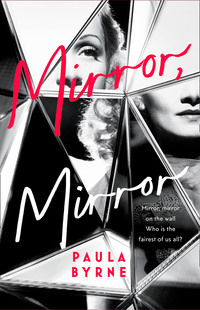
Czytaj książkę: «Mirror, Mirror»

Copyright
William Collins
An imprint of HarperCollinsPublishers
1 London Bridge Street
London SE1 9GF
www.WilliamCollinsBooks.com
This eBook first published in Great Britain by William Collins in 2020
Copyright © Paula Byrne 2020
Cover design by Heike Schüssler
Cover photographs © Sunset Boulevard/Getty Images, Shutterstock
Paula Byrne asserts the moral right to be identified as the author of this work
A catalogue record for this book is available from the British Library
Information on previously published material appears here
All rights reserved under International and Pan-American Copyright Conventions. By payment of the required fees, you have been granted the non-exclusive, non-transferable right to access and read the text of this e-book on screen. No part of this text may be reproduced, transmitted, down-loaded, decompiled, reverse engineered, or stored in or introduced into any information storage and retrieval system, in any form or by any means, whether electronic or mechanical, now known or hereinafter invented, without the express written permission of HarperCollins.
Source ISBN: 9780008307097
Ebook Edition © January 2020 ISBN: 9780008270568
Version: 2020-11-28
Dedication
For Christine Marie
A sister is both your mirror – and your opposite
Elizabeth Fishel
Epigraphs
Mirrors from Lohr were so elaborately worked that they were accorded the reputation of always speaking the truth and became a favourite gift at European crown and aristocratic courts. Uniquely, the mirrors also talked, in aphorisms like one that reads in the upper corner of a frame: Elle brille à la lumière (She is such a beauty).
Karlheinz Bartels, Schneewittchen: zur Fabulologie des Spessarts (Lohr am Main, 2012)
I don’t remember who started the rumor that Mars was scheduled to collide with the Earth that summer of 1938 … the next summer, not Mars, but a little man in Berlin changed the course of human history.
Maria Riva, Marlene Dietrich by her Daughter (New York, 1993)
Contents
1 Cover
2 Title Page
3 Copyright
4 Dedication
5 Epigraphs
6 Contents
7 Prologue
8 The Devil is a Woman
9 Someday I’ll Find You
10 The Scarlet Empress
11 I Like America
12 The Garden of Allah
13 Sigh No More
14 Stage Fright
15 This Time Tomorrow
16 The Lady is Willing
17 Bonne Nuit, Merci
18 The Little Napoleon
19 The Party’s Going with a Swing
20 The Woman One Longs For
21 Farewell Song
22 Manpower
23 Dream Girl
24 Song of Songs
25 I’m Old Fashioned
26 Follow the Boys
27 Poor Lady in the Throes of Love
28 A Modern Dubarry
29 There are Bad Times Just Around the Corner
30 Desire
31 You’re the Top
32 I Loved a Soldier
33 World Weary
34 A Foreign Affair
35 The Stately Homes of England
36 The Ship of Lost Souls
37 I Wonder What Happened to Him?
38 The Spoilers
39 Down with the Whole Damn Lot
40 I Kiss your Hand, Madam
41 Love a Little
42 Angel
43 Don’t Let’s Be Beastly to the Germans
44 I Am a Camera
45 Cowardy Custard
46 Around the World in 80 Days
47 This is a Changing World
48 No Highway in the Sky
49 Top of the Morning
50 Leap into Life
51 Twentieth Century Blues
52 The Big Bluff
53 Wait a Bit, Joe
54 Man by the Roadside
55 When My Ship Comes Home
56 The Imaginary Baron
57 When We Were Girls Together
58 Heads Up, Charley
59 Ace of Clubs
60 Touch of Evil
61 Let’s Do It
62 Madame Doesn’t Want Children
63 Bitter Sweet
64 Knight without Armour
65 Sail Away
66 Why Cry at Parting?
67 Why Must the Show Go On?
68 The Imaginary Baron
69 Dearest Love
70 Black Fox
71 Don’t Put your Daughter on the Stage
72 Art of Love
73 Nevermore
74 No Highway in the Sky
75 How Do You Do, Middle Age
76 Nights of Love
77 Pageant
78 Golden Earrings
79 London at Night
80 In the Shadow of Happiness
81 On With the Dance
82 Dishonored
83 Tonight is Ours
84 I Lift up My Lamp
85 The Party’s Over Now
86 Rancho Notorious
87 There’s a Younger Generation
88 Show Business at War
89 We Were Dancing
90 The Happy Mother
91 The Dream is Over
92 Kismet
93 Suite in Three Keys
94 Princess Ololah
95 Waiting in the Wings
96 Witness for the Prosecution
97 Kater Through the Looking Glass
98 Why Does Love Get in the Way?
99 The Tragedy of Love
100 I Travel Alone
101 I Wish You Love
102 Where Have All the Flowers Gone?
103 Just a Gigolo
104 You Were There
105 The Countess of Paris
106 Just Let Me Look at You
107 Paris When it Sizzles
108 Let’s Say Goodbye
109 The HMS Disgusting
110 The Blue Angel
111 Epilogue
112 Author’s Note
113 Also by Paula Byrne
114 About the Author
115 About the Publisher
LandmarksCoverFrontmatterStart of ContentBackmatter
List of Pagesiiiivvvii123456789101112131415161718192021222324252627282930313233343536373839404142434445464748495051525354555657585960616263646566676869707172737475767778798081828384858687888990919293949596979899100101102103104105106107108109110111112113114115116117118119120121122123124125126127128129130131132133134135136137138139140141142143144145146147148149150151152153154155156157158159160161162163164165166167168169170171172173174175176177178179180181182183184185186187188189190191192193194195196197198199200201202203204205206207208209210211212213214215216217218219220221222223224225226227228229230231232233234235236237238239240241242243244245246247248249250251252253254255256257258259260261262263264265266267268269270271272273274275276277278279280281282283284285286287288289290291292293294295296297298299300301302303304305306307308309310311312313314315316317318319320321322323324325326327328329330331332333334335336337338339340341342343344345346347348349350351352353354355356357358359360361362363364365366367368369370371372373374375376377378379380381382383384385386387388389390391392393394395396397398399400401402403ii
Prologue
Berlin, 1993
Die Deutsche Kinemathek
My mother was still alive when the wall came down, but she made no comment except this: ‘I have cried all my tears for Germany. They have dried and I have washed my face.’ She had the loveliest face since Helen of Troy, but her beauty was in flight, like Nike of Samothrace.
When she died alone, in her Paris apartment, she left no will. Her millions had been spent. But she had kept every possession in cardboard boxes: hats, scarves, gowns, shoes, clocks. I sorted 45,000 pages of correspondence, 16,500 photographs, and over 3,300 textile objects, and I sent everything I had to the Deutsche Kinemathek.
She was finally being honoured. Berlin’s most famous and infamous child. I could never imagine her as a girl. She was a goddess; unknowable, unreachable. When I was a child I had a doll called Heidi. She was the most beautiful doll, with golden hair, and nobody could have loved her more than I. But every day, I prayed that I would never have a daughter. Dolls could not feel pain. Could not be hurt. I feared girl children. I would not know how to be a mother to such complex creatures.
And now the last box has been sent. As I enter the museum, I find myself in a mirrored lobby, like a jewel box. A hundred images of myself are reflected back at me. I am old now. I see an elegant, white-haired lady in a smart suit. There are eyes everywhere, and with a sudden burst of grief and clarity, I know how she must have felt. Every aspect, every angle of her life scrutinised, photographed, filmed, analysed and judged. Nowhere to escape, and nowhere to hide. And now I understand what she meant when she told me ‘Kater, I was photographed to death.’
The Devil is a Woman
It’s funny how I can remember every single person who’s ever been kind to me.
When I look back now, I see so much, but I guess that’s the way it is for most people. I never knew my age in those days when we first went to Hollywood. That was because Mother constantly changed it, so I never had a chance to celebrate my birthday. To her friends and fans, I was a baby, to others, I was a young girl of nine, or maybe eight. All I knew was that I had the most beautiful mother in the world and that I was ugly.
My face was covered with pimples. Mother blamed the cream pastries I ate. It was one of the things I most loved about America: the food. For breakfast, the maid would bring me a stack of pancakes with maple syrup and whipped butter. There were strips of salty bacon ‘on the side’. American waffles with cream and blueberries. Gloriosky!
Mother glared at me, sipping water mixed with Epsom Salts. This was how she stayed pencil thin.
‘Sweetheart, hurry. The car is here. That Big Girl’s Blouse will be weeping into his coffee if I’m even five minutes late.’
Her co-star was English. Peter somebody. On the whole, she disliked Englishmen, ‘thick, white ankles, fingers like uncooked sausages’. She was obsessed by the beauty of her own slender ankles. ‘Aristocrats have thin ankles, only peasants have thick ones.’ She looked at my fat ankles, accusingly, as she said this.
I felt sorrow for my mother because she had given birth to such a plain child. I looked exactly like my father, but what was handsome in a man was plain in a female. In the mirrored dining table where we were eating a hurried breakfast I could see my reflection: high forehead, large flat nose, and deep-set eyes. My bushy eyebrows made me look perpetually cross. My hair was fine and a pale shade of ginger. I had blotchy brown freckles that I tried to scrub off with lemon juice. It never worked. But I had a lovely mouth, with a Cupid’s bow. It was the only feature that I had inherited from my mother. I decided then that it might be best to avoid mirrors.
As usual, it was an early-morning call. Mother was expected to be in Make-up at 5 a.m. Her car and driver were already outside the house. A hot Santa Ana wind had been blowing that week, and the Hollywood hills were sharp-edged and the colour of elephant skin. The morning air was cold, however, and I wrapped a warm rug around Mother’s legs. On the way to the studio, she talked non-stop: ‘It’s fine for stage actors, they’re the fortunate ones, they don’t have to be acting a love-scene at 9 a.m. after being in Make-up since 6 a.m.’
‘Any country that can make a dog a film star is not to be taken seriously.’
‘Harlow was at the dinner. That shows you the level of intelligence there last night!’
‘Abominable country, America.’
Mother was always edgy during pre-production. I listened and nodded and smiled and tried not to get carsick. I longed for the studio, and the hum of the carpenter’s saw. Only then would I know I was home.
She continued to complain that no drawings had been sent to her, and Nellie, her hairdresser, had not seen a single wig sketch. Von Goldberg, she knew, was still making adjustments to the script. What was everyone doing at Paramount? Hiding W. C. Fields’ gin bottles?
We drew up at the Bronson Gate. In those days – before the big earthquake – there was an elaborate stone belfry framing the famous archway. I nodded to the frieze of Shakespeare, who seemed to be presiding over the studio lot.
‘Good morning, Miss Madou. Good morning, Miss Kater.’
‘Harry, take me straight to Wardrobe. I need to speak to Travis.’
‘Yes, Miss Madou.’
That was the day I became my mother’s dresser.
Like most little girls, I thought my mother was perfect. Except my mother really was perfect. Everyone told me so, and she had the face and body to prove it. I guess that’s why I never told anybody the truth. Who would believe me? It’s strange how people refuse to think badly of the beautiful.
I remember the first time that my mother went to an airport full of ‘civilians’ – that is, not ‘Hollywood People’. She was horrified by the ugliness, the commonplace, the fleshy bodies. At the top of her voice, she exclaimed, to whoever cared to listen: ‘No wonder they pay us so much!’
In later years, when she had left the film industry, she was bemused by modern actresses, who relied on their talent and not their good looks to succeed. Not that she truly cared about her beauty; it was a commodity: ‘Glamour is what I sell. It’s my stock in trade.’ Mother liked her maxims: ‘Darling, the legs aren’t so beautiful; I just know what to do with them.’ Another favourite: ‘The Possible we do immediately. The Impossible may take a little longer.’ And another: ‘Nothing bad can ever happen to you when you’re with your mother.’ But the one she liked best was this: ‘Kater, remember, the mirror never lies.’
Someday I’ll Find You
Here they come, podgy daughter trotting alongside her, little piggy on the way to market. They’ve buffed and polished me so that I’m ready for her. And I go wherever she is. They all need me, the stars and the starlets, but nobody loves me more than Madou. The feeling is mutual. My passion for her remains unimpaired. Even when she is tired, she is staggeringly beautiful. I live for the moments when she gazes into me, and we become one.
Madou is to play a Russian empress. Perhaps the most famous woman of all time: Catherine the Great. Mr Goldberg (everyone knows that he added the von to make himself appear noble) could not resist. And who can blame him, darlings? The transformation from vulgar tart to sovereign ruler is just too delicious.
Naturally, his star cannot envisage the role until she has first created the wardrobe. Every seed pearl, every sequin, every feather, has to be perfect. Travis, head of Wardrobe, a man of indescribable and imperishable charm, will set her right. Travis dresses impeccably, like an English gentleman, exuding elegant masculinity. He always looks as if he has just stepped off a yacht, so unlike that vulgar imposter, Mr Moses von Goldberg, who looks like a Jewish schmatta tailor. Never trust a man with short legs, I always say, his brain is too near his bottom.
Travis’s rooms are exquisite; book-lined and stuffed with antiques. I reside in the right-hand corner: a huge floor-length looking-glass, dotted with bulbous lights. The daughter never looks my way, studiously avoids my gaze. Well, who can blame her, when she looks like a baby porpoise?
Madou looks directly at me and speaks.
‘She must look young, Travis. But who will believe that Madou is virginal? You must overdo the image. We need frills and flounces for the early gowns. Then later, when she gets to Russia we will need pelts; sables, mink, ermine, white fox, not chinchilla. So vulgar, so Garbo.’
Travis chuckles: ‘Kater, dearest, have a sandwich. It’s an American standard, egg-on-white. Delicious.’
Madou casts a critical look at him. She dislikes other people feeding her child: ‘Now, where are the sketches? Kater, lay them on the floor, so we can see.’
Madou emits a sigh of appreciation as she scrutinises the gorgeous designs: ‘Travis, sweetheart, that black velvet gown trimmed with ermine is magnificent, but it must be bottle-green. You understand? It will film better. And the fur should be mink, the white of the ermine will make the trim too distracting against the dark material.’
‘Joan, my dear, are you absolutely sure about the dark green?’
Travis is one of the select few who is permitted to use her first name, just as she is one of the select few permitted to use Goldberg’s, which she shortens to Mo.
‘Of course I’m sure, sweetheart. You must remember how difficult black is to light well. The wedding dress is good. The antique silver lace is perfect, and the white seed pearls and diamonds. But the hoops should be wider. I need to check the width of the doors. Mo will need to make them bigger. The fur hat should not flop over the face, the face is important, Travis, not the hat. Kater, let’s go and ask Mo about the doors.’
Before she leaves, she turns to look at me, and there, reflected in me, is her image. Venus could not look more lovely. Joan Madou: you are the fairest of them all.
The Scarlet Empress
Oh boy, there it was. The familiar smell of sawdust lingering in the early-morning Californian air. And then I was whizzed through the soundstage door into freezing St Petersburg. Gee, it was busy; horses neighing, cameras being pushed around on wheels, carpenters moving planks, grips high above, on ladders and scaffolds, rigging lights into position. I could smell glue, spirit gum, and the disgusting smell of sticky, fake snow.
In the centre of the winter set was a beautiful ebony carriage, the royal coach. Its silver lanterns sparkled in the bright lights, and a team of eight black stallions strained against a heavy, ornate harness. Extras, dressed as Russian soldiers with resplendent black moustaches, sat around waiting or stroking their Siberian horses. I later learned that they were polo ponies, rented from the Riviera Club’s team, and given fake manes and tails, courtesy of Hairdressing. But, as Mother would say, why spoil the illusion with the bald truth?
When I first came to America, it was Mo who taught me my first important English words; Hair and Make-up, Wardrobe, Dressing Room Row, Soundstage, Grips. Mother insisted that we speak German at home, and even our maid was sent over from Berlin. One of the reasons Mother refused to let me go to school was because she didn’t want me to speak English with an American accent. But Mo understood that I needed to try to fit in a little, in this curious world of make-believe that is ‘Hollywood’.
Mother’s stand-in was at the door of the coach, wearing an imitation cape, made of brown squirrel, not the silver-tipped Russian sable that Mother had insisted upon. She kept up her joke about the head of the studio, and his origins as a furrier.
‘Sweetheart, he knows the cost of good fur. But I bet he never sewed on real sable.’
She chuckled, and there was a malicious glint in her eye. She loved it when she got one over on the studio bosses. They would be furious when they found out about the expensive sable. The thought was delicious to imagine: ‘But Mr Zukor, I thought you liked fur.’ Mother scanned the set for her director, until she found him astride a boom mic, like a witch on a broomstick.
‘My mirror, Kater.’
I held it aloft as she donned her sable cape and pulled the hood over her golden hair. Dot from Make-up daubed glycerine onto those perfect lips, and with a ‘We are ready for you, Miss Madou’ from the assistant director, she was primed.
She stood perfectly still, in front of the door of the coach, gazing in wonder at St Petersburg in the depths of winter. The last time I had been in the studio, I had been to Shanghai. I remember Mo painting cloud formations on the top of a real-life express steam train. I didn’t need to go to the real China or Russia. I had it all right here. That day in China, I had learned that when the director uttered the words ‘Quiet on the set’ I dared not move, even breathe.
Mother could stand still for hours without even taking a bathroom break. She was as still as a statue, just like Queen Hermione in my book about Shakespeare. That was a winter’s tale, too. The queen was accused of a bad thing and, to avenge her husband, she locked herself away for sixteen years until she returned as a statue who magically becomes human again – right in front of the audience.
Thus she stood, Even with such life of majesty – warm life –
I stood in the shadows, fidgeting, clutching her hand mirror. Travis had made me a white coat, in honour of my new occupation as ‘assistant to Miss Madou’. My stomach rumbled and groaned. I was so hungry. I hoped no one could hear. The commissary had a new sandwich. I wondered if I would be allowed a Coca-Cola. Or one of those wonderful vanilla milkshakes, with ice cream. My mind wandered.
‘Make-up.’
With those words, I dashed onto the hot set. Mother took the hand mirror and scrutinised her face. A false eyelash had dropped onto her cheek. She removed it expertly, handed back the mirror, and smiled at me. I had done well. I escaped back into the shadows.
‘Cut. Print.’
Back in Mother’s dressing room, there was a buzz of activity. I knew that the first sign that Principal Photography was about to begin was the influx of slim white boxes containing flowers. Her director always sent her tuberoses or white lilacs, the studio sent snapdragons or lilies, her new co-star sent her red roses, a bad mistake, as she loathed red roses, especially ‘American Beauty’. She loved yellow roses, but they were only to be given at the end of the affair. Never at the beginning.
I put the roses on one side to be given away to the maid, then I began my job of filing away the flower cards, not so that Mother could send thanks, but so she knew who had forgotten to send flowers.
That morning, she had swept into her dressing room armed with white vinegar and bleach. She took it upon herself to clean every room she occupied. Surgical alcohol was used to sterilise the bathrooms. She would never sit down on a toilet seat for fear she would contract a disease. Many years later, I discovered the reason for her paranoia. At the time, it was just another mystery to be kept ‘from the Child’.
Then we unpacked the boxes. All of them were marked in German so that only we would understand their contents. The first box contained her African doll, her lucky mascot, her ‘savage’. He was a present from Mo, and he sat on her dressing table, propped up by the mirror. He was always the first to be unpacked and the last to be packed. I never liked him.
Besides, I had my own doll, with silky flaxen-blonde hair, like Mother’s, and enormous blue eyes. My Heidi. Mother said she was very expensive. She came from a famous shop on Regent’s Street in London. When I lay her down, her eyelids closed, like magic. When I pressed her tummy, she cried ‘Mama’. She had her own wardrobe: an outfit for every occasion. I loved to dress and undress Heidi. No one could be a better mother than I was to my doll. On special occasions, I would allow her into my bed.
Travis, one of the kindest of Mother’s friends, made doll clothes that were miniature versions of the ones he made for Mother. He even made Heidi a real sable coat and matching muff to keep her warm. He would wrap the doll clothes in fine tissue, and tie them with pink grosgrain ribbon. Travis was a man interested in detail. He told me that he was born in Texas, where the men rode horses and wore cowboy hats, even to the office. He spoke to me as he would to a grown-up, and if I didn’t understand a particular English word, he would take out his pencil and draw an image to explain it.
Travis had a secret. When he thought that no one was watching, he would take out his hip flask and pour amber liquid into his coffee, his hands trembling. He had such beautiful hands; slender and elegant, with perfectly polished nails. On his pinky finger, he wore a gold and black ring. I think he knew that I was watching him, but he knew that I would never tell on him. I was so good at keeping secrets.
After I unpacked Mother’s savage doll, I undressed Heidi and put on her white lace nightdress. I brushed out her long blonde hair with a doll brush that was made of real silver. I popped her into her doll bed. Then I got back to work.
Mother and I decanted vases, gramophone, records, ashtrays, cigarette boxes, pens, pencils, writing paper, special padded hangers, towels, bath mats, flasks. Thermoses, containing her beef tea and chicken soup, soon lined the shelves. Mother was the only star to have her own kitchen appended to her dressing room. Her famous goulash would bubble away on the stove, scenting the air with caraway and sweet paprika.
I went to the studio every day with Mother because of the Lindbergh baby who was taken away and killed in the woods. Mother, hysterical with fear, hired a bodyguard, who stationed himself outside her dressing room. To keep me busy, Mother gave me a list of duties.
Shine the shoes
Pass the hairpins
Pour the coffee (morning)
Pour the champagne (evening)
File the flower cards
Open the mail
Put cufflinks in boxes
Sharpen the black wax eye pencils
Pop out the top hat (this was probably my favourite)
The one duty I didn’t like very much was tidying her vanity table. It was always cluttered with pots of cold cream, flacons of No. 37 Veilchen, make-up, brushes, sponges, photographs, and the savage who stared at me with its tiny red eyes.
I kept my eyes averted from the silver and black glass triptych … mustn’t catch its eye. But I knew he was watching me, trying not to laugh at me, keeping his disdain at bay.
I Like America
Night falls quickly in Hollywood. The Child removes her mother’s shoes and leaves them to cool. Later, they will be stuffed with tissue and stored away in their chamois bags. Slippers are placed on Madou’s feet; she is wearing natty cream silk lounging pajamas, with a black velvet trim.
She looks at me, her reflection in threes. The Holy Trinity. A nimbus of light frames her face. She rubs on cold cream, flannels it off, stares again with deep concentration. Her fair hair is damp and swept back from her face. Her skin is pale, slightly pink, translucent like the finest porcelain. She resembles a beautiful boy. Beautiful boy triplets. How divine. I hum softly:
Mad about the boy
I know it’s stupid to be mad about the boy
On the silver screen
He melts my foolish heart in every single scene …
Madou picks up the telephone. As usual, she’s booked a call to the husband she never sees, back in Europe: ‘Papi, sweetheart, Chevalier told me Lombard smells of cheap talcum powder, so I said, “What place did you smell it?” So, of course he was stuck and couldn’t answer. Can you imagine his face? Mo was magnificent today. Do you know what he said to me? “No one lights you like I do, because no one loves you like I do.” He knows now that he should never have abandoned me. That last picture was an abortion. We belong together. With this picture, we will make history. She has never looked more beautiful, but it’s all down to Mo.’
The Child pours a glass of champagne from the ice bucket, and places it on the poudreuse. She is reading something; fairy tales by the Brothers Grimm, no doubt she’ll skip over Schneewittchen. She’s munching on potato chips, stuffing them into her cakehole, in greedy, fat handfuls.
Madou squints at her reflection, and then relaxes into a state of dreamy contemplation as she continues her telephone conversation: ‘Peter has as much sex appeal as a dish of leftover potato salad. Of course, that pleases Mo. He’s so jealous, unlike you, Papi, who have every right to be jealous, but is never. I have to go now. Kisses to you.’
Tonight, Madou is gay and jocular, but I, for one, have not forgotten her agony when her director ran away. Memory is viciously insistent on such occasions. Again and again, late at night, tired and alone, she’s gazed into me, eyes half-closed in recollection, and told me, told herself, the story. How Mo had discovered her in the filthy backstreets of Berlin, brought her to Hollywood, made her a star, and then left her to the mercy of this nest of vipers.
She was just nineteen and the mother of a baby girl when she boarded the boat train at the Lehrter Bahnhof for New York followed by the long train ride to Pasadena. The little man was dismayed when he first saw her in her grey two-piece suit, looking like a lesbian; he instructed her to lose weight, and to buy better clothes.
Just like that – ‘lose the weight’ and, good soldier that she is, she did. She stopped eating. She took up smoking, sipped beef tea and hot water with Epsom Salts and drank endless cups of coffee. She loathed American coffee, but she drank the ‘gnat’s piss’ all the same.
She adores Mo, refusing to believe the stories that he began his working life as an errand boy in a lace-making warehouse in New York. In her eyes, he was a genius of aristocratic Prussian stock. Her saviour.
In Hollywood, he set about the business of lighting. He despised most actors. ‘Directing actors is practising puppetry,’ he told her. ‘It’s about light and shadow.’
That first day on the hot set, she complained about her Slavic nose. He smiled, took out a phial and painted a silver line on the centre of the nose – then climbed onto the set to adjust a tiny spot to shine directly on the line from above her head, reducing the nose by a third.
Madou was a quick learner. From that moment on, she would sit before me or some other mirror, and draw a line of white paint down the centre of her nose (in a shade lighter than her base), lining the inside of her lower eyelid with white greasepaint – using the rounded edge of a thin hairpin.
Then she held a saucer over a candle, where a black carbon smudge would form on the underside, and mixed in a few drops of lanolin. Warmed and mixed with the soot, it created a perfect kohl for the eyelids, which she applied with a hairgrip – heavy at the base line, then fading up towards the eyebrow.
Together, they created the famous look, the mysterious face with the sculpted cheeks. The play of light and shadow created with diffused light. Nobody lights you like I do, because nobody loves you like I do. He is a painter of chiaroscuro who sees everything in terms of light and shadow. He places his light, and only then builds a scene around it.
Who else would think of using veils and nets to create shadows? To the amazement of the crew, he removes his cigarette, and burns holes in the net to make the individual spots shine through. Then, when he is satisfied, he sets her in the light he has created for her. He is a magician, a sculptor. She is Galatea, with skin as white as milk. He is Pygmalion. Herr Direktor, her master, Lord of Light. She is his willing slave.
Together they create magic. It is a perfect partnership. He is in love with the image on the silver screen, and so is Madou. But there is a third person in this relationship. Moi. I am the mirror, that never lies.
The Garden of Allah
Mother slipped off her travel pajamas and dressed herself in tailored tweed trousers and a silk shirt. She was cooking goulash for Mo. She tied a lace apron around her waist, and twisted a scarf around her hair.
Mo had found us a new house in Beverly Hills, just north of Sunset Boulevard, on the corner of Bedford and Benedict Canyon. It was a low, white Spanish-style villa, set in an acre of manicured lawns, with the requisite blue swimming pool, ‘for the Child’. I loved the sun-drenched garden; a riot of colour, with huge red and gold trumpet-shaped flowers, orange and lemon trees, figs, camellia, gladioli, and lush green palms, which rustled like paper in the warm breeze. Beside the guest house was a miniature rose garden. Hummingbirds, tiny mechanical jewels, hovered and spun. My bodyguard showed me how to make a bird feeder with sugar and water, which I hung from a tree in the shade.
The Mirror House was perfect for a movie star. Inside, the walls were lined with exquisite hand-painted wallpaper, and lacquered floors were strewn with animal skins. The sunroom was dominated by a large jungle mural, and the sofas and armchairs were covered in butter-soft white leather.
I thought it was oh-so-elegant. Mother thought it vulgar and ‘oh-so-Hollywood’. She lowered the blinds to black out the sun, and rarely ventured out into the garden for fear of ruining her milky-white skin. The only rooms she liked were her ivory and gold bedroom, and the stunning mirrored dining room; its verre églomisé panels depicted towering palms, and wild jungle animals.
Mirrors. There were mirrors everywhere. It was a mini-Versailles. They lined the walls of the interiors, and if that weren’t enough, there were mirrored fireplaces and mirrored furniture; a French-style dressing table, a backgammon table, and mirrored lamps. The doors were framed with mirrors. In Mother’s bedroom, there was even a mirrored ceiling.
Wherever I wandered, I would catch a glimpse of a pudgy little girl, dressed in lurid puff-sleeved organdie dresses, which did little to conceal the rolls of fat around her middle. How horrid she looked. How she must be avoided. I resolved from the first to spend as much time as I could outdoors. That was easy to do if one lived in Hollywood.
Floating on my rubber ring in the blue pool made me feel weightless. Under the watchful eye of my bodyguard, I spent hours in the water as soon as I returned home from the studio. But I was always careful to ensure that I was dressed and ready for dinner when Mother called.
Today, Mother was in the best of moods. The rushes of The Red Queen were a triumph. Mo was happy. As soon as he arrived, Mother removed his shoes, washed and massaged his feet, and encased them in soft Turkish slippers. I poured him a glass of ice-cold champagne. Mother stirred the goulash. I always wondered how she managed never, ever to get a single drop on her clothes.
‘Oh Mo, those long dresses mean that for once they can’t see the famous Madou legs. Serve those damn furriers right. What a joke.’
Mother chuckled. She had also taken a hearty dislike to her handsome co-star, which made her director very happy.
‘Peter … that … useless abortion. Do you know he orders ice-cream for dessert? A grown man! Only Americans eat like children. You know he has Kotex stuffed down there. That mennuble.’
Mo puffed on his pipe and listened. Then he took a deep breath.
‘Sweetheart, have you thought about Kater’s schooling? She needs to be around friends her own age. She shouldn’t be in a soundstage all her young life. It’s not healthy. There will be no kidnapping. She is well protected.’
‘But Mo, she speaks only German. It’s impossible. I will engage a tutor. Maybe you’re right. You are always right.’
I froze. I wanted to learn more English, and I wanted to go to American school, but I couldn’t bear not to be with Mother in the studio.
‘Mutti, who would fetch your hand mirror? And sort the flower cards, and thin your fake eyelashes?’
I need not have worried. Mother had not the slightest intention of sending me to school. She was terrified of me becoming ‘American’, and I was never allowed friends of my own. I worried that I would not be allowed on-set the next morning, as Mother was filming the ‘Examination’ scene. It was my favourite costume, and I longed to see her under Mo’s lights.
When dinner was over, I excused myself from the table and prepared for bed. First, I took my bath. The water turned a rosy pink. My tummy hurt. I called aloud for Mutti who screamed when she saw me: ‘No, this cannot be. She’s only ten.’
(Oh, I thought, so I am ten, not eight or nine.)
‘It must be the Californian weather. Look at the Italians, and the Mexicans are even worse. I should have kept her in Berlin, where it’s cold.’
She was striding around the bathroom.
‘Kater, you must not go near a man. Do you understand me? Stay away from men. Why have you done this to me?’
She towelled me down and gave me a pink silk sanitary belt and a napkin, told me this would happen every month, and sent me to bed. I had no idea why I should stay away from men. Did that mean all men, like Mo, and the pool man? And what about my bodyguard, who helped me to feed the hummingbirds? Life with Mother was so confusing.
I knew she was angry with me. Later, she phoned her mother in Berlin to share her disappointment. I heard snatches of conversation: just a child, Californian heat, never stops eating this terrible food, enormous, diet, tennis lessons, so dreadful for me, how can anyone bear to be a mother of girls … and then I drifted into sleep.
Sigh No More
Long after the Child is fast asleep in bed, Madou cleanses her face with witch hazel and puts on a dusky silk nightdress. She has sent Mo home. She wants to be alone. She sits at her dressing table, staring at me, without really seeing. I tell her, over and over again, that she is even more radiant, even more luminous than ever before. She searches her face for fine lines, but there are none on Nefertiti.
It’s that wretched child that has caused her to feel so bad. So selfish. So she’s growing up. No longer a child. Puff-sleeved dresses will return with a vengeance. But Madou has nothing to fear. In this new picture, she will be at her loveliest. Goldberg will make sure of that. It will be his parting present. He will leave her, again, but he will give her his light.
There are times when I have to administer a finger-wagging to those I love. Madou knows the growl of the Black Dog. Her friends see the relentless energy, the commitment, the long hours, the discipline. I see the days spent in bed, with the drawn blinds and the refusal to eat. I shall have to be firm. This business with the Child is a blow; a set-back. I need to impart some ‘Mother-knows-best’ wisdom.
‘Well,’ she says, wearily. ‘And what do you have to say?’
‘You know perfectly well what I’m going to say.’
‘That everybody worships me. I’m tired of being worshipped. It’s nauseating.’
‘There’s hell to pay if they don’t.’
She smiles.
‘So you think I’m an egomaniac? I work hard to keep everyone fed and clothed. My life is not my own – I belong to my work.’
‘You know what I always say, dearest: work is more fun than fun.’
‘What will my fate be, mirror? I suppose it is written in the stars?’
‘I don’t believe in astrology; the only stars that I can blame for my failures are those that walk about the stage.’
She laughs. I can always make her laugh. She looks across to the window, and the inky-black night. It’s nights like these that make her feel far from home. A necklace of bright stars arcs around the sky.
She lights a cigarette and blows blue smoke into my face. She smokes slowly and methodically, no matter how much nervous strain she feels. I leave her to her thoughts. She stubs out her cigarette, sets the alarm to 4.30, turns out the lamp, and slips into bed.
Stage Fright
In the morning, Mother called for me, and I breathed not a single word for fear she would remember Mo’s admonitions, and send me to school. It was freezing cold as we climbed into the studio car; a reminder of the desert that Hollywood was built upon. I had learned to dress with several layers, shedding each skin as the sun rose and became scorching hot. I looked like a roly-poly caterpillar; a look not enhanced by Mother plonking a beige knitted woolly hat on my head.
It was pitch dark on the lot, except for the street lamps, which lined Dressing Room Row. Back in her dressing room, the lovely aroma of greasepaint, coffee and Danish pastries filled the air. Nowadays, people ask me if I hated my life then, but, no, I loved it. Sure, I was sometimes lonely, but never, ever bored. Besides, back then, I knew no other life. Even now, the smell of greasepaint mixed with coffee takes me right back to those days, and the memories are warm and comforting. Bodies betray us.
We sprang into action; we knew our duties. That day, Mo was shooting an important scene; the Red Queen’s inspection of her Russian army. Mother would look her most beautiful, but there was much work to be done.
I placed her ashtray on a side table and brought a fine-boned china cup and saucer for her coffee. Mother undressed and was wrapped in a white cotton robe. Hair first. Always hair first. Nellie brushed her hair away from her face, twisting and plaiting with expert hands. Then Dot began her work. Nobody spoke. All was quiet concentration. I thinned out the eyelashes and handed them to Dot with the special glue. Mother scrutinised her face in the mirror. She took a hairpin, dipped it in white greasepaint and smeared it along the waterline of her eyes. They grew larger, magically. Then, the lips. The perfect Cupid’s bow.
Finally, it was time for the review dress. It was the green velvet one we’d seen in the sketch that first day. Edged with mink. Travis had excelled himself. Everyone would remember this dress. Garbo would be mad as hell when she saw it. Travis had created an oversized muff that matched the trim and the hat. Mother was right to insist that her hair should be pulled back, so the Cossack hat, set at a rakish angle, did not detract from the face. On anyone else the huge hat would be absurd. She had never looked more ravishing.
How to transport her to the soundstage, when the dress was so wide she could only exit the door sideways? A horse and cart were sent to her dressing room. I leapt forward to help her into the cart.
‘No, Angel. You must not touch the velvet or it will leave finger marks.’
Travis obliged, wearing special gloves. There was a special bucket seat at the back of the cart for me. Mother stood erect, holding onto a rail. The horse set off at a snail’s pace, transporting his most precious cargo.
When she entered the soundstage, the crew burst into spontaneous applause. Piercing whistles reverberated around the set. A film crew has seen and heard it all. They are tough, hard to please, impressed by nothing. Mother bestowed a tiny smile in grateful acknowledgement. Mo took her hands and kissed them reverently. Then he led her to the set. I followed behind, curious to see Mo’s latest creation. It was the most terrifying thing I’d ever seen.
Hundreds of grotesque, malformed gargoyles and hobgoblins writhed and screamed, or smirked insanely. They lined the doorways, corridors and tables of the Imperial Palace. Oversized Byzantine saints and martyrs glared menacingly from great heights. Wooden crucifixes with emaciated male figures peeked out between huge stone pillars. Flickering candles in iron-branched candelabras created shadows of frightening intensity.
Worst of all were the El Greco skeletons: they twisted over mantels, peered through windows; macabre guests at the long banqueting table, bent over bowls of rotting, waxen food. The figures were draped in mouldering shrouds and grave clothes, their lean fingers reaching out to me. On the wall, near the door, I saw a dried, withered body of a child hung up by its hair. On a pedestal, I saw a screaming man being forcibly sodomised by a metal pike.
Cleverly, these corpses only served to highlight Madou’s ethereal beauty, so she had no fear of them. Not that anything or anyone could inspire fear in my mother. As for worry about her small daughter witnessing this set of cruelty, she had no such concerns.
Nor did she need to fear the width of the iron doors: they were gargantuan. Looking back with adult eyes, I know that those doors were gigantic! It took at least five people to open and close them, so heavy they were. The imperial throne was shaped into a double-eagle, and there was a huge mirror curved into a winged gargoyle.
Finally, Mo pointed to his living sculpture: three topless maidens, looped by their wrists to a horizontal cartwheel, twirled their contorted bodies around and around in a slow dance like erotic trapeze artists. Mother did not flicker.
‘Mo, it’s superb. But I want to see my troops.’
First, she called for her special huge mirror, and it was rolled on, cables coiled around its base, snake-like. When the lights were plugged in, she looked at her reflection. A nimbus of light surrounded her face.
The Red Queen in lush green velvet. Mo kissed the back of her neck – looked at her in the long mirror, and smiled as he went back to work.
Madou was incomparable in that scene. Hundreds of handsome Cossacks created two straight lines. If she felt nervous, it did not show. She walked between them, to inspect her guard, staring intently at their crotches. She halted and looked down at one of the troops, talking to his trousers, and not his face, saying, ‘Hmm, you’re new here.’
When a sword was pushed into her abdomen, she purred, ‘Is that your sword, or are you just pleased to see me?’
She was magnificent, electrifying. She was in command. The spoilt German bride, transformed into an empress, ready to defeat her faithless, gormless husband and his army. Every male gaze was turned upon her, longing to kiss her hand, ready to die for their queen.
Then she turned, picked a piece of stray hay from a bale, and placed it seductively between her lips. She sucked the straw, staring boldly at her director. Teasing him, taunting him. He had not instructed her to do this. He who controlled her every movement, every gesture. I could tell by his face that she had overstepped the mark. There was a stunned silence. He stared at his star. She held his gaze, cool and still.
‘Cut. Print.’
This Time Tomorrow
Tonight, back home, they quarrel fiercely. He stalks over to her desk, where he finds a love letter. She sits, with her stillness, looking at her reflection, while he rages behind her, waving the letter, with a theatrical flourish worthy of a Drury Lane actor. I have heard this all before. It is a well-rehearsed narrative. I am the only witness, the sole audience member, forced to endure this man’s appalling arrogance.
MO: It was I who found you on the filthy streets of Berlin and brought you to Hollywood. My mistake was to fall in love. I ought to have known that you were unfaithful to the core.
MADOU: You knew about my history before you met me.
MO: Yes, I saw you posing for photographs with violets and lavender at your groin. I know all about Gerda. And that other woman who sang that song, Margo. Margo Lion.
Yes, he knew all about them. That stupid song they would sing at the cabaret. What was the song?
MADOU: ‘My Best Girlfriend.’
MO: Yes, that absurd song. Drawing attention to yourself in that revolting manner.
MADOU: Why don’t you stop bouncing up and down like a rubber ball.
MO: So it was Berlin. I know you were curious, and wanted to try everything, but don’t forget it was my idea to introduce you to Hollywood with that Sapphic kiss. Full on the mouth. Dressed in men’s evening clothes, and top hat. My idea. Not Yours. I changed your name from Maria to Joan.
As he continues his ranting monologue, her face turns very still. Only her eyes move. I know she is thinking over the Berlin scenes she has talked of so often when we are alone. Her mind is drifting back to the bare-breasted whores who chatted with clients at the Café Nationale. The rent boys, on every corner, flicking their whips, dressed in leather and feathers. The White Mouse, on the Behrenstrasse, where Anita Berber danced her naked dances of Horror, Lust and Ecstasy, wearing her drugs in a silver locket around her neck. The little hotels in the Augsburger Strasse, where you could rent a room for an hour. God, how she missed that life. So much colour, so much excitement.
Mo was a fool. She alone had taken her inspiration for Lola Lola from the cross-dressed boys from the cabaret. One of the blonde transvestites she especially admired wore ruffled panties, a feather boa, and a white silk top hat. The boys treated her like a sister, and they went dancing; she in her men’s tails and top hat. She liked to wear her dead father’s monocle. It made her feel close to him.
Of course she preferred women, but they were impossible to live with. Mo knew about her past. Why did he insist on being so bourgeois? She lights a cigarette and turns around.
‘You know, Mo, in America, sex is an obsession, in the rest of the world it’s a fact.’
He suddenly bursts into laughter. She can always make him laugh, even when he’s angry with her. He bends down to kiss the nape of her neck. He is sorry. He should not have read the letter, which she left open for him to see.
Mo was obsessed by her from the first time he saw her in that beastly revue, Two Neckties. He had almost given up hope of finding his Lola Lola, when, by accident, he saw her in the play. The first time he laid eyes on her, she was standing offstage, leaning by a pillar, and she looked aloof and bored. She spoke only one line. She was wearing a conventional dress, but when she twirled around, she showed her underwear.
But it was her face – that face, so exquisite, but with the promise of devilry. What he loved was her nonchalance, and her cold disdain in the face of the knowledge that a famous Hollywood director was in the audience. She was equally indifferent when he invited her to his office for a screen test. She looked bored, and made no effort to be charming, and that was what interested him, poor little fool.
He asked her to sit on top of a piano and sing a ditty. She complied, but was sullen and dragged on a cigarette, blowing smoke out of the side of her mouth. She was asked to sing a song in English. The pianist, though able, was unfamiliar with the tune, although tried his best to accompany her rather mediocre singing, it must be admitted. Madou knew her limits.
Every time he made a mistake, she berated him, ‘It’s music, remember. Call that piano playing? How can I sing to that rubbish? You’re not playing a washboard, jerk!’ And again: ‘What do you have for brains?’
Pale with anger, she climbed down from the piano, and she slapped him, hard, across the head: ‘And I have to sing this crap – just don’t screw up again, or I’ll kick you.’
She knew that the studio executives, brought over from Hollywood, were horrified by her open contempt for a fellow artist, but Goldberg was delighted. This crass, uncouth, trampy woman was exactly what he had been searching for. He had found his Lola Lola; seducer of men, corrupter of morals, careless, contemptuous and carnal.
Mo knew that she could love no one, only herself. But that skin; white as milk, Parian marble, semi-translucent; pure white and entirely flawless.
He saw that she was so utterly beautiful, even before she was beautiful. He knew what he had to do; he would dominate her with his light to create perfection. That way she would never leave him.
The Lady is Willing
The review scene was the last time that my mother and Mo were really happy. All of a sudden, she had important issues to discuss with her leading man – the man she used to loathe, with fingers like sausages. For days, I was barred from her dressing room. Goulash no longer bubbled on the stove. Nellie kept guard and gave me dollars to spend in the commissary. There was a new chocolate malted that she wanted me to try. On the way, I saw Mr Goldberg. He looked sad.
Was I starving! I ordered hot dogs with onions, mustard, and ketchup; potato chips; corn on the cob, oozing warm butter. I crammed it into my mouth, relishing each morsel, away from Mother’s prying eyes.
‘You want apple pie, honey? Whipped cream and ice cream?’
I nodded. The lady was so nice.
‘It’s good that you enjoy your food, honey. I like to see a young girl who appreciates her food. You want more?’
My empty plate was my answer. I pushed it over the counter before she changed her mind.
People liked to feed me, I guess it’s because they felt sorry for me. The more I ate, the thinner my mother became. I remember when I first began to eat alone. It was that day at the commissary, when the nice lady had pity in her brown, knowing eyes. I felt ashamed. That afternoon, I ate and ate. I took cookies and a huge tub of ice cream, and found a secret corner to eat. I ate quickly, not savouring the taste but stuffing my mouth as though my life depended on it. It felt so good to eat alone. All I could think about afterwards, was when I could eat again. And how I could get the food, without my mother knowing.
And here’s the thing, I got to be good at it. Really good at it. The secrecy was thrilling. I had my favourites: Kraft macaroni and cheese, Wonder Classic white bread, Charleston Chews, Bumble Bee tuna, Lay’s sour cream and onion chips, Wheat Thins, Yodels, Ring Dings, Cheese Nips.
When I had obtained my stash (often via my kindly bodyguard) I would ask permission to go to my bedroom, and then I would turn on the electric fan to disguise the rustle of paper. One night, I ate half a chocolate cake. I especially loved candy, and when I’d finished, I folded the wrappers into tiny squares so that they could be hidden away. No one would know my little secret.
And how could it be bad when it made me feel so good, so warm inside? Here’s the thing: food was my friend. It didn’t insult me, or ignore me, or judge me. It was the gift that kept on giving. The discomfort was a small price to pay, the tightness of the waistband of my dress, which chafed my skin, the back ache, the stretch marks.
Compulsive eating: it creeps up on you, and before you know it, it feels like a thousand lead weights bearing down on you. But by then it’s too late to stop. I ate when I was sad, when I was bored, when I was feeling bad about myself (most of the time), and when I was lonely. Can you imagine how it feels to be a child who is heavier than her mother? Here’s another funny thing about compulsive eating. I truly believed that the more I ate, the more invisible I would become.
One day, I stole a cookie from my mother’s dressing table. I tried not to look in the mirror, but I swear I heard it say, ‘Go ahead and eat it, porker.’
Mo no longer appeared at the breakfast table for Mother’s scrambled eggs. Never mind, more for me. She glared at me when I had extra helpings, and smoked her cigarette, puffing furiously.
‘A bigger dress size. How can that be?’
Mother is ashamed, but nothing that anyone else says can hurt as much as the things that I say to myself. When I pulled on my bathing suit, over my hips and belly, I tried not to notice the soft rolls of fat. In the blue rectangular pool, I felt light as air. I spent hours floating until the skin on my fingers wrinkled.
I was sure that Mo would be replaced before too long, and I was right. The next morning a dozen long-stemmed red roses appeared in their long, white coffins. American Beauty. Whoops. I waited for the storm.
‘Why can’t the shop girls cut the thorns from the roses? But if they were not stupid, they wouldn’t be working in a florist’s shop.’
The sender of the red roses appeared in her dressing room. She cooked him a perfect omelette in her crinoline and wig, and somehow managed to never get a drop of oil on her dress. The next evening, he appeared at the house of mirrors for her famous pot au feu. Mother looked divine in a Hausfrau apron with a bandana tied around her hair. She removed his shoes, and massaged his feet. I poured the champagne into crystal-cut glasses that sparkled and gleamed. I loved to hear the hiss of the bubbles as they danced around the rim of the coupe. The breasts of Marie Antoinette, Mother said, with a smile.
At dinner, she smiled and tapped her finger on the side of his head: ‘You see, there’s nothing there. Quite empty. Nothing inside that pretty head. Not a single idea, and that’s what I like.’
Nevertheless, there was talk over dinner about the New Deal. I liked the nice new president who seemed to be trying to help people who couldn’t afford food. The thought of being hungry made me feel ill. Mother had her own views on why the bad times didn’t seem to affect the motion-picture industry: ‘Nobody wants to pay for reality during a depression – that’s there for nothing.’
She glanced at the LA Times on the sideboard.
‘All those millionaires jumping out of skyscrapers just because they lost some of their precious money. All they had to stop doing was being so dramatic and get a job.’
I had eaten so much at supper that my new pink organza dress split its stitches. I heard it tear as I stretched for the salt cellar. My cheeks burned hot, and I could feel the sweat under my waist and my arms. Mother was too absorbed in her new friend to notice. I asked permission to leave the table, and scarpered. On the way to my bedroom, I played my daily game of dodging all the mirrors.
Back on the hot set, Mo was displeased with his star. He barked out his criticisms, called her ‘a fat cow’ in German.
‘Drop your voice an octave and don’t lisp.’
‘Look at that lamp as if you could no longer live without it.’
‘You are the Empress of Russia, not a German milkmaid.’
He made her descend a staircase forty-five times, over and over again, until she got it right. She did it without demur. Her velvet crinoline, so magnificent, was heavy, and the intense heat of the lamps burned onto her face, but she didn’t perspire, and never once complained of fatigue. She was so courageous. Didn’t flinch, despite the insults, and the pain etched on her lovely face. Over and over and over again. Up and down. Down and up. Such a soldier, such a queen. She had 10,000 men. He marched her up to the top of the hill, and he marched her down again.
But I was furious. Why was Mo being so cruel to my mother? What had she done that was so bad?
Bonne Nuit, Merci
That gorgeous tart-face and her garter belt launched a legend. But, more than this, Madou knew how to sustain a legend.
The reflection is of a movie star, but as I know all too well, she is also a woman who reads. Knut Hamsun, Selma Lagerlöf, Hugo von Hofmannsthal, and Friedrich Hölderlin. She worships Rilke; she knows, by heart, the writings of Erich Kästner. Very fancy, very modern.
According to her myopic critics, her acting talent isn’t supreme, her singing voice at best mediocre; she can’t dance for toffee. None of that matters a jot. She isn’t a celebrity; she is a Movie Star.
Here’s what I think about Moses von Goldberg. He saw her as someone who could take his direction, someone pliant, and ready to be moulded. Poppycock! I once heard him say, ‘I can turn you off and on like a spigot.’ Their first film together set the tone for their professional relationship: the clever, gentle, sophisticated, older gentleman dominated and humiliated by a crass showgirl. He would return to this theme over and over again.
Lola Lola had to be able to inspire obsession in an intelligent man, and that was exactly the quality he was looking for. Madou had it naturally. It couldn’t be faked. Eventually, inevitably, the girl destroys him. He should have known. But how could he have known that Professor Unrat’s descent into a grinning cuckolded stage clown would mirror his own doomed relationship?
As I say, he wasn’t counting on her intelligence. She was no statue, or puppet. When he deserted her, to save himself, she found her own way. He left Hollywood to make another picture, telling her that she’d be better off without him, that she would develop as an actress. But she was terrified of losing his light. Then she had an idea. She would steal his light.
For days, she watched Herr Direktor’s films in the projection room, over and over again. The others thought she was vain, but she was mastering his art. Light and shadow. Shadow and light. Another director was found, and on the first day of shooting she asked for her mirror.
She looks at him scornfully when he brings her a hand mirror. She points her finger, and I am wheeled in front of her: an eight-foot mirror on castors, dotted with light bulbs. She looks around the set at the crew, who are half mesmerised, half shocked. She is terrified, but, always the warrior, she sets about her job. She instructs the electricians to plug in the lights, and the grips to position me, so that she can see herself exactly as the camera will see her.
Then she makes her next move.
‘With your permission, gentlemen,’ she issues instructions to the electricians high up.
‘You on the right, come down, but slowly, there stop, set it.’
Then it is the turn of the small wattage lights, and then the all-important key lights. The spotlight near her face, but high, high above it, and a little to the right. She raises her finger, until she feels the exact amount of heat.
All the time, she stares at me, the mirror, and, like a miracle, shadows begin to appear. She is moulding, shading, highlighting. Then the face appears, in all its luminous beauty. A small butterfly shape flutters under the nose. She is ready for the camera to roll.
The crew, hardened and tough, begin a slow, appreciative, clap. She smiles: ‘Thank you, gentlemen.’
She has taken control of Joan Madou, the Movie Star.
Mo was vanquished, and he knew it. Vanquished by a mirror.
The Little Napoleon
A bad day at the studio.
The crew was pale. Nobody said a word.
‘Do it again.’
‘Why are you so incapable of doing anything correctly?’
‘Clear the set.’
This was the third time Mo had cleared the set. I waited outside in the blazing Californian heat while he screamed and shouted at her. Mother stayed silent.
This was the final scene. Madou was to ring the great cathedral bell, proclaiming herself the Empress of Russia. A huge steel crucifix had been attached to the end of the rope, which was weighted with sandbags, rigged onto a pulley. Every time she pulled the rope, using the full force of her body, the crucifix whacked against her inner thigh. She was required to ring the bell eight times.
‘Cut! Miss Madou, what on earth are you doing. You are not ringing for the butler at an elegant dinner in Paris, you are ringing the bells of the Kremlin. Do it again!’
On the fourteenth take, he cried: ‘Miss Madou. Try for a little expression on that beautiful face of yours. You are seizing a throne, not calling in the cows like an Austrian milkmaid.’
On the twenty-fifth take, her hands trembled and she began to perspire. The crew looked on in shocked silence. The tension in the air was unbearable. At that moment everyone on-set despised Mr von Goldberg.
On the fiftieth take, she could take no more. Her pale, lovely face was contorted, like the agonised screams of those gargoyles. She was not the Empress of Russia, triumphant, victorious, ringing the bells of her success. She was a hollow shell. And that’s the one he chose.
‘Cut! Print! Ladies and gentlemen, thank you.’
And with those words he left the set.
Nellie and I rushed to my mother. The metal edges of the crucifix had lacerated her inner thighs, blood seeped through her white long tights. Nellie begged her to see the studio doctor. Mother finally spoke: ‘No. Do not let anyone know about this. Not a soul. Bring me a bowl, towels and alcohol. Take me to my dressing room and lock the door.’
I could hardly bear to look as she poured the stinging liquid onto her cuts, but she didn’t flinch. Nellie and I bandaged her legs, and then we drove home in silence.
Back in the House of Mirrors, Mother prepared her goulash, opened the wine, and waited for Mo. He didn’t appear. At nine, she cracked and telephoned him.
When he arrived, she served him his food in the mirrored dining room. She was limping.
‘Is it good? Would you like more flat noodles?’
He looked at her in sorrow and shame. But he said nothing.
‘It’s fine, Mo. You were right. You are always right. I was terrible in that scene. I am sorry for being so much trouble to you.’
I felt so hungry that my belly ached, but I excused myself and left the table. She would be angry with me for my appalling manners, and I knew I would pay for it, but at that moment I hated the little man. The Red Queen had made her final move. I didn’t know why or how my mother had won. I just knew that she had.
The Party’s Going with a Swing
As a rule, Madou dislikes Hollywood parties, mainly because of the low level of intelligence among her fellow actors. We have one of our infrequent ‘discussions’ about her profession. It is my belief that intelligent actors are seldom as good as unintelligent ones. That’s part of her problem. She’s too damn smart for this tawdry business.
‘My dear Joan, acting is an instinct. A gift that is often given to people who are very silly.’
‘Actors don’t ever grow up. I have no real desire to be an actress. To always play someone else, to be always beautiful, with someone constantly straightening out every eyelash. It’s a bother to me. I do it for the money.’
‘They’re made of papier mâché, creatures of tinsel and sawdust. You’re not an actress, my dear, you’re a personality. A star.’
‘How do I look?’
‘Charming. You’re a permanent pleasure to the eye.’
She puts down her hairbrush and clips on her diamond earrings. It’s time for the wrap party. One thing that can be said for Hollywood is that it really knows how to do a wrap party.
Madou adores her crew, and they adore her back. She admires their discipline, and their professionalism. She is generous to a fault. One time, a grip fell from a lighting rig, and damaged his back. Madou paid for all of his hospital bills, and sent packages of food to his family. If someone so much as sniffs around her, she fetches her thermos flasks of broth and advises on the best medications. Her wrap parties are legendary.
She is still angry with Mo, so she wants this party to be one to be remembered, insisting that it is hosted on the set of the Russian Imperial Palace. She is dressed to kill, in a Molyneux silk sheath and a white fur stole. Diamonds glitter at her earlobes and throat. She adds a ruby and diamond ring; a present from her latest conquest, knowing that Mo will notice and be furious.
One final glance, and she is off to the sound set. Once there, she asks one of the crew to wheel over her mirror. She wants me to see it all. What an enchanting spectacle! Mo’s huge banqueting table, which formerly held rotting fruit and platters of painted food, is now home to piles and piles of presents exquisitely wrapped in gold and silver, gleaming in the spotlights.
Trays of champagne flutes hiss and sparkle with amber bubbles. Party food lines the table; egg sandwiches, platters of sliced ham, and bowls of Russian potato salad. The showpiece is a magnificent cake depicting scenes from The Red Queen. There’s a snow scene of the entry into St Petersburg, complete with a gingerbread carriage frosted with ebony icing. Sugar-frosted pine trees glisten, and shimmery white chocolate snowflakes rest softly on the gingerbread window panes of the Winter Palace.
For the indoor scenes, marzipan gargoyles grin and leer, and sugar-crafted pillars are entwined with delicate garlands of pale edible flowers. In the middle of the creation is a sugar paste figure of the empress in the Imperial Palace wearing her white and gold wedding dress, and sitting on a white and silver-leaf throne. Naturally, this confectionary delight of a cake is too beautiful to eat. It exists merely to be worshipped, just like Madou herself.
The Child, I’m happy to say, doesn’t see me, but stares greedily at the platters of food on the never-ending table. It is time for the present-giving ceremony. Twenty-dollar gold pieces are sliced open to reveal paper-thin gold Patek Philippe wristwatches, with personal messages signed inside. These are given to the men, along with cufflinks, leather wallets, gold cigarette cases.
For the women, diamond clips from Cartier, some with rubies, sapphires, then patterned gold. Others are given handbags, scarves, and perfume. Lower down the line, waitresses are given signed photographs. Madou bestows every present with a handshake and a beatific smile.
Finally, she calls for Mr von Goldberg. He doesn’t want to be there. He is shifty, uncomfortable, so déclassé. He is despised by the crew. Madou kneels at his feet, and she kisses his hand reverently: ‘Without my master, my Lord of Light, I am nothing.’
He presents her with a sapphire and diamond cuff. But it’s me that she turns towards, twirling and twisting her slender wrist so the bracelet dances and gleams in the light. The Child, I see, looks on enviously. She is singularly unattractive. How did Madou give birth to such an unappealing child? No one will ever present her with fine jewels, fit for a queen.
I dare her to come closer, but she backs away and returns to the table. I regret to say that when she thinks no one is looking, she crams forkfuls of cake into her fat little mouth. Then she takes the sugar figure of the empress and bites off its head. She carefully places the decapitated figure back in its place on the marzipan throne.
The Woman One Longs For
Later that night, when the party was over, Mother and I went to the editing room with flasks full of beef tea for Mo. The studio was always a strange place at night. We drove through a silent New York street, a shabby Little Italy tenement, then BOOM, we turned a corner into a night shoot set in Victorian London. The commissary truck supplying sandwiches and hot drinks, lights blazing. On and on we went until we reached a three-storey building with blacked-out windows. The edit suite; Mo’s domain.
He showed Mother his best results. She was respectful, gracious. She knew that he would work long into the night, cutting and splicing, wearing his special white gloves. He seemed happy. He talked away as he worked. This is poetry, Joan. You are more than an actress, you are a dramatic encounter with light.
There are many encounters between my mother and Mo that I have edited from my memory, but this one remains a cherished moment. He was so proud of his work. I can remember his exact words.
‘You see, Joan, she has to become ruthless to compete with the men around her. She has been groomed for stardom by her mother, given a new image, presented to the public, and then become dehumanised, imprisoned by her own image. You see what she has become?’
If only my mother had taken the hint. Listened to Mo and his warning. Things could have turned out differently. For all of us. I wish I could turn back the clock to this moment, and tell her to stop, now before it’s too late.
Mo told her to stick around for retakes, and then she could depart for Europe, as she wished. Then there were sittings for publicity photos. Mother presided over the contact prints, retouching them with her wax pencil, shaping the nose, the hands (which she hated), the corners of the mouth, and when the product was perfect, she ordered dozens of copies for herself.
Mo left a message to join him in the projection room to view the rough cut. Mother was luminous. As Mo intended, the corpses and gargoyles served to enhance her beauty, the purity of her white skin. No one films you like I do, because no loves you as I do. Mother knelt at Mo’s knees, her golden hair fan-like against his trousers. He put his hand gently on her hair, his eyes sad.
In the morning, we stripped Mother’s dressing room, and then we packed for Europe. Mother’s clothes were carefully wrapped in tissue paper and stored in enormous steamer trunks, which looked like coffins. We packed the dolls. On the train we pulled down the blinds, locked the doors, took off her departure outfit, and packed it away in tissue. She removed her garter belt, then the expensive silk stockings, rinsed them and hung them carefully over towels to dry. A more comfortable bra was put on. She washed her face and brushed out the curls in her hair. Put on a navy PJ set and silk dressing gown.
‘Soon, I will drink real coffee in Paris, not the piss that Americans drink.’
I ate my last cheeseburger and a slice of lemon meringue pie, and waved goodbye to the Big Green Lady with the torch, and I promised her that I would be back soon.
Mother was in a good mood when we boarded the Europa and entered our staterooms, which were already filled with huge baskets of flowers and bottles of champagne in ice buckets. The pungent scent of tuberoses and white lilac filled the air. The maid had already begun unpacking the coffins for Frau Madou; her tuxedos and evening gowns were hanging on padded hangers, and evening shoes and bags had been labelled and stored away.
Mother was chatting and laughing with the waiter and her steward. She was so relaxed, and I didn’t understand why until I realised that everyone was speaking in German. So that’s why she was happy! My heart swelled with love and pity. All those times when she was so edgy, it hadn’t occurred to me that she could be homesick.
We ordered room service: liver dumplings, cabbage rolls, frankfurters, red cabbage, sauerkraut, liverwurst on black bread. When she finally finished eating, she worked her way through the large pile of cables, while I sorted the flower cards. She picked out one to read.
‘Sweetheart, just listen to this: Darling I yearn for you (stop) it is one week today since your beautiful naughty hand opened a white rose (stop) how will I live without my love and my life.’
Mother was unimpressed: ‘Nebbish, that woman is getting too vain.’
Mo’s telegram pleased her more: I AM MADOU STOP MADOU IS ME STOP DO NOT FORGET TO COME BACK STOP
Then there was a cable from my father, telling Mother that she must not come to Berlin, and that they would reunite in Paris. But nothing could prevent her from bubbling over with happiness.
The captain had invited her to be his guest. We dined in the vast splendid dining room with its carved mahogany pillars, festooned with carved garlands and eagles. Everyone turned to stare when she made La Grande Descente and we walked to the table. Mother was resplendent in a low-cut gown of gold lamé that clung to her body as if she had been dipped in silky butterscotch.
I started to worry when the waiters began to bolt down the tables. As the ship began to roll, the dining room emptied. Mother held her glass of champagne firmly, and calmly carried on eating her pickled herring in sour cream.
Her mood only changed when she discovered a copy of Mein Kampf in the ship’s bookstore. Luckily, it was the day that we docked, though she wasted no time in telling Papi, who was there to meet us at Southampton.
I kissed Papi and made my curtsy, and then they talked about stuff I didn’t understand. The book burnings at the Opernplatz, how Mutti (he always called her Mutti) must not go to Berlin, how it wasn’t safe.
‘Papi, don’t be so dramatic. Why doesn’t someone just kill that dreadful little man?’
Papi chuckled: ‘Mutti, the hotel outside Paris. It’s beautiful. It’s in Versailles. A hotel of mirrors. We shall go shopping.’
‘Papi. May we go fur shopping? I stole my Russian sable from those damn furriers at the studio, and now I have a taste for it.’
‘Darling, we shall go fur shopping in Austria, lingerie shopping in Paris, suit shopping on Savile Row.’
‘And Berlin?’
‘No, Mutti, not Berlin.’
We had a phrase for when Mother was not working: ‘in real life’. In real life, she wore trouser suits and shirts with cufflinks. In real life, she ate as much as she wanted and let her hair dry naturally.
As Papi promised, we stayed at the Trianon Palace Hotel, close to Versailles. Our suite of rooms was fit for Madame de Pompadour: all mirrors, gilt, and rococo furniture. I imagined Cinderella dancing in the Salon Clémenceau, and losing her glass slipper on the wrought-iron and bronze-gilded staircase.
After we had finished scrubbing and bleaching the bathrooms, Mother bathed, while I set up her desk. I unpacked and laid out ashtrays, water glass, tray with pencils and Waterman pens, desk blotter and blue ink, two boxes of blue monogrammed paper and envelopes. Stack of Western Union forms.
The first day we ate beluga caviar and filet mignon, with white asparagus, washed down with pink champagne for the grown-ups, and freshly squeezed lemonade for me.
In Europe, Mother never seemed to tire: ‘Papi, I want to go lingerie shopping. But I want silk only, not lace. Lace rolls into a wet sausage between one’s legs. So vulgar, so low-class shop girl. Very Garbo.’
Papi chuckled indulgently and telephoned for a saleswoman to bring her wares to the hotel. She arrived in a navy serge suit with a huge suitcase while I was having my rest. Later, Mother called me into her room. Strewn over her bed were dozens of gossamer silk mousseline confections in champagne, coffee and ivory. Satin, crêpe de Chine, so soft to the touch they slipped between my fingers.
Mother picked up a pair of pink silk panties edged with golden-brown lace, and, turning to Papi, announced: ‘You never know, said the widow.’ It was one of her favourite sayings whenever she handled beautiful lingerie. It was one of those adult jokes that escaped me, but I laughed along with her, because I loved to see her happy.
Fresh from The Red Queen, Mother had developed a taste for fur. We went fur shopping. She acquired a floor-length mink cape, and a silver lamé dress with a five-foot train edged in black fox. Two silver foxes, joined at the snout, were bought to be draped over her pinstriped suits. For me, she bought a white rabbit coat and matching beret.
Mother was getting fat on the delicious hotel food. We ate chicken poached with truffles, lamb, céléri à la grecque, artichoke vinaigrette, spring-pea soup, soufflé potato, leaf spinach, endive salad, caramelised pear, raspberries with cream, lemon soufflé tart, and soft cheeses. I still longed for melted cheese and bacon on white, and Paramount’s coconut cream pie.
In the evening, we went to the opera. Mother wore a dress of pale chiffon, which clung to her curves like a second skin. She looked just like a Greek statue. I had taped her breasts with adhesive to make them appear naked and perky, just like we did at the studio. She often told me that I had ruined her breasts when she had fed me as a baby, so it was important that I make them perfect again, as they had once been.
Papi had given me opera glasses, and when I peered through them I admired the beauty of the dress extras, which caused great mirth to my parents, who explained that these were real people in real clothes. In Hollywood, central casting often hired old failed actors from a special list who came perfectly groomed and dressed in their own evening clothes. It was sometimes so hard to tell reality from studio life.
We visited Versailles and lingered in the Hall of Mirrors. Even for someone who feared mirrors as I did, it was a glorious sight. The seventeen mirror-clad arches echoed the seventeen windows looking out on the garden. I counted each of the twenty-one arch mirrors, 357 in all. The guide explained how Jean Baptiste-Colbert had enticed glass-makers from Venice to teach the art to French manufacturers. Mirrors were a symbol of power and status. The guide told us how the Venetian Republic sent agents to France to poison the workers who had betrayed the secrets of mirror-making.
The light reflected from the glass and the chandeliers and the windows bathed us in a golden glow. I heard Mother muttering darkly to herself as she caught sight of her iridescent beauty in the mirrors.
Later that evening, she confined herself to fish soup and coffee, smoking furiously in short, stabbing motions. Over dinner, there was talk of Berlin. Words I had never heard: Nazi, Gestapo, SS. Germany was not safe, so we packed for Vienna.
Mother had longed for coffee with Schlag, which, as she had promised, was delicious. The Viennese adore this rich, sweetened whipped cream, which they put on pies, fruit, cake and coffee. ‘Papi, do you think the Viennese do it with Schlag?’
We shopped at the House of Knize for tails and tuxedos, bought tickets for the Mozart concerts in the Golden Hall of the Wiener Musikverein, and took strolls in Belvedere Palace park.
In Salzburg, Mother wore blue-flowered chiffon, and played ‘The Blue Danube’ over and over again on her gramophone. In Lanz of Salzburg, she dressed me in a Tyrolean peasant dress with a red bodice and full blue skirt.
‘Sweetheart, another size larger? How is that possible? Here put this striped apron around your waist. Stand straight. Slouching does not help matters. Hmm, the blouse is too tight around the upper arms.’
A circle of customers gathered to watch the show. They pitied my beautiful mother, who was only trying to do her best with me. Salzburg was a disaster.
But then, gloriosky! A telegram arrived from the studio trusting that she’d had a pleasant rest and bidding her imminent return to California. Von Goldberg was to direct her in a film that he had written for her, and she was to wire her acceptance so he could proceed.
The phone rang: ‘Mo, sweetheart, what is this madness? Those little Russian Jewish furriers think they are God. They should kiss your feet, not de Mille’s behind. You tell them that Mr von Goldberg will tell me what to do, and I will do it.’
She hung up. I tried hard not to show my joy that I was going home. That evening we stayed in and had room service. Papi finished his accounts, and Mother read her book. It felt just like being in a real family that I had once seen in a movie.
Farewell Song
Madou stares into me as she scrubs her hands over and over again with Roger & Gallet sandalwood soap. It is time to teach that bastard a lesson. Ever since she returned from Europe, at his behest, he has been beastly.
Jealousy … such an ugly emotion, so demeaning, so low-class. He has become boring, joyless, with his cow-like eyes full of recrimination and self-pity. But there will be no undignified scenes. Better to behave admirably in the face of his ungovernable rage.
She knows this is their swan song. She’s said it before, and gone crawling back to him, but this time, he’s gone too far. She is contracted for one more picture, and then she is free. This movie will be her favourite because she has never looked more ravishing. It will be the only picture of which she will ever own a print, but sitting here, in the thick of it, all she feels is the pain, the humiliation.
Regrettably, she is, once again, playing a whore. Why? Because that’s what he truly thinks of her. It’s time for more finger-wagging.
‘So you’ve come back for more, my dear? Glutton for punishment or Jacobean revenge tragedy? That type of man never changes.’
She takes a cigarette out of the case on her dressing table and lights it.
‘Most women set out to try to change a man, and when they have changed him, they do not like him. I’ve never tried to change Mo. He is what he is. I accept him the way he is.’
‘You’re in for a bitter time.’
‘Then I shall summon up my courage and face it properly.’
‘You need to develop as an actress. Every picture you appear in is exactly the same; frivolous, superficial, and without the slightest intellectual significance. Don’t you want to go down in posterity as a great actress?’
‘I don’t give a damn about posterity. Why should I care what people think about me when I’m as dead as a doornail?’
‘You might feel differently when you’re older, and wiser. Well, you have been warned. Better stop shilly-shallying and get to it. You’re needed in the Canvas room.’
The setting of the new picture is Seville. There is lace everywhere; scalloped lace, Chantilly lace, antique lace in every colour imaginable. Mo loves lace because he can put his light behind it, creating patterns and shadows that enhance his star’s beauty. In the Canvas room, they unfurl flags of silks and muslin. The Child hovers, as ever, her eyes watchful.
‘Kater, sweetheart, we must have Spanish combs. Tortoiseshell and ivory. And those silk carnations we found in Paris with Papi. I knew we would need them one day. Fetch Travis. And Nellie.’
Nellie crafts a braided wig that looks similar to Madou’s blonde, wispy hair, and then sews the wig onto the large comb. Madou’s hair is dragged so tightly back from her forehead it makes her scalp bleed. She loves the effect it has on her skin; a natural facelift. She never complains about the pain.
And nor does she demur when Mo explains his insane idea about his close-up opening shot. His plan is to fire an air gun into a mass of party balloons. When all of the balloons have exploded, the camera will reveal her perfect face. He tells her it is important not to flinch, not to blink. Not to show fear.
‘Excuse me, Mo. I’m not sure I understand you. You are intending to explode balloons in my face? Who is shooting the gun?’
‘I am, my darling, I would not trust anyone else. But you must not show any reaction. Not a flicker of an eyelash.’
‘Then we will need to change the top of the dress, so it’s lower. And we must have a very high comb, with a veil. And if you shoot me in the eye, we will need an eye patch.’
The Child looks on anxiously. She fiddles with her doll. She’s far too quiet for a child. Easy to forget that she’s around, except that I see everything. I also observe that Nellie has made a tiny doll comb and veil. Travis has created a ruffled Spanish doll dress, red with black silk spots. The Child forces the comb up into the hair of the doll, pushing the hair back from the face. The doll is exquisite; arms and neck made of the finest wax, dimples where dimples should be, eyelashes that look real. Ears like delicate pink shells. There she is; a perfect mini Madou.
Mo turns to his star.
‘Joan. They have decided not to renew my contract. It’s better this way. I can do no more for you.’
She pretends to be angry. She tells him that it’s his own fault. He replays the same theme, over and over again, the man who suffers for his passion, who throws himself away on a vulgar guttersnipe who tortures him for her pleasure. She’s sick of it. Why does she always have to play a cold-blooded whore?
He glares at her. ‘Why do you think?’
In this picture he reveals his torture about their relationship: ‘That woman has ice, where others have a heart.’ He has her speaking a contemptible line to her lover: ‘If you really loved me, you’d kill yourself.’
He tries to take it out on her with his art, but he is a fool. She doesn’t care. Anyone could see that. He could never pull her strings. She is the girl tossing him into the air. One evening after a day’s filming, she loses her cool and screams at him: ‘You made me in your image. Now deal with me.’
But she suffers, too. One evening, she returns to her dressing room, exhausted. Her head aches. Nellie has made little braids of Madou’s hair and wires a large comb to her head. A heavy mantilla is attached to the comb. Madou sits at her dressing table and Nellie takes out her wire cutters, snips the bands and releases the comb. Madou falls forward, exhausted from pain, and rests her arms and head on the table. When she comes up, tears are coursing down her face.
The film is a box-office disaster, but I have a feeling that one day, probably after Mo’s death, the critics will reassess their verdict and pronounce it a masterpiece. While the rest of Hollywood is producing screwball comedies, he is the one exploring the agony of love.
I can imagine the scene. She will be an old diva. They will ask her if the film was a metaphor for his hopeless love and disillusion. She will laugh: ‘We were just making a picture. It was our last collaboration. They say it was all about Mr von Goldberg and me. Such affectation. Nebbish. But I was most beautiful in that film. It was all down to Mo, of course.’
That appalling little lace-maker is finally out of her professional life, but there is one final, ugly scene that I am forced to witness. Although he will no longer work with her, he hasn’t yet learned how not to be in her bed. But he won’t stand for it, when she flaunts her love affairs in his face. Now, he will leave.
Mo kisses her softly on the back of the neck, and takes a last glance at her reflection in me. He is wearing a degraded brown hat, and absurd Turkish boots.
She isn’t going to let him leave without a fight.
‘So, you are again throwing me to the wolves? You bring me to this dreadful country and you throw me away, like a piece of rotting fruit. I gave you everything.’
‘Yes. I have never denied that you have been a sublime inspiration.’
‘Then why are you deserting me?’
‘If you don’t know the answer to that question, there’s no use my trying to explain.’
‘Mo, that’s a woman’s line.’
‘Perhaps our roles have reversed?’
‘Don’t be clever. If you want to leave, then leave.’
‘It is better this way. For us both. We have gone as far as we can together. Now I have to save myself.’
‘So you are going?’
‘Yes, my love.’
And he leaves. Just. Like. That.
She gazes into me for a long, long time. There have been endings before, fights, and reconciliations. But this one is different. I do my best to give comfort. She expects it of me. She has no one else to turn to.
‘Darling Joan, in moments of private chaos, it is better to be alone. Loving advice merely increases the misery. But I will never let you down, and I will always speak the truth: Thousands of people have talent. I might as well congratulate you for having eyes in your head. The one and only thing that counts is: Do you have staying power?
She finally speaks: ‘Yes, I do.’
She snaps on Mo’s resplendent bracelet of diamonds and sapphires and she sweeps out of the dressing room.
Manpower
Mo vanished out of our lives almost overnight, and a new man appeared in the House of Mirrors. He was a tall, blond, blue-eyed Englishman, who loved Shakespeare, the theatre, and my mother. And I think he loved me. I know that I adored him. He listened intently when I asked him a question, and he spoke to me as if I were a grown-up. He was a classically trained actor, with the most beautiful cut-glass English accent. Of all my mother’s lovers, he was the man I most wanted to be my father. His name was Lacy.
He gave me my first Shakespeare play, told me to read it slowly, and not to be frightened by the difficult words, but to keep a dictionary beside me. It was the start of a life-long love affair. The play was A Midsummer Night’s Dream, and I was enthralled. There was a funny man called Bottom, and he was transformed into a donkey, and the Queen of the Fairies fell in love with him. She reminded me of my mother. The queen loved the changeling child, just as my mother loved only me, and said I belonged to no one else, not even Papi.
There was another Shakespeare queen, too, who was a bad queen. I told Mother all about her. She snorted: ‘Lady Macbeth. Peculiar idea of hospitality!’
I had displeased Mother. I didn’t know then that an adult could feel jealous of a child. She didn’t like Lacy giving me so much attention. It was she who had insisted that the studio find her a new leading man, and they brought him over from England, especially for Mother. Mother wanted my undivided attention. When she was angry, she never raised her voice, she simply pretended that I didn’t exist, or gave me ‘the freeze’ – that look of hers that was as cold as Siberia. Her mouth full of lemons.
In the morning, she left for the studio without me. For once, I could lie in bed. I remember waking to an odd sound, a low shuddering sound. I looked at the mirrored closet doors … they were rattling. The next thing I knew, the new maid ran in and grabbed me. She was gibbering in Spanish and I just about made out, ‘the door frame … is the safest place’. The earth was moving, and I was excited and terrified in equal measure. As we headed down the staircase, it began moving up towards us, and the huge chandelier in the hall was shaking and jingling ominously. We just about made it to the huge oak front door, as the chandelier crashed behind us. Then all was silent.
Mother had no way of knowing we were safe. All the phone lines were down. Luckily, she had not even left her dressing room at the moment that the first tremors began. Lacy rushed to find her, shouting that at least they could die together. Mother was horrified. She pushed him out of the way and ran to find a phone.
On the way, she met another famous actress; she never would tell me her name.
‘Joan, why are you running?’
‘My child. I’ve left her at home. I need to reach her.’
‘It will be fine. Don’t worry, my children are at home, and I’m not worried.’
‘Yes,’ my mother cried, ‘but your children are adopted!’
My memory is hazy about our reunion. How did Mother get to me? The phone lines were down, and people were terrified of the aftershock and hid under tables and door frames. All was quiet. I guess I’ve seen so many film sets that the sight of Hollywood diminished to rubble didn’t seem so peculiar. I always had a problem distinguishing between appearance and reality, and who could blame me?
Find me she did. Our maid took me to her church, which was still standing, though its windows had been blown out. Long Beach was levelled, the House of Mirrors was a mountain of smashed glass, and so we moved into the Beverly Wilshire Hotel for the night. Mother and I lay together in the king-size bed, waiting for the aftershocks, Mother muttering, ‘There are no earthquakes in Germany.’ After running to stand under the door frame three times, we decided to get some sleep. Mother told me about Lacy’s impertinence, reassuring me that she would only ever want to die together with me. I was expected to show my gratitude for the honour of dying with her, but all I could really think about were the delicious black and white ice cream sodas at the hotel’s drugstore fountain.
Our suite at the Beverly Wilshire was so elegant. In the main room, greeting our arrival, was an enormous bunch of white roses and lilies, and a huge bowl of fruit. Mother hated all fruit except for apples. She took a red apple from the bowl and bit into its crisp flesh, and a dribble of apple juice trickled down her scarlet lips.
Dream Girl
They escape the House of Mirrors, but will not escape me. The most dangerous place to be in an earthquake is next to a mirror. Broken glass lines the streets of Long Beach; scenes of destruction and debris that look like a war zone in a movie, except for once, in Hollywood, it’s real life. All those broken mirrors create a tsunami of bad luck. In the end, 117 people die in the earthquake, and many more are injured.
It’s a good thing I wasn’t shattered because that would have been the end for Madou. A broken mirror is seven years’ bad luck. Seven because life renews every seven years. Every cell in the body renews so that the person is a different person. Shedding skin, like a snake. Every seven years, skin flakes off, hair falls out; nails break off and regrow. Regenerated cells in the hair, the skin, the liver, the stomach and intestines, the bones. Every seven years, they all become new people with new consciousness. How can anyone know themselves when every seven years the person is changing, the human body in constant flux? Seven years are enough to change every pore and every emotion.
Some people believe the seven years’ bad luck could be washed away by immersing the pieces of broken shards of mirror in south-flowing water for seven hours. What an absurd superstition. No, you must apologise for your clumsiness and then bury the fragments of the glass in the cold earth, carefully and respectfully.
If the person happens to be looking into the mirror when they break it, then they fracture their soul. Breaking a magic mirror is even more dangerous. Magic mirrors reflect the shadow soul, and show the true nature of the person being reflected. Certain death will come to those who shatter a magic mirror. The Child wants to protect her shadow soul, so she covers me, especially at night, before she retires to bed. For extra good luck, she recites her favourite poem:
And moving through a mirror clear
That hangs before her all the year,
Shadows of the world appear.
. . . . . . . . . . . . . . . . . .
But in her web she still delights
To weave the mirror’s magic sights,
For often through the silent nights
A funeral, with plumes and lights
And music, went to Camelot:
Or when the moon was overhead,
Came two young lovers lately wed;
‘I am half sick of shadows,’ said
The Lady of Shalott.
Are the gods of Hollywood speaking through the earthquake? I have a feeling that for the next seven years things may not go quite so well for Madou.
Song of Songs
‘Papi, you will not believe this … now listen carefully and tell me what to do.
‘“Applause for Joan Madou, who has finally dismissed the Jewish director who has always cast her as a prostitute or a fallen woman, but never in the role which would bring dignity to the great citizen and representative of the Third Reich. Now, Madou should come home to the Fatherland, assume her historic role as a leader of the German film industry and end allowing herself to be the tool of Hollywood’s Jews!”
‘Do they really believe that I will be returning to Germany, when eight million Jews are trying to escape? Papi, you must leave at once, and you must bring Mother with you. I’ll send you more money. Now, speak to your daughter.’
‘Hello, Papi. How is Sofi?’
I knew from the silence that I had displeased my father by my reference to his long-term mistress. But I loved her deeply, and it was so long ago that I had seen her, and felt her arms around me. I should have remembered to be more careful.
‘I’m sorry, Papi. I’ve been rude. I miss you so much. I worry about Mutti. She’s seemed so worried, and Mo has gone.’
‘Do not worry, Kater. I need to speak to your mother, again.’
‘Papi, may I have a dog?’
‘Goodbye, Kater.’
On my father’s advice, Mother contacted the studio’s head of publicity, and later that day announced that she would sever all ties with Germany and apply for American citizenship. She also released a statement, praising Mo as her God: ‘It is not my wish for our association to be broken. I would prefer to go on as in the past. He feels that this is the time for me to go on alone. So that is what I shall do.’
Many years later, Papi told me of the danger he was under. On the evening of Mother’s statement, Papi was paid a visit requiring him to take on a senior position in the German film industry. He thanked the official for the great honour, and asked for twenty-four hours to think about it. As soon as he was alone, he packed a suitcase, threw it into his car and drove slowly and calmly all through the night until he reached Paris. Don’t bring attention to yourself. Don’t stop. Don’t panic. He told me that he had never been so afraid in all of his life. He then telephoned my mother. She cried with relief. I wondered why she had forgotten to ask about Sofi.
My father was pleased when Mother told him that the studio had renewed her contract, making her the highest paid star in Hollywood. She celebrated by renting a new house in Bel Air, and going jewellery shopping. She went to Trabert & Hoeffer-Mauboussin and bought magnificent cabochon emeralds. People said they were a present from one of her lovers, but that wasn’t true. They were a present to herself. They were to be one of her best investments.
I called them my sisters. The emerald and diamond cuff was 128 carats, and its huge cabochon stone, the size of a bantam egg, could be snapped into a ring. There were two clips, one pin, a necklace, and a pair of earrings. My green charges lived in grey, velvet caskets and they barely left my sight. I felt less lonely now that I had my emerald sisters. I hoped that Heidi didn’t feel jealous, though she would always be my priority. But I had other responsibilities now. My mother had entrusted me with her most special possessions, and I vowed never to let her down. Nothing bad could ever happen to my sisters as long as they were with me. Sometimes, they appeared in her films, sparkling in the lights, for ever in posterity. Now they are long-gone, disappearing somewhere to pay bills and taxes. But will they ever grace a wrist, a finger, a neck as beauteous as my mother’s?
Mother made her first picture without Mo. It was called The Song of Songs. Lacy was her leading man. Ah, so that’s why he came for scrambled eggs in the mornings! In the absence of Mo, Mother was taking on ‘Madou’ as her personal duty. She tells me that she needs to protect and perfect what Mo has created. It will become a lifetime dedication. It will show how the pupil has learned from the master. She will create a legend. Yes, the looks, the costumes will stand the test of time. She and Travis concentrated on creating a series of breathtaking images. She remembered the lessons from her master, very well.
Travis and Mother created a fabulous black velvet, off-the-shoulder evening dress, with egret feathers. She was as ravishing as ever, but there was a terrible, unforgettable moment when she first arrived on-set, and spoke for everyone to hear: ‘Mo, where are you?’
The scene everyone remembers was Mother posing naked. Lacy, who played a sculptor, sketches her naked, so that he can preserve her beauty in cold marble. Draped in black silk, Mother slowly removed her robe, revealing her milk-white body from shoulder and neck, the camera then dropping to reveal her naked legs. It was one of the most daring scenes in movie history.
Now that I’m old, I love to look back at that film, and witness Lacy’s love for my mother. I wonder why she is so often compared with a statue. Perhaps because statues never grow old. I won’t say because she was as cold as marble. That would be unfair. Lacy was so handsome, so English. The first man I really loved. Who made me feel safe.
Lacy encouraged me to read the Song of Songs, telling me that it contained some of the most beautiful language ever written about the love between man and woman. He told me that first love was precious and pure. He explained that this was the way he thought about my mother. One day, he trusted, my first love would feel this way about me. Ever-dutiful, I took out my bible.
I am my beloved, and my beloved is mine.
He feeds among the lilies.
Let him kiss me with the kisses of his mouth – for his love is more beautiful than wine.
Her breasts are twin fawns.
I opened for my beloved, but my beloved had left.
Lacy was right. It was the most moving description of love that I had ever heard. My mother was so darned lucky that a man like Lacy loved her so passionately. I wondered what first love might be for me. To this day, I am relieved that Lacy never discovered the truth.
I’m Old Fashioned
Her first film without Mo is a perfect disaster.
‘Darling, the part is rather thin.’
‘Next time, I’ll ask for a fat one,’ she snaps, glaring accusingly at the Child.
She is angry that I tell the truth. She has created the face. Yes, but Mo would have retouched the side of her neck to bring out the beauty of her jawline. Ha, I have her there. She cannot deny that I’m right.
‘Nuts! You don’t know what you are talking about. The face is perfect. Look at the cathedral arch of the lips, the hooded eyes, the height of the cheekbones.’
‘But the talent, dear. Let’s not forget the talent. Do not think that I criticise’.
‘I love criticism just so long as it’s unqualified praise.’
‘Now, dear, remember what I always say: wit ought to be a glorious treat, like caviar. Never spread it about like marmalade.’
She smiles again, a wistful, sad smile.
‘The human race is a let-down, mirror, a bad, bad let-down. It thinks it’s progressed, but it hasn’t. It thinks it’s risen above the primeval slime, but it’s wallowing in it, clinging to our hair and to our eyes and to our souls.’
‘You know what I tell you, Joan. Refuse to be unhappy. And if life becomes insufferable … Sail away, sail away, sail away …’
‘I know the film stinks. You’re right. It’s good that you tell the truth. True friends tell the truth.’
‘My dear, it’s discouraging to think how many people are shocked by honesty and how few by deceit. Success is far more perilous than failure. You’ve got to be doubly strong and watchful and weary.’
The Child, who has been listening, while buffing the emeralds, suddenly stands. She comes to her mother, strolling with her usual bovine listlessness. She puts her arms around her mother, sensing her unhappiness. Tells her that she’s so beautiful in Song of Songs. How handsome Lacy is in the film. How Lacy loves her so. How she will always love her mother. How she will always be a good girl, and never cause her grief.
Madou is becalmed. She turns from the dressing table to address her child.
‘I do it all for you. To give you this life in the sunshine. Now, kiss me and go to bed.’
And so it went on. The films were all flops. Entertainment, not art. Madou insisted that I was positioned beside the camera, so she could see what the camera saw, but it was to no avail. I regret to say that her new director could not create the mystery. It was vexing, but there it is.
When one sees her perform as Lola Lola, one sees what might have been if she had only allowed that raw talent to develop. Not that she cared. She didn’t care one jot. She took her pleasures elsewhere. The men came and went. The women, too. Only her love for her daughter remained a constant.
I begin to despise her. The daughter, I mean. Her embonpoint distinguishes her from other children her age. So heavy, such a jiggly-puff. A girl of ample proportions. Bovine. Broad in the beam. A hefty, tubby butterball.
She might take a few lessons from her mother, for whom self-sacrifice is all. It can’t be easy for the Child, being such a dismal mediocrity. But she is thoroughly greedy. Devouring sensational amounts of food in great gobbling gulps like a pig at a trough. Podge and Stodge. Pig-Wig. Little Miss Chunk-a-lot.
Madou seems to shrink, as her daughter bulges. I see Nellie letting out the daughter’s dress (flowered crêpe de Chine), which is straining at the armholes. In contrast, Madou’s dresses cling like scales to a fish. She smokes constantly, and sips beef tea. She is a woman of extraordinary discipline when it comes to food.
I see the daughter cleaning the Turkish carpets with sauerkraut. It is the perfect way to remove stains and refresh the colours. Whenever she thinks no one is looking, she grabs handfuls of sauerkraut and stuffs it into her fat mouth. That is the reason she volunteers for that particular job. On her hands and knees, scrub, scrub, scrubbing. Gobble, gobble, gobble.
And that face, so pimple-ridden, and her hair, a peculiar hue of lurid orange. One wonders how on earth a goddess could give birth to such a horror. But Madou adores her second self. When her child is ill, with flu, she nurses her with all the fervour of Florence Nightingale.
Madou works tirelessly at the studio, night and day. She constantly tells me that it is for the Child. Never complaining, never taking a bathroom break when she is in front of the camera for hours on end. Living for the moment that she can pack her trunks and leave the tinsel enchantment of Hollywood for Europe and civilization.
Madou is to appear in her first Technicolor picture ‘on location’. It is to be shot in the Arizona desert masquerading as the Sahara. We pack as though we are never to return, Madou arranging things with military precision. Our hotel is in Yuma, and Madou sets about sterilising the toilets and unpacking the stockpiles of toilet paper that she has ordered from the drugstore.
Sand dunes stretch out as far as the eye can see. The Child has brought her cowboy boots and her snake stick, and she is on the look-out for scorpions. The hot wind flaps the canvas of our dressing-room tents. Despite the intense heat, Madou does not perspire. Her co-star does not fare so well. He peers into me and sees that his toupee has slipped in the heat. Madou glues it to his head with half a bottle of spirit gum.
Madou loathes her director, and takes every opportunity to express her contempt.
‘Remember when Mo created the desert in the studio with nothing. It was wonderful, not like this abortion. All of these people with sunstroke. That old lady’ – gesturing towards her male co-star – ‘puts ice-packs on his wrists, while I sit under a hairdryer. Even the camels are dying of the heat. I was raised properly. To endure. Never to complain. A soldier’s daughter never cries.’
The picture is another flop. Madou’s magic is in chiaroscuro. She was made for the mystique of black and white. Technicolor always lets her down. Her director is frustrated almost to tears with her perfectionism. She insists on her hair being perfectly coiffed, even when the ‘Sahara’ wind is blowing. In despair, he sends her a memo: ‘Surely a little reality can’t do a great beauty any harm?’
Madou is furious. ‘What does he mean by “reality”? Nebbish. We work in make-believe. We are make-believe.’
Follow the Boys
Lacy returned to England to make a movie, and Mother gained a new friend; a woman writer whom she called the White Knight. To this day, I never can remember her name, except that is sounded like an expensive automobile. All I know is that the White Knight claimed that she could get any woman away from any man. Among her many lovers were Isadora Duncan, Alice B Toklas, and Garbo. During one of her many rifts from Garbo, the Knight met my mother. Mother, who loathed the Swede, loved the idea of stealing her rival’s girlfriend.
Mother’s latest circle of friends included two freakishly handsome, impeccably dressed young men whom Mother called ‘the boys’. Ben was a party planner for the rich and famous, and Andrew sold real estate. They knew everyone in town. If you weren’t invited to their parties, then you were nobody. You might as well leave Hollywood if you weren’t on their guest list. They made Mother laugh until she peed her pants. After giving birth to me, she suffered from a weak bladder. The boys would regale her with the latest Hollywood gossip, and she would laugh until she cried and then dash for the bathroom.
The boys teased Mother about having the Swede’s sloppy seconds. For once, when her rival’s name was mentioned, she seemed amused: ‘You know, the White Knight really has ideas above herself. She’s terrified that Garbo will discover our affair, and so she’s taken to wearing an oversized fedora to disguise herself. The other day, she climbed into the studio car with a controlled furtiveness that Sir Henry Irving would have envied.’
The boys howled and looked at Mother adoringly. They giggled appreciatively when she told them that the Swede was a peasant who wore dirty underwear and who didn’t know how to please a woman.
One of their jobs was to watch over me as I swam in the new blue pool, and I hated to see them snigger when I appeared in my lurid red polka-dot swimsuit and red rubber cap, looking like a boiled lobster. I loathed the boys as much as they loathed me, but a small compensation was their King Charles Spaniel called Gus. He was adorable, and would splash around with me in the pool.
The boys encouraged Mother to join the Hollywood circuit. Mo Goldberg had never permitted her to go to social events; he wanted her to maintain her mystique. The studio was equally delighted that she was more visible and willing to be photographed at the latest party. Mother found it difficult to make friends with other women, so she relied on the boys to give fashion advice. They would never lie to her. OK, so Andrew was ‘matchy-matchy’ in the accessories department, but she knew they would never lead her the wrong way. Ben was a fan of sequins. Preferably gold. He was all about the dazzle.
Costume parties were suddenly all the rage in Hollywood. Mother was invited to a ‘come as the person you most admire’ party. She discussed the possibilities with me.
‘Angel child, I should come as myself, but I think it would be more compelling if I came as Leda and the Swan. Get Travis on the phone. We will need real swan feathers, and lots of them.’
They put me straight through and I handed the phone to Mother.
‘Travis. You don’t know the myth of Leda and the Swan? I thought you were intelligent. Let me remind you: “He holds her helpless breast upon his breast.” Now, the swan must look enfolded within her. Order long feathers from the wings, and short ones for the neck. How about real emeralds for the eyes?’
Travis was jealous of the boys, but he could not resist the challenge. He had always loved feathers. Could my mother look more beautiful? Swathes of billowing white chiffon festooned with feathers sculpted her body, and the swan curled around her legs, her neck, and rested its head on her right breast. Goddess and swan entwined.
I asked Mutti about Leda and the Swan: ‘You and your obsession with stories. Why don’t you ask Lacy when he’s next in California?’
She took a young starlet as her special guest, dressed as Madou in top hat, monocle and tails. They were the sensation of the evening.
I was to go to a party of my own. I had never been to a children’s party. Travis made me a new dress, and Mother tied a huge satin bow on top of my head. I looked like a huge Easter egg. Bridges, the new driver, delivered me to a big house in Hollywood.
All of the American children knew each other. I was worried about my German accent, so I hid in the shadows and watched them.
‘Do you like parties?’ a voice whispered.
‘I don’t know. I’ve never been to one before. My mother arranged for me to come to this one.’
‘Who is your mother?’
‘Miss Joan Madou.’
‘Oh she’s so famous. Do you like being her daughter?’
Nobody had ever asked me that before. Before I could think about it my reply slipped out …
‘No, I don’t.’
The voice trilled a laugh, the loveliest laugh I had ever heard.
‘Do you hate being fat?’
‘Yes. I do. And I hate this stupid dress and bow. But where are you?’
I heard the creak of a porch swing.
‘Come and sit with me.’
‘Whose party is it?’
‘It’s mine.’
‘Really, but why are you sitting here all alone?’
‘I worked at the studio today. I’m so tired.’
‘Oh, which studio?’
‘MGM. But I don’t really like it. No one lets me eat. They weigh me and measure me, and tell me to do this and do that. I like it when I sing, because then they all stop talking and listen.’
A scent of hotdogs wafted over.
‘I wish I could have a hot dog.’
‘Wait there.’
I went over to the barbeque and took two hot dogs, corn on the cob, and Coca-Cola. I made sure there were onions and ketchup and mustard. I put it all in a cardboard box and returned to the porch swing. We feasted, and the juices ran down our chins, which made us giggle. Then we told our secrets. We became friends. Whenever we met throughout the years to come, we returned to being two fat girls on the porch eating hot dogs. We were shadow children.
When I got home, Mother asked, ‘Did you like Judy Garland’s party?’
I chose my answer carefully because I wanted to see her again.
‘I prefer our parties, Mutti. They’re more interesting.’
Mother was pleased with my answer. I had done well.
Darmowy fragment się skończył.