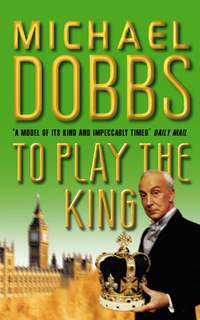
Czytaj książkę: «To Play the King»
MICHAEL DOBBS
TO PLAY THE KING


Copyright
This is entirely a work of fiction. Any references to real people, living or dead, real events, businesses, organizations and localities are intended only to give the fiction a sense of reality and authenticity. All names, characters and incidents are either the product of the author’s imagination or are used fictitiously, and their resemblance, if any, to real-life counterparts is entirely coincidental.
HarperCollinsPublishers Ltd.
1 London Bridge Street
London SE1 9GF
www.harpercollins.co.uk
First published in Great Britain by HarperCollinsPublishers 1992
Copyright © Michael Dobbs 1992, 2014
Michael Dobbs asserts the moral right to be identified as the author of this work
Cover design © HarperCollinsPublishers Ltd 2015
Cover photographs © Shutterstock.com
A catalogue record for this book is available from the British Library
All rights reserved under International and Pan-American Copyright Conventions. By payment of the required fees, you have been granted the non-exclusive, non-transferable right to access and read the text of this ebook on-screen. No part of this text may be reproduced, transmitted, down-loaded, decompiled, reverse engineered, or stored in or introduced into any information storage and retrieval system, in any form or by any means, whether electronic or mechanical, now known or hereinafter invented, without the express written permission of HarperCollins ebooks
HarperCollinsPublishers has made every reasonable effort to ensure that any picture content or written content in this ebook has been included or removed in accordance with the contractual and technological constraints in operation at the time of publication
Source ISBN: 9780006471646
Ebook Edition © APRIL 2015 © ISBN: 9780007397617
Version: 2018-10-08
Praise for To Play the King:
‘With a friend like Michael Dobbs, who on earth needs enemies? Gloriously cheeky. Dobbs’ books grab because of their authenticity’
The Times
‘Highly readable…a model of its kind and impeccably timed’
Daily Mail
Lucy and Andrei
For Medford 1971. For Fiskardon 1981.
For Villars 1991.
For Everything.
Contents
Cover
Title Page
Copyright
Praise
Dedication
Introduction
Prologue
PART ONE
Chapter One
Chapter Two
Chapter Three
Chapter Four
Chapter Five
Chapter Six
Chapter Seven
Chapter Eight
Chapter Nine
Chapter Ten
Chapter Eleven
Chapter Twelve
Chapter Thirteen
Chapter Fourteen
Chapter Fifteen
Chapter Sixteen
Chapter Seventeen
Chapter Eighteen
PART TWO
Chapter Nineteen
Chapter Twenty
Chapter Twenty-One
Chapter Twenty-Two
Chapter Twenty-Three
Chapter Twenty-Four
Chapter Twenty-Five
Chapter Twenty-Six
Chapter Twenty-Seven
Chapter Twenty-Eight
Chapter Twenty-Nine
Chapter Thirty
Chapter Thirty-One
Chapter Thirty-Two
Chapter Thirty-Three
Chapter Thirty-Four
Chapter Thirty-Five
Chapter Thirty-Six
PART THREE
Chapter Thirty-Seven
Chapter Thirty-Eight
Chapter Thirty-Nine
Chapter Forty
Chapter Forty-One
Chapter Forty-Two
Chapter Forty-Three
Chapter Forty-Four
Chapter Forty-Five
Chapter Forty-Six
Epilogue
Keep Reading
About the Author
By Michael Dobbs
About the Publisher
INTRODUCTION
When I wrote To Play the King in 1990 as a sequel to House of Cards, it was partly because I believed that the Royal yacht was heading for turbulent waters. And so it proved to be. I wrote about fractured marriages, financial scandal, political controversy and public humiliations, and for the next few years the Royal Family seemed to follow the script with breathless tenacity. At times it seemed as though various individuals were openly auditioning for parts in the story. If my book was intended to be by way of a warning, as I suppose it was, it failed completely. The House of Windsor was to endure some of its worst moments. The yacht nearly sank and some members of the crew were thrown overboard.
My fictional king isn’t simply a version of Prince Charles – there have been many heirs to the throne who have got themselves into difficulties and I took a little inspiration from more than one – but it was inevitable that some comparisons would be made. At the time I began writing, it was clear that his marriage was falling apart, despite all the official denials, so I decided that my kingly character would have no wife. I hope none of what I wrote amounted to disrespect because that is not what I intended.
In any event, despite those dire years, both he and the institution have displayed their tenacity and powers of recovery, and today they stand higher in public esteem than they have for decades. The Royal yacht sails on.
And so does FU. Nearly thirty years after I created him, he has developed a life of his own, in books, on global television, as a character who has been quoted both in Parliament and the press. Do you suspect he might even have been muttered about in the corners of various palaces? Well, you might say that but I am not going to comment…
M.D. 2013
PROLOGUE
Away with Kings. They take up too much room.
It was the day they would put him to death.
They led him through the park, penned in by two companies of infantrymen. The crowd was thick and he had spent much of the night wondering how they would react when they saw him. With tears? Jeers? Try to snatch him to safety or spit on him in contempt? It depended who had paid them best. But there was no outburst; they stood in silence, dejected, cowed, still not believing what was about to take place in their name. A young woman cried out and fell in a dead faint as he passed, but nobody tried to impede his progress across the frost-hard ground. The guards were hurrying him on.
Within minutes they were in Whitehall, where he was lodged in a small room. It was just after ten o’clock on a January morning, and he expected at any moment to hear the knock on the door that would summon him. But something had delayed them; they didn’t come until nearly two. Four hours of waiting, of demons gnawing at his courage, of feeling himself fall to pieces inside. During the night he had achieved a serenity and sense of inner peace, almost a state of grace, but with the heavy passage of unexpected minutes, growing into hours, the calm was replaced by a sickening sense of panic which began somewhere in his brain and stretched right through his body to pour into his bladder and his bowels. His thoughts became scrambled and the considered words, crafted with such care to illuminate the justice of his cause and impeach their twisted logic, were suddenly gone. He dug his finger nails deep into his palms; somehow he would find the words, when the time came.
The door opened. The captain stood in the dark entrance and gave a curt, sombre nod of his helmeted head. No need for words. They took him and within seconds he was in the Banqueting Hall, a place he cherished with its Rubens ceiling and magnificent oaken doors, but he had difficulty in making out the details through the unnatural gloom. The tall windows had been partially bricked up and boarded during the war to provide better defensive positions. Only at one of the farther windows was there light where the masonry and barricades had been torn down and a harsh grey glow surrounded the hole, like the entrance to another world. The corridor formed by the line of soldiers led directly to it.
My God, but it was cold. He’d had nothing to eat since yesterday, he’d refused the meal they had offered, and he was grateful for the second shirt he had asked for, to prevent him shivering. It wouldn’t do to be seen to shiver. They would think it was fear.
He climbed up two rough wooden steps and bowed his head as he crossed the threshold of the window, onto a platform they had erected immediately outside. There were half a dozen other men on the freshly built wooden stage while every point around was crammed by teeming thousands, on foot, on carriages, on roofs, leaning from windows and other vantage points. Surely now there would be some response? But as he stepped out into the harsh light and their view, their restlessness froze in the icy wind and the huddled figures stood silent and sullen, ever incredulous. It still could not be.
Driven into the stage on which he stood were four iron staples. They would rope him down, spread-eagled between the staples, if he struggled, yet it was but one more sign of how little they understood him. He would not struggle. He had been born to a better end than that. He would but speak his few words to the throng and that would be sufficient. He prayed that the weakness he felt in his knees would not betray him; surely he had been betrayed enough. They handed him a small cap into which with great care he tucked his hair, as if preparing for nothing more than a walk through the park with his wife and children. He must make a fine show of it. He dropped his cloak to the ground so that he might be better seen.
Heavens! The cold cut through him as if the frost were reaching for his racing heart and turning it straightway to stone. He took a deep, searing breath to recover from the shock. He must not tremble! And there was the captain of his guard, already in front of him, beads of sweat on his brow despite the weather.
‘Just a few words, Captain. I would say a few words.’ He racked his mind in search of them.
The captain shook his head.
‘For the love of God, the commonest man in all the world has the right to a few words.’
‘Your few words would be more than my life is worth, Sir.’
‘As my words and thoughts are more than my life to me. It is my beliefs that have brought me to this place, Captain. I will share them one last time.’
‘I cannot let you. Truly, I am sorry. But I cannot.’
‘Will you deny me even now?’ The composure in his voice had been supplanted by the heat of indignation and a fresh wave of panic. It was all going wrong.
‘Sir, it is not in my hands. Forgive me.’
The captain reached out to touch him on the arm but the prisoner stepped back and his eyes burned in rebuke. ‘You may silence me, but you will never make me what I am not. I am no coward, Captain. I have no need of your arm!’
The captain withdrew, chided.
The time had come. There would be no more words, no more delay. No hiding place. This was the moment when both they and he would peer deep inside and discover what sort of man he truly was. He took another searing lungful of air, clinging to it as long as he could as he looked to the heavens. The priest had intoned that death was the ultimate triumph over worldly evil and pain but he discovered no inspiration, no shaft of sunlight to mark his way, no celestial salvation, only the hard steel sky of an English winter. He realized his fists remained clenched with the nails biting into the flesh of his palms; he forced his palms open and down the side of his trousers. A quiet prayer. Another breath. Then he bent, thanking God that his knees still had sufficient strength to guide him, lowering himself slowly and gracefully as he had practised in his room during the night, and lay stretched out on the rough wooden platform.
Still from the crowd there came no sound. His words might not have lifted or inspired them, but at least they would have vindicated. He was drenched in fury as the overwhelming injustice of it all hit him. Not even a chance to explain. He looked despairingly once more into the faces of the people, the men and women in whose name both sides had fought the war and who stood there now with blank stare, ever uncomprehending pawns. Yet, dullards all, they were his people, for whose salvation he was bound to fight against those who would corrupt the law for their own benefit. He had lost, but the justice of his cause would surely be known in the end. In the end. He would do it all again, if he had another chance, another life. It was his duty, he would have no choice. No more choice than he had now on this bare wooden stage, which still smelt of resin and fresh sawdust. And they would understand, wouldn’t they? In the end…?
A plank creaked beside his left ear. The faces of the crowd seemed frozen in time, like a vast mural in which no one moved. His bladder was going – was it the cold or sheer terror? How much longer…? Concentrate, a prayer perhaps? Concentrate! He set on a small boy, no more than eight years old, in rags, with a dribble of crumbs on his dirt-smeared chin, who had stopped chewing his hunk of loaf and whose innocent brown eyes had grown wide with expectation and were focused on a point about a foot above his head. By God, but it was cold, colder than he had ever known! And suddenly the words he had fought so hard to remember came rushing back to him, as though someone had unlocked his soul.
And in the year sixteen hundred and forty-nine, they took their liege lord King Charles Stuart, Defender of the Faith and by hereditary right King of Great Britain and Ireland, and they cut off his head.
In the early hours of a winter’s day, in a bedroom overlooking the forty-acre garden of a palace which hadn’t existed at the time Charles Stuart took his walk into the next life, his descendant awoke with a start. The collar of his pyjama shirt clung damply and he lay face-down on a block-hard pillow stained with sweat, yet he felt as cold as…As cold as death. He believed in the power of dreams and their ability to unravel the mysteries of the inner being, and it was his custom on waking to write down everything he could remember, reaching for the notebook he kept for the purpose beside his bed. But not this time. There was no need. He would never forget the smell of the crowd mixed with resin and sawdust nor the heavy metallic colour of the sky on that frost-ridden afternoon. Nor the innocent, expectant brown eyes of a boy with a dirty chin smeared with crumbs. Nor that feeling of terrible despair that they had kept him from speaking out, rendering his sacrifice pointless and his death utterly in vain. He would never forget it. No matter how hard he tried.
PART ONE
CHAPTER ONE
Never cross an unknown bridge while riding an elephant.
(Chinese proverb)
December: The First Week.
It had not been a casual invitation, he never did anything casually. It had been an insistent, almost peremptory call from a man more used to command than to cajolement. He expected her for breakfast and it would not have crossed his mind that she might refuse. Particularly today, when they were changing Prime Ministers, one out and another in and long live the will of the people. It would be a day of great reckoning.
Benjamin Landless opened the door himself, which struck her as strange. It was an apartment for making impressions, overdesigned and impersonal, the sort of apartment where you’d expect if not a doorman then at least a secretary or a PA to be on hand, to fix the coffee, to flatter the guests while ensuring they didn’t run off with any of the Impressionist paintings enriching the walls. Landless was no work of art himself. He had a broad, plum-red face which was fleshy and beginning to sag like a candle held too near the flame. His bulk was huge and his hands rough, like a labourer’s, with a reputation to match. His Chronicle newspaper empire had been built by breaking strikes as well as careers; it had been as much he as anyone who had broken the career of the man who was, even now, waiting to drive to the Palace to relinquish the power and prestige of the office of Prime Minister.
‘Miss Quine. Sally. I’m so glad you could come. I’ve wanted to meet you for a long time.’
She knew that to be a lie. Had he wanted to meet her before he would most certainly have arranged it. He escorted her into the main room around which the penthouse apartment was built. Its external walls were fashioned entirely of high-impact glass, which offered a magnificent panorama of the Parliament buildings across the Thames, and half a rain forest seemed to have been sacrificed to cover the floor in intricate wooden patterns. Not bad for a boy from the back streets of Bethnal Green.
He ushered her towards an oversized leather sofa in front of which stood a coffee table laden with trays of piping-hot breakfast food. There was no sign of the hidden helper who must only recently have prepared the dishes and laid out the crisp linen napkins. She declined any of the food but he was not offended. He took off his jacket and fussed about his own plate while she took a cup of black coffee and waited.
He ate his breakfast in single-minded fashion; etiquette and table manners were not his strong points. He offered little small talk, his attention focused on the eggs rather than on her, and for a while she wondered if he might have decided he’d made a mistake in inviting her. He was already making her feel vulnerable.
‘Sally Quine. Born in Dorchester, Massachusetts. Aged thirty-two, and a girl who’s already made quite a reputation for herself as an opinion pollster. In Boston, too, which is no easy city for a woman amongst all those thick-headed Micks.’ She knew all about that; she’d married one. Landless had done his homework, had pawed over her past; he wanted to make that clear. His eyes searched for her reaction from beneath huge eyebrows tangled like rope. ‘It’s a lovely city, Boston, know it well. Tell me, why did you leave everything you’d built there and come to England to start all over again? From nothing?’
He paused, but got no reply. ‘It was the divorce, wasn’t it? And the death of the baby?’
He saw her jaw stiffen and wondered whether it was the start of a storm of outrage or a move for the door. But he knew there would be no tears. She wasn’t the type, you could see that from her eyes. She was not unnaturally slim and pinched as the current fashion demanded, her beauty was more classical, the hips perhaps a half-inch too wide but all the curves well defined. She was immaculately presented. The skin of her face was smooth, darker and with more lustre than any English rose, the features carefully drawn as though by a sculptor’s knife. The lips were full and expressive, the cheekbones high, her long hair thick and of such a deep shade of black that he thought she might be Italian or Jewish. Yet her most exceptional feature was her nose, straight and a fraction long with a flattened end which twitched as she talked and nostrils which dilated with emphasis and emotion. It was the most provocative and sensuous nose he had ever seen; he couldn’t help but imagine it on a pillow. Yet the eyes disturbed him, didn’t belong on this face. They were shaped like almonds, full of autumnal russets and greens, translucent like a cat’s, yet hidden behind oversized spectacles. They didn’t sparkle like a woman’s should, like they probably once had, he thought. They had an edge of mistrust, as if holding something back.
She looked out of the window, ignoring him. Christmas was but a couple of weeks away, yet there was no seasonal cheer in the air. The festive spirit lay discarded in the running gutters, and somehow it didn’t seem a propitious day for changing Prime Ministers. A seagull beaten inland by North Sea storms cartwheeled outside the window, its shrieks and insults penetrating the double-glazing, envying them their breakfast before finally tumbling away through the blustery sky. She watched it disappear into the greyness.
‘Don’t expect me to be upset or offended, Mr Landless. The fact that you have enough money and clout to do your homework doesn’t impress me. Neither does it flatter me. I’m used to being chatted up by middle-aged businessmen.’ The insult was intended; she wanted him to know he wasn’t going to get away with one-way traffic. ‘You want something from me. I’ve no idea what but I’ll listen. So long as it’s business.’
She crossed her legs slowly and deliberately so that he would notice. From her days as a child she had had no doubts that men found her body appealing and their excessive attention meant she had never had the opportunity to treat her sex as something to treasure, only as a tool to carve a path through a difficult and ungenerous world. She had decided long ago that if sex were to be the currency of life then she would turn it into a business asset, to open the doors which would otherwise be barred. And men could be such reliable dickheads.
‘You’re very direct, Miss Quine.’
‘I prefer to cut through it rather than spread it. And I can play your game.’ She sat back into the sofa and began counting off the carefully manicured fingers of her left hand. ‘Ben Landless. Age…well, for your well-known vanity’s sake, let’s say not quite menopausal. A rough son-of-a-bitch who was born to nothing and now controls one of the largest press operations in this country.’
‘Soon to be the largest,’ he interrupted quietly.
‘Soon to take over United Newspapers,’ she said, nodding, ‘when the Prime Minister you nominated, backed and got elected virtually single-handed takes over in a couple of hours’ time and waves aside the minor inconvenience of his predecessor’s mergers and monopolies policy. You must’ve been celebrating all night, I’m surprised you had the appetite for breakfast. But you have the reputation of being a man with insatiable appetites. Of all kinds.’ She spoke almost seductively in an accent that had been smoothed and carefully softened but not obliterated. She wanted people to take notice and to remember, to pick her out from the crowd. So the vowels were still New England, a shade too long and lazy for London, and the sentiments often rough as if they had been fashioned straight from the dole queues of Dorchester. ‘So what’s on your mind, Ben?’
A smile played around the publisher’s rubbery lips but his eyes remained unmoved, watching her closely. ‘There is no deal. I backed him because I thought he was the best man for the job. There’s no private pay-off. I shall take my chances, just like all the rest.’
She suspected that was the second lie of the conversation, but let it pass.
‘Whatever else happens, it’s a new era. A change of Prime Minister means fresh challenges. And opportunities. I suspect he’ll be more relaxed about letting people make money than was Henry Collingridge. That’s good news for me. And potentially for you.’
‘With all the economic indicators scooting downhill?’
‘That’s just the point. Your opinion-research company has been in business for…what, twenty months? You’ve made a good start, you’re well respected. But you’re small, and small boats like yours could be swamped if it gets rough over the next couple of years. Anyway, you’ve no more patience than I do in running a shoestring operation. You want to make it big, to be on top. And for that you need cash.’
‘Not your cash. If I had newspaper money poured into my operation it would ruin every shred of credibility I’ve built. My business is supposed to be objective analysis, not smears and scares with a few naked starlets thrown in to boost circulation.’
He ran his thick tongue around his mouth as if trying absent-mindedly to dislodge a piece of breakfast. ‘You underestimate yourself,’ he muttered. He produced a toothpick, which he used like a sword-swallower to probe into a far corner of his jaw. ‘Opinion polls are not objective analysis. They’re news. If an editor wants to get an issue rolling he commissions people like you to carry out some research. He knows what answers he wants and what headline he’s going to run, he just needs a few statistics to give the whole thing the smack of authenticity. Polls are the weapons of civil war. Kill off a government, show the nation’s morals are shot to hell, establish that we all love Palestinians or hate apple pie.’
He grew more animated as he warmed to his theme. His hands had come down from his mouth and were grasped in front of him as if throttling an incompetent editor. There was no sign of the toothpick; perhaps he had simply swallowed it, as he did most things which got in his way.
‘Information is power,’ he continued. ‘And money. A lot of your work is done in the City, for instance, with companies involved in takeover bids. Your little polls tell them how shareholders and the financial institutions might react, whether they’ll be supportive or simply dump the company for a bit of quick cash. Takeover bids are wars, life or death for the companies concerned. That information of yours has great value.’
‘And we charge a very good fee for such work.’
‘I’m not talking thousands or tens of thousands,’ he barked dismissively. ‘That’s petty cash in the City. The sort of information we’re talking about allows you to name your own figure.’ He paused to see if there would be a squawk of impugned professional integrity; instead she reached behind her to pull down her jacket, which had ridden up against the back of the sofa. As she did so she exposed and accentuated the curves of her breasts. He took it as a sign of encouragement.
‘You need money. To expand. To grab the polling industry by the balls and to become its undisputed queen. Otherwise you go belly-up in the recession. Be a great waste.’
‘I’m flattered by your avuncular interest.’
‘You’re not here to be flattered. You’re here to listen to a proposition.’
‘I’ve known that from the moment I got your invitation. Although for a moment there I thought we’d wound up on the lecture circuit.’
Instead of responding, he levered himself out of his chair and crossed to the window. The gun-grey clouds had descended still lower and it had begun to rain again. A barge was battling to make headway through the ebbing tide beneath Westminster Bridge where the December winds had turned the usually tranquil river into a muddy, ill-tempered soup of urban debris and bilge oil. He gazed in the direction of the Houses of Parliament, his hands stuffed firmly into the folds of his tent-like trousers, scratching himself.
‘Our leaders over there, the fearless guardians of the nation’s welfare. Their jobs are full of shared confidences, information waiting to be sensationalized and abused. And every single one of those bastards would leak the lot if it served their purposes. There’s not a political editor in town who doesn’t know every word of what’s gone on within an hour of a Cabinet meeting finishing, nor a general who hasn’t leaked a confidential report before doing battle over the defence budget. And you find me the politician who hasn’t tried to undermine a rival by starting gossip about his sex life.’ His hands flapped in his trouser pockets like the sails of a great ship trying to catch the wind. ‘Prime Ministers are the worst,’ he snorted contemptuously. ‘If they want to rid themselves of a troublesome Minister, they’ll assassinate him in the press beforehand with tales of drunkenness or disloyalty. Inside information. It’s what makes the world go round.’
‘Perhaps that’s why I never went into politics,’ she mused.
He turned towards her, to discover her seemingly engrossed in removing a stray hair from her sweater. When she was sure she had his full attention she stopped toying with him and hid once again inside the folds of her silk-cotton jacket. ‘So what is it you are going to suggest I do?’
He sat down beside her on the sofa. No jacket, only a swathe of tailored shirt, now at close quarters. His physical presence was, surprisingly to her fashion-conscious eye, indeed impressive.
‘I’m going to suggest you stop being an also-ran, a woman who may strive for years to make it to the top yet never succeed. I’m suggesting a partnership. With me. Your expertise’ – they both knew he meant inside information – ‘backed by my financial clout. It would be a formidable combination.’
‘But what’s in it for me?’
‘A guarantee of survival. A chance to make a lot of money, to get where you want to go, to the top of the pile. To show your former husband that not only can you survive without him but even succeed. That’s what you want, isn’t it?’
‘And how is all this supposed to happen?’
‘We pool our resources. Your information and my money. If there’s any action going on in the City, I want to be part of it. Get in there ahead of the pack and the potential rewards are huge. You and I split any profit right down the middle.’
She brought her forefinger and thumb together in front of her face. Her nose offered an emphatic bob. ‘Excuse me, but if I understand you right, isn’t that just the tiniest bit illegal?’
He responded with silence and a look of unquenchable boredom.
‘And it sounds as if you would be taking all the risk,’ she continued.
‘Risk is a fact of life. I don’t mind taking the risk with a partner I know and trust. I’m sure we could get to trust each other very closely.’
He reached out and brushed the back of her hand; a glaze of distrust flashed into her eyes.
‘Before you ask, getting you into bed is not an essential part of the deal – no, don’t look so damned innocent and offended. You’ve been flashing your tits at me from the moment you sat down so let us, as you say, cut through it all and get down to basics. Getting you on your back would be a pleasure but this is business and in my book business comes first. I’ve no intention of cocking up what could be a first-class deal by letting my brains slip between my legs. We’re here to screw the competition, not each other. So…what’s it to be? Are you interested?’
As if on cue a phone began to warble in a distant part of the room. With a grunt of exasperation, he levered himself up, but as he crossed the room to answer the call there was also anticipation; his office had the strictest instruction not to bother him unless…He barked briefly into the phone before returning to his guest, his hands spread wide.
‘Extraordinary. My cup runs over. That was a message from Downing Street. Apparently our new Prime Minister wishes me to call on him as soon as he’s back from the Palace, so I’m afraid I must rush off. Wouldn’t do to keep him waiting.’ His candle-wax face was contorted in what passed for a grin. She would be the focus of his attention for only a few moments longer: another place, another partner beckoned. He was already climbing into his coat. ‘So make it a very special day for me. Accept.’
She stretched for her handbag on the sofa but he was there also, his huge labourer’s hand completely encasing her own. They were very close and she could feel the heat from his body, smell him, sense the power beneath the bulk which was capable of crushing her instantly if he so chose. But there was no threat in his manner, his touch was surprisingly gentle. For a moment she caught herself feeling disarmed, almost aroused. Her nose twitched.
‘You go sort out the nation’s balance of payments. I’ll think about mine.’
‘Think carefully, Sally, and not too long.’
‘I’ll consult my horoscope. I’ll be in touch.’
At that moment the seagull made another screeching attack, hurling insults as it pounded against the window, leaving it dripping with guano. He cursed.
‘It’s supposed to be a lucky omen,’ she laughed lightly.
‘Lucky?’ he growled as he led her out of the door. ‘Tell that to the bloody window cleaner!’
CHAPTER TWO
A man should sleep uneasy in his palace if he wishes to keep it.
It hadn’t been as he had expected. The crowds had been much thinner than in years gone by; indeed, fewer than two dozen people standing outside the Palace gates, skulking tortoise-like beneath umbrellas and plastic raincoats, could scarcely be counted as a crowd at all. Maybe the great British public simply didn’t give a damn any more who their Prime Minister was.
He sat back in the car, a man of bearing and distinction amidst the leather, his tired smile implying a casual, almost reluctant acceptance of his lot. He had a long face, the skin ageing but still taut beneath the chin, austere like a Roman bust with lank silver-sandy hair carefully combed away from the face. He was dressed in his habitual charcoal-grey suit with two buttons and a brightly coloured, almost foppish silk handkerchief which erupted out of the breast pocket, an affectation he had adopted to distance himself from the Westminster hordes in their banal Christmas-stocking ties and Marks & Spencer suits. Every few seconds he would bend low, stretching down behind the seat to suck at the cigarette he kept hidden below the window line, the only outward show of the tension and excitement which bubbled within. He took a deep lungful of nicotine and for a while didn’t move, feeling his throat go dry as he waited for his heart to slow.
The Right Honourable Francis Ewan Urquhart, MP, gave a perfunctory wave to the huddled group of onlookers from the rear seat of his new ministerial Jaguar as it passed into the forecourt of Buckingham Palace. His wife Mortima had wanted to lower the window in order for the assorted cameramen to obtain a better view of them both, but discovered that the windows on the official car were more than an inch thick and cemented in place. She had been assured by the driver that nothing less than a direct hit from a mortar with armour-piercing shells would open them.
The last few hours had seemed all but comic. After the result of the leadership ballot had been announced at six o’clock the previous evening, he had rushed back to his house in Cambridge Street and waited there with his wife. For what, they hadn’t quite known. What was he supposed to do now? There had been no one to tell him. He had hovered beside the phone but it stubbornly refused to ring. He’d rather expected a call of congratulation from some of his parliamentary colleagues, perhaps from the President of the United States or at the very least his aunt, but already the new caution of his colleagues towards a man formerly their equal and now their master was beginning to exert itself; the President wouldn’t call until he’d been confirmed as Prime Minister and his aged aunt apparently thought his telephone would be permanently engaged for days. In desperation for someone with whom to share their joy, he and Mortima took to posing for photo calls at the front door and chatting with the journalists on the pavement outside.
Urquhart, or FU as he was often known, was not naturally gregarious, a childhood spent roaming alone with no more than a dog and a satchelful of books across the heathers of the family estates in Scotland had attuned him well to his own company, but it was never enough. He needed others, not simply to mix with but against whom to measure himself. It was what had driven him South, that and the financial despair of the Scottish Highlands. A grandfather who had died with no thought of how to avoid the venality of the Exchequer; a father whose painful sentimentality and attachment towards tradition had brought the estate’s finances to their knees. He had watched his parents’ fortunes and their social position wither like apple blossom in snow. Urquhart had got out while there was still something to extract from the heavily mortgaged moors, ignoring his father’s entreaties on family honour which in despair had turned to tearful denunciation. It had been scarcely better at Oxford. His childhood companionship with books had led to a brilliant academic career and to a readership in Economics, but he had not taken to the life. He had grown to despise the crumpled corduroy uniforms and fuzzy moralizing which so many of his colleagues seemed to dress and die in, and found himself losing patience with the dank river mists which swept off the Cherwell and the petty political posturings of the dons’ dinner table. One evening, the Senior Common Room had indulged in mass intellectual orgasm as they had flayed a junior Treasury Minister within an inch of his composure; for most of those present it had merely confirmed their views of the inadequacies of Westminster, for Urquhart it had reeked only of the opportunities. So he had turned his back on both the teeming moors and dreaming spires and had risen fast, while taking great care all the while to preserve his reputation as an academic. It made other men feel inferior, and in politics that was half the game.
It was only after his second photo call, about 8.30 p.m., that the telephone jumped back to life. A call from the Palace, the Private Secretary. Would he find it convenient to come by at about nine tomorrow morning? Yes, he would find that most convenient, thank you. Then the other calls began to flow in. Parliamentary colleagues unable any longer to control their anxieties about what job he might in the morning either offer to or strip from them. Newspaper editors uncertain whether to fawn or threaten their way to that exclusive first interview. Solicitous mandarins of the civil service anxious to leave none of the administrative details to chance. The chairman of the party’s advertising agency who had been drinking and couldn’t stop gushing. And Ben Landless. There had been no real conversation, simply coarse laughter down the phone line and the unmistakable sound of a champagne cork popping. Urquhart thought he might have heard at least one woman giggling in the background. Landless was celebrating, as he had every right to. He had been Urquhart’s first and most forthright supporter, and between them they had manoeuvred, twisted and tormented Henry Collingridge into premature retirement. Urquhart owed him, more than he could measure, while characteristically the newspaper proprietor had not been coy in identifying an appropriate yardstick.
He was still thinking about Landless as the Jaguar shot the right-hand arch at the front of the Palace and pulled into the central courtyard. The driver applied the brakes cautiously, aware not only of his regal surroundings but also of the fact that you cannot stop more than four tons of reinforced Jaguar in a hurry without making life very uncomfortable for the occupants and running the risk of triggering the automatic panic device which transmitted a priority distress alert to the Information Room at Scotland Yard. The car drew to a halt not beneath the Doric columns of the Grand Entrance used by most visitors but beside a much smaller door to the side of the courtyard, where, smiling in welcome, the Private Secretary stood. With great speed yet with no apparent hurry, he had opened the door and ushered forward an equerry to spirit Mortima Urquhart off for coffee and polite conversation, while he led Urquhart up a small but exquisitely gilded staircase to a waiting room scarcely broader than it was high. For a minute they hovered, surrounded by oils of Victorian horse-racing scenes and admiring a small yet uninhibited marble statue of Renaissance lovers until the Private Secretary, without any apparent consultation of his watch, announced that it was time. He stepped towards a pair of towering doors, knocked gently three times and swung them open, motioning Urquhart forward.
‘Mr Urquhart. Welcome!’
Against the backdrop of a heavy crimson damask drape which dressed one of the full-length windows of his sitting room stood the King. He offered a nod of respect in exchange for Urquhart’s deferential bow and motioned him forward. The politician paced across the room and not until he had almost reached the Monarch did the other take a small step forward and extend his hand. Behind Urquhart, the doors had already closed; the two men, one ruler by hereditary right and the other by political conquest, were alone.
Urquhart remarked to himself how cold the room was, a good two or three degrees below what others would regard as comfortable, and how surprisingly limp the regal handshake. As they stood facing each other neither man seemed to know quite how to start. The King tugged at his cuffs nervously and gave a tight laugh.
‘Worry not, Mr Urquhart. Remember, this is the first time for me, too.’ The King, heir for half a lifetime and Monarch for less than four months, guided him towards two chairs which stood either side of a finely crafted white stone chimneypiece. Along the walls, polished marble columns soared to support a canopied ceiling covered in elaborate classical reliefs of Muses, while in the alcoves formed between the stone columns were hung oversized and heavily oiled portraits of royal ancestors painted by some of the greatest artists of their age. Hand-carved pieces of furniture stood around a huge Axminster, patterned with ornate red and gold flowers and stretching from one end of the vast room to the other. This was a sitting room, but only for a king or emperor, and it might not have changed in a hundred years. The sole note of informality was struck by a desk, placed in a distant corner to catch the light cast by one of the garden windows and completely covered by an eruption of papers, pamphlets and hooks which all but submerged the single telephone. The King had a reputation for conscientious reading; from the state of his desk it seemed a reputation well earned.
‘I’m not quite sure where to start, Mr Urquhart,’ the King began as they settled in the chairs. ‘We are supposed to be making history but it appears there is no form for these occasions. I have nothing to give you, no rich words of advice, not even a seal of office to hand over. I don’t have to invite you to kiss my hand or take any oath. All I have to do is ask you to form a Government. You will, won’t you?’
The obvious earnestness of his Sovereign caused the guest to smile. Urquhart was in his early sixties, ten years older than the King, although the difference appeared less; the younger man’s face was stretched and drawn beyond its years with a hairline in rapid retreat and the beginnings of a stoop. It was said that the King had replaced his complete lack of material concerns with a lifetime of tortured spiritual questioning, and the strain was evident. While Urquhart had the easy smile and small talk of the politician, the intellectual aloofness of an academic and the ability to relax of a man trained to dissemble and if necessary to deceive, the King had none of this. Urquhart felt no nervousness, only the cold; indeed, he began to pity the younger man’s gravity. He leaned forward.
‘Yes, Your Majesty. It will be my honour to attempt to form a Government on your behalf. I can only hope that my colleagues won’t have changed their minds since yesterday.’
The King missed the mild humour as he struggled with his own thoughts, a deep furrow slicing across the forehead of a face which had launched a million commemorative mugs, plates, tea trays, T-shirts, towels, ashtrays and even the occasional chamber pot, most of them made in the Far East. ‘You know, I do hope it’s auspicious, a new King and new Prime Minister. There’s so much to be done. Here we are on the very brink of a new millennium, new horizons. Tell me, what are your plans?’
Urquhart spread his hands wide. ‘I scarcely…there’s been so little time, Sir. I shall need a week or so, to reshuffle the Government, set out some priorities…’ He was waffling. He knew the dangers of being too prescriptive and his leadership campaign had offered years of experience rather than comprehensive solutions. He treated all dogma with a detached academic disdain and had watched with grim satisfaction while younger opponents tried to make up for their lack of seniority with detailed plans and promises, only to discover they had advanced too far and exposed vulnerable ideological flanks. Urquhart’s strategy for dealing with aggressive questioning from journalists had been to offer a platitude about the national interest and to phone their editors; it had got him through the twelve tumultuous days of the leadership race, but he had doubts how long such a game plan would last. ‘Above all, I shall want to listen.’
Why was it that politicians uttered such appalling clichés, which their audiences nevertheless seemed so blithe to accept? The Monarch was nodding his head in silent agreement, his tense body rocking gently to and fro as he sat on the edge of his chair. ‘During your campaign you said that we were at a crossroads, facing the challenges of a new century while building on the best from the old. “Encouraging change while preserving continuity.”’
Urquhart acknowledged the phrase.
‘Bravo, Mr Urquhart, more power to your hand. It’s an admirable, summation of what I believe my own job to be, too.’ He grasped his hands together to form a cathedral of bony knuckles, his frown unremitting. ‘I hope I shall be able to find – that you will allow me – some way, however small, of helping you in your task.’ There was an edge of apprehension in his voice, like a man accustomed to disappointment.
‘But of course, Sir, I would be only too delighted…did you have anything specific in mind?’
The King’s fingers shifted to the knot of his unfashionably narrow tie and twisted it awkwardly. ‘Mr Urquhart, the specifics are the stuff of party politics, and that’s your province. It cannot be mine.’
‘Sir, I would be most grateful for any thoughts you have…’ Urquhart heard himself saying.
‘Would you? Would you really?’ There was a rising note of eagerness in his voice, which he tried to dispel, too late, with a chuckle. ‘But I must be careful. While I was merely heir to the Throne I was allowed the luxury of having my own opinions and was even granted the occasional privilege of expressing them, but Kings cannot let themselves be dragged into partisan debate. My advisers lecture me daily on the point.’
‘Sir,’ Urquhart interjected, ‘we are alone. I would welcome any advice.’
‘No, not for the moment. You have much to do and I must not delay you.’ He rose to indicate that the audience was at an end, but he made no move towards the door, steepling his fingers to the point of his bony, uneven nose and remaining deep in thought, like a man at prayer. ‘Perhaps – if you will allow me? – there is just one point. I’ve been reading the papers.’ He waved towards the chaos of his desk. ‘The old Department of Industry buildings on Victoria Street, which are to be demolished. The current buildings are hideous, such a bad advertisement for the twentieth century, they deserve to go. I’d love to drive the bulldozer myself. But the site is one of the most important in Westminster, near the Parliament buildings and cheek by jowl with the Abbey itself, one of our greatest ecclesiastical monuments. A rare opportunity for us to grasp, don’t you think, to create something worthy of our era, something we can pass on to future generations with pride? I do so hope that you, your Government, will ensure the site is developed…how shall I put it?’ The clipped boarding-school tones searched for an appropriately diplomatic phrase. ‘Sympathetically.’ He nodded in self-approval and seemed emboldened by Urquhart’s intent stare. ‘Encouraging change while preserving continuity, as one wise fellow put it? I know the Environment Secretary is considering several different proposals and, frankly, some of them are so outlandish they would disgrace a penal colony. Can’t we for once in our parsimonious lives make a choice in keeping with the existing character of Westminster Abbey, create something which will respect the achievements of our forefathers, not insult them by allowing some misguided modernist to…’ – his lips quivered in indignation – ‘to construct a stainless-steel mausoleum which crams people on the inside and has its mechanical entrails displayed without?’ Passion had begun to overtake the diffidence and a flush had risen to colour his cheeks.
Urquhart smiled in reassurance, an expression which came as easily as oxygen. ‘Sir, I can assure you that the Government’ – he wanted to say ‘my Government’ but the words still seemed to dry behind his dentures – ‘will have environmental concerns at the forefront of their considerations.’ More platitudes, but what else was he supposed to say?
‘Oh, I do hope so. Perhaps I should apologize for raising the matter, but I understand the Environment Secretary is to make a final decision at any time.’
For a moment, Urquhart felt like reminding the King that it was a quasi-judicial matter, that many months and more millions had been poured into an official planning inquiry which now awaited the Solomon-like deliberation of the relevant Minister. Urquhart might have suggested that, to some, the King’s intervention would look no better than jury-nobbling. But he didn’t. ‘I’ll look into it. You have my word, Sir.’
The King’s pale blue eyes had a permanent downward cast which made him appear always sincere and frequently mournful as though burdened by some sense of guilt, yet now they sparkled with unmistakable enthusiasm. He reached out for the other man’s hand. ‘Mr Urquhart, I believe we are going to get along famously.’
Seemingly unbidden, the King’s Private Secretary was once more at the open doors and with a bow of respect Urquhart made his way towards them. He had all but crossed the threshold when he heard the words thrown after him. ‘Thank you once again, Prime Minister!’
Prime Minister. There it was. The first time. He’d done it.
‘So…what did he say?’ They were in the car on the way to Downing Street before his wife roused him from his reverie.
‘What? Oh, not a lot. Wished me well. Talked about the great opportunities ahead. Went on about a building site near Westminster Abbey. Wants me to ensure it’s built in mock Tudor or some such nonsense.’
‘Will you humour him?’
‘Mortima, if sincerity could build temples then the whole of England would be covered in his follies, but this is no longer the Dark Ages. The King’s job is to give garden parties and to save us the bother of electing someone else president, not to go round interfering.’
Mortima snorted her agreement as she fumbled impatiently through her bag in search of lipstick. She was a Colquhoun by birth, a family which could trace its descent in direct line from the ancient kings of Scotland. They had long since been stripped of the feudal estates and heirlooms, but she had never lost her sense of social positioning or her belief that most modern aristocracy were interlopers – including ‘the current Royal Family’, as she would frequently put it. Royalty was merely an accident of birth, and of marriage and of death and the occasional execution or bloody murder; it could just as easily have been a Colquhoun as a Windsor, and all the more pure stock for that. At times she became distinctly tedious on the subject, and Urquhart decided to head her off.
‘Of course I shall humour him. Better a King with a conscience than not, I suspect, and the last thing I need is sour grapes growing all over the Palace. Anyway, there are other battles to be fought and I want him and his popularity firmly behind me. I shall need it.’ His tone was serious and his eyes set upon a future of perceived challenges. ‘But at the end of the day, Mortima, I am the Prime Minister and he is the King. He does what I tell him to, not the other way around. The job’s ceremony and sanctimony, that’s all. He’s the Monarch, not a bloody architect.’
They were driving past the Banqueting Hall in Whitehall, slowing down as they approached the barriers at the head of Downing Street, and Urquhart was relieved to see there were rather more people here to wave and cheer him on for the benefit of the cameras than at the Palace. He thought he recognized a couple of young faces, perhaps party headquarters had turned out their rent-a-crowd. His wife idly slicked down a stray lock of his hair, while his mind turned to the reshuffle and the remarks he would make on the doorstep, which would be televised around the world.
‘So what are you going to do?’ Mortima pressed.
‘It really doesn’t matter,’ Urquhart muttered out of the corner of his mouth as he smiled for the cameras as the car turned into Downing Street. ‘As a new King the man is inexperienced, and as constitutional Monarch he is impotent. He has all the menace and bite of a rubber duck. But fortunately, on this matter, I happen to agree with him. Away with modernism!’ He waved as a policeman came forward to open the heavy car door. ‘So it really can’t be of any consequence…’
Darmowy fragment się skończył.