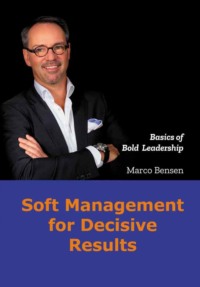
Czytaj książkę: «Soft Management for Decisive Results»
Marco Bensen
Soft Management for Decisive Results
Basics of Bold Leadership
Impressum

Bibliographic information from the German National Library:
The Deutsche Bibliothek lists this publication in the Deutsche Nationalbibliografie; detailed bibliographic data are available on the Internet at http://dnb.de
Editor: Marco Bensen
Bensen Coaching & Consulting
Hohegrabenweg 42a
40667 Meerbusch
Coverpicture: © Oliver Druse. Snap Count Shootings
This work is protected by copyright. Any use is only permitted with the consent of the author. This applies in particular to duplication and processing in electronic systems.
About the Author
Marco Bensen has been in management positions in the hotel industry for over 25 years, including many years as General Manager and Area General Manager. His career began at the Hotel Management School Groningen (NL) and led him internationally through several positions, in several hotel chains, in many cities and countries. In addition to his professional activities, Marco also volunteered as chairman, board member and board member of various associations and clubs and an academy. In addition to his mother tongue Dutch, Marco speaks German, English, Spanish and French.
In addition to all these experiences, Marco has deepened his knowledge and skills with a master‘s degree in Hospitality Management from the renowned University of Brighton. He dedicated his thesis to the topic of leadership. Over several decades, Marco has processed hundreds of books, countless reports, journals, texts, theories and online material on leadership, organizational development and personal development.
His passion for leadership was inspired by countless personal encounters with leaders from all kinds of industries, fantastic personalities, sensational and not-so-sensational superiors, and an incredible number of wonderful employees and colleagues. Not only did excellent leadership serve as an inspiration and example, he also learned from a lack of leadership and poor interactions with employees by average managers.
Motivation, productivity, effectiveness and ultimately the organizational and financial results, are fully dependent on the quality of leadership in the organization.
Content
About the Author
Foreword
Soft Management and Hard Management
Introduction
Soft vs. Hard Management
Focus of Management
Theory X and Y and their self-fulfilling prophecy
Effectiveness vs. Efficiency
Authority? Of course! Authoritarian? No way!
Authoritarian
Authority
Humility – Servant Leadership
Ego
Hierarchy
Flat or steep Hierarchy?
Informality or formality?
Unconventional thinkers and crazy people
Works Council
Trust
The value of trust
Conditional or unconditional trust
Communication
The value of communication
Verbal and non-verbal communication
The quality of communication
Listening
Feedback
Methods of conducting conversations
Leadership qualities
Human Potential Leadership
Employees: costs, resources or potential?
Employees as a cost factor?
The role of human potential management
The value of human potential leaders
Customer or employee: who is more important?
Employee Experience
The value of employee satisfaction
Top info for hard managers
Employee satisfaction factors
Employee dissatisfaction
The job should be fun
Vision, mission, guiding principles and staff programmes.
Remuneration models and working conditions
Payroll and Benefits
Tarif & Co
Special and additional benefits
Working Environment, Work Form and ‘New Work’
New Work
Leadership 4.0
Training and further education
Cost or investment?
Advantages and disadvantages of training and further education
Coaching, Mentoring
Recruitment
Recruitment needs
Recruitment process
References
It is up to us leaders, to focus on the essentials of an organization - leadership and employee focus - to strengthen the organization and bring it forward sustainably. Marco Bensen
Foreword
Anyone can perform hard management; you just focus on the numbers and only care about the employees to a limited extent. And of course, you do that under the safe protection of your own ego. But is it effective? To be sure, it has nothing to do with leadership. Leadership means taking care of employees. If you deal with your employees in a correct way - generously, supportively, trustingly, openly communicating, informing, participating - then employees will be more motivated, have a greater commitment, and accordingly will perform better.
In short: Leadership leads to better economic results.
For me, bold leadership means having the courage to step beyond the limits of your own inner world and to open up and dedicate yourself to the environment. To do this, you have to move out of the comfort zone of your protective ego. You will only be able to look after your employees, if you have the courage to do so. So, it takes a strong personality to engage in bold leadership.
This book serves to share bold and disruptive leadership techniques with executives. There is a lot of material on leadership; books, articles, interviews, studies, videos and personal experiences that are shared publicly. Many experts are very educated, have a lot of expertise, and apply scientific studies. However, you have to filter heavily in order to find the information you need bundled together.
It starts with the questions: What is leadership? How do you define leadership? If you look at the definition from various experts, you get as many different results. However, there are topics about which there is a consensus and there are some terms that are mentioned again and again: Leadership is about people; Leadership is about inspiration, motivation and vision; Leadership is about development, integrity, empathy and goals; Leadership is a skill that can be learned.
I have had my personal definition of leadership for a very long time and it is based precisely on this premise: Leadership is the ability to motivate people independently in the direction of a common goal by means of integrity, inspiration, and support, with the help of a vision.
For everyday life, however, I use a simple definition that also fits more with bold leadership and simple leadership
Leadership is easy: Just take care of your people! Marco Bensen
I will never claim that I know more than others. However, I can definitely say that I have examined, studied, and collected significant information from theory and practice on all leadership topics, including 25 years of leadership experience. In addition to studies, seminars, books and articles, this also includes a large number of personal conversations with real leaders from various industries. Combining all this theoretical and practical information, I have synthesized highly solid information on leadership. You will find it all in this book, so all you need to do is process the information and filter out what you need.
You will find that I am an absolute believer in soft management – soft leadership. Put simply, that means having a positive focus on employees. Only inspired and satisfied employees will achieve optimal performance in the mid- and long term. Soft management is by no means about softness, about an ideal world or being sweet and nice. It’s about tough facts like performance, goals, and results. For me, employee-oriented leadership is the true spirit of leadership.
The hotel and catering industry, where I was privileged to gain my experience, is part of the service industry and as such, an industry par excellence where people management plays an absolutely crucial role. However, leadership principles are universal and apply to all industries and organizations that work with people. Bad people management will lead to even the most well-regarded company performing far below its potential. Proper people management and leadership, on the other hand, will do wonders and will also jumpstart even a mediocre company into top performance.
Soft Management and Hard Management
Introduction
Leadership is easy: Take care of your people and both you and your organization will be successful.
As simple as this sounds, obviously it is more difficult in day-to-day life. There are so many great managers out there, but finding the right leaders is another issue. How do you recognize leaders? Well, leaders move us and they inspire us to perform at our best. True leadership is not tangible, but you know when it is there; it works through emotion, inspiration ... and through success.
Leadership is all about people; it’s about inspiring people to believe in themselves. To believe that anything is possible and to believe in something much greater than your own self-preservation. When we have that kind of influence as leaders, great things happen. Thomas Gifford
In the several decades that I have been working in the hotel industry, I have met countless executives at different levels. Some were my direct superiors while others worked at a different or higher level in the organization, but many were also colleagues on an equal level or managers who reported to me.
And of course, I also ran into many executives from other organizations and industries. There were so many inspiring executives who really had something to show for themselves, who could think outside the box, and from whom one could really learn a lot. They understood how to set an example, how to communicate properly with others, how to get people going, and how to focus on the right things.
On the other hand, I have also met executives who (mostly unconsciously) slowed others down, who covered up their insecurity with arrogance, and who had their focus on anything but the team. You can learn a lot from both types of manager; however, the important thing is understanding what to apply and what to avoid from what you have learned.
In any case, the leadership styles of these two manager-types can clearly be differentiated from each other. Executives who don’t have their employees behind them, lead with a clear focus on the hard side of management. Executives who understand leadership and who are able to inspire others, generally have a soft leadership style.
Soft vs. Hard Management
Focus of Management
In management there is a continuum between hard and soft.
The hard part is management that creates plans, sets up structures and monitors the performance. Focus is on the task and on the results. Management is more aggressive and it’s all about the bottom line.
With soft management on the other hand, focus is on employees. It is a humane management style that is largely based on emotions and in which the focus is on dealing with each other and on communication.
Let me add right here that soft management is by no means about soft personalities. On the contrary, it takes a strong leadership personality to apply soft management. Executives cannot afford to be insecure and have a too much self-doubt. They need the focus for the personalities in the team and the related needs and emotions. Herewith it is also said that hard management doesn’t need a tough cookie to implement it. Hard management can be carried out by both strong and weak managers. For soft management and bold leadership, it definitely requires a strong leader.
“The challenge of leadership is to be strong but not rude; to be kind but not weak; to be brave but not intimidating; to be thoughtful but not lazy; to be humble but not shy; to be proud but not arrogant; To have a sense of humor, but without being a fool. “ Jim Rohn
Soft management – motivating employees and giving meaning to work – has nothing to do with pampering the staff; it is all about respect for individuals. And it’s about the realization, that encouragement, freedom, support and good communication enable employees to develop themselves and to make a valuable contribution to the team and the company.
It is important not to confuse soft and hard management with soft and hard skills, even though there are overlaps. Hard skills relate to characteristics such as competencies and knowledge. Soft skills are about personality traits and skills like leadership style, communication skills, etc. Managers need both distinctive hard skills and soft skills to be successful. However, expertise does not come overnight, it has to be built up. Soft skills form the basis on which the hard skills can develop.
It permeates mercilessly through all organizations: Soft leadership, i.e., positive focus on people, moves an organization forward. Hard leadership, i.e., focusing exclusively on results, leads to decay in the medium and long term.
Too much focus on the hard side of management can lead to linear performance improvement at best. However, a focus on the soft, non-linear side will lead to exponential performance improvement.
Soft management is indisputably the more effective management style; it is the true spirit of leadership and achieves better results than hard management.
Theory X and Y and their self-fulfilling prophecy
Theories X and Y are leadership philosophies, recognized in theory and science, developed by American management professor Douglas McGregor. The leadership styles used here are based on assumptions about human nature in relation to behaviour at work.
Theory X represents leadership by authority, since it assumes that humans are inherently lazy and perceive work as negative. In this theory employees do not develop their own motivation but must receive their impetus from outside. Work functions solely through guidance and complete external control is therefore required. Managers who see their employees in this way and who advocate this management philosophy must necessarily apply an authoritarian management style. Otherwise, at least in their eyes, the organization cannot function correctly. Basically, with Theory X, there is distrust on both sides.
The central principle of Theory Y is that employees are perceived positively. This management philosophy assumes that employees are quite ambitious, identify themselves with the objectives of the organization, and thus develop an inner motivation that makes external control superfluous. The transfer of responsibility and trust are natural, and employees act proactively.
Theory Y embodies soft leadership, Theory X hard. These theories are quite black and white and mutually exclusive (Theory Z was later developed as a compromise solution to this; however, it has not really established itself). We can use this to represent management philosophies or leadership styles and, above all, their potentials and dangers.
“Leaders are responsible for creating an environment in which people feel at their best.” Simon Sinek
Both theories cause a self-fulfilling prophecy of which managers are unfortunately far too little aware. Managers who apply Theory X, i.e. who give employees little or no freedom and no trust, provoke passive work behaviour and a lack of commitment. This then leads to employees only doing their job by the book and not taking any initiatives or responsibility. This in turn leads to the manager seeing his assumptions about the employees’ work behaviour confirmed. This manager, of course, does not see that his own lack of leadership is the trigger for this situation, and thus there is no other way out than to continue to lead in an authoritarian manner in order to keep things from falling apart.
This self-fulfilling prophecy also applies to Theory Y, only then in reverse and in a positive sense. Trusting and supportive leadership promotes independence, responsibility and performance.
Surely, we do not need to discuss at length which of the leadership philosophies X or Y fits better in our time of modern leadership.
Effectiveness vs. Efficiency
Effective leaders have the ability to constantly move themselves and others into action because they understand the invisible forces that shape us. It is about motivation, development, persuasion, and setting achievable goals. This is sustainable and it has to do with courageous leadership. Effective leaders have the ability to get the job done cost-effectively.
Commonly used terms in management and leadership are efficiency and effectiveness. Very often I have noticed that these terms are unquestioningly mixed together and used indiscriminately, even though they are substantially different.
Efficiency is about getting more done with less effort and is often about cost. Efficiency focuses on short-term results and is not concerned with quality, sustainability, or motivation.
Effectiveness, on the other hand, not only focuses on achieving goals but also on the right way to achieve that goal. Effectiveness is a longer-term approach and thus focuses on sustainable results. If one wants to move an organization forward, it will not be enough to proceed efficiently. One must then make effective decisions and take effective actions.
“Efficiency means doing things right; effectiveness means doing the right things.” Peter Drucker
The quote above was also used by Stephen Covey, only he replaced efficiency with management and effectiveness with leadership. When two of the greatest management and leadership experts of our time combine these terms, then most probably there is something to it.
Both effectiveness and efficiency are necessary in work processes and there are many implementation strategies in which efficiency is required. In leadership, however, effectiveness is more in demand than efficiency.
For example, imagine a full restaurant with 100 seats, with only one person in the kitchen and one person serving. This staff scheduling is definitely very efficient but also clearly not effective. Not only will you have all your guests running away due to lack of quality and long waiting times, but you will also lose your staff because they simply won’t go along with it. Efficiency is a tool for managers; effectiveness is a tool for leaders.
It’s about the effectiveness of leadership styles based on commitment and trust in middle management. Of course, this requires anything but an authoritarian leadership style.
Key takeaways
Hard management focuses on plans, structures and the task. Soft’ management focuses on the people
It takes a strong leader to implement soft management.
Theory X is based on authoritarian leadership, Theory Y is based on soft leadership.
Management concerns efficiency, leadership concerns effectiveness.
Authority? Of course! Authoritarian? No way!
Authoritarian
Believe it or not, they still exist: authoritarian leaders who see themselves as being the top of an organization or team and act accordingly. They are autocrats who only occasionally, for token reasons, tolerate another person’s opinion, and they are often supporters of theory X. The only reason that this type of leader is no longer as clearly perceived as the choleric patriarch was in the past is that today’s authoritarian leader has become cleverer and can package his/her appearance better. Nevertheless, they still exist. Being authoritarian is too often still seen as a virtue in leadership circles. You’ve earned it, you’re ‘important’, and therefore you have the ‘right’ to be more ruthless. Whether these authoritarian leaders are actually smarter, have better ideas, make better suggestions, know more or are ultimately more valuable is irrelevant; they are simply the ‘boss’.
However, we also have to make this claim a little more precise and put it into perspective. An organization needs decisive and dynamic leaders who, because of their role, can sometimes appear dominant. If the leader is too considerate in situations where quick action is required, then damage can be done, and that doesn’t help either. An organization needs leaders who can apply an authoritarian leadership style when the situation demands it, but only then. This applies, for example, to crisis situations and conflicts, when decisive action is primarily required. In such cases, we are clearly talking about a situational authoritative leadership style and not an authoritarian personality.
However, we are not talking about snapshots and situational behaviour here, but about fundamental behaviour. Decision-making and being an active superior also requires a high degree of prudence and responsiveness to employees. If this is not the case, there is a danger of being too authoritarian, with all the corresponding negative side effects.
Authoritarian personalities are often not in control of and are in fact led by their ego. Studies have found that authoritarian behaviour has its origins in the past, usually the childhood of the authoritarian person. Narcissistic feelings of inferiority, powerlessness and individual insignificance have been developed at some point and are then rationalized by the affected person (the authoritarian) as love or loyalty. In the ‘flight into authoritarianism’, the independence and integrity of the self is abandoned.
To some extent, authoritarian personalities are thus also victims of their situation. They need compensation for an emotional or mental deficit and find it by acquiring a position of power. And the best way to do that is through an authoritarian demeanour. An additional problem is that such personalities need this compensation in order to survive. The fear of losing the power position leads to a reinforcement of the authoritarian behaviour. So, it does not get better and such vicious circles can be demotivating for any organization or for a team and thus it is destructive.
However, even if the authoritarian behaviour of a leader is not self-inflicted, this is no justification in a business enterprise to tolerate this destructive behaviour. Authoritarian behaviour only serves the authoritarian leader and not the good of the team.
“If authority is complete, then so is the madness of the man who declares it, and so is the potential for abuse of power.” Rick Wilson
In the many years that I have worked in the dynamic hotel industry, which is focused on profitability, I have met many managers with many different leadership styles. I have never met an authoritarian leader who got the maximum out of his team. Under such a leader, employees rarely did what they were really capable of, but only what they had to. Authoritarian leaders fail to unlock potential in their employees because of their misplaced focus. And in the end, an organization is about getting the most out of its people and its team in order to achieve the best possible results in the long term.
Leaders know this and will not accept too much authoritarian behaviour on the part of the managers in the company, so that existence of the teams and their results are not endangered.
In general, criticism of authoritarian leadership styles is getting louder these days and new generations are acting differently. Start-ups and agencies are leading the way. They want to build social connections in every department and perceive themselves as a team to get the most out of a company. Very few supervisors want to appear authoritarian and dominant. They respect each employee as an individual and want to benefit from their core competencies and advantages. An employee will best contribute to a team if he/she has the feeling to play an important role in the company. If his/her wishes, ideas or food for thought remain unheard, he/she will keep them to him/herself in the future and not use them profitably for the company.
Authority
There is a crucial difference between authority and authoritarian:Authority is a personality trait, an aura that a person has. Authoritarian refers to a person’s behaviour.
Authority is only authentic and valuable when it is bestowed upon one and not when it has to be demanded or forced, as in the case of an authoritarian person.
“A leader who refers to his titles relies heavily on positional power to get things done. A natural leader can mobilize others without formal authority.” Gary Hamel
Originally - in the times of ancestors - authority was basically based on competence and physical strength. The one who could do something very well or who was the best, also had the authority in the respective field.
Our society today is much larger, much more complex and often authority based on competence is replaced by authority based on social status. Although competence is still important for achieving a certain level of authority, it is no longer the main prerequisite. Authority based on social status is based on the ability to perform certain social functions and it is also based on the personality of a person who has achieved a high level of self-realization and integration. Such a highly developed individual radiates authority without flexing his muscles. This also distinguishes us from the animal world, where authority based on physical strength is usually still decisive.
Now I don’t want to claim that authoritarian leaders who appear excessively strong are animalistic. However, such personalities do lack a certain social development or social understanding, the sense of the ‘whole’. Yet it is precisely this social competence that makes a leader who uses authority to lead his team or organization to peak performance. This is because authority, regardless of position, is indispensable in an organization. It gives team members support and orientation and opens up possibilities for better results. Various studies confirm that people follow authority because it makes them better and moves them forward. Positive authority supports our development. It is then not far-fetched to claim that authority based on strongly developed social skills, i.e., leadership, moves an organization and its results ahead.
Humility – Servant Leadership
It’s not about you! It’s about the others, your team, your organization, the partners, the results. Your role as a leader is to help. Apart from the terms ‘authoritarian’ or ‘authority’, leaders are by no means ‘special’ people and they are not more important than anyone else. However, leaders have certain skills that others don’t have and that makes them valuable to people and to organizations.
“When you were appointed a leader, you were not given a crown. You were given the responsibility to bring out the best in others.” Jack Welch
Leaders also will never claim to be managers, to be ‘the boss’ or to be important. They are simply there to help.
Ego
“The two biggest obstacles to good decision making are your ego and your ignorance,” says stock market guru Ray Dalio. His thesis is confirmed by many experts who study the subject. When a leader needs to make good, informed decisions, he is able to leave his ego out of it.
Oh yes, we all have egos, and that’s a good thing, otherwise we wouldn’t survive at all. Our ego protects us and helps us take care of ourselves when necessary. The question is, when do we let our ego take precedence and when do we hold it back? Are we able to control our ego? We have already found that authoritarian personalities often are not able to control their ego and are accordingly led by it. This leads to situations in which they appear authoritarian, arrogant, harsh or inconsiderate, regardless of whether this is appropriate or what effect it has on the environment.
“Do not strive to be a successful person; strive to be a valuable one.” Albert Einstein
Bold leaders have a firm grip on their ego and do not make the mistake of letting it lead them. They understand that leadership is ‘influence’, and that the quality of that influence is critical to the team and the organization. Leaders do not lead for themselves, but for a greater good. This is authentic leadership or better, servant leadership.
Servant leadership is more an attitude than a leadership style and is indisputably highly valuable in organizations and teams. Such leaders see themselves as servants of the team and have as a goal to lead the team members to high performance.
As a Servant Leader, you first and foremost need the ability to lead yourself. Do you know yourself? Do you know your strengths, weaknesses, skills and knowledge? Do you know your values, preferences, personality type and representation system? Do you know where you are going, where you want to go and why you want to go there? Are you satisfied with yourself? Only if you can lead yourself, you can take along others with you.
Servant Leaders are courageous; they are not yes-sayers but problem solvers. They are not brakers, but promoters. They are not critics, but caretakers. Servant Leadership is one of the best examples of soft management and needless to say, it takes a strong personality to live it consistently.
Key takeaways
There is a big difference between authority and authoritarian; authority is a personality trait, a charisma. Authoritarian refers to the behaviour.
‘Servant Leadership’ is an attitude, a mindset. Servant Leaders do not lead for themselves, but they serve a greater good.
Hierarchy
Flat or steep Hierarchy?
A hierarchy is a ranking that consists of different levels. As a rule, higher levels have more rights and powers than lower levels.
The question is: Does an organization needs a hierarchy? Advantages of a hierarchy are that there is a clear division of responsibility, a clear communication structure and a specific division of labour. So far so good; a hierarchy creates clarity. Every manager knows - and this is confirmed by many studies and investigations - that a company or organization needs functioning structures and clear lines of communication in order to avoid chaos and to guide the common focus in the right direction. But do you absolutely need a hierarchy for this or is a clear distribution of roles and tasks sufficient?
“Fight hierarchy and bureaucracy as hard as possible. Never let them become the master; always remember, they are servants.” Herb Kelleher.
Disadvantages of hierarchies are that they slow down communication and decision-making processes and inhibit the development of employee potential. These drawbacks are directly related to the quality of leadership in an organization. The problem of hierarchy therefore only partly lies in the levels; The main challenge of the hierarchy lies in the quality of leadership and in the narrowing of the ‘lower’ levels. The original military-hierarchical pyramid model simply no longer works today, at least not in business environments. Another danger is that an overly rigid hierarchy leads to rigid work processes and a lack of exchange. The quantity of work is raised with while the quality stagnates. In extreme cases, there can also be resistance, rejection, or defiant reactions against the authoritarian leadership.
In some structures, such as that of a small company with only a few employees or a start-up, there usually exist very flat hierarchies. Here you will more likely find a holocracy; a management approach that works without hierarchies. There is a fixed set of rules for all independent units. This structure is part of ‘New Work’ - more about that later.
In larger organizations with several departments and management levels, a certain hierarchy makes sense and is helpful, but here, too, its advantages only come into play if the key managers are also leaders.
The effectiveness of a hierarchy is directly related to the basic culture of the company and also that of a nation. The hierarchical structures and communications in Germany are very different from those in the Netherlands, just as in the USA they are very different from those in Japan. In Germany, a somewhat steeper hierarchy is still preferred, whereas in the Netherlands, flatter hierarchies are more popular.
From a factual point of view, it is probably better to use the hierarchical system that best suits the culture. However, the question is not how it has worked best so far, but how we can do it better, and most importantly, how will it work best in the future.
Nowadays hierarchies are flattening out. In return, the importance of innovation increases and with that, also the individuality and maturity of the employees. This is not only due to the switch of generations in companies and organizations, but also from the exemplary effect of other organizations and nations, where flatter hierarchical structures are perceived as more effective or more pleasant. Examples of this are many of the world’s top-selling companies, such as Facebook, Amazon, Apple and Google, all of which have the image of a flat hierarchy.
Rigid, steep hierarchies, which are more associated with hard management, will be less and less effective and more and more destructive. Those corporate executives who believe in the need for a rigid hierarchy will lose ground, and so will the companies in which they operate. The solution is of course a flatter hierarchy and that requires soft management, bold leadership, which understands that hierarchy has to be reduced to what is really important.
Informality or formality?
Clearly informality!
Unless you want distance between yourself and your co-workers, then formality is better of course. However, I don’t know any good and effective managers who want to keep their employees and colleagues at a distance. Executives who insist on formality can be very good managers, but they will never have the entire team behind them.
The basic concept of authoritarian leadership is based on commands and control. As a result, decisions are made from top to bottom and implemented without acceptance of criticism or counter-arguments. This requires a strict separation of subordinates and managers. And all of this is much easier for the authoritarian manager, if there is a certain emotional and human distance to the employee. And that can be done very easily at first by using last names instead of first names and of course via formality. Using first names and informality would be very confidential and therefore of course not appreciated under any circumstances. And as such, the authoritarian leader is right; informality and first names are much less distant than formality and last names.
The main question however is; why would managers want to keep a distance to their employees and colleagues? What is the use of this? At best, it helps to protect one’s own emotional or social incompetence, but it does not help the team and mutual communication. formality fits into a steep hierarchy where distance between the levels is wanted. However, here, too, I do ask the question; what is the advantage of a distance between the levels? Distance between people and levels leads to deficits as there is less open, direct and effective communication. Maybe that’s more efficient, but efficiency has nothing to do with quality - in this case with the quality of communication.
Very often I have heard the argument from formality-advocates that it is too easy to say “you asshole” in an informal environment compared to a formal environment. I have always wondered about this clichéd argument, because…why wouldn’t you want to allow that? If you can’t speak up to someone directly, either out of excessive respect or out of fear, you’re doing it behind their back. And that doesn’t make working together and overall communication better. Of course, this is not specifically about the word ‘asshole’ per se - there are certainly better words to conduct healthy communication - it is about the openness and quality of communication. Just imagine; the boss makes a wrong decision which demotivates the team and nobody in the team dares to say anything. What influence will this have on the quality of teamwork? Or on the result? Imagine, on the other hand, that you could communicate openly with the boss if something does not fit and you can get the problem straight out of the world; isn’t that a completely different quality then?
“The best way to earn respect is to treat others with respect.” Kalpana Manchikanti
Here’s another myth related to formality and informality: Respect. How many times have I heard that is absolutely necessary to have formality, because of respect. Now I know that the fear of informality is cultural and has nothing to do with respect. Unfortunately, most formality-advocates are ignorant of this and genuinely believe that formality is related to respect. Or to put it another way, there is a fear that the respect will be less with informality. For those who believe that, here is the solution: You don’t get respect through formality or distance. You get respect through how you behave, how you treat others and via your performance. Therefore, also informality is not the absolute criterion for more respect, however it simplifies communication and thus makes it much more effective.
In general, behaviour in companies is becoming increasingly informal, especially in companies with younger and more international employees. It’s often even taken for granted. The general trend is definitely going into the direction of informality and executives are very well advised to follow this trend so as not to appear stiff, old-fashioned and distant at some point. Depending on the culture, the transformation from a formal to an informal culture could take place slowly, over generations. I would definitely prefer and recommend to any company the ‘overnight’ option. There are employees who adapt very quickly and maybe some who need a little longer to get used to the new communication, but the goal definitely is clear, and the advantages will be noticeable quickly.
Darmowy fragment się skończył.