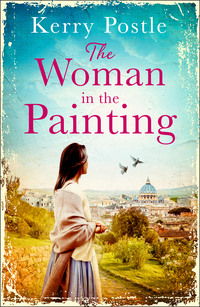
Czytaj książkę: «The Woman in the Painting»
About the Author
KERRY POSTLE left King’s College London with a distinction in her MA in French Literature. She’s written articles for newspapers and magazines, and has worked as a teacher of Art, French, German, Spanish, and English. Kerry’s first novel, The Artist’s Muse, came out in 2017, followed by A Forbidden Love in 2019.
She lives in Bristol with her husband. They have three grown-up sons.
The Woman in the Painting is her third novel.
Praise for Kerry Postle
‘Richly entertaining, wry and funny, and at the same time dark, thoughtful and allusive’
‘A richly layered read, that delivers on many levels’
‘Postle has taken me into a world full of characters that jump off the page with life’
‘This novel evokes a time and a place with such power’
Also by Kerry Postle
The Artist’s Muse
A Forbidden Love
The Woman in the Painting
KERRY POSTLE

HQ
An imprint of HarperCollinsPublishers Ltd.
1 London Bridge Street
London SE1 9GF
First published in Great Britain by HQ in 2020
Copyright © Kerry Postle
Kerry Postle asserts the moral right to be identified as the author of this work.
A catalogue record for this book is available from the British Library.
This novel is entirely a work of fiction. The names, characters and incidents portrayed in it are the work of the author’s imagination. Any resemblance to actual persons, living or dead, events or localities is entirely coincidental.
All rights reserved under International and Pan-American Copyright Conventions. By payment of the required fees, you have been granted the non-exclusive, non-transferable right to access and read the text of this e-book on-screen. No part of this text may be reproduced, transmitted, downloaded, decompiled, reverse engineered, or stored in or introduced into any information storage and retrieval system, in any form or by any means, whether electronic or mechanical, now known or hereinafter invented, without the express written permission of HarperCollins.
Source ISBN: 9780008331092
E-book Edition © May 2020 ISBN: 9780008310288
Version: 2020-04-20
Table of Contents
Cover
About the Author
Praise for Kerry Postle
Also by Kerry Postle
Title Page
Copyright
Dedication
Prologue
Chapter 1
Chapter 2
Chapter 3
Chapter 4
Chapter 5
Chapter 6
Chapter 7
Chapter 8
Chapter 9
Chapter 10
Chapter 11
Chapter 12
Chapter 13
Chapter 14
Chapter 15
Chapter 16
Chapter 17
Chapter 18
Chapter 19
Chapter 20
Chapter 21
Chapter 22
Chapter 23
Chapter 24
Chapter 25
Chapter 26
Chapter 27
Chapter 28
Chapter 29
Chapter 30
Chapter 31
Chapter 32
Chapter 33
Chapter 34
Chapter 35
Chapter 36
Chapter 37
Chapter 38
Chapter 39
Chapter 40
Chapter 41
Chapter 42
Chapter 43
Historical Note
Acknowledgements
Dear Reader …
Extract
Keep Reading …
About the Publisher
For Simon
for loving my books when he hates historical fiction.
Prologue
Raphael’s house, Rome, April 1520
The heavens opened and the rain poured down, making the streets of Rome look like streams. I was standing outside the studio I’d been working in for days, trying to dry off before entering, an ever-increasing puddle forming around my feet. I shuddered, wet and cold. The light was gloomy. I looked around. Outside, the clouds were dark, loud, threatening; inside, a sense of foreboding enveloped me like a cape. I never did like this weather. It always filled the air with sorrow, and now it gave me the uneasy feeling that I’d done the wrong thing.
The clouds clapped thunderously in agreement.
The door I was about to open was blown suddenly ajar by the wind. I stood still. Inside I could hear Cardinal Bibbiena, the man who, with flattery, had persuaded me to paint over my late master’s most precious work. He was talking to somebody. I waited. Listened.
‘The woman in the painting, who is she?’ The voice was accusing, the accent northern European.
‘Some whore he paid for.’ I winced at the Cardinal’s answer. ‘Look here. He’s even added a ribbon with his name on as proof of purchase.’ He laughed. His guest did not.
‘His reputation as the most …’ The stranger paused, looking for the right word. ‘… amorous artist in all of Rome was no idle boast then.’ The flames of his northern disapproval licked around the door.
‘No, indeed it was not. His nature was ever thus.’ The Cardinal adjusted his tone.
I hovered, afraid to enter, reluctant to retreat. The Cardinal’s fleshy ringed hand slipped round the side of the door, pulling it to, shutting me out. I put my ear up close to listen some more.
‘That must have been trying,’ the cold, faceless voice said. ‘For you. And your niece.’
‘No. All this—’ I imagined the Cardinal gesturing towards the painting, as I’d seen him do so many times before ‘—was nothing but lust, not love. Love. That was something Raphael shared with my dear Maria.’ The Cardinal sniffed loudly as if fighting back the tears. ‘He never recovered after she left this world. However, I have made plans to bury him in the Pantheon, in the same tomb as my beloved niece. They will be together at last.’
I reeled at the news and put a hand against the stone doorway to steady myself.
‘Fitting,’ came the reply.
‘Yes, they were perf—’ But before the Cardinal could finish the lie his guest cut him off. He had not come here to listen to how Raphael and the Cardinal’s niece were perfect for each other, or some other made-up story.
‘The world grieves to lose such a rare talent.’ The northerner’s voice now softened. I imagined him moved by the beauty of my deceased maestro’s work on the easel before him, admiration warming his eyes. I’d recently added the finishing touches to it, painting over the tell-tale foliage and ruby ring. ‘Even this rendition of a whore shows the scope of the artist,’ he said. My chest dared to swell a little with pride, my ear suddenly forgiving of his harsh northern consonants, strangely deaf to his slur on the model. But he hadn’t finished. ‘Though it is not as flawless as many of his other works. The background is …’ He paused to find the right word. ‘Clumsy.’
My hand shot up to my mouth in time to silence the splutter of surprise provoked by this foreigner’s damning summation of the changes I myself had made to the painting. The Cardinal had told me he found them sublime. I held on to that. What did this man with the guttural accent know of beauty?
‘And this hand,’ he went on, ‘it’s …’ He paused again. This time I wasn’t hopeful. ‘This hand, well, it’s so … unnatural.’ Though expecting the slight, I still flinched at the injury. Unnatural? The Cardinal had assured me the now ringless hand was so well executed as to be indistinguishable from any done by Raphael himself. But it made no difference; the stranger’s words cut too deep for me to be able to heal the wound they had inflicted on me. My chest hurt as if punctured, and my mind conjured up a vision of claw-like hands stab, stab, stabbing at the parts of the painting I had worked on with such devotion. That northern European accent was beginning to grate.
But not as much as the Cardinal’s deep, throaty laugh that followed. And not as much as the words that came after that.
‘Yes,’ he answered when he’d composed himself, ‘sadly those elements do detract from the rest of the work. It’s almost as if he’d allowed his least talented apprentice loose on it. That aside, Raphael was peerless – a prince among painters, brought down by this lowborn wench. That must surely be the reason for the angel tears falling from heaven down in the streets outside.’
It was still raining heavily – and ordinarily I would have wondered at the Cardinal’s quickness of wit in using the elements to convey his own sorrow. But the revelation that he thought me the least talented of Raphael’s apprentices came as a shock. My whole body shook and shivered, with cold, loss, then shame. Yes, an overwhelming sense of shame ran through me. I was drenched with it. It flushed out my vanity and ambition and presented them to me for what they were – ugly sins that had turned my head and seduced me into betraying one of the kindest people I had ever known.
‘So the woman in the painting,’ the grating voice started up again, ‘she is the one who killed Raphael? She is the baker’s daughter of whom everyone is talking?’
‘Yes. Base. Immoral,’ the Cardinal replied, the deep laugh now a lascivious sneer. ‘This is the woman who brought down one of the finest artists the world has ever known with her wantonness. This is La Fornarina.’
I lifted my ear away from the door. I’d heard enough. My mind searched wildly for a borrowed dignity with which to disguise the tatters of my own. I scraped together some well-woven deceits with which to cloak myself made up of my righteous indignation at the Cardinal’s undeniable duplicity. But it was no use. Thunder clapped outside once more. Yes, I had done the wrong thing and I did not need the elements to tell me so.
Chapter 1
Twelve years earlier
Rome, January 1508
The year was 1508, the month January, and it was a Friday. I remember it all too clearly. I was still innocent then. ‘Pietro! Get that weak arse of yours up now!’ My father’s rough hands dragged me from my sleep. He threw open the shutters, exposing me to the bright glare of the early morning sun. ‘If the Venetian throws you out too, I’ll …’
My body tensed as he bellowed at me. ‘S-s-s-s-sorry,’ I stuttered, waiting for the blow.
It didn’t come. Instead, my father looked out of the window, distracted by a commotion that had broken out down in the street below. ‘The lads have pulled something out of the Tiber!’ a voice called up to him. More voices joined in, urgent, excited.
My father looked back at me for a second, his eyes distressed at my attire. His knuckles twitched but they stayed at his sides; the sounds of men running towards the river was too great a lure even for him. He left the room, though his disgust remained.
I looked down at myself, at the white shirt and the yellow hose I still had on from the day before and that I loved so well. My legs hurt, my eyes felt swollen, my head ached. Yesterday.
Yesterday my father was proud of me; I was an apprentice in the workshop of the great artist Michelangelo. This morning I was not.
Artists. They weren’t popes or cardinals, kings or princes; in Rome they were better than that. At least in the eyes of people like my father – the common man. And that was because they walked among us, drank with us, sang with us, painted us. They even took us on as apprentices making our fathers proud.
Gifted, feted, popular, they enjoyed all the dishes at the rich man’s table without having to torture or kill for them. Though Michelangelo had seemed no less ruthless to me.
It’s true that most artists sang their happy song like a bird within its gilded cage, wings clipped, without the freedom to sing as they chose, fly where they might or most importantly paint what they liked. But one or two, whenever their patrons left the cage door wide open, soared high above and up into the heavens. And there they dazzled us.
Michelangelo was one such painter, though his temper was as brutish as his work was divine. And yesterday, talk in his workshop had turned to another: Raphael Sanzio. Though I’d not yet seen a single one of his paintings (he’d been working in Florence), I knew that as an artist he shone so brightly that nothing could subdue his brilliance, nor eclipse his perfection. Perfetto, ottimo, squisito, meraviglioso, eccellente, superior, divino. It was claimed that there weren’t enough superlatives in the whole of the Italian language to express how exceptional Raphael was. And rumour had it that as a man he was as sublime as his work, in both character and appearance.
And now he was coming to Rome. The prospect of his imminent arrival was causing the already full cups of the rich and powerful to bubble over. Lists were being drawn up in fortified palazzos around the city of all the artworks they would have Raphael paint for them. Of altarpieces, frescoes, birth trays, tondi, even going so far as to ponder which jewels and garments each family member should wear for that most essential object for the aristocrat hoping to dazzle with a show of wealth – the portrait. Prosperous families were coming to blows over whom Raphael would paint first.
And Michelangelo hated him for it.
That was why two starry-eyed apprentices, caught with Raphael’s name in their mouths, were beaten and dismissed with nowhere to go. Luigi and Federico had promise. They would never fulfil it now, the fools. Those of us suspected of the lesser crime of listening to them had received a good kicking but were not completely discarded. Michelangelo had handed us over to another artist who had recently arrived in Rome, this time from Venice.
‘That artist you’ve been passed on to, Sebastiano Luciani, he’s got a good reputation. But be careful. They say he’s another moody bastard.’ My brother Giacomo’s voice, deep with sleep, pulled me back to the present. He had still to get up. ‘So keep your head down, otherwise Father will have it.’ He yawned. ‘And don’t speak unless you have to. That stammer of yours can get you into trouble.’ Giacomo’s eyes studied my attire as I left the room. ‘And try not to draw too much attention to yourself,’ he called after me as I stooped down to pick my jacket up from the floor. I left, closing the door behind me.
I’d recently started grinding pigments at Michelangelo’s. I’d enjoyed it. I walked in disgrace to the workshop of my new maestro, Sebastiano Luciani. A great colourist, he would surely have pigment grinders of his own. So what of me? Only the idea of Raphael Sanzio, an artist beautiful in mind and body, or so it was said, prevented me from feeling like a condemned man. By the time I stepped over the threshold of my new maestro’s workshop I knew what I had to do – not say a word and try my best. I took off my jacket and ran a hand over my hose for luck before pulling on a white tunic and tying my leather apron at the back.
I had much to learn, from watching more advanced apprentices as well as observing Sebastiano himself. Yet as I and the other boys were taken round the workshop that first morning to admire our new maestro’s work, I for one saw nothing superior in it. Though I knew better than to share my opinion. With every flick of Sebastiano’s self-satisfied wrist as he presented another of his paintings to us, my face expressed wonder while my mind felt nothing but disappointment. The artist from Venice had some way to go before he even came close to deserving the reputation bestowed upon him.
It was said he had trained under the great Giorgione. If that was true he disguised it well.
‘And this,’ he said, standing in front of an unfinished work depicting a young, dark-haired woman, a fur-lined cape draped over her shoulder, ‘is a piece I call La Fornarina – The Baker’s Daughter – because she is the woman in the painting.’ He clapped his hands together with delight and gave a little laugh as though sharing a secret joke with someone. No one laughed back.
‘Note the composition … and the tones here … and here … And I say again, it’s of …’ He paused like an actor waiting for the crowd to finish his line. The silent horseshoe of apprentices grew bigger as each boy, bar one, breathed in. They wiped the palms of their hands on the leather aprons that protected their belted white tunics while taking a step back. Their wide eyes shouted respect and fear but not a peep came out of their mouths. Only Giulio Romano, standing at one end, an apprentice I’d known quite well at Michelangelo’s, seemed calm and composed enough to say anything. I was surprised to see him here. Giulio was older than me and more skilful than the rest of us, the equal of Giovanni da Udine, who wasn’t here; Michelangelo must have kept him on. Giulio appeared decidedly unimpressed as he looked at the unfinished painting before him. I caught his eye, distracting him from his silent assessment. He raised an eyebrow, mouthed: ‘You tell him what it’s called.’ I looked at him with foolish, trusting eyes and began.
‘La F-f-forn, f-forn …’ My mind swam, my face felt hot, and my eyes asked Giulio for guidance.
He mouthed: ‘La F-f-fornicatora.’ Desperate and horrified that I’d stammered, I took Giulio’s lifeline without caring to see what it was. Without thinking I threw it back out as quickly as I could.
‘La F-f-fornicatora.’
The moment I said it I knew. And the squeal of delighted horror that pierced my left ear made by the young boy standing next to me confirmed it. But it was too late to take it back. The new apprentices fizzed and frothed, unable to suppress their mirth, and as I searched Giulio’s face for an explanation I saw that his treacherous eyes had disappeared behind tears. Of laughter.
‘Stupid boy!’ It was Sebastiano who spoke.
Something ungovernable had been unleashed and the maestro of the workshop, the great Sebastiano Luciani, held me responsible for unleashing it.
He stood and waited, holding his head high like the grand maestro that he was. He coughed first, glowered second, and on the third count he attempted to beat the horseshoe of apprentices back into shape.
‘It’s called La Fornarina. FOR-NA-RI-NA!’
Squeaks and titters escaped from behind hands. The damage had been done. Sebastiano ranted and railed like a bad choirmaster unable to keep control. Squeaks became shrieks, the titters guffaws. Eventually, beaten, a pained expression settled on his face and his nose twitched as if displeased by a bad odour. ‘Let’s to work!’ he exclaimed with a clap of his hands. And then he walked away.
That was the end of our introduction to the workshop, and my first meeting with la fornarina, the woman in the painting. I did not like her.
Chapter 2
A flurry of prospective patrons with a penchant for portraits patrolled the workshop over the following days and weeks. Now there’s a sentence I couldn’t have said at the time. I kept my head down and worked hard. My father’s ire was – for the moment – appeased. And though, after that first day at Sebastiano’s, I’d been demoted to mopper-upper (all because I’d got the name of a painting wrong), I very quickly worked my way up to brush cleaner. Giulio said I was the best. The best brush cleaner he’d ever seen. And, very recently, I had been called on to grind pigments. At last. The job I’d had when I was at Michelangelo’s was mine once more. Giulio had seen to that.
Giulio had a very special talent when it came to drawing that was in great demand. And the guilt he’d felt at the humiliation he’d caused me had prompted him to use his particular drawing skills to help me out. He had an excellent hand and eye when it came to drawing the human form, and Taddeo, in charge of assigning jobs in the studio, had a greedy interest in Giulio’s particular line of work. He was so hungry to accept Giulio’s latest drawing of a young woman, undressed, that he overlooked the fact that I might need training for one of the jobs I was soon going to be called upon to do. That I was managing to grind Verona green, umber, sienna, until I could hide behind their undulating hills of colour, must have misled him. But for now, we had no idea what disaster lurked up ahead. For both of us.
It was a Tuesday, the day that wretched girl came. Or was supposed to. I’d seen her once or twice. She was more graceful than in Sebastiano’s, admittedly unfinished, portrait of her, her features less lumpen. She’d been unreliable of late, and her blatant lack of respect for the maestro divided the apprentices, shocking some (Taddeo and myself), entertaining others (Giulio and everyone else). Out of all the people to pass through the studio, she was the only one who’d ever said buongiorno to me. But I still didn’t like her.
And now Sebastiano was waiting for her to arrive. He paced the studio floor, starting each time a would-be patron came through the door. His face forced a smile as noble after noble looked round the studio with a view to securing a portrait of themselves. The rich and the vain of Rome, unlike the girl with the floury skirt, were queuing up to be painted. They had bags of money with which to pay, while la fornarina clearly paid in other ways. As I peered over my impressive mounds of ground pigment, I observed Sebastiano. His eyes smouldered like hot coals sparking angrily to life every time they caught an apprentice chatting, smiling, looking up from his work. I slumped further down behind my pigment piles. I could only imagine that the girl in the unfinished painting was late with her payment.
A common baker’s daughter, immortalised in paint by one of the finest painters in all Europe. At least, that was the reputation Sebastiano had. She did not realise her good fortune.
I looked on while the nobility of Rome jostled with each other to enjoy the same privilege, bombarding the maestro with questions.
‘Who have you painted?’
‘Him? Have you really?’
‘Her? Well I never.’
‘Them? How marvellous.’
‘Could I possibly see them?’
‘When can you start?’
‘When can you finish?’
‘How long must I wait?’
Interest was overwhelming. Portraits were easier and evidently more profitable than painting an elaborate fresco cycle for a church or a monastery, they needed less planning and were relatively quick to complete. Sebastiano must have been pleased when he’d turned his hand to them. But as I noticed the colour in Sebastiano’s face rising, caught the flames flickering in his eyes, it was clear portraits were not uppermost in his mind this Tuesday. I kept my head down. He could go off at any second.
‘Have you seen her?’ He drew close to Giulio, his eyes pulled to the door by invisible strings.
I clapped a pigment-covered hand over my mouth as I watched an interested patron reach out to touch a just-finished portrait left to dry on an easel in the corner. ‘The hair, it looks so real,’ he trilled with enthusiasm.
Sebastiano turned. The invisible strings snapped.
‘DON’T TOUCH!’
The nobleman jumped back. When the shock had subsided he glared at the artist.
‘Signore, it’s best you don’t touch it … per favore!’ Sebastiano added quickly, his good sense returning. It was one thing to shout at one’s apprentices and quite something else to shout at one’s patrons.
‘One drawback with portraits,’ he explained, his tone somewhere between apologetic and grovelling, ‘is the drying time of the oil paint … signore … and it’s a devil to get off one’s fingers.’
Still, portraits were durable (when ready), and easy to display. And fashionable. That made them desirable at any price. That’s why, shouted at or otherwise, this nobleman couldn’t hand his ducats over fast enough in order to seal the deal.
For the next few hours Sebastiano occupied himself with business matters. He needed to simmer down. He sat in a quiet corner with interested patrons, and in a special book he recorded names, measurements, family mottoes, interests, estimated completion times, costs.
But when the business had been settled, and the last of the noblemen had been shown out, it was clear that the maestro still had that girl on his mind.
‘Is she here yet?’
He stood before his painting of her and shouted. ‘Taddeo! I need— Fetch me— Don’t forget— Give me that—’
Sebastiano’s demands spread out across the studio like molten lava and not even my mountains of ground colour could stem the flow.
‘Here, boy. Pietro!’ Taddeo had found me. ‘The maestro needs lamp black.’
‘But I don’t know how to m-m-m …’
With consummate care and attention Taddeo trained me dutifully in the preparation of lamp black by considerately pointing to Cennini’s handbook, il libro dell’arte. Every artist’s workshop had a copy as it told you how to make pens, paper, brushes, work on frescoes, grind pigments – you name it, Cennini’s handbook could tell you how to do it.
‘Chapter th-th-thirty-seven,’ he yelled at me, with the stammer a cruel and unnecessary addition, I thought. There was no need to make fun of me. ‘Everything you n-n-n-need to know is in there.’
Sebastiano mixed lamp black with lead white to form the imprimatura for his paintings, the base for his portrait work. And so he needed it. Lots of it, as portraits were fast becoming his stock in trade. In itself lamp black was comparatively simple to make. And it was quick. The easiest way, according to Cennini, was to burn linseed oil in a lamp and collect the soot created by the process. It needed no grinding, and, once burned, the soot was as fine as powder. Even a fool could make it. ‘Lamp black. Sebastiano needs more lamp black!’ Taddeo shouted at me.
‘Is she here yet?’ the maestro’s plaintive cry reverberated around the studio like an echo. Giulio raised an eyebrow.
*
The following Tuesday the atmosphere in the workshop was even more tense.
‘The takings are down,’ Giulio whispered in my ear as he passed by.
‘B-b-but the p-p-portraits—’
‘I know,’ he said, cutting me off. ‘If he would only allow me to do them.’
I sniffed at Giulio’s arrogance. But he had a point. All Sebastiano had to do was work on the designs, start the drawings. The more experienced apprentices – Giulio among them – could do the rest. But the maestro would not entertain the possibility. Unfortunate, as he was experiencing artistic paralysis, the cure for which was that common girl. I willed her to appear.
‘That commission, the one from Pope Julius,’ Sebastiano barked at Taddeo, ‘is it here yet?’ That a papal commission Sebastiano had been promised had yet to turn up also did nothing to lighten the mood. ‘It should be here by now,’ the maestro muttered. Though apprentices nodded, they kept their eyes on their work, afraid to look up. Still, we all expected instructions from the Vatican to arrive at any moment.
‘Is she here yet?’ Sebastiano paced the studio. ‘Is she not here yet?’
A red velvet curtain divided the workshop in two: one area, closest to the entrance, for the apprentices; and the other, at the far end, for the maestro and his baker’s daughter. He had already pulled it up in anticipation of her arrival, ready to let it fall dramatically the instant she crossed from one side to the other. He had yet to finish his painting of her. Tongues had, initially, wagged with wanton excitement as to why that was. The maestro, it was said, was too busy fornicating with the fornarina during their sessions together to find the time to plunge his paintbrush in his paints and get the work done. But that wasn’t it, even though many of the younger apprentices held on to this illusion and even though, I suspected, the maestro would have wanted it so.
No, the reason he hadn’t finished his painting of her was down to the fact that she rarely turned up. And many of the apprentices were now beginning to lose interest in the girl, the maestro, their supposed relationship, and the painting.
Giulio was taking a break from grinding lapis lazuli to make pens, some fine, some broad. He’d been instructed to make six of each. I was tempted then to ask why he had twenty quills ready instead of twelve. But I already knew the answer. He was stealing them. Out of defiance. But also because he needed them. I’d seen him slip charcoal into his pockets before, that he’d used to pursue his sideline in unsavoury drawings. I wondered that his pockets weren’t bulging. I looked at them and saw that they were.
‘Where is she?’ Meanwhile Sebastiano’s frustration spread out over the studio like a barbed net, causing apprentices to jump and writhe and pray that the girl would arrive soon and put them all out of their misery.
Giulio breathed in deeply. Both eyebrows rose. He glanced at me. He’d had enough. Mischief danced across his features.
He rummaged round his bag and pulled out a miniature portrait – a copy, no doubt, that he had made himself. It was of a young man, handsome, and clothed. Giulio passed it round the squirming apprentices as if it had soothing powers.
‘Look. This is a portrait of Raphael of Urbino, the artist. He’s recently arrived here in Rome.’
At the mention of Raphael’s name, I felt the pain in my leg where Michelangelo had kicked me, imagined my father’s knuckles as they twitched at his sides. I kept well away. Taddeo’s beady eyes were everywhere and I could not afford to get into any further trouble. Giulio on the other hand seemed to laugh in the face of fate. And fortune seemed to favour him.
‘Giulio! You need to be quicker.’ Taddeo’s voice was all authority. Giulio’s face was all scorn. You couldn’t rush Giulio Romano and to do so made him slow down intentionally. He put down the quills he’d been working on, stretched out his arms high above his head then gave a yawn. Taddeo scuttled back to his place.
Meanwhile, the miniature portrait had made its way around nearly every workbench, dazzling the eye and mind of each apprentice and elevating them above Sebastiano’s net of barbs. Raphael. Quite the hero, and to see his likeness confirmed it. The apprentices at the workbench nearest to Taddeo had put down their tools in anticipation. Unable to resist, they huddled round the boy currently looking at it.
‘Is that him? Is that Raphael?’
It did not matter that the words were whispered, barely audible to the human ear. Sebastiano had heard them. Like a hunting dog, and Michelangelo before him, he sniffed the air.
‘That’s Raphael?’ ‘Is that Raphael?’ ‘Raph—?’ Excitement had rendered the apprentices oblivious.
Sebastiano threw his paintbrush to the floor and roared.
‘I never, NEVER, want to hear that name in here again. Understand?’ The voices of the young apprentices died instantly; the miniature was hastily pushed under a pile of sketches.
‘What’s the time?’ Sebastiano asked.
‘Half past ten.’
‘I know it is, Taddeo. I know what the time is, you halfwit!’ Sebastiano said. ‘But where is she? That’s what I want to know, you oaf. Where is she?’
The maestro stormed off, wearing his bad mood like an aura around his head. He stood before his portrait of the baker’s daughter, as if willing her to step out of the picture.
The apprentices pulled out the miniature again, the urge to see this now forbidden young artist more irresistible than ever. ‘Nature made him then broke the mould,’ one of them said with appreciation, taking care not to mention the artist by name. I was sure I’d heard that phrase somewhere before, but, while I struggled to place it, Taddeo, with eyes cruel and greedy as a tyrant’s, marched over to see what was going on.
That tyranny begets tyranny was never borne out so clearly. Within seconds he had prised the portrait from their hands and was holding it up. He shot a look of victory in Giulio’s direction. His mouth was open, about to chastise the apprentices for wasting time. Then he heard the cry.
‘Taddeo!’
Sebastiano’s faithful assistant glanced up at the portrait in his hand. He lowered his eyes. They met the maestro’s, recognised what was coming next. Taddeo’s eyelids flapped wildly, as if by blinking alone he could become airborne and escape. Beads of sweat broke out across his forehead.
‘It wasn’t me … It was them … They had it … I …’ He mumbled his excuses. A spurt of pleasure shot through me as I watched his suffering. At once unfair and so deserved.
Sebastiano thundered over and snatched the offensive image out of the faithful Taddeo’s hands.
He looked at it.
If the mention of the young artist’s name had irked him already, the sight of Raphael’s image up close put him in the foulest of tempers. Dark clouds marred Sebastiano’s features like flies on rotting flesh. I glanced over at Giulio. He had a knowing look upon his face. It gave me a secret thrill to see it.
Sebastiano, miniature in hand, went over to the far side of the workshop to where his easel was set up. He smashed the perfect image down on a nearby table. ‘Damn that wastrel from Urbino!’
He returned to pacing. This time we all hid behind our work.
‘Have we no letter from the Vatican yet?’ he shouted, pushing the miniature away. We’d heard a workshop was being set up for Raphael. He had wealthy patrons, said to be friends of the Pope. ‘Look at him!’ Sebastiano said to himself, glowering at the likeness as if it were alive, ‘as beardless as a young girl!’ Several of the apprentices came out of hiding. They dragged strange sounds from their mouths and nodded, thinking they’d been called on to agree. They had not.
‘Who asked you?’ Sebastiano growled at their forced laughter and nodding heads. ‘Go back to your work. Now!’
I looked towards the entrance, attracted by a sudden movement. And there, framed in the doorway with her eyebrows raised in mockery at the commotion, stood the girl. The girl the maestro had been waiting for. Here. In the studio. At last. Knowing I’d seen her, she glided in.
Sebastiano, his face blanching at the sight of her, ran to pull the heavy red velvet drape down, an action he had been waiting to perform for such a long time. She made her way to the table, intrigued no doubt to see the face of the man who had provoked the scene she’d just caught the tail of. She picked up the small portrait and gave an approving smile. Her face opened up like a flower in the sunshine at the sight of it.
Sebastiano noticed. His already cloud-eaten face turned blacker still. He tugged on the curtain repeatedly. It resisted his pull.
‘Damn! Damn!’
The atmosphere in the studio cranked up to thunderous; in an instant the velvet curtain had crashed to the floor.
‘Take it to the side, for heaven’s sake!’ At the flick of his wrist he conjured up two apprentices. They scuttled over and made the curtain disappear.
The girl was still waiting. Still amused. Still unperturbed.
‘It’s too warm to be wearing this,’ she said, as she picked up the fur-lined cape hanging over the back of her chair. She draped it over her left shoulder nevertheless, while stooping over to pick up a laurel wreath from her basket. She wore it on her head like a green crown. I watched her, grateful for the patches of light and pockets of calm she had brought in with her. The maestro’s bad temper, like a poison-tipped arrow, breached the walls of almost every other person in the studio, while she remained inviolate.
We had never observed Sebastiano paint this model before, though we’d occasionally heard them behind the velvet. We liked to imagine the scene, full of lust and desire. But today, with no curtain to shield our eyes, nor fuel our imaginations, we would get the opportunity to see Sebastiano and his model in the flesh. There was a sufficient whiff of excitement at the prospect to cut through the dark clouds of the morning.
We buried our heads in cleaning, grinding, planning, sketching. Every apprentice made the workshop seem busy. The noises of wooden brushes dropping on floors, paper tearing, knives cutting, chair legs scraping, had the space filled with life so that Sebastiano and his model would soon believe that no one was interested in what they were doing or saying.
But we were.
Whenever we looked something up in the Cennini, or asked a fellow apprentice for some help, we watched out of the corners of our eyes. Our maestro performed his role much as we’d envisaged, with the wandering hands of an attentive paramour. Yet his model seemed to have forgotten the yielding lines our heads had written for her, replacing them with some feisty ones of her own. She sat, her back straight, on a chair on a raised platform, bathed in the light that flooded in through the window.
Sebastiano went to hang a pearl drop from her ear.
‘Please don’t. I can do this myself,’ she told him, with a shrug. No, Sebastiano’s model was not responding in the way we’d expected at all. Sebastiano’s fingers dropped from her ear to stroke her face; she reeled her head back like an untamed horse. The maestro attempted to smooth down her dress; she brushed his hand away. He caught her hand in his; she withdrew it, a delicate hand from a coarse, ill-fitting glove.
‘I am the great Sebastiano!’ he said, smoothing his own dark hair back with disappointed fingers. His widow’s peak and pointed beard made his face look, in that moment, like a heart. Vulnerable, he cast his eye around the studio. Had we witnessed his humiliation as the girl rejected him? Overheard the girl’s insolence as she refused his help? Our studied concentration on the jobs in front of us, and our louder-than-usual discussions regarding work-related matters, reassured him. ‘The great Sebastiano!’ he repeated, as he returned to the task in hand: the painting of the girl.
‘Your hand needs to be pointing towards your heart,’ he said. Afraid to touch her now, he modelled the pose for this lowborn girl himself.
I stole a glance at Giulio. His eyes twinkled with tears of mirth. To see the power this model wielded over the maestro entertained him.
‘Now turn to the left and look at me. Look at me. Yes, that’s right.’
I too was amused.
Yet something niggled at the back of my mind. Who was this worthless girl to treat the ‘great Sebastiano’ so? And how could he let her?
There was no money in it. And, from appearances today, no profit of the sort Sebastiano was interested in either. Whatever he was hoping to get from her it was apparent that he wasn’t getting it. Nor ever would. I did not know whether to applaud or curse her but one thing was clear – she was not the girl we’d all assumed she was.
‘When can you come again?’ The sitting had come to an end and the maestro’s voice was little, beseeching.
‘I don’t want to sit for you again. You’ve finished.’
‘I haven’t. The hand, pointing to your heart. It’s not quite right.’
‘You are the great Sebastiano,’ she said, her voice mocking, ‘you don’t need me to finish your painting.’
‘You can’t stop coming. I forbid—’
The girl raised her hand. She looked around the workshop. It was silent. Conspicuously so.
‘Sebastiano!’ Her voice rang out like a warning bell. If she’d intended to bring the maestro to his senses, she hadn’t succeeded.
Lust and pride, a heady concoction, had got the better of Sebastiano the great. And it made for the most unedifying of sights.
‘You WILL come back … Powerful Romans pay a lot for a portrait by Sebastiano Luciani …’ Bitterness twisted itself around his words. ‘I have noble families queuing up for the privilege … yes, it’s a privilege … I paint you and receive nothing in return. Girls like you …’
She threw her head back and lifted her shoulders. She’d heard enough. ‘Remember, I did not ask to be painted.’ She was strong, proud.
‘I have an agreement with your father. I have paid him …’
‘To PAINT me,’ she said, giving way momentarily to exasperation. ‘And now you have. But as for—’ She broke off, aware that she had an audience. ‘As for all the rest, believe me when I say that I will not be bought.’
We silent apprentices listened on. Excitement crackled in the air.
‘Besides, my father needs me. There’s a grain shortage going on. It might not affect you, but times are hard for ordinary working Romans.’ She paused. ‘And you made a promise you’d be finished by now. A promise.’
‘Margarita. I can gi—’
‘Ssh!’ she hissed, trying to silence him. ‘It’s not about the money. All right, I will stay, for a little while longer, if you need to paint my hand. But trust me when I say I am deaf to all other entreaties.’ We waited.
But as maestro painted model, they said nothing more to each other. Pockets of chat and the sounds of work built up again. The show was over. For the moment.
Chapter 3
Giulio was the first to retake the floor. He had finished with the quills and was now back on the lapis lazuli. His eyes twinkled with mischief. ‘They found another body in the Tiber this morning, wearing nothing but a pendant of St Stefano.’ He waited for the gasp. Instead, just when Giulio thought it was over, the disagreement between Sebastiano and his feisty model bubbled up again. Apprentices’ eyes shot to the warring pair but Giulio drew them back again. He would not be outdone. He’d found the maestro’s humiliation as amusing as the rest of us, but what was a lovers’ tiff compared to the gruesome tale he had to tell? Lovers’ tiff? It wasn’t even that. No, Giulio had had his fill of listening to the desperate bleating of a lovesick fool chasing some girl the like of which he could pick up easily in one of Rome’s many brothels.
He clicked his fingers, gave a dismissive shrug of his shoulders to show his disappointment at the master’s performance, and carried on with his own story. He beckoned us closer. ‘Man. Young,’ he clarified. ‘Found with the remains of his hose wrapped around an ankle, a coin in his throat with a huge stone wedged in his mouth to keep it there, and a pendant of St Stefano wound one time too many around his neck.’
For a second Giulio looked straight at me, a knowing look on his face. I told myself I was imagining it.
‘He was a pretty boy, if you get my meaning,’ he added. I knew then I was not. My stomach lurched. My skin prickled. I felt threatened. But the other apprentices noticed nothing of the tacit communication that had passed between Giulio and myself. All they wanted was for him to go on with his grisly story and they strained their ears to listen some more.
‘Nose cut off.’ No longer interested in me, he threw himself into the performance, slicing the air with the side of his hand. While his audience made noises of pity for the pain of losing one body part, he hit them with another. He thrust his hips forward and slapped his two hands between his legs. ‘Cock too.’ This time he grinned like a fool. Smothered titters and horrified howls rippled around him. ‘I even heard that they cut off his …’
‘LAMP BLACK!’ Sebastiano’s roar, followed by the sound of something clattering to the floor, put an end to the morning news as told by Giulio. The maestro’s disagreement with his model was over, again, and the one with us was about to start.
My heart was still thumping against the prison of my ribcage, my mind imagining the dead body. But Giulio had been silenced. For now. And I was glad of it.
I looked over to discover what had brought about this change. A messenger from the Vatican had finished talking with a disgruntled Sebastiano. The messenger made apologetic gestures; Sebastiano exuded disappointment. The workshop had not secured the large commission after all. I watched him as he returned to his model. He whispered what I deduced from the look on her face was a question. It caused her to pick up the miniature of the artist Raphael that had been thrown down on the table earlier on while the maestro himself moved his head round the workshop like a lit torch in the dark. We looked down at our work.
‘You shouldn’t ask a question when you have no desire to know the answer,’ his model’s even voice replied. ‘I am no flatterer, nor will I ever be.’ What could Sebastiano have asked? My mind worked hard to fill in the gaps; all I could come up with were the vain enquiries of a self-deluding madman.
Sebastiano puffed up his chest. This could only end one way.
The girl gave her answer. Sebastiano let out a roar.
We worked hard, harder than ever. Lamp black, lamp black, lamp black, I told myself. The pressure was palpable. The maestro’s roar told us his model’s answer had not been the sweet consolation he was seeking after the papal disappointment. He was going to be taking his frustration out on us for the rest of the day. As I struggled to keep up with the demand for lamp black, the girl who was responsible for Sebastiano’s latest show of anger walked by. She passed in front of the bench I was working at, swinging her basket. She displayed none of the outward signs of a lover spurned or model chastised. If she was quaking with fear, she didn’t show it.
I looked up all the better to see what the attraction was now that she was so close to me. Though the clothes she had on now were not as fine as the ones she had been dressed up in by Sebastiano for the painting, and the pearl earrings were no longer hanging from her ears, and a single laurel leaf was all that was left of the wreath sitting on her head, the colour and style of her hair were the same, as was the shape of her face and the deep brown eyes.
I thought about the portrait. Close though the Venetian was in capturing this young woman’s likeness, I could not say that his art had in any way improved upon nature. The girl, though not of noble birth, as was clear from the way she dressed, was a beauty, her skin soft and plump, the light in her eyes warm and radiant. The light in the studio was good and to see her movements swathed in it made me question Sebastiano’s rendition. He acted like a man bewitched but there was no hint of this in his work. What he had produced was a lacklustre imitation, competent in that it was recognisable, but without expressing the life and energy of this bewitching creature who danced past me, skirts swaying, hair bouncing, and whose flesh, I couldn’t help but notice, quivered ever so slightly with every up and down sweep of her arm.
Not that I found this jiggling of flesh attractive myself, not even at fourteen, but I could see, in that moment, why many men would. She moved the way she spoke. There was something to be learned from her. She was rebellious yet not aggressive, confident yet not brash. Strength, grace and gentleness radiated from every step and turn of her head. Qualities I’d thought of as quite disparate harmonised within her. I was in awe and could do nothing to resist. Sebastiano, in the same moment, had noticed her movements too. They elicited an altogether different response in him. And it wasn’t the one we’d seen when he’d been painting her earlier.
‘Stop swinging your basket!’
He was cross with the girl. No longer the amorous artist. It must have been something she’d said.
Though usually changeable in temper, events of the morning had made his humour worse than ever. I looked over to see him push the miniature of the artist from Urbino across the table in a fit of rage. It scraped across the surface, flew off the end, and crashed to the floor.
Not satisfied the miniature was on the floor, he kicked hard at it, pushing it away still further. Giulio sucked the air in through his teeth. The girl with the basket reddened. For the first time she appeared vulnerable. I was surprised.
Then I understood.
Sebastiano was jealous.
I looked at his blotchy face. His nose was an angry red and his eyes were incandescent with a rage so strong it threatened to consume him.
As for the girl’s cheeks, they returned from flush red to a warm pink the nearer she got to the door. She sprang by, determined not to be cowed by Sebastiano’s display of bad temper. She gave me a wink.
‘STOP … SWINGING … THE BASKET!’
Sebastiano’s voice boomed across the workshop like a clap of thunder.
In my shock I jumped. I have no idea what the dancing girl without the pearl earrings did because I froze. It was my heart that now lurched into my mouth – preferable to the contents of my stomach that had threatened to make a reappearance in response to something Giulio had said earlier.
I’d knocked over the lamp and I watched in horror as hot linseed oil surged from it to create the most perfect of arcs. It slipped through the air and landed in the uncovered lapis lazuli dust on the neighbouring bench. Its globular heaviness made the precious pigment puff up. Thousands of specks of exquisite colour cascaded before my eyes. It was as if time had slowed down as I watched this disaster unfold. When I’d looked back up from the now settled ultramarine powder the girl was nowhere to be seen. The main door slammed shut. She’d gone.
I turned to look at Giulio. Mockery had vanished from his eyes. Arrogance had abandoned him. He was looking behind me. His mouth opened as if to speak but it was as if the deluge of the shock within had flooded him so completely that no sound came out.
Then I felt it. Sebastiano’s heavy palm, slap, on the back of my head.
I stumbled forward, gasped for air. I sneezed, my nostrils irritated by the dust Giulio had produced after hours of grinding. Celestial dust. Colour of the heavens and the Madonna’s sacred robe. The most expensive pigment in all the world. And now it lay over the bench like a fine covering of newly fallen snow. The hand that had struck me wrapped itself around my upper arm and squeezed hard. I felt the gold ring on one of his fingers dig into me. I sneezed some more, unable to stop. I watched, appalled, as moisture now clung to the lapis dust to form dark, wet dots. The same hand that squeezed me shook me. Pain and shock rendered me breathless. Sebastiano had achieved his aim: I stopped sneezing. But by then it was too late.
I looked at Giulio. In my naivety I hoped that he might be able to do something, say something, that would save me: it was clear he could not. Invisible ropes had already started to pull him back to his place of work. His eyes looked on me with sympathy but his work-worn hands were securely tied. He had no choice but to watch as Sebastiano dragged me to the heavy oak door of the workshop and cast me outside. He threw my jacket after me.
‘Think yourself lucky I don’t get you locked up for this. The money you’ve lost me! Now clear off! Talentless dog that you are!’
As the door slammed shut behind me, I imagined my father’s knuckles cracking.
Darmowy fragment się skończył.