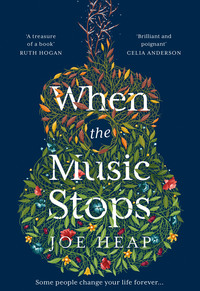
Czytaj książkę: «When the Music Stops»
WHEN THE MUSIC STOPS
A Novel by Joe Heap
With Music by John Sands
Joe Heap

Copyright
HarperCollinsPublishers Ltd
1 London Bridge Street
London SE1 9GF
www.harpercollins.co.uk
First published in Great Britain by HarperCollinsPublishers 2020
Copyright © Joe Heap 2020
Cover design and illustration by Andrew Davis © HarperCollinsPublishers Ltd 2020
Joe Heap asserts the moral right to be identified as the author of this work.
A catalogue copy of this book is available from the British Library.
This novel is entirely a work of fiction. The names, characters and incidents portrayed in it are the work of the author’s imagination. Any resemblance to actual persons, living or dead, events or localities is entirely coincidental.
All rights reserved under International and Pan-American Copyright Conventions. By payment of the required fees, you have been granted the non-exclusive, non-transferable right to access and read the text of this e-book on screen. No part of this text may be reproduced, transmitted, down-loaded, decompiled, reverse engineered, or stored in or introduced into any information storage and retrieval system, in any form or by any means, whether electronic or mechanical, now known or hereinafter invented, without the express written permission of HarperCollins.
Source ISBN: 9780008293208
Ebook Edition © April 2020 ISBN: 9780008293222
Version: 2020-10-09
Dedication
To my grandparents, John and Jean, without whose stories this story could not have been written.
Epigraph
Greek myth tells of Orpheus, who travelled to the underworld to win back his lost lover, Eurydice. His means of transport was music – music that made the gods weep to hear it, music that stopped the rivers and made nature pause. The Hymns of Orpheus are lost to us now, but their voices are still ours to use, that we may each bring back our own Eurydice.
Musicologists disagree about how many of these voices, called modes, there are. Some say five, or nine, or twelve. For this book, we will cover the seven commonly accepted modes used in antiquity. The number seven was important to the ancients – seven Olympian gods, seven days of the week, seven ages of man. Seven is a mystical number, a magical number, and perhaps this little book yearns to do something magical.
I do not believe in gods, but I believe in music. Music can draw the dead close to us, for a while. If we could meet them, in the sunlit fields of song, surely we would stay forever.
– Jack Shapiro, The Songs of the Dead
Contents
Cover
Title Page
Copyright
Dedication
Epigraph
Chapter 1: The Child
1936
Chapter 2: The Maiden
1948
Chapter 3: The Lover
1954
Chapter 4: The Rebel
1966
Chapter 5: The Matron
1976
Chapter 6: The Mother
1981
Chapter 7: The Crone
1992
Coda
Acknowledgements
Keep Reading …
About the Author
Also by Joe Heap
About the Publisher
1.
The Child
THE STORM WAKES ME. It must have been going for a while. The boat is rocking like a rollercoaster and the sea is loud. I squint at my clock. The red numbers say it’s half two in the morning, but this clock hasn’t been set since we left … where was it we left? Somewhere else. Somewhere not home. I can’t guess the time these days. Now that I’m an ancient ruin. I’m not sure how long I slept. I stare at the flashing dots on the clock: : : : : : :
Someone is banging at the door.
‘Mum? Are you awake?’
‘Abigail?’
The door opens. ‘Yes Mum, it’s me. Do you mind if I put the light on?’
‘Mind? Why?’
The light clicks on and there is Abigail. She looks flustered, and she’s hanging onto the doorframe. The bedroom tips to one side.
‘Are you okay?’ Abigail staggers over and sits on the side of my bed like a nurse. She was a nurse, before this. Her auburn hair is unbrushed and I want to get a comb.
‘I just wanted to check you’re okay.’
‘Why?’
‘Because of the storm.’
‘Oh … Bad?’
Abigail sighs. ‘Yes, Mum, it’s pretty bad.’
‘Don’t need helping.’ I look up into my daughter’s face. She has freckles but no wrinkles. She’s still so young.
‘I know you don’t need helping, you stubborn old goat.’
I make horns with fingers at the sides of my head and bleat. Abigail laughs and kisses my forehead. ‘I just need to help David secure the boat, and I don’t want you to worry if you can’t find me.’
I take a deep breath. ‘Don’t worry. Go. Take care.’
The older I get, the less I talk. The words are still there in my head, I just can’t get them out. Or if I do, they’re wrong. I say ‘knife’ when I mean ‘fork’ and ‘hello’ when I mean ‘goodbye’. I used to be a musician, and I preferred playing music to talking. Maybe this is nature’s punishment – use it or lose it. Meanwhile, the trapped words boil away in my head like the contents of a pressure cooker. Long, rolling sentences bubble up. Presumably in this metaphor my brain is the old piece of meat, liquefying in its juices. I don’t like it but there’s nothing to be done. I sling one arm around Abigail’s neck and half-hug her.
‘See you soon, Mum. Sleep tight.’
Abigail clicks the light off and closes the door. I settle back into bed. The storm seems worse, in the dark. I feel it throwing our boat up and down. Out of habit, I count the things I remember.
1) My name is Ella Campbell.
2) I’m on a boat.
3) I’m on the boat because I’m on holiday.
4) I’m on holiday with Abigail, the baby and … and … him. Abigail just said his name, but it never seems to stick in my head.
5) The boat belongs to ‘him’.
I wish I could remember his name. The man who brought us on holiday. He wears a lot of aftershave and thinks that because I am from Glasgow I must be mad for porridge and bagpipes. The only places he’s visited in Scotland are golf courses. He bought this boat and he’s sailing it back to England. He’s a roaster, but I don’t tell this to Abigail.
Another wave breaks over us. The boat shudders and I feel sick. Perhaps if it weren’t so dark, I’d feel better. At home (The Home), I have a light that comes on when I clap. I try this, but it doesn’t work. Perhaps the light can’t hear me over the storm.
‘Abigail?’
There’s no reply. Abigail will come to check on me, of course. Over my bunk, on the right-hand side, is a window. Push yourself up with both hands. Careful, you old codger, feel for the porthole. I touch my nose to the cold glass. On other nights there has been a moon or stars. One night, the ocean looked like silver velvet being shaken over a stage. I remember the Palladium … or was it the Lyceum? I don’t remember the show. There’s no light now.
I’m about to get back under the covers when the boat lifts
up,
up,
up …
It’s like a hand is scooping us out of a bathtub. I feel weightless.
Now the boat drops again, smacking the waves. I’m knocked backwards, out of bed and onto the cabin floor. For a moment I forget to breathe. The pain follows. I can hardly hear my own cry. There’s not much space between the bed and the door, and I’ve hit my head on something. It’s still dark except for the glow of the clock. This is awful. When I next see Abigail and him, I’m asking to go home. I don’t want ‘one more adventure’, as he calls it. He doesn’t know the meaning of the word.
I’m near the door, so if I reach up, somewhere above me … my fingers brush a pom-pom, dancing at the end of a string. I grab hold and pull. The light comes on. My legs are tangled in white sheet. Get up, don’t lie on the floor, get yourself sitting. I could try to stand, but the boat is still bucking and I don’t want to be thrown again.
I crawl to bed and settle down to sleep. But I can hear something. Very faint. I’m not hearing it through the air but through my pillow. It’s coming through the floor, through the walls. High and thin, almost drowned out by the storm.
A baby crying.
My mouth curls up in a smile. My grandson. He is four months old. Or is it five? Too young to be dragged out on this boat, just like I’m too old. Thunder rattles my chest as I think about the baby. If the memory is hazy, that’s just what babies are like. Blurry, not-quite-developed. One day he might be a judge or a poet or a landscape gardener. But we can’t see that yet; he’s keeping it to himself. I hope he’s not too miserable. The sea has been making him sick. How long have we been on this boat?
I open my eyes and stare at the light. Abigail could be with the baby. Sometimes he can’t be soothed, for all her trying. No wonder, in this storm. But the doubt is there in my mind, getting stronger. Abigail is good at soothing him. There’s something reassuring about her that she didn’t get from me. She must have been a good nurse, before he made her give it up. She says he didn’t make her, that she wanted to …
The baby is still crying.
The boat is rolling through hills and valleys. But what’s to lose, when you’re eighty-seven? I get to sitting, holding tight to the bed. The cabin light flickers and dies. I sit in darkness and say several words that an eighty-seven-year-old isn’t meant to know.
Deep breath.
I launch myself toward the door. The boat tips and I slam into solid wood. Out of the cabin, into the narrow corridor. That’s the one good thing about this cramped boat – never far to fall. In the dark, I feel the walls either side. There’s something else, an unfamiliar feeling. My feet are cold. There’s water in the corridor.
I edge along, legs threatening to mutiny. Opposite me are two doors, one Abigail’s room, the other a spare bedroom which has been the baby’s playroom. On my side is the door to the nursery.
‘Abigail?’
There’s no reply but the storm. I grab the handle to the nursery, but there’s more water in the hallway now, pressing against it. Are we sinking? One foot against the wall and both hands on the handle, I pull. The door opens onto the sound of wailing.
‘Abigail? Are you in there?’
No reply. My head swims with darkness. If there were light I would feel better. I can’t see the baby and there’s water in the nursery. That’s not right. I’m the one who opened the door, I’m the one who let the water in. Have I made a mistake? Too late to go back. I edge forward, guided by the crying. Inside there’s less to hold onto. Each cabin has a built-in bed, but the baby sleeps in a travel cot on the floor.
A cot which is level with the floor.
Hold onto the crying – he’s still there. The boat starts to race downhill like a bobsled. I grip the doorjamb just in time and for a moment all the water around my ankles is gone, washing to the far end of the room. The baby falls silent. Is he drowned? My fall is broken and I almost lose my grip. The baby coughs and screams.
This room is a mirror image of my own. Clothes have started to baffle me in the last year, the landscape of blouses and underwear leaves me frustrated. In the dark, this mirror-room is a cruel puzzle. There is a sudden flash of dazzling blue light. In that moment I can see the cot, can see the baby kicking his legs against the wet mattress. Then the light is gone, replaced by thunder. Before I can lose the image, I step forward.
The baby is frantic, his wails staccato, as though he can’t wait to draw breath before the next one. Not the cry of a baby who is tired, hungry or sick. A cry of terror. I feel over the mattress until my hands close around his warm, squirming body. Tiny hands grip the edges of my own as I lift him. He’s big for his age – I’ve never lifted him myself. I’m usually in a chair, propped with cushions. My vertebrae pop-pop-pop. His hot face screams into my ear.
‘Sssh, sssh, there now.’ He squirms in his soaked sleeping bag and batters me with tiny fists. ‘Come on lovey, I’m here now.’
My arms tremble with the strain. I just want to lie down and go to sleep. Maybe it’s safest if I stay here. Abigail must be busy, making the boat right. But then I remember the water – the water that I let in. We can’t stay here, it isn’t safe. How will I get him upstairs, in the dark? I remember his nightlight. It’s made of soft plastic, shaped like an egg. If you press on the pointy end, a light comes on.
I put him on the bed. I crouch down and feel in the cold water for the box of toys. My hands turn numb as I run them over rattles and teething rings, fabric books and soft animals. I throw the rejects into the water. Finally, I have it. The cabin is lit by blue light, shifting to green as I look to the baby on the bed, staring at me with his mouth an ‘O’. Regaining composure, he resumes his wailing.
‘Sssh, hush now, I’m coming.’
My head feels waterlogged. I get the baby as far as the hallway without much trouble. Then the boat tips back, like a rollercoaster climbing to the top of a big drop. I can see the stairs up to the saloon but can’t move toward them.
Wait. Wait for it …
The boat tilts a little, then we’re racing down, faster than before. I launch myself at the stairs like a nightie-clad Olympian. I catch the first stair with my foot, and the next. Though I’m climbing the stairs, it’s like running downhill.
We reach the top stair. We’re in the lounge, except now I can’t stop –I’ve too much speed and the tilt of the boat means that the wooden floor is a polished slide. My feet go out from under me and I land heavily. We slide across the length of the room and crash into the back wall.
I’m still holding the baby. There’s no way of telling whether I’ve broken any bones. Everything hurts. The deck here is wet, like downstairs, but there’s no water sloshing around. The baby squirms against my chest and the room is lit by changing colours. I look around and see the baby’s nightlight, rolling on the floor, turning red, then blue, then green. How did that get there? Abigail must have brought it to see by.
The door to the deck is flapping open, letting in rain. Papers skitter and Abigail’s novel flaps on the floor like a wounded bird. I shuffle to the door and shut it with one foot. The room is suddenly calm, though the storm still rattles the windows. In one corner of the cabin is the baby’s bouncy chair, with straps to stop him falling out. I shuffle over and put him down, then struggle for a minute to get him out of his wet sleeping bag.
I look around the cabin. On each side is a sofa. I can sleep on one of those. It will be comfortable. But the baby is still crying so hard. If I could feed him, he might be happier, but Abigail only gives him breastmilk. If I could just sing one nursery rhyme, maybe he would calm down. But with the sound of the storm and the baby crying, I can’t remember. What was that one – ‘Old Man Farmer’? ‘Clip Clop Horsey’? I try to hum, but the melodies have rusted away.
I look around the room, seeing by the ghostly nightlight. There’s a barometer set into a model ship’s wheel. There’s a picture of a Greek village, with white walls and blue domes and more sea in the background. There’s a guitar …
A guitar.
I fix on the guitar. It glows in the blue phase of the nightlight. I’ve seen it before. But I feel like I never really noticed it. It’s mounted upright on the wall by two brackets. One under the body and one higher up, around the neck.
I don’t know much about objects these days. The microwave on the boat is just a microwave. I couldn’t guess how old it is, whether it was cheap or expensive. A pair of shoes is a pair of shoes. Pens and pencils, rubber balls and jackets – they’re like pictures in a children’s book.
But … I know a lot about this guitar. It’s acoustic. It’s concert size. It may be here as decoration, but it’s not cheap. Inlaid mother-of-pearl on the headstock for the logo: GUILD. Yes, an M-20. American made. Nylon strings. There’s a plectrum wedged between the strings at the headstock. The bridge and fingerboard are rosewood, satin finish. Bone nut and saddle. Mahogany body with a sunburst finish.
There’s a flash of lightning, burning the shape of the guitar onto my eyes. I struggle to stand. Then the deck sinks and I make my run. I grab hold of the guitar, to stop myself falling. I hope whichever idiot decorated this boat didn’t bolt it to the wall. After a moment of fiddling with the neck clasp, the guitar tumbles into my arms.
I take my prize back to the baby. I sit, legs complaining at being forced to sit like a four-year-old at nursery. Can I play it? I don’t know. Abigail used to like hearing me play. Maybe Abigail’s baby will like to hear me play as well.
The guitar is out of tune. I pluck the top string a few times and fiddle with the tuning peg. Without having to think about it, I continue up the strings. I hold down a fret of the last string to match it with the sound of the next. A squall of rain on the windows drowns me out for a moment. The guitar sounds grateful to be tuned. I strum with the plectrum and the guitar raises its voice over the storm.
For that strum, the baby stops crying. He opens bloodshot eyes and looks at me. This feels so familiar, but I can’t think of anything to play. My left hand tries to form a chord, but my fingers tangle over one another. Perhaps if I could remember a song, the chords would come. I cast around the room, the rain-streaked windows, the baby, the nightlight. I can’t remember songs about these things. I take things out of my dressing gown pockets. An open packet of sherbet lemons, some balled-up tissues, a piece of folded paper. I unfold it and find it’s a brochure …
IONIAN FISHING TOURS.
That word, Ionian …
I remember a tune. A song called ‘The Child’. I smile at the coincidence. My fingers form the first chord and my hand strums down. Cmaj7. It rings out and again the baby falls silent.
I hum the first note. My voice is thin, but I feel the buzz in my ears as the note from the guitar and the note from my throat rub against each other. I’d forgotten this feeling. How long since I played? How deep is the ocean?
The life behind me is lit through broken cloud. Close to where I stand, everything is in shadow – the nursing home, the last years with my husband, the journey which brought us here. I can see the space but not the detail. Off on the horizon I can see a few acres of golden light, my childhood. Between the light and the shade, there are patches of sun, but most of the land is dark. My life is a mystery to me. Mostly I think about the distance between me and that golden horizon.
But the guitar is in my hands and the sound is in my throat. I’m ready to play again. There’s a roll of thunder but I ignore it. Just a show-off percussionist. I strum the first chord and start to sing.
The song tumbles out of me and the boat tumbles over darkened sea. Though my hands are stiff, though my fingertips sting with the pressure of the strings, though my voice is cracked like an unrosined bow, I feel light. It’s as if, after hobbling around for so long, I tried running and found I could sprint like a teenager.
The sounds ring in the cabin. If I play hard enough, it’s as though I’m driving the storm back. The song is simple. That word, ‘Ionian’, comes back to me. Ionian is a way of playing music. A ‘mode’. A way of spacing the notes apart. And it’s old. Before music became Handel and Beethoven and Charlie Parker, there were modes. As old as the hills, as old as the sea. They were played on instruments with one string, clay pipes and ocarinas, instruments made of animal bone and hollowed turtle shells. I can’t remember the others yet, but I’ll try. I’ll try anything to feel this way again, racing downhill.
The song isn’t long. It would fit onto a single page. So I play it again and again, strumming the chords and humming the melody. Without pausing, I look at the baby. He’s watching me calmly. The storm still beats against our thin shell, the room still races up and down, but his eyes are drooping. I smile at him. He looks at me like he looks at Abigail on her breast. His breaths become long and deep.
Even when he’s asleep, I don’t stop playing. I want to enjoy this a little longer. The dizzy feeling has become almost nice. My bones ache, I’m sore from my salt-stained nightie, but I don’t want to stop. I close my eyes. Perhaps it’s the rolling of the sea, perhaps the reeling repetition of the music, but I’m spinning. Not dizzying but slow, like a gigantic whirlpool. Is the boat swirling? Has someone pulled the plug out of the ocean?
As the light starts to fade, I cling to the guitar like a buoyancy aid and keep playing until, swoosh-swoosh-swoosh, I circle the drain and tumble into darkness, the tune echoing in my ears like falling water.

1936
ELEANOR CAMPBELL HAS NEVER been this angry in her whole life. Her skirt has rucked up and her knees scrape the tarmac of the playground. Her tiny fists, balled so tight that the knuckles shine, are pounding the sides and stomach of Kevin MacAndrew, who is curled like a hedgehog in self-defence.
‘Give … her … it … back!’
Kevin makes a wordless cry but does not open. If there is any sense in his bellow, it is lost in the noise of the crowd which has swallowed them both. Ella and Kevin are just seven, but the older kids don’t step in – there are rules. The grey Glaswegian sky is starting to spit rain, so she has to finish this before a teacher calls them in. The thing that Ella wants from Kevin is tightly clamped in the folded stodge of him, like a shilling in a Christmas pudding. She punches him again, in the small of the back. Rene hovers somewhere over Ella’s shoulder, hands cupped over her mouth in an expression of suppressed horror, or laughter, or both.
‘Give … it … back, you wee … you wee …’ Ella summons the worst swear word she knows. ‘You wee bugger!’
She punches him hard in the ribs at the moment of the curse and, like an unvanquishable picture-book dragon whose weak spot has been pierced by an arrow, Kevin’s eyes go wide. He uncurls, lying flat on his back, gasping for breath, the object of Ella’s battle displayed on his heaving belly – Rene’s calf-leather pencil case, with the red ribbon tied on the zip.
‘Ha! I win,’ Ella pants, and has a moment to savour her victory before she is lifted off the ground, upwards and backwards, by her collar.
‘Hey! Geddoff me you bugger!’
The curse, used once, slips out with the intoxication of triumph. The crowd gasps.
‘Eleanor Campbell!’
Ella’s eyes go wide at the adult voice, fear quenching her anger. She sees Kevin being hauled to his feet by another teacher while the headmistress marches her in the direction of the school, parting the tide of children like Moses. She hears whispers as they pass.
‘Man, she’s crazy.’
‘What’s her name?’
‘She’s a gypsy – they’re all like that.’
‘She’s no a gypsy – gypsies don’t go tae school.’
‘She is too! She has dark eyes and hair.’
‘Ella Knorr?’
‘No, Eleanor. Eleanor Campbell.’
‘She fights like an animal.’
With a backward glance, Ella spots Rene. She has escaped punishment, picking her pencil case off the floor and holding it tight to her chest. Nobody comes close; Rene is protected. Ella smiles and does not fight as the headmistress steers her with one hand toward the office.
* * *
‘Thank you, Ella.’
Rene is skipping, blonde ringlets bobbing. By Ella’s count, she has already thanked her eleven times since they left school.
‘Stop thankin’ me,’ she mutters under her breath.
Ella has spent the last three hours in the headmistress’ office, writing lines on soft paper with a blunt pencil until her hand cramped. She was spanked first, of course – ten strokes on the bottom being the highest penalty at Peterhead Primary. She would have taken many more to avoid the lines.
Three hours seemed like an eternity packed with eternities, only divided up by the heavy tick of the office clock and a sharp word from the secretary if she stopped. Ella would write some more, then stop, and count by the clock how long it took for the telling-off to come. Her record was forty-seven seconds. Ella finds that the memory of a punishment fades fast after it is over, but this one is taking its time. Like the time she sucked the ink from her father’s fountain pen and had to have her tongue scrubbed with soap.
‘But you got it back!’ Rene chirps happily. ‘I would never have got it back!’
Ella enjoyed the praise at first, but since they got out of the school gates it’s giving her a funny feeling in her stomach. She’s trying to ignore the children in the crowd who are looking or pointing at her, the ones who are whispering to their parents, who turn to look. She hasn’t seen Kevin or his parents. Maybe he went home.
Ella feels heavy, like she can barely lift her feet off the ground. Perhaps it’s the folded paper sitting in her pocket like a girder. She can’t stop thinking of the note, awaiting her father’s signature like a pact with the devil. Two weeks of no playtime, eating her lunch in the headmistress’ office and reading quietly while the sounds of the playground ring at the window.
‘I don’t want to go home.’
She says it quietly, and she’s not sure if Rene has heard her. She whispers because she doesn’t want anyone to hear, but also because it’s an admission of weakness. Rene draws a little closer and puts her arm around Ella.
‘I’m sorry …’
Most kids in their year are met by parents, but she and Rene live so close to the school, in adjacent Bedlay Street, they’re allowed to walk home together. They go to one of their houses, and whichever mother it is will give them something to eat. They do this every weekday except Wednesday, when Rene goes for her guitar lesson with Mr Veitch and her mother picks her up later.
Rene comes to school in the morning with the guitar in its case, smaller than a full-sized one, but still huge compared to Rene, painted blue with an apple tree on one side, done by her dad. Of all Rene’s possessions, this is the one that Ella envies the most, and the one which first convinced her that the Mauchlen family must be wealthy.
Ella has seen the guitar only once, because Rene is under strict instruction not to open the case until her lesson after school. But Ella has a very good memory. Like a camera, says her dad. (Sometimes, when Eleanor wants to remember something, she makes a little click under her breath like she’s taking a picture with her eyes, though she’s never held a real camera.) Ella can close her eyes and see the guitar. The body is the colour of caramel, the tuning pegs shine like six pearls in the dark case, which is purple velvet. The guitar even smells expensive. She ran her fingers over the strings, just once, and listened to them purr before Rene shut the case nervously.
Ella speaks again, feeling the shape of her plan before she knows what it is.
‘If we didn’t go home, we could go to the park …’
Rene takes her hand silently and keeps walking.
‘And if we went to the park … we would be late … Mam would be worried …’
Rene looks around for her older brother, Robert. Ella can’t see him in the crowds.
Ella can’t remember a time when Robert wasn’t around, though it feels like they’ve said no more than a dozen words to each other in all that time. Robert is like Rene’s shadow. He usually walks near to them on the way to and from school, making sure they don’t stray. But sometimes he stops to talk to a friend.
When they’re at Rene’s house, Robert is often sitting in the corner with a book from the library. Books with no pictures. Books with covers the colour of dust. Ella thinks he must be very clever. She’s impressed and irritated by the thought. She thinks Robert must look down on them – all of two years younger than him – as simple creatures. Ella wants to prove to him that she’s not a baby, but also wants to know what’s so interesting in all those books.
‘We’d get in trouble,’ Rene says.
‘I’m already in trouble …’ Ella lets this point hang in the air, leaves the ‘for you’ unspoken.
‘Yes,’ Rene concedes. ‘But … why do you want to be late? We could play in front of the fire. Mama might make us griddle cakes.’
This is a good point. The house alternates, and today it should be Rene’s house. Rene’s mother makes them hot cakes with butter, or brings out biscuits and cheese. Sometimes, she will fry them each a sausage, which they eat with slices of bread dipped in the fat. They have to share with Robert, but he doesn’t talk much and offers Ella the biscuit tin first. If the food is not as good at Ella’s house, Rene never says anything about it.
Her stomach rumbles, and for a moment Ella thinks about ditching her plan. But no – the note weighs heavy in her pocket, tugging one side of her cardigan lower than the other. Her father is a quiet man, which makes his temper all the more frightening. Ella wishes he would just yell at her, but his anger stays bottled up. The sandstone tenements tower either side of them like a canyon, and she can’t escape the feeling that this tide of bodies is washing her to her doom.
‘No, we should go to the park. Not far, just over the hill.’
Rene’s hand loosens on hers for a second, and Ella thinks she will lose her to the tide. But then she grips tight again.
‘Okay. We’ll go to the park.’
Ella smiles – she feels better right away. She’s sure that this plan is a good one. It’s so good, it’s like she didn’t even think of it herself. They will go to the park. They will hide until Ella is sure they’re going to be missed. Then they will go home. Her mum will be so relieved to see her that she won’t care about the note from the headmistress. She’ll just be happy that they’re safe.
* * *
‘Can we go now?’ Rene asks, for the fifth time.
‘Just five more minutes,’ Ella says, for the fifth time.
The park is empty, or near enough. It’s not really a park, just some open land at the top of Bedlay Street which crests into a small hill. Down on the other side are more tenements and Sighthill Church, where they go on a Sunday to hear about God. To the east, separated by a metal fence, is Petershill Football Ground. There aren’t any trees here, but everybody knows it as ‘Paddy’s Park’ and nobody knows why.
They aren’t far from Springburn Park, with its bandstand, Winter Gardens, and overflowing baskets of flowers. But even Ella wouldn’t dream of wandering that far. In Paddy’s Park they look like what they are – a couple of kids playing out after school.
Ella isn’t sure how much time has passed. It feels like hours, but there’s no clock in sight. She’s good at reading the time and likes clocks. She likes pressing her ear to her dad’s watch, listening to the ticking inside, the invisible mechanism hammering away like a tiny factory, forging the present moment.
Ella looks at her friend, who is sitting on the hill facing north, away from Bedlay Street, playing with the buckles on her satchel. They can see the church from where they are, and it’s hard not to feel that it’s watching them back. Ella believes in Him but is still on the fence about His rules and regulations. She thinks the priest might be exaggerating to stop her having any fun.
Rene coughs.
Rene Mauchlen is everything that Ella isn’t – blonde, rosy-cheeked, and (to Ella’s mind at least) rich. In later years, it will seem ridiculous to Ella that she ever thought of Rene’s family as wealthy. They live on the same street, in the same kind of two-room tenement flat. But in addition to a radio they have a gramophone, and more than a dozen shiny black records to play. They always have powdered chocolate in the cupboard for cocoa, and biscuits in the tin. The door on their cast iron range has brass hinges, which shine like gold ingots in the gaslight, whereas the hob in Ella’s house is dull black.
And there’s the guitar, of course.
Every minute or so Rene coughs again, but Ella is used to it. Rene always coughs or wheezes, especially in the winter. She has something called asthma, which is like having a cold except it doesn’t really ever go away. She has to take medicine for it every morning – a treacly syrup which is supposed to taste like strawberries, but which Rene says is like licking a penny. Sometimes, when it’s bad, she doesn’t come to school. Ella thinks this is pretty good, but Rene says it’s no fun. When the wind doesn’t blow, all the smoke from the houses and factories curls up on the city like a cat on a rug. That’s when it’s worst. Rene will sit at the edge of the playground with a look of concentration.
‘We should play a game,’ Ella says, though her mind is elsewhere. She needs to keep Rene here for now.
‘Hmm …’ Rene looks around, at the empty park. ‘What sort of game?’
Ella sighs and sits down next to her friend. ‘I Spy?’
‘Aye, okay. I’ll go first.’ She thinks for a long moment. ‘I spy with my little eye, something beginning with … G.’
Ella fixes her gaze on the grey horizon.
* * *
When they finally leave, the light has gone from the sky and the lamps are all lit down Bedlay Street. At regular intervals down the roofs on either side of them, chimney rows smoulder. Rene has gone very quiet with the cold and is breathing quickly. Her arms are hugged around her. Ella is clenching her jaw shut to stop her teeth chattering. They go up the steps to Ella’s front door, into the gas-lit close. The light wavers over the bottle-green tiles covering the walls, which are scrubbed clean every Tuesday. They could go to Rene’s first, where they’re expected, but Eleanor wants Rene there to back up her story if her mum doesn’t believe her.
They climb the stairs to the third floor and knock. There are noises inside, and the door opens to reveal Ella’s mum, framed in golden light. She’s wearing her apron, and her hair is up in curlers and paper.
‘Girls? Isn’t it your day with Lorna?’
Lorna is Rene’s mum. With a sinking feeling, Ella realizes that her plan hasn’t worked – they’ve been gone all this time, and her mum hasn’t even missed them. Neither of them says anything, stunned by the warmth coming through the door and their own failure.
‘Well, you better come in before you let all the heat out. Come on now. I’ll make you some tea.’
Ella and Rene follow dumbly. There are two rooms in Ella’s house, unless you count the passage. The first room on their right is Ella’s bedroom. The second is the main room, where they cook and eat their meals. Her parents sleep in here on the fold-down bed. They step into the main room and Ella feels shivers of heat running up her spine. The fire is built up, and there’s something bubbling in a pan on the hob. The room smells of ironing.
‘What do you want, girls? Has Lorna already given you something to eat?’
She turns and speaks directly to Rene, who seems unable to say anything. Ella wants to say something to salvage her plan but can’t come up with anything before her mum speaks again.
‘Rene? Are you all right, hen? You look pale.’
Ella looks to her friend, whose eyes have gone wide. She thinks it must be because she has been caught in their lie. Rene opens and closes her mouth a few times, like a fish gulping on a riverbank, then takes a step forward.
‘Rene?’
Ella’s mum steps forward at the same moment, just in time to catch Rene. She holds under her arms, but Rene’s head rolls on her shoulders. She’s out cold.
Ella just stands there. What can she do? She doesn’t understand what’s happening. At least her mother seems to understand, scooping Rene’s limp body into her arms and, with a grunt, lifting her.
‘Come on,’ she says, but Ella doesn’t move, blocking her mother’s way. ‘Eleanor, move!’
‘Where are you going?’
‘To your room.’ Her mother pushes past, and Ella sees the scuffed underside of Rene’s shoes pass her face.
‘My room? Why?’
‘Because the fire’s not lit in there and the bed’s made.’
‘What’s wrong with her?’
‘She’s had a funny turn. Probably because it’s too hot, and she’s frozen through.’
Eleanor follows into the hallway, and her mother gives her a backward glance.
‘Where were you, before this?’
Ella looks down and says nothing. Guilt is curdling in her stomach. Her mother pushes the door of the bedroom open with Rene’s feet. The lamps aren’t lit in here; the fire is built for later. Not much heat comes through from the main room and Ella can see her breath steaming. When Rene is laid on the bed, her mother goes back to the main room to fetch a taper for the lamps and some water.
Ella walks to where her friend is laid out on her bed. They’ve played games before where one or the other of them was Sleeping Beauty or Snow White, waiting for the Prince’s kiss, but Rene was never much good at lying still – she’s too much of a fidget, too suspicious that she’s about to be tickled. Now she’s playing the part perfectly. Ella is stretching out her hand to touch Rene’s cheek when her eyelids flicker. Ella pulls her hand back in shock as though burned.
‘Rene?’
Her friend makes a noise which is not words before Ella’s mum bustles in, holding a lit taper.
‘You back with us, hen?’
She looks down at Rene on the bed, her face lit in flickering light like a painting of Florence Nightingale.
‘Mm,’ Rene hums, which is the closest she’s got to speech.
‘Good.’
Ella’s mum gets up on tiptoes to light the lamps, putting the taper to the soot-blackened filaments until the flame rears up and is tamed by a turn of the tap. Though they’ve had electricity in the flat for the last two years, the landlord has never replaced the gaslights, until now. Tomorrow a man is coming to take them out and put brand-new electric lights in. Ella can’t wait. She thinks it will feel like living in the future.
Her mother comes to the bed and again nudges Eleanor to one side.
‘Have a drink of water, hen. You’ll feel better for it.’
Rene nods once, tries to lift her head from the pillow and fails. Eleanor’s mum lifts her head for her and brings the glass to her lips.
‘I wish your dad was home …’ she mutters, seemingly to Ella but clearly not looking for a reply. Then, more certainly –
‘Eleanor, I need you to go and get Lorna. Go and get Mrs Mauchlen.’
‘Mam?’
‘Just do it, Eleanor.’
* * *
By the time Ella gets back to the house with Mrs Mauchlen in tow, Rene is sitting up in bed, sipping tea and eating a piece of toast with butter. She’s still pale, and coughs several times so hard that her eyes water, but she tells them all how she’s fine. Mrs Mauchlen, who has wrung her hands and fretted all the way to the house, is visibly annoyed with Ella, who wasn’t able to explain what was wrong. They both get a telling-off for staying out, but no punishment is mentioned and Rene climbs onto her mother’s back to go home, linking her arms around her neck.
As they’re leaving, Rene looks over her shoulder to Ella, and there is something in her eyes that she’s trying to communicate, but Ella doesn’t know whether it’s regret, accusation or apology. It will bother her later that, though she can recall the expression exactly, she still doesn’t know what it means. Then they are gone.
* * *
A new day breaks. Ella swings her legs out of bed, toes sinking into the colourful rug that her mum made with scraps of fabric, pulling them through hessian. When they read the Arabian Nights in school, she imagined the flying carpets looking like this one. The rug is colder than she expected. She pads to the window in her nightie and, rather than pulling the curtain back, steps around it, as though stepping on stage.
It has snowed. Isn’t it too early in the year for that? Ella isn’t sure. But it has snowed. Not good snow, sure enough. Not snowball snow, or snowman snow, or sledging snow. A dusting as thin as a sheet, pulled over the streets and rooftops as far as Ella can see. It frosts one side of every drainpipe, silvers the acres of roofing slate. Only the warm chimney pots are free of its shroud.
Though she knows it to be false, Ella cannot shake the feeling that today is Christmas. A day for presents, special food and no school. It annoys her that she can’t get this out of her head, because she will be disappointed when she has to get her uniform on. School is no fun without Rene, and she has been off all week, since they came home from the park.
Still, Ella doesn’t feel like sleeping any more. She may as well find out if her parents are awake in the next room. Often, she will peek around the crack in the door to see if their bed has been folded into its recess. If not, and she sees the forms of her parents, rising and falling out of sync, she will sit and hum tunes in the corridor until they wake up and notice her. Sometimes she will crawl into the bed between them, though her dad doesn’t like this. Ella likes those mornings.
Today, there is no doubt. The bed is up, and the door to the front room is open a little. There is a soft glow – the lamps are lit. And there is a smell, unfamiliar on a school day. Frying bacon. Ella breathes big lungfuls of it in disbelief. She has skipped forward in time to Christmas Day, that’s the only explanation that makes sense.
A smile breaking involuntarily over her face, Ella steps forward, puts a hand to the door and pushes into the warmth and light and good smell of the front room. She stands in the space vacated by her parents’ bed and looks expectantly at her mother and father, who are surely waiting for her with presents.
They haven’t seen her.
Both of them have their backs to her, her mother hunched slightly over the cast iron range, prodding the frying bacon with the wooden spoon that she cooks everything with – clootie dumplings, onion soup, rice puddings with jam. Usually her father will be sitting in his chair at this time, polishing his shoes or trimming his nails. Always quiet, self-contained, as though he has not really woken up yet, and is performing these actions in a trance.
But today he is not in his chair, he is standing next to her mother, one hand on her shoulder. Ella has become fully convinced that today is, if not Christmas Day, a special occasion, and this is the first inkling that something might be amiss. She watches for a moment, tempted (as she always is when she has entered a room undetected) to creep up and startle them.
‘Morning.’
Her voice is cheery, but she does not shout. Nevertheless, her parents startle and spin around.
‘Eleanor!’ her mother says, taking a step forward hesitantly, still holding the wooden spoon. Her father doesn’t move, doesn’t say good morning. Her mother seems to think better of walking across the small room to get her.
Ella walks around the low sofa where she and her mother sit in the evenings, while her dad sits in his wingback armchair facing them. Without the sofa in her way, she can see that something is lying on the hearth rug. It makes her stop. She was right after all – it’s Christmas, or her birthday, or some other special day which doesn’t come every year. Her parents have got her a present. A big one.
She looks at the present. How did they know she wanted one? How did they know she wanted a guitar exactly like Rene’s?
No.
Not a guitar like Rene’s, but Rene’s guitar. The blue case painted with an apple tree in four colours – light and dark brown for the trunk, green for the leaves and red for the apples. She knows the painting, done by Rene’s pa, like a face, with all its asymmetries and wrinkles. Her parents say nothing. Ella says nothing. In the silence, she kneels down.
Ella has never seen a child’s coffin. She’s only been to the funeral of her great-aunt Lydia. Suddenly she is possessed by the strange notion that if she opens the case, she will find a body inside. Of course, the dimensions do not allow for that – the legs would be too squashed up in that long neck of the case.
‘Mrs Mauchlen came by this morning …’ her father begins, but her mother puts a hand on him and he stops abruptly.
Ella crouches forward and puts her hands on the case, then feels around the lid, undoing the clasps. She lifts the lid, which crackles as it hinges upwards. Gleaming in the warm light, Rene’s guitar is as beautiful as it ever was. Ella’s eyes trail over the floral pattern around the sound hole, the gleam of the tuning pegs, the thick velvet lining the case.
For all this, Ella doesn’t want it. She feels no desire for the guitar, to own it or even touch it. This absence of desire is the most troubling thing she has ever felt, so keen it is. She thinks this not-wanting must be a mistake and reaches to take out the guitar.
She lifts it slowly by the neck and body and places it on her knees. She does not strum the strings. She does not want to hear them. Both hands are placed over the strings, muting them, like a hand over a mouth. She hopes they stay silent forever.
* * *
Ella supposes it’s because she’s a child that she keeps waiting to see Rene. She doubts that adults expect to see their dead friends turning a street corner, or sitting on the step outside their close, waiting for them to come and play. She doubts they feel the same missed-step jolt in their belly when they remember. She doubts adults see those person-shaped holes in the world. It is a stupidity unique to childhood, she thinks, and cannot wait to outgrow it.
She goes to the funeral, undistinguished as Rene’s best friend among the rest of her class. She sees Robert, through the crowds, but does not speak to him. He’s wearing a black jacket and tie, with black shorts and a black cap. The whole outfit must have been bought for the occasion. Ella thinks he looks like a crow with skinny white legs. She watches as he’s hugged by a succession of relatives. They look like they’re trying to squeeze the breath out of him, and Ella wants to tell them to stop. Robert just stands there, unmoving, until they let him go.
Back at school, Ella sits at the edge of the playground. It’s not because she’s mourning, but because she can’t think of anything else to do. She comes home every afternoon, spends the evenings with her parents, half-listening to the radio until it’s time for bed, where she goes without complaint. On Sundays there is church, but Saturdays drag on endlessly, longer than the rest of the week combined.
Ella fades into the background. People stop noticing her. She becomes ghost-like. She doesn’t mind. After all, this is all her fault.
* * *
A month after the funeral, Ella is sitting on the low wall at one edge of the playground, her back against the wire fence. She’s examining her own shadow. The December sun is not shining, exactly, but the clouds today are paper-thin. As she watches, another shadow draws near and intersects with her own, creating a patch between them that is darker than either on its own.
‘Hello, Eleanor.’
She looks up and sees a halo of auburn curls surrounding a serious face. If Ella were to say that Robert Mauchlen looks angelic it would not be entirely complimentary. He looks like one of those Old Testament angels she’s seen in church, who the Almighty has given an especially onerous task – casting out Satan, evicting Adam and Eve, sweeping over Egypt to take the souls of first-born children. More than the average nine-year-old boy, Robert looks like he has something on his mind.
Ella has been expecting this moment. Hoping for it, even. She wants Robert to tell her off. She wants him to shout at her. She wants him to blame her for Rene. Even as fear curdles in her belly, she’s anticipating the relief of punishment. Robert just stands there, as though he’s about to say something. But the words never come. Then his hand shoots out and he places something in her lap. He sits next to her.
Ella can feel her heart pounding. The object in her lap is wrapped in brown paper. She assumes it’s something disgusting. Dog poo, perhaps. Or insects – a collection of earwigs and centipedes. She resists the urge to shrug the parcel onto the ground and pinches the corner between thumb and forefinger. The brown paper opens almost like a flower.
Sitting in the middle is the biggest block of tablet that Ella has ever seen. Of all the sweets that Ella and Rene most treasured – soor plooms, sherbet straws, Berwick cockles – tablet was the most precious. Mrs Mauchlen makes it herself, with a tin of condensed milk and a huge bag of sugar, stirring the pan until her arm aches and the mixture solidifies into something crumbly at the edges, fudgy in the centre. Ella’s mum always gets it wrong, overcooking the mix so it sets hard as toffee.
Ella breaks a piece off and pops it in her mouth. The sugar coats the roof of her mouth, makes the back of her throat tickle, and she finally believes it’s real. She quickly wraps up the precious stuff and shoves it in her cardigan before anybody notices what she’s got. She tries to think of something to say to Robert. He asks a question instead.
‘What do you like to do?’ Robert asks.
Before, Ella would have said that she likes playing with Rene.
‘I like listening to the radio.’
‘Oh?’ Robert’s eyebrows rise. ‘What do you like to listen to?’
Ella thinks. Actually, she doesn’t like the radio that much any more. She doesn’t like the comedians and the storytellers that were always her favourites. They all seem like they’re trying to distract her from how she feels, and she doesn’t want to be distracted.
‘I like the music,’ she says, at last. This is true. Music doesn’t distract her. Music lets her feel what she’s feeling more strongly. To Ella’s surprise, Robert is nodding.
‘Me too.’
‘You do?’
‘I’d like to be a musician, when I grow up.’
‘Don’t you want to do something with books? You could be a librarian. Or, um … the man who delivers books to the library.’
‘Hm.’ Robert sounds sceptical. ‘Maybe. But it would be fun to play music.’
‘Fun?’
‘Aye. Else why would they call it “play”?’
This is the most insightful thing Ella has heard anyone around her age say, by such a large degree, that it strikes her as mystical. She has never thought a job could be like playing before. It seems like a secret hidden in plain sight. For a minute they are silent. Ella feels she shouldn’t waste this opportunity.
‘D’you think it gets easier?’ she asks, very quietly.
Robert runs a hand through his curls, breathes in and out. He looks so adult to Ella, he might as well be one of the teachers.
‘People keep saying that … But I don’t know. Maybe they’re just saying it so that we don’t give up.’
‘Give up what?’
‘On being normal, I guess.’
‘Oh.’ Ella can’t say anything more. She couldn’t have expressed the feeling she has had for the last few weeks better than Robert just has.
‘You’re clever,’ she says at last. When she looks over at him, Robert is blushing furiously. He clears his throat.
‘I should go.’
‘Okay.’
He gets up to leave and walks away without looking back.
‘Thank you!’ Ella blurts out.
Robert turns. ‘What for?’
Ella frowns, realizing she isn’t sure. It just seemed like the right thing to say. Her whole being wants to say thank you to Robert for something bigger and more important than she can understand.
‘For the tablet, of course,’ she says, remembering the little parcel in her cardigan.
Robert hesitates for a second, nods tightly, and disappears into the crowd.
2.
The Maiden
I WAKE FROM THE DREAM.
Or I wake from the memory.
Or I return to the present.
I’m not sure which and it doesn’t really matter. For a moment, I feel nothing. Then there’s pain, spreading like ink on blotting paper. I remember I’m not seven but eighty-seven years old. My back hurts. My arse hurts. My wrists and ankles really hurt. I open my eyes and find that I’m not in my cabin. It must be sometime in the day; I’ve had a siesta in the saloon. Reflections of sunlight ripple over the wooden ceiling. That’s strange …
I turn my head to look and my eyes widen. I’m lying on the floor. The floor is covered in water, newspapers and novels strewn around. The guitar is a little way away. The storm comes back to me. A little way from me, in the bouncy chair, I see a small, crumpled body.
I jump up.
Well, my mind jumps up. My body doesn’t follow. I try again. Like a choked engine, my body stays on the floor. Pain stalls me. I have pills for my back which I could take. But they’re all the way downstairs, in my cabin. I fix my eyes on the baby, his bundled body. He has slept there all night, in a wet sleepsuit, in this draughty room. Nobody has come to him.
I try a third time. Slowly, I sit up. I crawl across the room until I reach him. I kneel and put one hand to his chest. The wet fabric is cold. No movement. No breath. His head is slumped into his chest.
‘No, no, no …’
The baby’s head jerks up. He gasps and his eyes flicker. I gasp too, then laugh with relief. My hands fumble with the straps.
‘Oh lovie, come on now …’
I lift the limp weight of him up to my chest. As I hold him, he shivers and cries once. Legs and back protesting, I carry the baby to the sofa and sit with him. He doesn’t cry again, but the shiver returns. I take a blanket and wrap it around us, rubbing his back and kissing his head. The warmth allows his shiver to blossom. It scares me that his tiny body is shaking so hard, as though it might shake apart. At length his blue eyes open, and he picks his head up.
For a minute there is calm in the room. Just me and the baby, looking into each other’s eyes. Then he starts to cry. It’s small at first, but he soon warms to it. Outside, the storm has passed. The saloon has windows on all sides. The sun is beating down over endless ocean. There are no boats or ships, no islands.
‘Abigail?’
It’s silly to call for her, my voice no louder than the baby. If Abigail were able, she would have come already. She must be busy. I swaddle him with the blanket. He kicks, trying to be free. I arrange the cushions so he won’t roll off the sofa.
I bend to pick up Abigail’s novel. It’s been soaked and half-dried in a shaft of sun. The pages are warped and stuck together. I try to smooth it into shape and find it’s not a novel at all.
TEN STRANGE LESSONS
Dispatches from the Frontier of Physics
I wonder what Abigail makes of it. She was a curious child, a question-asker. Like her father, I think, though I don’t remember Abigail’s father at all. I do my best to close the book, but it keeps springing open at the page where it landed in the storm.
I read:
The passage of time is perhaps the clearest, most common-sense aspect of our daily lives. We wake in the morning and go to bed at night. The space in between is obvious to us. But the closer we look, the more ‘time’ seems to disappear. Our newest theories suggest that time itself is an illusion. It is simply not real.
I set the book down. I don’t understand any of it. Wrapping my dressing gown around me, I open the doors onto the deck. I’ve had trouble walking on the boat; my balance isn’t good. Now the ocean is so calm I barely notice it. The varnish is hot and tacky under my bare feet.
‘Abigail?’
All around me the ocean laps at the hull. I put my hands on the railing, queen of all I survey. I don’t like the sea; I never learned to swim. There’s something about not being able to see through the waves to what’s underneath. It’s not just the fear of drowning. It’s the size of the sea, the way it seems to go on forever. It makes me feel small, the opposite of sitting in a room surrounded by chairs, lampshades and yesterday’s newspapers. Those things are there for me. The sea isn’t there for anyone.
I trudge to the back of the boat and look down, trying to remember what’s different about the picture. There’s no white water …
The engine is quiet.
I remember the sound of the engine. Almost musical – a drone-like hum and, under that, a different vibration, a slow thrum-thrum-thrum like a pulse, a bass note that changed tempo depending how fast we were going. Now there is silence, but we’re not in port. I don’t know anything about sailing, but I think the water looks deep.
I turn around to the stairs on the left of the cabin doors and carefully start to climb. I’ve only been up these stairs once, when Abigail wanted to take photographs of me pretending to drive. I wouldn’t be surprised if he was up here, hiding from his responsibilities with the baby, using all those dials and levers and flashing lights as an excuse not to do any real work. I open the door to the cockpit.
‘Hello?’
There is nobody. The engine is off, and the lights are off. I flick a couple of switches. Nothing happens. I hobble back down to the deck. The sun is so strong it could pin me to the deck, and the baby is still crying.
‘Abigail?’
I walk the strip of deck that runs down the side of the saloon, up to the bow of the ship. There is no one here, nothing to see except the glare off the polished wood.
Except, near the railings are a pair of shoes. The laces are still tied, as though someone kicked them off in a hurry. They’re wet, bleeding twin puddles onto the deck. I look at the shoes for a long moment, trying to remember where I’ve seen them before. They are running shoes, neon yellow, the sort a young woman would wear …
But I can’t remember.
I look over the side of the boat to see its name, painted blue on the white hull.
MNEMOSYNE
A memory surfaces of the first time we went to see the boat.
‘How do you pronounce it?’ Abigail had asked, looking at the painted name.
‘Nemmo-sign,’ he said, with confidence.
‘Nem-oss-inny,’ I said at the same moment. He ignored me. I don’t know where that came from.
‘Anyway,’ he went on, ‘I’ll change the name when we get her back to England. Something classic like Discovery.’
Eejit.
I shuffle back down the boat and let myself into the cabin. It’s hot in here. When the engine was running, you could come in from outside and feel the cool air. I close the door and turn to see Rene sitting on the sofa next to the baby, stroking his head. She looks up at the sound.
‘Hello?’
‘Rene? What are you doing here?’
‘I dunno. I just woke up. Who are you?’
‘It’s me, Ella.’ I stare down at Rene’s frown for a long moment. ‘Ella Campbell.’
‘Ella? Naw.’
‘I am, honest.’ I walk over and sit on the sofa, with the baby between us. Rene is still wearing her school uniform – pleated skirt and knee-high socks, white cotton blouse. My friend peers at my face, brows knitting together.
‘Oh aye, it is you, Ellie. You cut your hair short. You look like your nan.’
‘You remember my nan?’
‘She lived in that single-end on Gourlay Street. She made us buttery rollies that one time.’
I haven’t thought of Gourlay Street, my nan, or buttery rollies for a long time. Rene’s reappearance is like looking under a floorboard and finding a biscuit tin of childhood treasures. I have questions, but the baby chooses this moment to make a single, high-pitched cry. It sounds odd, and I realize he must be very hot, wrapped up in that blanket. I unwrap him and hold him in my arms again.
‘Whose wean is that?’
Rene’s accent is stronger than I remember. I hadn’t realized my own had faded in the years since I left Glasgow.
‘He’s my daughter, Abigail’s.’
‘You have a daughter? So, this is your grandson …’ Rene thinks for a moment. ‘What’s his name?’
‘I don’t remember.’
‘You don’t remember your own grandson’s name?’ Rene chuckles.
‘I forget things. That’s what being old is like.’
‘Aye, I suppose.’
The baby is quiet, but his eyes dart around the room desperately. He’s searching for the same person I am.
‘What does it feel like, being old?’ Rene sticks her chin out at me and squints as though trying to puzzle something out. I think for a minute, then say –
‘What does it feel like being young?’ I smile, confident that I’ve said something wise, but Rene isn’t impressed.
‘No, that’s not an answer. I’ve always been young; I don’t know any different. You’ve been young and old, and all the bits in the middle. So, what does it feel like?’ She squints at me. ‘Is it crap?’
I see my friend as an equal, but Rene doesn’t see me the same. I feel like I’m looking from behind a mask. Something grotesque I’ve put on for Halloween and can’t get off.
‘It feels like … it feels like …’ I shake my head in frustration. ‘It feels no different! I feel no different. I’m the same person. You never feel grown up. You just feel like your body has gotten old and creaky and stupid. But you’re the same, inside.’
‘Okay …’ Rene nods at her shoes for a second, thinking. ‘Do you want to play a game?’
* * *
I wake with the baby still in my arms. The sun is on a different side of Mnemosyne now. I don’t know whether the sun has moved, or we have. We played I Spy until I fell asleep. Rene is on the sofa opposite, on her front, trying to read a newspaper. Already this seems normal. I’ve spent a lifetime waiting to turn a corner and see my friend, so it doesn’t seem strange that it’s finally happened.
The baby is still sleeping. What is his name? I must find out; it’s embarrassing not knowing. Abigail was always saying it. These facts haven’t gone anywhere. My doctor explained it like this – all my memories are still there, in my head, but they’ve become like locked rooms. The corridors between them have caved in.
I forget everything my doctor tells me, but I’ve remembered this. A big house, with many rooms in many styles. But now the house has gone to seed, damp has rotted the timbers, the windows leak and mould spots the plaster. If I could get to those locked rooms, I could rescue some trinkets, bring them close to the centre of myself. Even now I have a few dry, tidy rooms, like a down-at-heel aristocrat who can’t afford to fix the mansion.
I look down at the baby. He’s a good boy. I’ll put him in his bouncer while I get some pills. I push us off the sofa as the boat tilts.
‘Y’all right?’ Rene looks up from the paper.
‘Just going to put the baby down.’
‘Ellie, what’s an “internet”?’
I think for a moment, but my understanding of the internet can barely be more than that of a child of 1936.
‘It’s a fishing thing.’
‘Ah, right. Thought so.’
‘I’m just going downstairs.’
‘Okay. See if you can find any games to play.’
Downstairs, the lights are out. The doors to the cabins, where portholes let daylight in, are closed. I feel my way down the last few stairs and gasp. I’d forgotten the ankle-deep water. Some floating thing bumps against my leg and makes me jump. I move forward, feeling against the walls.
I open the first door, the baby’s room. A little light fills the corridor. I can see the object that bumped against my leg was a half-empty water bottle. There is more – a teething toy, shaped like the head of an elephant with flappy fabric ears; several jars and sticks which have escaped a bag of make-up; a blue plastic razor.
Is the water higher than before? It’s hard to judge, when I only felt it in the dark. I move forward until I get to my own room. All the bedsheets are in a sodden mess on the floor. The contents of my bedside table have spilled out, moisturizing creams and incontinence pads cruising around the room like battleships. I wade back into the corridor.
Here I remember – I should let Abigail know about the water. I try the handle of her bedroom and find it unlocked.
‘Abigail? Abigail?’
There is no response, but I wonder if she might be in the bathroom. I sit on the edge of the bed. I want to call his name, just in case he’s the one in the bathroom. But I can’t remember his name, or his face, or where he met Abigail in the first place, and so entered our lives.
The objects on the dresser have been stirred around but haven’t fallen. Only the compact mirror has fallen and shattered. Eventually, I get up and knock on the bathroom door.
‘Hello?’
There’s no reply, so I turn the handle. Empty. I stand there, trying to remember what I know. Where is Abigail? I’m sure I’m being stupid. It doesn’t help that I’m thirsty. Maybe Rene will remember what port we sailed from.
I trudge back around the bed. As I pass, I see something tucked under a pillow in a black case. I pull out a camera and sling it around my neck.
Before I go back up to the main cabin, I look into the room next to Abigail’s. The one they’ve been using as the baby’s playroom. The door opens easily. Water rushes around my ankles, as though there was more water in this room than in the corridor. A sodden teddy bear slides past me, face down. I notice that the wall – curved like the curve of the hull – is dented inward. The wood panelling is splintered. A little water dribbles down, like blood from a graze. Something floating in the water bumps against my leg.
I close and lock the door, then put the key in my pocket. I go back up to the main cabin.
‘You find anything to do?’ Rene kicks her legs back and forth.
‘Not really.’ I almost mention the playroom, but I don’t. ‘I found this camera. Maybe we can look at some pictures.’
‘Y’can’t look at pictures on a camera, Ellie. If y’open the back the film is all spoiled.’
‘This one’s different.’
I sit next to Rene. After some fiddling, the camera turns on and the little screen lights up with a picture of Mnemosyne and a man, arms raised in something like triumph. Rene gasps, mouth forming an ‘O’. I’m pleased to have something fancier than Rene Mauchlen, even if it’s not really mine.
‘Wow, that’s …’ Rene searches for the right word. ‘Braw.’
‘See, you can look through the pictures like this.’
I flick through more pictures of him posing in front of his new boat. I remember now – we came on holiday so that he could buy the boat second-hand. He was going to sail us back to England. What went wrong?
‘Is that your daughter?’
I look at the picture. A family at a restaurant table. On the left is Abigail, smiling brightly, hair tied back in a ponytail. On the right stands him, wearing the look of someone who thinks a stranger is about to drop his expensive camera. In the middle, with the baby on her lap, is a crumpled old woman.
Oh.
That’s me.
‘Here, you play with it.’ I hand the camera to Rene, who folds her legs and bends herself close to the screen. I go over to the baby and stroke his head. He doesn’t stir.
‘Hello, baby.’
I prod him in the ribs. He still doesn’t wake, even as I shake him a little. This isn’t how a baby should look. I lift him into my arms and he’s limp, like a wet rag. I carry him to the sofa and stroke his head, trying to think. There’s a dip, running from one side of his head to the other. This means something, but what? God, I wish I weren’t so old.
Rene comes over, peering at the baby. ‘What’s the matter?’
‘I don’t know … he’s all floppy.’
‘He looks peely-wally. Perhaps he’s tired? Mam says I go floppy like that when I fall asleep next to the radio, and Pa has to carry me through to the next room.’
‘But he was sleeping already.’
‘Perhaps he’s hungry?’ Rene frowns.
‘Yes, maybe. Oh, where’s Abigail?’
‘His mam?’
I nod. ‘She’s the only one who can feed him. But she’s been gone for a while now.’
‘If she’s not around, he must be thirsty.’
‘You look after him for a minute.’
‘Aye, all right.’
I go to the little kitchen at one end of the living room. There’s only enough room for me to stand here, surrounded by the surfaces. I look in the food cupboard first, in case there is baby formula. When Abigail was small, they encouraged you to use formula. Better than breastmilk, they said, fortified with vitamins. Abigail won’t touch the stuff.
I can’t see any here. Tins of beans, a packet of rice – nothing for a little baby to eat. Next, I look in the fridge. The light doesn’t come on and there’s no gust of cool air. There are the leftovers from a meal we had, an unopened pack of that salty Greek cheese Abigail likes, jars of pickles and olives.
Why is there no milk? We’ve had cups of tea and coffee. There are dirty cups in the living room. Abigail was always bringing me cups of tea, even though it meant I always needed the loo. I look in the cupboard under the sink. Here there are bottles of bleach, a dustpan and brush, a clear, green liquid in a squirty bottle, and a pallet of white plastic pots.
Yes – this is it. A quarter of the UHT milk pots have been used. One by one I rip the foil lids off the pots. I make a mess of screwing the parts of the bottle together. I take it all apart again and put the teat in the right way around. Finally, it’s ready. I rush back through to the living room. The baby is unmoving.
Rene is stroking his head, unconcerned. She leans over him with the interest of one child in another. ‘This is where I was’ if they are older, ‘this is where I will be’ if they are younger, looking for clues to the mystery of their existence. My breath is fast; I can’t calm myself. I sit down and pick up the unmoving baby, push the teat past his lips. He does not suck. The bottle just sits in his mouth. His eyes flutter for a second but nothing more. He looks dead.
‘Come on, baby. Have a drink. You’ll feel better.’
I take the bottle out of his mouth, put it back again. I pinch his cheek, bob him up and down. Nothing. I used to know how to get babies to drink. I put the bottle back in and, as I sit in that position, a memory surfaces. The baby is a different baby. Baby Abigail. I remember. I tilt the bottle down, toward his chest, so the teat is pressed against the roof of his mouth. I rub it from side to side. Without opening his eyes, his lips seal around the bottle and he starts to suck.
‘Oh good,’ Rene says matter-of-factly. She gets up on her knees so she can stare out of the window at the sea. I don’t dare move as he takes the bottle. At first it’s slow, just one suck every five seconds or so. But it becomes faster, more urgent. A minute passes.
‘I wish I’d had a baby.’
Rene watches the waves. She looks calm, but her jaw is clenched. I feel sick, but I should be brave in return.
‘I’m sorry you’re dead.’
Rene shrugs once and flops down on the sofa, fiddling with the buttons on her blouse.
‘S’all right. It’s not so bad. I just wish I’d had time to do more stuff.’
‘We can do stuff now.’
She nods sulkily. ‘What happened, after I died?’
I’m about to say I don’t remember, then realize this would be rude. I try to remember. ‘Everyone was upset. The whole school. All our year came to sing at the church.’
‘And Mam? And Pa?’
‘Of course.’
‘And Robert?’
It takes me a moment to remember Robert as he was to Rene. Nine years to our seven, skinny and quiet.
‘He was there.’
‘Was he all right, without me?’
‘I think he was angry.’
‘At who?’
‘At everyone. At me.’
‘Why you?’ Rene looks at me, puzzled.
‘Because … because I kept you out in the cold. In Paddy’s Park all those hours while you coughed.’
‘Nah.’ Rene shrugs. ‘It would still have happened. My lungs were bad. Springburn has all those smoky factories.’
‘Well, I felt bad.’
‘Y’shouldn’t have. Did Robert forgive you?’
‘I think so …’ I change the subject. ‘Are you hungry?’
Rene shakes her head.
‘Not any more.’
There’s a sucking sound – the bottle is empty. Rene comes to the kitchen with me and puzzles over the empty cartons, sniffing one suspiciously. By the time I get back to the sofa the baby has his eyes open. When I put the bottle to his mouth, he thrashes his head and tries to swipe it out of my hand. He succeeds on the third try and it rolls with the tilt of Mnemosyne to the far side of the room. He wails with gusto.
‘You should sing him a lullaby,’ Rene says, helpfully.
‘I can’t think of one.’
I go downstairs to find the nappy bag and a change of clothes. I pause at the top of the stairs, heart pounding. I mustn’t stop. The baby grow is difficult. Even when it’s done there are spare poppers and bits of fabric are bunched up, but he’s dressed and clean.
It doesn’t fix the crying.
For five minutes I stop, leaving him with Rene. I drink a glass of tepid tap water and eat chicken in white sauce from the tin. I take tablets for my back. I know there are other tablets I should be taking, but Abigail is the one who doles them out in my weekly organizer.
Still the baby cries.
Using cushions and a blanket from the sofa, I make a sort of crib on the floor, enough that I know he won’t roll away. The water has dried in the sun by now. I put him down; I need to think. Thinking is hard enough, but with the constant wailing it’s impossible. Rene is sitting on the sofa with a guitar in her lap. I’d forgotten about it until now. She is struggling to reach the frets with one hand and get her other arm over the body.
‘This one’s bigger than mine …’ She plays a few wobbly notes, the beginnings of ‘Frère Jacques’, then gives up. ‘Can you play?’
‘Perhaps, a little.’
‘You should play us something. The baby might like it.’
I take the guitar. I don’t want to admit I can’t remember any songs. I can’t even remember the one I played last night. But there are others like that one. Seven of them.
I remember a line from somewhere … The seven ancient modes are not scales in the true sense. They do not specify particular notes. Rather, they are patterns, spacing the notes we can play closer or further apart like the notches on a key. And that is what the modes are – seven keys to this earlier music.
With that, I remember the second song. I sit on the sofa, position the guitar while Rene scoots closer, and start to play. The opening bars see-saw between A minor and B minor. The tune I’m humming rises and falls gently like waves.
The baby stops crying. He watches us, me playing and Rene pressed into my side. I reach the end of the tune and circle back to the beginning, closing my eyes.
‘When did you get so good?’
I ignore Rene’s question. I have a familiar feeling. We are going down. The sea is draining, like water in a lock. It feels like being in a descending lift. It gets stronger as I play, until I daren’t stop playing.
Down, down, down, into darkness.

1948
ELLA IS SITTING AT her window, with Rene’s guitar resting on her knee as the sun rises over Springburn. There’s steam curling up from the back court, where Mrs Kerr has lit a fire in the building where they wash their clothes. It takes a while for the cast iron tub to heat up, but Mrs Kerr rises every morning before the cockerel, and the little shed is puffing like a traction engine.
Ella plays and sings, looking through the rising clouds to the grey city beyond. She likes to start the day by practising. Ella never had music lessons like Rene did. She taught herself from books that her dad bought at the big music store on Sauchiehall Street. This tune, called ‘The Maiden’, is from one of those. She knows it so well, it’s like she’s been playing it her whole life.
It’s eleven years since Rene died. Ella wonders what her friend would have made of the last eleven years. It seems strange to her that Rene never saw the war. She wasn’t there when they announced it over the radio, or when they built the timber scaffolds in front of the tenements to protect the entrances. The wood was rough-hewn from pines and much of it still had the mossy bark left on. It looked like something out of a picture book, like Robin Hood and the Sheriff of Nottingham.
And of course, Rene wasn’t there when their fathers left. She wasn’t there when the bombs fell, intended for the shipyards on the Clyde but often straying into quiet streets. She wasn’t there to keep Ella company on the half-days when school was closed in the mornings. She wasn’t there when they’d gathered them in the gymnasium under the school to sleep the night. Ella remembers thinking that, if Rene had been there, it would have felt like an adventure. Without her, it was more time to be scared on her own.
Now the war is over, though much of the city lies in ruins, and her childhood seems further away than a mere decade. Her father hasn’t returned yet, because it takes time to put all the pieces back in the toybox. Rene’s father, who she called Pa, won’t be coming back at all, killed in Africa not by tank or grenade but by a tiny, biting insect that gave him malaria. At least her friend didn’t have to read that telegram, didn’t have to watch her mother fade to a ghost.
All these thoughts pass fleetingly through Ella’s mind as she plays, because playing familiar tunes does not require thought. Playing feels like opening a door to a private room where she can go and collect herself. That’s why she does it – not to get better or impress anyone, but only to feel free for a while, a bird in flight.
Ella hadn’t started playing the guitar straight away. Before the funeral, she’d put the guitar in its case under her bed, pushing it right to the back and filling in the space with everything she had – a box of wooden dolls, tangled skipping ropes and the teddy bears she already considered herself too old for.
Ella didn’t mind being the keeper of the instrument, so long as she didn’t have to look at it. She couldn’t bear the thought of anyone else seeing the guitar, let alone playing it. It would feel like a betrayal to let anyone else have it. She told her parents she wouldn’t be learning the instrument, and they had agreed with a shrug.
All the time, the guitar lay silent in its case under the bed. Or at least, it should have been silent. At night, when the house was quiet, Ella would turn over in bed, and the creak of the iron springs was answered by a hum. The noise was so soft she could never be sure if she had really heard it. Not a plucked note, but the gentle buzz you would hear if you opened the case. Ella would turn over again, to see if the noise repeated, but it was never clear enough to be sure. The guitar was mocking her.
Finally, she’d had enough. Ella didn’t want to look at the guitar, but if she got it out, she could lay an old blanket over the strings, so they would be muted. After the lights had been turned out, but while there was still enough of a glow from the fire to see by, Ella had gotten out of bed, pulled everything aside and dragged the case out. She lifted the lid and sat staring at the guitar. The blanket she’d intended to put over the strings was next to her, and Ella felt suddenly guilty, as though it were a sack for drowning kittens.
The next morning, before she’d even been out to visit the second-floor toilet, Ella told her parents she was going to learn guitar. Her father had given her a lecture about not wasting money only to change your mind later, but she had promised. He didn’t seem to believe her, but they’d gone to the biggest music shop in town, where he asked a sales clerk for a guide.
Left to herself for a moment, Ella had scuffed her feet and looked around the shop. Along one wall were booths where you could play the latest records on big headphones. Three young men were bobbing their heads to different tempos. She had gone to look through a rack of music books. There were a lot of books about music, Ella thought – who had time to read them all? They were the size of sheet music, no thicker than a quarter inch. They had titles like A Theory of Harmony, Patterns for Improvisation and A Repository of Melodic Ideas. Sitting among them, one title caught her eye.
The Songs of the Dead
by
Jack Shapiro
Was it that word, ‘dead’, that made her stop? Or the whole title, like a puzzle to be solved, for how can the dead sing? She thought of Rene, who had liked to sing. Ella had reached the book down from the shelf. There were more words than notes in this book, which contained just seven songs, or ‘exercises’:
1. The Child (Ionian)
2. The Maiden (Dorian)
3. The Lover (Mixolydian)
4. The Rebel (Aeolian)
5. The Matron (Phrygian)
6. The Mother (Lydian)
7. The Crone (Locrian)
‘Ah, these books aren’t primers, Miss.’ The sales clerk has reappeared with her father, carrying a book called The Complete Guide to Guitar. ‘They’re for the advanced player.’
Ella ignored him and held the book up to her father. ‘Can I get this one?’
Her father looked at the clerk, who had pulled a face. ‘That one is rather esoteric, sir. I think your daughter might be better …’
Her father had flipped the book over, read the title, and looked at Ella with something like understanding.
‘That’s all right. We’ll get the both of them.’
Ella plays ‘The Maiden’ through for the fourth time, watching the steam from Mrs Kerr’s washing. She wonders what she thought she would find in The Songs of the Dead. It’s full of strange ideas about life and music, with hand-drawn pictures that look like they belong in a spell book.
‘Eleanor! Come get your breakfast,’ her mother calls from the next room.
Being an only child, Ella has always had her own bedroom. But now, with just her and her mother, the house feels almost luxurious with space – a room each! Her mother says that being left to her own devices made Ella wilful, but Ella isn’t sure. She gets up and smooths her new dress out. She likes the fabric – little white flowers on a blue background – but can’t help feel the cinched waist would look better on someone with actual hips.
‘Come on love, before it gets cold.’
Her mother has made pancakes, once a treat, though the milk used for the mixture is so watered down that they are leathery, and there’s no sweetness to be had. At least there’s a little butter to spread. Ella was always scrawny, but the last few years have been especially lean. Hunger hasn’t stopped her upward growth, and she feels like a malnourished house plant, grown too tall in the search for sunshine. At least she has a job. She can afford to put a bit more food on the table, when the ration book allows.
The pancakes are gone in a minute and they sit in silence, sipping the tea. Ella looks at her father’s shoes, which have been propped on the rail around the hearth since he left, so that they’re inclined towards the fire. Every week or so her mother will take the shoes and polish them, if only to get the dust off, but then they go back in front of the fire as though he will put them on any minute and needs them warmed.
‘You better get off. Don’t want to be late.’
‘Want me to pick anything up on my way home?’
‘You’re all right, love.’
Eleanor looks over at her mum, in her floral pinny and hairnet. She is only in her early forties but looks like an old woman. Ella wonders if she’ll look like this in twenty years’ time.
‘Bye, Mum.’ She kisses her on the head, then goes to fetch the satchel that she wears to work.
* * *
It’s a quiet morning in the bank – the worst kind. By the time Ella has ridden the tram into town and walked to St Vincent Street, she’s ready to lose a few hours to work. Ella is grateful for her job but that doesn’t mean she has to enjoy it. It’s better than a munitions factory or sewing uniforms till her fingers bleed, but that doesn’t make it any less dull.
The main hall is grand – a wide checkerboard floor, curving wooden counters polished until they shine, and a glass dome in the ceiling to flood it with light. The grandeur of the dome is reduced only slightly by the crosses of brown tape over every pane to stop them shattering in an air raid.
Ella takes up her place at the counter. She deals with an update to a pension book, serves a small withdrawal and helps an elderly gentleman make out a cheque. But there are gaps between all of these, and the gaps are the worst. There are three other tellers, all of them men too old to go to war. There’s no music, and they’re not allowed books either, or magazines. Not that Ella can imagine any of her colleagues reading anything as frivolous as a magazine. They are allowed to talk to one another, if there are no customers to serve, but the men never stoop to make small talk with Ella. Sometimes she wonders whether they think that, if they are unpleasant enough to her, she might leave and be replaced by a man. Mostly she thinks they’re just rude.
She wishes she could listen to some music. She knows she could do anything if there were music. Her fantasy which recurs the most – more often than tables piled high with food or beds piled high with silken sheets – is endless music. The fantasy is vague, almost abstract. Sometimes she imagines the music following her, like the soundtrack of a film. Other days she imagines disappearing into the music altogether, floating away into a lifelong song.
Today Ella has fixed the handle of a rubber stamp with her attention and is trying her best to let her mind wander when she becomes aware of a customer standing on the other side of the counter. She snaps to attention.
‘Good morning, sir, how can I help you?’
‘Hey.’
‘Hello? Oh!’
She didn’t recognize him at first, perhaps because he has grown, or perhaps because she hadn’t expected to see him here. It’s Rene’s brother, Robert. She wonders if Rene would recognize her brother now, changed from a scrawny nine-year-old to a young man, broad-shouldered, with his curly auburn hair cut short enough that it can be gelled and neatly combed down. A single curl stands in rebellion near his temple. He’s holding a parcel under his arm, wrapped in brown paper. He still looks like he has something on his mind.
‘How are you, Ella?’
‘I’m fine, fine.’ She nods, not used to making small talk. ‘You?’
He bobs his head agreeably. ‘Fine, aye. Nothing to complain about.’
‘You got a job at the docks, Mum said?’
‘Got myself an apprenticeship as an electrician. But they sent me on an errand to head office, so I’m in town …’
The explanation seems to suggest something else. Ella becomes aware of her colleagues turning their heads to look. She hopes the manager isn’t lurking in the background somewhere.
‘How can I help you, Robert?’
‘Oh, I don’t have an account here.’
Ella frowns. ‘Would you like to open one?’
‘Oh, no, no …’
If she once felt intimidated by the two-year difference in their ages, Ella has forgotten. Her anger, never at the end of an especially long fuse, flares.
‘What do you want, Robert? This is a bank, not a dinner dance.’
Does she hear one of the men snigger? Robert’s eyebrows rise, but he looks more amused than offended.
‘I was just wondering when you take your lunch? I wondered if you fancied something to eat? I’ll pay.’
Ella feels several conflicting emotions at once, primarily embarrassment but also fear, curiosity and residual anger.
Her stomach growls.
‘Something to eat?’
* * *
By the time the hour hand of the main hall clock has crawled to one, Ella is so nervous that she steps out and immediately accepts Robert’s offer of a cigarette. He lights it for her with a brass Zippo. She takes a quick drag, appraising him properly for the first time. Smart shoes, trousers pressed, but his burgundy tie is askew. He doesn’t look out of place in his beige electrician’s coat – even at twenty, there is something of the absent-minded professor about Robert.
They walk in silence through the city centre, which is quiet even at lunch hour. Sometimes it feels as though the city is being slowly deserted and nobody is telling them. Ella feels she will wake up one day and find herself alone in this crumbling maze. She’s light-headed from the cigarette. There’s a cold wind blowing down Buchanan Street and they hunch into it, drawing a little closer together.
Miss Cranston’s tea room is warm and brightly lit. The air inside is steamy. A girl at the door takes their coats and shows them to a table.
‘Have you been here before?’
‘No, I haven’t …’ Ella puzzles over her menu, because she can’t think of a single thing to say to the man across the table. While not exactly scandalous, this meeting will inspire gossip. The sort of thing a young woman should avoid if she wants to maintain her good name. Ella feels that, through no fault of her own, she’s never had a good name to tarnish. Everyone in the cafe seems to be side-eyeing them.
‘You should order something.’
Robert nods, gets the waitress’ attention, orders a pot of coffee and afternoon tea. The waitress nods and retreats.
‘Coffee and tea?’ Ella asks, incredulously. ‘I thought we were having something to eat?’
Robert smiles, not unkindly.
‘Afternoon tea is something to eat – sandwiches and scones and little cake things. You’ll like it.’
‘Oh.’ Ella reddens. ‘That sounds nice.’
They sit in uncomfortable silence for a long minute. Just as earlier at the bank, Ella feels she needs to say something to move things along.
‘Look, Robert, this is very nice … I’m flattered … But don’t you think I’m a bit young?’
‘Young?’ Robert rubs behind his ear, a habit of his when he’s confused.
‘Yes, I mean … I’m eighteen, you’re what? Twenty now?’
Realization seems to dawn on Robert and he panics. ‘Oh! No that’s not … what I mean is …’
Ella watches him fluster for a minute, completely lost.
‘What I mean to say is, I’m not trying to court you.’
At this exact moment two waitresses appear, bearing coffee and a tiered silver stand, laden with sandwiches and cakes. Robert clears his throat and looks up at them.
‘Sir?’ one of them asks, eyebrows raised.
‘Yes,’ he says, sounding as though he’s being strangled by his necktie, gesturing to the table in front of them. They set to work laying out everything.
When they are gone, Ella and Robert sit looking at each other. Her mouth twitches with a smile, which breaks into a full-blown grin, and then she’s laughing. Robert smiles, then breaks down, suppressed laughter shaking him. In the quiet of the tea room, the moment is amplified so that Ella cannot stop herself from laughing, gripping the table with one hand, wiping her eyes with the other. People are definitely looking now, but she doesn’t care. This is the best lunch break she’s ever had.
When they’ve calmed down, they take a breath and look at each other again. Robert takes the coffee pot in hand.
‘Shall I?’
‘Please. Mind if I …?’
‘Go on, you must be hungry.’
Ella puts a few of the little triangular sandwiches on her plate – ham and cucumber, egg and cress, something fishy that might be salmon. She starts to eat. The white bread is light and fluffy, the inside spread thickly with butter. She pauses to add a generous serving of cream to her coffee and three spoons of sugar. The tension has gone between them, as they go about the little rituals of serving themselves.
‘God, I wish I worked here instead of the bank.’
‘You must make more than a waitress?’
‘Not by much, I reckon. They don’t pay me anything like what the men get. If I worked here, I could take some leftovers home.’
Robert smiles.
‘I see what you mean. Come to think of it, I think I’d rather be a waitress than an electrician.’
‘You’d look very fetching in that black and white pinny.’
‘I don’t think I’ve got the legs.’
This makes Ella grin as she’s biting down on a cream scone, and her resulting imprecision makes jam spurt onto her hand.
‘Bugger,’ she mutters under her breath, licking it off and reaching for a napkin. A man in the corner audibly tuts.
‘You’re going to get me kicked out of this place.’ Robert laughs.
‘Now that would be a memorable lunch break.’
‘I think you’re supposed to save the scones for after you’ve finished the sandwiches, no?’
She shrugs. ‘They looked too good; I couldn’t help myself.’
‘Here, you should have one of mine.’
‘You sure?’
‘I’m not that hungry.’
Without waiting to be told again, Ella slides the scone onto her plate and gulps some more coffee.
‘Shouldn’t you be telling me why I’m here?’ she asks.
Robert’s eyebrows rise for a moment, as though he had forgotten he was the one who asked her here. ‘Oh, yes. So … you still have the guitar?’
Ella stops midway through the miniature chocolate cake she’s stuffing into her mouth and swallows hard.
‘Look, I know it belonged to Rene. And I wouldn’t blame you for wanting it back … But I’ve grown very attached to it.’
‘No, that’s not what I mean.’ Robert spreads his hands on the table. ‘Thing is, your mum was talking to my mum, and she said that you got really good. At the guitar, I mean.’
‘No.’ Ella shakes her head. ‘I mean, that’s nice of her to say. I’m not bad, I guess, but I taught myself.’
‘She said you could play along with anything on the radio, just by listening.’
Ella shrugs, not confirming or denying.
‘The thing is, I play a bit of saxophone, and I’ve got a band.’
‘Oh?’
‘Well, it’s not really my band. The guy whose band it is fell off some scaffolding at the docks a couple of weeks ago.’
‘That’s awful!’
‘He’s okay. Well, not okay, but he’ll be okay. He’s all in casts at the moment, and he’ll not be playing guitar any time soon …’
Ella starts to put things together.
‘You’re asking me? I’ve never played in public, not even in a talent show.’
‘Well, I’d want to hear you play first. If you’re interested.’
Ella pours herself another cup of coffee and catches a passing waitress. ‘Can we have some more cream please?’ She takes her time stirring in the sugar.
‘What do you think?’
She takes a deep breath. ‘Can’t you get anyone else? I can’t be the only guitarist around our way.’
All of Springburn is musical, she thinks. In their close alone, Ella can think of two trumpeters, the hermit in the single-end who plays the C melody sax and a drummer in the basement. The family upstairs all seem to play piano and violin.
‘I am not saying you’re the only choice, I just thought …’
‘There’s Mr Mactaggart up the road.’
‘Bill Mactaggart must be in his sixties – he doesn’t want to go around with a bunch of teenagers playing residentials in a badminton club.’
‘You have a residential?’
Robert shrugs by way of downplaying the term. ‘Once a week at the club on Keppochhill Road, you know the one?’
‘Never been there, but aye.’
‘Well, it’s okay. We play every Wednesday and we get the takings on the door. But the owner says we have to replace Jimmy on guitar if we want to keep our spot.’
‘How do you split the takings?’
‘Evenly. It’s not loads, but the other night we took home three and six each.’
Ella pauses in ferrying the last cake to her mouth.
‘When can I audition?’
Robert grins. ‘What are you doing tonight?’
* * *
The men’s changing rooms of the badminton club are unheated, so Ella sits on a wooden bench with her coat still on. The air smells like BO and talc. Resting on her lap is the heaviest guitar she’s ever held. It’s an Epiphone, an American import with a sunburst finish and violin cut-outs. Ella has never played on a full-sized guitar like this, only on a three-quarter scale bought for a seven-year-old. She has no time to get used to stretching her hands over the wider frets.
Worse still, there’s a cable running from the guitar to a menacing metal box at her side, with the words ‘HIGH VOLTAGE’ stencilled in red on the back. Another cable runs from this box out of the room, to where Robert is searching for a plug socket. Apparently, he made the amplifier himself from spare parts. Ella keeps her hands off the guitar strings to avoid fatal electrocution.
There is a sudden hum from the box.
‘There you go!’ Robert shouts from the hallway.
The two other boys eye her. They seemed amiable enough when Robert introduced her, but it’s clear she’ll have to win them over. Willie Barr sits on the opposite bench a little further down, with his bass drum, cymbal and snare arranged in front of him. Sandy (no surname given) stands, warming up with scales on his double bass. Robert strides back over.
‘Well? You should try something.’
Ella takes a deep breath and gingerly places her fingers on the strings. The humming goes expectantly quiet. She holds down G major and strums. In the small, tiled space of the changing room, the sound from the little box is enormous. It rings in her ears like a bell. She looks to Robert, who is grinning at her surprise. He turns a dial on the amplifier and the volume is tamed.
‘You ready to try something?’
* * *
Despite the combined weight of the amplifier and the guitar in its case, Ella floats home. She can’t remember feeling more exhilarated. Perhaps when Rene was alive, perhaps all that time ago. What has she been doing since? What the hell has she been doing for eleven years, when she could have been doing this?
Her fingers are stinging, her ears are ringing. As of twenty minutes ago, she is a proud member of the Jimmy Grey All Stars. When Ella is more established in the band, she will suggest changing their name to someone who was actually playing in it. She races up the stairs of their close and fumbles the key into the lock.
‘Mum, I’m home! Sorry I’m late, I—’
Before she can finish her sentence, a man steps from the door to the front room, his face half obscured by the shadows. He stands there, unspeaking.
‘Dad?’
She puts down the guitar and amplifier just inside the doorway and steps closer. The man who might be her father stands his ground.
‘You’re late.’
‘Yes, I … Dad?’
Ella moves forward, pulling him into a hug. He’s no taller than she is now, which strikes her as very odd. He puts his hands on her shoulders and pushes her back to arm’s length, looking her up and down. Her mother is standing in the doorway to the front room, smiling uncertainly. She looks like she’s been crying.
‘Come on, the both of you. I’ll make a pot of tea.’
Ella’s father grunts and lets go her shoulders. She stands in the dark of the corridor, listening to her parents talk to each other for the first time in years. She feels as though she has forgotten how to walk, how to move. She has waited so long for his return, so why this weight in her stomach? The man in the next room looks like her father, sounds like her father, even smells like her father – coal soap, Brylcreem and Ogden’s pipe tobacco in a precise ratio. But for all that, the man in the next room fails to unlock any of the memories Ella has of him. She can’t shake the feeling that he’s a doppelganger.
A dark reflection.
* * *
It is the third Wednesday night they’ve played the badminton club, and Ella has never seen it so busy. She wouldn’t be big-headed enough to suppose this was anything to do with her if Robert hadn’t said so himself.
‘They’re coming to see you, Ella!’
‘Pfft, no way.’
‘They are too. There aren’t any other bands with a girl on guitar.’
Ella smiled. ‘So, I’m a circus attraction? The bearded lady, that kind of thing?’
‘No, not like that. I mean, name me another band that has a girl in it. Not a singer, I mean.’
Ella knows he’s right – she can think of women who sing, and the music halls have plenty of women who play piano, or niche instruments like the harp. There are no dance bands with a woman.
‘Well, let’s just hope the novelty doesn’t wear off too soon.’
Robert rolled his eyes. ‘Well, I think it’s great.’
Tonight, they’ve run through their repertoire of dance tunes, foxtrots and waltzes, with the occasional tango as an ‘exotic’. Robert has been sharing his gramophone records with her so that she can learn new tunes at home. She’s even learned to sing a few of them, though she knows she’s a better guitarist than a singer.
When everything is done, she packs away quickly while Robert goes to talk to the manager about getting paid. She helps Willie disassemble his drums, which live in the back room of the club unless they’re needed for another gig.
‘Thanks, Ella. Will you join us for a dram?’
The manager lets them buy beer if they drink it in the back room. Ella shakes her head quickly, not meeting his eyes.
‘No, I should get home. My dad will be waiting for me.’
Sandy looks up from the chord chart he’s frowning over.
‘That’s a shame,’ Willie says. ‘He should let you stay out a bit later.’
‘I’ll walk you home, if you like,’ Sandy says.
Ella is taken aback. Sandy never speaks, to her or anyone else, unless it is to ask a question about the music.
‘Yeah, all right.’
Robert comes back, bearing a plate of sandwiches from behind the bar. He puts it down and turns out his pocket onto the nearest beer-stained table, then sorts the coins into four piles.
‘Good news – we can all retire. Five and two.’
Willie rubs his hands together in exaggerated glee.
‘Five and two! A few more nights of this and I’ll be able to buy the radio instead of us shelling out the rent every month. Jimmy falling off that scaffold is the best thing that ever happened to us!’
Robert punches him on the shoulder, but Willie just laughs. Willie has three younger sisters and no dad. He makes a joke out of everything, but Ella knows that he isn’t doing gigs for the fun of it.
‘Want to fritter some of this hard-earned cash on a drink?’ Robert turns to Ella.
Whenever Robert talks to her, the other two turn away, as though it’s a private conversation that needs to be respected.
‘’Fraid not; I need to get home. Sandy’s going to walk me back.’
Robert rubs behind his ear. ‘All right then. See you on Friday for practice?’
‘See you then.’
‘I’ll let you know if we get any other gigs, of course.’
‘Of course.’
‘Right, well … night then.’
Ella turns to grab her gear.
‘Oh! You should have my half of the sandwich.’
‘You sure?’ She smiles.
‘Aye, Mum always has something waiting for me.’
‘I’ll have it, if it’s going wastin’,’ Willie teases.
Ella grabs the half of ham sandwich before he can and shoves it in her mouth with a grin.
* * *
It’s cold out, but the sky is scattered with stars which shimmer in the black pools of rainwater. Ella and Sandy walk in silence. Her shoulders ache from carrying the guitar and amplifier to-and-fro, but none of the All Stars owns a push bike, let alone a car, so all gigs must be within walking distance or they’d need to scrounge a lift.
She shouldn’t complain, of course – with his double bass strapped to his back, Sandy looks like a skinny-legged ant carrying a leaf several times his weight. He seems nice enough, and plays well, but Ella knows almost nothing about him. He has a good job at the docks – an apprentice draughtsman. He’s older than the rest of them, stayed in school longer. She thinks they’re going to walk the whole way in silence when suddenly he pipes up.
‘Your dad giving you trouble for staying out?’
‘He …’ Ella isn’t sure what to say, though she sure wants to talk to about it. ‘He just got back from service, I think he’s a little …’
She trails off, not knowing how to express it.
‘My dad got back a couple of months ago.’ Sandy looks straight ahead.
‘Oh?’
‘Rob and Willie don’t understand – Willie never had a dad, growing up, and Rob … well, you know.’
Ella isn’t sure where this is going but lets him talk.
‘I’m just saying, I know how it is.’
She isn’t sure that she does know what he means, because it hasn’t occurred to her that there might be something in common between the families of men returning from war. To her, it’s just her dad. His problems are his own. The way he won’t say anything as they sit around eating breakfast. The way he will slope off to the pub as soon as it opens. The way she hears him through the walls in the night, shouting in his sleep.
‘I think … I think it’ll be better when he gets a job.’ She looks at Sandy, who looks back, briefly.
‘Yeah, I’m sure it will be.’ He doesn’t sound very sure. ‘I guess what I’m saying is, when they left they were our dads, but now they’re back they’re soldiers. They’re used to routine and being given orders and giving orders. And they’re used to excitement and being surrounded by other soldiers. They’re used to … I don’t know.’ He shakes his head.
Darmowy fragment się skończył.