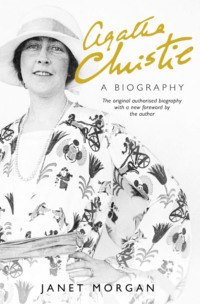
Czytaj książkę: «Agatha Christie: A Biography»
JANET MORGAN
Agatha Christie
A Biography


HarperCollinsPublishers Ltd. 1 London Bridge Street London SE1 9GF
Previously published in paperback by Fontana 1985
First published by William Collins Sons and Co.Ltd 1984
Copyright © Janet Morgan 1984
Janet Morgan asserts the moral right to be identified as the author of this work
A catalogue record for this book is available from the British Library
All rights reserved under International and Pan-American Copyright Conventions. By payment of the required fees, you have been granted the nonexclusive, nontransferable right to access and read the text of this ebook on-screen. No part of this text may be reproduced, transmitted, downloaded, decompiled, reverse engineered, or stored in or introduced into any information storage and retrieval system, in any form or by any means, whether electronic or mechanical, now known or hereinafter invented, without the express written permission of HarperCollins ebooks
HarperCollinsPublishers has made every reasonable effort to ensure that any picture content and written content in this ebook has been included or removed in accordance with the contractual and technological constraints in operation at the time of publication
Source ISBN: 9780008243951
Ebook Edition © AUGUST 2017 ISBN: 9780007392995
Version: 2017-07-28
Dedication
For Shiela
Contents
Cover
Title Page
Copyright
Dedication
Foreword
Preface
1 ‘The Millers, a family’
2 ‘In private and in your own time’
3 ‘A possession that is yours to do what you like with’
4 ‘She will have to make up her mind between them some time’
5 ‘He will change your entire life’
6 ‘This waiting is rather hard but all is ready’
7 ‘Menace and murder and sudden death’
8 ‘1st Class! Good oh! Right here’
9 ‘The next I write will be the 5th’
10 ‘I do not think she knows who she is’
11 ‘A ghastly ten days’
12 ‘An unquestionably genuine loss of memory’
13 ‘London – Paris – Lausanne – Milan – Venice’
14 ‘An idea I’ve never ever considered’
15 ‘Corpses and stiffs’
16 ‘A nice parallel track’
17 ‘Things all seem to come at once’
18 ‘Only an interruption’
19 ‘A certain amount of fêting’
20 ‘Digging up the dead’
21 ‘All the panoply and misdirection of the conjuror’s art’
22 ‘I shall go on enjoying myself’
23 ‘An onlooker and an observer’
24 ‘Like a cinema film run backwards’
25 ‘An ordinary successful hard-working author’
26 ‘It will not, I think, be long’
Index
About the Author
About the Publisher
Foreword
It was not a predictable match.
In 1981 Agatha Christie’s daughter Rosalind, Mrs Anthony Hicks, was at last persuaded to allow Collins, publisher of her mother’s books, to commission a biography, its author to have unrestricted access to family archives. For years, Mrs Hicks had resisted this; like her mother, she believed that a writer’s work should stand by itself, the context of and motives for its production being irrelevant to readers’ enjoyment. As for her mother, for Rosalind private life was precious; once breached, all she valued would become the public’s property.
In the case of so well and worldwide-known an author as Agatha Christie, a brand (shudders from Rosalind), it was admittedly unrealistic to hope that the drawbridge would never be lowered. Agatha Christie was after all the writer so famous that her first book for Collins, The Murder of Roger Ackroyd, had been chosen in 1934, with As You Like It and The Gospels, as the first Talking Book produced in Britain for blind people. At some future time, an emissary would have to be given entrance. But would that be Mrs Hicks’ decision or one bequeathed to her son, Mathew Prichard, Agatha’s only grandchild?
Mrs Hicks understood the contract between Agatha Christie and her readers. Appreciating the comfort which financial security had given her, she saw it as her duty to protect the integrity of her mother’s work, spending hours in correspondence with agents and publishers, in checking proofs, appraising covers, scripts for film, television, radio, correcting slips in reviews. Rights brought responsibilities. She refused to engage in crude forms of commercial exploitation – invitations, for instance, to endorse the manufacture of teacups with Poirot moustaches – but an occasional celebration was allowed. (A memorable Nicaraguan commemorative postage stamp depicted little grey cells spilling from Hercule Poirot’s head.) The ultimate invasion, an Authorised Life, was strenuously repelled.
What led Mrs Hicks to change her mind? In 1979 a bomb was hurled through the defences. Sapping and mining had been underway for years via often dotty speculative biographies, focusing on the episode in December 1926 when Mrs Christie had vanished from her home in Surrey. As Agatha wrote years later in her Autobiography, she was exhausted after the death of her mother and ensuing house-clearing, and distressed by her husband Archie’s admission that he loved someone else. Her flight, to which she did not allude, was an escape. Thirteen days later, at the Hydropathic Hotel in Harrogate, North Yorkshire, Agatha was identified by her husband.
The story was now worked into a clever, if tasteless, film script, Agatha, written by Kathleen Tynan. The film’s plot, derived from sensational newspaper reports in 1926, was that Mrs Christie had arranged her disappearance in order to engineer a charge of murder. The film proposed that Agatha intended to kill herself in such a way as to make Miss Neele, the woman Archie loved and later married, the chief suspect for Agatha’s murder. In those days, if convicted, Miss Neele would have been hanged. This confection – foggy moors, helmeted policemen, steam engines, a grand spa hotel, pearl necklaces, cloche hats, reporters shouting telegrams, and, triumphantly, Vanessa Redgrave as Agatha and Dustin Hoffman her saviour – made a successful entertainment. So successful that, the family feared, people would come to believe it1. Rosalind’s objections went further. She believed in treating people fairly and was angry at this mockery of her mother, who had evidently been at her most vulnerable, by hard and careless people. Rosalind applied for an injunction. It was refused. Agatha Christie had died in 1976. The family was reminded, ‘You can’t libel the dead.’
The challenge now was to defend Agatha’s reputation, not as a writer but as a human being. But what had happened in December 1926? In her Autobiography, written in the 1950s and ’60s, Agatha herself had not chosen to – indeed, even after help from psychiatrists, had been unable to – unravel the story, so Rosalind would have to investigate it herself. This was daunting, especially since so much time had passed. Rosalind had been seven years old when her mother had left the house in the winter night, when the house had filled with policemen, the garden with press, curious crowds pushing against the gates, the servants scared, her father haunted. For fifty years there had been no explanation. She did and did not wish to know. The living are as vulnerable as the dead.
Rosalind could not do this herself. She needed an outsider, someone at a distance. I don’t know who suggested me. I suspect that it was Rosalind’s husband, the kind, scholarly, amusing Anthony Hicks. He knew my tone of voice, having seen pieces I’d written in the TLS, and, I believe crucially, had understood the role I had acquired in being asked to edit the Diaries of the former Cabinet Minister, Richard Crossman, a voracious observer and vivid journalist. The diaries, at mazy length, had originally been dictated, and while he lived, Crossman himself clipped and sorted the first volume for publication. As well as providing essential editorial apparatus, my task was to assess the truthfulness of his tidied up version not so much as to the events and people he was describing but to the impressions he had recorded messily at the time. For later volumes, prepared for publication after Crossman’s death, both responsibilities had fallen to me.
An unexpected match. There was surprise and in some quarters irritation that this sought-after commission should be entrusted to a writer with experience neither of biography nor detective fiction. Looking back, I think that what Agatha’s family were hoping for was simply to find someone to assemble and assess evidence and apply judgement, as an apprehensive patient or litigant might put their case to a medical or legal specialist.
I was interested because I thought that writing a biography would be difficult. Trying to absorb and reflect a life. Understanding not just what I would be told, but why. Steering a course among strong currents. I remembered the ominous words of Philip Williams, biographer of Hugh Gaitskell: ‘Wait till the widow is dead.’ Here, a daughter was very much alive. Stipulations could to be made about non-interference with what I was to publish but an inclination to shape certain passages would surely be irresistible. It is significant that, when Rosalind agreed to an Authorised Life, she was much the same age as her mother had been when she decided to write her Autobiography. That was to be Agatha’s own life as she saw it, anticipating versions with which she might not agree, which she might find ridiculous.
What I hadn’t realised was the pervasive obsession that a large number of people had with this matter of Agatha Christie’s disappearance. As a child, I had read her detective stories in green-striped Penguin Crime paperbacks (and had preferred Michael Innes) and, before meeting her family at Greenway in Devon to discuss this biographical proposition, I had galloped through a selection of her novels and read her Autobiography, but I had no idea that at every turn I should expect this sinkhole, The Disappearance. I have begun here by alluding to it not to inflate its importance but, first, to explain what prompted Mrs Hicks to authorise and Collins to commission a biography, and, second, to suggest that in the broad sweep of Agatha Christie’s life this affair was relatively insignificant.
This biography described what took place in December 1926 and its aftermath, in as thorough a reconstruction as I was able to provide. Rosalind’s friends and family warned me not to explore the subject with her until I knew all I wanted to ask. ‘She will talk about it only once.’ This was not the case. On my second visit, and first long stay, at Greenway, Rosalind pulled from her handbag an account of those events written as a letter by her mother’s secretary-companion Carlo. Tea was on the table, beyond it, a fire, worryingly, burnt brilliantly. Anxious lest I should never see the letter again, I read it with what I hoped was the appropriate mixture of interest and nonchalance, and put it in my pocket.
Months later, I was ready to address this period in Agatha’s life, following her from Surrey to Yorkshire, putting what happened to her in the context of what came before and afterwards. As this biography describes, people who had been present at the time, including some at the Hydropathic Hotel in Harrogate, now felt able to talk about what they remembered. Persistent myths were exposed, notably Mrs Christie’s alleged reply to a reporter who accosted her on the staircase: ‘You are Agatha Christie.’ ‘Yes, but I’ve lost my memory.’ When I was writing this biography, I was shown an uncut draft of that reporter’s own memoir, in which he admitted that he’d invented the exchange.
A fake scoop, making Agatha’s whole adventure seem to have been a fake. Today, oddly, Agatha’s purported reply sounds more genuine. During the past half century, as neuro-science has developed with the support of advanced imaging technology, we have learnt more about the work of memory and the brain. Agatha’s condition sounds like Transient Global Amnesia, an isolated episode, in which the person affected becomes disorientated but remains alert, capable of general understanding and management of themselves: how to catch a train, book in to an hotel. No new memories are made of what must afterwards be a frightening blank, but afterwards those who have experienced it will remember who they are and recognise people in their circle. Nowadays the fictitious exchange with the reporter could have been a diagnosis.
Agatha herself tried for years to discover what had happened to her. This biography explores her return, in detective stories and in the novels she published as ‘Mary Westmacott’, to the subject of remembering and forgetting. As she aged, she became more detached about that unhappy time. I believe that, liking to be technically up to date, she would have found current neuro-scientific research dazzling and engaging. I hoped, when my account of Agatha’s disappearance was first published, that it would be understood for what it was: an extreme reaction to prolonged physical and emotional stress, a shock, a flight. Agatha’s family and friends understood it thus, and were relieved. I had too much faith in reason. Others continue to write nonsense about the Agatha Christie Mystery of 1926 but, then, romance generally trumps a rational explanation.
Let us put that early drama into proportion. More than half of Agatha’s long life was still to be lived. Other challenges were ahead – the war, absence and loss of people she loved, serious financial uncertainty – and the eventual satisfaction of having surmounted them. Chief among the surprises was her second marriage to the archaeologist, Max Mallowan. A scholar and a hands-on field-worker, fifteen years younger than Agatha, he guided her into a rich and fascinating world. Their work in the Near East in the 1930s, ’40s and ’50s was Agatha’s first real partnership, their camp life in the desert the opening for her to make an entirely different home.
New settings, spare landscapes and clear skies, crisp seasons, domestic privations (which she became skilful at overcoming), sharpened her energy and her wits. Her journeys during those years between England and Iraq, Syria, Turkey, gave sparkling material for two of her most picturesque stories, Death on the Nile and Murder on the Orient Express, She had fun with new characters, like the domineering wives of expedition leaders, a category into which she herself never fell, whose tyranny towards young male archaeologists Agatha had observed when she first met Max. Speculation about ancient civilisations led her to try new themes, Murder in Mespotamia, for example, and her play Akhnaton. In these years a gaiety about Agatha, an amused delight in life, fizzes to the surface and for the next half-century carries her through.
It was only in 1999 with the appearance of Charlotte Trümpler’s magnificent exhibition, Agatha Christie, Max Mallowan and the Near East, that I recognised the extent and significance of Agatha’s contribution to Near Eastern archaeological exploration2. Detection its evident theme, the exhibition’s title lured the larger public; its content was irresistible: evocative sound and film, photographs of Agatha in flowing skirts, floppy hat and stout boots plodding through the sand, of Max allocating bonuses to queuing labourers, of camels, tented camps, sunsets, and excavated hoards. A carriage from the Compagnie des Wagons-Lits, as from the Orient Express, was lifted by the British Museum (their idea) into the courtyard.
Imaginative and innovative but in no way frivolous, the exhibition and its catalogue memorably illustrated the work of Mallowan’s expeditions over successive seasons. It was known that Agatha’s household management had made the Mallowans’ camps happy and productive, that her earnings had helped fund the expeditions, and, later, endowed a chair in Near Eastern archaeology at the University of London. Her part in the conservation, recording and presentation of finds had not been acknowledged. Now we can appreciate how much she did: delicate work cleaning clay tablets and, special treasures, the Nimrud Ivories, learning how best to display and photograph them
Come, Tell Me How You Live, her recollection of those years, describes a world Agatha grew to love. Seventy years later, the places she describes – Aleppo, Raqqua, Nimrud, Mosul, Palmyra – have been violated, their people dispersed and worse, artefacts and archives pilfered, monuments destroyed. The Mallowans would have found this horrific. They loved the people of Iraq and Syria and their work at those sites was as important as, at home, Agatha’s books and plays. In some respects, Come, Tell Me How You Live seems uncomfortably light-hearted. Here and there, Agatha’s observations about religious and cultural difference sound superficial compared with the infinite, nuanced complexities of which we have become increasingly aware. We have to remind ourselves that she wrote the book for Max, a present when he came back from the war, a nostalgic memoir, a picture of expedition life that is essentially domestic.
As was Agatha herself. Her interest was in houses, their fabric and furnishings (a wooden lavatory seat was indispensable), provision of supplies and transport, selection of clothing and, sustaining all, the preparation and consumption of food and drink: Come, Tell Me How You Live. Against this background she describes what might be daily life in any large house: tensions among her husband’s team, servants’ rivalries and quarrels, the locals’ rapacities, imbalances suddenly injected by arrivals from the world outside. Famous for comfort and ingenious contrivance, the Mallowans’ camps were Agatha’s household. Come, Tell Me How You Live is, from one who wrote much about death, a joyful book about Living.
Agatha enjoyed good things: books, music, the theatre, pictures, conversation, houses and gardens, outings, her family and friends, delicious things to eat. A wise, civilised manner of life, suffused with humour, generosity and good temper, achieved with effort. I used to think that Agatha Christie was strange, manipulative, fertile in thinking of ways to murder and trick. With older eyes, I realise that this verdict was too severe. Ultra-professional, honest about what she had found she could do, she gratefully did it, to earn her living and keep herself and her readers entertained. As Max used to say: ‘The world is full of two kinds of people, ladies and gentlemen, and both work until they drop.’ The language is dated but, in Agatha’s case, his description is true.
Janet Morgan
April 2017
1A letter by Ted Hughes about Sylvia Plath, published in the TLS of 24 April 1992, reprinted 6 January 2017, describes similar anguish and his frustration at the failure of, in this case, an academic even to imagine the consequences of self-indulgent theorising.
2First exhibited at the Rurhlandsmuseum, Essen. Agatha Christie und der Orient. Kriminalistik und Archäologie, Scherz Verlag, (Bern), 1999; Agatha Christie and Archaeology, The British Museum Company Ltd, (London), 2001.
Preface
Agatha Christie valued her privacy. She rarely gave interviews and never put herself on display: ‘Why,’ she asked, ‘should writers talk about what they write?’ Her reputation, she believed, should stand or fall by her work, and that wish was respected by her family, friends and advisers. They were ready to assist serious analysts of her writing but kept at a distance those who sought to discuss her life. There have been, nonetheless, many biographies of Agatha Christie, in many languages. Some have been no more than fantasies. Others have relied on material from published sources – newspaper reports, reviews, books published by people who knew her or worked with her (though the better acquainted they were, the more circumspectly they wrote) – and have drawn on her own books, plays and poems, especially her recollections of Syria in Come, Tell Me How You Live and her Autobiography, and on her second husband’s reflections in Mallowan’s Memoirs.
In 1980 it was felt that the time had come for a full and thorough account of Agatha Christie’s life, and her daughter, Mrs Anthony Hicks, invited me to write it. Her view was that there was no point in embarking on this venture unless all her mother’s papers were opened to me, with complete freedom to use them as I thought best. This book is based, therefore, on the letters Agatha wrote and received, on her manuscripts and plotting books, photograph albums and scrapbooks, diaries and address books, receipts and accounts, saved from well before her grandparents’ time to the present day. My chapter headings, all quotations, are taken from these sources.
Biographers, however, do not look only at papers. Agatha’s houses and gardens, furniture and possessions have been equally revealing; her family have given me generous access to all these, particularly to Greenway, her house in Devon. Here, with the books she read as a child still in the library, her china in the cupboards and the trees she planted in the garden, I have written most of this book. Mr and Mrs Hicks have been welcoming and hospitable; their greatest kindness has been to read every word of this biography, several times, to point out factual errors, chase references, and talk about Agatha Christie, without once insisting on a view of her character or work that might differ from my own. No biographer could ask for more and I would like to thank them here.
At Greenway, too, I first met many of Agatha’s family and friends. There, and later at their own houses, they told me more about her. I am particularly grateful to her grandson, Mathew Prichard, his wife, Angela, and their children; to Mr and Mrs Archibald Christie, the son and daughter-in-law of Agatha’s first husband, Archie, and his wife Nancy; and to Mrs Cecil Mallowan, Mr and Mrs John Mallowan and Mr and Mrs Peter Mallowan, the family of Agatha’s second husband, Max. I would also like to thank Lady Mallowan, who, as Miss Barbara Parker, first knew Agatha and Max on their archaeological expeditions to Iraq and who later married Max. She has not only described them both to me but has also explained a great deal about their work at Nimrud. Agatha’s family have all spoken freely and thought carefully about my many questions; they have made letters, papers and possessions available without hesitation and smoothed my path towards other witnesses.
Apart from the odd name-dropper (and there are only a couple), people who knew Agatha have hitherto refrained from discussing her with strangers. Old friends kept their stories to themselves, professional colleagues and advisers confined their published remarks to diverting anecdotes about her books and plays, and, by and large, those who worked for her, however briefly or casually, maintained a silence as deep as that of any doctor, priest or lawyer. They knew her as a person, not as a phenomenon; they saw how she shrank from publicity and sympathised. Only the password ‘authorised biographer’ unlocked those doors. Reassured, Agatha’s friends and acquaintances gave me their time, their recollections and their correspondence. Others, who did not know Agatha Christie but were interested in her work and character, guided me to new sources and gave me expert advice. My portrait of Agatha Christie is composed of these memories and reflections and I would like to thank the following people for their part in making it: Mrs Edward Allen; Jeffrey Andrews; Mr and Mrs Tom Ayling; Larry Bachmann; Dr and Mrs Richard Barnett; Mrs J. Barrett; William W. Baxter; the Hon. Mrs Guy Beauchamp; Guilford Bell; Sir Isaiah Berlin; Mrs Connie Bessie; Miss Kathleen Bird; Mrs Anthony Boosey; the late Sir James Bowker; Lady Bowker; Miss Christianna Brand; Richard Buckmaster; Nigel Calder; Miss Elizabeth Callow; Lady Campbell-Orde; Lady Camoys; Sir Simon and Lady Cassels; Mrs Rose Coles; Lady Collins; Edmund Cork; Miss Jill Cork; Miss Pat Cork; Denis Corkery; Miss Ann Disney; Jonathan Dodd; Edward Dodd; Sergeant Durrant of the Surrey Constabulary; Eiddon Edwards; Michael Evelyn; Anthony Fleming; Mr and Mrs Peter Fleming; Richard Fletcher; Mr and Mrs G. Gardner; Sir Julian Gascoigne; Mrs Raleigh Gilbert; Hugh Goodson; Mrs D. Gould; Mr and Mrs Basil Gray; Miss Deborah Greenep; Mr and Mrs Donald Griggs; Caroline Grocholski; Mrs John Gueritz; Professor and Mrs Oliver Gurney; Mr and Mrs C. Hackforth-Jones; Dr Donald Harden; Sir Peter and Lady Hayman; Sir William and Lady Hayter; the late Sir John Hedges; Lady Hedges; Mrs Diana Helbaek; the late Mrs Arthur Hicks; Brigadier and Mrs William Hine-Haycock; Mrs Daphne Honeybone; Mrs Irene Hunter; Mr and Mrs Peter Hulin; Sir Geoffrey Jackson; Mrs Frank James; Dennis Joss; Mr Rodney Kannreuther and the late Mrs Kannreuther; Mr and Mrs Austen Kark; Mr and Mrs Arthur Kellas; James Kelly; Denis Kelynack; Mr and Mrs Richard Kindersley; Sir Laurence and Lady Kirwan; Frank Lavin; Richard Ledbetter; Mr and Mrs Maurice Lush; the late Mrs Ernest Mackintosh; Harvey McGregor Q.C.; Mr and Mrs Richard Mallock; Mrs M. Marcus; Commander Marten and the Hon Mrs George Marten; Mr and Mrs A.R. Maxwell-Hyslop; the Hon Mrs John Mildmay-White; Dr and Mrs Philip Mitchelmore; Charles Monteith; John Murphy; Professor and Mrs David Oates; Miss Jennifer Oates; Miss Dorothy Olding; James Paterson; S. Phelps Platt Jr; Sir John Pope-Hennessy; Professor and Mrs Nicholas Postgate; Briton Potts; Mr and Mrs J.B. Priestley; Dr and Mrs Julian Reade; Sir John and Lady Richmond; Mrs Betty Rivoli; Miss Patricia Robertson; Sergeant Geoffrey Rose of the Thames Valley Police; Mrs Adelaide Ross; Raymond Ross; Lady le Rougetel; Sir Steven Runciman; Mrs Herta Ryder; Sir Peter Saunders; Mrs Reginald Schofield; Professor and Mrs Seton Lloyd; Mr and Mrs Guy Severn; Madame de Soissons; Mr and Mrs J.C. Springford; Dr Anthony Storr; Julian Symons; Miss Geraldine Talbot; Mrs M. Thompson; Miss Barbara Toy; Lord and Lady Trevelyan; Dr Alan Tyson; John Vaughan; Algernon Whitburn; the late Mr Albert Whiteley; Stephen Whitwell; Mr and Mrs Michael Wildy; Professor Donald Wiseman; Mr and Mrs John Wollen; Nigel Wollen; Sir Denis and Lady Wright; and Rolando Bertotti, the head waiter at Boodle’s. There are others, too, whom I would like to thank but their names are obscured by a blot where a raindrop has fallen on my pages. I will thank them properly when we next meet and in the meantime they have my apologies.
I am especially grateful to those who have allowed me to quote from letters to or from Agatha Christie and from family papers. Mrs Anthony Hicks, Mr and Mrs Mathew Prichard, John Mallowan and Peter Mallowan have been immensely helpful and I am also indebted to Edmund Cork and his family. I would also like to thank: Anthony Fleming, for permitting me to quote from the letters of his mother, Miss Dorothy L. Sayers; Mrs Frankfort, for an extract from a letter from her father, Professor Stephen Glanville; Lord Hardinge of Penshurst, whose reports to Collins are quoted here; Lady Kirwan, for quotations from letters from Agatha and Max; Mrs Anne McMurphy, formerly Miss Marple, whose letter from Agatha revealed the origins of that heroine’s name; James Paterson, for extracts from his correspondence about the Churston window; Miss Dorothy Olding, whose exchanges with Edmund Cork I have plundered; Sir Peter Saunders, for quotations from letters and telegrams about plays; Professor Harry Smith, for allowing me to quote from a letter from his father, Professor Sidney Smith; and Miss Barbara Toy, whose correspondence I have cited in writing about Murder at the Vicarage.
I also wish to thank the directors of Agatha Christie Ltd, and the board of Booker McConnell Ltd, for allowing me to use their records; the BBC Written Archives Centre, and Mrs J. Kavanagh, Neil Somerville and Jeff Walden, for permission to quote from their records; the British Red Cross, and the archivist, Miss Margaret Wade, for details of Agatha Christie’s service in the First World War; the directors of William Collins Ltd, for opening their files and allowing me to quote from them; Harrods Press Office, for their efforts to trace a letter Agatha Christie sent them in 1926; the Harrogate Advertiser and Herald, whose archive gave an illuminating picture of the town and its visitors in the ‘twenties; the Home Office Library and the Departmental Records Officer, for their invaluable help in my search through the accounts of Agatha’s disappearance; Hughes Massie Ltd, for permission to examine the records of Agatha’s dealings with her agent; the Imperial War Museum for giving me access to the tape-recording Agatha made for their oral archive; the Trustees of the Allen Lane Foundation, and Dr Michael Rhodes, the archivist, for allowing me to cite extracts from Agatha’s correspondence with The Bodley Head; the Trustees of the Mountbatten Foundation, for enabling me to quote from Earl Mountbatten’s correspondence with Agatha about The Murder of Roger Ackroyd; the trustees of the Harold Ober estate, who made the correspondence of Agatha’s American agent available to me, the Rare Books and Manuscripts Section of the Firestone Library at Princeton University, which houses it, and Miss Jane Snedeker, who guided me to it; the Surrey Record Office, and Dr Robinson, for their help in disentangling the events of 1926; and the University of Manchester Library, and Miss J. Sen, for supplying details of the careers of the doctors who attended Agatha in 1926.
There are others who, out of enthusiasm, curiosity or both, contributed to this book by producing new ideas and surprising references. I particularly wish to thank: Dr Marilyn Butler; Professor John Carey; Christopher Campbell; Stephen Hearst; Leofranc Holford-Strevens; Miss Frances Irwin; Edward Jospé; Mrs Cécil Jospé; Gordon Lee; Douglas Matthews; Mrs Alexandra Nicol; Miss Olivia Stewart; and Miss Anne Willis. I am equally grateful to those who interpreted, typed, arranged and copied my manuscript as I moved from one house, hotel, office and country to the next: Mrs Rigby Allen; Mrs Berry; Miss Michelle Cooper; Vincent Jones; Mrs Daisy Sasso; Mrs Jean Smith; and, as choreographers, Mrs Sheila George and Ray Walters. I would also like to thank Mr Bobby Burns and the Hon. Mrs Burns for their patience and hospitality while I cut and shuffled the text in their house in Jamaica.
The encouragement and guidance of my publishers have been indispensable and I am grateful to Bob Gottlieb of Alfred A. Knopf, Philip Ziegler of William Collins, Elizabeth Burke, Elizabeth Bowes Lyon and Elizabeth Walter.
This book is not only for people who like detective stories but also for those who are interested in a writer’s development and experience, in Agatha Christie’s character and the instinct which made her work a success. Like the lives of many writers, hers changed pace as she reached middle age. There was less incident, more consolidation. She was, moreover, quiet and reflective by temperament, and increasing age and fame made her more so. Though her energy remained immense, she gave most of it to her work. This book looks at the way in which she distilled her experience in her novels, plays and detective stories. Only in one case, however, does it reveal the solution to a plot and then only where Agatha Christie has done so in her own memoirs.
Agatha Christie lived to a great age and she was prolific. I have not given a chronological list of her work at the end of this book, for it is already long and readers who would like such a bibliography may find it in one of the interesting critical accounts of Agatha’s writing. The Agatha Christie Chronology by Nancy Blue Wynne (New York: Ace Books, 1976) is particularly useful; less accurate but more daring is Charles Osborne’s The Life and Crimes of Agatha Christie (Collins, 1982). Robert Barnard has published an excellent study in A Talent to Deceive (Collins, 1980); Gordon C. Ramsey’s Agatha Christie: Mistress of Mystery (Collins, 1972) is thoughtful and was examined before publication by Agatha Christie herself. Sir Peter Saunders’s autobiography, The Mousetrap Man (Collins 1972), gives a producer’s perspective on her work for the theatre, while Tom Adams and Julian Symons have compiled a volume that is stimulating to look at as well as to read, by writing about the jacket designs for some of her paperbacks, in Tom Adams’s Agatha Christie Cover Story (Paper Tiger, 1982). Those who need assistance in keeping track of the characters in Agatha Christie’s work will find, as I have done, that Randall Toy’s The Agatha Christie Who’s Who (Muller, 1980) is painstaking and invaluable. Citations from the reviews of books and plays may be found in many books about Agatha Christie, notably Dennis Sanders and Len Lovallo’s Agatha Christie Companion (Delacorte Press, NY 1984), which is devoted to this theme. I have preferred, however, not to draw greatly on such material, for, apart from their remarkable geographical spread, reviews of Agatha Christie’s work are interesting mainly for their predictability.
There is one more group whom, at the end of this preface, I would like to thank: the secret army of those who gave good advice, pursued elusive references and raided libraries and bookshops across the world, so that they could telephone to Devon – and remoter spots – with answers to questions I thought urgent. Though these friends are anonymous here, I will write their names, with gratitude and affection, in their copies of this biography.
Janet Morgan
1 ‘… the Millers – a family’
Even the beginnings were deceptive. To comfortable middle-class households in Torquay, the airy coastal resort in Devon where Agatha was born, the end of the nineteenth century seemed to be a Victorian afternoon. They did not notice that twilight was stealing over the terraces, the gardens and the pier. Agatha’s own family, the Millers, looked equally prosperous and secure, but their fortunes, too, were imperceptibly growing shakier. And, like most families, the Millers were not as ordinary as they first appeared. In fact, they were decidedly unconventional.
Agatha was the youngest of three children. Madge, her sister, had a passion for disguise that exasperated her teachers and, eventually, her husband, as much as it entertained her friends and bewildered her visitors. Monty, Agatha’s brother, had a different if related talent – for hitting on wild schemes into which he would draw harmless bystanders, to no one’s profit but everyone’s delight, particularly that of the women. Frederick, Agatha’s father, was a charming, nonchalant American, keen on amateur theatricals, fussy about his health but not, until too late, about his investments; her mother, Clarissa, known always as Clara, was capricious, enchanting, and said to be psychic. She was also prone to spiritual and intellectual recklessness. Agatha adored them all.
Frederick and Clara had a romantic and complicated history. Clara’s childhood was a mixture of comfort and insecurity that made her an especially possessive mother; this, in turn, fed Agatha’s devotion, which for a time was to become obsessive. To understand Agatha, it is necessary to know her parents and, equally important, the two women who shaped their lives: her grandmother and step-grandmother, Mary Ann and Margaret.
The family was connected as neatly as characters in a detective story. These links are clearer if they are described like the settings for Agatha’s plots, with the help of a plan:

Mary Ann and Margaret West and their ten brothers and sisters were orphans and were brought up on a farm in Sussex by childless relations. In 1851 Mary Ann met Captain Frederick Boehmer of the Argyll Highlanders, who pressed her to marry him. Since he was thirty-six and she sixteen, her family demurred but Captain Boehmer argued that, as his regiment was about to be sent abroad, the wedding should take place at once – and it did. Mary Ann and Frederick had five children in quick succession (one died as a baby) of whom the only daughter, Clara, was born in Belfast in 1854.
In April 1863 Captain Boehmer, then stationed in Jersey, was thrown from his horse and killed, at the age of forty-eight, leaving Mary Ann, now twenty-seven, with four children to support as best she could. She was an excellent needlewoman and, by embroidering pictures and screens, slippers, pincushions and the like, augmented her husband’s tiny pension. As Frederick had lost what savings he had in some vague speculative venture, Mary Ann had a great struggle to make ends meet. It is little wonder that in an entry in a family ‘Album to Record Thoughts, Feelings, etc.’ known as the ‘Confessions’, written eight years after Frederick’s death, she gave her state of mind as ‘Anxious’.
Meanwhile, Mary Ann’s elder sister, Margaret, had been working in a large hotel in Portsmouth, a post found by an aunt who had for many years been its forceful and greatly respected receptionist. Margaret, already formidable herself, married when she was twenty-six, in April 1863. Her husband, Nathaniel Frary Miller, a widower, had been born in Easthampton, Massachusetts, and had become a successful businessman, a partner in the firm of H.B. Chaflin in New York City. Nathaniel and his first wife, a hospital nurse, had only one child, a son, Frederick Alvah Miller. After his mother’s death, Frederick was brought up mostly by his grandparents in America, but, after his father remarried and settled in England, where his firm had business in Manchester, Frederick visited Nathaniel and Margaret there. Here he met Clara.
It was a fortnight after Margaret’s marriage to Nathaniel that Mary Ann lost her husband. Margaret wrote immediately to her younger sister, offering to take one of the four children and bring it up as her own, and Mary Ann, now despairing, decided that Clara should go to live with her aunt and uncle in the North. The little nine-year-old was lonely and homesick in her new surroundings and Clara always believed Mary Ann had sent her away because she cared more for the boys, rather than, as seems likely, because she felt it would be less easy for a girl to make a career for herself. Clara’s chief consolation was her favourite book, The King of the Golden River, which she brought with her from Jersey. She would read aloud to her uncle Nathaniel the story of its hero, a lonely but determined little boy, who conquered his desolation by being sensible and considerate. Clara, quiet and imaginative, knowing her aunt and uncle were being kind to her but feeling bereft and misunderstood, treasured this book all her life, as Agatha did in her turn.
Clara’s upbringing and tastes were those of an intelligent but sheltered late-Victorian girl. When she was seventeen, she too listed her likes and dislikes in the ‘Confessions’. Her ‘favourite qualities in man’, she said, were ‘firmness, moral courage and honour’, and, in woman, ‘refinement, frankness and fidelity’. Her favourite occupation was reading and talking, her chief characteristic ‘a great love for children’, and ‘the fault for which she had most toleration’ (in this case her own), ‘reserve’. But the young woman whose ‘present state of mind’ was ‘wishing for a long dress’ and who admired Landseer and Mendelssohn, Tennyson, Miss Nightingale and the novels of Miss Mulock, nevertheless had a more robust and merry side. She gave her favourite food and drink as ‘Ice-cream; American soda water’, her favourite fictional heroine as Jo, the energetic tomboy in Little Women, and to the question ‘If not yourself, who would you be?’ she replied firmly, ‘A school-boy.’
When Clara came to live with the Millers, Frederick, Aunt Margaret’s American stepson, was seventeen years old and the cousins became fond of one another. Although there was only eight years’ difference between them, it seemed a larger gap: Clara lived quietly at home in England, while Frederick, after school in Switzerland, had enjoyed a lively, to Clara a dizzy, time in America. As one of his friends later told Agatha, ‘He was received by everyone in New York society, was a member of the Union Club, and was widely known, and there are scores of present members of the Union Club, mutual friends of ours, who knew him, and were very much attached to him.’ After Frederick’s marriage, his and Clara’s names appeared in the New York Social Register; in his own copy Frederick’s blue pencil ticked the names of his many New York friends and acquaintances and others in the best families of Philadelphia and Washington.
The sort of life Frederick led is described in the novels of Henry James and Edith Wharton. The American upper-class society in which he moved was small and intimate – some nine hundred families only are listed in the Social Register of 1892 – and much time was taken up with visiting friends and relations, reading newspapers and writing notes at the Club, dining, dancing, going to the theatre and (less frequently for those who were not devotees) concerts and galleries, playing tennis, croquet and cards, smoking (a serious pastime) and watching horses racing or, alternatively, yachts. Frederick Miller was not, however, one of the moody young fellows depicted in novels of the time, but, in Agatha’s words, ‘a very agreeable man’. Indeed, in his own joking entry in the ‘Confessions’, written when he was twenty-six, he gave an accurate picture of his temperament – easy-going, philosophical, hardly energetic. His favourite occupation was described as ‘doing nothing’, his chief characteristic, ‘ditto’. The characters in history he most disliked were Richard III and Judas Iscariot, his favourite heroes in real life Richard Coeur de Lion and ‘a country curate’. His pet aversion was ‘Getting up in the morning’, his present state of mind ‘Extremely comfortable, thank you’, and to the question, ‘If not yourself, who would you be?’ he placidly replied, ‘Nobody.’ Only one question had a really enthusiastic answer and that concerned his favourite food and drink, where he crowded into a two-line reply: ‘Beefsteak, Chops, Apple Fritters, Peaches, Apples. All kinds of nuts. More peaches. More nuts, Irish stew. Roly Poly Pudding’, and, an asterisked afterthought, ‘Bitter Beer.’
In the same entry Frederick described the characteristics he most admired in women as ‘amenibility to reason’ (his spelling, like that of Madge and, especially, Clara and Agatha, was often erratic), ‘with a good temper’. These were his little cousin’s qualities. She was devoted to Cousin Fred, who had been the first person to compliment her, at the age of eleven or so, on her beautiful eyes, and who sent her when she was seventeen a volume of Southey’s poems, bound in blue and gold and inscribed: ‘To Clara, a token of love’. Clara, for her part, sent Frederick letters and poems and, later, notebooks embroidered with daisies, monograms in gold thread, inscriptions and, most ambitious, a red heart stuck with two arrows. She took pains over these tributes; she was a much less skilful needlewoman than her mother and in one piece of embroidery was obliged to leave off the last letter of Frederick’s name, having misjudged the space available. She also gave him serious and sentimental poetry; a maroon and gold album contains the verse, mostly about love and death, which she composed during their engagement. Occasional corrections in Frederick’s hand show that he not only conscientiously read his cousin’s poetry but here and there improved it.
The most lively verse in that collection was a satirical view of marriage, ‘The Modern Hymen’, which Clara described as being a purely egotistical arrangement: ‘For the Bride, fair beauty, For the Bridegroom, wealth. Two in one united, And that one is – Self.…’ Clara’s and Frederick’s marriage was not at all on these lines. She had refused his first proposal because she thought herself to be ‘dumpy’ and he, though believed to be rich because he was an American, enjoyed a comfortable but not enormous income.
The cousins were married in April 1878; Frederick was thirty-two and Clara twenty-four. A month later, in Switzerland, she wrote a long, rhapsodic poem for him, asking God to send her ‘an angel friend’, whom she could charge to protect and support ‘her darling’; the gift to Frederick is the more touching because it has at the foot a slightly botched attempt at a drawing of an angel and a request to ‘excuse this piece of paper … the only thin piece I had left’, as well as enclosing two dried edelweiss, a gentian, a violet and some clover. These, with the notebooks, Frederick always kept by him.
Margaret Frary Miller, Frederick and Clara’s first child, was born in January the following year, in Torquay, where the Millers had taken furnished lodgings. Soon after Madge’s birth her parents took her to America, so that Frederick could present his wife and baby daughter to his grandparents, and it was thus that the second child, a boy, was born in New York in June 1880. This was Louis Montant, named after Frederick’s greatest friend. The Millers and their two children then returned to England, where they expected to stay only a short time before going back to America to live. Frederick, however, was suddenly obliged to return to New York to see to various business matters and suggested that while he was away Clara should take a furnished house in Torquay. With the help of Aunt Margaret, now a widow, Clara accordingly inspected two or three dozen houses but the only one she liked was for sale, rather than for rent. Despite – or perhaps because of – the restrained and ordered environment in which she had been brought up, Clara was determined and impetuous, and she immediately bought the house, with the help of £2,000 which Nathaniel had left her. She had felt at ease in it at once and when its owner, a Quaker called Mrs Brown, had said, ‘I am happy to think of thee and thy children living here, my dear’, Clara felt it was a blessing. Frederick was somewhat taken aback to discover that his wife had bought a house in a place where he expected them to stay a year or so at most but, always good-natured, he fell in with her wishes.
The house was Ashfield, in Barton Road. It has long been demolished but some impression of it can be had from Agatha’s recollections and those of her contemporaries and from photographs taken at the turn of the century. Ashfield was large and spreading, like other Torquay villas of its kind, built for the sizeable families of the professional middle class, who needed plenty of spacious rooms to hang with draperies, cram with furniture and stuff with interesting objects which they liked, or liked to display. Such houses were no trouble to heat, because fuel was cheap, or to clean and maintain, because servants were inexpensive, with enterprising and ingenious plumbers, glaziers, carpenters and masons in abundant supply. Ashfield was an attractive and unusual house; a rectangular two-storey part, with wide sash windows, adjoined a squarish three-storey section, with tall windows, some of those on the ground floor having coloured glass in the upper part, while the lower sections opened on to the garden. There was a multiplicity of chimneys; trellis-work and climbing plants covered the walls. The porch, which was large and topped with window boxes, was entirely shrouded with creeper. Attached to the house was an airy conservatory, full of wicker furniture, palm trees and other spiky and exotic plants, and at ten-foot intervals along the edge of the lawn, where it bordered the gravel, were huge rounded pots of hyacinths, tulips and other plants in season. A second, smaller greenhouse, used for storing croquet mallets, hoops, broken garden furniture and the like, and known as ‘Kai Kai’, adjoined the house on the other side. (Towards the end of her life Agatha described this greenhouse in Postern of Fate.)
The garden seemed limitless to Agatha, most of whose childhood world it composed. She described it as being divided in her mind into three parts: the walled kitchen garden, with vegetables, soft fruit and apple trees; the main garden, a stretch of lawn full of trees – beech, cedar, fir, ilex, a tall Wellingtonia, a monkey-puzzle tree and something Agatha called ‘the Turpentine Tree’ because it exuded a sticky resin; and, last, a small wood of ash trees, through which a path led back to the tennis and croquet lawn near the house. Ashfield was, moreover, at the end of the older part of the town, so that Barton Road led into the lanes and fields of the rich Devon countryside. The houses and gardens seemed immense and that was how Agatha remembered them when she was grown up – but Ashfield was certainly big.
It was as well that the house was spacious, since Frederick had a mania for collecting. Torquay being a fashionable resort, patronised by people with money, taste and plenty of spare time, it had attracted a number of dealers, into whose smart shops he would make a detour on his daily walk to the Yacht Club. The shopkeeper who did best was J.O. Donoghue, of Higher Union Street, whose lengthy bills give a detailed picture of Frederick’s purchases of coffee tables, card cases, plaited baskets, salts, oriental jugs and jars, china plates, cut-glass candlesticks, paintings on rice paper, muffineers and innumerable pieces of Dresden china. The stack of bills preserved among Frederick’s papers also shows the extent of the Millers’ domestic establishment and hospitality. Five-course dinners were prepared daily by Jane, the cook, with a professional cook and butler hired for grand occasions, when at each course a choice of dishes would be presented. Clara kept a book of ‘receipts for Agatha’, which indicates the richness and expense of the food that was served: fish pies, for instance, were made of filleted sole layered with oysters (though there was a footnote saying ‘Best brand of tinned oysters “Imperial”’) and directions were given for preparing truffles to add to meat or chicken, for making breakfast dishes of cold salmon and of kidneys and mushrooms, for dishes of quail, splendid savouries, and various complicated salads, smooth creams and junkets. The only really economical recipe, for macaroni cheese, instructed the reader to ‘get the macaroni at a shop in Greek Street, Soho, kept by an Italian’ and carried the terse comment ‘Not very good.’
Into this well-equipped household Agatha was born on September 15, 1890. She was the much-loved ‘afterthought’; her mother was thirty-six, her father forty-four and there was a gap of eleven years between Agatha and Madge and ten between Agatha and Monty. Madge was by now a boarder at Miss Lawrence’s School in Brighton (later to become the celebrated girls’ boarding school Roedean) since this accorded with Clara’s current view of what should constitute female education. Madge’s letters to her baby sister – ‘My dear little chicken … Who do you get to make you a big bath of bricks in the schoolroom now that your two devoted slaves have left for school to learn their lessons?’ – reflected her gregarious and comic nature. She was a tumbling, bouncing girl, not beautiful but with an attractive, mobile face and an engaging grin. The only wistful note in her entry in ‘Confessions’ was her answer to: ‘If not yourself, who would you be?’ to which she replied, ‘A beautiful beauty.’
Madge adored jokes, pranks and disguises and Agatha was awed and delighted by her sister’s exploits. She talked with amazed pride of the time when Madge dressed up as a Greek priest to meet someone at the station and of the occasion when, having come to Paris to be ‘finished’, she accepted a dare to jump out of the window and landed on a table at which several horrified Frenchwomen were taking tea. Madge would thrill her sister by spicing affectionate play with a dash of spookiness, saying solemnly, ‘I’m not your sister,’ looking for a moment like a stranger, or, in an even more terrifying version of this game, putting on the silkily ingratiating voice of the imaginary madwoman Madge and Agatha called ‘The Elder Sister’, who lived in a cave in the nearby cliffs, and uttering the horribly unreassuring words, ‘Of course I’m your sister Madge. You don’t think I’m anyone else, do you? You wouldn’t think that?’
It is much harder to catch a glimpse of Agatha’s brother, Monty. Here and there, in the first dictated draft of the part of her autobiography that deals with her childhood, Agatha alluded to the fact that ‘at about this time, Monty disappeared from my life’; as it was, he hardly seems to have been there at all. This is partly because, when Agatha was young, Monty was at Harrow and when she was older he had vanished abroad. He was not a scholar – he left Harrow without passing his examinations – but his winning disposition helped him to survive. Agatha told the story of Monty’s being the only boy allowed to keep white mice at school, since the Headmaster had been induced to believe that Miller was especially interested in natural history. Her picture of him was, as one would expect, of someone who, by virtue of his being a boy and ten years older, led a strange and exciting life of daring exploits in boats and later in motor cars, in which he would sometimes disdainfully allow his little sister to take part.
Things cannot have been easy for Monty, in a circle of four forceful women – his energetic and argumentative elder sister, shrewd impulsive mother, and two formidable grandmothers. A photograph shows him, in an ill-fitting buttoned uniform, with a sullen expression on his handsome face; he might be any age from nine to nineteen and he looks bored and unhappy. But other pictures show Monty at his most gay and irrepressible: we see him, in smoking jacket, top-hat and huge leather boots, sitting in ‘Truelove’, the tiny wheeled horse and carriage with which the children played, cheering on a puzzled goat which has been attached to the reins. Monty has a look that is simultaneously wild and self-indulgent.
In his portrait, painted when Monty was nineteen or so, he seems calmer but somehow unconvincing, as if he were not sure whether to look foppish, quizzical, or rakish. His entry in the ‘Confessions’ (which he forgot to sign) conveys a similar impression of uncertainty. His remarks were those of someone trying to be amusing, with neither the panache nor the wit to carry it off: ‘Your favourite heroes in real life?’ – ‘Fenians’; ‘Your present state of mind?’ – ‘Oh my!’; ‘Your favourite qualities in man?’ – ‘Being a good fellow generally’; and – a clue to the fact it is Monty who is writing – ‘Your idea of misery?’ – ‘Borrowing money.’ There was something melancholy about Monty and, though his influence on his younger sister was much less direct and obvious than that of Madge, he nevertheless presented a worrying puzzle to Agatha.
Agatha Mary Clarissa was named after her mother and grandmother, the name of Agatha, she believed, being added by Clara, with her usual agility, as a result of a suggestion made on the way to the christening. (One of Clara’s favourite novels was, moreover, Miss Mulock’s Agatha’s Husband.) During the course of Agatha’s life, she was to acquire, or adopt, a number of different names and titles; to her friends and family (except those close relations who later called her ‘Nima’, her grandson’s corruption of ‘Grandma’) she was always ‘Agatha’. As her first publisher told her in 1920, it was an unusual and therefore memorable name – and that is what we will call her here.
Frederick’s collection of bills also gives some impression of the furniture, books and pictures amongst which Agatha grew up. Some of the better furniture was sold in the years after her father’s death, when her mother’s circumstances were considerably reduced, but a good deal of it, including many of the lamps, screens and pictures, and much of the china, cutlery and glass, was used to furnish the houses in which Agatha subsequently lived. As she said herself, her father’s taste in pictures did not match his discrimination in buying furniture. The fashion of the eighteen-eighties and eighteen-nineties was to hang as many pictures as possible on whatever wall space was available and this Frederick proceeded to do, with vague oils, Japanese caricatures, pastels on copper and masses of engravings, including one called ‘Weighing the Deer’, of which he was particularly fond. Certain cherished objects were assigned to those members of the family who would eventually inherit them. (Clara’s Aunt Margaret would write names of the future beneficiaries on the backs of the canvases.) Agatha’s particular inheritance was ‘Caught’, an oil of a woman catching a boy in a shrimping net, exhibited at the Royal Academy in 1884 and acquired by Frederick ten years later for the sum of £40. In the same year, when Agatha was four, her father commissioned a local artist, N.H.J. Baird, to paint the family dog, an exercise which was regarded as so successful that Mr Baird was subsequently invited to paint Frederick, Agatha, Monty, Madge, and Agatha’s nurse. When, at the age of seven, Agatha was asked to name her favourite poets, painters and composers in the ‘Confessions’, she loyally put Baird’s name alongside those of Shakespeare and Tennyson.
The focus of Agatha’s life as a small child was ‘wise and patient Nanny’, the cook Jane, and successive parlourmaids. Her recollections of these companions date from an early age. Unusually, too, her Autobiography described what Nursie and Jane looked like, her nurse with ‘a wise wrinkled face with deep-set eyes’, framed, as in Mr Baird’s portrait, by a frilled cambric cap, and Jane, ‘majestic, Olympian, with vast bust, colossal hips, and a starched band that confined her waist’. Nursie represented ‘a fixed point, never changing’. For instance, her repertoire of six stories did not vary, whereas Clara’s were always different. Clara, unlike Nursie, never played the same game twice; as Agatha wrote of her mother’s tales and games, their unpredictability sometimes shocked her but she also felt the enchantment of the perpetually unknown. Nursie’s religious beliefs were firm. She was a Bible Christian, devoutly keeping the Sabbath by reading the Bible at home. Clara, by contrast, experimented with various schools of religious thought: she had nearly been received into the Roman Catholic Church; next she tried Unitarianism, which in turn gave place to Theosophy and then, briefly but keenly, to Zoroastrianism. She was at one point deeply interested in Christian Science and occasionally attended Quaker meetings. Clara broke the rules – she and Agatha would gaily gather up all the towels in the house to play with – while Nursie enforced them. When Agatha was four or five, Nursie returned to Somerset. Agatha missed her desperately, for she had been the centre of order, calm and stability.
So was Jane, who presided over the kitchen. There she was, massive, placid, always gently munching on some delicious scrap, providing regular meals at regular times, and bits and pieces in between. It is not surprising that food was always a pleasure and a solace to Agatha and that she is remembered for the ample meals she offered, the expertise with which she would make éclairs and mayonnaise, and the delight she took in food that was served to her. Jane taught Agatha to make cakes, ‘some with sultanas, and some with ginger,’ as she wrote proudly to her father when she was eleven, ‘and we had Devonshire cream for tea.’ She was passionately fond of cream: Devonshire cream on its own, eaten with a spoon; double cream mixed half and half with thick milk and drunk from a cup; or clotted cream put together with treacle to make ‘Thunder and Lightning’. This was real Devonshire cream, as thick as butter and as smooth, with a yellow crust and palest gold below, a simple but matchless taste, a slippery consistency and a flavour bland yet unlike anything else – just the sort of dish for which a lonely child might yearn.
Agatha was, moreover, energetic and intelligent; she got hungry and bored, in spite of the games and stories she invented, and she remained a skinny child. Monty called her ‘the scrawny chicken’. Meals, punctually served, were benchmarks in the day and the ceremonies of presenting and consuming food were fascinating, especially since she was orderly and fond of ritual. Throughout her life she served formal meals as they were composed in her childhood, with silver and glasses correctly placed, flowers arranged, napkins folded, course succeeding course. A meal was a celebration.
Liking the way things were arranged, Agatha was also interested in the way people were ordered. She was to discover as she grew up the fine gradations of Torquay society but her first inkling of a hierarchy was in the household at Ashfield. With her sharp ear for words and phrases, she noticed forms of address: cooks were always ‘Mrs’, housemaids equipped with ‘suitable’ names (even if they did not arrive with them), like Susan, Edith, and so on, and parlourmaids, who ‘valeted the gentlemen and were knowledgeable about wine’, had names sounding vaguely like surnames – Froudie was one of the Millers’ parlourmaids – to go with their ‘faint flavour of masculinity’. Duties, too, were clearly allocated and, while there were few complications in Ashfield’s small household of three servants, from time to time Agatha would be aware of friction between the nursery and the kitchen. Nursie, however, was ‘a very peaceable person’.
As the servants deferred to Agatha’s parents (Jane, when asked to recommend a dish, would not dream of suggesting anything except, non-committally, ‘A nice stone pudding, Ma’am?’), so the lower servants genuflected to those in higher authority. Agatha was deeply impressed, as a child, by the reproof which Jane (addressed by the other servants as Mrs Rowe) administered to a young housemaid who rose from her chair prematurely: ‘I have not yet finished, Florence.’ A sensitive child, she could spot where power lay and, as children do, grew skilled at managing complex relations with a number of adults with whom she had understandings of varying degrees of complicity. Agatha knew about the servants’ world, not only because these were the adults with whom she spent a fair amount of time but also because she needed to keep her wits about her in order to avoid trouble and interference, obtain attention and titbits, and know what was going on.
Like most children, too, she was interested in the execution of practical tasks – the way pastry was made, ironing done, fires laid, boots blackened and, as Agatha observed, ‘glasses washed up very carefully … in a papier-mâché washing-up bowl’. She acquired a proper respect for the efficient exercise of these domestic skills, enhanced by Clara’s instilling into her that servants were highly trained professionals, versed not only in the intricacies of whichever part of the household they managed but also in the correct relations that should prevail between themselves and the people for whom they worked. Agatha emphasised this point in her Autobiography, since she was aware that the world before 1939 which she was describing was quite different from that of many of her readers, who might be baffled by the nuances of these domestic relationships.
To Agatha her mother was an extraordinary and magical being. Now in her late thirties, Clara supervised her household and her husband with natural authority, reinforced by experience. She knew and thought about her husband and children sufficiently keenly for them to believe that she had second sight (Madge once said to Agatha that she didn’t dare even to think when Clara was in the room), an impression that must have been fortified by her fickle but profound interest in various bizarre philosophies. She still wrote poetry; one of her stories, with Callis Miller as a pseudonym, survived among Agatha’s papers. The narrator of ‘Mrs Jordan’s Ghost’ was the unhappy spirit of a dead woman, manifesting itself whenever a particular piano was played. The preoccupations of this forlorn soul – rippling music, an ominous verse, guilt and purification, a vaguely apprehended unknown Power, ‘the unwritten laws of this mysterious universe’ – were exactly what one would expect in a story by Clara. An exotic figure, looking in her later photographs drawn and astonished, she seemed to Agatha a charming mixture of waywardness and dignity, certainty and vagueness.
Agatha saw her mother at special times: when she was ill or upset; when she needed permission to embark on some rare adventure or wished to report on one; and after tea, when, dressed in starched muslin, she would be sent to the drawing-room for play and one of Clara’s peculiar stories – about ‘Bright Eyes’, a memorable mouse, whose adventures suddenly petered out, or ‘Thumbs’, or ‘The Curious Candle’, which Agatha later dimly remembered as having had poison rubbed into it (this tale too, came to an abrupt stop). It was then that she could study her mother’s ribbons, artificial flowers and jewellery. Small girls (as she recalled in Cat Among the Pigeons) are not immune to the spell of jewels and those belonging to an older woman are especially magical, for they represent all sorts of mysteries and transformations. In her Autobiography Agatha described Clara’s ornaments, although her list is thin in comparison with the pile of jewellers’ accounts among Frederick’s bills: for lockets and stars, brooches and fans, buttons, rings, scent bottles and card cases, and two of the items Agatha remembered, a diamond crescent and a brooch of five small diamond fish, bought, endearingly, during the last weeks before Agatha’s birth.
In Nursie, Jane, Clara and Madge, Agatha was surrounded by strong and influential women. Her father, kindly and interested in his daughter’s progress, had his own detached way of life. In the morning after breakfast he would walk down to the Royal Torbay Yacht Club, calling en route at an antique dealer’s, to see his friends, play whist, discuss the morning newspapers, drink a glass of sherry and walk home for luncheon. In the afternoon he would watch a cricket match, or go to the Club again and weigh himself (preserved among his papers is a sheet of Club writing paper, with such records of stones and ounces as: August 9th, p.m., blue suit, 14.0; September 13th, a.m., Pep. Salt., 14.0), before returning to Ashfield to dress for dinner. Frederick’s photographs show him stout and contemplative, and, in part because of his fashionable moustache and beard, he looked older than his years.
There were two other important and impressive women in Agatha’s childhood: her grandmothers Margaret and Mary Ann. Margaret, Clara’s aunt and Frederick’s step-mother, was known as Auntie-Grannie, while Mary Ann, Clara’s mother, was known as Grannie B. It was at Margaret’s house that the family gathered. After Nathaniel’s death she had moved from Cheshire to a large house in Ealing, filled with a great deal of mahogany furniture, including an enormous four-poster bed curtained with red damask, into which Agatha was allowed to climb, and a splendid lavatory seat on which she would sit, pretending to be a queen, ‘bowing, giving audience and extending my hand to be kissed’, with imaginary animal companions beside her. ‘Prince Goldie’, named after her canary, sat ‘on her right hand’ on the small circle enclosing the Wedgwood handle of the plug. On the wall, Agatha recalled, was an interesting map of New York City. Throughout her life Agatha maintained that a well-appointed and efficient lavatory, preferably of mahogany, was an essential feature of a house or an archaeological camp; she was delighted to discover in her house in Devon a room fitted with wooden furniture almost as magnificent as her grandmother’s.
Auntie-Grannie passed her days not in the drawing-room, ‘crowded to repletion with marquetry furniture and Dresden china’, nor in the morning-room, used by the sewing woman, but in the dining-room, its windows thickly draped with Nottingham lace, every surface covered with books. Here she would sit either in a huge leather-backed carver’s chair, drawn up to the mahogany table, or in a big velvet armchair by the fire. When Agatha was tired of the nursery and the garden, full of rose trees and with a table and chairs shrouded by a willow, she would come to find her grandmother, who would generally be writing long ‘scratchy-looking’ letters, the page turned so that she could save paper by writing across the lines she had just penned. Their favourite game was to truss Agatha up as a chicken from Mr Whiteley’s, poke her to see whether she was young and tender, skewer her, put her in the oven, prick her, dish her up – done to a turn – and, after vigorous sharpening of an invisible carving knife, discover the fowl was a squealing little girl.
This memory, like many of Agatha’s other recollections of her paternal grandmother’s house, was of fun and of eating. She described with great vividness each morning’s visit to the store cupboard; Margaret, like her stepson, was a collector but, as well as hoarding lengths of material, scraps of lace, boxes and trunks full of stuff, and surrounding herself with a profusion of furniture, she also assembled quantities of food: dried and preserved fruit, pounds of butter and sacks of sugar, tea and flour, and cherries, which she adored. (The ‘Confessions’ gives Margaret’s favourite food and drink as stewed cherries and cherry brandy and when she left Ealing thirty-six demijohns of home-made fruit liqueur were removed from her house.) She would dispense the day’s allocation to the cook, investigate any suspected waste, and dismiss Agatha with her hands full of treasure – crystallised fruit like jewels.
Mrs Boehmer, Grannie B., lived in Bayswater but made frequent visits to her sister at Ealing. Here Agatha saw her, and always on Sundays, when the family would assemble at Auntie-Grannie’s table for a large Victorian lunch: ‘an enormous joint, usually cherry tart and cream, a vast piece of cheese, and finally dessert’. Two of Clara’s brothers would be there, Harry, the Secretary of the Army and Navy Stores, and Ernest, who had hoped to become a doctor but, on discovering he could not stand the sight of blood, had gone instead into the Home Office. (Fred was with his regiment in India.) After lunch the uncles would pretend to be schoolmasters, firing questions at Agatha, while the others slept. Then there was tea with Madeira cake. On Sunday, too, the grandmothers would discuss and settle the week’s dealings at the Army and Navy Stores, where they had accounts and where, during the course of the week, Grannie B. would make small purchases and take repairs for Auntie-Grannie (who, Agatha suspected, discreetly added a small present of cash when reimbursing her sister). Agatha joined her grandmothers on some of these expeditions, which are recalled in her description of Miss Marple’s missions to the Army and Navy Stores in At Bertram’s Hotel.
Agatha’s Autobiography gives only the most general description of her grandmothers’ appearance. As widows usually did, they dressed in heavy black. Both seemed to Agatha extremely stout. Grannie B. in particular suffered from badly swollen feet and ankles, as Agatha was later to do, and her tight-buttoned boots were torture. In fact their photographs show that they were small women but to Agatha, a thin and bony child, they and the silky stuffs in which they were swathed must have appeared imposing. It was their conversation she remembered and recorded most clearly: good-natured bickering between the two sisters, each teasing the other over who had been more attractive as a girl – ‘Mary’ (or ‘Polly’, as Auntie-Grannie called Grannie B.) ‘had a pretty face, yes, but of course she hadn’t got the figure I had. Gentlemen like a figure.’ And Agatha drank in their gossip about friends who came to call: Mrs Barry, for instance, whom Agatha regarded with profound awe because she claimed to have been in the Black Hole of Calcutta. Though implausible, her story was so horrid that it fascinated the company.
These conversations were riveting to an imaginative child whose fancy careered ahead of her understanding and who was particularly susceptible to words. (On one occasion a farmer’s angry shout ‘I’ll boil you alive,’ when Agatha and Nursie wandered on to his land, struck her dumb with terror.) Especially interesting were the anecdotes of gallant colonels and captains, with whom Auntie-Grannie kept up ‘a brisk, experienced flirtation’, knitting them bed-socks and embroidering fancy waistcoats, and who made Agatha nervous with their heavy-handed archness and tobacco-laden breath. She remembered exceptionally clearly the remarks, deliberately made in her hearing, about the relationship between a retired Colonel in the Indian Army and the young wife of his best friend, who had retired to a lunatic asylum: ‘Of course, dear, it’s perfectly all right, you know. There is nothing at all questionable about it. I mean, her husband particularly asked him to look after her. They are very dear friends, nothing more. We all know that.’
Margaret seems to have been a more forthright and colourful character than her younger sister; certainly Agatha’s Autobiography contained many references to the opinions, precepts and warnings handed out by her Ealing grandmother, whereas she recalled little of the views of her quieter counterpart in Bayswater. But the serene and affectionate Mary Ann, who never remarried, busying herself with her needle and giving her attention to her three sons, and the more striking Margaret, with her pithy wit and scorn of humbug, thoroughly interested in what the world was thinking and doing, surrounded by cupboards and drawers full of bits and pieces, both provided models of what an old lady might be like. From their characters Agatha was later to draw much that was instructive and entertaining.
2 ‘… in private and in your own time’
Clara’s views on education were almost as inconsistent and ‘advanced’ as her religious opinions. Agatha was not only to be educated at home, unlike Madge, but Clara now maintained that no child should be allowed to read until it was eight years old, since delay was better for the eyes as well as the brain. This was too much to hope for in Agatha’s case. She was fascinated by words and phrases, lived among talkative adults who were natural storytellers and was surrounded by books, many of which had belonged to Madge and Monty: Walter Crane’s Panpipes, a wonderful book of songs like ‘Willow, O Willow’ and ‘Early One Morning’, with swirling art nouveau illustrations of elves, flowers and wreaths; fairy tales like The Giant’s Robe and Under the Water, the story of children who discovered an extraordinary world beneath a stream. One enduring memory was of reading The Adventures of Herr Baby while staying with Auntie-Grannie in Ealing. This book, written by Mrs Molesworth in 1881, had belonged to Madge; it is the tale of an irritatingly precocious four-year-old’s travels abroad with his family and how he is lost, found and restored to them. Mrs Molesworth’s children’s books were popular during Agatha’s childhood and she acquired them as soon as they were published: Christmas Tree Land, for instance, in 1897, and The Magic Nuts in 1898. At this time, too, Edith Nesbit was writing marvellous fantasies, all of which Agatha read: The Story of the Treasure Seekers, which came out in 1899, when she was nine, The Phoenix and the Carpet of 1903 and The Railway Children of 1906.
There was also the literature Clara had enjoyed as a child, exciting, simply written, illustrated books from New York, and the volumes she had been given later, like Louisa M. Alcott’s unfussy, family-centred Little Women, which appeared when Clara was fifteen, and Little Men, which came out three years afterwards. Some of Madge’s and Monty’s books had also come from America, including a series of startling thrillers: Mr Barnes of New York (first chapter entitled ‘A Vampire Brood’); Cynthia Wakeham’s Money; The Masked Venus; and Mr Potter of Texas (Chapter One, ‘The Deserted Hotel’: ‘Sir, I have something to tell you!’ – ‘My heavens! Is there a woman – an Englishwoman – in this accursed place tonight?’).
An increasingly wide range of literature became available for children at the end of the eighteen-nineties and in the early nineteen-hundreds. For small children there were ingenious ‘pop-up’ books (Madge had a collection) and vividly illustrated stories, like Punch and Judy, but until Beatrix Potter began to produce short books of simply worded tales with pretty drawings (The Tale of Benjamin Bunny appeared in 1904) there was little that children aged from four to seven could easily read for themselves. For older children, however, literature brightened up considerably, the work of Edith Nesbit and Frances Hodgson Burnett, for example, being perfectly suited to someone of Agatha’s age and circumstances. The language is exact, the sentences uncluttered, and the ideas – missing fortunes from India, tyrannical schoolmistresses, adventurous children, secret gardens, magical cities, juggling with time – just the right mixture of the fantastic and the familiar. Agatha could look up strange words and puzzling references; the Millers’ house was well furnished with encyclopaedias, atlases and dictionaries. These late-Victorian and early-Edwardian children’s books were, too, full of complex and extraordinary fantasy, reflecting the hidden themes of ‘real life’ – quests, adventures, transformations, the wish to make order out of chaos or to obtain justice, the curious effects of money, death and love. Agatha was brought up on such reveries – the weird sketches and mad verse of Edward Lear and the remarkable worlds created by Lewis Carroll (Frederick had bought Through the Looking Glass in 1885, when Madge was six), not just those explored by Alice but also the more baffling, yet perfectly comfortable territory of Sylvie and Bruno. Like dreaming, reading mirrored and assuaged a child’s subconscious turmoil.
In spite of Clara’s notion that premature reading was injurious, Agatha received presents of books from an early age. In 1893 Madge gave her The Ballad of Beau Brocade, difficult for a three-year-old but with a jolly swing to the lines (‘Seventeen hundred and thirty-nine, that was the date of this tale of mine. First Great George was buried and gone, George the Second was plodding on …’). When she was eight Auntie-Grannie presented her with Robinson Crusoe and, two years later, with Frances Hodgson Burnett’s newly published book, Granny’s Wonderful Chair (‘Chair of my grandmother, tell me a story …’). Agatha’s family also encouraged her to read by sending her regular letters, short and easy, whenever they were parted. Frederick, whose own taste was for melancholy but uplifting American verse and for the jauntier Thackeray, sent particularly charming notes. In January 1896, when Agatha was five, her parents took Madge to America, and Frederick wrote from New York: ‘Tell Grannie it was three degrees below zero (thirty-five degrees of frost). You see all the people in the streets with fur around their throats and little covers for their ears so they don’t get frozen!’ Madge took trouble to print her letters to her ‘dear Pip’, decorating them with animals and palm trees, and during their absence Clara wrote often to ‘her sweet darling little girl’. Clara’s letters invariably bore only the vaguest of dates (Agatha inherited this habit) but postmarks on the envelopes show that when Agatha was seven she was receiving detailed instructions to help Nursie track down missing photographs and ensure that Grannie rested properly. By the time she was five, Agatha had taught herself to read by puzzling out a text that had often been told aloud to her, L.T. Meade’s The Angel of Love, a long book, full of interesting words like ‘monstrous’, ‘discomfited’ and ‘tirade’. She used a copy that Monty had given Madge for Christmas in 1885; its spine is broken and it falls open at the place where, taking pity on the little girl in the black and white illustration, whose sisters are saying, ‘We think her very ugly,’ Agatha or Madge has coloured her hair with purple crayon.
Frederick now declared that Agatha should also learn to write. She started with pencil and by the time she was seven graduated to ink and an italic nib, in which she wrote a large, legible hand, joining up some of the letters. She had mastered reading by matching meaning to the appearance of entire words, rather than single letters, and for a long time she had difficulty in distinguishing B from R. Her spelling was always of the hit and miss sort that characterises people who remember words by ear rather than by eye. Madge encouraged Agatha to practise her writing, ruling a copybook with pencilled lines and writing out sentences for her sister to follow. Each sentence featured a different letter of the alphabet and they all had Madge’s special touch: for J there was ‘Jealousy is a green-eyed monster,’ P was represented by ‘Pork pie is made of pig and paste’ and I had ‘I was an idler, who idolised play.’
Agatha liked arithmetic, which Frederick taught her every morning after breakfast. He soon moved her on to questions concerning the allocation of apples and pears and the diminution of bathsful of water, problems she enjoyed enormously. Like her father, Agatha had a tidy mind and was naturally quick at sums and tables; later, in her mid-twenties, when she qualified as a dispenser, she had no difficulty in mastering the basic principles of physics and chemistry or remembering the proportions of each substance required to compound a particular drug. Her natural grasp of such concepts as quantity, scale and proportion, together with the fact that she had an ear that was more discerning than her eye, also encouraged her aptitude for music. She learnt to play the mandolin and would practise on her grandmother’s piano in the unheated drawing-room at Ealing. Frederick was very musical and could play anything by ear; with her father’s help and that of a German music teacher, Fräulein Üder, and her successor, Mr Trotter, Agatha progressed from The Merry Peasant, by way of Czerny’s Exercises, to Schumann and Grieg.
Apart from her music teachers, Agatha had no professional tuition at home but her general education was every bit as good as, if not better than, that of her contemporaries who were formally taught. She read voraciously, devouring Jules Verne’s early science fiction and Henty’s adventure stories, and tasting the sets of bound volumes Frederick had accumulated: complete editions of George Eliot’s works, Mrs Henry Wood’s novels, Scott, Dickens, Trollope, Byron and Kipling, sets of the Cornhill Magazine, the Art Journal, The Nineteenth Century and The Lady’s Magazine, novels by the Brontë sisters and Marion Crawford, Oscar Wilde’s poetry, the French classics, thirty volumes by British essayists, Pinero’s plays and every novel of Disraeli. All these, save for some racy plays in French, she was allowed to read.
There was, moreover, a great fashion for question and answer books, compendia of general knowledge and books of lists. Dr Brewer’s Child’s Guide to Knowledge was one, full of useful information on which a child could be tested, as in the games played by Agatha’s uncles. The Home Book of Pleasure and Instruction not only gave directions for such exercises as ‘How To Make A Rag Doll Which A Baby May Put Into Its Mouth Safely’, but also instructed the reader in ‘The Twenty-four Classes of Linnaeus’, ‘The Synopsis of Seaweed Tribes’, ‘Hints on Heraldry’, ‘The Principles of Photography’, ‘The Classification of Shells’, and so on. Such books also contained various games with words and numbers: acrostics, letter and figure charades (TELEGRAPH: I am a word of nine letters; my one to seven is a Chinese plant; my five, six, seven, one, two, is a fireside requisite; etc.), inversions, rebuses, enigmas, arithmorems, chronograms, cryptographs, and the like. These riddles provided amusement and trained the mind in what is now called lateral thinking. To her interest in order, hierarchy and proportion, Agatha added a liking for manipulating letters and numbers, interpreting codes, and playing with arrangements and sequences to hide or uncover other meanings.
Although Agatha was always defensive about the fact that she had neither gone to school nor had teachers at home, in many ways an education of this sort was as valuable as school lessons would have been, and it was undoubtedly instructive and memorable. She acquired a great deal of general information, learnt how to look things up for herself, and browsed over all manner of subjects. For a short time, when she was about thirteen, she attended classes for two days a week at Miss Guyer’s Girls’ School in Torquay, where she studied algebra and sought to grasp the rules of grammar and spelling. But, perhaps because her early education had ranged about with such lack of discipline, she was intellectually wayward. She had not been trained to work at subjects that bored her, bother with fundamental rules of spelling and grammar, or follow an argument through logical steps to the end. In itself this was no hardship; there are many ways to be creative and to manage one’s life, and Agatha’s native wit, orderliness and common-sense served her well. Indeed, she managed so well that she was inclined to think ‘education’ greatly over-rated, a common view among highly intelligent, successful people whose formal education has been slender – particularly among women who, for reasons of health or because of their social class or sex, have been discouraged from taking much formal intellectual instruction. Pleasingly, it often goes hand in hand with a great admiration for people – generally men – who have achieved academic success. Agatha, for one, held these two views simultaneously.
She was also scathing towards those who observed, later in her life, that as a girl she had lacked the company of other children. From the age of five or six she was taken by Nursie to dancing classes, where marches, polkas and dances like Sir Roger de Coverley were taught and the children taken through Swedish exercises with silk and elastic chest-expanders. Later, there was Miss Guyer’s and, after that, when Agatha was fifteen, a succession of pensions at which she boarded in Paris. The first of these establishments was Mademoiselle Cabernet’s, where Madge had crashed among the tea-things and where Agatha now learnt the history and the provinces of France and failed lamentably at dictation, having learnt French, like her native tongue, largely by ear. She made friends among the girls – French, Spanish, Italian and American. She took drawing lessons, at which she was hopeless, and an effete gentleman called Mr Washington Lobb instructed her in dancing and deportment. From Mademoiselle Cabernet’s, which Clara judged unsatisfactory, Agatha moved briefly to Les Marroniers, a sound and ‘extremely English’ school at Auteuil, and from there to Miss Dryden’s, a small finishing school in Paris kept by the sister-in-law of Auntie-Grannie’s doctor. Here Agatha learnt and recited a great deal of French drama, worked seriously at singing and at the piano with an excellent Austrian teacher, Charles Fürster, and wrote essays on such themes as ‘Qu’est-ce que les affections corporatives?’, ‘Qu’est-ce que l’esprit de corps?’ and ‘Le sublime est-il la même chose que le beau?’ – the sort of philosophical questions, simultaneously sweeping and precise, that were (and still are) typical of French education, and to which Agatha provided typical French answers: full of subjunctive verbs, following a standard pattern and falling into three parts.
It is nonetheless true that Agatha spent much of her early childhood without the companionship and competition of other children. Madge and Monty were away at school, so that for most of the time she was the focus of her parents’ notice. She was devoted to her animals – her cat, her Yorkshire terrier, Toby, and Goldie, the canary – and it was with her pets and her imaginary companions – Mrs Benson and the Kittens, Dick and Dick’s mistress, and later, a school of invented girls and a dynasty of make-believe kings and queens – that she entertained herself in the schoolroom and the garden at Ashfield and Ealing. Though she did see other children at her dancing class and when they came to tea, there were none in the houses neighbouring Ashfield and in her first ten years or so none with whom she could regularly play and quarrel, or share adventures, books, toys, and the time and attention of adults.
When Agatha was five, she at last found some friends. Frederick, whose income was diminishing (it turned out that his business managers in America had made unfortunate investments and disbursements of the property that supported his father’s trust), decided to let Ashfield for the winter and take the family abroad, where the cost of living was lower. The practice of moving to France or Italy was not uncommon among English upper-class people who felt the need to economise in a good climate and there were certain towns in France and Italy where it was fashionable to stay. Pau, in South-West France, looking out from a crest to the Pyrenees, was one of these. It had crisp, clean air, which in the early nineteenth century had given it the reputation of being particularly healthy, and the proprietors of its large and ornate hotels were accustomed to taking English and American visitors for long stays. There were English bookshops and tearooms, and even an English hunt. It was, in fact, rather like Torquay, with French food and, to Agatha’s amazement, since no one had warned her, the French language. Instead of sea, there were mountains, and it was there when summer came, that at the little town of Cauterets she met three or four English and American girls of her own age, with whom she could romp and explore. Like other children, she found living in a big hotel particularly agreeable, with its huge public rooms, empty at certain times of the day, long corridors for racing, interesting lifts and surprising staircases. There was more forbidden territory than at home and, precisely because it was not home, more scope for mischief. Feuds could be sustained and alliances struck with pages, maids and waiters (one, called Victor, used to carve mice out of radishes for Agatha and her friends), pacts and contests more intense than engagements with the servants at home, because, being transient figures, hotel staff could be teased with less risk. All summer long Agatha larked about with Dorothy and Mary Selwyn – putting sugar in the salt-cellars, cutting pigs out of orange peel to decorate astonished visitors’ plates – and, when the Selwyns left Cauterets, conspiring with Margaret Home, an English girl, and Marguerite Prestley, an American, whose chief attraction was her fascinating pronunciation and vocabulary and her possession of a good deal of inaccurate but ingenious biological information. In old age Agatha remembered this interlude clearly and affectionately.
Darmowy fragment się skończył.