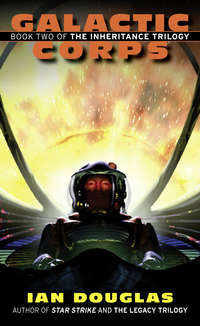
Czytaj książkę: «Galactic Corps»
GALACTIC CORPS
BOOK TWO OF THE INHERITANCE TRILOGY
IAN DOUGLAS

As always, for Brea. My light. My life. My muse.
Table of Contents
Title Page
Dedication
Timeline of the Inheritance Universe
Countdown …
Prologue
Chapter 1
Chapter 2
Chapter 3
Chapter 4
Chapter 5
Chapter 6
Chapter 7
Chapter 8
Chapter 9
Chapter 10
Chapter 11
Chapter 12
Chapter 13
Chapter 14
Chapter 15
Chapter 16
Chapter 17
Chapter 18
Chapter 19
Chapter 20
Chapter 21
Chapter 22
Chapter 23
Chapter 24
Chapter 25
Epilogue
Also by Ian Douglas
Copyright
About the Publisher
Timeline of the Inheritance Universe
Years before present
50,000,000–30,000,000: Galaxy dominated by the One Mind, sentient organic superconductors with hive mentality. They create the network of stargates across the Galaxy, and build the Encyclopedia Galactica Node at the Galactic Core.
30,000,000–10,000,000: Dominance of Children of the Night, nocturnal psychovores. They replace the One Mind, which may have transcended material instrumentality.
10,000,000 TO PRESENT: Dominance of the Xul, also known as the Hunters of the Dawn. Originally polyspecific pantovores, they eventually exist solely as downloaded mentalities within artificial cybernetic complexes.
Circa 500,000 B.C.E.: Advanced polyspecific machine intelligence, later called variously the Ancients or the Builders, extends a high-technology empire across a volume of space several thousand light years in extent. Extensive planoforming of Chiron, at Alpha Centauri A, of Mars in the nearby Sol System, and of numerous other worlds. QCC networks provide instantaneous communications across the entire empire. Ultimately, the Builder civilization is destroyed by the Xul. Asteroid impacts strip away the newly generated Martian atmosphere and seas, but Earth, with no technological presence, is ignored. A Xul huntership is badly damaged in the battle over Mars; it later crashes into the Europan world-sea and is frozen beneath the ice. Survivors of the Martian holocaust migrate to Earth and upload themselves into gene-tailored primates that later will be known as Homo sapiens.
10,000 B.C.E.–7500 B.C.E.: Earth and Earth’s Moon colonized by the Ahannu, or An, who are later remembered as the gods of ancient Sumeria. Around 7500 B.C.E., asteroid strikes by the Xul destroy An colonies across their empire. Earth is devastated by asteroid strikes. One colony, at Lalande 21185, survives.
Circa 6000 B.C.E.: Amphibious N’mah visit Earth and help human survivors of Xul attack develop civilization. They are later remembered as the Nommo of the Dogon tribe of Africa, and as civilizing/agricultural gods by other cultures in the Mideast and the Americas.
Circa 6000–5000 B.C.E.: N’mah starfaring culture destroyed by the Xul. Survivors exist in low-technology communities within the Sirius Stargate and, possibly, elsewhere.
1200 B.C.E. [Speculative]: The Xul revisit Earth and discover an advanced Bronze Age culture. Asteroid impacts cause devastating floods worldwide, and may be the root of the Atlantis myth.
700 C.E.: The deep abyssal intelligence later named the Eulers fight the Xul to a standstill by detonating their own stars. The astronomical conflagration of artificial novae is seen in the skies of Earth, in the constellation Aquila, some 1,200 years later.
The Heritage Trilogy
2039–2042: Semper Mars
2040: 1st UN War. March by “Sands of Mars Garroway.” Battle of Cydonia. Discovery of the Cydonian Cave of Wonders.
2040–2042: Luna Marine
2042: Battle of Tsiolkovsky. Discovery of An base on the Moon.
2067: Europa Strike
2067: Sino-American War. Discovery of the Singer under the Europan ice.
The Legacy Trilogy
2138–2148: Star Corps
2148: Battle of Ishtar. Treaty with An of Lalande 21185. Earth survey vessel The Wings of Isis destroyed while approaching the Sirius Stargate.
2148–2170: Battlespace
2170: Battle of Sirius Gate. Contact with the N’mah, an amphibious species living inside the gate structure. Data collected electronically fills in some information about the Xul, and leads to a Xul node in Cluster Space, 30,000 light years from Sol. A Marine assault force uses the gate to enter Cluster Space and destroy this gate.
2314–2333: Star Marines
2314: Armageddonfall
2323: Battle of Night’s Edge. Destruction of Xul fleet and world in Night’s Edge Space.
The Inheritance Trilogy
2877: Star Strike
2877 [1102 M.E.]: 1MIEF departs for Puller 659. Battle of Puller 659 against Pan-Europe ans. Contact with Eulers in Cygni Space. Battle of Cygni Space. Destruction of star in Starwall Space, eliminating local Xul node.
2886: Galactic Corps
2886 [1111 M.E.]: Raid on Cluster Space by 1MIEF. Discovery of stargate path to major Xul node at Galactic Core.
2887 [1112 M.E.]: Operation Heartfire. Assault on the Galactic Core.
Countdown …
They had about ten and a half minutes yet, give or take a bit, before the expanding blast wave of the nova reached them. Plenty of time if nothing unexpected happened.
“Skipper! I’ve got a bender coming through dead ahead!”
She checked the ID. The call was from second lieutenant Trace Wayne, only thirty kilometers off Lee’s port wing. A bender was something warping space, possibly one of the Euless triggerships … but there was a chance it was something else.
It was. She saw the brilliant flash of twisted starlight, saw the Xul Type IV materialize out of empty space fifty kilometers ahead. Like humans, the Xul used the Galaxy-spanning network of stargates, but their ships also possessed FTL capability which sharply warped local space.
And the alien warship had dropped into the normal space time matrix directly between most of Lee’s squadron and the stargate.
They were going to have to fight to get through.
Prologue
They were not omnipotent.
Throughout their multi-million-year period of galactic dominance, they’d been known by many names. The Destroyers. The Hunters of the Dawn. The Enemy. The Xul. They called themselves by a thought symbol that might translate as We Who Are.
Perhaps ten million years ago, give or take some few hundreds of thousands of years, We Who Are had possessed organic bodies; as such, they’d been a species, like all heirs of flesh, shaped and constrained by the impersonal forces of evolution. In common with all products of the evolutionary process, they’d possessed a marked will to survive.
What most clearly distinguished We Who Are from most other species was simply the extremes to which that will carried them.
Early in their history, they’d survived—barely—a traumatic encounter with another species upon their home planet. That encounter left them shaken, brutalized, and monomaniacally mistrustful of the motives of anything Other.
It left the other species extinct.
That ancient struggle for dominance, ultimately for survival, imprinted itself upon the psyche of We Who Are. When, in due time, they began moving out into the Galaxy, they carried that imprint with them. No other species posing a threat, however remote, to We Who Are could be permitted to survive.
Over the course of some millions of years, We Who Are extended and expanded the range of their lonely suzerainty over the Galaxy. Eventually, however, they encountered the far-flung bastions of another starfaring species, nocturnal psychovores who styled themselves as the Children of the Night. Like We Who Are, the Children possessed as a racial trait the need to exterminate all competition. Unlike We Who Are at that time, perhaps eight million years ago, the Children were already ancient, their line extending back into a murkily remote past when they, in their season, had wrested dominance of the Galaxy from a still more remote species, a self-aware congeries of organic superconductors that called themselves the One Mind.
Young, fired with righteous ambition and an instinctive determination to crush all competition in order to be alone, and therefore safe, within their Galactic fastnesses, We Who Are eventually triumphed after a savage no-quarters war that scoured a hundred thousand worlds of life. The Children of the Night passed into the ultimate Night of extinction, as had the One Mind before them.
And with that victory, the We Who Are became the new xenophobically senticidal caretakers of the Galaxy.
More millions of years passed. Eventually, like the majority of technically oriented species before them, We Who Are chose to discard their organic bodies, uploading their consciousnesses into nearly immortal cybernetic shells. They carried with them, however, the racial traits of mind and awareness that had distinguished them as organic beings—including the blatantly Darwinian imperative to eliminate all possible competitors, all possible threats to their existence.
In fact, this radical form of natural selection had dominated the galactic scene ever since sentient life had first emerged, some eight billion years before. In any given epoch, it took only a single intelligent species with technic aptitude and a lack of empathy for anything Other to emerge from the cauldron of its birthworld and insure its survival by eliminating all possible rivals. Galactic civilizations rarely overlapped perfectly in terms of their scientific and technical levels; with each encounter, one species tended to be older than the other, usually by many thousands or tens of thousands of years, and hence far more technically advanced.
As new civilizations emerged and achieved technical capabilities permitting space flight and long-distance communication, most wondered why the skies of their worlds, which should have been humming with the signs of advanced civilizations, seemed so silent, so empty. Each time new races, new civilizations took their first tentative steps out beyond the worlds of their genesis, We Who Are, sooner or later, detected their efforts from their scattered bastions, descended upon their worlds, and relentlessly exterminated them. Hence, the silent sky.
But like the Children of the Night, the One Mind, and so many others who’d come before, We Who Are were not omnipotent. The vast, sprawling spiral of the Galaxy, possessing some three hundred billion stars, is far too large, with far too many worlds, for any one race to monitor every possible lifeworld, every emerging sentient species.
And there were so many of these. …
In the outlying regions of the Galaxy’s Perseus Arm, within the dense polar jungles of the warm, inner world of a class-G5 star, a race of brachiating mollusks—morphologically, at least, they somewhat resembled certain members of that terrestrial phylum—swung from the interwoven branches of sessile thermovores not unlike Earthly trees. The species was young, as yet, but had developed an elaborate philosophy based on mating calls, territoriality, music, and mathematics. One day, they might have much to offer an evolving Galactic polylogue, but they hadn’t yet developed electronics or radio, much less the instantaneous magic of quantum-coupled communications. The huntership-communes of We Who Are had passed through this star system several times within the past ten thousand or so years, but not noticed the species’ thriving, arboreal cities.
Not yet.
Closer in toward the galactic core, within the teeming star clouds of the Sagittarius Arm, on the rugged, tide-strained volcanic moon of a superjovian gas giant, a race of armored paraholothurids built water’s-edge hive-cities of compacted excrement and composed palendromic epics celebrating their having been chosen as slaves of the sky-disk they saw as the eye of God. Natural radio emitters, they broadcast the glory of the one true religion to the stars. We Who Are had detected those signals and searched for their origin; so far, they’d not found the holothurids’ world, for they tended not to think of planetary bodies outside of the star’s liquid-water habitable zone as a possible abode of life.
That particular blind spot had given them trouble more than once in the past, and likely would again.
Closer in still toward the galactic hub, near the merging of the Norma and Scutum-Crux Arms, a fiercely radiating type A star blasted its unusual coterie of rocky worlds with intense radiation. Bathed in abundant radiant energy, Life had emerged on the innermost world and, borne by the local stellar winds, had seeded the other, outer planets of the system as well. Sentience had arisen here a few million years before, rising among several of the numerous, fast-evolving taxas of selenium-germanium chelated crystalline chemovores that constituted the local biosphere. Here, again, the manipulation of naturally occurring radio waves became the basis for communication, and, again, those manipulations had been detected in the depths of space, light-years distant.
The pace of crystalline life, however, tends to be slow, too slow for We Who Are to distinguish that life from the inorganic chemistry of accreted minerals. Those received artificial signals had caused the local We Who Are node some considerable concern, but it was clear that the problem soon would take care of itself. Type A giants are short-lived stars, their lifetimes on the main sequence lasting less than half a billion years. The local star already was showing signs of instability, and soon the abundant radiation that made life and sentience possible here would become that life’s executioner.
Twenty-three thousand light years from the Galaxy’s center, within the smear of stars and nebulae known as the Orion Arm, a world called Chiron by its most recent inhabitant, represented two distinct threads of civilization within the Galactic scene. Bathed in the yellow and orange hues of a double star, the world’s continents were battered and cratered by an intense celestial bombardment of half a million years before, and everywhere stood the somber and silent ruins of a golden civilization swept away by the firestorm. They were known by those who’d come later variously as the Ancients and, so numerous were the crumbling shells of their hell-blasted world-cities, as the Builders.
The Builder civilization had been a brilliant concord of machine intelligences arisen and evolved from various organic precursors; the asteroids that had destroyed Chiron had been flung into the planet by We Who Are, whose hunterships had sought out the Builders’ colony worlds scattered widely across perhaps a third of the Galaxy and in like manner, relentlessly and methodically exterminated each one.
Chiron was also known to its more recent colonists as Alpha Centauri A-II. Just four and a third light years away lay the G2 star called Sol, and the homeworld of an ambitious, carbon-based, oxygen-metabolizing species of sexual mammals that called itself Humankind. Within the past thousand years, an eye’s blink against the span marking the rise and extinction of myriad expressions of galactic life and sentience, humans and their artificially sentient machines had left the world of their birth to venture to the worlds of nearby stars, beginning with Chiron, and going on to assimilate numerous star systems scattered throughout an oblong realm measuring perhaps eight light centuries across at its greatest extent, four at its smallest. They’d encountered other intelligent species—the primitive An, the advanced but retiring N’mah, and the benthic species of brilliant mathematicians known to them as the Eulers—all three the shattered remnants of past encounters with We Who Are.
And, more than once within the past handful of centuries, Humankind, too, had attracted the xenocidal attention of We Who Are, and the destructiveness of those encounters was rapidly escalating. Most recently, a human battlefleet had used an ancient system of stargates to reach an important node of We Who Are near the Galactic hub, and there used Euler technology to detonate the star.
The resultant nova had finally caught the full attention of the Galaxy’s overlords.
And they moved now with blatantly uncharacteristic haste to obey their racial hard-wiring and eliminate once and for all this new and potentially serious threat to their survival.
The final clash, the final Armageddon would come soon, and, when it did, it would do so on a scale unknown since the extinction of the Builders.
1
1506.1111
First Platoon, Bravo Company
Carson Gate/Cluster Space
0540 hrs, GMT
Gunnery Sergeant Aiden Garroway wiggled a bit deeper into the bottle’s embrace as the armorer swung the dome canopy down over his head and sealed it in place. “Link check,” he heard, the Navy chief’s words forming in his mind.
The canopy was opaque, a nanosurfaced ceramic-iridium laminate impervious to almost anything up to a direct hit by a 100-gigawatt laser, but the bottle’s electronics fed the external view directly into Garroway’s brain, channeling the data through his cerebral implants. The armorer’s face leered down at him, distorted by the feed’s fisheye effect, and by the reflections from the fishbowl helmet of the man’s vacwear utilities.
“Link is on-line,” Garroway replied. “You’re going to have to fix that, though, Chief. God, you’re ugly.”
The man laughed. “Not as ugly as the Xulies. Good luck, Marine.”
“Ooh-rah.” With a thoughtclick, Garroway switched the data link to an external view, fed from the Ishtar’s outer hull.
The view here, high above the stargate, was stunning, spectacular. …
Carson was a nondescript double star near the fringe of Commonwealth space, a planetless pair of cool M-class dwarfs circling one another in a tight embrace. Two light hours out, so distant that the two suns themselves were merely bright ruby points of light against the background scattering of stars, the local stargate drifted in slow orbit, an immense, slender-rimmed hoop twenty kilometers across, gleaming silver and red in the somber light.
The Marine transport Ishtar was drifting slowly toward the gate belly-first, some fifteen kilometers above the structure’s center. Her ventral hatches were open, her forward dropdeck exposed to hard vacuum—hence the need for the armorer’s helmet and sealed utilities.
He switched the feed back to his pod’s external optics. Around him, caught in the glare of overhead lights, were the launch racks holding other bottles, and Navy and Marine personnel—armorers, deckhands, and technicians—were moving among them, prepping each for drop.
“Be sure to bring back some good suit vids, okay, Gunny?” the armorer told him. “I hear it’s real pretty over there.”
“I’ll see what I can do, Chief. But I imagine we’re going to be too busy to get anything artistic.”
“Shit, I didn’t say artistic. I just hear the view’s nice, is all. What I really want to see is some after-op combat footage of a bunch of dead Xulies!”
“You and me both, Chief.”
“Bravo Company,” another voice said, cutting in. The dry, staccato tones were those of the company commanding officer, Captain John “Blackjack” Black, though the actual speaker would be Smedley, the company AI. “Squad and section leaders, check your Marines and report status.”
Garroway was the gunnery sergeant assigned to the company HQ, and, as such, was the senior NCO in charge of the seven other enlisted Marines in the unit, under Captain Black himself. He ran through the electronic links with the other HQ personnel—two riflemen, two comm officers, two Navy hospital corpsmen, and a tech specialist/observer. All feeds showed green and ready, systems charged and go, weapons safed and ready.
“Green Tower,” he said over the company net, using the HQ section’s code name to link through to Smedley. “This is Tower Two. All Tower platforms report ready for drop.”
“Copy, Two,” Smedley replied.
Garroway chuckled. The AI was named after Major General Smedley Butler, one of the Corps’ heroes from the ancient, pre-spaceflight era of almost a thousand years ago. According to the histories, though, the original Smedley had been quite a character, often in trouble with his superiors because of his rough manner. Somehow, Garroway doubted that the guy had been quite as laconic as his artificial namesake.
There were historical simulations of the original Butler on file back on Mars, and in the library on board the Hermes. He decided he would link in some time, just to see how the two compared.
“First Platoon, ready to launch,” 2nd Lieutenant Cooper, the platoon’s commanding officer, announced over the Net.
“Second Platoon, ready to go.” That was 2nd Lieutenant Hamblet.
“Third Platoon, ready,” 2nd Lieutenant Costigan added.
“PryFly, Bravo Company,” the captain’s voice said. Garroway thought he heard some stress there. If so, it was the old man himself speaking, and not his electronic proxy. “We are ready for launch.”
“Very well,” another voice said, this one from Ishtar’s primary flight control center, or PryFly. “Bravo Company release in five … four … three … two … one … release!”
Garroway felt the sharp jolt as magnetic grapples released his bottle, and then the Ishtar’s ventral hull was receding against the stars. From his perspective, it appeared that the transport had suddenly begun accelerating away from him; in fact, Ishtar had just halted its gateward drift, allowing a cloud of M-CAPs to emerge from her belly and continue drifting toward the gate at a steady kilometer per second.
M-CAPs, Marine Combat Assault Pods, were only the most recent means of transporting individual Marines into battlespace, an upgrade to the Space Assault Pods, or SAPs in wide use until only a few years ago. Somewhere between a very large, bulky, and powerful unit of heavily armed space armor and a very tiny, lightly armed, underpowered one-man space craft, a CAP carried a single Marine within its claustrophobic core. A gravitic drive allowed the device to accelerate at forty gravities—about four hundred meters per second per second. It responded directly to a Marine’s thoughts, through his cereblink, and provided him with constantly updated information on his surroundings and the tactical situation.
For self-evident reasons, Marines called them bottles, among other nastier, more vitriolic names.
“Okay, people,” Blackjack’s voice told them over the Net. “We’re doing this by the book. We want to maintain the element of surprise for as long as possible, so do not engage your gravitics until I give the word. Power at ten percent only. Magnetic shielding engaged. Optical benders on. Everyone copy?”
A chorus of voices came back over the Net, mingled calls of “aye, aye, sir” and “copy that” and “ooh-rah.” A display open to one side within Garroway’s mind showed the telemetry from each pod, all green and go.
The assault force, one hundred fifty Marines of Bravo Company, First Marine Assault Battalion of the First Marine Interstellar Expeditionary Force was going to war.
Falling … falling … the bottles drifted into the opening of the stargate unpowered, with just enough power trickling through their drives to keep them from running afoul of one another, and to keep the magnetic shields charged and ready. Around them, unseen within the distant rim of the gate, a pair of Jupiter-massed black holes circled along their ancient tracks in opposite directions, at a velocity approaching that of light. The stresses on local spacetime were somehow—the technology was still well beyond the capability of human physics—focused at the gate’s lumen. The frequency of those rotating singularities had already been tuned to connect this gate with one particular other gate … one some twenty thousand light years above the plane of the Galaxy.
For the briefest of instants, Garroway felt the sharp, inner twist of tidal forces, and then he was through.
The sky wavered … shimmered … then blinked.
And he was somewhere else, somewhere … astonishingly else.
Not for the first time, Garroway wondered why you couldn’t see through an open gate to the other side, or why radio or lasercom signals could not be passed through, while solid things like starships made the passage almost unimpeded. The physicists said that had to do with a kind of flicker or stutter effect due to the period of the rotating singularities that allowed mass through in discrete, quantum chunks, but which interfered with the wave aspect of energy. Even so, he’d once seen the flash from a nova pass through an open gate, and do so with power enough to destroy a Xul huntership.
So much Humankind had yet to learn.
He looked around, studying ambient space with all the rubbernecking fervor of a first-time tourist in EarthRing City. An ancestor of Garroway’s had been here once, centuries before. The place was known as Cluster Space, and it was located, so far as AI navigational programs could place it, some twenty to twenty-two thousand light years above the plane of the Galaxy, and at least thirty thousand light years from Earth.
From out here, of course, the microscopic yellow speck of Earth’s sun was quite invisible, utterly lost within the vast and milky swirl of pale light hanging in the sky, a spiral that looked oddly like a pale-colored whirlpool frozen in an instant of time. Most individual stars at this distance were lost; only novae or the very brightest of giant suns were visible as separate stars out here. What remained was a kind of graininess or digital noise to the light. In fact, it looked much like the pale glow from the Milky Way seen on a pellucidly clear, dark night on Earth or, better, Mars … and for an obvious reason. It was the same glow, but seen from the outside against the black emptiness of the intergalactic voice, rather than from within one of the Galaxy’s spiral arms.
Here, the Galaxy stretched across half of the sky, tilted at a slightly oblique angle. Garroway could distinguish the slight differences in hue, blue and blue-white in the spiral arms, reddish in the swollen bulge of the central core. The smear of nebulae, some coal-black, other emission nebulae showing pale glows of green or red, wove among the stars like ragged streamers in an unfelt wind.
Opposite, against the ultimate void of the intergalactic abyss, a solitary globular star cluster hung in isolated splendor, a teeming beehive of suns, spanning a breadth of sky perhaps sixteen times as large as the full moon when seen from Earth, glowing with an almost undetectable reddish hue identical to the ruddy glow of the Galactic Core.
In a different direction lay the local star, a class-M red dwarf visible solely as a bright red spark against the night. That star, catalogued simply as CS-1, but nicknamed Bloodlight by the Marines, was the primary target of the op, which had been tagged Clusterstrike by the mission planners.
Behind the Marines was the stargate … but not the gate into which Bravo Company had just fallen. The tidal stresses of the gate back in Carson Space had linked across the light millennia with the gate here, allowing the swarm of Marine bottles to come through, gate-to-gate.
A flood of radio-frequency noise washed through his bottle’s exposed sensors, and Garroway set his personal AI to screening it, sifting through for hard data on enemy positions. The enemy was here. Humankind’s ancient enemy, the Xul …
Among other threats, a trio of Xul fortresses orbited here, only a few hundred kilometers away, and those fortresses had to be eliminated if Clusterstrike was to succeed. Trans-gate probes had already slipped through and located each of the three, along with every other enemy ship and station within this system. Those probes had managed to return, apparently unnoticed, but Marine bottles were larger and noisier than AI probes, and they were in this instant terribly vulnerable to attack.
Unlike the earlier Space Assault Pods, each M-CAP was effectively invisible, the coating of nano covering each one serving as uncounted trillions of optical relays, pulling light from one side of the bottle around to a carefully calculated point on the opposite side before releasing it. The effect was to make the bottle almost invisible so that light, radar, and other radiation was curved past the bottle rather than reflecting from it—optical bending. The various patches in each bottle’s hull not shielded by the benders—which allowed the Marines to see out and to communicate with one another and with the company AI net, among other things—were so small they were nearly invisible at any range greater than a few meters.
Still, the illusion was not perfect, and things like radiated heat or the spatial distortion caused by a gravitics drive could cause enough of a ripple against background stars to reveal their presence to a careful and watchful enemy. At Captain Black’s command, and under Smedley’s precise control, the school of invisible fish shifted vector as a unit, moving now slantwise across the opening of the stargate, each platoon angling toward a different target, the three Xul bastions guarding this gateway into Cluster Space.
So far, their entrance appeared to have gone unnoticed.
It would have been a mistake, though, to assume the Xul were careless or less than alert. Intelligence had reported that their defenses had been tightening up at all of their known gate outposts over the past few years, as the Xul Mind as a whole began, slowly, to react to Humankind’s attacks.
For almost nine years, now, 1MIEF had been playing a deadly game, one absolutely vital to the survival of Earth and Humankind. With both military and civilian intelligence services certain that the ancient enemy, the Xul, had learned the location of Sol and of the existence of humanity, Lieutenant General Martin Alexander, acclaimed Hero of the Battle of the Nova, had for almost a decade, now, been wielding the 1st Marine Interstellar Expeditionary Force like a personal weapon. Again and again, a Xul bastion outpost, either long-known or newly discovered, would be targeted by 1MIEF for a lightning raid. Usually, the Xul bastion would be located within a system containing one or more of the ancient stargates.
Those gates were still mysteries. Human xenosophontologists and intelligence officers all agreed that the system of stargates scattered throughout the Galaxy and beyond were not, themselves, the product of Xul technology, but were leftovers from some other, much more ancient civilization, now long vanished. But the Xul, like the N’mah and humans, used the gates to their own advantage with other technologies for crossing the long, empty light years. The Gatenet provided a transport web spanning tens of thousands of light years—if you knew where each gate attunement led.
The Xul appeared to be very much at home with the Gatenet, had woven it into the fabric of their empire. Humans were still learning the shape and dimensions of that Net. But one by one, human forces continued to secretly find, note, and then attack every Xul gate outpost they could find. By keeping up a relentless assault, the hope was to keep the Xul preoccupied with tracking down and destroying 1MIEF, rather than with moving into the star systems occupied by Humanity—including Sol—and obliterating them.
Clearly, the Xul could send Humankind into extinction if they set their considerable assets toward that goal; the trick was to keep them so off balance with constant raids, each one a pinprick on its own, that they never got around to that final genocidal thrust at the worlds occupied by humanity.
How long could 1MIEF keep up the pinpricks? No one knew, though the topic was a favorite during off-watch bull sessions in the Marine squad bays on board each of the fleet’s transports. Marine and Navy sim-warriors and armchair generals made elaborate bets as to how long the task force could stay on the offensive, whether or not they’d be recalled to Sol, and how long it would be before the Xul empire collapsed.
Garroway had participated in a few of those sessions, but had refrained from joining in on the betting. If he’d started making wagers, he would have been betting against his own survival … a distinctly uncomfortable position in which to find oneself. He believed in the Marine Corps and in the Corps’ indomitable fighting spirit, but he also knew just how large the Xul presence in the Galaxy must be. Conservative estimates said the Xul hunterships outnumbered all human starships on the order of several tens of thousands to one. The Galaxy was that large.
Not good odds. Not good odds at all.
His bottle was rapidly approaching one of the Xul fortresses now, a massive, squashed sphere five kilometers across. The surface showed a platinum-silver sheen that appeared smoothly reflective from a distance but which, as his M-CAP fell closer, was revealed to be a maze of geometric shapes, angles, protrusions, towers, squared-off valleys, and raised blocks. Weapons ports and turrets revealed themselves everywhere, plasma guns and magnetic accelerators and other weapons that affected the very nature of matter itself—and which were still sheer magic in so far as human technology was concerned.
Smedley announced that they were passing through the first of several magnetic screens. The surface nano on each pod adjusted to let it slip through without disturbing the field and announcing the Marine assault team’s presence. Garroway found he was holding his breath, wondering when something would trigger, when surprise would be lost and the battle would begin. …
M-CAPs were superbly stealthy, as close-to-invisible as modern military technology could make them. Though bottles could accelerate at forty gravities, their approach so far had been deliberately low-key and unobtrusive, too slow for the automated Xul defense systems to recognize a threat.
They hadn’t been seen so far. That, or the Xul targeting sensors already had them locked in, and were simply waiting for the order to fire.
Closer now … fewer than five kilometers. His personal AI took over full control of the small ship, identifying the best place for touch-down, coordinating with the company AI and the other fifty bottles in First Platoon, slowing Garroway’s bottle with precisely timed bursts of its gravitics drive until it was hovering motionless a few meters above the surface. Gently, then, the craft lowered itself against the small but distinct gravitational attraction of the Xul fortress, until the two kissed.
“Contact,” Garroway reported. Within his mental tacsit display, other Marines were reporting a successful touch-down all around him.
According to plan, the Headquarters element had grounded with First Platoon, which had as its target the largest of the three Xul bastions. Second and Third Platoons were deploying to the other two fortresses. Each Marine element was now on its own.
Still under AI control, Garroway’s bottle extended its boarding cutter, a cylinder extruding nano-disassemblers from its business end to eat through the ceramic composites that made up the Xul structure’s hull and create a tightly sealed docking collar. The bottle should be able to eat through the outer layers of armor within a minute or so, allowing Garroway and the other Marines to drop down into the interior of the fortress.
“Incoming bogies!” a shrill voice called over the tactical net. “We’ve got incoming bogies!”
So the Xul had finally adapted to this form of attack. The pods must have triggered some sort of alarm or defensive system as soon as they’d started touching down. On Garroway’s mental tac display, a cloud of red targets was now emerging over the Xul fortress’s close horizon, bearing down on the Marine assault platoon like an angry swarm of bees.
“Perimeter defense!” Captain Black called. “Take ’em down!”
The thirty M-CAPs of First Platoon and the HQ section had set down on the Xul fortress in an AI-controlled pattern, with an outer ring along the perimeter of Marines with heavy weapons, and two inner rings intent on tunneling into the fortress. Garroway snapped on his targeting link, and felt his bottle spin within the boarding collar to bring the target cloud under his weapon.
The AP-840 M-CAP mounted a single weapon at its stern—the part of the bottle opposite the boarding collar, still raised three meters above the Xul hull. After latching on and digging in—“taking a bite,” as Marine slang put it—the M-CAP essentially became a mounted turret weapon. The gun, depending on the mission load-out, could be a V-90 Striker missile launcher, a rapid-fire magnetic pulse gun, or a Starfire plasma weapon.
Garroway’s bottle mounted the V-90. The Striker was a smart weapon that could carry a variety of warheads. The missiles filling Garroway’s ammo bins each were fitted out with ND-4 nanodisassembler pods. Tracking the incoming cloud in his mind, nudging the selector to full auto, he thoughtclicked the firing control and a stream of forty-centimeter missiles snapped from his weapon mount. The missiles coordinated with one another to disperse into the cloud, ignoring the leading elements of the enemy force and detonating deep within the attacking formation.
Each exploding pod released a cloud of its own—millions of molecule-sized nanodisassemblers traveling at high speed and programmed to begin taking apart whatever they happened to strike. Working on an atomic level, they were fast; almost immediately, red-highlighted targets on the tactical display began winking out, as though black cancers were eating through the formation from within, the decay beginning at a dozen different starting points and swiftly working its way out.
Other Marine M-CAPs around the perimeter began firing as well, adding their own clouds of nano-D to the general destruction, or lashing out with man-made bolts of plasma lightning.
Then the cloud reached the Marine perimeter.
Each target was a Xul warrior—a machine, actually, that was apparently grown within the hulls of their hunterships and forts. Two to three meters long, egg-shaped, but with smooth convolutions and bulges, each extruded a number of tentacles at seemingly random points on their shells, each possessed glittering lenses, also randomly positioned over their bodies. Some of those lenses would be eyes. Others …
Laser fire snapped across the outer hull of Garroway’s pod, generating a silvery puff of expanding vapor. Damn! The Xulies weren’t supposed to be able to see the Marine bottles with the optical benders on … but, then, no one was certain what wavelengths the Xul warriors used for vision, or what other senses they might possess.
He snapped off another burst of nano-D in response, but the Xul that had nailed him had already vaporized an instant before, caught by a flash from Sergeant Colby’s plasma gun.
“Thanks!” Garroway called to her over the tactical net.
“Don’t mention it, Gare!” was her response. She was already tracking another Xul warrior, as was Garroway. As the enemy swarmed over the Marine position, he’d switched to single shots and shoot-to-hit; the enemy was widely enough dispersed now that the Marines could no longer wipe out large numbers of the enemy combat machines with area fire. His bottle spun wildly, tracking a Xul as it streaked past low above the surface of the fortress. Garroway held his fire until his targeting cursor tracked past several nearby Marine bottles, then slammed a nano-D pod squarely into the now-fleeing machine from behind. The Xul warrior fell to pieces, a spray of dissolving parts, seconds later.
Local nano-D levels were rising sharply in the immediate battlespace. Drifting motes of disassembler were striking his pod, now, then rebounding. They were programmed to recognize the outer nano coatings of the M-CAPs and ignore them and seek other targets, but a few were beginning to burrow into his bottle at points scoured clean of nano by the Xul laser bursts. The automatic defenses on Garroway’s pod were growing erratic, and would soon fail.
“Smedley!” Garroway called, loosing another barrage at a pair of incoming Xul combat robots. “I’ve got nano-D on my pod, friendly fire! Tell the bastards to go chow down on something else!”
The company AI tweaked the electronics in Garroway’s bottle, and the errant nano-D drifted away into space like a puff of vapor, repelled by the brief, coded signal. A lot of the stuff was starting to work on the Xul fortress’s hull around the bottles, too. That might cause problems later, but there wasn’t much that could be done about it. Modern battlefields tended to soften and sludge down as random traces of nano-D, both friendly and enemy, began to accumulate in the area.
Then there was a sharp jolt, and Garroway’s bottle dropped by a meter, sliding down hard into the boarding collar. The deck he was standing on dilated open. He didn’t immediately fall in the microgravity of the Xul fortress but, setting the pod’s combat initiative on auto, he triggered a pair of battlespace drones, launching them into the emptiness at his feet.
A firefight was raging down there, as other Marines entered the enemy bastion. Garroway’s drones uplinked to his helmet, showing him images of Marines in heavy armor struggling in a low, broad passageway with Xul fighterbots coming at them tentacle to metallic tentacle. He charged his suit’s weapons, then gave a hard shove down through the open deck. Passing through the boarding collar, he entered the fight.
The passageway was two meters tall and ten to twenty wide, and the Marines were forced to stoop slightly because a Marine in Type 664 combat armor stood at nearly two and a quarter meters.
It was a Dantean scene, a circle of Hell, with Marines and Xul fighterbots struggling at knife-fighting range. It looked as though it should be unbearably noisy, but the interior of the Xul fortress was in hard vacuum and each bolt of plasma, each detonating grenade, each ripping or exploding alien shell did so in eerie silence. When Garroway’s boots touched the deck, though, he could feel the noise, a kind of steady, pounding thrum in the bulkheads and deck as the vibrations were transmitted through Xul ceramic to his combat armor.
The one advantage possessed by the Marine assault team was that they were physically shorter than the Xul machines, which, in that low corridor, were coming at them horizontally, pulling themselves along with powerful flicks of their tentacles against the deck and the overhead. As a result, the only weapons the enemy could bring to bear were those set into the tops of their egg-shaped bodies. After a few moments, the Marines, too, began leaning forward, lifting their boots off the deck, dropping prone to minimize their cross-sections as targets as they poured a devastating and concentrated fire into the attacking hordes.
Garroway mounted an MPPG-40 on the right arm of his combat armor, a rapid-fire mass driver on his left. He shouldered forward about twelve meters, taking up a firing position next to Corporal Gerad Kukovitch, a massively built fungie in the company from Spokane, Washington. Kuk was mounting a 20mm full-auto grenade launcher on his suit; he was one of the few people in the company big enough to pack one. The Marine was floating horizontally, taking partial cover behind one of a number of pillar-like structures scattered through that alien hall. They looked like massive, meter-thick bundles of rope or ceramic cabling growing like tree trunks between deck and overhead. Garroway stretched out beside him, firing from the other side of the pillar.
Side by side, the two Marines coordinated their fire, ’Vitch’s grenades silently flashing as they ripped through the enemy ranks, Garroway’s MPPG sending blinding bolts of blue-white energy arcing down the corridor, ripping deep into everything they touched. Sergeant Larissa Colby joined them a second later, adding her plasma weapon to the melee. One by one, other Marines began locking in with the growing phalanx of Marines while their suit AIs linked in with one another under Smedley’s guidance to coordinate their fire.
Together, as a unit, they were far more effective in concentrating their fire.
And then, almost magically, the enemy horde vanished, seeming to melt away into deck, overhead, and the far bulkheads of the chamber.
“Keep alert!” Captain Black called over the company Net. “They’ll be back! Special weapons forward!”
Two Marines moved up the debris-filled space, hauling massive tubes with them. Tripod legs unfolded as they planted the mounts against the deck and activated them.
For some centuries, Marine tactics against Xul ships and bastions had involved boarding the enemy and lugging backpack nukes into the structure’s depths. Nuclear explosions on the outer hull of one of the immense Xul hunterships or the even larger enemy fortresses did little permanent damage, and the resultant craters generally were patched over within a matter of minutes by flying clouds of fist-sized repair robots. A nuke detonating deep inside a Xul ship, though, tended to cause terrible damage, hampered automated repair efforts, and often loosed the microsingularities these monsters used as their power sources, and that was almost always fatal even to the largest Xul ship or structure.
Backpack nukes had been standard Corps issue until a few years ago. Now, however, the Marines had something a little better in their arsenal. …
2
1506.1111
First Platoon, Bravo Company
Cluster Space
0635 hrs, GMT
“Enemy targets bearing ahead and behind,” Smedley reported in maddeningly calm tones.
“Here they come again, boys!” Captain Black warned. “Let ’em have it!”
“Ooh-rah!” Second Lieutenant Cooper yelled over the Net. “Kill the bastards!”
The defenders of Xul ships and bases tended to act and react in predictable ways. Assaults were en masse, wave attacks with thousands of units moving forward as one in an attempt to overwhelm Marine perimeter defenses. Once the Marine defenders had killed enough of the oncoming Xul combat units—estimates suggested the number ran around twenty-five to thirty percent of the total number of the attackers—the remainder would break off and disappear, usually by vanishing back into the walls of the structure’s interior passageways and compartments. Some minutes would pass while the Xul built up their numbers once again, bringing in fresh combatants from deeper inside the target, and then the assault would be renewed.
That was what was happening now, as the passageway once again filled with black metallic egg shapes and flickering, writhing tentacles, coming in from both directions. Garroway crouched behind the pillar and aimed his weapon, thought-snapping the firing command, the plasma gun’s link with his armor electronics triggering bolt after searing bolt of man-made lightning.
Garroway let himself settle into the rhythm of combat, picking out targets and burning them down. The riflemen needed to buy a few precious minutes for the special-weapons boys, and then they would be able to withdraw.
Xul ships and space fortresses had often been compared to organic structures, like the physical bodies of immense living organisms kilometers across. While no one knew how true this might be, the comparison was unavoidable. The masses of alien circuitry making up much of their internal mass appeared to have been grown rather than constructed, and there were nothing like crew compartments or quarters on board these things. Rather, the Xul appeared to be electronic life forms uploaded into the circuitry of a titanic computer. When any part of the structure was damaged, robotic devices the size of a human fist appeared in clouds swarming through the damaged area, appearing to extrude themselves into new circuitry in the same way that medicos used nanochelation to plate out circuitry inside the human brain and nervous system, but on a much larger scale.
These tentacled combat robots the Marines were engaging now appeared to be analogues of white cells and other immune-defense systems in an organic system. If that was so, the passageways like this one, which seemed to riddle all Xul structures with labyrinthine complexity, could reasonably be compared to a body’s circulatory system, to blood vessels and lymphatic ducts serving as conduits for robotic devices designed for a variety of tasks including both repair and defense.
And to carry the uneasy comparison just a bit further, that meant that the Marines of 1MIEF were microbes, invaders penetrating the Xul’s giant circulatory system with the intent of killing it.
At least in the human organism, bacteria didn’t come in the form of platoons of Marines, heavily armored and carrying plasma and antimatter weaponry.
As with armchair discussions of 1MIEF’s strategy and tactics, the topic was often discussed in Marine squad bays during off-duty hours. For now, Garroway’s thoughts touched on the image only briefly: Let’s give this fat bastard one hell of an upset stomach! The rhythm of targeting and firing fell into an almost automatic process, guided by his training and the mental conditioning of weiji-do.
The two heavy gunners, meanwhile, rapidly completed setting up their weapons, one aiming forward, into the advancing mass of Xul warriors, the other aimed into the attackers in the opposite direction. A moment later, the weapons rocked in their mounts, and a pair of silvery shapes, each roughly the size of a big man’s forearm and fist, flashed from the muzzles and, accelerating on their microgravitics, streaked into the surrounding darkness. One slammed into the side of an advancing Xul warrior, knocking it aside and continuing to accelerate as it flashed out of sight.
Designated RD-260, the weapon was popularly known as the RAM-D, for Remote Antimatter Detonator. Each round contained nearly a kilogram of antimatter suspended in hard vacuum and an electromagnetic bubble, preventing it from coming into contact with the containment cylinder’s poly-ceramic and steel walls.
The gunners began reloading, hauling new RAM-D rounds out of the carry-satchels mounted on the hips of their armor. Tactical doctrine called for loosing three rounds apiece … if the enemy gave them that much time.
Sergeant Dixon, meanwhile, was laying down the back-up, a Mk.17 backpack nuke. He had it up against the overhead close beside one of the chamber’s pillars, holding it firmly in place while the nano coating on the device’s back formed an unbreakable bond with the surface of the alien composite. Dix’s nuke was the mission’s back-up guarantee … just in case the Xulies intercepted the other packages.
Garroway kept up a steady fire, frying Xul combat machines as quickly as he could target them. The microgravity environment within the confines of the passageway, however, was becoming clogged with drifting bits of debris, everything from glittering particles the size of grains of sand up to the three-meter shells of almost-intact Xul warriors burned out by Marine marksmanship. Clouds of nano-D adrift in the area were dissolving the larger pieces, but left behind a gritty, clinging dust that illuminated the enemy’s laser beams as they flashed and probed through the gloom.
The Marines’ armor was deflecting most of the incoming lasers, the outer layers of nano redirecting and scattering each flash harmlessly in a cascade of brilliant iridescence. Laser bolts repeatedly struck the pillar Garroway was half sheltering behind, striking with sharp, silent flashes and puffs of white vapor.
Some of the enemy fire was getting through, however, striking Marine armor on bare patches not covered by nano—on sensors and joint lines and link connector pads. Corporal Tomkins was down, air and boiling blood spraying from a severed lower arm until the suit’s autosealers and nanomedibot injectors could kick in. “Corpsman! Corpsman front!” In seconds, Doc Huston was with the wounded Marine, dragging him out of the line of fire, putting his own armor between the wounded man and the enemy as he hauled the man back toward the pods.
Then PFC White was hit, half of her visor charred, cracked and leaking air. Doc Billingsly had her in seconds, slapping a sealant patch over her visor before it could crack further, and pulling her back out of the firefight. The Marines continued putting down a devastating defensive fire, drawing closer to one another as their defensive perimeter tightened up.
The special-weps gunners loosed their second rounds, firing almost together. The leading Xul machines reached the Marine perimeter at almost the same moment, colliding headlong with Marine riflemen in a confused tangle of armored legs and arms and whiplashing tentacles. Suddenly, the defensive perimeter was broken, with dozens of the gleaming combat machines smashing through the line and grappling with the armored Marines. In an instant, the battle went from a firing line drill to a knife fight.
One of the massive warrior robots collided with Garroway as he burned down a Xul machine alongside it, and the impact drove him back like the blow from a sledgehammer. The enemy was too close for plasma weapons now, too close even for his flamer. As Garroway tumbled over backward in the embrace of a Xul attacker, he thought-clicked his slicers into place—squared-off plates extending from his suit gauntlets over the backs of his hands thirty centimeters beyond the tips of his fingertips. Each plate was nano-grown from a carbon-niobium alloy in a sheet with edges feathered down to just an atom or two thick, rigidly anchored in a quark-quark substrate. They were monofilaments made rigid, sharp enough to slice cleanly through any solid matter less dense than neutronium.
Garroway’s right arm came up and around as he shifted in his mind to weiji-do, the martial art form modern Marines trained in extensively in boot camp. Weiji-do, the Way of Manifestation, was a set of mental conditionings and downloaded training related to more ancient forms like t’ai chi. The imagery was of the essential chaos at the root of all existence out of which matter and energy were summoned, a deliberate tie-in with the principles of quantum physics that pulled energy from the base-state Quantum Sea.
Mentally drawing on the chaos of unformed reality, he focused a savage thrust of mental energy into the slicer blade as he rotated his suit sharply, sending the blade like a scalpel through the ceramic-plastic laminates of the Xul machine’s shell. Pivoting, he arrested his rotational energy and came back with his left blade; the Xul machine’s tentacles dropped away as the machine’s body gaped open with mirror-smooth surfaces at the cuts. A final thrust, and the machine snapped into two pieces, lifelessly inert. Electricity snapped and flickered across exposed alien circuits, the bolts grounded out by Garroway’s armor.
Continuing to rotate, he brought the mass driver mounted on his left arm to bear on another Xul machine as it grappled with PFC Nikki Armandez. BB-sized pellets accelerated to ultra-high velocity slashed across the machine’s shell, ripping open a fist-sized gash in the black sleekness. The machine bucked and jerked, like a living thing, as Armandez twisted clear of flailing tentacles.
Around him, the other Marines were fighting hand-to-hand—or, rather, hand-to-tentacle—as well, firing into enemy combat machines when they were a meter or two away, slicing them into tumbling, drifting chunks when they closed to within an arm’s reach.
Garroway was forcibly reminded of an ancient adage drilled into all Marines in boot camp: the most dangerous weapon in combat was a Marine. It didn’t matter whether he was armed with a plasma weapon, a mass driver, antimatter drone, forearm-mounted slicers, or his bare hands. It wasn’t the Marine’s high-tech toys that were dangerous. It was the Marine that wielded them.
In seconds, the breakthrough had been stopped, the alien machines inside the perimeter literally cut to pieces, while the rest withdrew as suddenly and as silently as they’d appeared. Four more Marines were down, their armor burned open, air and blood leaking into the chamber as a thin, icy pink haze.
Garroway did a quick mental rundown. First Company and the HQ element together totaled fifty men and women, five of them corpsmen. That left thirty-nine combat effectives on the line, now, and that included the specialist comm and computer personnel who had other things to do besides burn down enemy robots.
“Four AM-drones away!” 2nd Lieutenant Cooper reported over the Net.
“That’ll do it,” Captain Black said. “Everyone start falling back to the entry point. Bring the wounded!” A tiny point of light began winking in Garroway’s mind—the recall beacon, indicating the direction of his waiting M-CAP.
Garroway and Corporal Kukovitch held their position behind the pillar, covering several other Marines as they fell back past them toward the waiting M-CAPs, dragging along the bodies of fallen comrades.
That was a point of pride. No Marine was left behind, living or dead, and no Marine or corpsman serving with the unit assumed any Marine was dead in the field, no matter how bad the wound appeared to be. Unless someone had been smoked—literally turned to vapor by an enemy weapon—the possibility remained that they could be retrieved, even if large parts of their bodies had to be regrown or replaced.
Hell, Garroway had experienced that himself nine years back, at the Battle of Nova Space. They’d come after him, too, pulling him from a derelict alien spacecraft as a nearby star exploded. If they hadn’t, he would have been an irrie—an irretrievable—himself.
They leapfrogged back, section by section, one group of Marines providing cover as the rest fell back in moves of several meters at a time. Within a few minutes, they closed in around the tight cluster of M-CAP pods, where they’d broken through into the Xul base’s interior, creating a new, much tighter perimeter. For the moment, the Xul warrior robots were not in evidence—not out in the open, anyway, but sensors wired into Garroway’s external armor were picking up motion—vibrations detected through the Xul hull metal each time he touched it. Each Xul wave attack tended to be larger, usually by an order of magnitude, than the last.
They were gathering. The next assault on the Marines was going to be a big one.
“Medical Ontos now on final approach,” Smedley’s voice said.
“Heads up, people,” Captain Black warned. “Medevac coming in!”
A portion of the overhead flexed, suddenly, directly above the center of the new Marine perimeter, then began breaking apart in a swirling storm of disintegrating chunks. In the next instant, something broke through, ten meters wide and massive, chewing its way through the tough Xul hull armor in clouds of nano-D.
For a moment, it was difficult to see exactly what was eating its way down through the overhead. Something was there, a dark bulk that appeared to swirl and shimmer, becoming at times translucent, almost transparent, and which seemed to reflect the surrounding darkness of the passageway.
Then the effect faded, and the mass solidified into a dark gray surface displaying the Commonwealth emblem and the word marines prominent on the curved hull. A ramp was already lowering. That rear entrance couldn’t open wide in the narrow confines of the fortress passageway, but light from the vehicle’s interior spilled through a narrow opening into the dark space, reflecting from drifting debris.
The craft was an MCA-71 Ontos, one of the bug-like 383-ton Marine workhorses that had served with the Corps for twenty-some years. This one had been designated for medevac. More Navy corpsmen were already descending through the open cargo bay hatch into the Xul fortress, helping to move Marine casualties out of the Xul passageway and into the comparative safety of the rugged little transport.
Garroway held his defensive position with the other Marines on the perimeter. Briefly, he tapped into the telemetry from one of the RAM-D pods—RAM Two; a schematic animation opened in a side window in his mind, showing a drone’s-eye view as the device steered itself swiftly through twisting corridors into the bowels of the Xul fortress. RAM-Ds possessed extremely sophisticated on-board AIs that allowed them to operate with considerable autonomy, and gravitics sensors that let them home on the microsingularities orbiting within the heart of Xul structures.
The image flared in a burst of static snow, then winked out.
“RAM Two has been intercepted,” Smedley’s voice reported. “RAMs One, Three, and Four are proceeding on course.”
Garroway braced for a possible shockwave. If whatever had snagged RAM Two broke the magnetic containment field isolating the antimatter charge, in just a moment there was going to be a very large explosion. …
But seconds passed, and there was no blast. Much Xul technology was still mysterious, and at times seemed unevenly applied. Telemetry indicated that the other three charges were continuing on course, moving swiftly into the fortress’s depths. Perhaps the Xul hadn’t noticed them yet. Or perhaps they didn’t yet know what they were, and had just snagged the one in order to find out.
And that meant the explosion could come at any time. Tampering with a kilo of antimatter was never a good idea. …
Marines and corpsmen began loading the strike force’s dead and wounded onto the medevac Ontos. Still moving section by section as their squadmates covered them, Marines began scrambling up into their waiting M-CAPs. Corporal Fitzhugh yelled a warning at the same time Smedley flashed a new alert—targets emerging from the passageway bulkheads in all directions. Again, Garroway chose a target and commenced fire, burning down one oncoming Xul machine … then another … then a third as the shadowed distance seethed with black movement. The Marines were pumping out an incredible volume of fire—plasma bolts, lasers, nano-D rounds, high-velocity mass-driver slugs, pounding and slashing away at the advancing wall of Xul robots, filling the broad two-meter space between overhead and deck with spinning chunks of metal and ceramic. Garroway’s plasma gun flashed an overheat warning to his helmet display, and he switched to his mass driver to let the primary weapon cool. How long, he wondered, could they keep this up? …
Well, it wouldn’t, it couldn’t last much longer. With the RAM-Ds well on their way into the fortress’s interior, it was, as the ancient adage put it, time for all of them to get the hell out of Dodge. Garroway wasn’t sure what “Dodge” was, but he knew the sentiment behind the expression well.
The open ramp on the Ontos was closing, the slender gap of light visible from the cargo deck narrowing to a slit, then winking out. The shielding nano on the transport’s surface created a shimmering effect and, once again, the massive intrusion of the Ontos’ hull became, not invisible, but eye-wrenchingly difficult to look at.
“Everyone clear!” 2nd Lieutenant Cooper called over the Net. “Medevac lifting off!”
With a jarring vibration felt through the deck, the Ontos lifted clear of the Xul fortress, leaving a swirling tumble of debris in its wake. In twos and threes, the M-CAPs were pulling free of their entry holes, following the Ontos into the void.
There were only a dozen Marines left on board the Xul station now. This was the most deadly part of any board-and-destroy op, with most of the assault force already off the target, and the last few on board trying to make their escape as the bastion’s defenders closed in.
PFC Armandez was still a bit ahead of the main Marine line. She’d been falling back toward the M-CAPs when the Xul attack had begun anew, and dropped down behind one of the sheltering pillars to fire on the enemy. “Nikki!” Garroway called. “Get the hell back here! We’ll cover you!”
She was starting to turn toward Garroway when a pair of Xul lasers struck her low in the back, at the seam between her torso armor and her power pack. Part of the energy was dissipated by her armor, but he saw a puff of vapor and that was a sure sign her suit had been breached and was leaking air into vacuum. She slumped and went into a tumble.
The medevac Ontos was already gone. Garroway pushed off from the deck, diving in a flat trajectory through the narrow space to snag Armandez and awkwardly grapple her into his arms. Triggering his suit gravitics, he propelled the two of them together back past the Marine perimeter.
A solid wall of Xul warriors surrounded the handful of Marines. “Everyone get out!” Garroway yelled. According to his helmet electronics, he was the senior man present, and it now was up to him to get the last of them out.
“How are we gonna get Nikki out?” PFC Lauden yelled, slashing at the oncoming tide with his mass driver.
“Never mind, damn it! Just clear out! Now!”
“Aye, aye, Gunny!”
The other Marines began clambering into their pods.
Marine histories were full of stories of valiant last stands, of a last Marine who stayed behind to cover his squadmates as a tide of enemy fighters rolled over his final position. Garroway had no intention of becoming another.
He also wasn’t leaving Armandez behind. Towing her along, following the homer beacon flashing in his mind, he made his way to his M-CAP, still imbedded in the passageway’s overhead.
The problem was that M-CAPs were definitely one-Marine vehicles. Two people might squeeze into one together, if they were real friendly … and if neither was wearing their bulky Type 664 combat armor.
Working quickly, Garroway stuffed the unconscious form of the wounded Marine up into his M-CAP, literally stuffing her as far up the narrow opening as he could manage. The nearest Xul warriors were almost on him. …
Again, he triggered his slicers, extending the ultra-hard, ultra-thin blades to their full extent. Positioning himself directly under the opening to his pod, he slashed hard with his left arm … then his right …
His own legs, severed high up on the thighs, spun to either side, trailing globules of rapidly freezing blood and lubricant. The pain didn’t hit him immediately, wouldn’t hit him, he didn’t think, for a few precious seconds, if he didn’t let it. …
He did immediately feel the shock of falling pressure, like a hammer blow to his lungs. Air shrieked out of his armor into the surrounding hard vacuum until his suit’s inner layer, reacting automatically to the falling pressure, sealed over the gaping stumps of his legs. Garroway was already pulling himself up into his pod, as biting cold and lung-searing decompression threatened to drag him back into unconsciousness … and death. He had to struggle to work his torso up past Armandez’s legs; even minus his own legs, he wasn’t sure there was enough room inside the bottle for two.
It was starting to hurt now. A lot. …
His armor’s built-in medinano dispensers were already firing swarms of microscopic healers into his bloodstream, however. Anodynes began dulling the sharp shriek of pain; fluorocarbons began picking up where the near-vanished oxygen had left off; artificial coagulants began sealing off the wounds, stopping blood loss while cerebral monitors blocked the onset of shock.
It was a near thing. The inside of his helmet visor was iced over, and he was having trouble seeing. By feel, he found the pod’s linking plate and slapped his open palm across it. Numbers and status readouts flickered through his mind, but he ignored them, triggering the hatch seal.
He felt the hatch iris shut just below his sealed-off stumps, the scraping sensation threatening to override the anodynes. A warning light flickered on in his mind, followed by a verbal readout. “M-CAP hatch seal failure. M-CAP hatch seal failure.”
Damn. Even with his legs gone, he wasn’t in far enough to let the bottle’s hatch seal shut.
The hell with it. The bottle wasn’t supposed to accelerate with a hatch open, but he overrode the watchdog circuit and thought-clicked the launch command. There was a grating rasp, then a sudden shock as the pod broke free, accelerating clear of the Xul fortress.
For a moment, he half feared sliding out an open hatch beneath him as the pod accelerated on its way, but he appeared to be well wedged into place. Exploring with his gloved hands, he decided that the bottle’s outer hatch had, indeed, cycled closed; it was the inner hatch that was blocked open by the stumps of his legs, and that was what was causing the alarm. The bottle’s rather narrow-minded AI didn’t think the craft was sealed and ready for flight unless all hatches were shut, sealed, and locked.
He dismissed the irritating alarm. There was nothing he could do about the cause, and he appeared to be safe for the moment.
Well, safe from the threat of being left behind, at least. His warning indicators showed enemy fire passing close by his craft.
He goosed it, ordering full acceleration and praying the inertial dampers were working well enough to shunt aside the fearful pressures of a high-G boost. There was no time, no place for subtlety in the escape. With the fortress fully alerted to the Marine incursion, there was no hope of sneaking away unseen. The M-CAP’s nano coating lowered the craft’s visibility at all electronic wavelengths, making it tough to see and track, but at point-blank range it was hard not to pick it out, by the distortion it caused against the background starfield, if nothing else.
Through his interface with the tiny craft, he could see the fortress, looming huge as it receded astern, and a sky filled with streaks of white fire. Weapons fire—whether human or Xul—was in fact invisible in vacuum, but the pod’s computer painted the tracks in as a flight aid. With a thought, he banished the special effects; there was nothing he could do in the way of actively dodging incoming fire, and seeing those bolts was both distracting and terrifying. If his pod was hit in the next few minutes, he would never feel the blast that killed them.
He ordered the pod’s computer to establish a course consisting of random jinks that would continue to bear on the stargate.
Without the flashing lights and energy bolts, surrounding space took on an almost surreal aspect of beauty, majesty, and peace. The Xul bastion continued to dwindle astern, as the stargate slowly grew larger ahead. In the distance, the glowing spiral of the Milky Way Galaxy stretched across half of heaven, as beautiful, as insubstantially delicate as a dream. Green icons floated between him and the gate, a scattering of pinpoints marking Bravo Company’s other M-CAPs.
One pinpoint flared for an instant, a dazzling star, then vanished. Corporal Levowsky’s pod, according to the readout. PFC Hollander’s pod went next. Damn! …
He forced himself to ignore the ongoing roll call of Marines who would not be retrieved. Some of the escaping Marines were going to get nailed just by sheer chance, judging from the volume of hostile fire, and those Xul laser and plasma bursts were hot enough to reduce an M-CAP and its passenger to thin, hot gas in an instant.
At this point, it was down to sheer chance. The Marine pods all were jostling and jinking their way toward the stargate. Some percentage of them would not make it. Which ones were hit, which ones made it, that now was entirely in the laps of the Gods of Battle.
Garroway had another alarm to contend with as well, and, once again, it was something he couldn’t do much about. He’d lost much of the air inside his armor when he’d breached his own suit. In the moments since, his armor had been struggling to replenish internal pressure from the life support system in his backpack. He was no longer chewing cold vacuum, which was a distinct improvement … but by tapping the rebreather source gases in his tanks, he’d sharply lowered his stay time. His armor’s on-board computer estimated that he was down to another hour or so before his oxygen supply went critical.
And according to the telemetry from Armandez’s armor, her LSS had been damaged as well, leaking a good eighty percent of her gas supply to space before it had sealed off the damage. Their rebreather filters would continue to pull oxygen from exhaled carbon dioxide and water vapor as they breathed, but there would be less and less free O2 available with every breath cycle as more and more of it was locked up by his metabolism.
Again, he killed the warning.
What he couldn’t kill were the growing physical problems brought on by his self-inflicted wounds. The pain was manageable for the moment, thanks to the nano-anodynes, but it was growing steadily worse. Shock and blood loss both had brought him close to unconsciousness, and he’d severely compounded that threat with the abrupt loss of pressure in his suit. Again, the problems were being held at bay for the moment—fluorocarbons were far more efficient at oxygen and CO2 transport in the circulatory system than were red blood cells, so you didn’t need as much of the stuff as you’d lost, but his blood volume was dangerously low and threatening still to drag him into shock, despite the medinano churning away in his brain.
He hoped the bottle’s AI was bright enough to get them through the gate, because he didn’t think he was going to be awake for very much longer. …
“Hey, Gare?” a female voice called over the combat Net. “Gare, you okay?”
“Yeah.” The word felt fuzzy on his tongue. He was having some trouble focusing now. The com ID said the voice belonged to Sergeant Colby.
“Cut your random guidance,” Colby told him. “We’re trying to rendezvous for a pick-up!”
Garroway thought-clicked the guidance control, resuming a straight-line course. If the Xul were watching closely, they would be able to nail him in seconds … but somehow that just didn’t seem important any longer.
“Hang on, Garroway,” another voice said, a man’s voice, this time. His helmet identified it was 2nd Lieutenant Cooper. “We’ve got you, buddy.”
The downloaded visual showed three other Marine bottles closing on him from three sides. Magnetic grapples emerged from their hulls, latching on. Despite the inertial damping, he felt the slight jar as they grabbed him, then began accelerating again, four pods moving randomly now as a single unit.
He could also hear another voice in the background, an AI reciting a running countdown. “Eight … seven … six … five …”
It took him a moment to realize the count was for the antimatter charges left on board the Xul bastion.
That woke him up, shaking off the growing lethargy, at least for the moment. He looked back at the Xul fortress just as the numbers ran out. “… three … two … one … now … now … n-”
White light filled heaven.
The blast was soundless, of course, in the vacuum of space, but the Xul bastion, shrunken now to something the size of a football held at arm’s length, blossomed along one side as three kilograms of antimatter came into direct contact with the normal matter surrounding them. In an instant, the five-kilometer-wide structure vanished, engulfed by the deadly white bloom.
The image winked out, then, as the M-CAP’s optics shut down to preserve the bottle’s electronics and Garroway’s optical centers. His eyes were safe, since the image was being downloaded directly into his brain, but too much energy in the input could make his brain think it had just been blinded, and at a certain safe level, the input was cut automatically.
For a long moment, he rode in darkness, seeing now with his own eyes, but with nothing to look at but the darkness of the pod’s cramped interior, and Armandez’s armored legs and boots pressed up against his visor.
He felt the shockwave as it passed, a distant, rumbling thunder felt rather than heard against the pod’s hull. Radiation counters soared, and more warning lights flashed in his mind and on his helmet display. He, Armandez, and the three Marines hauling him to safety had all just received lethal doses of hard radiation.
Well, that wouldn’t be the first time. If they got back to the hospital ship Barton in time, they could do something about that. His legs, too.
If …
The outside optic feed was restored as light levels fell to acceptable levels. Garroway was fading fast, but he was able to see not one, but three brilliant suns now shining in an uneven embrace of the approaches to the stargate. All three Xul fortresses had been successfully reduced.
And almost directly ahead, the first starships of 1MIEF were emerging from the stargate, Ishtar, Mars, and Chiron, followed by the fleet carriers Chosin and Lejeune, already loosing their swarms of Marine aerospace fighters. Surrounding the vanguard was a small cloud of destroyers and light cruisers, followed by the immense MIEF flagship Hermes.
Three small, purple icons were trailing along beneath the Hermes’ lee, but as the flag completed its transit of the gate, those icons accelerated sharply, arrowing into the Cluster Space system and swiftly flashing into the faster-than-light invisibility of their Alcubierre Drives.
Those, Garroway knew, were Euler Starblasters, alien weapons of incredibly destructive power. He tried to twist around to follow the line of their flight, in toward Bloodlight, the distant red sun of this system … but within the next second or two, everything—the M-CAPs, the distant sprawl of the Galaxy, the trio of short-lived suns guarding the stargate and the stargate itself—all were lost to a vast, swelling blackness as unconsciousness claimed him at last… .
3
1506.1111
UCS Hermes
Stargate
Cluster Space
0717 hrs, GMT
Lieutenant General Martin Alexander, CO of the 1st Marine Interstellar Expeditionary Force, was linked into Hermes’ tactical command net, and from his mind’s-eye vantage point high atop the data stream he could see the unfolding of the entire battle. Bravo Company, chosen to spearhead this op, was pulling out, the individual M-CAPs hurtling at maximum acceleration for the safety of the stargate, as three brand-new and short-lived stars burned behind them.
The virtual icon of Vice Admiral Liam Taggart hovered next to Alexander’s awareness, backlit by the stars of the Galaxy. “Battlenet is reporting multiple targets accelerating toward our position,” Taggart’s voice said in Alexander’s mind. “I’d rather not let them get too close. If I may? …”
“Of course, Admiral. Get those damned things out of my sky. …”
Technically, the two men shared command, Taggart commanding 1MIEF’s naval forces and actions, while Alexander commanded the Marine units, both in space and on the ground, while supreme authority was vested with the Commonwealth Senate.
In fact, Alexander held overall command of the entire expeditionary force. The Senate was some tens of thousands of light years distant, now, and it was up to Alexander to determine how best to carry out the civilian command authority’s directives. The 1MIEF was an extension of Alexander’s determination and will, whatever the chain of command might look like charted.
If Alexander was in overall command, Taggart’s request for permission to engage the enemy was still little more than a polite fiction. The two long ago had arrived at a flexible and efficient compromise in military authority, and Alexander trusted the older man’s experience with naval tactics. The two men worked well together, had been working well as a superb team now for over nine years.
Usually, Alexander preferred to stand back and give Taggart free rein. But Cluster Space was important, the biggest and most strategically vital Xul node yet encountered, and Operation Clusterstrike had been conceived as a major body blow against the Xul.
They would take this one down by the book.
The MIEF fleet was dispersing now as it cleared the Gate, the ships bathed in the intense glare from the exploding fortresses. Xul ships were approaching from the system’s heart, but Ishtar, Mars, and Chiron were already directing their long-range weaponry against them, slamming them with long-range mass-driver fire. A cloud of smaller warships—cruisers, light cruisers, and destroyers—accelerated rapidly, spreading out both to present more difficult targets, and to allow them to put the enemy vessels into a crossfire. As the big carriers came through behind the lead battlecruisers, swarms of Marine fighters and AI combat drones began streaming from the launch bays, filling Alexander’s virtual sky with hurtling, gleaming shapes.
Traditionally, Marines were intended to secure an invasion beachhead, emerging from the sea to seize and hold a landing area until regular Army troops could arrive and take over. That, at least, had been the Corps’ tactical dogma as far back as the twentieth century, when the Marines had ceased being purely naval troops and come into their own as an independent fighting force. Over the next few centuries, the major combat role for the Corps had been as elite infantry, tasked with a variety of missions, from boarding, search, and seizure to hostage rescue to combat assault.
Most recently, however, in the escalating war with the Galaxy-wide empire of the Xul, the Marines assigned to 1MIEF had been tasked with gate-clearing, a euphemism referring to ops like this one, requiring Marine elements to melt their way into the interior of one or more enemy bastions guarding a stargate’s approaches, planting nuclear or antimatter charges deep within the structure’s bowels, then fighting their way clear as the fortresses exploded. The moment the forts were destroyed or crippled, the main naval elements of 1MIEF could pour through the stargate and secure the gate approaches.
And then the Euler ships would come through.
“Your people did a hell of a job,” Taggart said, indicating the burning, new suns of the three Xul fortresses. They were fading now, though local space was still bathed in the harsh, 511?keV radiation released by the annihilation of positronium. A kilogram of antimatter detonated in each of those Xul bastions made a hell of a bang.
“Thank you, Admiral. I’ll be happier when we know the bursters hit their target.”
Alexander watched the straight-line trails marking the inbound course of the three Euler Starbursters on his internal display, arrowing toward the distant pinpoint of Bloodlight. Two more minutes …
“I’d still like to know how a species that evolved in a deep ocean basin could even have an idea of what the stars are,” Taggart said, “much less develop the technology to reach them. Doesn’t make sense.”
“Given enough years,” Alexander replied, “damned near anything is possible. Just be glad the Eulers and their technology are on our side!”
The Eulers were the benthic inhabitants of several star systems in Aquilan space, some twelve hundred light years from the worlds of Sol. Contacted nine years before, during the first incursion by the Marine Interstellar Expeditionary Force into the region of space near Nova Aquila, Eulers was the name humans had given them. Their name for themselves, it seemed, was a mathematical equation, an indication of their intensely mathematical worldview, and the humans studying them had named them after the human mathematician who’d developed that particular equation for humankind.
After nine years of study, there was still no other way to transcribe the thought-symbol they applied to themselves, or even to be sure they possessed language as humans understood the term. The massive, tentacled beings appeared to communicate with one another by changing colors and patterns visible in their mottled skin and by the taste of chemicals in the water, though direct telepathy among their own kind had not been ruled out.
Remarkably, for an oceanic species, they did possess sophisticated computer implant technology, and that was how they were, in fact, able to communicate with humans, through shared virtual realities. Their technology, their industry, and their material fabrication sciences all were quite advanced, despite the apparent disadvantage of living in the ocean deep at crushing pressures.
Like the N’mah, the Eulers defied the old xenosophontological dictum that had once declared that an intelligent species evolving in the sea would never develop technology because they could never make fire. Eons ago, they’d gene-engineered crab-like creatures to serve as their symbiotic extensions, first into the shallows of their home world, then onto dry land and, eventually, into the depths of space, to other worlds. Through their symbiotes, they’d developed fire, and industry, and a faster-than-light stardrive identical in its physics to the Alcubierre Drive employed by the Commonwealth. And the Eulers had traveled far.
Thousands of years ago, they’d encountered the Xul. The details still weren’t well understood by human xenosophontologists, but there’d been a war, perhaps several. The Eulers had learned how to use their FTL ships as shockwave triggers to make stars explode.
The Marines had learned that little trick from the Eulers nine years ago, at the Battle of the Nova. The Alcubierre Drive worked by encapsulating the starship in a bubble of severely warped space-time. Space ahead of the vehicle was sharply contracted, while space behind was expanded. The ship itself didn’t move at all relative to the space-time matrix around it, but the space moved, and carried the ship with it, accelerating to a fair-sized multiple of the speed of light.
So far so good. Humankind used several different techniques to travel FTL, now, including the mysterious stargates scattered across the Galaxy and beyond, and the matrix transition employed by very large carriers like the Hermes.
The weapons potential, however, arose when you slammed a bubble of Alcubierre-warped space through the core of a star. When the already incredibly dense mass of fusing hydrogen at the heart of a sun was suddenly condensed by the passage of an Alcubierre bubble, it triggered a partial collapse that sent a shockwave rebounding out from the core that blew the outer layers of the star into space in a titanic explosion—an artificially generated nova.
Three thousand years ago, the Eulers had fought the Xul to a standstill, albeit at horrendous cost, scorching many of their own worlds to lifeless cinders in order to vaporize the foe’s fleets of titanic hunterships. Now the Marine and naval forces of 1MIEF were using the same weapon, but carrying the attacks to the enemy in long-range strikes of annihilation. A young Marine named Garroway had piloted an Euler starcraft through the star warming a Xul-controlled system at the Battle of the Nova nine years ago. Since a ship under Alcubierre Drive was not, technically, in the usual four-dimensional matrix of space-time, it could pass clean through the target star without actually colliding—or vaporizing. The shockwave trailing behind it, however …
Since then, 1MIEF had continued using Euler technology. Human FTL ships were much larger and, therefore, easier for the enemy to intercept, and the Euler version of the Alcubierre Drive was far more powerful, warped space more tightly, and therefore made a bigger ripple when it hit the core of a star.
The three Euler Starbursters now streaking toward the Bloodlight, the Cluster Space sun, were piloted by sophisticated artificial intelligences, however, rather than humans or Euler-symbiotes. It was easier that way. Unlike most humans—those who weren’t religious fanatics, anyway—AIs could be programmed to welcome death.
Victory required that only one Starburster reach the local star; sending three was for insurance. Since the Euler craft could not transit a stargate faster-than-light, however, and since they possessed nothing in the way of defenses except their speed, the fleet first had to move through and seize a volume of battlespace on the far side of the gate. To do that, of course, it was necessary to destroy any sentry fortresses the Xul had placed nearby … and that was where the Marines came in.
Darmowy fragment się skończył.