Czytaj książkę: «Roaring Girls»


Copyright
HQ
An imprint of HarperCollinsPublishers Ltd
1 London Bridge Street
London SE1 9GF
First published in Great Britain by HQ, an imprint of HarperCollinsPublishers Ltd 2019
Text copyright © Holly Kyte 2019
Illustration copyright © Becky Glass 2019
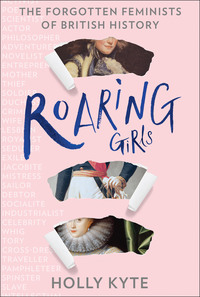
Cover images: Dorothy Jordan by John Hoppner, 1791 © National Portrait Gallery Duke of Aumale by Franz Xaver Winterhalter, 1846 © Bridgeman Images Lady Diana Cecil attrib. to William Larkin, c. 1614 © Bridgeman Images
Holly Kyte asserts the moral right to be identified as the author of this work.
A catalogue copy of this book is available from the British Library
All rights reserved under International and Pan-American Copyright Conventions. By payment of the required fees, you have been granted the non-exclusive, non-transferable right to access and read the text of this e-book on screen. No part of this text may be reproduced, transmitted, down-loaded, decompiled, reverse engineered, or stored in or introduced into any information storage and retrieval system, in any form or by any means, whether electronic or mechanical, now known or hereinafter invented, without the express written permission of HarperCollins.
Source ISBN: 9780008266080
Ebook Edition © 2019 ISBN: 9780008266097
Version: 2019-11-21
AUTHOR’S NOTE:
Spellings, capitalisation and italicisation have been silently modernised throughout for clarity and consistency.
Dedication
For Mum and Dad, for everything.
Epigraph
roaring girl: (n) a noisy, bawdy or riotous woman or girl, especially one who takes on a masculine role
OXFORD ENGLISH DICTIONARY

COVER
TITLE PAGE
AUTHOR’S NOTE
COPYRIGHT
DEDICATION
EPIGRAPH
INTRODUCTION
MARY FRITH: The Roaring Girl
MARGARET CAVENDISH: Mad Madge
MARY ASTELL: Old Maid
CHARLOTTE CHARKE: En Cavalier
HANNAH SNELL: The Amazon
MARY PRINCE: Goods and Chattels
ANNE LISTER: Gentleman Jack
CAROLINE NORTON: A Painted Wanton
AFTERWORD: Unfinished Business
NOTES
ACKNOWLEDGEMENTS
ABOUT THE PUBLISHER
INTRODUCTION
Girls, we’re told, are not supposed to roar. We’re supposed to shut up, be quiet, stop nagging. We’re supposed to calm down, dear. If we don’t, we’re bossy, we’re aggressive, we’re nasty, we’re bloody difficult. We’re a bunch of loud-mouthed feminazis and hysterical drama queens. If our skirts are too short, we’re asking for it, but if we don’t make an effort, we should be ashamed. If we don’t speak out, how can we expect recognition? But if we do speak out, we get trolled. And that’s in the twenty-first century, after four waves of feminism, when equality has supposedly been won.
Imagine, just for a moment, that you’re a woman in the seventeenth century. In your world, feminism doesn’t exist. You’ve been born into a rights vacuum. Your life is one long list of obligations and prohibitions. Your sole destiny as a wife and mother has been preordained since day one and the feminine ideal expected of you is to be chaste, modest, obedient – and, whenever possible, silent.
But what if you don’t want to be silent? What if you want to roar?
Mary Frith was just such a woman. A notorious cross-dressing thief in Jacobean London, she was smashing up every rule in the book when she swaggered onto the stage of the Fortune Theatre in the spring of 1611, dressed in a doublet and a pair of hose, sword in one hand, clay pipe in the other, to perform the closing number of the play she had inspired. It was called The Roaring Girl.
A Roaring Girl was loud when she should be quiet, disruptive when she should be submissive, sexual when she should be pure, ‘masculine’ when she should be ‘feminine’. She was everything a woman was not supposed to be, and in a world before feminism, she was society’s worst nightmare.[1]
A WOMAN’S LOT
The eight Roaring Girls who feature in this book lived in Britain in the 300 years before the first wave of feminists fought tooth and nail for women’s suffrage in the late 1800s, and during those centuries, the political and cultural landscape of the country changed almost beyond recognition. Collectively, these women witnessed the final wave of the English Renaissance and the last days of the Tudors. They saw their country rent by Civil War, their monarch murdered and his son restored. They found Enlightenment with the Georgian kings and experienced Empire and industrialisation in the long reign of Victoria. Britain was transforming at an astonishing rate, yet throughout this period – though it was bookended by female rule – a woman’s legal and cultural status remained virtually stagnant. She began and ended it almost as helpless as a child.
The sweeping systemic changes needed to revolutionise a woman’s rights and opportunities may have failed to materialise by the late nineteenth century, but the first rumblings of discontent had long been audible in the background. By the dawn of the seventeenth century, a radical social shift had begun to creak into action that would falteringly gather pace over the next 300 years. For although Mary Frith was the original Roaring Girl, she wasn’t the only woman of the era to find herself living in a world that didn’t suit her, and who couldn’t resist the urge to stick two fingers up at society in response; the seeds of female insurrection were beginning to germinate across Britain, and the women in this book all played their part in the rebellion.
From the privileged vantage point of the twenty-first century, it’s easy to forget just how heavily the odds were stacked against women in Britain in the centuries before the women’s rights movement, and how necessary their rebellion was. From the day she was born, a girl was automatically considered of less value than her male peers, and throughout her life she would be infantilised and objectified accordingly. Her function in the world would forever be determined by her relationship to men – first her father, then her husband, or, in their absence, her nearest male relation. On them she was legally and financially dependent, and should she end up with no male protector at all, she would find it a desperate struggle to survive.
By the age of seven a girl could be betrothed; at 12 she could be legally married. Her only presumed trajectory was to pass from maid to wife to mother and, if she was lucky, grandmother and widow. Any woman who tried to deviate from this path would quickly find her progress blocked by the towering patriarchal infrastructures in her way. Denied a formal education and barred from the universities, she would find that almost every respectable career was closed to her. She couldn’t vote, hold public office or join the armed forces. The common consensus was that her opinions were of no value and her understanding poor, and consequently she was excluded from all forms of public and intellectual life – from scholarship to Parliament to the press. While the men around her were free (if they could afford it) to stride out into the world and participate in all it had to offer, she was expected to know her place and to stay in it – suffocating in the home if she was genteel; toiling in fields, factories, homes and shops if she wasn’t. Genius was a male quality, and leadership a male occupation. Even queens would have their qualifications questioned by men who assumed they knew better.
The only ‘careers’ open to a woman during this period were those of wife and mother, but even if her homelife turned out, by chance, to be happy, these roles still came with considerable downsides. Legal impotence was perhaps the most obvious. In the eyes of the law, the day they married, a husband and wife became one person – and that person was the husband. From that moment on, the wife’s legal identity was subsumed by his.[2] Her spouse became her keeper, her lord and her master, while she, as an individual, ceased to exist. Any money she might earn, any object she might own – from her house right down to her handkerchiefs – instantly became his, while all his worldly goods he kept for himself.[3] A wife could no longer possess or bequeath property, sign a contract, sue or be sued in her own right. In principle, she was now her husband’s goods and chattels, and he could treat his new possession however he liked. If she were still in any doubt about what to expect from married life before she entered it, the Book of Common Prayer made it alarmingly clear: ‘Wives, submit yourselves unto your own husbands, as unto the Lord.’[4]
If the marriage proved miserable, even unbearable, the wife was expected to endure it. Her husband could beat her, rape her, drag her back to his home if she fled – the law would look the other way. And if he strayed from the path of righteousness into another woman’s bed, well, that was her fault, too; it could only be because she had failed to please him.
With no effective method of controlling her own fertility, successive pregnancies were often an inevitable feature of a married woman’s life, and this brought with it not only the terrors of giving birth, which, quite aside from the pain, could so easily result in her death,[5] but also the horrifying prospect that most of her children would likely not long survive. A couple during the early modern period might expect to have six or seven children born alive, but to see only two of them reach adulthood.[6]
If the marriage should break down altogether, a wife might find herself excommunicated – not just from society, but from those children, too. Like everything else, they belonged to her husband, and he could strip her of all custody and access rights with only a word. If desperate, she might try for a divorce, though if she did, she’d soon learn that she had little or no chance of ever obtaining one. Unless she was rich enough to afford a private Act of Parliament, and could prove her husband guilty of adultery and numerous other misdemeanours, including bigamy, incest and cruelty, the likelihood was all but non-existent. A husband looking to dispose of an unwanted wife, however, might have more luck – he had only to prove adultery in the lady. If all else failed, he could have her committed to the nearest lunatic asylum easily enough,[7] or perhaps drag her to the local cattle market with a rope around her neck and sell her to the highest bidder.[8]
For all these dire pitfalls, the onus weighed heavily on women to marry and have children, yet at any one time during this period an average of two-thirds of women were not married,[9] and their prospects were often even worse. The single, widowed, abandoned and separated made up this soup of undesirables, and with the notable exception of widows who had been left well provided for (they could enjoy an unusual degree of financial independence and respect), they were particularly vulnerable to hardship, poverty and ostracisation. The stigma of having failed in some way marked most of these women. And then, as now, women were not allowed to fail.
Forever held to a higher ideal, women have always had to be better. They alone were the standard bearers of sexual morality; they alone were responsible for keeping themselves and their family spotless. And since society saw no way of reconciling the fantasy of female purity with the reality of sex, it simply divided women into virgins and whores – idolised and vilified, worshipped and feared, loved and loathed. There could be no middle ground; even in marriage a woman’s sexuality had to be strictly controlled, because left unchecked it had the dizzying power to demolish social order. All it took was one indiscretion and man’s greatest fears – cuckoldry, doubtful paternity and the corruption of dynastic lineage – could come true. To avoid this chaos, women were subject to a different set of rules that were deemed as sacred as scripture: a man could philander like a priapic satyr and receive nothing worse than a knowing wink; if a woman did the same, she was ruined. Her reputation was as brittle as a dried leaf, and a careless flirtation or a helpless passion could crush it to dust. So rabid was this mania for sexual purity that it could even apply in cases of rape – so rarely brought to court and even more rarely prosecuted, though women undoubtedly endured it, and the shame, blame and suspicion that went with it.
These pernicious double standards permeated every form of social interaction between the sexes – even the very language they spoke. The nation’s vocabulary had developed in tandem with its misogyny, resulting in a litany of colourful pejorative terms designed to degrade and humiliate any woman who proved indocile. Too chatty, too complaining, too opinionated and she was a nag, a scold, a shrew, a fishwife, a harridan or a harpy. An unseemly interest in sex saw her branded a whore, wench, slut and harlot. And if she ever dared succumb to singledom or old age, she deserved the fearful monikers of old maid, crone and hag. Terms such as these were part of people’s everyday lexicon, and they have no equivalents for men.
Such thorough disenfranchisement – intellectual, economic, political, social and sexual – was the surest way to keep women contained, but despite these desperate measures, it remained a common gripe that women didn’t stick to their predetermined codes of conduct anywhere near enough. They were sexually incontinent, fickle, stupid and useless. They gossiped, carped, prattled, tattled, wittered and accused. They had even started to write books. If they would not shut up and play the game, they would have to be forced, and in these tricky cases, ostentatious methods were called for.
A nagging, henpecking or adulterous wife who had overleaped her place in the hierarchy, for example, might be ritualistically shamed in a village skimmington or charivari – in which her neighbours would parade her through the streets on horseback, serenading her with a cacophonous symphony beaten out on pots and pans, and perhaps burning her in effigy, too. Alternatively, she might be subjected to the cucking stool – an early incarnation of the more notorious ducking stool – which essentially served as a public toilet that the offending woman was forced to sit on. And there could hardly be a more sinister or more blatant symbol of the systemic gagging of women than the draconian scold’s bridle – an iron mask fitted with a bit that pinned down her tongue, sometimes with a metal spike, to quite literally stop her mouth.[10] This unofficial punishment, which was particularly prevalent during the seventeenth century, was mostly reserved for garrulous, gobby women who had spoken out of turn (or just spoken out) and challenged the authority of men, but it might also be meted out to a woman suspected of witchcraft – if she wasn’t one of the thousands who were ducked, hanged or burned for it, that is.[11]
These elaborate tortures pointed to one simple fact: that the potential power women had – be it sexual, intellectual, even supernatural – scared the living daylights out of the patriarchy. In response, it did everything it could to suppress that power and preserve its own supremacy: it kept them ignorant, incapacitated, voiceless and dependent.
By the dawn of the seventeenth century, this sorry template for gender relations had prevailed largely unchallenged for millennia. It’s a model so deeply entrenched in Western culture that it can be traced right back to the Ancients, who set the gold standard for excluding and silencing women, not only in their social and political structures but in their art and culture, too.[12] Its justification was based on one disastrously wrong-headed assumption: that women were fundamentally inferior to men. And for that we can blame both bad science and perverse theological doctrine.
Even today, we cling to the myth that men and women’s brains are somehow wired differently – an idea that modern science is rapidly disproving.[13] But in 1600, the belief that gender differences were every bit as biological as sex differences was absolute. Ever since the Ancient Greek philosopher Aristotle hypothesised that women were a reproductive mistake – physically defective versions of men – it had been persistently argued in Western debate that they were mentally, morally and emotionally defective, too. It didn’t help that seventeenth-century medicine had also inherited from the Ancient Greeks the nonsense theory that the body was governed by the ‘four humours’ – blood, phlegm, yellow bile and black bile – which in turn were thought to be linked to the four elements: earth, fire, water and air. The belief was that a woman was comprised of cold, wet elements, while a man was hot and dry – a crucial difference that supposedly rendered her brain softer than his and her body more unstable. The catastrophic conclusion was that women had only a limited capacity for rational thought. It was no use educating them; their feeble brains couldn’t bear the strain of rigorous intellectual study. They could not be trusted to think and act for themselves, which was why they required domination. And their bodies and behaviour had to be constantly policed, because women were famously susceptible to both sexual voracity and madness – which frequently went hand in hand and were often indistinguishable.
These pernicious, ancient ideas were only reinforced by Christian doctrine. The creation myth made it abundantly clear that Eve, the first woman and mother, who had been fashioned from Adam’s rib for his comfort and pleasure, was the cause of original sin and the source of man’s woe, while early Christian writers spelled it out to the masses that it was a wife’s religious duty to bow to her husband’s authority, because ‘the head of the woman is man’[14] and to submit to him was to submit to God. By the seventeenth century, the damage had set in like rot. The message had been parroted and propagated by nearly every father, husband, preacher, politician, philosopher and pamphleteer across the land for thousands of years, until almost everyone – even women – believed it.
THE OLD RADICALS
With so many barriers in her way, so many erasures to contend with, it’s a wonder that any woman ever made it into the history books. To dismantle such deeply embedded foundations is a monumental task – so much so that we’re still working on it today. In Britain, we have at least made progress enough for this to seem an unbearable world to live in – the Gilead of our nightmares. So how did any woman cope with it? How did any woman even begin to challenge it?
The truth is, the majority didn’t even try. Browbeaten by continual put-downs and a lack of opportunity, they grimaced and bore it, most of them too poor, too ill-educated, too legally and financially dependent on men to have a means of protesting. Power and influence were not within the average woman’s grasp, and if she were anything other than white, she faced almost insurmountable odds – the lives of black and brown women in Britain are particularly absent from the historical records, though they were certainly not absent from the country.
Faced with this dead end, some women chose to take pride in their domestic roles and make the best of their lot; others were so inured to misogyny that they accepted it as normal, even became complicit in it, conned into believing that they could somehow profit from playing nicely in this twisted game.[15]
But there have always been women who refused to play by rules that had so obviously been written by men, for men. Women who couldn’t just keep quiet and carry on. Who didn’t fit the narrow criteria of what a woman ought to be, and felt instinctively that they were as valuable as any man. How did these women – the clever, the curious, the talented; those who preferred women to men, who preferred sword-fighting to child-rearing, who preferred breeches to petticoats, learning to laundry, discussion to silence, independence to marriage; who yearned for the open seas, not the scullery, and dreamed of fame, not obscurity – how did these women negotiate the hostile world around them and find the outlets they needed for all their complexities?
There was only one way: they would have to rile, unnerve, disobey and question. They would have to forfeit the title of ‘good girl’ and become a Roaring Girl instead.
This book explores how just a few of them managed it. Together, the eight Roaring Girls collected here span the full spectrum of the social hierarchy, from a duchess to a slave, and encompass a rainbow of personalities: in these pages you’ll find poets and adventurers, scientists and philosophers, actors and activists, writers and entrepreneurs, thieves and soldiers, ladies and lowlifes, wives and spinsters, mothers and mistresses, flamboyant dressers, plain dressers and cross-dressers, of every sexual preference – in short, all kinds of womanhood. Their roaring ways took various forms. Some of them used words, others action; some broke the law, others changed the law; some used their femininity, others threw it off entirely and appropriated the ways, manners and dress of men instead. All of them were playing with fire, and inevitably they sometimes got burned. For every admirer who cheered them on during their lifetimes, there were plenty more who denounced them as monsters, lunatics, freaks, devils, whores and old maids, and quickly forgot them once they were dead.
Indeed, to their contemporaries, their achievements might not have seemed particularly worth remembering. After all, they didn’t conspicuously change the world – not one of them ruled a nation, wrote a classic novel, made a pioneering discovery or led a revolution. Yet progress can come in small, surprising packages, too. That the historical records took note of these women at all suggests that they were the exceptions, not the rule, living extraordinary, not ordinary, lives, and in the pre-twentieth-century world that was quite enough to get society in a tizz. By living differently, truthfully, loudly and unashamedly, these Roaring Girls were challenging the system, and – whether they knew it or not – making a difference. The imprint they made on history may have been faint, but it’s there to be seen if we take the trouble to look. These women helped change our culture, however incrementally, and together they give a tantalising glimpse of the breadth, boldness and sheer brilliance of the legions of women who have fallen through the cracks over the centuries and tumbled headlong into the ‘Dustbin of History’.[16]
IS THIS WHAT A FEMINIST LOOKS LIKE?
The urge to label such extraordinary women from history as ‘feminists’ is almost irresistible. Naturally, we want to ‘think back through our mothers’, as Virginia Woolf phrased it,[17] and find inspiring heroines to admire; it’s our way of trying to bridge the gap between us, so we can all be on the same team. But to foist modern values and paradigms onto women who lived hundreds of years ago is to set ourselves a trap. If we take the dictionary definition of a feminist as one who supports ‘the advocacy of women’s rights on the ground of the equality of the sexes’,[18] the majority of the women in this book don’t qualify. Most would never have spared a thought for whether women should be granted equal rights with men – that was too big a question too soon, given the scale of the obstacles; they were usually far too busy trying to negotiate their own lives to worry about anyone else’s. The human rights that women enjoy today would have been met with stunned disbelief by these women, and the word ‘feminist’ with a blank stare.[19] The women’s suffrage movement was only just beginning to coalesce in the 1850s, so any woman who spoke out in defence of her sex before then was not a spoke in the wheel of any political or civil movement, buoyed by support from like-minded allies; she was a lone voice in a din of misogyny.
When examining the lives of historical women, there’s no ignoring that their world was not our world; they lived by a different set of standards, a lower bar of expectation, and to try to force our modern concept of feminism to fit retrospectively would be foolhardy. As such, our Roaring Girls don’t always behave in the ways we might want them to or say the things we want to hear. Many of them are a mass of contradictions. With their natural instincts so out of kilter with the social conventions of their day, the result was often paradoxical characters who were both products of their time and ahead of their time. To avoid disappointment, they should always be viewed against their own historical backdrop, rather than ours.
Which is why it can only ever be anachronistic to label these women simply as feminists. And yet, the spirit of feminism was not born with the word. There was no Damascene moment when the movement burst into being, fully formed and fully armed, like Athena sprouting from the head of Zeus. It didn’t arrive with the first Suffragists in the 1860s; it didn’t even arrive with Mary Wollstonecraft in the 1790s. Its birth was slow, incremental, painful and faltering, forged over centuries and across the world, by actions great and incidental, by people famous and forgotten.
What binds these women together, then, is not that they were feminists as we would understand them today, but that they all in some way broke the heavily gendered rules of what a woman ‘ought’ to be and began the work of rewriting them, exposing ignorance, reclaiming their freedoms and overturning preconceptions as they went. They may not have realised it, but that in itself was a feminist act. If we can allow ourselves to relax the remit of the word, we might call these formidable women a fraction of the many early feminists, proto-feminists, accidental, unwitting, even reluctant feminists, who, despite every effort to suppress them, dared to be extraordinary – who, between them, struck the first sparks of what would later become a blaze.
This book is intended as a celebration of these unconventional women’s lives, in all their messy, three-dimensional wonder, in the hope of affording them a little of the gratitude and recognition they so richly deserve, and reclaiming some of the complexity that has historically been denied them. It’s time we viewed such women not as saints or martyrs, heroes or villains, virgins or whores, masculine or feminine, but as real, contradictory, compelling human beings who laughed, loved, cried and fought their way through life, making the best of it, making mistakes – and each in their own way making history. Above all, it’s a collection of stories about courage – the courage of women who, in a world that constantly told them no, stood firm and roared back the word yes.

THE ROARING GIRL
It is Sunday, 9 February 1612, and a crowd has gathered in the churchyard of old St Paul’s Cathedral to see a woman punished. Her crime is against nature; she has disgraced all womankind with her monstrous acts, and now, before the public and before God, she must admit her shame and be cleansed of guilt.
Barefoot and bare-headed, the woman walks out into the wan morning light, swathed in a white sheet and clutching a long taper. For those who can read it, a placard proclaiming her sin hangs around her neck. As she makes her way unsteadily across the cold flagstones of the yard towards the pulpit and carefully climbs the steps to the platform, the jeers from the crowd rise up and follow her.
From the pulpit stage, she looks out over her audience and sees a swarm of eager faces. They are waiting for the show to start, so when the priest begins his sermon, the woman takes her cue. She drops her eyes, suppresses a smile and does her best to cry.

The woman was Mary Frith, and six weeks before, on Christmas Day 1611, she had been arrested (not for the first time) at St Paul’s
Cathedral for walking the streets of London at night dressed in men’s clothes. The result was a charge of public immorality, and a punishment designed to humiliate, disgrace and correct her: she would do public penance in a white sheet, at the open-air pulpit of St Paul’s Cross within the cathedral grounds,[1] where all could bear witness to her forced repentance and the purification of her soul.

This symbolic ritual was a tried and tested disciplinary measure, already centuries old by 1612, but in this instance, it was a waste of time. The ecclesiastical court, which dealt with all lapses in personal morality, was attempting to shame and reform a woman who would not be shamed or reformed, and in the end, the event was more farcical pantomime than solemn ceremony. The penitent herself, it was observed, regarded her punishment with such merry disdain that she was drunk throughout the proceedings; for her, it seems, this was just another opportunity to play to the crowds. Her priest’s sermon, meanwhile – a lengthy lecture denouncing her sin and calling on her to repent – was so mind-numbingly tedious that most of the audience lost interest and wandered off partway through. Those who stayed, however, were rewarded for their patience with precisely what they had come for: a free performance by ‘Moll Cutpurse’ – one of the most famous, and infamous, women in London.
THE THREE FACES OF MARY
When Mary Frith completed her act of penance at St Paul’s Cross in 1612, her name – or at least that of her alter ego, ‘Moll Cutpurse’ – had been on the lips of most Jacobean Londoners for several years, especially those who frequented the playhouses, taverns, brothels and bear pits of Bankside, the lawless entertainment district of Southwark that lay conveniently outside the City’s jurisdiction. Whether they loved or loathed her, feared or admired her, Mary’s notorious career as a cross-dressing thief (or ‘cutpurse’[2]) and street entertainer had fascinated the public, and by the time she’d reached her mid-twenties, she had achieved cult celebrity status – so much so that several playwrights had already appropriated, refashioned and immortalised her persona as a wholly unconventional folk heroine.
Fifty years later, Mary’s legend as one of the most enjoyably outrageous and controversial women of the age was still going strong, confirmed by the arrival in 1662 of a sensationalised ‘autobiography’, The Life and Death of Mrs Mary Frith, which, if it were what it pretends to be – the candid deathbed diary of a repentant sinner – would constitute an invaluable primary source for Mary’s life and an important early example of life writing by an Englishwoman. As it is, the diary is almost certainly a fake. There is no credible evidence that Mary wrote it herself; after all, she’d been dead for three years before it appeared, and although up to 50 per cent of women in London were literate by the late seventeenth century (a much higher proportion than in most parts of the country), it’s unlikely that a woman of low birth such as Mary would have been one of them.[3]
The book’s numerous factual errors and omissions point instead to another hand, and given its erratic style, maybe even several. Falling into three distinct and sometimes contradictory sections – an opening address, an introduction summarising Mary’s upbringing and a ‘diary’ of her life as a cutpurse – it comprises a string of unapologetic, entertaining, though often disjointed, anecdotes of her misdeeds, and seems to have more in common with the fictionalised criminal biographies that were popular at the time than it does with a genuine diary,[4] veering in tone from comic to defiant to political and even preachy.
This ‘diary’, then, is an unreliable account of Mary’s life, though that’s not to say it’s worthless. Plenty of the details within its pages chime with what we know to be true. It’s plausible that the authors had their anecdotes either directly from Mary when she was alive – an old woman entertaining anyone in the alehouse who would listen with tales of her outrageous youth – or from those who knew her, or, more likely, that they adapted them from the tales of her exploits that had been passed from gossip to gossip for decades. Mary had already written herself into London’s folklore with her riotous escapades, leaving the diary’s anonymous authors the task of matching, if not surpassing, these outlandish oral tales.
But herein lies the problem with Mary Frith. With the historical records frustratingly reticent on her real life (her appearances in them are few, though always revealing), much of what we know – or think we know – of her comes from the various fictionalised versions that appeared over the years, making her as slippery a character in death as she was in life. The legend who features in the ‘diary’, the character who walked the stage and the flesh-and-blood woman who left an imprint on the records don’t always agree, splitting her image into hazy triplicate. The diarists were aware of the issue. Their excuse for the ‘abruptness and discontinuance’ of their story is that ‘it was impossible to make one piece of so various a subject’.[5] This isn’t just an unwitting admission of their own fudged documentation of her life; evidently Mary’s baffling complexity made her as intangible to her contemporaries as she is to us.
Lower-class, lawless, unconventional and disobedient, Mary Frith was disturbing – but also strangely alluring; she represented an unusual kind of woman in the seventeenth century, one to whom society had no answer. By definition, such women lived a precarious life and needed cunning strategies to survive, and in Mary’s case that meant barricading herself in behind a protective wall of myth and mystique, cultivating multiple personalities and perfecting her performance of each one until the real woman became as elusive as wisps of smoke. With so many Marys before us, it’s as if she’s laid down a challenge: to find the real Mary Frith, and catch her if we can.
A VERY TOMRIG OR RUMPSCUTTLE
The mystery authors of The Life and Death of Mrs Mary Frith do their best to get to the bottom of this unfathomable woman, but she is ‘so difficult a mixture’ of male and female, of ‘dishonesty and fair and civil deportment’, that they seem torn from the start between admiration and alarm. Faced with a cross-dressing thief who on the one hand must surely be morally reprehensible, but on the other was famed for her good humour and entertaining shenanigans, they delight in her one minute, sneer at her the next – sometimes all at once. Their introduction showers Mary with mock-heroic epithets: she is ‘a prodigy’, an ‘epicoene wonder’, ‘the oracle of felony’, the gold-standard bearer of thievery – a profession that is now in ‘sad decays’ without her; but she is also a ‘virago’, a ‘bono roba’ (prostitute), a monstrous hybrid of masculine and feminine, so unattractive that she was ‘not made for the pleasure or delight of man’. Such a woman made little sense to her peers; she was as much a side-show freak as she was a folkloric heroine, and needed to be explained to the uncomprehending but fascinated public.
In their attempt to do just that, the authors begin at the beginning, with Mary’s childhood, which, if the bare bones of their introduction are to be believed, served as a dress rehearsal for the role she would play in later life. With an air of surprise, they report that this natural rebel was born to perfectly ordinary, law-abiding parents – an ‘honest shoemaker’ and his wife, who lived in the Barbican area of London – in the latter years of Elizabeth I’s reign (the exact year is unclear). Tender, affectionate and indulgent, Mr and Mrs Frith offered their daughter a humble upbringing, though a happy and stable one.[6] By rights, she ought to have been just another honest, hard-working young woman who soon married and settled into her predetermined roles of wife and mother. But no.
Mary’s ‘boisterous and masculine spirit’ manifested itself early and would not be tamed. To curb her unruly ways, we’re told that her parents took particular care over her education (which by the standards of the day meant teaching her to read but not to write, as well as a few domestic accomplishments), but their efforts had little effect. Young Mary was a child of action, not academia. She was an archetypal tomboy – ‘a very tomrig or rumpscuttle’ – fizzing with energy, and resistant to every norm of female behaviour: she would ‘fight with boys, and courageously beat them’; ‘run, jump, leap or hop with any of them’, and ravage her pretty girls’ clothes in the scuffles. She didn’t care – her dresses hung awkwardly on her ungainly frame and only annoyed her.
Drawn to the places where the rabble congregated, this scrappy urchin spent most of her time at the Bear Garden, the rowdy entertainment arena wedged in among the playhouses of Bankside, where bear-baiting, bull-baiting and dog fighting kept the blood-lusty crowds amused. Here, in the fug of the bustling, stinking, noisy Southwark streets, all the vices were out on display: drunks and tavern brawlers, punters and prostitutes, cutpurses and cheats jostled along together, while down the road, above the gateway of old London Bridge, the heads of traitors sat on spikes, like gruesome lollipops in a sweet-shop window. Young Mary saw it all, and she wasn’t fazed in the least; in fact, she fitted right in.
However unladylike, this was the world where Mary Frith felt at home, for she was ‘too great a libertine … to be enclosed in the limits of a private domestic life’. As womanhood approached, she showed no interest in the feminine pursuits she was expected to learn: ‘she could not endure that sedentary life of sewing or stitching’, preferring a sword and a dagger to a needle and thimble. The bakehouse and the laundry were alien to her, and the ‘magpie chat of the wenches’ an irritation. Mary preferred a more direct form of expression. Even when she was young she was ‘not for mincing obscenity’; by adulthood, the habit had developed into ‘downright swearing’. Such profane language from a woman was unfeminine and unacceptable and, along with the rest of her behaviour, it had to be policed (as Mary would later discover – her reputed potty mouth would be listed in the court records as one of her many arrestable offences). To complete this picture of the ultimate anti-woman, we’re told that ‘above all she had a natural abhorrence to the tending of children’, and steered well clear of becoming a mother (another claim that is borne out by the records).
If this character portrait is accurate, Mary was a woman destined to offend and perplex seventeenth-century society in every way. Indeed, so far was she from the meek, mild, modest woman that custom demanded that it was doubted she was a woman at all. She had unsexed herself, become a ‘hermaphrodite in manners as well as in habit’; she was ‘the living description of a schism and separation’, combining the ‘female subtlety’ of one sex and the ‘manly resolution’ of the other – and to a society that only dealt in strict gender binaries, such a combination was profoundly unnerving.
A lower-class girl with no money, little education and scant opportunities had very few options in life even if she conformed, but if, like Mary, she either would not or could not conform, the choice was almost made for her. Such girls often found themselves tripping over into the wrong side of the law in order to survive, usually through thievery or prostitution, but even in that world there was a hierarchy to climb. If Mary wanted to live differently to most women, she would have to behave differently to most women. And if she wanted a modicum of the power and freedom that men had, then she would have to settle for power and freedom in the criminal underworld.
MOLL CUTPURSE
Too proud to beg, too wild for domestic drudgery and quite possibly too repulsed by men to contemplate prostitution, Mary Frith decided to make her living as a cutpurse. It was the most dangerous choice of all these unappealing options, for to embark upon a career of thievery automatically meant risking her liberty and her life. England in the early seventeenth century was a visibly savage place: legal punishments were reliably disproportionate to the crime and barbaric public executions were a favoured form of entertainment. With property deemed as valuable as human life – and frequently even more so – theft and burglary were among the country’s capital offences; if Mary’s fingers weren’t quite nimble enough, she could be facing a stint in Newgate Gaol, or worse, the drop at Tyburn.[7] But in a city where ostentatious wealth rubbed shoulders with grinding poverty, the temptation to pick the glittering pockets of affluent bankers, merchants, lawyers and lords was just too great. Undeterred, or perhaps just desperate, Mary joined the hordes of cutpurses who plagued Elizabethan London early – probably when she was still a child – and quickly demonstrated a knack for getting away with it.
Undoubtedly it played to her advantage that law and order was then a haphazard thing – the professional police force had yet to be established and certain areas, including Mary’s stomping ground of Southwark, fell outside the City’s jurisdiction, making them attractive dens for every kind of vice. These areas were more or less governed by underground criminal networks. Magistrates relied on local volunteer constables to keep the peace and apprehend criminals, who in turn relied on members of the public to raise a ‘hue and cry’ whenever they spotted a misdemeanour. Mary was presumably so adept at sleight of hand that she mostly managed to pilfer unnoticed, though she wasn’t always so lucky.
The records show that on 26 August 1600, when she was still a teenager, she was first charged by the Justices of Middlesex with stealing an unknown man’s purse, while working in cahoots with two other women. She wriggled out of it on this occasion but was indicted again on 18 March 1602 for stealing a purse from a man named Richard Ingles, and again on 8 September 1609, for burglary.[8] Every time, she managed to secure a verdict of not guilty and escape a trip to Newgate – or the noose – so that by her early twenties she had made quite a career for herself. And with it came a well-earned new nickname: ‘Moll Cutpurse’.[9]
The details of Mary’s subsequent life as a cutpurse are filled in by The Life and Death of Mrs Mary Frith with unashamed glee. After a short preamble, Mary’s so-called ‘diary’ embarks on a chain of anecdotes about her many misadventures, tricks and petty revenges, even providing a kind of instruction manual in places on how she and her colleagues successfully plied their trade. Helpful details such as dates are absent, and psychological self-analysis doesn’t trouble her – ‘It is no matter to know how I grew up to this,’ she states dismissively, ‘since I have laid it as a maxim that it was my fate.’ She is, however, allowed the odd moment of reflection when it’s to marvel at what an extraordinary creature she is. ‘I do more wonder at myself than others can do,’ she declares in awe, with the same air of amusement with which she relates all of her history. For the purpose here, more than anything, is to entertain with her oddity. Accordingly, her crimes are softened to ‘pranks’ and, like her literary descendant Moll Flanders, she is portrayed as an honest thief and magnetic heroine, her maxim for life: ‘To be excellent and happy in villainy’, because that has always been ‘reputed equal with a good fame’.
Judging by these anecdotes, Mary’s good fame was justified. She tells of being tricked into boarding a ship for the plantations of Virginia and her subsequent escape by paying off the captain, and of how, being poor and friendless, she then joined a gang of pickpockets, who judged her to be ‘very well qualified for a receiver and entertainer of their fortunate achievements’ – or rather a receiver of stolen goods. This was a life she rather took to, for although the danger was evident, she was ‘loath to relinquish the profit’, and seems to have quickly established a unique and powerful position for herself as protectress and confidante of this coterie of thieves. It was a mutually beneficial arrangement. Being ‘well known to all the gang, and by my good dealing with them not a little in their favour’, Mary was offered protection and anonymity in return – a real case of honour among thieves. She would share out the profits fairly, act as ‘umpire in their quarrels’ and lend money to the most desperate, thereby preventing them from committing dangerous robberies and effectively saving them from ‘the hangman’s clutches’. By fashioning herself as the fair, magnanimous champion of lowlifes in this way, Mary earned the respect and devoted loyalty of her fellow cutpurses, ‘so that among all the thieveries they did, my name was never heard of; for they made it the chiefest of their religion to conceal me and to conceal nothing of their designs from me’. In effect, she had negotiated her way to the top of her own organised crime ring – and secured her own immunity in the process.
It was a wily strategy, though not foolproof – as we know, Mary occasionally found herself in hot water, but when she did, the pickpocket community was allegedly swift to come to her rescue. In one instance, cited in the diary, when Mary is taken up for stealing a watch, she employs one of her gang to commit the ultimate theft in front of a packed courtroom, purely to get her off the hook. Once she had pleaded not guilty, she says, ‘it came to this issue, whether that watch for which I was indicted was the gentleman’s watch or no’. The constable who had apprehended her was called forward to deliver the watch for the gentleman to identify, but just as the constable was making his way into court, Mary deployed her secret weapon: ‘one of my small officers dived into his pocket and sought out the evidence against me, and departed invisible’.
This neat trick naturally incensed the Lord Mayor, who immediately suspected her chicanery, but with no evidence to hand, there was nothing he could do. Once again, the jury were forced to acquit Mary, leaving her free to continue with her shady dealings, undiscouraged and irredeemable as ever. Before long, she tells us, she had the confidence of famous highwaymen, too, and begins to cut a figure rather like a seventeenth-century Fagin, sending off her gang of pickpockets and robbers to do their light-fingered work and bring back the spoils to their mistress.
It’s not known exactly when Mary Frith began to combine her pickpocketing with transvestism, but it seems likely to have coincided with the advent of her entertainment career – a male-dominated industry like all the others – when she was in her early twenties.
Counterintuitive though this decision seems for a thief whose life depended on anonymity, in around 1608 Mary began to see the advantage in developing her persona as ‘Moll Cutpurse’ into a public attraction; by simply donning a doublet, hat and cloak, she could become a ‘character’, who simultaneously drew the crowds to her and distanced her from them. It soon become her signature. Dressed in men’s clothes, she would walk the streets of Southwark, challenging ‘diverse gallants’ to sartorial competitions and entertaining the crowds with her ‘mad pranks’, while her gang of footpads weaved through the distracted audience, cutting purses as they went. Now a decoy as well as a fence and low-level criminal mastermind, Mary Frith had pulled off a protean magic trick: she had become Moll Cutpurse, the charming, eccentric rogue who could never be caught in the act.

Mary’s transvestism was unusual, but it didn’t occur in isolation. It was part of a Europe-wide underground trend for female cross-dressing that first sprang up in the 1570s, reached a peak in the 1620s, thrived throughout the eighteenth century and continued on into the early nineteenth, when it rapidly fizzled out. The UK was particularly prone to this phenomenon, having one of the highest incidence rates in Europe – there are at least 50 recorded cases during this period of women living as men, either to work, marry or serve their country as soldiers and sailors – and it’s easy to see the appeal.[10] A woman’s clothes were ornamental rather than practical, designed to hinder, not help her. Her rigid stays and voluminous skirts accentuated her primary functions of mother and sex object, and were as cumbersome and restrictive as the social rules that bound her. To throw them off in favour of a doublet and hose offered a long list of symbolic attractions. For some women, sidestepping the arbitrary trappings of gender was a survival strategy or simple expedient, a handy disguise when in trouble, in love or going off to war. For others, it was an expression of their complex sexuality, which, in an era before sexual categorisation, had only a one-size-fits-all model. For many more, it meant safety – from harassment, seduction, rape and prostitution, from forced marriages and unwanted pregnancy. And for the ambitious or adventurous, who, as Mary Beard puts it, had ‘no template for what a powerful woman looks like, except that she looks rather like a man’,[11] it meant a sudden open door to agency and opportunity. For those who dabbled, it was pleasingly provocative. For those who went the whole hog, it was a liberation. For all of them, it was a direct challenge to the intractable social codes that governed everyone’s lives – an early feminist act of defiance.[12]
To a country that had long employed sartorial sumptuary laws to scrupulously to preserve the distinctions of rank in its citizens, this trend for female transvestism indicated their alarming lack of control over the distinctions of gender. The Bible had decried cross-dressing as an ‘abomination unto the Lord’,[13] a subversion of the ‘proper’ hierarchy between woman, man and God, as the pamphleteer Phillip Stubbes was keen to remind everybody in his 1583 Anatomy of Abuses. All cross-dressers, he wrote, were ‘accursed’. Men who did it were ‘weak, tender and infirm’, degrading themselves to the status of feeble, powerless females.[14] Women who did it were hermaphroditic ‘monsters’ and presumptuous whores, attempting to steal a man’s power and usurp his sovereignty.
It was this perceived power exchange that was key to transvestism’s ability to unsettle and enrage society. In women, not only did it smack of insubordination, but with its elements of disguise, evasion and masculine aggression, it carried an intrinsic connection to both criminality and sexual incontinency. In 1615, a fencing master named Joseph Swetnam was so incensed by this fad that Mary Frith was spearheading that he published The Arraignment of Lewd, Idle, Froward, and Unconstant Women – a misogynist’s rant in which he bloviated against the ‘heinous evils’ of women. The book was so popular it went through ten editions by 1637, and the concerns it spoke of went right to the very top. King James I, another notorious misogynist, voiced his own anxieties in January 1620, when he commanded that the clergy ‘inveigh vehemently and bitterly in their sermons, against the insolence of our women’ for ‘their wearing of broad brimmed hats’ and ‘pointed doublets’, for having ‘their hair cut short or shorne’ and for carrying ‘stilettoes or poinards [daggers]’.[15] His decree then sparked a pamphlet war the following month between the anonymous authors of Hic Mulier, or, The Man-Woman and Haec Vir; or, The Womanish Man, who publicly fought out the big question: where these ‘masculine-feminines’ a monstrous ‘deformity never before dreamed of’, or emancipated slaves fighting for freedom of choice and self-expression?[16] It could not have been clearer that, even after decades of furiously debating the controversy, this new breed of woman that Mary represented encapsulated men’s fears that ‘the world is very far out of order’.[17]
Consequently, and perhaps inevitably, the panicked authorities frantically cracked down on this destabilising wave of transvestism in an attempt to stamp it out. Several women are known to have been arrested and punished for it long before Mary took it up: in 1569, one Joanna Goodman was whipped and sent to the Bridewell house of correction for dressing as a male servant to accompany her husband to war; in July 1575, the Aldermen’s Court sentenced Dorothy Clayton to stand on the pillory for two hours before sending her to Bridewell Prison and Hospital because ‘contrary to all honesty and womanhood [she] commonly goes about the City apparelled in man’s attire’; in 1599, Katherine Cuffe was sent to Bridewell for disguising herself in boy’s clothes to meet her lover in secret, as was Margaret Wakeley in 1601, because she ‘had a bastard child and went in men’s apparel’.[18]
Most of these women had been accused of sexual misconduct in connection with their transvestism and were using it as a form of disguise. Mary’s motives, however, appear to have been quite different, with her cross-dressing driven partly by a need to advance her career as a crooked street entertainer, and partly by sheer enjoyment.[19] If she was aware of the hazards before she began, she was not put off; indeed, she seems to have been intent on exploiting every one of its discomforting associations. Her outfit of choice was usually a doublet and petticoat, mixing male and female dress, which, rather than disguising her femaleness, deliberately drew attention to her man-womanness. This was not a woman attempting to blend in and disappear; it was a woman who wanted to be noticed – a natural extrovert, who couldn’t resist the overriding urge to step outside the conventional bounds of female experience and thumb her nose in a small but symbolic way at society’s assumption that she was not fit to participate in the world as fully as men. Her method would have its advantages and disadvantages, but certainly Mary Frith had achieved her end: ‘Moll Cutpurse’ had gone up in the underworld – soon there was hardly a soul in London who didn’t know her name.
THE ROARING GIRL
It was around 1610, when Mary was in her mid-twenties and had spent a good couple of years building her dubious reputation as a curious local personality, that London’s playwrights began to take notice of her. And like her biographers, they, too, would mould her image to suit their own ends.
The theatre had come of age during Elizabeth’s reign and, despite occasional closures due to the plague (in 1603–4 and again in 1606–9), it was maturing under James I. Nestled between the inns, bear-pits and brothels of Southwark, playhouses were grubby, raucous places, where ‘all around were card-sharps, dicers, con men and money lenders, roaring boys and roaring girls’,[20] and all of life, from nobodies to nobles, pooled together for their penny’s worth of entertainment. They were also places where women, though welcome in the pits and the galleries, were still categorically banned from the stage.
Mary might not have been allowed to perform herself, but now, at the height of her fame, her alias Moll Cutpurse began to make cameo appearances in several comedic works of the day, taking the lead role in at least two. The Mad Pranks of Merry Moll of the Bankside, with her Walks in Man’s Apparel, and to What Purpose was entered in the Stationer’s Register by playwright John Day in 1610, and though it hasn’t survived, the title gives a flavour of the jolly, affectionate take on her street performances that it likely contained. What has survived are two plays that both date from 1611 and feature very different treatments of Moll. One, Nathaniel Field’s Amends for Ladies, gives her the short shrift you might expect, allowing her only a brief walk-on part and branding her a ‘rogue’, a ‘whore’ and a ‘bawd’; the other would put Moll centre stage and overturn every assumption society held about her.
In the spring of 1611, Ben Jonson’s The Alchemist had lately been performed at the original Bankside Globe Theatre by Shakespeare’s company, the King’s Men; Shakespeare himself, now approaching semi-retirement, was preparing The Winter’s Tale for performance there in May. Across the river, between Whitecross Street and Golden Lane to the west of Shoreditch, on what is now Fortune Street, sat the Fortune Theatre, the rectangular (rather than polygonal) playhouse owned by theatre manager, brothel keeper, property dealer and pawnbroker Philip Henslowe and his son-in-law, the retired lead actor Edward Alleyn. There, the prolific dramatists Thomas Middleton and Thomas Dekker were presenting The Roaring Girl, a ‘city comedy’ to be performed by Prince Henry’s Men (formerly the Admiral’s Men), the second most important acting troupe after Shakespeare’s.
The play’s prologue makes it clear that Jacobean audiences were in for something new. No doubt they had turned up to watch this long-awaited piece with their own ideas of what to expect from a roaring girl, muses the speaker: she ‘roars at midnight in deep tavern bowls’; she ‘beats the watch’ and controls the constables; she ‘swears, stabs’ and ‘gives braves’, causing mayhem wherever she goes. As the female equivalent of a noisy, riotous roaring boy, who had been a stock character of English literature since the previous century, she could mean nothing but mischief. But this would be the tale of a roaring girl who ‘flies / With wings more lofty’ – a new kind of woman, never before seen, ‘whose notes till now never were’. Who could this woman be? The audience knew her name already. It was ‘Mad Moll’, of course, the actor cried, whose ‘life our acts proclaim!’[21]
The play makes full strategic use of its audience’s preconceptions, however, for its plot relies on the assumption that a woman like Moll Cutpurse – famed for wearing men’s clothes, carrying a sword, smoking a pipe and thieving – would be every father’s nightmare daughter-in-law. So when young lovers Sebastian Wengrave and Mary Fitzallard find themselves thwarted by Sebastian’s father, Sir Alexander, who prohibits the match because of Mary’s puny dowry, Sebastian’s cunning plan is to pretend that he’s in love with Moll Cutpurse instead, ‘a creature / So strange in quality, a whole city takes / Note of her name and person’.[22] She is assumed to be a woman so repugnant that his father will overcome his financial misgivings about Mary Fitzallard and see her, by comparison, as a dream alternative.
It all goes according to plan. When Sir Alexander hears that Sebastian is to marry Moll he voices his outright disgust at his son’s choice, describing her as nothing short of an aberration. She is a ‘scurvy woman’, ‘a creature … nature hath brought forth / To mock the sex of woman’. She ‘strays so from her kind, / Nature repents she made her’. His judgement is unequivocal: Moll is a ‘monster’.[23]
Panicked at the prospect of the censure and embarrassment that will surely follow if his son ends up shackled to such a creature (‘Why, wouldst thou fain marry to be pointed at?’ he asks Sebastian in disbelief),[24] Sir Alexander resolves to stop the marriage and employs a spy and trickster – the aptly named Trapdoor – to wheedle his way into Moll’s service to ‘ensnare her very life’ and remove her from the picture. The traps are duly laid: because she is a woman and therefore surely vain and stupid, the villains try to flatter, trick and con her; because she is a cross-dresser and therefore surely a whore, they then try to seduce her, and because she is a thief and therefore surely greedy, they plant a trail of jewels in her path to make her fingers twitch.
When Moll swaggers on stage, however, first in mannish riding habit and later in full doublet and breeches, sword at her side and pipe in her mouth (played, confusingly, by a man pretending to be a woman dressed as a man), all the villains’ plans – and their assumptions – are dramatically upended. Far from being the victim of this play, Moll Cutpurse is its undoubted heroine, outwitting her enemies at every turn. This is no monstrous whore; Moll is a model of chastity, wit and integrity, the moral heart of the action and (no doubt thanks to her real-life template) the most vibrant, fully formed character in the play. In her, the audience was confronted with an all-new image of female virtue: a woman who challenges her would-be seducer Laxton to a duel for impugning her honour (and wins); who protects her enemies from a gang of marauding cutpurses rather than robbing them, and who is clever enough to see through Trapdoor’s subterfuge in an instant. To defy the feminine ideal entirely, she is also staunchly anti-marriage, preferring ‘to lie o’both sides o’th’bed’ and retain her independence than to take orders from a man. If Sir Alexander knew her at all, she says, he would understand that she and Sebastian could never possibly marry – not because he could never want such a monster, but because she ‘would ne’er agree!’[25]
Sebastian, at least, has the sense to realise that Moll is in fact the only person who ‘has the art to help them’, and that if his plan is to work, he must confide in her rather than dupe her. And his trust in her pays dividends, for by the close of the play, she has bested her foes, brought the lovers together and restored order and justice. Sir Alexander is left begging her pardon for slandering and prejudging her, begrudgingly admitting that ‘Thou art a mad girl, and yet I cannot now / Condemn thee.’[26]
If we were to judge Mary Frith solely by The Roaring Girl, she would be a much easier figure to grasp, for Middleton and Dekker’s version of her is remarkably close to our idea of a modern-day feminist heroine. To give this flagrantly unconventional female character such moral goodness, to have her triumph and be the agent of peace and harmony, when to the pamphleteers, the authorities and even the King she was a harbinger of social chaos, was a radical move. She is like no other heroine in Elizabethan and Jacobean drama.[27] Even Shakespeare’s most famous cross-dressing women – Viola, Portia and Rosalind – do so for the purposes of disguise, to win or save their lover, and once their task is complete, order is restored and the threat that their cross-dressing posed is removed. They all end their respective plays back where they ‘belong’: married and in their ‘proper’ clothes. Moll is very different. Like her real-life counterpart, she cross-dresses because she wants to, and at the end of The Roaring Girl she is celebrated for refusing to bow to conformity and remains entirely herself – unmarried, in breeches and in full control of the action.[28]
This was a revolutionary female character to see in the theatre. In a play littered with low comedy (smutty jokes on her hermaphroditic qualities are everywhere – she is ‘a codpiece daughter’, a ‘cutpurse drab’, ‘a monster with two trinkets’, a ‘gaskin-bride’[29]), Moll is never degraded; she is untouched by the slander and is the most powerful character on stage at all times. She also has all the best lines. The longest and most rhetorically slick speech in the play is hers, and as an impassioned diatribe against men’s objectification and predation of women and the sexual hypocrisy that so easily branded them harlots, it forms the moral nub of the play. Her words are directed at her would-be seducer Laxton, but to all men by extension:
… Thou’rt one of those
That thinks each woman thy fond flexible whore,
If she but cast a liberal eye upon thee,
Turn back her head, she’s thine …
Why, she asks, is a woman like her presumed immoral and considered fair game, and then cursed with a ‘blasted name’, just because she’s ‘given to sport’ and ‘often merry’? Is a woman not allowed to enjoy herself without inviting sexual advances? Apparently not. Nor was she always in a position to protect herself. Society preferred to ignore the unseemly truth behind its sexual politics, but here was Moll stating it plainly: that most women who ended up falling from grace did so not because they were morally corrupt, but because their circumstances were desperate. Forever at the mercy of poverty, chance and exploitative men who preyed on the vulnerable, it was all too easy for ‘distressed needlewomen’ and ‘trade-fallen wives’ to be used for pleasure and discarded as whores. Women who found themselves in dire straits would of course take all that was offered: ‘Such hungry things as these may soon be took / With a worm fastened on a golden hook.’
Fallen women rarely found a public defender, but here, in the character of Moll Cutpurse, they had a fearless one who was stepping up and placing the blame firmly where it belonged: not with women, but with the sexual assumptions that served women so ill. The notorious thief had become the woman’s champion,[30] who, despite the censure levelled at her, would always answer back and turn the gender tables: ‘I scorn to prostitute myself to a man,’ she roars in conclusion, ‘I that can prostitute a man to me!’[31] It’s an extraordinary speech for two male writers to put into a woman’s mouth in 1611 – one that spoke such enduring truths that it still resonates today.
Mary Frith’s madcap life may have been ripe for adaptation, but Middleton and Dekker took some bold liberties in their interpretation of it. Their portrayal of Mary as Moll Cutpurse is unquestionably rose-tinted, transforming her from the monster that society saw into an idealised blend of the ‘masculine’ and the ‘feminine’. In their version, she is not even a thief – a twist taken up and perpetuated by Mary’s ‘diary’, in which she insists that ‘I never actually or instrumentally cut any man’s purse, though I have often restored it.’ There is little doubt that the real Mary Frith was a thief, but for the play’s message to carry, and to please the Master of the Revels, Moll’s moral character had to be blameless – even if that meant playing down her crimes and restyling the woman herself into a more appealing package for the theatre-going public.
Not one to let truth get in the way of a good story, Thomas Middleton was blasé about his play’s inaccuracies – in an epistle to accompany the play, he simply pleads artistic licence:
Worse things, I must needs confess, the world has taxed her for than has been written of her [here]; but ’tis the excellency of a writer to leave things better than he finds ’em …
The legend of Moll Cutpurse – however romanticised – had now been enshrined in literature, but despite the airbrushing, the play still has something to say about the character of the real woman. In Mary Frith the playwrights seem to have recognised a free spirit, a merry, eccentric rogue, who they believed was not only harmless, but in a strange way heroic. This unusual woman, who was so openly disputing the status quo, didn’t give a damn what people thought of her, and when Moll proudly owns this fact – ‘Perhaps for my mad going, some reprove me – / I please myself, and care not else who loves me’[32] – it sounds remarkably like genuine admiration on the part of the playwrights.
In fact, it makes perfect sense that the theatre world should have embraced a figure like Mary. No doubt Middleton and Dekker spotted the lucrative commercial potential of such a larger-than-life celebrity, but the playhouse also occupied a liminal space on the fringes of society where, within the limits of censorship, misfits were welcomed, boundaries were pushed and the established order challenged. And with young boys in dresses playing the roles denied to women, theatre was an artform that relied on transvestism. This simple act of transformation – deemed wholly immoral off-stage – was so integral to the workings of pre-Restoration theatre that it was self-consciously worked into many of its plots, becoming a legitimate stage convention by which female characters could wrest some power and agency for themselves. These gender games could be exposed and toyed with at will by the playwright to remind audiences just how easily the divisions between masculine and feminine could be questioned and the hierarchies that relied on them overturned.[33] In the safe space of the theatre, the normal rules didn’t apply.
It was in the dramatists’ interests, then, to present cross-dressing as something exciting and titillating, but essentially innocuous, though in the real world it remained a different story. At a time when women were being whipped or sent to prison for cross-dressed misdemeanours, publicly flaunting one’s transvestism on stage was downright dangerous. Yet that’s precisely what Mary Frith now proceeded to do. As Moll recites the Epilogue to The Roaring Girl, she tells the audience that if the play didn’t pass muster:
The Roaring Girl herself, some few days hence,
Shall on this stage, give larger recompense. [34]
And so she did. One day in April 1611, at the close of the play’s performance, Mary Frith herself appeared on the stage, in full male dress before perhaps two or three thousand people, to perform an afterpiece (usually a short musical extra or jig performed after the main show). She was, it turns out, entirely complicit in this production that had so publicly appropriated her persona, and now she was taking full advantage of it for a little self-promotion.[35]
Did this appearance make Mary Frith the first woman ever to perform in a public London theatre? Very likely, yes.[36] But she was pushing the boundaries to their limits with this coup de théâtre. Women were not allowed on the stage, let alone in men’s clothes, and in striding onto that proscenium, she was usurping a man’s place, making a show of herself and blurring the distinction between make-believe and reality. It was a daring, transgressive, illegal act that would land her in big trouble.
CRIME AND PUNISHMENT
The London authorities didn’t look on Mary Frith’s antics with as kind an eye as the theatre world did. To them, she represented everything their king hated: she was a cross-dresser, a smoker (James I wrote a treatise against this ‘filthy custom’ in 1604)[37] and an upstart, uncouth, unbiddable woman. It’s not known whether Mary managed repeat performances at the Fortune Theatre, or whether it was a one-off, but soon after her scandalous appearance on stage in April 1611, she was arrested and charged with multiple offences to prevent it ever happening again. Unlicensed, she had ‘sat there upon the stage in the public view of all the people there present in man’s apparel& played upon her lute & sang a song’. Not only that, she had engaged in ‘immodest & lascivious speeches’ with her audience, throwing out a bawdy challenge to those in the audience who thought she was a man: that ‘if any of them would come to her lodging they should find that she is a woman’.[38]
This was unacceptable, not least because such a display would draw an undesirable crowd. Wherever Mary Frith appeared, a gang of roaring boys and girls was sure to follow. When Middlesex magistrates decided the following year, in October 1612, to ban all ‘jigs, rhymes and dances after their plays’ across England, they seemed to have Mary’s performance in mind. The reason cited was that when similar ‘lewd’ entertainments had appeared at the Fortune Theatre, they had attracted hordes of cutpurses and other ‘ill-disposed persons’ at the end of every play, who shattered the peace and caused ‘tumults and outrages’.[39] It was this, as much as her transgression on stage, that had goaded them into arresting her – Mary’s very presence on the stage was seen as a threat to public order.
Her punishment was to be committed to Bridewell Prison and Hospital – a house of correction on the banks of the Fleet River in the City where petty crooks, vagrants, persistent drunks and fallen women were briefly incarcerated and subject to hard labour (usually beating hemp) and floggings. Mary appears to have been one of those who resisted correction, however, because within a year, she had reoffended: on Christmas Day 1611, she was caught at St Paul’s ‘with her petticoat tucked up about her in the fashion of a man with a man’s cloak on her to the great scandal of diverse persons … & to the disgrace of all womanhood’.[40] She spent the festive season back in Bridewell before being hauled before the Bishop of London in the New Year, answering fresh charges for what Mary calls in the diary her ‘unseasonable and suspicious walking’.[41] She made her excuses, she says, claiming that she had been out late to attend a woman in labour, and was discharged with a small fine. Her revenge on the constable who arrested her, she tells us proudly, was sweet: having employed one of her ‘imps’ to trick him into believing he had inherited a great fortune, she enjoyed his disappointment immensely when he then learned that he hadn’t.
In reality, Mary confessed to the Bishop a litany of other ‘unwomanly’ acts: that she had ‘long frequented all or most of the disorderly & licentious places in this city’, usually dressed as a man, including alehouses, taverns, tobacco shops and playhouses. That she had ‘this long time past usually blasphemed & dishonoured the name of God’ and ‘associated herself with ruffianly swaggering & lewd company’ – namely cutpurses, drunks and dissolutes, ‘with whom she hath to the great shame of her sex often times (as she said) drunk hard & distempered her head with drink’.[42] This transcript of Mary’s confession brings us closer to her true character than anything else can: by her own account, she was a hard-drinking, pipe-smoking, foul-mouthed cross-dresser who could usually be found bantering with the ragged company of the city’s most disreputable alehouses – and occasionally picking a pocket or two. This was who she was, and this was the realm in which she ruled. But she was also a wily actress, and so before her godly accusers she launched into a dramatic apology, protesting that she was ‘heartily sorry for her foresaid licentious & dissolute life’ and giving a solemn promise that from then on she would behave ‘honestly, soberly & womanly’.[43] Perhaps in that moment, when her liberty was at stake, she even half meant it.
Before her grilling in the Bishop’s court was over, Mary’s accusers succumbed to the age-old assumption that her cross-dressing must go hand in hand with whoredom, and so there came the inevitable charge that she had also been ‘dishonest of her body’ as a prostitute and ‘drawn other women to lewdness’ as a bawd (or madam). If the diary is to be believed, Mary did indeed have a sideline as a bawd, though even then, she managed to defy convention – as well as procuring women for men, she apparently also found ‘the sprucest fellows the town afforded’ for the pleasure of ‘great women’, and in one anecdote even convinces these fellows to pay maintenance for their illegitimate children.[44] The real Mary Frith, however, ‘absolutely denied that she was chargeable with either of these imputations’, and aside from the diary anecdote, there’s no evidence to suggest she was lying. Nonetheless, the Bishop of London ‘thought fit to remand her to Bridewell … until he might further examine the truth of the misdemeanours enforced against her without laying as yet any further censure upon her’.[45] The authorities didn’t know what to do with Mary Frith, so for want of any other ideas, they bundled her off to prison for the third time.
In time, the Bishop’s court hit upon what it thought would be the perfect punishment for Mary: she must do public penance in a white sheet at St Paul’s Cross – a purification ritual that would act as a second baptism and openly humiliate her, too.[46] Public shaming was an integral part of retributive law enforcement before and beyond the seventeenth century – the stocks, the pillory, the drunkard’s cloak, skimmingtons and carting were among the standard punishments for errant citizens[47] – and though such draconian tactics may have worked on some, they seem to have yet again abjectly failed to ‘correct’ Mary. The prolific letter-writer John Chamberlain witnessed the scene at St Paul’s Cross that day in February 1612 when Mary performed her penance, and he wasn’t fooled by her act of contrition. With little sympathy for this ‘notorious baggage’, he wrote to a friend the following week that ‘she wept bitterly and seemed very penitent, but it is since doubted she was maudlin drunk, being discovered to have tippled three quarts of sack [wine] before she came to her penance.’ Her bleary-eyed speech of mock-repentance went unrecorded, but Chamberlain noted with some amusement that ‘she had the daintiest preacher or ghostly father that ever I saw’, who delivered his sermon so ‘extreme badly’ that most of the audience didn’t bother to hear the end of it. Those who did, he said, ‘tarried rather to hear Mall Cut-purse than him’.[48]
The event was nothing short of comical. And in the diary’s account of the episode, Mary’s defiance in the face of it is everything you would hope for: ‘They might as soon have shamed a black dog as me with any kind of such punishment,’ she says bullishly. For half a penny, she crows, she would have travelled to all the market towns in England in her white sheet, wearing it as a badge of honour rather than a cloak of shame.
Unrepentant, undeterred, unchanged, the Mary of the diary relishes every ripple of disruption she causes, and ensures she has the last laugh on the crowd who come to watch her: ‘without any regard to the sacredness of the place’ and ‘in revenge of this disgrace intended me’, her gaggle of trusty fingersmiths ‘spoiled a good many clothes by cutting off part of their cloaks and gowns and sending them home as naked behind as an ape’s tail’. We can only hope it’s true: that all those who came to gloat over Mary that day left St Paul’s with their bare arses exposed, even more humiliated than her.
Darmowy fragment się skończył.