Czytaj książkę: «Iron and Rust»


COPYRIGHT
Harper
An imprint of HarperCollinsPublishers
1 London Bridge Street
London SE1 9GF
www.harpercollins.co.uk
First published by HarperCollinsPublishers 2014
Copyright © Harry Sidebottom 2014
Maps © John Gilkes 2014.
Cover layout design © HarperCollinsPublishers Ltd 2015
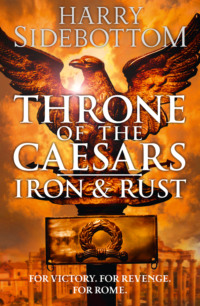
Cover photographs © Stephen Mulcahey/Arcangel Images (eagle sculpture); Shuttershock.com (ancient ruins, background).
Harry Sidebottom asserts the moral right to be identified as the author of this work.
A catalogue record for this book is available from the British Library.
While some of the events and characters are based on historical incidents and figures, this novel is entirely a work of fiction.
All rights reserved under International and Pan-American Copyright Conventions. By payment of the required fees, you have been granted the non-exclusive, non-transferable right to access and read the text of this e-book on-screen. No part of this text may be reproduced, transmitted, down-loaded, decompiled, reverse engineered, or stored in or introduced into any information storage and retrieval system, in any form or by any means, whether electronic or mechanical, now known or hereinafter invented, without the express written permission of HarperCollins.
Source ISBN: 970007499847
Ebook Edition © 2014 ISBN: 9780007499861
Version: 2015-02-17
DEDICATION
TO EWEN BOWIE, MIRIAM GRIFFIN
AND ROBIN LANE FOX
Our history now descends from a kingdom of gold to one of iron and rust.
CASSIUS DIO LXXII.36.4
There have never been such earthquakes and plagues, or tyrants and kings with such unexpected careers, which were rarely if ever recorded before.
HERODIAN I.I.4
CONTENTS
COVER
TITLE PAGE
COPYRIGHT
DEDICATION
EPIGRAPH
MAPS
THE ROMAN EMPIRE AD235–8
THE CENTRE OF ROME
AFRICA PROCONSULARIS
THE NORTHERN FRONTIER
THE EAST
CAST OF MAIN CHARACTERS
IRON & RUST
CHAPTER 1
CHAPTER 2
CHAPTER 3
CHAPTER 4
CHAPTER 5
CHAPTER 6
CHAPTER 7
CHAPTER 8
CHAPTER 9
CHAPTER 10
CHAPTER 11
CHAPTER 12
CHAPTER 13
CHAPTER 14
CHAPTER 15
CHAPTER 16
CHAPTER 17
CHAPTER 18
CHAPTER 19
CHAPTER 20
CHAPTER 21
CHAPTER 22
CHAPTER 23
CHAPTER 24
CHAPTER 25
CHAPTER 26
CHAPTER 27
CHAPTER 28
CHAPTER 29
CHAPTER 30
CHAPTER 31
CHAPTER 32
CHAPTER 33
CHAPTER 34
CHAPTER 35
CHAPTER 36
CHAPTER 37
HISTORICAL AFTERWORD
THANKS
ABOUT THE AUTHOR
ALSO BY HARRY SIDEBOTTOM
ABOUT THE PUBLISHER


CAST OF MAIN CHARACTERS
IN THE NORTH
Alexander Severus: The Emperor
Mamaea: His mother
Petronius Magnus: An imperial councillor
Flavius Vopiscus: Senatorial governor of Pannonia Superior
Honoratus: Senatorial commander of the troops detached from Moesia Inferior
Catius Clemens: Senatorial commander of the 8th legion in Germania Superior
Maximinus Thrax: An equestrian army officer
Caecilia Paulina: His wife
Maximus: Their son
Anullinus: An equestrian army officer
Volo: The commander of the frumentarii
Domitius: The Prefect of the Camp
Julius Capitolinus: Equestrian commander of 2nd legion Parthica
Macedo: An equestrian army officer
Timesitheus: Equestrian acting-governor of Germania Inferior
Tranquillina: His wife
Sabinus Modestus: His cousin
IN ROME
Pupienus: The Prefect of the City
Pupienus Maximus: His elder son
Pupienus Africanus: His younger son
Gallicanus: A Senator of Cynic views
Maecenas: His intimate friend
Balbinus: A patrician of dissolute ways
Iunia Fadilla: A young widow, descended from Marcus Aurelius
Perpetua: Her friend, wife of Serenianus, governor of Cappadocia
The die-cutter: A workman in the Mint
Castricius: His young and disreputable neighbour
Caenis: A prostitute visited by both
IN AFRICA
Gordian the Elder: Senatorial governor of Africa Proconsularis
Gordian the Younger: His son and legate
Menophilus: His Quaestor
Arrian, Sabinianus, and Valerian: His other legates
Capelianus: Governor of Numidia, and enemy of Gordian
IN THE EAST
Priscus: Equestrian governor of Mesopotamia
Philip: His brother
Serenianus: His friend, governor of Cappadocia
Junius Balbus: Governor of Syria Coele, son-in-law of Gordian the Elder
Otacilius Severianus: Governor of Syria Palestina, brother-in-law of Priscus and Philip
Ardashir: Sassanid King of Kings
OUR HISTORY NOW DESCENDS FROM A KINGDOM OF GOLD TO ONE OF IRON AND RUST.
CHAPTER 1

The Northern Frontier A Camp outside Mogontiacum, Eight Days before the Ides of March, AD235
Hold me safe in your hands.
The sun would be risen, well up by now, but little evidence filtered through to the inner sanctum of the great pavilion.
All you gods, hold me safe in your hands. The young Emperor prayed silently, his mouth moving. Jupiter, Apollonius, Christ, Abraham, Orpheus: see me safe through the coming day.
In the lamplight the eclectic range of deities regarded him impassively.
Alexander, Augustus, Magna Mater: watch over your elect, watch over the throne of the Caesars.
Noises, like the squeaking of disturbed bats, from beyond the little sanctuary of the domestic gods, beyond the heavy silk hangings, disrupted his prayers. From somewhere in the further recesses of the labyrinth of purple-shaded corridors and enclosures came the crash of something breaking. All the imperial attendants were fools – clumsy fools and cowards. The soldiers had mutinied before. Like those disturbances, this one would be resolved, and when that happened the members of the household who had deserted their duty or taken advantage of the uproar would suffer. If any of the slaves or freedmen were stealing, he would have the tendons in their hands cut. They could not steal then. It would serve as a lesson. The familia Caesaris needed constant discipline.
The Emperor Alexander Severus pulled a fold of his cloak over his bowed head, placed his right palm on his chest, composed himself again into the attitude of prayer. The omens had been bad for months. On his last birthday the sacrificial animal had escaped. Its blood had splashed on his toga. As they marched out from Rome an ancient laurel tree of huge size suddenly fell at full length. Here on the Rhine, there had been the Druid woman. Go. Neither hope for victory, nor trust your soldiers. The words of the prophecy ran in his memory. Vadas. Nec victoriam speres, nec te militi tuo credas. It was suspicious she had spoken in Latin. Yet torture had not revealed any malign worldly influences. Whatever her language, the gods needed propitiating.
To Jupiter an ox. To Apollonius an ox. To Jesus Christ an ox. To Achilles, Virgil and Cicero, to all you heroes …
As he made every vow, Alexander blew each statuette a kiss. It was not enough. He got down on his knees, then, somewhat encumbered by his elaborate armour, stretched full length in adoration before the lararium. Close to his face, he noticed the gold thread in the white carpet. The fabric smelt slightly musty.
None of this was his fault. None of it. The year before last in the East he had been ill. Half the troops with him had been sick. If he had not ordered the retreat to Antioch, the Persians would have destroyed them all; not just the southern force which was left behind, but the main Roman field army as well. Here in the North the frontier had been breached in numerous places. Opening negotiations with some of the barbarians was not weakness. There was no profit in fighting them all at once. Judicious promises and gifts could induce some to stand aside, maybe even join in the destruction of their brethren. It did not mean their punishment was waived, merely deferred. Barbarians had no concept of good faith, so promises to barbarians could not be considered binding. Such things could not be stated in public, but why did the soldiers not see these obvious truths? Of course, the northern soldiery, recruited from the camps, were little better than barbarians themselves. Their comprehension was equally limited. That was why they could not understand about the money. Since Caracalla, the Emperor who may have been his father, had doubled the pay of the troops, the exchequer had been drained. Veturius, the treasurer appointed by his mother, had taken Alexander to the fiscus. There had been nothing to see except rank after rank of empty coffers. As Alexander had tried to explain more than once on various parade grounds, donatives to the army would have to be extracted by force from innocent civilians, from the soldiers’ own families.
A rush of light as a hanging was pulled back. Felicianus, the senior of the two Praetorian Prefects, marched in. No one announced him and no one closed the curtain. Through the opening, past the Prefect, flew innumerable tiny birds. They darted everywhere around the chamber, flashing bright yellow, red and green as they passed through the band of light. How many times had Alexander told their keepers about the trouble and expense in collecting them? At every dinner when they were released to hop and flutter about entertainingly one or two were lost or died. How many would be left after this?
Felicianus swiped with futile aggression at those that veered and banked near his head as he walked towards the pale gleam of the twin ivory thrones. The Emperor’s mother was seated there in the gloom. Granianus, an old tutor of Alexander’s, now promoted into the imperial chancery, stood by Mamaea, whispering. The secretary of studies was always to be found by the side of the Empress, always whispering.
Alexander returned to his devotions. What you do not wish that a man should do to you, do not do to him. He had had the phrase inscribed over his lararium. He had heard it in the East from some old Jew or Christian. An unwelcome thought struck him. He raised himself on to his elbows. He looked for the court glutton. Alexander had seen him eat birds, feathers and all. It was all right. The omnivore was in a corner beyond Alexander’s musical instruments. He was huddled with one of the dwarves. Neither was paying any attention to the ornamental birds. They were staring blankly into space. The mutiny seemed to have drained all their vitality.
‘Alexander, get up, and come here.’ His mother’s voice was peremptory.
Slowly, not to appear too craven, the Emperor got to his feet.
The air was thick with incense, although the sacred fire burnt low on its portable altar. Alexander wondered if he should tell someone to get some fuel. It would be terrible if it went out.
‘Alexander.’
The Emperor turned to his mother.
‘The situation is not irretrievable. The peasant that the recruits have clad in the purple has not arrived yet. His acclamation will attract few supporters among the senior officers.’
Mamaea was always good in a crisis. Alexander thought of the night of his accession, the night his cousin-brother died, and shuddered.
‘Praetorian Prefect Cornelianus has gone to fetch the Cohort of Emesenes. They are our people. Their commander Iotapianus is a kinsman. They will be loyal. The other eastern archers also. He will bring the Armenians and Osrhoenes.’
Alexander had never liked Iotapianus.
‘Felicianus has volunteered to go back out to the Campus Martius. It is brave. The act of a man.’ Mamaea lightly ran her fingers over the sculpted muscles of the Prefect’s cuirass. Alexander hoped the rumours were untrue. He had never trusted Felicianus.
‘The greed of the troops is insatiable.’ Mamaea addressed her son. ‘Felicianus will offer them money, a huge donative. The subsidies to the Germans will end. The diplomatic funds will be promised to the soldiers. And they will want those they believe their enemies.’ She dropped her voice. ‘They will demand Veturius’ head. The treasurer must be sacrificed. Apart from the four of us, Felicianus can surrender anyone to them.’
Alexander looked over at the glutton. Among all the court grotesques, the polyfagus was Alexander’s favourite. It was unlikely the mutineers would demand the death of the imperial omnivore.
‘Alexander.’ His mother’s voice brought him back. ‘The soldiers will want to see their Emperor. When Felicianus returns, you will go out with him. From the tribunal you will tell them you share their desire for revenge for their families. You will promise to march at their head against the barbarians who killed their loved ones. Together you will free the enslaved and exact awful vengeance on those who inflicted such terrible sufferings. Give the soldiers the proper address of an imperator: fire and sword, burning villages, heaps of plunder, mountains of enemy corpses. Make a better speech than you did this morning.’
‘Yes, Mother.’
Felicianus saluted, and left the tent.
It was monstrously unfair. He had done his best. In the grey light of pre-dawn he had gone to the Campus Martius. Clad in his ornamental armour, he had ascended the raised platform, stood and waited with the troops who had renewed their oaths to him the night before. When the mutinous recruits had emerged out of the near-darkness, he had filled his lungs to address them. It was never going to be easy. Latin was not his first language. It had made no difference. They had given him no chance to speak.
Coward! Weakling! Mean little girl tied to his mother’s apron strings! Their shouts had pre-empted anything he could have said. On his side of the parade ground, first one or two then whole ranks had put down their arms. He had turned and run. Pursued by taunts and jeers, he had stumbled back to the imperial quarters.
With the Prefect Felicianus gone, Mamaea sat as immobile as a statue. Granianus tried to whisper. She waved him to silence. The small birds fluttered here and there.
Alexander stood, irresolute. An Emperor should not be irresolute. ‘Polyfagus.’ The fat man lumbered up and waddled after Alexander to where the food was set out. ‘Amuse me, eat.’
Alexander pointed to a mountain of lettuces in a basket. The glutton started to eat, his jaw chewing steadily, his throat bobbing. He ate with little enthusiasm.
‘Faster.’
Using both hands, the omnivore stuffed the green leaves into his mouth. Soon there were none left.
‘The basket.’
It was made of wicker. The polyfagus broke it, and began. Although piece by piece it disappeared into his mouth, he was not attacking it with anything like his customary relish.
Alexander wished he could be free of his mother. But there was no one else. No one else he could trust. He had trusted the first wife they had given him. Yes, he had trusted Memmia Sulpicia with all his heart. But then her father Sulpicius Macrinus had plotted against him. The evidence produced by the imperial spies had left no doubt. The frumentarii of Volo, the Spymaster, had been thorough. Even before Sulpicius was tortured, there had been no doubt. His mother had wanted Memmia Sulpicia executed as well. Alexander had been firm. They had not let him see his wife, but he had commuted her sentence to exile. As far as he knew, she was still alive somewhere in Africa.
The omnivore spluttered, and reached for a pitcher.
Much the same had happened with his second wife, Barbia Orbiana. He had not been fortunate with his fathers-in-law.
The polyfagus took a huge draught of wine.
It might have been very different if his father had lived. But he had died before Alexander was really old enough to remember him. Then, when he was nine, they had told him Gessius Marcianus, the half-recalled equestrian officer from Arca in Syria, had not been his father at all. Instead he was the natural son of the Emperor Caracalla. But by then Caracalla too had been dead for a year or more. This unexpected turn in Alexander’s paternity had revealed that the newly reigning Emperor Elagabalus was not only his first cousin but his half-brother as well. It had been given out that their mothers, the sisters Soaemis and Mamaea, had committed adultery with Caracalla. And then Elagabalus had been prevailed upon to adopt Alexander. Not many a boy had three fathers publicly acknowledged before he turned thirteen, with two of them worshipped as gods, and the last just five years his senior.
Five years his senior, and perverse beyond measure. Mamaea had tried to shield Alexander from Elagabalus and his courtiers, both from their malice and their influence. Alexander’s food and drink was tasted before it was brought to the table. The servants around him were individually chosen by his mother, not drawn from the common pool in the palace. It was the same with the guards. Droves of experts in Greek and Latin literature and oratory had been hired at vast expense, along with men skilled in music, wrestling, geometry and every other activity considered suitable to aid the cultural and moral development of a princeps. None had been selected for his light-heartedness. After his accession, many of the intellectuals had remained at court, like Granianus moving to positions in the imperial secretariat. Their augmented status had not instilled any increase in levity.
While his cousin-brother reigned, Mamaea had kept Alexander safe. Yet despite all her efforts, dark stories of depravity and vice seeped from the intimates of Elagabalus. Alexander remembered how, all at once, these whispered stories had appalled and excited him. Elagabalus had cast off any decency, cast off the restraint of his mother. A life of dinners, women, roses and boys, of futile pleasure on more pleasure; a hedonistic Pelion heaped upon Ossa; a life which put the imaginations of Epicureans and Cyrenaeans to shame. Think of the freedom, the power. Like a diligent warder, Mamaea had shielded Alexander from the chance to experience such temptations. But she had not shielded him from the end of it all.
A dark night, torchlight reflected in the puddles. Two days before the ides of March. Alexander was thirteen, standing in the Forum with his mother. Shadows shifting on the tall columns of the temple of Concordiae Augustae. The Praetorians handed their victims over to the mob. Both were naked, much bloodied. Elagabalus, they dragged with a hook. It entered his stomach, curled up into his chest. Soaemis, they hauled by her ankles, legs obscenely apart. Her head banged on the roadway. Most likely they were already dead. Mamaea watched the final progress of her sister, a journey she had in part orchestrated. Alexander had wanted to go back up to the palace and hide. No, at a signal from his mother the Praetorians had hailed him Emperor, and formed around him to take him to their camp.
Alexander cast around to get rid of the image. All types of cold food were presented to his gaze: watermelons, sardines, bread, biscuits. There was a mound of snowy-white imperial napkins. Alexander tossed one across. ‘Eat this.’
The polyfagus caught it, but did not begin to eat.
‘Eat!’
The man did not move.
Alexander drew his sword. ‘Eat!’
Mouth hanging open, the polyfagus was panting.
Alexander flourished the blade at his face. ‘Eat!’
A change in the light. A waft of air in the perfumed stillness. Alexander swung round.
A barbarian warrior stood in the opening. He was young, clad in leather and fur, lank long hair to his shoulders. His sudden appearance defied all explanation. In his hand he carried a naked blade. Alexander became aware of the sword in his own hand. Then he remembered. He had long known this would happen. The astrologer Thrasybulus had told him. Somehow he found the courage to raise his blade. He knew it was hopeless. No one can fight what is ordained.
When his eyes adjusted, the barbarian was visibly surprised. Somehow it was evident he had expected the chamber to be empty. He hesitated, then turned and left.
Alexander laughed, the sound high and grating to his ears. He laughed and laughed. Thrasybulus was wrong. He was a fool. He had misread the stars. Alexander was not fated to die at the hands of a barbarian. Not now, not ever. Thrasybulus was no more than a charlatan. If he had been anything else, he would have seen his own fate, would have known what the next day now held for him. The stake and the faggots; let him burn slowly or suffocate in the smoke.
This would all end well. The Emperor knew it. Alexander had faced death, and he had not been found wanting. He was no coward, no mean little girl. Their words could no longer hurt him. He was a man.
Along with the barbarian, the last of the servants seemed to have vanished. Even the dwarf was gone. The pavilion was empty except for his mother on her throne, Granianus beside her, and Alexander himself with the polyfagus. Alexander did not care. Elated, he rounded again on the latter. ‘Eat!’
There was a sheen of sweat on the man’s face. He did not eat, merely pointed.
Three Roman officers now stood in the doorway, helmeted, cuirassed. The leading one was holding something in one hand. Like the barbarian, they waited until they could see in the gloom.
‘Felicianus has returned.’ The speaker threw the thing he carried. It landed heavily, half rolled.
Alexander did not have to look to know it was the head of the senior Prefect.
The officers drew their weapons as they moved into the tent.
‘You too, Anullinus?’ Mamaea’s voice was controlled.
‘Me too,’ Anullinus said.
‘You can have money, the Prefecture of the Guard.’
‘It is over,’ Anullinus said.
‘Alexander will adopt you, make you Caesar, make you his heir.’
‘It is over.’
Alexander moved to his mother’s side. The sword was still in his hand. He was no coward. There were only three of them. He had been trained by the best swordsmen in the empire.
The officers stopped a few paces from the thrones. They looked around, as if taking in the enormity of the actions they were about to commit. The raking sunlight glanced off the swords they carried. The steel seemed to shimmer and hum with menace.
Alexander went to heft his own weapon. His palm was slick with sweat. He knew then his purchase on courage had been temporary. He let go of the hilt. The sword clattered to the ground.
One of the officers snorted in derision.
Sobbing, Alexander crumpled to his knees. He took hold of his mother’s skirts. ‘This is all your fault! Your fault!’
‘Silence!’ she snapped. ‘An Emperor should die on his feet. At least die like a man.’
Alexander buried his head in the folds of material. How could she say such things? It was all her fault. He had never wanted to be Emperor; thirteen years of self-negation, boredom and fear. He had never wanted to harm anyone. What you do not wish that a man should do to you …
The officers were moving forward.
‘Anullinus, if you do this, you break the oath you took before the standards.’
At his mother’s voice they stopped again. Alexander peeped out.
‘In the sacramentum did you not swear to put the safety of the Emperor above everything? Did you not swear the same for his family?’
His mother looked magnificent. Eyes flashing, face set, hair like a ridged helmet, she resembled an icon of an implacable deity, the sort that punished breakers of oaths.
The officers stood, seeming uncertain.
Could she stop them? Somewhere Alexander had read of the like.
‘Murderers are paid in just measure by the sorrows the gods will upon their houses.’
Alexander felt a surge of hope. It was Marius in Plutarch; the fire in his eyes driving back the assassins.
‘It is over.’ Anullinus said. ‘Go! Depart!’
The spell was broken, the thing now irrevocable. Yet they did nothing precipitous. It was as if they were waiting for her last words, knowing they would receive no benediction, instead nothing but harm.
‘Zeus, protector of oaths, witness this abomination. Shame! Shame! Anullinus, Prefect of the Armenians, I curse you. And you, Quintus Valerius, Tribune of the Numeri Brittonum. And you, Ammonius of the Cataphracts. Dark Hades release the Erinyes, the terrible daughters of night, the furies who blind the reason of men and turn their future to ashes and suffering.’
As her words ended, they moved. She stilled them with an imperious gesture.
‘And I curse the peasant you will place upon the throne, and I curse those who will follow him. Let not one of them know happiness, prosperity or ease. Let all of them sit in the shadow of the sword. Let them not gaze long upon the sun and earth. The throne of the Caesars is polluted. Those who ascend it will discover for themselves that they cannot evade punishment.’
Anullinus raised his sword. ‘Go! Depart!’
Mamaea did not flinch.
‘Exi! Recede!’ he repeated.
Anullinus stepped forward. The blade fell. Mamaea moved then. She could not help raise her hand. But it was too late. Alexander looked at the severed stumps of her fingers, the unnatural suddenness of the wide red gash at his mother’s throat, the jetting blood.
Someone was screaming, high and gasping, like a child. Anullinus was standing over him.
‘Exi! Recede!’
CHAPTER 2
The Northern Frontier A Camp outside Mogontiacum, Eight Days before the Ides of March, AD235
A blustery spring day, as was to be expected in Germania Superior eight days before the ides of March. It had still been dark, spitting with rain, when they rode out of Mogontiacum. It was mid-morning and the sun was out when they reached the camp near the village of Sicilia. Soldiers moved through the lines with no pretence of discipline. Some saluted, some did not. Most were drunk, a number to the point of insensibility.
The cavalcade dismounted. Maximinus Thrax stretched his large frame and handed his reins to a trooper. The Rhine rolled past, wide and glittering in the sun. The outer walls of the great complex of purple pavilions shifted and snapped in the wind.
‘This way.’
Maximinus followed the Senators Flavius Vopiscus and Honoratus. There were naked corpses in the corridors. They were grey-white, waxy, with a sheen as if rubbed in oil.
‘Not all the familia Caesaris fled in time,’ Honoratus said.
‘Servants and some of the secretaries, easy to replace,’ Vopiscus said. ‘The Praetorian Prefects were the only men of any account to die.’
A rack of bodies blocked their path. The heads of the dead lay close together in some final conclave.
Maximinus thought of the squalor of blood and death. It did not upset him. He had seen many massacres. He had let none trouble him since the first.
They stepped carefully over the splayed limbs. Maximinus knew his face would be set in what Paulina called his half-barbarian scowl. He thought of his wife and smiled. There could still be beauty, trust and love, even in a debased age.
It was gloomy in the throne chamber. The atmosphere was close, smelling of incense and blood, of urine and fear. Anullinus and the other two equestrian officers were waiting.
‘The mean little girl is dead.’ Anullinus held the head by its short hair.
Maximinus took the severed head in both hands. As was always the case, it was surprisingly heavy. He brought it close, scrutinized the long face, the long nose, the weak and petulant mouth and chin.
Was it true that this weakling had been Caracalla’s son? The mother had claimed so; the grandmother too. Both had boasted of the adultery. Morality had yielded to political advantage, as could be anticipated with easterners.
Maximinus carried the object back to the opening. In the better light, he turned it this way and that. Of course, he had seen Alexander many times before, but now he could really study him. He needed to be sure. The nose was not dissimilar. The hair and beard were cut in the same style. But, although he had begun to go bald, there had been more curl in Caracalla’s hair. Certainly his beard had been fuller than this wispy affair. Maximinus was no physiognomist, but the shape of the head was wrong. Caracalla’s had been squarer, like a bull’s or a block of stone. And his face had been strong, even harsh. Nothing like this delicate, inadequate youth.
Maximinus felt in some measure reassured. Little could have been worse than being party to the killing of the son of his old commander, the grandson of his great patron. Maximinus acknowledged he owed everything to Caracalla’s father, Septimius Severus. That Emperor had picked him out of backwoods obscurity, placed his trust in him. In return, Maximinus had given his devotion. Without thought, Maximinus put a hand to his throat and touched the gold torque his Emperor had awarded him.
‘Bury it,’ Maximinus said, ‘with the rest of him.’
Anullinus took the repulsive thing. He turned towards the opening. The other two bloodstained equestrians moved deeper into the dark chamber, presumably to collect the cadaver. They all stopped at a sign from Vopiscus.
‘Emperor, your magnanimity to your enemy does you credit, but it might be better to exhibit the head to the army, let the soldiery be sure that he is dead.’
Maximinus considered the Senator’s words. Except in battle, it was not his habit to act on the spur of the moment. At length, he addressed Anullinus. ‘Do as the Senator Vopiscus suggests, then bury it.’
Before anyone moved, Honoratus spoke. ‘Emperor, possibly it would be good to send the head to Rome afterwards, have it burnt in the Forum or cast in the sewers. Such is usually the way with a usurper.’
For an instant Maximinus thought the usurper referred to was himself. His anger flared, then he realized. He could still be astounded at the creative ways in which Senators and the rest of the traditional elite habitually rewrote history, both their own and that of the Res Publica. Soon it would be almost as if they had never hailed Alexander Emperor, never sworn oaths for his safety or held office under him. Thirteen years of rule would be reduced to a fleeting revolt, a momentary aberration when Rome was dominated by an ineffectual Syrian boy and his scheming, avaricious mother. Their own part in that ephemeral regime would be buried in deepest obscurity. Perhaps they had spent the time quietly, out of public affairs, on their estates. An expensive education could smooth away the rough edges of inconvenient truths.
‘No,’ Maximinus said.
‘Whatever pleases you, Emperor,’ answered Honoratus.
‘He was no Nero. The plebs did not love him. There will be no false Alexanders. No runaway slave will gather a following, masquerading as him miraculously saved and come again; not in Rome, not even in the East. As for the Senate …’ Maximinus paused, scowling as he sought the right words. ‘… the Senate are men of culture. They do not need the thing flourished in their faces to believe. There is no need to paint them a picture.’
‘Quantum libet, Imperator,’ Honoratus repeated.
‘Anullinus, when you have shown the head to the troops, bury him. All of him. Come back for the rest.’
The officer shifted his loathsome burden into his left hand and saluted. ‘We will do what is ordered, and at every command we will be ready.’ The other two equestrians followed him out.
‘To deny a man Hades is to deny your own humanitas.’ Maximinus spoke out loud, yet to no one but himself. He moved deeper into the chamber. Something turned under his boot. It was a finger, cleanly severed, the nail perfect. The place was a slaughterhouse. There was blood everywhere, livid across the white carpets, darker on the purple hangings. The remains of the young Emperor lay, mutilated and decapitated, by his throne. His mother, also naked and hacked about, next to hers. There was blood on the ivory thrones.
How had it come to this? Maximinus had not wanted it. He had known Alexander was unpopular. Everyone in the army had known that. Perhaps in his cups he had voiced unguarded criticisms. But he had no idea the recruits he was training would mutiny. Once they had thrown a purple cloak over his shoulders in Mogontiacum, there had been no way back. If he had tried to step down, either the recruits would have killed him there and then or Mamaea would have done so later.
Almost certainly the revolt would have been crushed, and crushed swiftly – Maximinus’ head would have been on a pike by the end of the day – if Vopiscus and Honoratus had not ridden into the camp of the recruits. Vopiscus was governor of Pannonia Superior. He commanded the legionary detachments to the field army from both his own province and that of neighbouring Pannonia Inferior. Honoratus was legate of 11th Legion Claudia Pia Fidelis. He had led the detachments from the two provinces of Moesia up the Ister. Between them they had pledged the swords of some eight thousand legionaries, the majority veterans.
Even so, it had been up in the air until Iotapianus had brought them the head of the Praetorian Prefect Cornelianus. Iotapianus was a kinsman of Alexander and Mamaea. The archers he commanded were from their hometown of Emesa. With their desertion, there had been no hope for the Emperor and his mother.
Once you have taken a wolf by the ears, you can never let go. No, Maximinus had not desired the throne, but now there was no going back. At least his son would revel in their new station. Which might be far from a good thing. Maximus was eighteen, more than pampered and spoilt enough already. And Paulina, what would she think? She had always wanted her husband to better himself, to rise in society. But to the highest eminence of mankind? From her senatorial background, she knew all too well how others despised his low origins.
The red gashes on Mamaea’s body were painful to look at. Something about the old woman reminded Maximinus of the day long ago when he had walked into a hut and for the first time been confronted with the remains of a family who had been put to the sword: the old woman, the old man, the children.
He turned away. There was a table spread with food, a vast, fat man dead at its foot. Inexplicably, tiny birds hopped through the plates. The food was cold anyway. Maximinus had never cared for cold food. In the corner of the tent, a dog sat with a human head between its paws, contentedly gnawing.
‘Imperator.’
Vopiscus and Honoratus were at Maximinus’ elbow.
‘It is time to address the troops, Emperor.’
Maximinus drew a deep breath. He was just a soldier. Either of the two Senators would make a better speech. Either of them would make a better Emperor. But once you have taken a wolf by the ears …
Maximinus was just a soldier. The men out there were just soldiers. They demanded nothing elaborate. He would speak to them as their fellow-soldier, as one comilitio to another. It would take only simple words. He would march with them, share their rations, fight alongside them, share their danger. Together they must conquer the Germans as far as the Ocean. It was that or Rome would die. He would quote the last words of his old commander Septimius Severus: ‘Enrich the soldiers, ignore everyone else.’
CHAPTER 3
Rome The Senate House, Four Days after the Ides of March, AD235
It was still dark when Pupienus walked down from his house on the Caelian Hill. Not a star showed, not even the Kite or the Lycaonian Bear. The torches of his link-boys sawed in the gusting breeze. The pavements were dry, but the air smelt of rain.
Pupienus was in the habit of leaving his home at this hour. Normally, unless it was the day of some festival and piety demanded leisure, he would bear off to the right towards the Temple of Peace and the well-appointed offices of his high magistracy. Today was far from a normal day.
He walked under the Arch of Augustus and out into the Roman Forum. Off to the right, above the great façade of the Basilica Aemilia, the sky was beginning to lighten. Tattered black clouds could be distinguished, pressing down from the north. To most they would bring no more cheer than had the news from that direction the previous afternoon.
Down in the gloom, torches guttered across the Forum, each followed by an indistinct figure in shimmering white. All were converging on one point, like moths to a flame or ghosts to blood. The Senators of Rome were meeting in extraordinary session.
Pupienus was one of their number. Even after all this time, nearly thirty years now, it both thrilled him and seemed somehow unlikely. He had attained membership of the same order that had included Cato the Censor, Marius and Cicero. And he was not just anyone, not just a foot-soldier. Marcus Clodius Pupienus Maximus, Vir Clarissimus, twice Consul, was Prefect of the City of Rome, responsible for law and order in the eternal city, and up to one hundred miles beyond. To enforce his will, he commanded the six thousand men of the Urban Cohorts. He had come a long way since his youth in Tibur, let alone his childhood in Volaterrae. Pupienus stamped down the unwelcome thought of Volaterrae. The gods knew all too soon he would have to make another clandestine trip there and face the past he had taken so much trouble to hide.
The Curia stood four-square in the corner of the Forum, as if it had always stood there and always would. Postumus knew this building was not the original, but in some way that made no difference to the impression of permanence. He climbed the steps and passed under the portico. Pausing, he touched the statue of Libertas on the toe for luck, then went in through the bronze doors. He walked the length of the floor. He looked neither left nor right, not at friend or foe, not even at the presiding Consuls. He walked slowly, hands decorously hidden in his toga, eyes fixed upon the statue and altar of Victory. Dignitas was everything to a Senator. Without that potent mixture of gravity, propriety and nobility he would be no better than anyone else.
Pupienus ascended the tribunal. He made a libation of wine and offered a pinch of incense at the altar. The fumes curled up intoxicatingly from the little fire. The gilded face of Victory gazed down without emotion. He placed his right hand flat on his chest, bowed his head and prayed to the traditional gods. His prayers were for the health of the Res Publica, the safety of the imperium and the good fortune of his own family. They were all heartfelt.
His obligations to the divine met, Pupienus turned to the mundane. He greeted the Consuls and went down to his accustomed seat on the front bench. His two sons, Maximus and Africanus, were there. He let them wait, first hailing his wife’s brother Sextius Cethegillus, Maximus’ father-in-law Tineius Sacerdos and his own long-term ally and confidant Cuspidius Flamininus. Age and rank should come before familial affection. Finally, he embraced his sons. ‘Health and great joy,’ they repeated to each other. ‘Health and great joy.’
The house was very crowded, all the seats taken. Senators of less account stood packed together at the back. This would be a day to tell your grandchildren about. A new reign was beginning, the first for thirteen years. Anyone might seize the throne, but only the Senate could make him legitimate, vote him the powers necessary to rule. Without the Senate a new Emperor was no more than a usurper.
Pupienus let his eyes wander over the ranks on the other side of the Curia. The smooth, open face of Flavius Latronianus smiled at him. Pupienus smiled back. Some of the others he acknowledged more formally; none was his particular friend but, like Latronianus, all were Consulars, and all were men who had done the Res Publica good service and whose opinion carried weight. They returned his gesture.
The sight of those on the front bench immediately opposite gave him far less pleasure. Caelius Balbinus had the heavy jowls and florid face of the hardened drinker. He raised a hand to Pupienus with an ironic courtliness. As rich as Croesus, and as decadent as any oriental ruler, the aged Balbinus claimed descent from, among many other families and individuals of antique fame, the great clan of the Coelli. He revelled in the kinship this gave him with the deified Emperors Trajan and Hadrian.
Balbinus sat surrounded by other patricians cut from much the same cloth. Caesonius Rufinianus, Acilius Aviola and the grossly obese Valerii brothers, Priscillianus and Messala – all professed at least one ancestor who had sat in the very first meeting of the free Senate more than half a millennium ago. In recent times Emperors might have granted patrician status to the families of certain favourites, but Balbinus and his ilk looked down on the recipients. For them, no man was a true patrician unless his ancestor had been in the Curia on that day of liberty after Brutus had driven out Tarquinius Superbus and ended the rule of the legendary kings. Some, of course, boasted much more. According to Aviola, his line went back all the way to Aeneas himself and thus to the gods. Neither divine descent nor centuries of privilege tended to breed humility.
The young relatives of these patricians were still worse. Aviola’s cousin Acilius Glabrio and Valerius Priscillianus’ son Poplicola were two of the three-man board of junior magistrates who ran the mint. They were not even Senators yet. But they stood on the floor of the house, hair artfully curled, drenched in perfume, as if it was their entitlement. They knew as well as anyone that their birth, the smoke-blackened busts of their ancestors displayed in their palatial homes, would bring them office and advancement, irrespective of effort or merit, as it had for generations of their families.
Pupienus considered that he had nothing against the patriciate or the wider circle of the inherited nobility in general. The men on either side of him, Cethegillus and Sacerdos, came from the ranks of the latter. They each had several Consuls in their lineage, but remained men of sound mind and hard toil. They were men who could put public duty before their own self-regard and pleasures.
Pupienus himself had ennobled his family when he had held his first Consulship. Cuspidius had done the same, as had his other closest friends. Rutilius Crispinus and Serenianus were absent in the East, governing the provinces of Syria Phoenice and Cappadocia respectively. Part of Pupienus wished they were here now. He would have valued their advice and support.
Across the way, Balbinus was telling a joke, laughing at his own wit, his face porcine. Pupienus detested him. The higher Pupienus and his friends had climbed the cursus honorum, the ladder of offices, the more the likes of Balbinus had sneered at their origins. Their families were immigrants. Rome no more to them than a stepmother. Not one of their ancestors had been worthy of admittance to the Senate. What did that say of their heredity? What could a new man know of the age-old traditions of Rome?
The snide comments infuriated Pupienus. A novus homo had the harder path. He had to rise by his own services to the Res Publica, by his own virtue, not by the deeds of his distant ancestors. There was no comparison between the two. True nobility was to be found in the soul, not in a pedigree.
Balbinus finished his joke with a flourish. The patricians laughed, the corpulent Valerius Messala immoderately. Perhaps he was nervous. Perhaps it had penetrated even his obtuse understanding that in this changed landscape his splendid marriage to the sister of the murdered Emperor Alexander might leave him in a dangerous eminence.
One of the Consuls, Claudius Severus, rose to his feet.
‘Let all who are not Conscript Fathers depart. Let no one remain except the Senators.’
Some moments after the ritual sanction, the young patricians Acilius Glabrio and Poplicola sauntered towards the rear of the house. They did pass the tribunal, but stopped before the doors, still well inside the Curia itself. Pupienus was not alone in eyeing them balefully. There was always a majority of new men in the Senate.
The other Consul, the polyonymous Lucius Tiberius Claudius Aurelius Quintianus Pompeianus stood.
‘Let good auspices and joyful fortune attend the people of Rome.’
As he recited the injunction which always proceeded a proposal there was something of a disturbance behind him in the crowd of onlookers wedged in one of the rear doors.
‘We present to you, Conscript Fathers—’
Acilius Glabrio and Poplicola turned. Abruptly, the two arrogant young patricians were thrust aside, Poplicola so hard that he stumbled. A pair of Senators pushed past and got on to the tribunal to make their offerings.
The Consul exhibited the admirable self-control to be expected of a descendant of the divine Marcus Aurelius, and continued speaking.
Having paid their respects to the deities, the two latecomers descended and walked to the floor of the house. They stood there, glaring about them defiantly.
Pupienus regarded them with what he hoped was well-hidden disfavour.
Domitius Gallicanus and Maecenas were inseparable. The former was the elder and the instigator. He was an ugly man with a shock of brown hair and a straggly beard. His toga was conspicuously home-spun. Everything about his ungroomed appearance chimed with his self-proclaimed love of antique virtue and old-style Republican freedom. He was in his mid-forties. He had been Praetor some years before, but his ostentatious free speech and continual truculence towards the imperial authorities had stalled his career and so far prevented him becoming Consul.
Pupienus had never had much time for Gallicanus – a noble spirit should seek the reward of virtue in his consciousness of it, rather than in the vulgar opinion of others; he had even less since last night.
‘And that it be lawful for him to veto the act of any magistrate.’ The Consul had no need of the notes in his hand. ‘And that it be lawful for him to convene the Senate, to report business, and to propose decrees, just as it was lawful for the divine Augustus, and for the divine Claudius …’
Claudius Aurelius was proposing Maximinus be voted the powers of a tribune of the plebs, which gave an Emperor legal authority in the civil sphere. Distracted by the theatrical entry of Gallicanus and Maecenas, Pupienus must have missed the other of the twin bases of an Emperor’s rule: the clauses about the Emperor’s overriding military command.
Events had moved fast since noon the previous day when Senator Honoratus and his escort had arrived from the North, pushing their foundering horses down the rain-swept Via Aurelia and into Rome. It had been three days after the ides of March. It was the day of the Liberalia, when boys are awarded the toga virilis of manhood. Attending family ceremonies, the Senators had been scattered throughout Rome and beyond. It had been late in the afternoon before enough had been gathered in the Curia.
Honoratus was another novus homo. His hometown was Cuicul in Africa. Pupienus did not hold that against him. Honoratus had worked his way up the cursus honorum. After he had held a Praetorship, he had been given command of the 11th Legion up in Moesia Inferior, and from there appointed to a special command with the field army in Germania. Honoratus knew the ways of the Senate House as well as the camp. There had always been much to admire about him. Now there was something to fear as well.
Still in his mud-splattered travelling clothes, Honoratus had told the tale simply, without affectation. The Emperor Alexander had been murdered in a spontaneous and unsuspected uprising of the troops. The senior officers and the army had proclaimed Gaius Iulius Verus Maximinus Emperor. With mutiny in the ranks and a barbarian war on hand, there had been no leisure to consult the Conscript Fathers. Maximinus hoped the Senate would understand the need for alacrity. The new Emperor intended to take advice from the Conscript Fathers, and to continue the senatorial policies of his predecessor. Maximinus was a man of proven courage and experience. He had governed Mauretania Tingitana, and Egypt, and held high command on both the eastern and the northern expeditions. Honoratus commended him to the house.
It was a fine speech, Honoratus’ slight African accent – where the occasional ‘s’ was lisped into ‘sh’ – notwithstanding. The Senate would have voted Maximinus the imperial powers immediately – some had even begun to chant acclamations – had it not been for Gallicanus.
Like a hirsute revenant from the old Republic, Gallicanus had risen up and thundered against the vitiation of senatorial procedure. It was well past the tenth hour of the day. After the tenth hour no new proposal could be put to the house. It was almost dark. Were the Conscript Fathers ashamed of their deeds? Did they seek to hide in obscurity like foul conspirators, or depraved Christians? Had they forgotten that a decree passed after sunset had no legality?
The Consuls had been left with no choice but to end the session and call for the Senate to reconvene the following morning at dawn.
Custom demanded the Senators escort home the presiding magistrates. Pupienus was one of those who accompanied Claudius Severus through the rain to his house. At least it had not been at all out of the way. The Consul was his neighbour on the Caelian Hill.
Returned to his own home, Pupienus had time only for a quick bath and to put on dry clothes before his secretary, Curius Fortunatianus, had announced the presence at the door of none other than Gallicanus. For once, his shadow, Maecenas, had not been with the arbiter of traditional senatorial mores. Indeed, Gallicanus had made a request to speak to the Prefect of the City in complete privacy. The circumspect Fortunatianus had suggested Pupienus receive his visitor in the garden dining room. The hidden back door would allow the secretary, and for certainty perhaps another trustworthy witness, to listen unobserved. Although tempted, as it would ensure his own safety, Pupienus dismissed the idea as unworthy. Gallicanus might be unsavoury, a seeker of notoriety, and his conversation might move towards the treasonous – under the circumstances, Pupienus would have been amazed if it did not – but Senators should not inform against each other, and most certainly they should not set underhand traps.
Fortunatianus had shown Gallicanus into the small room where Pupienus had dressed and then left them alone. Gallicanus had never been known for subtlety. Peering into every corner, only just stopping himself from tapping the panelling, he had demanded Pupienus swear that no one could overhear them and that nothing said would be repeated. The oaths taken, Gallicanus had launched directly into business. This new Emperor was but an equestrian. Only one man from the second order in society had ever taken the throne. Pupienus would recall the weakness and brevity of the reign of Moorish bureaucrat Macrinus. This Maximinus was worse still. At best, he was a peasant from the remote hills of Thrace. Some said one of his parents was from beyond the frontiers, a Goth or one of the Alani. Others said both had been barbarians. He was a man of no education, no culture.
Pupienus knew the law of treason was ill-defined, but its malleability tended towards inclusion and condemnation. Gallicanus had already said more than enough to lose his estates and find himself heading towards either an exile-island or the executioner. Still, Pupienus had given his word. ‘What would you do about it?’ he asked.
Gallicanus had not answered directly. The principate of Alexander had been good for the Senate. Gallicanus’ tone was earnest. Both the Emperor and his mother had shown respect to the Curia. They had given the Senators the chance to regain their dignitas. More than that, with the creation of the permanent council of sixteen Senators always in attendance on the Emperor, they could be thought to have admitted the Senate into a real sharing of power. You might call it a dyarchy.
Although he had done very well under the regime, a dyarchy would have been far from what Pupienus would have called almost a decade and a half of ineffective and corrupt rule by a weak youth and an avaricious woman who had attached various ambitious and often venal Senators to themselves in an unavailing attempt to gain a reputation for statesmanship. He said nothing in response.
The Senate had been reawakened, Gallicanus had ploughed on. Not since the first Augustus had cloaked his autocracy in fine-sounding words and smothered the last of true freedom – maybe not since long before that – had the Senate been stronger. This Thracian barbarian had not yet squatted securely on the throne. Maximinus had few backers. Most of the Senators with the army would welcome his fall. Maximinus had no legal authority. The Emperor had never been weaker. It was time to bring back libertas. It was time to restore the free Republic.
It had been a measure of Pupienus’ many years of public service that he neither snorted in derision nor laughed out loud. Apart from the court fools and a man in Africa who had been driven out of his wits by the sun, he had never heard anyone say anything more insane.
Gallicanus must have taken the continued silence of his interlocutor as a sign of something else. ‘The Urban Cohorts under your command number six thousand men. Almost all the Praetorians are with the field army on the northern frontier. There are no more than a thousand left in Rome. Many of your men are quartered in their camp. It would be easy to win them over or crush them.’
‘Herennius Modestinus?’ Pupienus had said, speaking at last.
Gallicanus had smiled like a not over-bright student asked a question he had been expecting. The Prefect of the Watch was an equestrian of the traditional type, imbued with a respect for the Senate. Anyway, if he proved contumacious, the vigiles he commanded were just seven thousand armed firemen. There were almost as many in the Urban Cohorts, and they were real soldiers. Modestinus himself was only a jurist, while Pupienus had commanded troops in the field.
‘The detachments from the fleets of Ravenna and Misenum?’
At this question Gallicanus had shrugged with a certain irritation. ‘A few sailors in Rome to put up the awnings at the spectacles.’ It was evident they had not previously crossed his mind.
‘One thousand from each fleet, all trained and under military discipline.’ Pupienus had always tried to know such details: the numbers of troops, their billeting and mood, the disposition of their officers, the family connections of the latter. He had always talked to all sorts of people. Since his rise, especially since he had become Prefect of the City, he had also paid good money to know such things.
Gallicanus had waved the sailors away as of no consequence. There was something vaguely simian in the motion.
‘If I threw my lot in with you—’ Pupienus spoke slowly and carefully; even in the security of his own house he felt a vertiginous fear at saying these things ‘—and if I gathered under one standard all the armed forces in Rome, I would command some sixteen thousand. Of which, as you say, almost half are merely firemen. The imperial field army numbers some forty thousand, before reckoning what further forces could join it from the armies on the Rhine and Danube.’
Gripping him by the arm, Gallicanus thrust his ill-favoured face close to that of Pupienus. ‘My dear friend.’ Gallicanus squeezed the arm. His gaze and voice were fervent in their sincerity. ‘My dear Pupienus, no one doubts your commitment to libertas, your devotion to the Senate, or your courage. But in a free Republic it will not be for us to assign ourselves commands. As it was when Rome grew great, the Senate will vote who leads its armies.’
Gallicanus released Pupienus’ arm and began to pace the room. He was babbling about electing a board of twenty from the Senate, all ex-Consuls, to defend Italy. Others would be sent to win over the troops and the provincials. In his eagerness he was bobbing about the confined space and swinging his arms like an agitated primate in a cage.
Pupienus was seldom flabbergasted, and he had not been so angry for a long time. What sort of fool was Gallicanus? He had come into Pupienus’ home and endangered everyone in it with his talk of treason. And he had done so not to offer Pupienus the throne, not even to offer him a leading role in a new regime. Instead the ape had wanted Pupienus to seize the city for his insane cause, and then, rather than reap the rewards, simply give up his legitimate authority and step down to the level of a private citizen.
‘This must stop.’ Pupienus had recovered quickly.
Gallicanus had rounded on him, suspicion and anger in his eyes.
Pupienus had smiled. He had hoped it looked reassuring. ‘All we Senators wish we had lived in the free Republic. But you know as well as me that the principate is a harsh necessity. The imperium was tearing itself apart in civil wars until Augustus took the throne.’
Gallicanus had shaken his head. ‘We can learn from history.’
‘No—’ Pupienus had been adamant ‘—the same would happen again. The leading men would fight for power until one of them won or the empire fell. You have read your Tacitus. Now we must pray for good Emperors, but serve the ones we get.’
‘Tacitus served under the tyrant Domitian. He was nothing but a quietist, a time-server. He was a man of no courage, a coward.’ Gallicanus had shouted the last words.
‘You and I, we both held office under Caracalla.’ Pupienus had pitched his voice at its most reasonable. ‘Give up this scheme before you bring disaster on your family and your friends.’
Gallicanus stood wringing his hands and pressing them together as if he could physically crush this opposition. ‘I thought you were a man of honour.’
You ape, Pupienus thought, you stupid, arrogant Stoic ape. ‘I hope you will think so again, because I will never mention this conversation to anyone.’
Gallicanus had left.
The mellifluous tones of the Consul brought Pupienus back to the Senate House:
‘… And that whatsoever he shall deem to be according to the custom of the Res Publica and the greatness of divine and human, public and private matters, there be right and power for him to undertake and to do, just as there was for the divine Augustus …’
The Consul had reached clauses that were surely otiose. As Maximinus had already had been vested with the tribunician power, which brought the ability to make and unmake all laws, of course he could do whatsoever he should deem according to the custom of the Res Publica, and any other thing as well. Pupienus was only half listening. He was still watching Gallicanus posturing in his near-rags on the floor of the Senate House. The previous evening he had forgotten that Gallicanus had moved from following the doctrines of the Stoa to those of Diogenes. Not a Stoic ape then. A Cynic dog instead. It made little difference. The ragged Senator was still a dangerous fool, made all the more dangerous by a conviction that profoundest philosophy underpinned all his beliefs and actions.
Gallicanus had not been the only visitor to the house on the Caelian that night. Pupienus and his wife were starting their belated dinner when Fortunatianus had announced another caller. This time the secretary had suggested no ingenious espionage. He was plainly terrified. Honoratus was outside. The street was full of soldiers.
Pupienus had dreaded such a moment since first he acquired wealth and position. The knock on the door in the night. The imperial official standing in the torchlight, the armed men at his back. The muted terror sliding through the corridors of the house. In the reign of Caracalla, it had happened to several men close to Pupienus. Neither those vicarious experiences nor the years of expectation had made the sudden reality any easier.
Surely there had been no time for Gallicanus to have approached someone else. Even that hairy fool must have realized that he could never seize Rome without the Urban Cohorts. Pupienus had felt a hollow deep in his stomach. Could he have so misread Gallicanus? Was all that conspicuous virtue no more than a mask? Was all his talk of the Res Publica no more than a trap?
The new arrival could be unconnected. But still lethal. A new regime often began with a purge. But it could be nothing. With all the courage and dignitas he could muster, Pupienus had told Fortunatianus to bring Honoratus to him. While waiting, he had managed not to touch the ring on his right middle finger which contained the poison. Instead, he had put his hand on that of his wife, squeezed, and forced himself to smile into her eyes.
Honoratus was still wearing the same clothes muddied from the road in which he had addressed the Senate. He entered alone. Pupienus fought down a surge of hope. If it was premature, it would be all the more devastating.
‘Forgive the intrusion, Prefect.’ Honoratus had spread his arms wide, showing his empty palms. ‘I should have sent a messenger ahead. I have been somewhat occupied.’
‘Think nothing of it, Senator.’
Honoratus had bowed to Sextia. ‘My Lady, I need the advice of your husband.’
Like a true Roman matron, she had spoken some graceful words and withdrawn. Only the slightest catch in her voice betrayed the relief that her husband would be neither hauled off to the torturers in the palace cellars nor butchered in front of her.
‘Have you eaten?’
‘No.’
‘Please, do.’
Honoratus stopped his host calling for a slave to remove his boots. ‘I will do it myself. Discretion might be best.’ He pronounced it ‘dishcretion’.
Pupienus had watched the younger man wash his hands, tip a libation and start to eat. He sprinkled some salt on a hard-boiled egg, dipped it in some fish sauce. He ate it delicately. He reached for another. The speed of his feeding increased. He was hungry. Pupienus had forced himself to keep quiet. Behind the dirt and fatigue, Honoratus was still ridiculously good-looking: dark hair, dark eyes, the cheekbones of a statue. Pupienus had thought it would be almost unseemly to be killed by someone so beautiful.
Honoratus drained his glass.
‘Shall I call for more?’
Honoratus smiled. ‘You were never one for much wine, Pupienus. No, leave it until they bring in the next course.’
Pupienus had passed him more bread.
‘Alexander had to go,’ Honoratus had said. ‘He was trying to pay off the Germans. He was too scared to fight. The soldiers despised him. It would have been a disaster, much worse than the East. His mother’s greed was getting worse. The troops’ pay was late. If we had not acted, someone else would have.’
Pupienus had made an understanding noise.
‘Maximinus is a good soldier, a good administrator. He has courage. He will fight the German tribes, and he will win.’
Pupienus had repeated the noise, with just a hint of a question.
‘As an equestrian, Maximinus has no experience of the Senate. Although he has governed provinces, his whole attention must be on the northern war. Often he will be beyond the frontier, deep in barbaricum. In civil matters he will delegate and listen to advice.’
‘Whose advice?’
‘I rather hope mine, among others.’ Honoratus had laughed. He had very straight white teeth. ‘The new Emperor also puts particular faith in the governor of Pannonia Superior, Flavius Vopiscus, and the commander of 8th Legion, Catius Clemens.’
Pupienus considered his words. ‘I have known Flavius Vopiscus for many years. Catius Clemens I do not know so well, but if he is like his brother Celer, who is one of the Praetors this year in Rome, then the new Emperor has chosen his confidants well. All three are men of judgement.’
Honoratus had raised his empty glass to acknowledge the compliment. ‘Loyal friends are always the pillars of the throne. Maximinus would embrace you in his friendship. Your excellence as Prefect of Rome argues for its continuation.’
Now Pupienus toasted the kind words.
‘You have two sons. When the two Consuls who have given their name to this year step down in a couple of months, Maximinus is minded to appoint your elder son, Pupienus Maximus, as one of the Suffect Consuls. I will be the other. A still greater honour is being considered for your family. Next year the Emperor will take office on the kalends of January. Maximinus is thinking of taking your younger son, Africanus, as his colleague as Consul Ordinarius. For eternity, it would be the year of the Emperor Gaius Iulius Maximinus and Marcus Pupienus Africanus. So that the Emperor can get to know your son, form a true estimate of his virtues, Africanus will accompany me back to the field army.’
It was neatly done, Pupienus had thought, the blend of high honours binding the family to a potentially unpopular regime and the taking of a hostage. He spoke. ‘It will be difficult to live up to the benefactions shown, but we will try.’
‘Excellent,’ Honoratus had said. ‘Who was it who said, “Scratch the surface of any government and you find an oligarchy”?’
‘I cannot remember.’
‘No, nor me. Of course, you must keep Rome quiet: no rioting from the plebs, no conspiracies among the nobility.’
‘Of course.’
‘Excellent,’ Honoratus had said, again. ‘Now perhaps your servants could stop listening at the doors and bring in the main course. I am shtarving.’
Pupienus had rung a little bell.
‘One thing,’ Honoratus said. ‘I brought a new equestrian down to take command of the vigiles. I think you will like the new Prefect of the Watch. He is called Potens.’
‘Herennius Modestinus?’
‘Oh no – gods, no! Nothing like that.’
Inwardly, Pupienus had cursed. His voice must have betrayed him.
‘What do you take our new Emperor for? A barbarian?’ Honoratus had showed his teeth as he laughed. They really were perfect.
Pupienus had kept a very straight face.
‘Not half an hour ago, I thanked Modestinus for his noble efforts patrolling the streets night after night for fires and malefactors. I told him how much the Emperor appreciated his labours, but Maximinus had decided that a skilled jurist might be more sensibly employed handling all the legal entreaties addressed to the throne. When your son and I set off to the frontier, Modestinus will accompany us. At the imperial court the position of Secretary for Petitions awaits the man of law. Modestinus will make a fine a Libellis. He has always been dutiful, but somehow it was not right he remain in Rome while the Emperor was elsewhere. It was just that some said he was a little too fond of the old free Republic.’ And Honoratus had gazed hard at Pupienus.
The rest of the meal had passed without anything of significance, the conversation harmless.
Up on the tribunal, the Consul finally reached the end of the lengthy list of overlapping powers, privileges and honours proposed for the new Emperor. ‘And we recommend that these things be approved by you, Conscript Fathers.’ Claudius Aurelius sat down with the air of a task well done.
Laboriously, the Father of the House, Cuspidius Celerinus, used his walking stick to pull himself to his feet. An octogenarian, Celerinus was frail, but his reason remained acute. He knew what was wanted: something of moderate length, traditional in tone and panegyric in nature. His reedy old man’s voice still carried all through the Curia.
Like Cincinnatus summoned from the plough, Maximinus had answered the call of the Res Publica. The time for vacillation was past. Mars had come down from the heights. Grim-visaged, the god stalked the fields and villas, howled around the walls of towns. The dangers had never been greater. In the time of Cincinnatus, the lone tribe of the Italian Aequi besieged one legion on Mount Algidus. Now, all the barbaric tribes of the frozen North raged against the Romans, held the entire empire under siege, threatened humanitas itself. Come the hour, come the man. Hardened by war on every continent, only Maximinus, spurring the flanks of his foaming warhorse, could bring defeat to the savage Germans. As far as the Ocean, they would bow their heads to the majesty of Rome.
With his victory won, great Caesar would return to Rome. In the metropolis the antique virtues bred in his rustic home – piety, frugality, self-control – would cleanse away the stains of recent luxury and wickedness. A second Romulus, he would scour away the filth of corruption to bring forth another golden age. Justice would return to earth. All would salute him: the lands, the stretching leagues of the sea, the unplumbed sky. Let us salute him. Let Gaius Iulius Verus Maximinus become Emperor!
A roar of approval went up to the high ceiling, startling a pair of sparrows and sending them racing out over the heads of the spectators at the open doors. Old Celerinus sat down. His neighbours congratulated him. Pupienus walked over to join them. It had been a good speech, with echoes of Livy and Virgil, the patriotism of both suitable to the occasion.
In order of precedence, the Consuls asked the opinion of the assembled Senators: I agree. I agree. One after another, the four hundred or more assented. The Consuls put it to the vote.
With much shuffling and even a little barging, the vast majority of the Conscript Fathers rushed to arraign themselves on the indicated side of the Curia. They packed themselves together like herd animals threatened by a predator. Some were slower, through age or infirmity, or overtly paraded independence. Gallicanus and Maecenas moved tardily and but a little. Gallicanus barely crossed the middle of the floor.
Perhaps, Pupienus thought, I should have given you to Honoratus. The handsome friend of the new Emperor knew Gallicanus had visited, and must surmise that he talked treason, although possibly not the fanatic scope of it. The free Republic had been dead nearly three centuries. To revive it was a fool’s dream. But Gallicanus was a fool. A yapping Cynic dog of a fool. Like an undermined bastion, his arrogance could bring ruin on those around him at any moment. Perhaps indeed he should yet be handed over to Honoratus. But no, an oath was an oath. The gods were not to be mocked. Yet, if a way could be found, it might not stand to the discredit of Maximinus and those around him if an example were to be made of Gallicanus.
‘This side seems to be in the majority.’ The formal words of the Consul were an understatement. No one, not even Gallicanus, was fool enough to vote openly against the accession.
The Senators began to chant their thanks to the gods for their new Emperor: ‘Iupiter optime, tibi gratias. Apollo venerabilis, tibi gratias.’ It echoed around the marbled walls of the Curia like plainsong.
‘Iupiter optime, tibi gratias. Apollo venerabilis, tibi gratias.’
Singing with the rest, Pupienus wondered how long the gratitude to Jupiter the best, to venerable Apollo, to the other gods not yet thanked, would last. Could Honoratus, Flavius Vopiscus and Catius Clemens control the creature they had elevated? Could they mould Maximinus into something acceptable to more than the soldiery? Perhaps they could. They were men of ability as well as ambition. And there was Paulina, the wife of Maximinus. She was from the nobility. The Thracian was said to love her. She was reckoned a good influence.
Yet, no matter how he behaved, would the Senators ever truly accept Maximinus? They had fixed views on the person and role of an Emperor. He should be chosen from the Senators. He should respect the Senate and share the lifestyle of its members. Above all, he must be a first among equals, a civilis princeps. A shepherd boy from the North risen to equestrian rank via the army could not be such a primus inter pares.
Pupienus debated the wisdom of his actions the previous night. There was nothing else he could have done, nothing reasonable. But it might not pay to be too close to this new regime. Circumspection was the order of the day. Information should be gathered, a keen ear kept open for hints and whispers. He should be prepared, but nothing precipitous should be ventured. Ignorance breeds confidence, reflection leads to hesitation, as the saying went.
Iupiter optime, tibi gratias. Apollo venerabilis, tibi gratias.
CHAPTER 4
Rome The Carinae, Five Days after the Ides of March, AD235
Iunia Fadilla knew herself blessed. A descendant of the divine Marcus Aurelius, she was made aware on many occasions and by all sorts of men that she possessed both beauty and an intellect that they claimed was rare in her sex. Before his untimely death, her father had found her an agreeable and generous husband. Now, two years or so after the marriage, her elderly spouse more predictably had gone the way of her parent. As was proper, the eighteen-year-old-widow wore no jewels and her stola was of the plainest grey. Yet, as she left the recital, her demeanour was more than a little at odds with her costume of bereavement.
Her friend, Perpetua, evidently was happy as well. They walked, arm in arm, across the great courtyard of the Baths of Trajan. The rain of the day before had gone, and the sky was a clear, washed-out blue. Gaggles of schoolchildren darted here and there, shrieking, sandals slapping on paving slabs, unconfined by their teachers. Also freed from their labours, doctors, artisans and worse drifted in and out of the colonnaded doorways. A group of fullers and dyers laughed as they went to wash away the foulness of their trades. It was five days after the ides of March, the Quinquatrus, the day of the birth of Minerva. Tomorrow, the festival demanded they spread the sand, and men would die, but today all fighting was unlawful.
They left via the north-western gates which gave on to the Oppian hill and turned left. Perpetua’s black hair, her bright gown and gems, formed an attractive counterpoint to Iunia’s head of tumbling blonde curls and sombre attire. They affected not to notice the many looks of frank admiration. Each woman was trailed by her custos and a maid. Almost alone, these followers did not obviously share in the general contentment. The day had nothing of the holiday for them, and the two guards at least had taken little pleasure in the modern poetry.
Perpetua was talking politics. ‘My brother Gaius says this new Emperor may be good for our family.’
Iunia thought Gaius immature and ugly. She had no interest in his views on politics, or on anything else. Politics bored her. But she let her friend talk. She was very fond of Perpetua.
‘Now he is one of the Tresviri Capitales he was allowed to listen to the debate from one of the doors of the Senate House yesterday.’
‘Given their own addictions to self-advancement and sycophancy,’ Iunia said, ‘it is touching that the Senators think the junior magistrates will benefit from their example in the Curia.’
‘That,’ said Perpetua, ‘is your late husband talking.’
‘He had a point.’
‘Quite a big one, you always said.’
‘Well, average at least.’
They had walked down the alley between the Baths of Titus and the Temple of Tellus, and now took the quiet path to the right across the front of the latter and along the brow of the hill.
‘Anyway, Gaius says that, ages ago, this Maximinus served under Grandfather on the northern frontier, somewhere like Dacia or Moesia. Father was a tribune there and met him. Apparently, although a complete peasant, Maximinus is known for his loyalty. Gaius thinks it might mean that father will get to be Consul at last, maybe even as an Ordinarius. Imagine a year named after Father.’
‘Did he mention the prospects of your husband? Or of Toxotius?’ Iunia could never resist teasing her.
Perpetua laughed. ‘I am not going to rise to it.’
They went along the front of the Carinae. No one knew why this district of noble houses was so named. Nothing in sight even vaguely resembled the keel of a ship. Off to the left, at the foot of the incline was the Street of the Sandal-makers. Ahead, running around the hill and out of sight to the north, was the valley of the Subura. Down there all was bustle and crowds. On the Carinae a stately spaciousness held sway.
Approaching the Domus Rostrata, the grandest house of all, the women were somewhat surprised to find their path blocked by four men. Their rough attire proclaimed their membership of the urban poor. Iunia could think of no good reason why they should have ascended from the slums below and were now standing outside the home of the Gordiani, where once Pompey the Great had lived. Even Perpetua had gone quiet. Iunia sensed her guard move up closer behind.
Three of the men stepped to the side, bowed their heads, and muttered ‘My Lady’ as the women came near. The fourth loitered. He was little more than a boy, younger than them. He was short, with a thin, angular face like some malevolent creature from a story told to frighten children. He openly wore a dagger as long as a short sword at his belt.
At the last moment, he stepped aside. As he bowed, he made no attempt to disguise the way his gaze travelled over Iunia’s body.
‘Health and great joy.’ He spoke in well-accented Greek, as if greeting his social equals.
The women swept past. Neither acknowledged the existence of the plebeian interlopers. They had not gone far when they heard a burst of laughter, at once lascivious and mocking.
‘Imagine if they had overpowered our guards.’ Perpetua’s eyes were shining. ‘They could have dragged us down the hill. Once in their robbers’ lair, who knows what they might not want to do to two young senatorial matrons.’
Iunia laughed. ‘You have read too many of those Greek novels where the heroine is always being abducted and sold into a brothel, from which the hero rescues her at the last moment.’
‘Perhaps in my story the saviour might be delayed a little?’
‘You are incorrigible.’
‘Me?’ Perpetua said. ‘I was not the one making eyes at Ticida as he recited poems about my breasts.’
‘About some girl’s breasts. He has never seen mine.’
‘But he would like to, just like that young knife-boy.’
‘Then his poetry had better improve.’ Iunia flung out her arm portentously and declaimed:
‘Could I but become a crimson rose,
I might then hope you would pluck me
And acquaint me with your snowy breasts.’
Both women laughed, the more immoderately for their slight scare.
‘Ticida is good-looking,’ said Perpetua.
‘He is,’ Iunia agreed.
‘You have not taken a lover since Gordian left for Africa. Even male physicians argue that abstinence is a bad for a woman’s health.’
‘Although your husband is far away governing Cappadocia, it is a relief to know your health is in little danger.’
‘Toxotius is wonderful,’ Perpetua sighed.
‘You should be more discreet,’ Iunia said. ‘You know you should. If Serenianus finds out when he returns …’
‘He will not.’
‘But if he did. You know the penalties for adultery: banishment to an island, the loss of half your dowry, no prospect of a decent remarriage.’
Perpetua laughed. ‘I have often wondered about those exile-islands, full of traitors, adulterers and the incestuous. Think of the parties. Anyway, Nummius did not divorce you, and he knew all about you and Gordian.’
‘Nummius was a very different man from Serenianus.’
‘They say—’ Perpetua leant close, whispered in Iunia’s ear ‘—he liked to watch you and Gordian.’
‘Although they were of different generations, Nummius and Gordian were close friends,’ Iunia continued in a serious tone. ‘They held the same rank in society, both ex-Consuls. After achieving that rank, Nummius devoted himself to pleasure – some would say, to vice.’
‘They also say—’ Perpetua’s breath was hot in Iunia’s ear ‘—your physical demands hastened his death.’
Iunia ignored her. ‘Your husband disapproves of hedonistic excess. Serenianus sees himself as a senior statesman: pillar of the Res Publica, embodiment of old-style virtue. And, pretty though he is, Toxotius is just a youth. He is not even a Senator yet, just one of the Magistrates of the Mint. The humiliation of being cuckolded by a mere boy will infuriate Serenianus.’
Perpetua was quiet. They were walking past the mansion of the Consular Balbinus, another dedicated voluptuary. Usually, Perpetua would mention the time he had propositioned her. Today when she spoke, it was of something else. ‘Perhaps Serenianus will not come back from Cappadocia.’
Iunia squeezed her poor friend’s arm. It was good to be widow. She had no desire to remarry.
CHAPTER 5
Africa Proconsularis The Oasis of Ad Palmam, Four Days before the Kalends of April, AD235
A hard ride, and time was against them. Two days after they left the coast of the Middle Sea at Taparura, the country changed. The olive trees pulled back and thinned out. Between their shade the earth was bare and yellowed. The four-square towered villas gave way to isolated mud-brick huts, the comfortable abodes of the elite replaced by the hovels of their more distant dependants. Ahead, south-west over the plain, a line of tan hills showed.
Gordian did not push his men or their mounts too hard, but neither did he spare them. They were in the saddle well before dawn. All morning they rode at a mile-eating canter. A rest in the shade for the heat of the day, then they rode on through the late afternoon and into the darkness. They went in a pall of their own making, the horses’ hooves kicking up a fine yellow dust. It got into their eyes, ears, noses; gritted in their teeth. Gordian knew it was worst for those at the rear. At every halt, he reordered the small column. He thought of Alexander in the Gedrosian desert. The army had been short of water. A soldier stumbled across a tiny puddle. He filled a helmet with the muddy water and brought it to his King. Alexander had thanked him and poured the water into the sand. A noble gesture. Gordian would have done the same. But Alexander had not ridden in the rear. A general had to lead. Each time they mounted up, Gordian took his place at the front, flanked by his father’s legates Valerian and Sabinianus, and the local landowner Mauricius.
On the fourth day, they reached the hills. Close up, the rocks were not tan but pink. At the foot of the slopes was a small stone tower. Following the unmade road west, up into the high country, they passed three more watchtowers. Gordian said the same to the half-dozen or so garrison of each. Should the enemy return this way, make sure you send word to me at Ad Palmam; after that, exercise your initiative. They were reliable men, legionaries on detachment from the 3rd Augustan based at Lambaesis in the neighbouring province of Numidia. There was no discussion of what forms the initiative of those left behind might take after one or two had ridden off to raise the alarm, taking the only horses or mules with them.
Guided by Mauricius, they turned and took a track that snaked over the crests to the south. Near the top of the pass, Gordian left two men at a place with a good view back over the way they had come.
Having descended, they turned right and rode due west. After a day, another pass came down from the hills. Gordian sent four men up it: two to form a picket on the heights, and two to convey the usual instructions to the watchtowers on the other side and to scout beyond.
Six days’ riding since Taparura, four before that. Both men and horses were very worn. Nine horses had gone lame already before the hills. They had been left behind. Their riders had been mounted on baggage horses. The loads had been redistributed. Five men had fallen back out of sight. These stragglers had never caught up. Perhaps they had deserted. It would have been understandable, under the circumstances. Now the going was worse. A horse foundered. It was killed without ceremony. Its rider took the last baggage animal. The burden of the latter was tossed aside and abandoned.
Not far now, Mauricius assured them. Soon – today; tomorrow morning at the latest – we will reach the oasis of Ad Palmam. All will be good there.
They pressed on, the dust working its way into them as if every particle were animate with malice.
The landscape was like nothing Gordian had seen. The cliffs to the right were steep and jumbled, their stratifications tipped and fanned. In the main they were bare slopes. Some of the heights were ringed with darker, vertical rocks like cyclopean crenellations. A harsh place, but not that out of the ordinary. There were pockets of green in the dips and hollows. Now and then a flash of white or black movement betrayed the presence of a flock of goats.
To the left, there was no remission to the harshness. A great flatness stretched as far as the eye could see. Its surface was banded like agate; brown, tan and white. There were pools of standing water and dusky lines coiled between them. There was no telling if they were tracks, animal or human, or now dry channels carved by last winter’s rain. In the high sun mirages shifted; water, trees, buildings. Once, Gordian thought he saw a boat. Nothing else moved in all that vastness. Nothing real.
This was the Lake of Triton, the dreadful, great salt lake. Once it had been a real lake, if not an inlet of the sea. The Argo had sailed its waters. But even then it had been an evil place. Two of the Argonauts had been killed here; Mopsus by a snake, and Canthus by a local herdsman. For the rest to escape had needed an appearance by Triton himself.
Mauricius had told Gordian the local legends. At night men saw torches moving far out in the desert. They heard the music of pipes and cymbals. Some said they had seen the satyrs and nymphs gambolling. There were stories of buried treasure: a huge tripod from Delphi, solid gold. Those who searched never found it, and many never came back. Once, a caravan of a thousand animals had ventured off one of the two safe paths. Nothing was seen of them again. There had been no epiphany for them.
Looking hard, Gordian saw there were patches where the crust was broken, and a dark sludge exposed.
‘Ad Palmam.’
There – two or three miles ahead – was a line of green, utterly incongruous in the waste.
They rode on without speaking, every man trying to hide his trepidation.
Two hundred yards short, Gordian called a halt. Time was against them, but he did not know by how much.
Gordian dismounted, to ease his horse. Most of the others did the same. They watched the oasis. Nothing much moved. A couple of chickens scratched in the shade of some outlying trees. Once, further in, a flight of doves clattered into the air.
‘Well, we can not stay here for ever,’ the legate Sabinianus said. ‘I had better go and take a look.’
Gordian felt a rush of affection at the calm courage of the man.
‘Of course,’ Sabinianus continued, ‘if Arrian were here, I would recommend you send him. He is far more expendable, and I would sacrifice him happily to ensure my safety.’
Men smiled. Sabinianus and Arrian were the closest of friends, always laughing at each other, and at everything else.
‘Actually,’ Sabinianus said, ‘I would sacrifice anyone at all. I want you all to remember that.’
Gordian gave Sabinianus a leg up into the saddle. He wanted to say something, but the words would not come. The wry look on Sabinianus’ face, the turned-down mouth, was more pronounced than usual. With his knees, the legate moved his horse into a walk down to the settlement.
It had all happened with a dislocating suddenness. Just fourteen days before, all had been normal. As far as Gordian and his father, the Proconsul, had known, the province had slumbered under the North African sun in a state of profound peace. They had passed February in Thysdrus for the olive season; a round of local festivals and outdoor meals in the shade of the evening. As ever, the presence of the Proconsul had drawn intellectuals from all over the province, and abroad. There had been literary recitals and plays. The old man had formed a strong fondness for the town. He had bought two estates nearby, and had commissioned a new amphitheatre at vast, possibly ruinous personal expense. Gordian Senior had lingered there until the nones of March, when he had felt compelled to give orders to begin to prepare the journey north to the town of Hadrumetum, where he had to fulfil his duty as a judge on his assize circuit. There was much to organize in the entourage of a Proconsul. The representative of the majesty of Rome could not arrive like a beggar. When, finally, they took to the road, the gubernatorial carriage and its cavalcade went by easy stages. Gordian’s father was a septuagenarian; things should not be rushed. Ten miles a day was enough. Hadrumetum was in sight, but still some miles distant, on the ides, when the messenger drove his sweat-lathered horse up to them. The beast stood, head down, trembling, as he told them the bad news. Gordian found it difficult to accept. His mind kept shifting to the horse; the way it was standing, it might be permanently broken down.
The nomads had come up out of the desert to the west of the Lake of Triton. There had been no warning. They had rampaged through the oases – Castellum Neptitana, Thusuros, Ad Palmam, Thiges; each was left a scene of desolation. Not yet sated, the barbarians were riding north. Soon they would reach Capsa. Their numbers were immense; like nothing seen before. Their leader was Nuffuzi, a chief of the Cinithii. His prestige was such that warriors from other tribes of the Gaetuli had joined him, some from as far south as Phazania.
Gordian’s father might be nearing his eightieth year, but he had a long career behind him. He had governed many provinces, armed and unarmed. He had not survived, and usually prospered, by giving way to panic. ‘If you left the barbarians on the road to Capsa, and we are outside Hadrumetum, we have time to finish our journey, go to the baths, and then take counsel over dinner.’
The defence of Africa Proconsularis was overseen by Capelianus, the governor of Numidia, the province adjacent to the west. Between Gordian Senior and Capelianus there was a personal disagreement of very long standing. It was a delicate subject, best not mentioned in front of either man. The governing elite of the empire had long memories for any slight, let alone anything worse. Duty, or at least fear of imperial displeasure, would make Capelianus act eventually, but habitual animosity would not encourage the governor to rush to the aid of his neighbour.
The governor of Africa had few troops at his disposal. There was an Urban Cohort in Carthage and two auxiliary cohorts in the west, one at Utica and the other at Ammaedara. They were there to prevent riots in the towns, and the latter to suppress banditry in the countryside. Strung out along the borders to the south-west was a cohort of legionaries from 3rd Augustan and an irregular unit of mounted scouts, and to the east three cohorts of auxiliaries in Tripolitana. Although within the province of Africa, all the troops along the borders were notionally under the command of the governor of Numidia. For his father’s security, and greater dignity, Gordian had sought volunteers throughout the province from the regular units and from the various small groups of soldiers on detached duties. With these, and some veterans who found life outside the army less than they had expected, he had raised a mounted bodyguard one-hundred-strong for the Proconsul. This unit of Equites Singulares Consularis had been the sole military force with them in Hadrumetum.
The plan which the younger Gordian advanced over dinner was bold and did not meet with universal approval. Menophilus, the Quaestor in the province, and Mauricius, the local landowner, saw its merits. One of the Proconsul’s legates, Valerian, had been talked around, but the other two, the inseparable Arrian and Sabinianus, remained deeply sceptical. ‘Putting your hand in a rat’s nest,’ said Arrian. ‘You are not Alexander, and I am not Parmenion,’ said Sabinianus. You should abandon this desire for military glory. It does not fit the type of philosophical life you profess. You should take the sort of cautious advice the Macedonian King rejected from the old general.
Nevertheless, Gordian had persevered.
The nomads had come to pillage, not to conquer. It was too late to head them off – the worst damage was done – so they should be caught as they returned. Whether they took Capsa or not, it was unlikely they would venture deeper into Roman territory. They would know troops from Numidia would be mobilized to chase them. Almost certainly, the raiders would seek to leave the province by the same route they had entered. Ad Palmam was the key. At that oasis the land narrowed between the Lake of Triton and the smaller salt lake to the west. One of the two safe paths through the great waste ran off south-east from there. It intersected the other somewhere out in the wilderness. A force at Ad Palmam dominated both escape routes.
Gordian, guided by Mauricius and accompanied by Sabinianus and Valerian, would lead eighty men of the mounted bodyguard as a flying column. They would go via Thysdrus and Taparura. When they reached the hills, Mauricius could take them south by unfrequented ways to avoid running into the nomads.
Arrian was by far the best horseman among them. He would ride ahead, take spare horses on a lead rein. At the high country he would bear west for Thiges. He could take a couple of troopers with him, but, if he came across the nomads, he would have to rely on his mount and his skill.
‘I might try praying as well,’ Arrian had said, ‘although I know some think it useless.’
After Arrian reached the frontier wall, it was not far to the Mirror Fort. At their headquarters, he would take command of the five hundred scouts and then force march them back to join Gordian and the others at Ad Palmam.
Meanwhile, Menophilus would have ridden west from Hadrumetum, through the Sufes Pass, and collected 15th Cohort Emesenorum from Ammaedara. He would bring them down from the north through Capsa.
The raiders would be burdened with their plunder. They were barbarians, and had no discipline. They would straggle all over the country. Their retreat would be slow. Gordian and Arrian, if they acted with alacrity, could be waiting at the oasis long before the nomads appeared. Between them, the Romans would dispose some six hundred cavalry. More than enough to delay the enemy until Menophilus appeared with five hundred infantry in their rear – like a hammer on to an anvil.
‘You are proposing to surround a much greater number with about a thousand men,’ Sabinianus had said.
Gordian had agreed. ‘But we are not trying to massacre or capture them all. Merely retake their loot, kill some of them and teach the rest a lesson. Make them think twice before crossing the border again. Show weakness, and they will be back before the end of the year. There will be more of them. Garamantes, Nasamones, Baquates … tribesmen from far away will flock to the banners of this Nuffuzi. You all know the nature of barbarians: success breeds arrogance.’
No one at the dinner had an answer to that, not even Arrian or Sabinianus. He was self-evidently right: that was how barbarians were. Gordian Senior was predisposed to be won over. He had no desire to be rescued by Capelianus. The thing had been clinched by Mauricius. Could he join the expedition? The local magnate had twenty-five mounted, armed retainers with him. He was sure other nearby estate owners would contribute more. If there had been time, he himself could have produced perhaps nearly a hundred from his own lands.
The Proconsul had approved the plan. He told his son to take all the equites. The younger Gordian would not hear of it; nor would the others. Together they urged the governor to have a ship prepared in the harbour to take him and his household to safety, if things should go very badly wrong and the nomads threatened Hadrumetum. Gordian Senior had replied that he had never run from his enemies, and he was too old to start now.
Menophilus and Arrian had ridden their separate ways the next morning. Three days had passed getting ready the men, weapons, supplies, and animals of the flying column. When finally Gordian led them out, he was at the head of eighty troopers and a similar number of armed locals. He had waved to his father, blown kisses to Parthenope and Chione, his two mistresses, and wondered if he was doing the right thing.
When they had ridden through Thysdrus, they had got the news that Capsa had fallen. The barbarians appeared to be taking their time over their looting. The estimates of their numbers remained unreliable, hopefully vastly inflated. They had received no further word on the journey.
Gordian shaded his eyes, and watched. Another flock of doves got up as Sabinianus disappeared into the oasis. Perhaps his friend was right – perhaps he was doing this for the wrong motives. Still, it was all too late to worry now.
The doves circled and swooped back into the treetops. The chickens had vanished. It was quiet – dreadfully quiet – and very still. Now and then Gordian thought he half saw movement deep in the shade. If something happened to Sabinianus … Odysseus must have felt this apprehension when he sent Eurylochus to scout the smoke drifting up over the Aeaean island. Eurylochus had returned from the halls of Circe. It would be all right. We won’t go down to the House of Death, not yet, not until our day arrives. But Eurylochus had not come back from Sicily. All ways of dying are hateful to us poor mortals. If he had sent Sabinianus to his death … Gordian pushed the verses from his mind. No point in entertaining such thoughts; not until necessary.
‘There!’
Sabinianus had emerged from the tree line. He was still mounted. His horse was ringed by children. He beckoned.
‘Mount up.’
It was dark under the high fronds. Sabinianus led them through the oasis towards the settlement. There were conduits everywhere. Of all sizes, they crossed and recrossed each other, elaborately regulated by dams and aqueducts of palm-stems. Where the sun penetrated, the water was jade; elsewhere, a cool brown. The hooves of their mounts rattled over narrow wooden bridges. Sheltered by the date palms, there were fig trees and a profusion of shorter fruit trees: lemon, pomegranate, plum and peach. Below, almost every inch was set out in gardens for grain or vegetables. With the arrival of the other riders, the children had withdrawn to a distance. Gordian caught glimpses of them, and of adults through the trunks of the trees.
‘They have had a bad time,’ Sabinianus said. ‘I talked to the headman. Only a few killed, but the nomads seized everything portable – all the food stocks, everything of value. The women and girls were much raped; many of the boys too. The nomads took some with them. The headman seemed most concerned about the animals.’
‘The animals?’ Valerian sounded appalled.
‘No,’ Sabinianus said. ‘Not that. The nomads took all the animals, and, while they were doing it, trampled some of the irrigation.’
Pale mud-brick walls showed through the foliage ahead. Gordian signalled the column to wait while he rode around the settlement with his officers. It was laid out in an oval. There was no defensive wall as such. But the houses abutted each other, their windowless rear walls forming a continuous circuit, only occasionally pierced by a narrow, easy-to-block passage. Flat roofs with low parapets could form a fighting platform. A watchtower and some higher walls at the south end must be what passed for a citadel. The whole was not big – maybe seven, eight hundred inhabitants, certainly not more than a thousand; difficult to tell when the houses were packed that close. Gordian might be able defend the place when Arrian arrived with the speculatores, but the perimeter was much too long to be held by the fewer than one hundred and sixty men with him now. If only Arrian had got here first with the Frontier Wolves.
‘I had hoped—’ Gordian stopped himself, wished he had not spoken. He did not want to lower the spirits of the others. There was no point in unsettling himself. Disquiet was to be avoided, no matter the external circumstances. Unhappiness, even misery, was nothing but the product of ignorance or faulty judgement. Knowledge and correct thinking would dispel any suffering. But, somehow, the thing was too obvious. He had hoped; they had all hoped – expected, even – that Arrian would be here before them.
Three men, leading spare mounts, cover much more ground than the fastest of cavalry columns. The Mirror Fort was much nearer than Hadrumetum. The speculatores were famous rough riders. Something must have happened to Arrian: an accident, an encounter with the nomads. All ways of dying are hateful to us poor mortals.
Gordian took charge of himself. He would send another rider to bring the scouts. At least the nomads had neither left a rearguard at this oasis nor already returned. Gordian felt better, thinking and acting correctly. A philosophical education paid dividends. Mental disturbance was to be avoided like the plague.
‘We could impress the able-bodied inhabitants, arm them somehow.’ In the face of the silence of the others, Valerian stopped.
Sabinianus answered, in tones of mock-sympathy. ‘My poor, dear innocent friend, these people will not fight for us. They do not want us here. If we had not arrived, on the way back the raiders would have passed them by; just a bit more raping, perhaps a final bit of torture to try to prise out the hiding place of some probably imaginary treasure. But there would have been no killing, no wholesale destruction. Valerian, my dear, you are far too trusting. One day it will be the death of you.’
The citadel was built around a courtyard, with thirty stables opening off it. The other lean-to sheds were empty. Another forty horses were stalled in them. The remaining mounts were tethered in the open. It was not ideal, but most were in the shade. As the riders rubbed them down, Gordian was given a formal, if guarded speech of welcome in heavily accented Latin by the headman.
‘Riders!’
The shout stopped everything.
‘Coming down from the north!’ The man in the lookout tower was leaning far out, pointing, as if those below might have forgotten the track of the sun.
‘Riders, lots of them.’
‘Fuck.’ Sabinianus was eating some dates. His servant was grooming his horse. ‘Just when I was thinking of a nap.’
Holding his scabbard well away from his legs, Gordian took the stairs two at a time. No sooner had they arrived, and this had to happen. Exhausted men and horses. No Arrian or scouts. Probably untrustworthy inhabitants … The great Epicurus himself might have had trouble keeping his equanimity through all this shit.
At the top, Gordian doubled up, blowing hard. Too much soft living, rich food and drink, too many nights with Parthenope and Chione, never enough sleep.
A pillar of dust: tall, straight, definitely made by cavalry. There were a lot of them, coming this way, travelling fast. Under two miles away.
Gordian looked around. Mud-brick battlements, five paces square, above the top fronds. Excellent vision in all directions. Odd he had not noticed the tower when looking in at the oasis. Valerian was next to him. Gordian drew a deep breath. ‘Send a rider … No, go yourself. Get to the Mirror Fort. Bring the scouts.’
Valerian saluted. ‘We will do what is ordered—’
‘Too late,’ Mauricius interupted. ‘They have passed the turning. He would have to go south, through the desert, around the western salt flats. He would need a camel. It would take days.’
‘How many?’
‘Hard to say, but everything here will be long finished before he gets to the Mirror Fort.’ Mauricius shrugged. ‘I will send a couple of my men. Maybe—’
‘I would not bother.’ Sabinianus was shading his eyes with his hat. His bald forehead shone with sweat. He started laughing.
Gordian wondered about the effects of the ride, the desert.
‘Time for a nap, after all.’ Sabinianus said. ‘Unless I am much mistaken, here comes Arrian, and my little white-bottomed friend has brought the famous tough Frontier Wolves.’
Gordian held his war council in the room at the foot of the tower. It was the largest in the citadel. It had a high ceiling and, with the shutters closed and boys wielding fans, it was cool. There were six of them: Gordian himself, Valerian, the reunited Sabinianus and Arrian, Mauricius, and another local, Aemilius Severinus, the commander of the speculatores. They drank fermented palm wine and ate pistachios. From outside came the smell of chicken on a grill. Perhaps, Gordian thought, the nomads had not been entirely wrong: peasants always have something hidden.
‘Yes,’ Arrian said, ‘I could have got here quicker. But the scouts were dispersed all along the wall. Aemilius Severinus here agreed that it would be best to gather as many as possible. There are four hundred camped in the oasis.’
‘No one is criticizing you,’ Gordian said.
Sabinianus snorted.
‘No one apart from your twin, the other of the Cercopes.’ Gordian smiled.
‘The day I give a fuck about his views, I will—’
‘Sell your arse at the crossroads,’ Sabinianus said.
‘Possibly, although I was thinking of something else.’
‘If we could postpone the discussion of your descent into male prostitution,’ Gordian said, ‘it might be useful if you gave us some estimate of how many bloodthirsty savages were chasing you, and how soon they might be here.’
Arrian scratched his short, stubbly beard. He pulled the end of his upturned nose.
‘Hercules’ hairy black arse; it is as if he is auditioning to be in a comedy without a mask. What would a physiognomist read in his soul?’
Gordian gestured amiably for Sabinianus to be quiet. ‘If it helps him think.’
Arrian looked up, hands and face still. ‘I saw about two thousand, all mounted. But there was a lot of dust to the north of them. Although the majority of that would have been raised by baggage animals and captives.’
‘How long?’
Arrian spread his hands in a sign of hopelessness. ‘At first, the two thousand chased us hard. They gave up when they realized they would not catch us.’
‘Where was that?’
Arrian gestured to Aemilius Severinus.
‘Ten miles south of Thiges, fifteen north of here.’ The officer answered immediately and with confidence. Although most appointments were decided by patronage, probably the commander of the Frontier Wolves would not last long without certain qualities.
‘The afternoon wears on; most likely we can expect them at some point tomorrow.’
No one contradicted Gordian’s estimate.
‘How shall we greet them?’
Silence, until Gordian carried on. ‘I was thinking of a barrier – palm trunks, thorn bushes, whatever – across the neck of land.’
‘But it is near two miles across, and we are too few, with too little time,’ Sabinianus said.
‘A mounted charge, in a wedge,’ Valerian said. ‘No irregular troops will stand up to it, let alone a horde of nomads from the desert.’
‘True,’ Aemilius Severinus said. ‘But they would not need to. With their numbers, they would give way, flow all around us. Quite likely we could charge clean through them. But what good would it do? We would be charging at nothing, and all the time their arrows and javelins would be whittling down our numbers. Getting back might prove difficult, and if we ended up out there surrounded, on spent horses—’
‘What do these nomads value above everything?’ Gordian went straight on to answer his own rhetorical question. ‘They would do anything rather than leave behind the plunder they have amassed.’
‘They do claim to have a sense of honour.’ Aemilius Severinus spoke somewhat hesitantly. ‘Of course, they seldom live up to it. Things are not the same among them as with us.’
‘They are barbarians.’ Gordian waved aside the concept. ‘They saw several hundred speculatores riding here—’
‘And,’ Sabinianus cut in, ‘the gap between the salt lakes is narrow, and they will realize that it will be difficult to drive their stolen beasts and prisoners away under our noses.’
‘Exactly.’ Gordian grinned, feeling like one of those street magicians who haunt the agora when they produce something from up their sleeves. ‘Either they have to defend the herds, and we have something to charge, or they must come and root us out of the oasis. Either way, we get to fight hand-to-hand. And that is our strength, and their weakness.’
A breeze got up in the night, some time before dawn. It hissed and rattled through the palm fronds. Gordian leant on the parapet of the watchtower, waiting. He had been unable to sleep. There was little to see as yet. The shifting canopy of foliage just below him was black. It hid the settlement. Beyond the oasis, the desert was flat, laid out in tones of blue and grey. There was no moon. The thousands of stars were as distant and uncaring as gods.
The previous evening, not long after the war council ended, the first of the enemy had arrived. The speculatores that Aemilianus Severinus had put on picket had been driven back into the village. In the night, off to the north, the campfires of the nomads had parodied the stars. At last, the fires had burnt out, leaving just the real firmament and the blackness.
All ways of dying are hateful to us poor mortals. No, Gordian thought. There was nothing to fear, he told himself. If, in the end, everything returns to rest and sleep, why worry? Death is nothing to us. When we exist, death does not, and when death is, we are not. Anyway, it would not come to that, not today. Menophilus would be here in the morning; and with him would be the five hundred men of the 15th Cohort Emesenorum. There was nothing to worry about.
Even thinking of Menophilus somewhat calmed Gordian. As Quaestor, Menophilus had been appointed by the Senate, unlike the legates, who were family friends chosen personally by the governor. Gordian had not known Menophilus before they came to Africa, but had warmed to him. On first meeting, Menophilus had seemed reserved, even gloomy. The Italian was young – still only in his twenties. He had sad eyes and wore an ornament in the form of a skeleton on his belt. He talked readily of the transience of life and was known to collect memento mori. And, to cap it all, he was a Stoic. Yet he little inclined towards the boorish asceticism many of that school so often paraded. No sooner had the governor’s entourage established itself in Carthage than Menophilus had begun an affair with the wife of a member of the city council. Her name was Lycaenion; she was dark, full-bodied, very beddable, Gordian thought. Menophilus liked to drink as well. While these traits showed an agreeable capacity for pleasure, it was the calm competence of the Quaestor on which Gordian was relying now. Menophilus would be here. There was nothing to worry about.
Darmowy fragment się skończył.