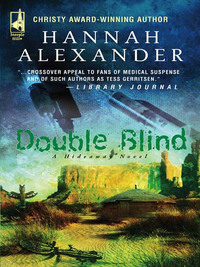
Czytaj książkę: «Double Blind»
Double Blind
Hannah Alexander
 www.millsandboon.co.uk
MILLS & BOON
Before you start reading, why not sign up?
Thank you for downloading this Mills & Boon book. If you want to hear about exclusive discounts, special offers and competitions, sign up to our email newsletter today!
SIGN ME UP!
Or simply visit
signup.millsandboon.co.uk
Mills & Boon emails are completely free to receive and you can unsubscribe at any time via the link in any email we send you.
Contents
Acknowledgments
Chapter One
Chapter Two
Chapter Three
Chapter Four
Chapter Five
Chapter Six
Chapter Seven
Chapter Eight
Chapter Nine
Chapter Ten
Chapter Eleven
Chapter Twelve
Chapter Thirteen
Chapter Fourteen
Chapter Fifteen
Chapter Sixteen
Chapter Seventeen
Chapter Eighteen
Chapter Nineteen
Chapter Twenty
Chapter Twenty-One
Chapter Twenty-Two
Chapter Twenty-Three
Chapter Twenty-Four
Chapter Twenty-Five
Chapter Twenty-Six
Chapter Twenty-Seven
Chapter Twenty-Eight
Chapter Twenty-Nine
Chapter Thirty
Chapter Thirty-One
Chapter Thirty-Two
Chapter Thirty-Three
Chapter Thirty-Four
Chapter Thirty-Five
Chapter Thirty-Six
Chapter Thirty-Seven
Chapter Thirty-Eight
Chapter Thirty-Nine
Chapter Forty
Chapter Forty-One
Chapter Forty-Two
Chapter Forty-Three
Chapter Forty-Four
Chapter Forty-Five
Chapter Forty-Six
Epilogue
Acknowledgments
We are always grateful to our editor, Joan Marlow Golan, and her wonderful staff and colleagues, Krista Stroever, Emily Rodmell, Lee Quarfoot, Megan Lorius, Maureen Stead, Amy Jones and Diane Mosher, for untiring editorial support, marketing and encouragement.
Thanks to our agent, Karen Solem, for great direction and wisdom.
Thanks, again, to Mom, Lorene Cook, for going far beyond the high calling of motherhood to help us in every sort of situation imaginable, whether it be reading, editing, publicity, cooking or catsitting. We love you.
Thanks to Vera Overall, Mother, who always encourages us and shows her pride in her son.
Thanks to Barbara Warren of the Blue Mountain Editorial Service for spotting problems before they become a part of the book.
Thanks to Jerry and Mary Lou Baugher for their love and hospitality, whose experience serving in a Navajo school was a great benefit.
Our deepest debt is to our Lord, who allows us to keep working at playing.
Chapter One
C urved, white wolf fangs gleamed against the blackness of Sheila Metcalf’s closed eyelids. She winced, eyes opening wide as a clipboard slipped from her fingers for the second time in less than an hour. It clattered onto the tile floor of the private patient room of Hideaway Hospital. As the sound reverberated into the hallway, her neck and shoulder muscles knotted with anxiety.
She glanced at the bed, where her patient, Mrs. Mann, remained asleep. At least the commotion had not disturbed her. Sheila only wished she didn’t feel so disturbed this morning…so unsettled, with an old, haunting, long-suppressed nightmare threatening, more than once, to follow her into her waking hours.
“Hey, girl, what’s up?” Jill Cooper, slender, dark haired and attractive, strode into the room at her usual brisk pace. She rescued the clipboard from the floor, glanced at it, then gave Sheila a look of concern. “Something wrong?”
“Sorry,” Sheila said. “I’m fumble fingers this morning for some reason.”
“Time for a break.” Jill’s voice was filled with the concern so evident in her gentle blue eyes. With her typical economy of movement, she set the clipboard on the nursing desk, then turned again to Sheila. “Why are you a fumble fingers?”
“I’m just distracted. I promise I’m not usually like this.”
“Think I don’t know that?” As nurse director of Hideaway Hospital, Jill had every right to question a substitute nurse’s bumbling mistakes, but her concern was warm and personal.
Sheila tried to smile, and knew the result was more of a grimace. She and Jill had known each other since Sheila had fled here to Hideaway with her father twenty-four years ago. The older sister of one of Sheila’s best friends in school, Jill understood what it was like to live with specters from the past.
Jill took a step closer. “So what’s the distraction?” she asked softly. “Want to talk about it?”
Sheila thought about the shadows of memories that never quite materialized, questions that had returned to nag at her after all these years. The fangs. The terror.
“Relax,” Jill said. “We don’t eat nurses for breakfast.”
Sheila forced a smile. The confessions could wait until later. “Dr. Jackson tells me differently.”
Jill chuckled. “Call her Karah Lee, and don’t listen to a thing she says. I picked on her a little when she first arrived, and she’ll never let me live it down.” Jill’s blue eyes turned serious again. “What is it?”
“Just stuff. I’ll get it figured out, don’t worry.”
“All the same, I think you need some downtime. A few minutes to regroup.” Jill reached into the pocket of her scrub top and pulled out a stethoscope. “Besides, Preston Black is in the building.” She said the words with one eyebrow raised, a half grin on her face. “He wants to talk to you.”
Sheila ran the tip of her tongue along her teeth to keep herself from saying anything. Preston didn’t understand the word no.
Jill held up her hands, correctly reading Sheila’s expression, her blue eyes twinkling. “Don’t blame me. I didn’t tell him you were working today, he just saw your Jeep in the lot. He’s placing a bid for the upcoming construction on the hospital, and he’s come to talk to our new comptroller, Doris Batson.” Jill winked. “You’d better keep your hands on that man. Doris is one of my best friends from high school, and I can tell you from personal experience that she’s a hunk magnet. Half the men in the hospital are already drooling over her.”
Sheila gave a pointed glance toward Mrs. Mann, in the bed across the room. Though the casual atmosphere here was a relief from the tension in her old job, Sheila hoped the staff didn’t make a habit of discussing personal issues in front of the patients.
“Mrs. Mann isn’t wearing her hearing aids,” Jill assured Sheila. “I keep trying to get her to put them in her ears, but she refuses. Says they garble everybody’s voices.”
As Jill stepped to the patient’s bed, she glanced over her shoulder at Sheila and jerked her head toward the door. “Out. Now. That’s a direct order. Even if you don’t talk to Preston, you need a break.”
“Where is he?”
“Front office, chatting to Blaze Farmer last I saw him. I’ll see you in the break room in a few minutes, and you can tell me all the juicy details, including this strange desire you suddenly seem to have to go to Arizona.”
Sheila’s eyes narrowed. “Preston can’t keep his mouth shut.”
“Actually, I think it was Blaze who blabbed for all to hear, and you know what good buds Preston and Blaze are. Was it supposed to be a secret?”
“Not necessarily, but it wasn’t something I wanted to be discussed by everyone in the break room, either.”
Jill pointed her thumb toward the hallway. “Out. We’ll talk about it later. Try to grab a cruller before Karah Lee and Blaze eat them all.”
Sheila sighed. Jill laughed. Mrs. Mann grunted, and Jill leaned over the bed, pressing her fingers to the elderly lady’s wrist.
“How are you feeling this morning, my dear?” she shouted.
Mrs. Mann gave Jill a look of complete trust. Sheila recognized the expression, because she’d been the recipient of that kind of trust from her patients many times. She had to keep reminding herself she was a good nurse.
A good nurse. Yes. She was.
When Clark Memorial Hospital in Branson lost federal funding last month, there had been some major layoffs. Though Sheila had worked there for five years, she still lacked enough seniority to save her job.
Amazing how losing a position, even when it wasn’t personal, certainly felt personal. With the population growth in this region of the state, the labor market was wide-open…except for registered nurses, it seemed. She’d discovered, when she went looking for a job, that there were a lot of mature nurses retiring to Branson to work part-time. She couldn’t find a job. Now she was per diem at three regional hospitals, and until she could get back on her feet financially, she’d moved in with her father on the farm a mile from Hideaway.
Shaking her head, Sheila stepped quietly from Mrs. Mann’s room into the wide hallway. It would be easily expected for anyone to ask why on earth a thirty-four-year-old woman would find it necessary to get back on her feet. But it would be more pertinent to ask why she’d been so inept at choosing a husband in the first place. Ryan’s irresponsible money management had been apparent to her long before his untimely death, but his romantic affairs had not. She couldn’t forgive herself for having such blind trust in him through ten years of marriage.
In an effort to escape her bad memories, she’d recently reverted to her maiden name. The change wouldn’t keep the creditors at bay, but she no longer wanted to be identified with the man who had betrayed her in so many ways.
Still, she’d rather be dealing with the difficulties caused by a faithless husband than the situation that had arisen this past weekend.
Every time Sheila closed her eyes, the imprint of black letters announcing the deaths of two of her childhood friends superimposed on her lids. The names had stirred only dim memories when she’d first read the letter two days ago but the impact of the deaths, the call of a time long past, had grown more and more disturbing during this morning’s work.
The familiar sounds of distant laughter, coughing and the moan of an elderly lady with dementia down the hallway, all helped Sheila focus a little more on her current job, but not completely. The past kept intruding on her thoughts—especially the loss that she had never reconciled in her heart or in her life.
The resurfacing memories scraped raw her nerves and set her heart beating double-time. Those recent deaths were tragedy enough, but she’d been forced to admit to herself this morning that they had been only the catalyst for a deeper horror that had haunted her for twenty-four years.
She walked toward the early May sunlight streaking through the blinds at the end of the hallway. Why had the past suddenly become so relevant to her again after all this time?
Her father hadn’t intended for her to see the obituary announcement for Tad and Wendy Hunt. Maybe Dad had the right idea. And maybe Sheila shouldn’t have been such a snoop—even though the letter had suggested that she might be able to step into the breach created in the clinic by the sudden rash of deaths at the school. Tad and Wendy weren’t the only ones who had died.
“Hey, stranger,” came a warm, deep voice. Preston Black stepped from the stairwell into that May sunshine at the end of the hall. His tall frame and broad shoulders cast a great deal of shadow along the hallway…the way his presence cast conflicting shadows over her thoughts.
She watched him stroll toward her. “Preston, we agreed not to—”
“You were the one who decided not to see me. I didn’t actually agree to anything, but I promise to back off. I won’t argue with you—”
“This isn’t about the fight.” She resisted the urge to take a step backward as he came toward her. “Okay, maybe it is about the fight, in a way, because I do not appreciate your telling a teenager, who in turn has told the whole hospital, about the subject of our fight.”
“Don’t call Blaze Farmer a teenager within his hearing. I didn’t tell him about any fight—and it wasn’t a fight, it was a strong disagreement—”
“Which is a fight, and you must have told him, because Jill just mentioned it to me.”
He grinned at her. “I didn’t think it was a secret that you wanted to go to Arizona, and we never actually fought, Sheila. Fighting connotes yelling, and—”
Sheila couldn’t prevent a smile of irony. “We’re doing it again. We can’t seem to say three words to each other without arguing.”
“Discussing. Let’s just call it that. Healthy discussion is good for the soul.”
“We’ve fought since Saturday,” she said, “which is not good for my soul.” It was why she’d wanted some space from him, because she did not want him to influence her decision; he had too much effect on her already.
“Sorry,” he said. “Could we just take a short walk? You’re due a break, aren’t you?”
“I’m supposed to save Karah Lee and Blaze from the crullers.”
“I beat you to it.” Preston patted his belly…his tight, muscled stomach. The phrase “washboard abs” must have been coined with him in mind. The man had the physique of someone who worked out every day, but he never stepped foot in a gym. He simply enjoyed working outdoors, hiking, building his own cabin. For the fun of it, no less; his prior career had been as a CPA and financial advisor. He’d been good at that, too.
Sheila couldn’t help appreciating the results of those outdoor activities, both in his musculature, and in the beautiful log cabin in the woods on which he’d completed the finishing touches barely a month ago.
He tugged on her elbow with the entreating look that always weakened her defenses. “If I start another argument with you, I’ll let you drive my Jeep all the way out to Arizona. In fact, I’ll drive you, myself— if you go.”
She led the way to the nearest exit, suppressing a smile that would betray her thoughts. Preston knew her well. How easy it would be to capitulate right now. “Just the Jeep, please.”
He gave an exaggerated sigh.
In spite of her misgivings about the subject and their relationship at the moment, she laughed, needing to allow herself the pleasure of his company for a little while. It was his presence that had helped her banish the past back to where it belonged—both the recent history with her late husband, and the distant, more disturbing history that was the true origin of this sense of loss that seldom left her in peace.
He pushed the door open and stepped into sunshine, then escorted her out, his attention on her even more focused than usual. With Preston, she couldn’t help herself; not only did he make her heart pound, he made her laugh, and made her think more deeply about her faith—because he asked so many questions that challenged her beliefs.
And yet, this time she had to draw the line. Shielding her eyes from the morning light, she looked up into Preston’s calm, gray-blue eyes, framed by brown-black waves of hair that were due a cut.
She had to face the fact that if she left him here, there was Doris Batson, the new comptroller, a beautiful woman, as accomplished as he in the intricacies of finance, who might be waiting in the wings for him. But Preston would have to make his own decisions about that.
“I promise to miss you,” she said, then saw the sudden flash of pain in those eyes.
His jaw muscles flexed as he obviously resisted the urge to restart the argument. “Then it’s definite.”
She nodded. She hadn’t realized it until this moment, but she was going to Arizona. Twin Mesas’ Christian boarding school desperately needed help, and she wanted to help it.
It was also the place that held the secrets of her past. Others might be able to put the past behind them and move forward, but she felt stranded there, still searching for her mother. And now there were more children at that school, who had lost not only a mother, but a father, as well.
She knew it was illogical to think that she might have something in common with those children after twenty-four years…but what if she did? What if she could help them in some way? She couldn’t bear thinking about other children facing the same night terrors she was now facing.
She also could not endure the nightmares much longer. It was time to find some answers, once and for all, so she could move on with her life.
Chapter Two
Preston Black had never wanted so badly to break a promise. This was one argument he needed to have with Sheila, and she refused to argue. Why hadn’t he been able to make her use that characteristic logic of hers?
She and her father had fled from Arizona for a good reason. They hadn’t been back since, and now, when there suddenly seemed to be some unexplained epidemic of deaths at Sheila’s former school, she had no business tempting fate—particularly since one of the deceased had worked in the very clinic where Sheila would be working if she returned.
Wasn’t it enough that Sheila’s mother, who’d also been a nurse, had died at that same school?
But he didn’t say any of this. He even resisted reminding Sheila that she wasn’t a missionary, and if she returned to the mission school for a few weeks, she would fall even further behind in paying off her late husband’s debts. Besides, she wasn’t trained in testing patients for the plague…or any of the other diseases that were endemic to that area of the country.
He gazed down into her feminine face with the gamine features, hazel eyes, firm chin. Like other important women in his life, she had a stout heart. His sister had combated threats from a stalker for years. His mother continued to battle a wicked mental illness with a brave spirit that had been bruised and wounded again and again, but never broken.
That was why Preston had recognized Sheila’s courage when he’d seen it…and fallen in love with her. Now, sure, he admired her spirit, but she wasn’t being reasonable about this. Why not?
He reached up to brush several strands of her thick, dark brown hair from her shoulder and to look at those lush lips, usually so quick to smile. At this moment, they seemed as weighted with sadness as her eyes.
“This is what you feel you have to do?” he asked.
Her eyes narrowed slightly. He could tell she was expecting him to continue to protest.
“I’m keeping my promise,” he said. “I meant it. I have no right to tell you what you can and cannot do.” They’d made no promises to each other about their relationship—or rather, at this point, nonrelationship.
He was learning to use that word more often. Relationship.
She gave a soft sigh and reached up to touch his chin, gently. “Yes, Preston, I feel I need to do this.”
He braced himself. “Are you doing it to get away from me?”
The soft touch became a sharp tap on his shoulder, and the tender glance disappeared. “I told you the reasons. You don’t seem to listen.”
He raised his hands. “Okay, that’s fine, I realize this isn’t all about me, but I just don’t think you’ve been completely forthcoming. If even part of the reason you’re doing this is to escape me, there are many safer ways than hauling yourself alone across country to a desolate—”
She raised a hand. “Finish that sentence, and you’ll be forking over your Jeep for my trip.”
“Sorry.” He forced a smile. “Of course, my Jeep has air-conditioning, and yours doesn’t. You probably should use mine.”
“Who needs air-conditioning? It’s barely May.”
“You know how hot it gets out there in the summer? May becomes June becomes July, and you don’t know how long you’ll be there.”
She slid a folded sheet of paper from the pocket of her tiger-print scrubs, her slender hands graceful as she unfolded and scanned the letter.
Preston studied her face as she read. He knew the contents of the letter, of course. She’d shown it to him Saturday after she found it on her father’s desk in his home office.
Buster Metcalf was an agricultural engineer who had moved with his family to the Navajo reservation in Arizona when Sheila was five. Five years later, when Sheila was ten, her mother had died suddenly, mysteriously. And that was all Preston had learned in the year he had known Sheila. He’d marveled at the lack of information he’d been able to get out of her about Evelyn Metcalf.
Sheila looked up and caught him watching her. “What?”
“Since we’re not arguing now, I’m just asking a question for the sake of information, but I don’t want you to bite my head off.”
Her eyes narrowed once more.
“Honestly,” he said, holding up his palms. “I’m just curious. How close were you to the victims of that fire?”
“Those victims have names. Tad and Wendy Hunt.”
“Right. It’s just that I’ve heard you speak in glowing terms about your other friends, but Tad and Wendy never came up.” Though Sheila’s father had kept in touch with some old friends from the reservation from time to time, Sheila hadn’t seen anyone from her past in all these years, but now that the school’s clinic suddenly needed emergency staffing, she was ready to drop everything and hurry to be of help?
Granted, selflessness was a part of her character, but Preston thought that she was also responsible to a fault. And right now, her own life was in such flux, she couldn’t afford the time or the emotional energy.
“I had a lot of friends.” She returned her attention to the letter.
Besides Tad and Wendy Hunt, who had returned to their alma mater to work and serve after college, someone else had died—Bob Jaffrey, the principal of the school. He had contracted and succumbed to an aggressive illness only days before the fire that took the other lives.
Sheila looked up at Preston again. “Canaan needs help in the worst way, not only because he had to step into Bob’s shoes, but there’s no one to take Wendy’s place as office assistant. I’m free.”
Preston had heard enough about Sheila’s treasured memories of her friend Canaan York to provide enough misgivings about her trip back to the school all by themselves.
“I thought Canaan was the school’s doctor,” he said. “Why is he suddenly filling in as principal? Can’t a teacher do it?”
“Good question. I’ll ask when I get there.”
Preston tamped down his frustration. “Have you even checked to see if they’ll accept you?”
“I called and spoke with Johnny Jacobs yesterday evening.”
Preston nearly groaned out loud. Johnny Jacobs was Canaan’s grandfather, the man who owned the school.
Preston could no more help his strong distrust of this situation than he could help his growing madness over this bullheaded woman to whom he’d had the questionable pleasure of giving his heart.
How, for instance, did Johnny Jacobs found a religious school, pay the staff himself and not give in to the temptation to direct the curriculum with his personal biases about God? He did accept donations for the school, as well, but what kind of overseers kept track of his actions? He could be one of those control freaks with his own religion, a cultist.
How could Preston stand by and watch the woman he loved involve herself in this situation?
And yet, far from influencing her, he knew if he said any more about it now, he would only lose what little favor he had left with her.
He felt more than helpless. More than frustrated.
Sometimes she just didn’t make sense to him.
“It was home for five years. I can’t ignore it,” she said, looking up at Preston.
“I don’t understand why anyone would have sent your father the news, anyway. He isn’t a doctor. After all these years—”
“But Mom was a nurse, and she worked with the kids. She knew everyone.”
Preston stared at her, and he knew the puzzlement he felt was plain in his expression.
She closed her eyes, and he heard her soft intake of breath.
He waited, staring at the dark fan of her eyelashes against her pale skin, then felt his heart squeeze, falling head over heels once again as she opened her eyes and looked up at him.
“What?” he asked softly.
“I think Johnny Jacobs always suspected that my mother’s death wasn’t from natural causes.”
“Did he ever say that?”
“He would never have said anything like that to me.”
“But after all this time—”
“I can’t tell for sure, but when I spoke with him, I got the impression that he suspects…I don’t know…something odd about these recent deaths. Maybe I’m jumping to conclusions, but I had the impression that he feels Mom’s death and these recent ones might be connected somehow.”
Preston held his tongue between his teeth. Even more reason for her to not go out there!
She read his expression once again. “Yes, I know my mother’s death was a long time—”
“And no reason to suspect that—”
“But if Johnny feels there’s a connection—”
“You don’t know that for a fact.”
“Not in so many words.”
What Preston thought was that Johnny Jacobs was eager to get Sheila out there because she was willing to be cheap labor. Had the man given any thought to her safety?
“There’s no reason to think I might be in danger,” she said.
“Except that Wendy Hunt worked in the clinic, your mother was the school nurse and now you’re going out there to work in that same clinic.”
As she gazed into his eyes, his heart contracted again. “You’ll think this is crazy, I’m sure, but I can’t help thinking this could be God’s timing.”
Oh, great, she’s pulling out the big guns. Who could argue with God? Of course, Preston had promised not to argue. But it couldn’t hurt to gather as many facts as possible about this endeavor. “So am I to understand that the reason Mr. Johnny Jacobs contacted your father about these deaths was to find out if you would go out there?”
She hesitated. “He knew I was in the medical profession now. Apparently he called Dad a week ago to see if I could go out. Dad just never told me.”
Preston took the letter from her hands and looked at it. There was something in Sheila’s past that she held back, even at those times when she seemed to share everything else in her heart. He’d realized Saturday that she was drawn to return to the place that had her history, where she’d been robbed of her mother….
Yes, she was going to help her old friends and she loved working with children, but she needed to solve a mystery in her life.
“Let me go with you,” Preston said.
She gave him a look of infinite tenderness, then took the letter from him and shook her head. “Nope.”
“You think I’ll only be in the way.”
She hesitated, then gave him a quick kiss on the cheek. “I know you will.” She looked at her watch, then refolded the letter and slid it back into her pocket. “I’m on my way to Arizona.”
As she turned to leave, he reached for her and caught her hand. In the year he’d known her, in all the time they’d spent together, he had never told her of the depth of his commitment to her. She didn’t want to hear it. Even now, he could see the wariness in her eyes.
“I…want you to know that I…My Jeep is yours if you need it.”
She smiled and squeezed his hand, then pulled away and went back into the hospital. The words he longed to say remained unspoken.
Chapter Three
O n Friday the thirteenth of May, the blue canopy of Northern Arizona sky shimmered with the sun’s rays, baking clumps of sage and meager stands of white-gold bunchgrass. The few clouds that nestled against rims of distant mesas did nothing to ease the punishing heat.
In spite of dry, hot air rushing in through window and vent, sweat gathered and dripped from every pore of Sheila Metcalf’s body. Where had all this heat come from? It was only the middle of May.
She couldn’t remember when she’d felt this alone or frightened. She missed Preston. She missed seeing the way his blue-gray eyes contrasted vividly against his tanned face. This separation would be good for both of them, but that knowledge didn’t keep her from wanting to be with him.
Her father hadn’t been too crazy about her return to this place, either. Together, he and Preston had mounted a united front for the first time since they’d met, but she hadn’t allowed them enough time to complete their mission. After making the decision to come, she’d taken two days to handle her arrangements and pack, and then she was off before either man could catch his breath.
Now she stared at the shimmering mirage on the deserted blacktop road ahead of her, driving ever nearer to the setting of her childhood nightmares. What on earth had she done? She wasn’t prone to making impetuous decisions. Why start now?
What kind of phantom was she chasing, alone, in the heart of the Navajo reservation? Dad had implied she might encounter the same danger her mother had met twenty-four years ago, but that brief comment had been all she’d been able to get out of him, the cranky old widower.
Actually, Dad wasn’t old at all. He was fifty-eight. And he only got cranky when she tried to talk to him about Mom, or when anyone tried to set him up with a woman.
Though Sheila couldn’t remember her mother very well—the shadowy images in her mind took clearer form only when she looked at old photographs—she never forgot the love that filled her whenever she thought of Mom. She always carried with her an impression of happiness at the memory of the small Navajo school she’d attended while Mom and Dad had worked in the area—Dad helping the farmers and shepherds, Mom treating children and families.
Mom had been Sheila’s inspiration to pursue a medical career. Right now she couldn’t help wondering if she’d have been better suited to Dad’s specialty—agriculture.
All during this hot drive—why hadn’t she taken Preston up on his offer to let her use his Jeep?—Sheila had journeyed as deeply into her memories as she could, frustrated by Dad’s unwillingness to communicate with her about Mom. With every mile she drew closer to the school, the tension in her body was increasing, the images from the nightmare arising more frequently, and more horribly.
At the school, Sheila would be conducting the children’s year-end physicals, drawing blood, as well as operating the clinic lab, keeping a close watch over the students who boarded at the school. When the term ended, she would be testing families coming to collect their children for the summer break. In a mission school such as Twin Mesas, families were encouraged to take advantage of the medical care. Sheila would truly be following in Evelyn Metcalf’s footsteps.
Johnny Jacobs and his grandson, Canaan York, remained concerned about the cause of the former principal’s death, she knew. It was a natural concern, of course, considering the responsibility on their shoulders not only for the health and safety of the children, but for all the families of the student body. According to Johnny, Bob Jaffrey’s family had refused to allow an autopsy.
Sheila squinted into the sun’s glare as she rounded a curve, and, for perhaps the tenth time today, questioned her decision. But after two long, painful years, dealing with the loss of her husband, and his betrayals, she felt she was at least finally making an effort to sort some sense out of the first part of her life—even if it meant returning to the scene of her childhood terrors to find answers to some difficult questions.
A movement far ahead on the right side of the road drew her gaze and broke her concentration. Whatever it was disappeared in the white glare of the sun. She fidgeted in her seat, stretching taut muscles, willing away the anxiety that had persisted throughout this trip. It was a frequent condition lately, something she couldn’t blame on the letter from the school, or even on her turbulent attraction to Preston.
Her digestion had started acting up about a week after Ryan’s death and the discovery of his unfaithfulness. Within three months, she’d lost so much weight she had to punch extra holes in her belt to hold up her jeans—a need she would have rejoiced about at any other time of her life.
Many mornings she’d awakened with a stiff neck and a headache from troubling dreams she couldn’t remember—at least not until the past few days.
The shock of Ryan’s death, and the gradual discovery of his affairs during their marriage had chipped away at her self-confidence and her faith in life. For the first year of widowhood, she’d often battled against a wavering faith in God.
Why her? After losing her mother at such a young age, why had she been forced to endure yet another tragic loss?
Dad had instilled strong Christian convictions within her. Sometimes she even questioned whether that set of standards was at the root of her troubles. Although Twin Mesas held many good memories for her, it was also where all her worst memories had been made—and it was a Christian school, where strict Christian values were taught and upheld.
Though Sheila had never renounced her faith entirely, she had rebelled against many of its strictures—most notably the one about believers marrying within their faith.
And look where it had landed her. Never again.
What hurt the most was that she had been the last to know about Ryan’s affairs. His final fling had been with the woman who was killed in the auto accident with him, Theresa Donohue, the fourth-grade math teacher whose classroom had been just down the hall from Ryan’s. But not one of Sheila’s friends had told her, though she’d discovered later that several of them had been aware of Ryan’s extramarital activities.
The movement on the desert, closer this time but still several hundred feet ahead, caught Sheila’s attention once again. The sun’s glare continued to blur the figure, but when she looked away she could see it dimly in her peripheral vision, the same way her nightmares caught her sometimes when she woke up in the mornings. The figure was too small to be a horse. A sheep, perhaps? Or a large dog?
She kept her attention on the road and allowed the approaching animal to develop along the side of her vision. It drew nearer, and she recognized the shape. A German shepherd.
Or a wolf.
She flexed her damp hands, wiping first one then the other on her jeans, blinking several times. It could have been anything but canine, and she’d be okay. But she’d rather see a nest of rattlesnakes in the middle of the road than the shape of a dog.
Suddenly, the animal disappeared, and a cloud of dust rose where it had been. She glanced that way, but saw nothing. Strange.
The steering wheel jerked in her hand. The right front tire of the Jeep sank into the soft shoulder of the road, and Sheila realized she’d allowed her focus to drift too far. She pulled the steering wheel to the left. A loud pop-thunk startled her.
She caught her breath, fighting the wheel, but the deep sand would not relinquish its hold. The Jeep coasted a hundred feet down the road and then came to a stop.
She’d blown a tire.
“Great driving, Metcalf,” she muttered to herself. “Now look what you’ve done.”
Glancing again across the broad slope of the desert horizon, she found herself wishing that a blown tire was her only problem.
Canaan York slowed his silver-blue Plymouth Voyager to ease the impact of a deep pothole that stretched across the dirt road. He scanned the broad plain of desert surrounding the solitary mountain of White Cone. Tanya Swift’s family lived about two hundred yards ahead. Their small frame home, painted clover-green with dark spruce shutters, was a mansion compared to the other houses in this section of the Navajo reservation.
When Canaan reached the house, he stopped, frowning. Maybe the little runaway hadn’t come back home.
A cloud of trailing dust rolled past the van and drifted in through the open windows, depositing a layer of grit over everything. Canaan blinked and tugged down on the bill of his baseball cap.
He glanced in the rearview mirror to make sure no dust streaked his face. He knew that, aside from the light tone of his skin, his long, somber face and dark brown hair and eyes identified him as Native American. Navajo. The People. But he was also well aware that the white half of his heritage continued to instill distrust in a few Navajo.
Unfortunately, Tanya’s family belonged to that few, depending on the circumstances. And now this had to happen. He could only hope Tom and Linda Swift had already left for their thrice-yearly tour of the Southwest to sell their crafts. If they were here, he would most likely get an earful on his inability to control the students at the school…one lecture among many he’d received from several sources since stepping into the breach two weeks ago and inheriting a job for which he’d never asked—nor trained.
He wondered, as he’d often done lately, why his grandfather had been so adamant that no one else at the school could do the job.
A movement caught his attention from a window beside the kitchen door. He studied the low-slung house for a moment. With an intuition developed over years of working with people, he knew Tanya was there. The empty driveway told him she was alone.
He climbed from the van and walked toward the house.
Twelve-year-old Tanya opened the door before he had a chance to knock. Her large, slanted, exotic eyes were filled with defiant apprehension.
“Hi, Canaan.” Her gaze darted past him. “You alone?”
He nodded. She reminded him of a half-grown lamb, inquisitive and always landing herself into trouble.
She relaxed visibly and stepped aside. “I know what you’re thinking, and I know what you’re going to say.”
He ducked slightly at the threshold, taking slow steps, allowing his eyes to adjust to the dimness of the unlit house.
“You’ve learned the art of mind reading on your long walk home?” he asked.
“You know I didn’t—”
“Walk all that way?” In the gloom, Canaan found a yellow-and-red-patterned kitchen chair and sank into it. “How often do I have to talk to you about hitchhiking?”
Tanya took two mincing steps toward him, the delicate lines of her young face sliding into a grin of mischief. “Who said I hitchhiked? Maybe I turned into Yenaldlooshi and raced the wind home.”
Canaan studied her expression to see if she was teasing. She wasn’t. He willed away the chill that slid over his skin. For a year, he had battled this superstition at the school, but it had persisted, even grown, the way a piñon sapling grew in the heat of the Arizona sun during a year of good rain. The children had recently begun to blame Navajo spirit entities for everything from unfinished homework to illness to lost track races.
He would have another talk with Betsy Two Horses. Giving her permission to teach a couple of informal classes on the ancient Navajo customs did not include filling the kids’ heads with terrifying myths.
“Maybe you raced like the wind to escape Yenaldlooshi, ” he suggested to Tanya, and continued to watch her expression carefully.
She pivoted away, but not before he saw the fear in her eyes.
He sighed. “Tanya, who tells you there is a skinwalker at the school?”
She shrugged, refusing to look at him, which revealed the extent of her fear and clued him to the reaction she expected from him. She wanted him to deny the possibility of any kind of evil beings.
If Wendy Hunt were still alive, she would’ve been the one to come and get Tanya. She would’ve reassured the girl that there were no evil animal beings, only evil people. Canaan sure missed Wendy’s influence right now. Wendy also would have had an additional advantage as the mother of Tanya’s friend April.
Or rather, Tanya’s former friend.
Canaan couldn’t give any reassurances to Tanya. “Why would this skinwalker still be at the school and not here? Wouldn’t he have followed you home, if he’s after you?”
“He doesn’t know the way.” She was still serious; no teasing here. “I left after sunrise this morning, so he couldn’t follow me.” She believed what she was saying.
“But he can follow your tracks tonight, and your parents are gone,” Canaan reminded her. “What if he knows you, and knows where you live?”
Tanya stepped to the long window that overlooked a cactus-and-rock garden. With a stiffened spine, she stared out across the plain, her chin raised defiantly.
“Come back with me now, Tanya, and you’ll be safer.”
“You can’t protect me from everything.”
“I didn’t say I could, but do you really want to stay alone here?”
Her chin lowered a fraction. A tremor shook her. “I don’t want to stay at that school. He’s there, Canaan.”
“Who, exactly, is he?”
Tanya jerked around, dark eyes wide.
“Have you forgotten that my great-grandfather was a hataalii, a medicine man?” Canaan asked.
She shook her head. “I haven’t forgotten. That’s why I trust you.”
“I know of the spirits we have always feared,” he said. “The only way to fight this evil is with a more powerful spirit. You’re safer from the skinwalker at the school than you are here.”
Tanya’s eyes narrowed in disbelief.
“This skinwalker you fear,” he said slowly, “what animal form does he take?”
Tanya stared at him and did not answer.
He hazarded a guess, hoping he was wrong. “The wolf?”
A quick intake of breath.
“I know about your fear.” The wolf was one of the most terrifying characters in Navajo lore, a destroyer. Canaan felt another chill of foreboding. “My Christian grandfather taught me special prayers to keep the Navajo werewolf away when I was afraid. He taught me when I was very young, and I still remember.”
Some of the tension eased from Tanya’s face. “You mean Johnny Jacobs?”
Canaan nodded.
“How much do you remember of these prayers?” she asked.
“All of them, but it isn’t the words alone that protect us. It’s where we keep our hearts and minds.”
Tanya hesitated. “What…what about that woman?”
“What woman?”
“The one who’s coming. The biligaana who’s going to be there today. The white doctor.”
“You mean Sheila Metcalf. She has nothing to do with any skinwalker, and she isn’t a doctor, she’s a nurse.”
The girl pressed her lips together, obviously refusing to hear his words.
“Sheila lived here with us for five years.” His voice was sharper than he intended. “She and I grew up together. I knew her.”
Tanya searched his expression. “You…you knew her?”
“Yes. She was a good friend. She was also a good friend to the Hunts.”
“She’s white. Look what happened to Mr. and Mrs. Hunt.”
“I’m half white, my grandfather, the school’s owner, is not Navajo, but that hasn’t stopped your father from sending you to our school.” Tanya’s father was a selective bigot, but his bigotry would overtake his daughter, too, if Canaan allowed it. Sheila’s arrival might be good for the children, if they would respond sensibly.
He stepped toward the door. “You coming with me?”
Tanya’s jaw slackened. “You’re leaving? Now?”
“I have work to do at the school.”
Tanya paused, then nodded her head. “Okay. I’ll come. But you teach me that prayer before it gets dark tonight. Okay?”
Canaan bowed mockingly. “Yes, boss.”
Chapter Four
S heila tightened the final lug nut on the wheel, tested to make sure all was secure, then released the jack, glad she hadn’t taken Preston up on his offer of his Jeep. With her own vehicle, she knew where everything was and had been able to change the tire in ten minutes.
After heaving the equipment into the back, she cast a wary glance across the desert for at least the twentieth time. All that moved was the undulating air above the ground, dancing in the unseasonably hot weather. A green line of cottonwood trees to the south told her there was a stream of water nearby. To the west, the plain seemed to stretch all the way to the foot of the towering Twin Mesas, at least two miles away.
She glanced back down the road and saw a sizable boulder a couple hundred feet away that she must have struck with the tire when she allowed the vehicle to wander so far off the road.
“Dumb, dumb,” she muttered to herself.
It wasn’t until she was again behind the wheel, pulling onto the road, that she realized her heart had been racing, her hands sweating, and her breath doing double time all the while she was outside the Jeep.
She drove barely a half mile, checking the rearview mirror several times, when she saw the sign for Twin Mesas School and turned off Route 77 onto a gravel road.
Piñon and juniper trees bordered each side of the road for a mile leading to the school. The campus was set in the middle of what appeared to be a flat plain, but she knew that hidden hollows and rocky arroyos mottled the topography.
The trees along the road cast little shade. She’d forgotten how sparse shade could be out here. Everything looked hot and dusty.
As she approached, Sheila’s gaze darted back and forth across the road, searching for another phantom, even as she scolded herself for allowing her imagination to run wild. No more specters materialized, of course. By the time she reached the school building, she also reached the conclusion that the heat had affected her. An overactive imagination didn’t help, nor did the headache that pressed along the back of her skull.
She loosened her death grip on the steering wheel and studied the place. Simple, large adobe buildings with rounded corners formed a courtyard around a playground partially shaded by piñon trees. A small garden of rocks and petrified wood ringed the first building, a pattern that repeated all through the courtyard. It would have looked peaceful to her, if not for the apprehension that she couldn’t shake.
Sheila didn’t recognize this place.
During her last phone call with Johnny Jacobs, he had mentioned that most of the buildings were new. He’d also asked her if she was sure she wanted to come.
She would bet her Jeep that Dad had called Johnny and tried to get him to talk her out of coming. Johnny hadn’t admitted to it when she’d asked him, but she’d heard hesitation in his voice.
Though Johnny lived in Tucson now, he’d always kept a close watch on all his holdings, and was particularly concerned about Twin Mesas, so much so that a year ago he’d sent his grandson, Dr. Canaan York, to keep a watchful medical eye on the children and their families. And now Canaan was interim principal. Why couldn’t Johnny have come to help out for the remainder of the school year? He had a background in education, whereas Canaan did not.
Canaan. Gentle, always laughing, smaller than the other boys his age when he was growing up. He’d been called pip-squeak, although Sheila had never called him that, of course. She had known how deeply that taunt had wounded him, but he’d never let on to anyone else how much it had hurt.
Sheila parked the Jeep by a split log railing at the first rock garden with a spindly olive tree in the middle, barely big enough to cast a shadow, much less provide shade. She turned off the motor and sat for a full minute, studying the landscape.
Occasional breezes whipped the sunbaked sand into vague, ghostly forms that darted between the buildings. If not for the sign beside the road, and the view of Twin Mesas from where she sat, she might have decided that her map had been misleading.
The thought barely developed, though, before three little boys shot out of the door of the building in front of her. Giggling and talking, they glanced her way, then ran toward the playground in the center of the circle of buildings.
Sheila released the steering wheel. Well, it looked like a school, anyway.
She shoved open the door of the Jeep and got out. She glanced at the boys, now climbing the wrong side of a slide.
The door they had exited swung open again, and a man strode out, a handsome man, Navajo. He didn’t look quite fifty. His black hair, close-cropped, grew thick enough to look good so short. Though not much taller than Sheila’s five foot five, his powerfully built body gave him the appearance of height. Doc Cottonwood.
He glanced at Sheila briefly, looked away, then jerked to a stop and stared at her. She stared back, attempting to moisten her suddenly dry mouth.
He walked toward her.
She suddenly felt like a schoolgirl again, with a huge crush on her favorite teacher.
He stopped before he reached the Jeep; his dark, inquisitive eyes searched her face, penetrating her protective exterior like a drill through soft wood.
“Sheila.”
She caught her breath.
A smile lifted the corners of his lips. “Little Sheila.”
“Hello, Doc.”
With a sudden burst of laughter, he sprang toward her, arms outstretched. She managed a weak smile just before he grabbed her up in a bear hug and swung her around.
“Been expecting you!” he exclaimed as her feet touched ground again. “Took you long enough. Canaan’s been talking about you coming for days. You two will have a lot to catch up on.”
She couldn’t keep from staring at him. He was still here after all these years, as handsome as she remembered. His dark brows and strong, bulldog chin still gave him that iron-stern expression with which he’d controlled even the most rebellious boys in gym class.
She dragged her gaze from his and gestured around at the buildings. “It’s all changed.”
He grinned, a brief flash of white teeth against red-brown skin. “Good thing,” he said, his attention never leaving her face. “Those old buildings nearly crumbled around us before Johnny made the right decision. He should’ve taken down all the shacks along the back road, but he couldn’t bring himself to do it. How about me? Have I changed?”
Sheila stood back to get a good look at his strong, still-young physique, which showed well in a pair of gray shorts and a snug red knit shirt. For her benefit, he even flexed a couple of muscles.
She grinned. “Not at all.” Gone was her schoolgirl crush, of course, but his charisma couldn’t be denied.
“Neither have you.” He leaned forward and chucked her under the chin.
Some things never changed.
She held out her dirty hands, motioning at her smudged white T-shirt and scruffy jeans. “Is there a place where I can clean up before meeting anyone else? I had a blowout a few minutes ago, and—”
He held up his hand. “Never fear, your apartment is ready for you. Give me the damaged tire and I’ll have it repaired in our auto shop on campus.”
Without another word, Doc got into the passenger side of the Jeep and gestured to Sheila. “Come on, I’ll show you where you’re staying.”
Sheila hesitated. She’d been instructed to report to Canaan York at the principal’s office as soon as she arrived.
“Canaan had to leave for a couple of hours,” Doc said, reading her expression—something he’d always done well. “One of the kids decided she wanted her mommy, and he had to go drag her back.”
Sheila glanced at him. There was that sharp way of speaking that Doc sometimes had that could hurt a sensitive child. As a track coach, he inspired either great loyalty or fearful respect. Either way, it got the job done. Even Sheila had won a race as a child, and had discovered, while in training, that Doc Cottonwood reserved his sharpest words for his favorite students.
She followed Doc’s instructions and drove the Jeep across the school grounds to the far side of the open courtyard.
When they reached the two-story building that Doc said housed the staff, he led the way to one of the ground-floor apartments. He opened the door and held it for her to enter.
“It’s small but efficient,” he said. “One bedroom, one bath, but count yourself lucky. A lot of the teachers have to share a bathroom.”
The interior smelled of the dry wind of the surrounding plain, flavored by sunbaked cedars and piñons. The walls were the color of kiln-dried clay.
“April Hunt just finished cleaning the place,” Doc said. “She cleans the offices and some of the apartments and classrooms for money that she blows on clothes on the mall trip once a month.”
Sheila turned to him. “April? Was she related to—”
“Tad and Wendy, yep. Their daughter.” He sobered, heavy brows lowering as he shook his head. “They had three kids, Steve, Jamey and April. Awful tragedy.”
Sheila nodded, feeling again the shock of the news. “Tad and Wendy were friends of mine when I lived here.”
The dark gaze snapped back to her. “Probably brought back memories for you.”
She spread her hands. How was she supposed to answer him? “The Hunt children are staying at the school?”
He gave his customary, curt single nod. “They’re still reeling from the blow, of course. Their clan would take them in, but the kids want to be here. So they’ll be staying at least until school is out. They’re living in one of the small old cottages at the edge of the campus.”
“Wasn’t it one of those cottages where Tad and Wendy died?” Sheila asked.
Doc nodded. “Johnny didn’t tear down all the buildings when he rebuilt the place. Unfortunately, it was one of the old shacks that burned.”
“What caused the fire?” Sheila asked. “I gathered Johnny didn’t know.”
“No idea yet.” He waved his hand around the living room. “What do you think? The apartments were the latest addition, built last summer.”
Sheila took the hint and allowed him to change the subject. She walked across a slate floor and reached out and touched the soft, plush love seat upholstered in shades of terra-cotta. The kitchen, separated from the living room by a breakfast bar, continued the desert decor.
“It’s beautiful,” she said. “It looks as if Johnny called in a professional decorator.”
Doc cleared his throat. “That would be me.”
She looked at him in surprise. “No way.”
His eyes glinted with pride. “Cheap labor.”
“You did this?” She shook her head as she admired the taste and style, took in the modern kitchen appliances. “I’d never have dreamed it.”
“You didn’t know your tough old track coach had a touch of the artist in him, did you?” He walked into the kitchen and opened the window over the sink. “Since I stayed on through the summer last year, I had to do something to earn my keep between sessions with the track team.”
“How did the summer sessions pay off with the team?”
“Trophies in every category.”
“Congratulations. I know that isn’t unusual for you, though,” she said.
He nodded his acceptance of her approval. “Let’s bring in your things, and then I’ll get that tire taken care of for you.”
He strode out ahead of her toward the Jeep.
She hesitated, glancing around the apartment, then through the window out across the plain. The gap was breached. After an agonizing time of alternating dread and expectancy, she had arrived.
This was the last place on earth she wanted to be.
Canaan and Tanya were about a half mile from the turn to the school when Tanya gasped and reached across the seat to grab his sleeve.
“Canaan, look!”
She leaned forward, lips parted. She slapped her hand against the windshield in the direction of a white-and-blood-red mound of fur at the right side of the road ahead of them.
Canaan stepped on the brake. A dog.
Tanya grabbed his arm again, her short nails digging into his flesh as the van rolled to a stop.
“It’s Moonlight!” Her voice rose to a screeching crescendo. “It’s our Moonlight!” She clawed at the latch, scrambling to get out.
“Tanya, wait.” Canaan shoved the gearshift into Park and reached for the girl’s arm. “A wounded animal is dangerous.”
“She’s not hurt, she’s dead! Look at the blood.” Tanya’s face crumpled. She jerked away from Canaan and jumped out onto the pavement.
Before he could get out of the van, she’d reached the dog and dropped to her knees. Sobs shook her body. With dismay, Canaan recognized Moonlight, the white animal that had wandered onto the school grounds a week or so ago and been adopted by the children, who had attempted to keep it a secret from the adults—no pets were allowed on school property.
The big dog’s eyes stared, sightless. But she hadn’t been dead long; Canaan caught a whiff of the faint coppery odor of blood and saw that flies had not yet begun to gather.
He bent down, took Tanya by the shoulders and pulled her to her feet. She whirled around and buried her face in his stomach.
“The wolf killed her, Canaan!” Her voice was muffled against his T-shirt. “He was jealous of her and he killed her.”
Canaan held her, feeling more and more uneasy at the way Tanya spoke about the wolf. “Moonlight has obviously been hit by a car, Tanya. You can see that.” And since he could see no black tire marks on the pavement, it looked as if whoever hit her didn’t even try to stop. In fact, it looked as if someone might have intentionally swerved onto the soft sand shoulder to reach the dog. Anger warmed Canaan’s face.
Tanya raised her head, her stare accusing. Sniffing hard, she stepped away from him, as if she resented his logic.
Canaan turned and followed her back to the van. He would have to break the news to the other children as soon as they reached the school. They would be as devastated as Tanya.
Darmowy fragment się skończył.