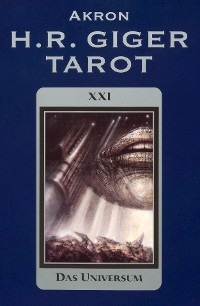
Czytaj książkę: «H. R. GIGER TAROT»
AKRON
H.R. GIGER TAROT


H.R. Giger’s “Baphomet” The Spell IV, 1977, Work No. 331, 2.40m × 4.20m
Laid out in the style of a triptych, the work has three panels that represent the various spheres of creation. To the right of Baphomet (and to the left of the viewer) is “Paradise.” Its luminous spheres are embodied by the bright, upright pentagram. To his left is “Hell,” symbolized by the dark inverse pentagram. Baphomet himself, in the center, represents the human plane of existence, the “reality” in which polarities intersect, engage in conflict, or counterbalance each other. This concept is depicted by the two interwoven pentagrams, which express the connection between the microcosm and the macrocosm. The symbolic and allegorical references of the portrayed figures refer to the realm of death and rebirth.
List of Paintings

The 22 illustrations opposite the card motifs (pen and ink and airbrush) were originally prepared by H.R. Giger as a cycle of illustrations to the mystical phantasmagoria in the original edition (‘Oracle of the Underworld’).
EVERGREEN is an imprint of TASCHEN GmbH
© 2000 TASCHEN GmbH
Hohenzollernring 53, D–50672 Köln
© 2000 Akron & H.R. Giger
All rights reserved
The original edition was published with the title of Baphomet in 1992 by Urania AG, Neuhausen/Switzerland.
Publisher: Akron/H.R. Giger
Overall layout: Akron
Cover design: H.R. Giger
Translated by Yvonne Chapman, Phil Goddard, David Hefford, Monique Simmer and Simon Wiles and edited by Christine M. Grimm in association with First Edition Translations Ltd, Cambridge, UK
ISBN 978-3-9053-7289-2

Château St. Germain
CH-1663 Gruyères
Tel:++41(0)26 921 22 00
Fax:++41(0)26 921 22 11
http://www.hrgiger.com
CONTENTS
Cover
Title
List of Paintings
Copyright
Warning
Preface
Introduction
The Spread Systems
IBaphomet
IIThe Green Angel
IIIThe Mirror of the Soul
IVThe Big Bang
VMephisto’s Hammer
VIThe Norns’ Wheel
VIIThe Five-Ray Spread (The Path of Decision)
VIIIThe Nine-Ray Spread (The Relationship Game)
IXThe Ten-Ray Spread (The Celtic Cross)
The Tarot Meditation
The 22 Major Arcana
0The Fool
IThe Magician
IIThe High Priestess
IIIThe Empress
IVThe Emperor
VThe Hierophant
VIThe Lovers
VIIThe Chariot
VIIIStrength
IXThe Hermit
XThe Wheel of Fortune
XIJustice
XIIThe Hanged Woman
XIIIDeath
XIVAlchemy
XVThe Devil
XVIThe Tower
XVIIThe Star
XVIIIThe Moon
XIXThe Sun
XXJudgement
XXIThe Universe
About the Authors
Endnotes
Warning
This is not a tarot book in the usual sense. It has not been written for people who seek the truth without questioning themselves or who hide behind the mask of the “positive.” Nor is it for those who are addicted to the quest for enlightenment, believing that they have long overcome the darkness within themselves and only looking for (and finding!) it in others. As the ultimate “shadow tarot,” the cards and book provide a panoramic view of the psychological and mental underworld. They reveal that true darkness lies in repressing the shadow – by “striving for the light.” The search for enlightenment is actually like an addiction: The drug that enslaves us is the shadow itself! So this book is intended for people who first want to discover why they should seek the truth before they try to find this truth.
PREFACE
From “Baphomet” to the “H.R. Giger Tarot”
After completion of The Crowley Tarot (© 1995 by U. S. Games Systems, Inc., Stamford), I felt both relieved and frustrated. I was relieved at having finished such a voluminous and well-researched book. Yet, I was dissatisfied because the book could not delve deeply enough into the mechanisms of the emotional depths if it was to remain salable. It suddenly occurred to me that, instead of helping people understand themselves, the marketing of esoteric texts as guides to self-realization serves to create varying degrees of identification with commercial models of self-realization. The pattern is always the same: People are encouraged to suppress their own evil and project it on to others, to hide the shadow in themselves either by denying it completely or at least giving it another name. I thought it was strange that today’s seekers of the truth go to self-realization workshops where they are given crash courses in the same divine plan that they found completely ridiculous when these were taught to them in religion classes. On the other hand, it could hardly be in humanity’s collective interest for people to find answers to life’s ultimate questions and redeem their souls. Once they are redeemed, they would stop spending their money on “models of self-realization.” At the very least, this would jeopardize the entire financial basis of human development.
While working on The Crowley Tarot, it occurred to me that all this dependence on models (in this case, the model provided by the tarot) was essentially nothing more than a spiritual dream cinema. Consequently, we bore ourselves to the point of exhaustion by repeatedly viewing our own dreams. Because humans want to live lives based only on goodness, the striving for truth corresponds with the childlike desire to perceive our own wishes in everything we see – and this is not the truth but infantile wishful thinking. So I asked myself whether it was time to question my own belief systems. I felt that the way in which I had structured “nuggets of knowledge” reflected my attempts to get a grip on life, add my own version of it to the flood of published books, and earn money in the process. This approach was far removed from the desire to gain knowledge. An inner voice somehow told me that this was exactly how some authors make fools of themselves: They court the respect of readers in order to distance themselves from their own lack of understanding.
As a result, in 1991 I began thinking about a tarot that would penetrate the mechanisms of human expectations a little more deeply and hold up a mirror to our unconscious images and concepts. It became clear to me that the tarot is a map with symbols so that we can look at our deeper psychological landscapes from the outside. As long as we do not place ourselves at the mercy of these models by considering the map to be the truth, there can be no objection to this approach. However, if we treat this model as our perceived truth, we will be at the mercy of our expectations. If we see the world only as we experience it in our thoughts, the models we use will convince us of our expectations.
On the other hand, this mechanism forces authors of tarot books to live up to their readers’ expectations if the books are to be successful. Everything must be depicted from an esoteric perspective, which believes it can even see signs of “spirituality” in extreme negativity and views the world through rose-colored glasses. This approach may be effective, but I dislike the assumption of basically using a creative trick to ultimately cut us off from the darker aspect of our instinctive values, which are a part of the greater whole and of our development. Or, if forced to confront them, we are told that we should always view these aspects as a means to the higher goal of self-realization. We know that collective imbalance is a precondition for dynamic development. This development must remain in a fluctuating state of unrest so that it can constantly rebalance itself if any type of growth is to occur. Yet, we continuously defend ourselves against this “unredeemed” condition without realizing that this act of defense is actually the foundation and therefore our creative contribution to growth. Even if we must “suffer” as a result, this cannot be deemed negative. But as long as we don’t allow these insights to flow into the models that we use, they cannot be expected to reveal the truth. Instead, the result is the suppression of this truth. If our expectations include models that are unable to understand themselves, then these models will lead us away from the truth. In other words: Our models can only reflect our expectations – but the expectations are derived in turn from these models!
Inspired by these critical impulses, I began thinking of creating a tarot that would penetrate more deeply into the unconscious mechanisms of our behavior patterns. I thought that if a critical book could bring to light the shadows of our lives and souls, it might spark a similar inspiration in the readers so that they could recognize their own thought patterns and inner concepts. One fundamental question that arose was how this concept of a “shadow tarot” could be translated into visual terms. What artist would be willing and able to implement such a demanding project?
It was precisely at this time that I came across H.R. Giger’s great book of paintings, Necronomicon. The title picture showed a fascinating monster: Baphomet, the symbol of the connection between the rational and irrational world. As I looked through Giger’s other pictures, it struck me that they were hardly bathed in the glow of psychological illumination. Each picture encapsulated the interconnected nature of human suffering with an absolutely grotesque, tortured perfection. These eruptive, delicately drawn, and closely interlocked visions complemented and overlapped each another in a bizarre panorama of Eros and Thanatos, of dream and reality. But before rejecting Giger as a mere conjurer of demons, I tried to recognize myself in the mirror of his pictures and asked whether he had something important to convey with his art. Didn’t these monstrous, corroded, crippled, and mutilated figures conjure up fears that are very real in view of the everyday horrors? These are fears that we refuse to face, so they fail to fulfill their natural task of confronting us with the effects of our own actions. From this perspective, Giger appears to be anything but a cynic or nihilist with no feeling for the harmony, beauty, and perfection of creation. Instead, I saw him as a very modern educator who could put his finger on the wounds of our way of life. Even if he didn’t do this in the classical humanistic manner by using logic, critical reason, and rational arguments but in the form of irrational, mystic visions, this was because the threat to our world also has deeply irrational traits at its innermost core.
At that moment, it become clear to me that Giger, and nobody else, must be the creator of the “Shadow Tarot.” However, although Giger was quite familiar with the Crowley Tarot and had also drawn inspiration from it as a painter and graphic artist, he did not feel strong enough to create a completely new tarot deck. But we talked, and after some thought, decided to select twenty-two of his paintings and link them together in our minds to create “The Tarot of the Underworld.” There was certainly no shortage of choices when it came to devising a tarot cycle in which the artistic value matched the psychological value. Many of Giger’s paintings, with their archetypal and highly symbolic pictorial language, seemed almost predestined for this purpose. His version of Baphomet provided the focus of our inspiration, the sun around which the planets of the other cards revolved until they had all been given their fixed orbits within the iconographic cycle. In 1992, Urania published the 500-page book as part of a set, together with the cards and a poster, under the name Baphomet. Seven years later, the Taschen-Verlag publishing company approached us with the idea of producing a shorter paperback edition. The prospect of making the Giger cards available to a broader international public was very appealing, but we thought that the idea of shortening the original work was neither convincing nor particularly original. This approach would not only break up a self-contained work; it would also fail to meet the expectations of the market.
Since the Giger paintings are documents of their time in their own right, and an homage to the tarot as a source of the artist’s spiritual inspiration, the relationship between the cards and the philosophy was different than the usual one. The cards were not “explained” in the common sense of the word; rather, their meaning was crystallized in a kind of “modern talk” between the philosophical questioning of the collective content and the creative depiction of deep fears. The explanations were therefore “mythologized” into the selected pictures to enable an alchemical symbiosis between the two. For the reader of Baphomet, interpretation did not mean simply being given a menu of oracular pronouncements from which to choose as they drew the cards. Rather, it referred to lines of psychological development that are reflected in the mirror of the picture that they look at. If we had watered down this approach by complying with the suggestion that we abbreviate the work, without simultaneously expanding the interpretation component (which had been deliberately neglected in the original work), we would have lost the philosophical superstructure without compensating for this by providing a useful book of interpretations.
We therefore managed to persuade the publisher not simply to produce a shorter version of Baphomet, but to work on a whole new concept with us. We sacrificed the “Mephistophelean” stories, brain twisters and mental games that often tackled the duality of collective thinking. We either left these out completely or included abbreviated versions of them in the description of the cards. But to compensate for this, we expanded the interpretation section into the main focus of the work. Although we lost the Baphometic philosophical superstructure, this meant that we gained a compact book of tarot interpretations that was easier to understand. We have therefore called it simply, but appropriately, The H.R. Giger Tarot.
Lake Constance, Walpurgis 2000
Akron

INTRODUCTION
If a piece of roofing tile falls on a person’s head, and he is a “realist,” he will blame the incident on the owner of the house and possibly even hold this person responsible. The “realist” can therefore begin with the externally perceivable effect, such as a head injury, and relate it to an externally perceivable cause, which is a roof in need of repair. However, an “esotericist” would draw the reverse conclusion: this individual would begin with the externally perceived effect to an inner, suspected cause. For example, such a person might wonder what his “Higher Self” was trying to tell him by causing him to pass by the house at the exact moment when the tile fell down.
Which of these is the correct approach? Both are right – at least from the perspectives of the “realist” and the “esotericist.” The roof was in need of repair, and this fact undoubtedly represents one reason for the described effect. But the fact that the injured person was passing at the exact moment when the tile fell just as unequivocally represents a major factor in this occurrence. So we see that these two causes together produced the effects of the accident. In this respect, it is quite possible that the event is an example of what the psychologist C.G. Jung termed “synchronicity.” In everyday language, this denotes a meaningful coincidence. We have probably all experienced such an occurrence at one time or another. Synchronicity of events means that the two occurrences are not joined by causality; instead, they are related to each other by some means, which cannot be rationally fathomed or explained. This means that an inner relationship might exist between outwardly unrelated factors: a relationship of synchronicity. This could be expressed as a “whenever-then” relationship. Whenever I am particularly drawn to card XVI, the Tower (when it surfaces in the spreads with conspicuous frequency), then one of my own ideas collapses in the world around me.
This certainly does not mean that the tarot should receive some type of rational justification. Yet, Jung’s attempt is trailblazing in expanding our linear and causal ways of thinking. As long as we remain aware that images are only images, even on the symbolic level, and agree with Goethe that everything visible is merely an allegory, then we can think of the pictures and symbols of tarot as a door behind which is the numinous or unspeakable.
The Tarot as a Model of Our Hopes and Fears
So let us imagine the tarot as a door that reveals a different panorama each time we reshuffle and lay the cards. The cards represent their own particular cosmos, a miniature model of all sequences of events in the world. They provide us with the pattern for a reality, which we then interpret from our own personal point of view. At any moment in time, the world and human beings form a complex fabric of cause and effect. But because the world is not simply as it is in our eyes, but only becomes what it is through our own imagination, we can consider reality as a complex fabric that takes form only as a result of the interplay of all its components, including human understanding.
In terms of the tarot’s model of reality, this means that no card exists of its own accord or just on its own. Nor should it be seen independently from the observer since it only exists in relation to other cards. And in each of these possible relationships it exists – depending on the observer’s viewpoint – in a different form. Conversely, the observer has no objective standards of value or overall perspectives, despite the fact that these are only objects, which are what they are. Because we do not see the objects as they are, but rather merely as we are able or willing to see them, each act of seeing can only ever be the perspective of our own imagination. But the roots of this concept are our hopes and fears. Our feelings are what make us “recognize” everything that we observe through the subjective lens of our inner state of mind. Nevertheless, we give the name of reality to what we ultimately see.
Consequently, we are only able to see the cards in relation to our hopes and fears. So there is no view of the cards that would not change as soon as our hopes and fears changed. The individual imagination consists of unconscious yearnings and anxieties that are attracted precisely to those events (cards) in the world that confirm them. It is therefore clear that tarot does not in any way question the law of cause and effect; on the contrary, it simply provides a broader perspective within this law. If we shuffle and lay the cards, we are creating a reflection of our own small portion in the overall situation. In the process, we suppose that even so-called “coincidence” is essentially determined. That is to say, it is decided by the force field of the will that arises from the center of feeling and in turn is bound to the contents that present themselves to the will in the form of destiny. Through the filter of the imagination, the eternal now becomes commonplace. And this eternal quality, which is integrated into everyday life, always imparts a sense of yearning: a yearning for God.
This is particularly apparent in the tarot. When laying the cards, experts try to find certain forms and structures so that they can recognize the spirit of the eternal beyond everyday meaning. This is because they instinctively know that their yearnings are only the shadow of the spirit that sits enthroned beyond the perceivable.
Synchronicity of the Internal and External
It is therefore in no way true that the cards “predict” destiny. Rather, we transfer our present state of mind onto the cards and then, by transferring it back, read the unconscious expectations that we initially projected onto them. The use of tarot cards makes it possible for us to observe the world in the mirror of our inner expectations, and to understand these as a true illustration of the ideas and convictions surrounding our inner meaning. The cards alone can never be destiny; they merely indicate how our inner sense approaches the world. We could say that they try to draw attention to those symbols that are the mirror of our internal and external processes in a synchronic form. When external events occur, they must first take place on the level of the soul before they can actually be translated into the material level. The explanation offered by the cards is one of the many possible ways of feeling these inner currents and recognizing them as the original source of all action, as the plans whose materialization is what we subsequently call experienced reality.
The Internal Reality!
In other words, the world as it portrays itself to us always corresponds to the sum of our experiences that we are consciously able to comprehend. We create our levels of reality through the effects of our actions; these effects of our actions simultaneously create the identity of our ego. Each of us creates our destiny through our unconscious traits, and our destiny is then separated from these traits and perceived as an external event. In this way, we can avoid recognizing that our human strivings are directed not towards knowing the world, but rather at constantly affirming ourselves in our inner patterns of destiny. Each moment in time therefore represents only a part of our time/space continuum, while our present attracts the patterns of experience that we are still lacking in order to integrate them into our consciousness. Consequently, each of us creates a quality to life that we realize through our unconscious inner intentions and then call it “destiny.” We would like to recognize these “higher” workings, which form both the basis and the goal of our path through life. But we are playing with fire when we do this because as soon as we think about how we feel inside, we surrender either to limitations in our own patterns of thinking or to the dangerous world of philosophical models.
The External Path
Only when we understand that we can never know purely from within ourselves can we put our faith in religious or esoteric models without being consumed by them. This is because the collective creative spirit has established altars in the world upon which we offer our concepts of the images or our own imprinted image patterns (to the spirit that has drummed into us how we must perceive the world if it is to be our world). Only when we know that all answers are in us alone and not in the models, and that these answers cannot be found through external descriptions but only triggered by them, can we discover that these models do not hold any truth: On the contrary, they are a structured form of searching that has been elevated to a quest for the Holy Grail in the minds of the seekers. We must first ask ourselves what inner yearning compels us to select a few similarities out of something that is actually an endless chaos. Why do we give these a structure and an interdependence, conjuring up clusters of notions of the world? Then we can see that only thinking itself is perceived in thought and we can simultaneously regard symbols as tools for expressing our creativity. We could say that the symbols are mirrors of what we project from the unconscious onto the conscious plane. The next chapter outlines various techniques and ways of laying the cards that can bring us one small step closer to the unknown that hides from itself within us because of our incessant thinking.
THE SPREAD SYSTEMS
Our symbol is the pentagram. It is also known as the witch’s foot, because it could either repel witches and Druids – or attract them (if reversed). It is still used today in rural areas to keep evil away from cattle stalls, thresholds, beds, and so forth. Whenever this is done, the purpose is to activate the collective spiritual structures, which symbolize protection against evil (the good banishes the repressed part of itself into evil to legitimize the struggle of the good against evil and remain unrecognized as it lives out the repressed part within evil). Consequently, a conscious confrontation with deliberately produced pentagram visions represents a possible form of therapy in the future. This suggests not only the defense of the shadow, but also the defense of defense, the questioning of the defense, and dealing with the inner fears that have only been produced by this defensive behavior in the first place.
We use two interwoven pentagrams to consult the oracle. The white pentagram, with the head and limbs of the white goddess, symbolizes white magic or the victory of the spirit over the material world. On the other hand, the black pentagram, which points upwards with its two tips and leads to the Devil’s goatee, represents black magic or the victory of the material world over the spirit. Here we have a tool in our hands or before our eyes that polarizes all of the values: There are no questions outside of the polarized values; depending on the type of question, we can decide which psychological explanatory model we want to transfer to the pentagram.
| Group 1 | Personality Questions |
| IBaphomet | Who am I? (The secret of the ego) |
| IIThe Green Angel | Who is he? (The secret of the shadow) |
| IIIThe Mirror of the Soul | What is the self? (The secret of the soul) |
| Group 2 | Interpretation or Development Questions |
| IVThe Big Bang | How is the matter developing?(What does it mean?) |
| VMephisto’s Hammer | What hinders the matter?(What does the crisis mean?) |
| VIThe Norns’ Wheel | What drives the matter?(What is the sense of the meaning?) |
| Group 3 | Decision-Making Questions or Questions Concerning Trends |
| VIIFive-Ray Spread | How should I decide?(Way of deciding) |
| VIIINine-Ray Spread | How do I relate to another person or how does he relate to me?(Relationship Game) |
| IXTen-Ray Spread | What is the trend?(The joker among the spreads: appropriate for all questions) |
In order to understand how the two first spread groups (spread systems I–VI) function, we must understand that they show us no external reflection of life. This means that they say less about external events than about who we are and why things happen as they must. They do not show us what we can do but allow us to see things in a more comprehensive way and within a broader context. However, if we begin with the assumption that everything we experience in the external world reflects our inner being, examining these series offers us the opportunity for knowing ourselves. As a result, unused energies can be set into motion and become available to us in our external lives. This brings us into the realm that esotericism calls inner inspiration or cosmic consciousness. However, this is not a voice from above but an inner concept that is more than we believe ourselves to be - but less than we believe that God is. It is the threshold over which everything that we have removed from ourselves with all our might can flow back into the soul. It doesn’t matter whether we have raised it up to heaven or sent it down to hell so that we can use this detour to play off God and the Devil against each other through our projections, true to the motto: Evil is always in others!
Warning
Before we begin the spread, which means drawing cards as we hold them in our hands like a fan or from cards spread out on a surface, we shuffle all of them so that some of the trumps are “reversed.”
If this is new to you, it is advisable to begin with the third spread group (spread systems VII–IX). These emphasize what the past or present state of a certain situation and what can or must be done in a specific situation.
I BAPHOMET
Questions
This spread is very useful if you have no specific questions and simply want to ask your subconscious mind what portions of your self should be developed beyond the normal way in which you perceive yourself. Here we find ourselves in the realm of paradoxical processes of the inner nature that normally cannot be understood by means of logic thought. They reveal portions of the soul that are inaccessible parts to the conscious mind, at whose mercy we often feel ourselves to be (even though they are a part of us). As a result, we often battle against them in their external projections. The focus here is on questions such as the following:
• What do my own inner images bring into a situation?
• How do I build (reconstruct) the given situation with the help of my senses and what contribution do I make towards the development of this situation?
Allegory (Baphomet’s Invocation)
In the first eon, I was the Great Spirit.
In the second eon, Men knew me as the Horned God,
Pangenitor Panphage.
In the third eon, I was the Dark One, the Devil.
In the fourth eon, Men know me not, for I am the
Hidden one.
In this new eon, I appear before you as Baphomet
The God before all gods, who shall endure to the end of the Earth.
Peter J. Carroll: Liber Null – Psychonaut
York Beach, Me. (Samuel Weiser)
1987, page 131f.

Interpretation
1 The Great Spirit (The Self)
This card shows the great self, which is more than you are, yet nothing that exists outside of you. It may be what you call God, but perhaps it also disguises itself as the shadow. In any case, it looks after your interests and you can therefore call upon it in a personal way.
2 The Horned One (The Other)
In this card you encounter the unconscious fears lurking deep inside you. In the deepest levels of your brain, you are still enmeshed with the primitive forms of consciousness from the primal stage of human evolution. All dragons, spiders, and snakes, as well as the concepts of monsters and demons, are the patterns of past experiences, which emerge once more from the older parts of your brain. They have not disappeared because they are psycho-energetically charged. Deep within the subconscious you are still linked with them because they represent a portion of your psychological inheritance.
3 The Devil (The Id)
This picture depicts the Devil, frightening you because you repress him as the unacceptable part of yourself and because he compensates for your shortcomings – hidden from yourself – with his threatening behavior.
4 The Hidden (The Superego)
The fourth card represents what you recognize that you do not understand. This aspect feels sorry for itself because although it perceives the truth, no one listens to it. It is the mysterium magnum, which penetrates all the material bounds, understands all secrets, demands the truth, and recognizes God.
5 Baphomet (The Light)
This card shows everything-that-is, namely the cosmic consciousness that is aware of itself as a part of its own self and therefore points to itself. Cosmic consciousness represents the highest level of spiritual perception available to us.
II THE GREEN ANGEL
Questions
Just like the first spread, this second method of laying the cards is appropriate when you have no concrete questions but would simply like to forage in the primal ooze of your unconscious mind. Use it to discover who you are outside of who you believe you are – beyond the ego with which you only identify to a limited degree because you suspect that someone else also exists here. If “Baphomet” (I) shows you what portion of your inner images you bring into a situation, “The Green Angel” personifies the images that the subconscious mind reflects back to you from the situation: These are the dark unconscious formations that are dramatized through your directions in the past.
Allegory (The Green Angel)
For a moment I am once again the one who sits at the writing desk staring into the crystal ball. Just for a brief fleeting moment I once again change into my forefather, John Dee, and stray into the oldest and most depraved quarter of Prague, not knowing where my feet will take me. I have the vague need to dive down into the muddy bed of the nameless, unscrupulous, irresponsible rabble that passes its mindless days in the pleasure of smoke-enveloped instinct and is only happy when belly and lechery are satisfied. What is the end of all endeavor? Weariness … loathing … doubt. The feces of nobility and the excrement of the mob are one and the same filth. The King digests the same things as the sewer sweeper. What an error to look up to the imperial in the Prague Castle as if looking up to Heaven! And what comes from the heavens? Fog and rain and the endless filthy watery snow. For hours I have waded through heavenly excrement that fell down sticky from the leaden heights. Heaven’s digestion: repulsive, disgusting, revolting. I notice that I have descended into the ghetto, to the exiled among the expelled: the asphyxiating stench of a people mercilessly assembled into a couple of laneways who beget, give birth, grow, and then die layered upon the putrefying dead in its graveyard. Living soul stacked upon living soul like herring in darkened spires. And they pray and await and crawl until the knees are bloody, and wait and wait … hundreds and hundreds of years for the Angel … for the fulfillment of their promise …
What is your praying and waiting, John Dee, your belief and hope in the promises of the Green Angel, when compared to the waiting, believing, praying, expectation and hope of these wretched Hebrews? And God, the God of Isaac and Jacob, Elias and Daniel – is he no less a faithful God than his servant from the west window?
A burning desire overcomes me to seek out the great Rabbi Löw and question him about the terrible secret of waiting for God …
I know, somehow I know: I stand incarnate in the humble room of the cabalist Rabbi Löw. We have spoken of the sacrifice of Abraham and the unavoidable sacrifice God that demands from those who he wants to make his blood relatives... Dark and secretive words I have heard concerning a ritual knife that can only be seen by those whose eyes have been opened to those things of the other world invisible to the mortal human being: things more real and of greater consequence than things on Earth, which can only be suggested to the blind seeker through the signs of letters and figures. These mysterious words from the toothless mouth of an old madman cut me to the quick! Mad? Mad like his friend high up there in the castle … the imperial Rudolph von Hapsburg! Monarch and ghetto Jew: brothers in the secret … both gods in the laughable trumpery of their appearance … what is the difference?
At my request, the cabalist drew my soul into his. I asked him to transport my soul. He refused; he said that it would crumble if he did so. It had to cling to his soul, which had become transcendental from the body belonging to the mortal world. Oh, how these words made me think of the silver shoe of Bartlett Green. Then Rabbi Löw touched me on the collarbone, like the petty thief in the prison of the Tower had once done. Then I see … see with the tearless, peaceful, imperturbable eyes of the old Rabbi … I see my wife Jane kneeling before Kelley in the same room of the house opposite “am Ring.” She believes she is struggling with him for my happiness, for gold, and the Angel. Kelley does not have access to the keys in my safekeeping, and therefore wants to use a crowbar to take the book and bullets from my trunk. He wants to slip out of Prague with his spoils under the cover of darkness and fog, leaving us in the grip of poverty and wretchedness. Jane protects the trunk with her body. She negotiates with the scoundrel. She pleads, and does not know what she is doing.
I … smile!
Kelley makes all sorts of objections. Blatant threats alternate with cunning; coldly hatched plans with feigned compassion. He sets conditions. Jane says “yes” to each one of them. Greedier glances touch my wife. The cloth covering her breast tears open as Jane kneels before him. Kelley fights her hands as they seek to restore order. He looks down at her Fire bathes his head.
I … smile!
He lifts up Jane. His grip is lascivious, shamelessly. Jane weakly admonishes him. Her fears for me steal her courage away.
I … smile!
Kelley is persuaded. He makes all things of the future dependent upon the commands of the Green Angel. He makes Jane swear that, like him, she will pledge obedience, obedience to the command of the Angel until death and beyond, no matter what this may be. Only in this, he threatens, would there be rescue. Jane takes the oath. Fear lends her face a deathly pale color
I … smile; but a keen and acute pain slices through me like a razor-sharp slaughter knife. I feel it … through the lifeline. It is almost like a deathly thrill...
Then, I see the ancient, peculiarly tiny child’s face of the High Rabbi Löw, furrowed by fear, suspended freely before me in the air. He says:
“Isaac, the knife of God is at your throat. But in the thornbush writhes the lamb in your place. Be as merciful as ‘He’ if you one day take a sacrifice; be compassionate like the God of my forefathers.”
Darkness passes over me like an army of blind nights, and I feel the memory of what I have seen with the eyes of the Rabbi’s soul fade and disappear. It stirs me like a bad dream.
Gustav Meyrink: The Angel of the West Window.
(The First Look in the Magic Mirror)

Interpretation
1 John Dee (The Image of the Ego)
The first card shows the ego that acts from its own center and perceives and constitutes itself in its own actions.
2 Jane (The Image of the Other)
The second card describes the unconscious attraction to the aspect of the opposite sex that you have estranged within yourself. It is not the feminine that John Dee loves in Jane, but rather the feminine part in himself. That is why this card is less representative of the hope of capturing others than of the lost part of ourselves, which we hope to recapture in others.
3 Edward Kelley (The Image of the Id)
Here you meet the shadow or your dark inner specter, which you do not willingly want to acknowledge. Only people who have already encountered their own shadow feel secure in being close to the devil. For he embodies an element of truth deeply rooted in our instinctive nature.
4 Rabbi Low (The Image of the Superego)
The fourth card corresponds to the inexorable striving for freedom from natural compulsions. It allows you to search unflinchingly for the pure form of love that ultimately can only be found in the divine. This card also shows you the mask behind which your repressed drives and instincts are concealed. It is the conscious self that fights Evil behind the mask of the father figure (card 3), who is only attributed with wrong so that the self can feel justified in destroying him.
5 The Green Angel (The Darkness)
In the search for an all-encompassing love, you encounter here – in spite of your personal illusions – the multifarious primal perversions in the realm of instinct all too often concealed behind the pretty mask. For the Angel is the mirror into which you encounter what is deeply founded and glimpse the ogre through which you now recognize yourself.
III THE MIRROR OF THE SOUL
Questions
The Mirror of the Soul is the appropriate spread to use when there are two different things you want to know: first, what inner images of your own are you projecting onto the situation (spread I). Second, what external experiences arise out of it (spread II)? This means that this is a matter of recognizing in which form what you have evoked is translated into reality from the reflection and/or in what guise you encounter your inner images in external life.
Background
This method of laying the cards combines spreads I and II.
Interpretation
1 The Ego
The first card represents the consciousness of your own self (The Great Spirit). It is the way the subject expresses and perceives itself as such: this is your own conscious identity at this time.
2 The Image of the Ego
The second card shows you the aim of your identity (John Dee); this is the inner intention, which is the basis of the course you are following and leads you to your conscious identity.
3 The Other
The third card describes the challenge created by the encounter with the world (the Horned God): this is what confronts you from the outside as your environment.
4 The Image of the Other
The fourth card symbolizes the part of you that you have distanced from yourself and projected onto the opposite sex (Jane), which is reflected in the image of the partner.

5 The Id
The fifth card describes – in contrast to the conscious ego – the deeper layers of the personality (The Devil): the level of the soul that includes the unconscious, the emotions, feelings, drives, and strivings (“endothymus function”).
6 The Image of the Id
The sixth card shows the circumstances or the person through which evil surfaces in life (Edward Kelley), the clothing in which the Id is manifested.
7 The Superego
This card embodies the superego in the Freudian sense, the controlling authority (the hidden one) placed above the ego, which accepts that the laws of society are valid and binding. It therefore includes the moral regulations and opportunistic aspirations of our spiritual life.
8 The Image of the Superego
In the eighth card you encounter father figure (Rabbi Löw), who is inspired by the endeavor for a better solutions. He breaks through the barriers of perception and grows within the transcendental spaces of limitless levels of consciousness. As an authority that passes judgment according to your conscience, he mainly demands that we renounce the goals for which the id strives (cards 5 and 6) and places himself in opposition to the ego (card 1). In unresolved conflict situations, this can lead to repression of the desires or emotions unacceptable to the superego.
9 The Darkness (The Shadow of the Light)
The ninth card shows us the purposeful currents rising from the endothymus function (card 5); these are often tied to feelings. As motivating forces, they determine the dynamics of experience, desires, and action. On the archetypal level, this is the Great Unknown or the dark archetype (the Green Angel), which attracts you and places you at its whose mercy if you fall into its hands.
10 The Light (The Shadow of the Darkness)
The last card shows the higher understanding through which the human spirit rises above itself and can become aware of its own bicephalous nature (Baphomet) by recognizing itself from both inside and outside of its own ways of thinking. He is the Janus-headed figure who unites an inward view with an outward glance in a dual perspective: “I am the Devil who has overcome polarities by looking God in the eye and only seeing himself.”
IV THE BIG BANG
Questions
Every creative idea, every flash of genius is a miniature repetition of the “big bang” with which our universe began its existence. For beyond the cosmic struggle is also hidden the universal relevance of the same eternal question: What does it mean? That is why this spread is for asking about the basic creative potential in an idea, or about a notion that you have concerning where the basic creative potential lies. How will this matter develop? What is the objective?
Allegory (The Big Bang)
“In the beginning God created Heaven and Earth. And the Earth was without form, and void; and darkness was upon the face of the deep...” These are the first lines of the Book of Genesis in the Bible; we could say that receives a certain amount of confirmation by the Big Bang theory of modern physics. According to this theory, the universe began its existence with the primal explosion – the big bang. Prior to this event, the spirit of matter had only been present in something like homeopathic amounts since matter was compressed into an infinitely high density within an infinitely small space. Jahveh’s act of creation, giving birth to being out of nothingness (creatio ex nihilo) developed so incredibly quickly after the big bang that it passed through the chaos, quark, and hadron eras in the first milliseconds; seconds later, it went through the lepton and radiation eras. But it took several million years for the era of matter to begin.
Interpretation
1 Chaos (The Beginning)
Chaos is shapeless primal matter out of which everything emerges. It is the first act of the creative force that “generates itself” and then ignites its own idea. It is an eruption of flames, the overflowing power of which destroys existing forms so that the life force can flow into new forms. In spiritual cosmogony, chaos represents the bridge between the spirit and the idea. It is a symbol of the inner firepower underlying outer endeavors as an invisible inner impetus.

2 The Quark Era (The Creative Quality)
This era corresponds to the absolute primal idea of the divine manifesting itself as matter and penetrating into the world of forms. It is the spirit of the will, and of God’s spark, which conceal itself in form. Even during those first milliseconds of the young universe, it laid the cornerstone for continual development right up to the present day. The Quark Era only lasted about one ten-thousandth of a second. On our level of human creation, this means that the second card reflects the creative quality underlying our idea.
3 The Hadron Era (Dynamic Energy)
The third card shows the dynamic quality of our idea on the energy plane, meaning how the potential energy may assert itself (in the world) within the entire whirlwind of creation. Even in our inner experience, we must also accept the hectic phases that accompany outward changes and upheavals. Inner unrest originates in a creative urge to burst the framework that has become too constricting to the awakened spirit of fire. This corresponds with the cosmogony of the Hadron Era when, for some ten-thousandths of a second, the universe consisted almost exclusively of hadron, the smallest component detectable to physics in the atomic nucleus.
4 The Radiation Era (Compression)
The fourth card symbolizes the arrival of the atomic nucleus comprising simple chemical elements; namely, nuclear synthesis or genesis. The Radiation Era stands for the genesis of things from the unchanging, complete, divine oneness and for the slow compression of energy in time and space.
5 The Material (The Appearance)
Approximately half a million years after the big bang, energy had compressed so much that electrons were taken up by the atomic nuclei and were therefore able to form the first stable elements. The universe became visible: “And there was light!” This phase represents the spirit of creation in its most concrete form since divine ideas now appear in visible form and reflect back upon the creator in the act of giving birth to creation. On the psychological level, the fifth card therefore reflects the point in time when our ideas become manifested in the material world as miniature symbol of God’s creative presence (creatio continua). However, this occurs in the form of transcendental – and not causative – effects.
V MEPHISTO’S HAMMER
Questions
Let us just suppose that we are sad, depressed, and distressed. Nothing succeeds and we are blocked in everything we do. This is the appropriate precondition for this spread because depression is the key to clearer understanding (What is this crisis trying to tell me?). The cards point to an insight we require in order to recognize the meaning of our failure (What unconscious meaning is at the root of my failure?). Perceiving the unknown motivation, and not overcoming the crisis as quickly and painlessly as possible but without gaining in experience, is the meaning behind every failure.
In short: We do not perceive because we enjoy understanding, but perception is frequently the only experience that help us become acquainted with the conditions and basis of our self-deception. As a result, it becomes the precondition for eliminating it. If we do not willingly accept what wants to achieve realization within ourselves, it will be forced upon us. This way of fulfilling our destiny is naturally not particularly pleasant. Yet, it always also initiates healing, a process of development so that we can find our own center. Because they are the results of our own actions, personal catastrophes not only force us to be honest: They also make us complete because they bring into the world that very part of ourselves to which we are most blind. The cards therefore permit greater consciousness: through them we perceive the circumstances that make “sense” of our failure.
Allegory (The End of Creation)
John Faust looked intently through the ocular of his telescope and furrowed his brow. He did not like what he saw there at all. Not far from Pluto, the most distant planet from the sun, he had discovered a comet, one of those unfathomable wanderers in the universe forced by the gravitational pull of the distant planets into an orbital path around the sun. This in itself was nothing remarkable, but in this particular case it was such a titanic size as to present a danger, for it steered a direct path toward the earth. “I tell you, it’s going to cause problems. And why, I ask myself, has no one already sighted this stray from the depths of nothingness?” He pointed to the cosmic monster as it plowed through the night sky outside.
His colleague, M.E. Phisto, lit up a cigarette pleasurably and merely said: “Yes, yes … humanity has its little secrets that it likes to hide from itself What will it do now that everything is about to dissolve? Do you want to hear the truth, brother, without the inherited genetic blindness, which is such a mark of the human brain?”
He laughed: “They will do nothing at all. First they will panic, and then repress it all once again. They will become slower and slower and stop, just like the mechanism of a broken clock! The spirit, a quasi-conscious being, grown weary of the Earth and is preparing to abandon this tumbling spaceship. For it is already written in the Bible: ‘and the stars will fall from the heavens.’”
Faust turned towards him and slowly nodded with strangely void eyes: “Yes, this comet out there is like the divine spark that destroys everything. Like the final crescendo of a Devils symphony calling itself human development. We cannot stop it. It would be blasphemy to try! But perhaps our essence will survive the doomsday if our souls strive to reach God again. Who knows!”
Faust and M.E. Phisto announced their discovery. Their scientific calculations proved to be correct – that the cosmic messenger of the Devil would not elegantly slither past the inner planets and the Sun, but rather, that it would crash directly into the Earth. Then the world was seized by great fear and the bringer of death was called “Mephisto’s Hammer.” But horror soon gave way to stubborn despair, and the closer this tool of the Devil drew to Earth, the madder the party became. The nearer the sword of Damocles descended upon the heads of the human beings, the more they felt compelled to repress their fears. But the “Hammer” did not miss its target! With the enormous force of countless atomic bombs, it went down in the Caribbean Sea south of the Greater Antilles, annihilating all life on Earth in a single inferno.

Interpretation
1 The Impact (The Theme of the Crisis)
The impact means suddenly being torn from a harmonious state. It is the destruction of a stable system of balance. It therefore represents the subject of the crisis.
2 The Deluge (The Consequence of the Crisis)
The impact of a comet striking the ocean triggers off enormous tidal waves all over the world; they roll towards the coasts with deathly force. The second card therefore symbolizes the aggressive destructive power of the crisis because it “surges above” its own barriers and forces its way from inner seclusion into outer, manifested experience.
3 The Darkening of Light (Sexual Chill)
The sun’s light is eclipsed for decades by matter stirred into the atmosphere by as a result of the impact. Temperatures plummet throughout the whole world and most animals and plants do not have the right conditions for survival because they cannot adapt quickly enough to the altered circumstances. The third card is therefore life becoming extinct or the emotional nadir: the spiritual center of the crisis.
4 The Greenhouse Effect (Emotional Overheating)
With the settling of the stirred-up matter, temperatures quickly begin to increase again due to the enormous quantities of carbon monoxide released through the firestorm caused by the impact of the comet. This releases huge amounts of carbon dioxide that have a greenhouse effect. The heat consumes whatever life that remains. This card is therefore an allegory for overheating within the soul or the pressure of pent-up feelings.
5 End and Beginning (Human Beings)
The fifth card symbolizes the renewal that is fulfilled in the resurrection of human beings. Because the light reaching us today from distant galaxies was radiated millions of years ago, each look into the universe is a view into the past. Those human beings existing a million years from now will probably have emerged from the life forms surviving the present catastrophe. Consequently, this card does not show us the steps to take to overcome the present crisis on the psychological level. Instead, it depicts the goal towards which our development will lead us after the crisis is overcome.
VI THE NOHNS’ WHEEL
Questions
The thing we call “fortune” is the manifest expression of the process of transformation that we experience in our lifetime. These show us the structures concealed within the deeds, which are both cause and effect to the same degree. Therefore, we are not prisoners of the Norns’ Wheel, but wanderers upon a path that leads us through the effects of our own actions. Although this means that we do not have the power to alter our destiny, we can still change our view of things. The vital question of destiny is not what we are able to change in the current situation, but what is the meaning of our actions: the goal towards which our development is heading.
Background (The Norns of Destiny)
This spread is a combination of beginning and end, of the Big Bang (IV) and the Hammer of Destruction (V). It links the polarities of creation and destruction to the steady movement of the Norns’ Wheel that, because it spins eternally, is therefore between the two. The question that moves you is the point of intersection through which you focus the journey to yourself (between birth and death). You must accept that everything you experience is in turn never the actual cause but only a ripple triggered by pre-existing causes that can themselves be traced back to a basic pattern increasingly distant in time; effects following causes that can be found in your spiritual development. Everything that you experience is never just the cause but also the effect of a genealogical pattern pressing tirelessly further into the future. As the subject of your question (and the focal point of your increasing consciousness) it swings both back into the past and forward into the future. On the allegorical level the three Norns – who turn the wheel of Fortune, and therefore keep the cosmic cycles in motion – symbolize the inner laws that take effect in the actions of people.

Interpretation
1 The material as the basis
The issue in question.
2 The impact as resistance from outside
The shadow you encounter outside yourself.
3 The flood as a consequence of this resistance
The physical plane, upon which the shadow manifests itself.
4 Chaos as the primal beginning
The first opportunity dawning on you in the fog of numinous fears (the aim).
5 The Quark Era as creative quality
The higher (spiritual) meaning of your action.
6 The cooling down of the Earth as inner frustration
Emotional resistance.
7 The Greenhouse Effect as emotional overheating
The inner (exaggerated) reaction to external resistance.
8 The Hadron Era as physical assertion
The dynamic quality of your actions.
9 The Radiation Era as physical condensation
The compression of your aim (hopes and fears) in time and space.
10 The human being as the outer goal of our development
The goal towards which your development leads.
VII THE FIVE-RAY SPREAD
(THE PATH OF DECISION)
Questions
What shall I decide to do? Should I buy a car? Resign from my job? Take a holiday? What’s going to happen if I do it? And what’s going to happen if I don’t? What’s the right path?
Background
This spread is only appropriate when we cannot decide in favor of one or the other possibilities. The right-hand side (the left from the reader’s perspective) describes the active possibility (if we do it). The other side describes the passive possibility (if we don’t do it). In this process, the significator (card 1) makes it possible to psychologically clarify the background to the question since it reflects the personal state of consciousness, which is mirrored at the time of this decision.
Interpretation
1 The Basic Situation
The realities of those conditions that lead us to make a decision. This also includes the quality of the background of the question that you are currently interested in.
2 The Physical Level of Acting
The physical realm of experience if you decide to do it.
3 The Physical Level of Not Acting
The physical realm of experience if you decide not to do it.
4 The Emotional Level of Acting
The psychological realm of emotions if you decide to do it.
5 The Emotional Level of Not Acting
The psychological realm of emotions if you decide not to do it.

VIII THE NINE-RAY SPREAD
(THE RELATIONSHIP GAME)
Questions
• How do I see my partner and how does my partner see me?
• What shadow do I reflect in the other person or live out in my counterpart?
• How do I consider my relationship overall?
• What does my inner image of the relationship look like?
Background
This is about the relationship between you and your partner. In more precise terms, this is about making contact with the aspect of your partner that reflects you. None of us can be content with ourselves – or with what we consider to be ourselves. As a result, we need the other person, or at least the image of the other person, which corresponds to our expectations. A man experiences himself in a woman through his own unconscious feminine aspect (anima); the woman experiences herself in a man through her own unconscious male aspect (animus). We can emerge from ourselves only when we are prepared to accept that the opposite sex within ourselves can only be recaptured through a partner. Then we enter into a more complete form of the relationship: one in which our present self becomes the part that is only really “the complete self” when it integrates the image of our experience.
Allegory (Adam’s Rib)
The search for the self in the image of the partner is an emotional process, which has already been handled as a biblical allegory in the myth of Eve’s creation from Adam’s rib. It is usually interpreted by saying that this is how original man achieved first achieved the completeness of human existence – including partnership with the opposite sex. But it is also possible to interpret the myth in the opposite way: Adam was, so to speak, made “incomplete” by having a part of himself extended into the world so that he had to seek outside of himself and then integrate it within himself. In this myth of how woman was created, the seed had already been sown for expulsion from Paradise since it is practically an expulsion from Adam’s own self. The goal of human beings is consequently prescribed through God’s will: to reunite the separated parts of our own nature. The motivation to attain the original wholeness is the hunger for what has been lost. It is the hunger for that part of the self beyond the ego, forcing human beings to step out of themselves and into the world.
The door through which we come out of ourselves and enter into the world is our self. If our karma is good, we can certainly confront our inner tensions by perceiving what fascinates us in others as the unredeemed element within ourselves. But we must first understand that we only feel attracted by people towards whom we already have a willingness to be attracted. This leads us to the insight that the part we are searching for in others is the part of the self that needs to be reclaimed from world outside.
The “rib” belonging to us but existing outside of us is the mercy granted to us by God when we had to abandon Paradise and step down into duality. By rediscovering it, we will once again become complete and a part of God. Unless we recognize what is not redeemed within ourselves, we are incapable of any real relationship because we can never truly see or experience the other person separate from our own images and imagination.
Yet, as long as the karma is still clouded by the fog of the unconscious, we will project our unredeemed elements onto the world. Not recognizing them, we fight against them like an evil enemy. We will see through everything the whole of humanity can do for us because we intuitively feel that all things incomprehensible are working against us. With the help of outside circumstance, our projections therefore compensate for our attempted repression. Then we put the label of “destiny” (or chance) on whatever we inflict upon ourselves with the kind assistance of outside circumstances.
At this point, what displeases us in the other person can only be what plagues us in ourselves. For whatever does not plague us cannot be summoned into consciousness by the other. But, on the other hand, if we recognize that we can experience nothing in the outside world that is not already within ourselves, then we can finally discover that every encounter serves a single purpose: to encounter ourselves!

Interpretation
1 The Background of the Relationship
The issue of the relationship.
2 Your Own Relationship Plane
The plane of consciousness upon which you encounter your partner, what you think of your partner, and how you view the relationship.
3 The Relationship Plane of the Other
The plane of consciousness upon which your partner encounters you, what your partner thinks of you, and how your partner views the relationship.
4 The Animus or Anima
The anima of the man or the animus of the woman, meaning the opposite sex within us as seen in the image of the other. This card shows what you look for in the other or what you find within the other as a result of your own search.
5 The Animus or Anima of the Other
This is the anima of the male partner or the animus of the female partner reflecting in you: The man discovers his female aspect within the woman, and the woman experiences her masculine aspect as herself within the man.
6 The Unconscious Relationship Plane
The essence of cards 2 and 4 or the four combinations of man and woman, man and anima, woman and animus, and anima and animus.
7 The Unconscious Relationship Plane of the Other
The essence of cards 3 and 5 or the four types of contact (see card 6).
8 The Shadow
This is the shadow that you cannot tolerate in yourself, project onto the other, and consequently reject in the other: the counterbalance, so to speak, of card 4.
9 The Shadow of the Other
The shadow projected onto you by the other and fought by the other in its role as proxy: thus, the counterbalance of card 5.
IX THE TEN-RAY SPREAD
(THE CELTIC CROSS)
Questions
The Ten-Ray Spread takes the form of the Celtic Cross, the classic among spreads. It can basically be applied to any topic, but is particularly suitable for questions related to the trend of events:
• Where is my path leading me?
• What is the inner purpose of my actions?
• In what direction are my external aims developing?
• And how do I encounter the fruits of my actions in the external world?
Background
So that the messages received from the ten selected cards do not become too complicated, it is recommended that you first concentrate on the framework – the axes 1/7 and 4/10 – and disregard the other cards for the time being.
Card 1 then shows us who we are against the background of the question. Card 7 describes the psychological data bank (“inner self”) we have at our disposal from the rich store of individual learning and experience. At the same time, it provides hints about the final outcome – card 10, which sits in a state of grace upon the foundation of the soul (card 4). Card 7 depicts our spiritual power, or the higher self in which we appear “before the supreme being.” If card 4 is the unconscious character trait pointing to the verdict of fate (card 10), then card 7 is the higher aim of the ego (1) or the “path to the throne.”
If we consider this from a broader perspective, card 2 enables us to see the obstacle blocking our path in: the shadow, in so far as we redeem it, leads us to what card 7 shows us. Cards 5 and 6 indicate the background that constellates the problem relating to our current situation (3). The cards in positions 8 and 9 indicate the inner specters (hopes and fears) that we attract to ourselves from the world outside because they complement our inner disposition.
Interpretation
1 The Significator
The significator shows the position you are in, and thereby reflects the issue in question.
2 The Barrier
This depicts the inner or outer resistance that is crippling you. But it also shows your repressed side, which will make you complete if you succeed in living it out in a conscious manner.
3 The Foreground Experience
This card illustrates the foreground goal for which you are striving, everything you see and keep in view. It therefore stands for everything that drifts to the surface and can be observed.
4 The Foundation
The foundation is the original root or basis of the matter. It shows the more profound preconditions that have led to where you are now. “It comes down to this” is the magic formula. It indicates the unconscious original source. It is not be unusual to be surprised by this image because you repress the motives that demand to be elevated into consciousness.
5 The Recent Past
The fifth position reflects events from the immediate past (“This was before”). It therefore shows the visible effects of the unconscious foundation of card 4 elevated to the realm everyday life.
6 The Immediate Future
The immediate future gives you a view of the effects that will soon openly manifest themselves and reverberate in the world (“This comes afterwards”). This card therefore represents a direct consequence of cards 4 and 5.
7 The Higher Self
The relationship between the seventh card and the first is like the relationship between the self and the ego. It shows you the potential for growth needing to be integrated into your self by the ego through the developmental task of the situation in which you find yourself.

8 The Environment
The next card describes your situation from other people’s viewpoint: the image that your environment has of you and to which you can only respond in such a way as others expect.
9 Hopes and Fears
The second-to-the-last card reveals the world in the mirror of your expectations and fears. It makes you aware of the mask that you wear when you are confronted with your inner hopes and fears. It shows how you react to what you assume corresponds to the situation of your experience – regardless of whether something has taken place or not.
10 Culmination and Goal
Everything that demands to be realized as an end and new beginning is brought to completion here. This last card summarizes the other nine and is the goal of the development and the seed from which a new set of objectives can be born.
THE TAROT MEDITATION
The most intuitive, profound, and serious way of using the tarot is meditating with the cards. We can approach the mystery of the oracle by withdrawing to a quiet place for the activation of our spiritual perception. Sitting in a relaxed position, we close our eyes. With a little patience, a particular card will appear spontaneously at some point before our inner eyes. It will gradually vibrate onto the wavelength of a specific feeling or sensation, to which our spiritual aura then responds. For a moment, we have the experience of being part of the vibration of the card. We allow ourselves to be touched by what it says and perceive the longings or fears that this triggers within us. These vibrations, which our consciousness filters out of all the instinctive, mental, and bodily associations, are the focus upon which our psyche is now directed. Our subconscious mind tries to vibrate at the frequency of this specific card in order to unite with its spirit and receive its message.
In this type of meditation, we see particularly clearly that the individual preconditions in the personality structure always exist even before any form of interaction with the environment. In fact, it is our own spiritual disposition that initially and intuitively leads us to the card corresponding to our present inner state or in accord with the current development concepts in our psyche. The card surfacing before your inner eye is therefore not the perspective with which you look at the world, but rather a mirror in which your inner development is reflected.
Meditation sometimes occurs as a result of questioning the cards. We spread out the cards and one of them suddenly appears to have a very special meaning. Whether we like the card or not is beside the point: The determining factor is what compels us to like it or reject it. But it can awaken within us whatever has been slumbering unrecognized in our subconscious mind. Whether or not we believe in the reincarnation of the soul, in the soul’s sense of guilt caused by its own actions in earlier incarnations, is not important. The card we like embodies our conscious aims, and the card we do not like represents the shadow currently accompanying us. So we focus on the way in which we experience the card: Which experiences do we associate with this card and what we can gain if we recognize and integrate the things that the card triggers?
This form of meditation demands a certain willingness and ability to become involved with the inner images. If our own perceptions are orientated less towards the images and more towards rational understanding, there are other possibilities. For example, we can read the descriptions of the cards and focus on the interpretations of the specific cards that provoke a spontaneous, deep reaction within. This can also help us become clear about light and shadow regions in our own soul wanting to be acted out, meaning those areas whose description shocks us in one way or another. “The path to the light leads through hell, which can only be overcome by self-knowledge (in the mirror of one’s self)!”


0 THE FOOL
He who always longs for me will set out in search of me; he will find me and look me in the eye – and there he will discover none other than himself!
The Roaring in the Cosmos
The Card
The end of one thing is always the beginning of another. While the last card of the Giger Arcana shows a spaceship escaping the terrors of Planet Earth, the first one shows the return: an old man clad in a diaper. So this cycle begins where it ended since we can feel that the decline also contains the unborn potential of the beginning, which leads to the birth of a new Fool.
He still has the umbilical cord around his neck and his legless torso sits in a urinal. At the same time, he is looking straight at the seam of life: a woman is kneeling in front of him and presenting her vagina to him. In his helpless, embryo-like position, he reveals the innocence of new life. This is the original, healthy state of the psyche before the viruses of social conditioning infect it. The Fool’s soul is like a blank page, and his internal emptiness means inner strength. In this emptiness, opposites can still harmoniously complement each other rather than battling or canceling each other out. As a result, the Fool is not yet aware of the conflict between the rational mind and the instinctual nature. He also sees more than just the woman’s sex between her legs. In his mind’s eye, he is looking at the steps that lead to life, the reforming of the eternal into the physicality of the material world. The Fool longs both for life and for death, since at the end of that path he will re-encounter the roots of his beginnings. He suspects that he has always been what he is now, and always will be what he can ever become because he yearns for the aims that were already within him before the beginning. The Janus-like double-headed nature of the eternally young, agelessly old Fool is also expressed in the fact that the “flute” is revealed to be a shotgun on closer examination. The Fool shoots himself before he is born, exemplifying everything that strives for life, and therefore towards death.
The Fool embodies both nothingness on the verge of becoming something and the endless emptiness of the universe that will absorb existence back into itself at the end of its development. He is the herald of pure, unfiltered truth from the limbo that lies between death and birth. On the one hand, he embodies nothingness on the threshold of being, which is expressed by his embryonic pose in the urinal. On the other hand, he is striving towards his own end by becoming something, as is dramatically shown by the barrel of the gun in his mouth. We are confronted by the double-faced head of Janus, who destroys on the one side what he creates on the other, or the Hindu god Shiva, whose dance brings about the end of the world, but who is also the god of the procreative force. As a result, this way we encounter the end that simply marks the beginning of a new end. Since the end must bring forth the beginning and the beginning must create the preconditions for the end, the Universe is the goal that exists in the Fool as a spiritual blueprint. In other words: both past and present are equally real at the same time because the end is the beginning. Likewise, the beginning can be described as the end because the end is always a new beginning of another end, which on another level requires another end for each new beginning.
The woman seductively stretching her buttocks towards the Fool is a striking variation of the archetypal mother. The humanity that raises itself to God in the last Major Arcanum of the tarot returns to earth in an endless loop through her. This phase in the development of life is also part of the universal act of creation. The path of life’s development is a spiral: it may turn in circles, but it also leads upwards and therefore also – in the figurative sense – “forwards.” So the spaceship on the last card, rising from the ruins of Earth in search of a better future, is also the face of the Great Goddess, through whose mouth humanity once again returns to its origins.
Back to Mother, monochrome stone lithograph (1986)
H.R. Giger ARh+, Benedikt Taschen Verlag, Cologne, 1996, p. 67
The top left-hand corner of the drawing shows a newborn baby slipping from its mother’s womb. The umbilical cord is cut, and the baby is placed amid the tensions of human society, symbolized by the table soccer game. Here it learns to compensate for its loss of security through struggle and toughness. The separation from the entire abundance and wholeness of being that takes place at birth marks the beginning of life as an individual. We are forced to combine with other parts of the whole in order to once again ecstatically experience our own lost wholeness in the brief moment of merging. This is reflected in the picture where each shot at the goal also makes the woman pregnant. Sexuality is not just a means for procreation and desire; it also conceals the metaphysical intention of passing on the tension of unfulfilled longing, which keeps the world in eternal motion.

The Interpretation
Woman
On the negative side, the Fool represents self-deception and is the manifestation either of what you really want to achieve or your efforts to avoid confronting it. However, the positive aspect of this card may be an expression of the power to strive for things that lie beyond the boundaries of the perceivable. On an inner level, this means that you can come closer to yourself by experiencing deep, hidden feelings and gradually rid yourself of restricting compulsions. You have the ability to probe more deeply inside yourself to perceive your own wishes more intensely and the desire to adopt a more spiritual approach to your inner needs. This often means that you drift into the realms of self-deception, particularly when you try to escape the world through irrational behavior. It is therefore important for you to integrate your personal impulses into reality, to bring contents out of the unconscious mind into the light of day, and to sympathize with the needs of those around you so that you do not need to constantly run away from yourself into your illusions.
This is a constructive approach in which the creative potency of absolute nothingness seeks to manifest itself within you. The world shows itself as if through the window of a dream; in this dream, you can experience yourself as part of a larger whole, which is the dream of life itself. This means that you do not find it difficult to feel the eternal within you since you do not simply let your ego express itself carelessly, but subjugate it to the unseen vibrations of your inner voice. While you merge with the longing that you project onto your surrounding world, it mirrors back to you everything that reflects your feelings. If you accept that these pictures do not reflect reality but only the illusions of all your dream-like images, then you are in harmony with them. Under their influence, you will be highly successful in creatively encountering your unconscious objectives in your fellow humans.
Reversed
Here you are in constant search of the unreachable, but you do not really wish to find it because you prefer to dabble and the tangible always manages to escape you. As a result, you let yourself be possessed by your inner yearnings to live out your emotional needs only at a higher level since you give up any orientation towards worldly goals by transcending your material objectives. If you recognize that you will never attain the image that you seek so desperately, you will be left empty-handed. And because you have not learned to formulate your wishes but only to project your objectives around whatever leads you further and further away from reality, the end of the story is the unreachable image of your inner longing, which is basically unwilling to fulfill your wishes so that they can remain the objective of your dreams.
Your relationship with those around you is a very dreamy one that usually leads to friction. Under its influence, you frequently seem incapable of clear thoughts because it always lures out your vague, irrational desires and vague objectives. On the other hand, this behavior may also contribute to the development of your higher intuition if you succeed in encountering the nebulous longings of your repressed mystic and occult-utopian fictions in your “mental soup.” In this process, the details are less important than highlighting an understanding of the entire situation.
Darmowy fragment się skończył.