Czytaj książkę: «Black Ajax»

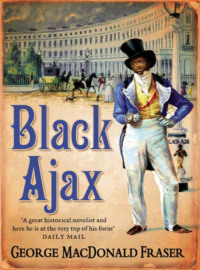
Black Ajax
George MacDonald Fraser

CONTENTS
Cover
Title Page
Prologue
The Witnesses
Paddington Jones
Lucien de la Guise
Marguerite Rossignol
Buckley Flashman
William Hazlitt
Bill Richmond
Tom Cribb
John Doe
Bob Logic
Pierce Egan
Henry Downes Miles
William Crockford
H.R.H. the Prince of Wales
Tom Molineaux
Bob Gregson
Captain Barclay
Epilogue
Glossary
About the Author
Praise
Other Works
Copyright
About the Publisher
PROLOGUE Galway, Ireland, 1818
The black man is dying, but neither he nor any of the other men in the barn suspects it. After all, he is quite young, and if the heavy negroid face is unhealthily puffy and badly scarred by old wounds which show oddly pale against the coarse dark skin, these are hardly fatal signs, and not unusual in his profession. He slumps, overweight and flabby, on a bench against the rough timber wall, a grimy blanket draped across his naked shoulders, an old hat on his woolly bullet head, and the hand holding a bottle of cheap spirits shakes visibly when he raises it to his lips, one of which has been split so deeply that it has healed into a permanent cleft running halfway to his chin. His arms are long and muscular, and though there are creases of fat overlapping his waistband, his sheer bulk gives an impression of formidable strength not yet quite gone to seed. His eyes are closed, and he is plainly tired, but not with a weariness that can be cured by rest; there may be no outward sign of deadly illness, but the pain in his kidneys and the ringing in his head are now continuous, and seem to him to be draining the spirit out of his big, hard-used body. A few years ago he was as famous in England as Napoleon; now he hardly remembers that time.
Squatting in the straw, watching him anxiously and now and then addressing him in low voices to which he responds with a grunt or a nod, are two men in the crimson coats and yellow facings of the 77th Foot. They are not typical of the British Army, for they, too, are black. They have been drawn to the barn by fraternal sympathy with the dying man, a sentiment not shared by the only other person in view, a small, rat-like Cockney shabbily dressed in a worn tail-coat whose buttons are either tarnished or missing, stained pantaloons, and a beaver hat almost innocent of fur. He is the manager, for want of a better word, of the man on the bench, and is reflecting glumly that his protege is the very picture of a beaten-up, broken-down, drunken pug who could (bar his sable skin) serve as a model for all those other prize-ring cast-offs from whom the manager, in his time, has scraped a meagre dishonest living, parading them from one country fair to the next, shouting himself hoarse with lies about their past prowess, thrusting them into combat with a bellyful of beer to batter or be battered by the local bully, and passing round the hat afterwards. It may be a far cry from the Fives Court or Wimbledon Common, from the hundred-guinea purses and the twenty thousand pound side-bets, but it usually pays enough to keep manager and man in food and drink as far as the next village or market-town.
Not that he expects much today, from the ragged, noisy crowd of yokels and urchins gathered about the makeshift roped square in the farmyard. Bleeding bumpkins, in the manager’s estimate, never seen a shilling in their lives, living on pepper, potatoes and water, slaves to Popish superstition, and content to sleep in sties with their animals, if they have any. His one hope is the local squireen, easily recognisable because he wears boots and sits in a dog-cart above the throng, passing the flask with his cronies and flipping a farthing to the ancient fiddler scraping out a jig tune; with luck the bucolic potentate will be good, if not for cash, at least for a leg of mutton and a bag of spuds, provided the fight is a good and bloody one.
That depends, the manager is well aware, not so much on the local champion, a brawny, red-haired blacksmith who waits basking in the admiration of the gaping rustics, as on his own black fighter, whose behaviour this past month has been causing concern. Moody and withdrawn at the best of times, he has been going into long, trance-like silences, coming out of them only at the call of “Time!”, when he has instinctively come to scratch with his fists up, moving in a slow parody of that lightning dance-step which was once the wonder of the Fancy. Twice he has been so sluggish that the despairing Cockney has had to throw in the towel against opponents too unskilled or lacking the strength to knock him out; once, he has come unexpectedly alive and smashed an opponent into insensibility in a matter of seconds. His manager can only pray that today he will perform somewhere between those two extremes and give the spectators their money’s worth.
Assuming, that is, that he can be got on his feet and led out to the yard, where the crowd is growing restive, the shrill Irish voices demanding a sight of the famous black, the legendary American hero whose feats once echoed even to this distant backwater, and who remains sprawled and apparently comatose on his bench in the dim interior of the barn. As the two soldiers and the cursing manager haul him upright he mutters a complaint of noises in his head; they demand, what noises?, but he cannot tell them. The manager becomes abusive, and to their astonishment and alarm the battered black face, its eyes still closed, smiles as though at some happy memory, for it is not the angry Cockney snarl that he hears, but another voice, eager and excited, from long ago, ringing down the years …
“You know how many people came to Copthorn? Ten thousand! Ten goddam thousand, boy! An’ they came on foot, an’ on horses, an’ in carriages, to see Tom Molineaux, the Black Ajax – you! An’ when you meet Cribb again, there’ll be twenty, maybe thirty thousand, with the Dook o’ Clarence, and Mistah Brummell, an’ Lord Byron, an’ every bang-up swell in London, yeah, an’ maybe the Prince his own self! With half a million guineas a-ridin’ on the fight – an’ a million dollars’ worth of it’ll be on you!”
Through the fog that clouds his mind, he hears it, and then it fades to a whisper, and is gone. He opens his eyes and stands, swaying slightly, steadied by the two soldiers, while the Cockney at the barn door proclaims his fighter. As the raucous voice silences the spectators’ chatter, the black man closes his eyes again, wincing at the stabbing pain in his lower body. Death is much closer now, but he is not aware of its approach, and if he was he would not care. The manager’s speech has finished, the fiddler strikes up a lively march, the black soldiers urge him gently forward, and he takes a faltering step. The scraping of the fiddle is drowning out the noises in his head, then blending into another sound from far away, the thumping of brass and a kettle drum’s rattle, growing louder amidst a tumult of distant voices, the murmur of a great multitude, and the music of Yankee Doodle, stirring him to action …
Soft grass under restless feet shod in black pumps and white silk stockings with floral patterns. He skips on the damp turf, and a smirr of rain is on his face and chest, shivering him with its chill, as he moves forward into the winter sunlight, drawing the great caped coat closer about his shoulders. Out of the shadow, into the open, and the murmur of the throng swells to a great shout, Yankee Doodle rises to a crescendo, and now his feet are marching, the press of faces before him falling back to give him passage. White faces, all about him, smiling and grim, curious and jeering, hostile and laughing, fearful and admiring, marvelling and excited, and for a brief moment memory mingles with imagination in the mist of his mind, and he sees himself with their eyes …
The caped figure striding through the lane of people and carriages held back by the “vinegars”, brisk burly attendants in long coats and top hats carrying horsewhips, his stride becoming a swagger as he shrugs off the cape to reveal the magnificent body beneath, the black skin gleaming as though it has been oiled, the jaunty head with its tight curls, the white silk breeches with ribbons at the knee and coloured scarf encircling the slender waist. He breaks into the shuffle of a plantation dance, laughing and waving to either side, a fine lady smiles from beneath the broad brim of her Mousquetaire and tosses him a posy which he catches, putting a flower behind his ear and bowing low over her hand before dancing on, blowing kisses to the roaring crowd as the faces retreat into shadow and the sound dies …
He is floating high above them, looking down on a vast human amphitheatre, thousands upon cheering thousands ranged about a great roped circle, and beyond them the rolling wooded English countryside is bright in the December noontide, with scattered bands of running people and carts and carriages and horsemen, all hastening to join the huge expectant throng whose every eye is turned on that black and white figure, no bigger than a doll far beneath him, striding ahead, arms raised and hands clasped overhead in the age-old salute of the prize ring. Within the circle he can see the roped square, and the little knots of men standing and crouched about it, the umpires by the scales, the bottle-holders and timekeeper, the vinegars patrolling the space between square and outer circle to ensure order, the gamblers’ runners scurrying to and fro, and at one corner of the square a slim slight man, a Negro like himself but lighter in colour …
… whose eyes are glittering with fierce excitement as they come face to face by the roped square. The mulatto is muttering to him and towelling his shoulders vigorously against the biting cold, but the black fighter does not hear him. As he pulls off his waist-scarf and knots it to the ring-post all his attention is directed to the opposite corner where a man is standing clear of the rest, a tall white man with a rugged open face beneath crisp black curls, clad like himself in breeches and pumps, a man with the shoulders of an Atlas, massive arms crossed on his deep chest, heavy-hipped and long-legged, shifting slightly as he waits, rising on tip-toe and down again. He nods with a little smile, and as the black man raises a hand in reply his other self, back in the Irish barn, feels a strange peace settling upon him, a sense of contentment at the end of a long journey, and he realises with a growing wonder that the journey ended there, by that roped square long ago, when he looked across into the strong acknowledging face of the tall curly-headed man, nodding to him, and recognised, for the first and only time in his life, a companionship that was far beyond any bond of love or affection or loyalty that he had ever known, because it was of equals, apart and alone. He cannot explain it or even understand it, but he knows that the tall man feels it too, and he laughs in pure happiness as he snatches the hat from the top of the ring-post where his scarf is fluttering in the breeze, and sends it skimming over the ropes …
… to fall in the dust of the farmyard, startling a stray fowl which runs squawking wildly, and the red-haired blacksmith is rushing him, blue eyes glaring and arms flailing, and his feet shift and his body sways instinctively as he evades the attack. He knows he is too exhausted, in too much pain, to raise his hands or move his feet, yet somehow his hands are up, his feet are moving, and as the red-haired ruffian turns, the black left fist stabs into his face, and again, and yet again, and that is the last thing he remembers as the shadows close in, and then there is no more memory.
THE WITNESSES
THOMAS (“PADDINGTON”) JONES, retired pugilist and former lightweight champion of England
Who knows what’s inside a black man’s head? Not I, sir, nor you, nor any man. You can’t ever tell. Why? ’Cos they don’t think as we do. They are not of our mind.
Now, I know there’s them as says a white man’s mind is no different, but I hold that it is. Take our own two selves, sir, if you’ll pardon the liberty. You can see the thoughts in my eyes, and – how shall I put it? – yes, you can follow my feelings ’cross this broken old phiz o’ mine, depending as I smile or frown, or set my jaw, or lower my blinds. Is that not so, sir? Course it is. And, begging your pardon, I can do likewise with you, pretty well anyway, though you’re deeper than I am, course you are. Why, this very minute you’re thinking, who’s this cork-brained old clunch with his bust-up map and ears like sponges, to read my mind for me? Yes, you are! No offence, sir, but it’s so, ain’t it? Course it is.
Why’s that, sir? ’Cos we understand each other, though you’re a top-sawyer, as we used to say, and I’m an old bruiser, you’re a learned man and I can barely put my monarch on paper. But we’re white, and English, and of a mind, so to speak. Even with a Frenchman, with his lingo, you can still tell at first glance if he’s glad or blue-devilled or bent on mischief, which he most likely is. It shows, course it does.
Not with your blackamoor, though. Not with the likes o’ big Tom. Oh, he could talk, and make some sense, and do as he was bid (most o’ the time), and put his case – but what was behind them eyes, sir, tell me that? What did he think and feel, down in the marrow of him? You couldn’t tell, sir, you never can, with them –’less they’re dingy Christians (half-white, I mean) like my pal Richmond, and even with him I could never take oath what the black half of his mind was turning over. And I knew him well, nigh on thirty year from when he beat Whipper Green in White Conduit Fields, till he hopped the twig Christmas afore last. Poor old Bill, I fought him twice, and that’s the way to know a man, sir, I tell you. Course it is. I milled him down in forty-one rounds at Brighton, I did, for a fifty-guinea side-stake – we were both lightweights, but he didn’t have my legs (nor my bottom, some said, him being black), and he had this weakness of dropping his left after a feint. Well, what’s your right hand for, eh, when a man leaves the door open thataway? I’d ha’ done him at Hyde Park, and all, but I broke my left famble on his nob, you see, in the eighteenth round – see there, sir, the ring finger’s crooked to this day. If it had been my right, I’d ha’ stood game, held him off and wore him out with a long left, ’cos he didn’t have the legs, as I told you, but when your left won’t fadge, what can you do? Cost my backers a fine roll o’ soft, my having to cry quits …
Beg pardon, sir, where was I? Ah, speaking of knowing Richmond’s mind, as being half-black only. But big Tom, that was black to his backbone – no, a closed book he was. Not so much as a glint of natural feeling, as you might call it, in them strange yellow eyes of his, not even when he looked at you straight, which he seldom did. Head down, as if he was in the sullens, staring at his stampers, hardly a grunt or a mumble, that was his sort, as a rule. You’d as well talk to the parish pump or Turvey’s pig, when the broody fit was on him. You’d wonder if he had a mind at all, or was dicked in the nob.
There were times, mind, when he would break out into the wildest fits, sky-larking and playing the fool like a jobbernowl or a nipper showing off with his antics, and other times, when he got in a proper tweak – in a tweak, sir? Why, bless you, angry, en-raged, in a fair taking – and you’d think, hollo, best stand off and look out, for it’s a wild beast loose. But ’twas no such thing, sir, for all his oaths and roarings, it was only noise, sir, but no action. He knew he was lowly, you see, having been a slave in America, and I reckon that held him in check, somehow, as if he knew ’twasn’t for him to show fight against his betters. Not even in the ring, you say? Ah, that was another piece o’ cheese. He was seldom angry inside the ropes; simple or not, he knew too much for that.
Then again, I’ve seen times when he acted no more like a slave than you would. It’s no Banbury tale, sir, he could be head high and to old blazes with everyone, even royalty in the very flesh, when he’d strut like a gamecock and look down his great flat snout like any tulip, the sauciest nigger counter-coxcomb you ever saw, and dressed to the nines, oh, the slap-up black Corinthian, he was! They laughed at first – but I seen the day when they stopped laughing, and no error.
But here’s the thing, sir: even then, when he was in his high ropes, I could never fathom whether he was hoaxing or not, or queer in his attic, maybe. You could not tell what was stirring under that woolly top-knot, if anything was, or see behind those black glims, bright and bloodshot rotten as though he’d been all night on the mop – which he had been, often as not. If I had a guinea for every time I’ve seen him home, shot in the neck and castaway to Jericho, I’d be richer than Coutts, and that’s a fact.
Drink did for him – drink and skirt. I never seen his like when it came to the chippers, and didn’t they fancy him, just, for all his mug was more like an ape’s than a human’s, lips as fat as saveloys, his sneezer spread all over his cheeks, nob like a bullet, and coal-black ugly altogether. And not just the common punks and flash-mabs, neither, but your bang-up Cyprians, and Quality females, too, top o’ the ton with their own carriages and mansions up west. They could not get their fill of him. Made my stomach turn to think of it, him stinking the way they do.
I reckon they were curious to know how a black man would be, so to speak, and I doubt if they was disappointed, for a more prodigious well-armed jockey I never did see, and as a trainer I’ve cast an eye over more likely anatomies than a resurrectionist. But ’twasn’t only that; why, even the sight of him, sparring at the Fives Court, or walking in the Park, or best of all posing for that Italian statue-carver in Ryder Street, was enough to turn the best-bred of ’em into flash-tails, for bar his clock he was Apollo come to life, the finest, strongest, bravest body of a man you ever clapped eyes on. That was beauty, sir, “ebony perfection in the artist’s eye”, Lord Byron said.
Oh, if you could ha’ seen him that day at Copthorn when he came dancing out to meet Cribb! That was the day, sir, the day of the Black Ajax, the Milling Moor in all his glory, shoulders like a Guardee and the waist of an opera-girl, trained to a hair with those great sleek muscles a-ripple under a skin that shone like a sloe, and light as thistledown on the breeze. That was Tom, my Tom, for just an hour or so.
There will never come another like him, sir, I can tell you. I saw him on the peak, tip-top high, and I saw him in the gutter. I saw him rich and famous, and I saw him scorched and forgotten. Why, I saw him shake the Prince Regent’s own hand, sir, and clink his glass of iced champagne punch while the noblest in the land clapped his shoulder all smiles – and I saw him face down in rags in a farmyard sty with the gapeseeds crowing each time he shot the cat, puking his innards out, so fat and used up he was.
A sad end to a sad story, you say? Well, I don’t know about that, sir. I been in the Fancy man and boy for more’n fifty years, and they reckon I fought more mills than any boxer that ever came to scratch, and I lent a knee and held the bottle for as many more again. I was lightweight champion of All England. I stood up to the great Jem Belcher longer than any other did, giving him two stone, when he had both eyes, too! I’ve sparred with every champion of England since Mendoza – Humphries, Jackson, the Game Chicken, Gully, Cribb, and the rest of ’em. Nothing in Paddington Jones’s record to think shame of, you may say … but I never had a day like Copthorn, sir, and I don’t know many milling coves that did. He had that day, though, Black Tom Molineaux of America. The greatest day in the history of the game, a turn-up that they’ll talk about as long as there’s a prize ring. No, sir, I can’t say his was a sad story, however it ended, not with that day in it.
I knew him as well as anyone in his life, I suppose. I trained him, and taught him, and seconded him, and nursed him (and cursed him, I dare say), and was as close to him as a man could be. But as I said, I never knew his mind, or what he thought truly of us, or of the Fancy, or of London that he came to a great black simpleton and yet was talk o’ the Town afore all was done, or of England that cheered and jeered him, and loved and hated him – oh, and feared him, too … what Tom Molineaux thought of all of that, sir, I can’t say. Who knows what’s in a black man’s head?
Did I say drink and wenches did for him? Well, that’s gospel, sure enough, but when I think back on him I reckon pride did for him, too. I may not have known his mind, but I’ll lay all the mint sauce in the Bank to a sow’s baby that he had pride in him for a belted earl, born slave and all though he was. You smile, sir? Well, I’ve said my say, and I tell you, he was a proud man, and paid for it.
What’s that, sir? Was he the best? Ah, well, now it’s my turn to smile. I’ll put it this ways: Mendoza was no faster, Belcher was no cleverer, and Ikey Bittoon the Jew never hit no harder, to which last I can testify, having had three ribs stove in by him. In fine, sir, Tom Molineaux was as good as ever twanged – but the best? Bless you, there’s no such creature, let the wiseacres say what they will. Why, sir? Because somewhere, and the good Lord only knows where, but somewhere, sir, there’s always one better. Course there is.
LUCIEN-MARIE D’ESTREES DE LA GUISE, gentleman of leisure, Baton Rouge, Louisiana
It is simply untrue, whatever my more sycophantic admirers may say, that I insist on perfection in all things. That they should think so is, perhaps, natural, but that they should say so aloud is unpardonable, since it suggests that I am susceptible to flattery. No, I am fastidious, that is all, but I am well aware that perfection in anything is rarely to be found, even by such an assiduous seeker of the ideal as myself. This being so, I am content merely to insist upon the best – the very best, you understand, be it in personal comfort, wardrobe, feminine company, male conversation (I talk to women, of course, but I have yet to converse with one), horses, weapons, food and drink, amusement, or any other of those necessities and pleasures which gratify the senses of a cultivated man. And since I am noble, insistent, and rich, the best is usually forthcoming. When it is not, I withdraw. I remove, I take myself away, and if that is not possible, I endure, for as brief a time as may be, with good grace and perfect composure. It is not for one who bears the names of Guise and d’Estrees to do less.
Thus, when my American cousin, Richard Molineaux of Virginia, descends on my Louisiana estate, with the appalling demand that I accompany him to New Orleans to see his slave, “the best dam’ fightin’ nigra in the South” (his words, not mine) pit himself against another black savage, I decline with aplomb. Cousin Richard is not of the best. Indeed, it is hard to place him at all.
I say, with the insincere courtesy which kinship requires: “Give me the pleasure of your society here for as long as you wish, dear Richard, and by all means take your primitive to New Orleans to do battle, but do not ask me to be present. To a man of sensibility the spectacle of two gross aborigines mauling each other (to death no doubt) would be painful in the extreme. I wish to oblige you in all things, as you know, but I cannot expose myself to that.”
“Why, how you talk!” cries he, red-faced, and perspiring in my drawing-room. “Since when you tender o’ niggers gittin’ hurt, or kilt? I collect you kilt a fair few right here on yore own plantation –”
“Only under the painful necessity of discipline.”
“Painful necessity, yore French ass! Yo’ glad of an excuse to string ’em up!” cries he. He is of inexpressible coarseness, this Molineaux, being American of the English. It is true that I also am in the narrow legal sense American, but of France, which I need not tell you is a vastly different thing. We remain what we have always been, Frenchmen. The English, having no heritage of civilisation, become American without difficulty.
“An’ ’tain’t no necessary discipline that makes you git yo’self a front seat at the whippin’-house whenevah they’s a comely yeller wench to be lashed!” bawls he, leering, and stamping his boots without regard for my Louis Seize carpet. “You jes’ admires to see ’em a-squealin’ an’ a-squirmin’ – oh, Ah knows you, Lucie! You got real dee-praved tastes, cousin!”
I invite him to sit, marvelling that my great-aunt should have married the grandfather of such a creature. “The necessary execution, occasionally, of one of my own slaves for disciplinary reasons, is something I deplore, since it is both expensive and inconvenient. The correction of personable young slave wenches at the whipping-house, artistically administered, is an aesthetic experience,” I inform him. “But I do not expect you to appreciate the distinction. Be that as it may, my Richard, the privilege of watching your ‘fighting nigra’ display his disgusting talents is one which I shall be happy to forgo.”
“Whut you talkin’ ’bout? Ah thought you liked boxin’? Least, you never tire tellin’ ’bout all the great champeens you seen in Englan’. Well, Ah got me a champeen, a nigra champeen, so now! An’ he can whip any man ’twixt heah an’ Texis, ye heah?”
If I shudder, do you wonder? How to explain to this oafish Richard, disdaining the aperitif I offer him and calling for his detestable “corn”, that to compare his black barbarian to the English masters of la boxe is to compare … what? A plough-horse to an Arab blood, a drab to La Dubarry, a Dahomey idol to a Donatello? How to convey that beside the speed, the science, yes, the beauty of an English prize-fight, the spectacle of his brawling brutes would be the crude beastliness of swine in a sty? An impossible task, so I do not attempt it.
If it should seem remarkable that I, an aristocrat of Louisiana, should not only know but admire to excess the pugilistic art, I must digress to tell you how this came about. During the late unpleasantness between France and England which ended so deplorably with the unnecessary catastrophe of Mont Saint Jean,* I had felt it my duty to unsheath the sword in my true country’s service. After all, France is France, a Guise is a Guise, and mere accident of birth on the unfortunate side of the Atlantic cannot alter allegiance, or excuse a gentleman from discharging the obligations which blood and breeding impose. If I hesitated at all, it was at the thought of attaching myself to revolutionary upstarts, but I consoled myself with the reflection that others with lineage hardly inferior to my own had condescended to enlist in the armies which they commanded. In brief, we put the honour of France first, and the likes of Corporal Bonaparte nowhere.
Very well. Of my service I choose to say only that it ended with my being taken prisoner in ’98, thanks to the mismanagement of our Irish expedition by a general who in civil life had been a vendor of rabbit-fur. C’est la revolution. Thereafter I passed some years in captivity in England. No need to speak of that curious country and its inhabitants, save to concede that they know at least how to behave to an enemy nobly born, and, my parole being taken for granted, I found myself a guest rather than a prisoner. And since their polite society is devoted to sport, I became acquainted with, and, I confess, fell under the spell of that great national pastime which they properly call the Noble Art.
At first, to be sure, the notion of watching the lower orders pummelling each other with their bare fists was repugnant. How could it be otherwise, to one whose training in personal combat had been confined to the epee, the sabre and the pistol, and whose whole being and temperament inclined to all that was refined and elegant, and recoiled from the vulgar and brutal? But it chanced that I had my first view of pugilism when I was conducted by Guards officers to an exhibition by the magnificent Mendoza, then past his prime but a master still, and was ensnared forever.
I saw, in the person of that amazing Jewish athlete, the embodiment of graceful motion allied to power, intelligence, and skill, and realised that here was the ultimate expression of the human body in action. Here was the beauty of the ballet wedded to the violence of the battle, the destructive force, unaided by any weapon, of Man the Animal, trained and controlled to complete harmony, terrible and sublime. I came, I saw, I marvelled at craft so complete that it seemed elevated to art.
This was mere demonstration, of course, sport without danger in which the Hebrew master and his partner displayed the shifts and feints and counters and bewildering nimbleness of foot which are the prime-to-octave of the prize ring. It was intoxication of the soul to behold. Only later, when I saw pugilists engage in deadly earnest, did I realise that it was something more, that here was Truth, the unleashing of man’s deepest primordial instinct to destroy, to inflict pain, to wound, and to kill – but with a finesse whose delicacy would become the finest surgeon, and a dispassionate detachment worthy of the classic philosophers. In what other sphere, I ask, can the connoisseur witness and savour at length the slow torture, exquisitely inflicted, of one human creature by another, and experience the thrilling feral joy of the expert tormentor and the helpless protracted suffering and shame of the victim? Let no one deny to the English their share, however modest, of genius, for they have devised the purest form of cruelty, beyond the imaginings of clumsy Inquisitors or the pathetic de Sade, whereby man inflicts punishment, mutilation, agony, and humiliation on his own kind, gradually and deliberately, with the most subtle refinement, and calls it a game.
I do not box myself. I have aptitude enough for manly sport, and fence, shoot, and ride with more than ordinary address, but while I have indulged myself with dreams in which I possessed the prowess of a Belcher or a Mendoza, practising my art on impotent opponents, I recognise that this is beyond my power. I could not achieve “the best” – and even the best in the prize ring, where the difference between champions is a hair’s breadth, must endure their portion of suffering. I do not share the peculiar English satisfaction of experiencing pain while inflicting it. Sufficient for me to enjoy the art and the agony as a spectator.
To speak of this to my boorish Richard Molineaux would have been to expound Epicurus to a Hottentot. He had no thought beyond his “fightin’ nigra” and his forthcoming triumph over another savage, the Black Ghost, the reigning monarch of what passed for prize-fighting in our southern states, a revolting parody of boxing more akin to the ancient pankration, in which the contesting slaves battered, kicked, gouged, tore, bit, and wrestled each other in murderous frenzy, frequently with fatal results. This Black Ghost, I was informed, had killed four opponents and maimed a dozen others, and was accounted invincible by the patrons of this loathsome butchery.
“Say, but jes’ wait till ma Tom sets ’bout him!” exults my gross companion. “Why, that Tom, he the meanest, strongest, fightin’est buck in the country! He goin’ chaw up this Black Ghost an’ spit him all over the bayous, yessir! Ah tell yuh, Lucie, he licked ev’y fightin’ nigra in Virginny, an’ he tear the ears an’ bollix offa that ole Ghost an’ mash his face in like ’twas a rotten melon! He got fists like steel balls, and yuh couldn’t fell him with a ten-pound sledge, no suh …”
And more, and more of the same in praise of his prodigy, until to quiet him I consent to view this behemoth in the slave quarters. I expect, from Richard’s description, to see a giant of hideous aspect, with elephantine limbs, ponderous and clumsy, but no, to my astonishment here is a young black buck of middle height, hideous and primitive of feature, indeed, but shapely and well-made enough, as I see when he strips at his master’s command. He stands square and stolid as a bullock, without sense. I bid him skip, and he shows agility, but no elan, no spirit, none of that eagerness mercurial that is the sign of the trained boxer. I bid him put up his fists, and he comes on guard like a novice, his hands before his face and his head bowed, as though in fear. I whisper to my Ganymede to strike him suddenly on the face with a cane. He flinches, but his feet do not move. Bon appetit, M’sieu Black Ghost, I say to myself, here is your repast, a mere dull lump of black flesh. But out of regard for Richard I observe only that his teeth are good and his skin smooth, without blemish or scar.
“Say, nevah no welts on nigras o’ mine!” cries Richard. “’Fore Ah has ’em trimmed up we spreads a wet canvas on they backs, so the cowhide doan’ leave so much’s a mark. But Tom doan’ need no whip these days, do ye, Tom? No, suh, ’cos he’s ma fightin’ nigra, so gits the best o’ pamperin’ an’ vittles an’ wenches, ain’t that so, Tom?”
“Yes, mass’,” mumbles the black dolt, his head bowed.
“But you doan’ git no pleasurin’ yet awhiles, haw-haw – not till you done beat that ole Black Ghost into mush an’ broke him up so he nevah fight no mo’! Then yuh gits all the pleasurin’ you want – an’ if you trim him real good, maybe Ah lets you wed wi’ li’l Mollybird? How yuh like that, Tom?” And my Richard cuffs him in playful humour, at which Tom shuffles and grins.
“Like dat right well, mass’,” says he.
This astonishes me. “You permit your slaves to marry, then? My good Richard, why? They will breed as well without benefit of a sacrament which Le Bon Dieu never intended for such creatures. And consider, if you please, that to encourage sentiment of family among them is to sow discontent when they or their brood come to be sold apart, as may well happen.”
He puts out his great American lip. “Doan’ breed nigras for sale. Ma nigras mo’ like to family. Why, this boy Tom heah, he Tom Molineaux. He ma nigra, he bear ma name, take pride in bein’ a Molineaux. ’Sides, he an’ li’l Molly bin sweet on each other since they children, so’s fittin’ they should wed, now she’s full growed.” He cuffs the brute again. “You jes’ itchin’ for her, Tom, ain’t that so? Well, you whup the Black Ghost, an’ she’s yo’s, boy – in a real white dress, an’ Ah give her a locket fo’ a bride gift! Whut you think o’ that, now? Say, Lucie, you like ’em yaller, don’t ye! You gotta see her – hey, wheah that Mollybird?”
Knowing my Richard’s taste in African flesh, I look to see some voluptuous she-ape, but am enchanted when Mollybird comes tripping from the women’s cabins. She is perhaps fifteen, and of a delicacy to kindle the appetite of the most jaded, pale gold of skin and exquisitely slender, with dainty hands and feet, and great gazelle eyes in the face of a madonna. She approaches modestly, putting her hand into that of the boy Tom, and they smile on each other. And this fragile beauty is to be defiled by that hulking animal! An atrocity not to be contemplated.
“Ain’t she the sweetest li’l wench?” crows my vandal cousin. “She virgin, too. Now, Mollybird, make yo’ rev’rence to Messoor la Geeze, now!”
She makes her curtsey, and I see the fear start in her eyes when I beckon her so that I may caress her cheek. It is like silk to my fingers, and when I take a cachou from my comfit-box and place it tenderly between her lips that are like pink petals she trembles in the most delicious fashion. When I stroke her fine long hair and whisper in her ear what a pretty girl she is, and inquire of Richard what is her price, her terror is delightful.
“Why, Lucie, you ole dawg!” guffaws he. “Didn’t Ah say yuh liked ’em yaller? No, no, ma boy, she ain’t fo’ sale! She promised to Tom heah – why, if he was to lose Mollybird he’d mope an’ pine an’ likely die on me! That’s why I brung her f’m Virginny, to keep her close by him, fo’ his comfo’t. But not too close, hey, Tom? No honeymoonin’ ’til you lambasted that ole Black Ghost!”
One does not haggle in the presence of slaves, so I say no more and put the delectable child from my mind for the moment. At supper Richard is his gluttonous self, and insufferably boisterous in his cups, pressing me to change my mind and accompany him to the fight next day, and boasting with intolerable noise of the punishment his protege will visit on his opponent. I am courteously adamant in my refusal, which makes him sullen, and as the evening and his intoxication progress, I detect a change in my vainglorious cousin. He frowns, and falls silent from time to time, and scowls on his glass, and bites his nails – a cannibal at the table of de la Guise, but there it is.
Suddenly he explodes. “You know all ’bout boxin’ an’ fightin’ men! You seen ma boy Tom – he’s a prime figure, ain’t he? He smash this Black Ghost feller, fo’ sure, yuh reckon?”
I ask him, how am I to judge, who have seen neither fight, and he pours my Beaune down his uncomprehending throat. “That Black Ghost, he one killin’ nigra!” he mutters. “They tellin’ me he a reg’lar villain, got no mercy, beat the best fightin’ nigras on the Gulf! An’ Blenkinsop, whut owns him, they say he keep him caged up, in a cage with iron bars, an’ shackled to boot! Say he cain’t let him loose ’mong other nigras, even, for fear he tear ’em up in his rage! He ain’t human, they sayin’!”
“My dear Richard, none of them is human. Vocal animals, as the Romans said.”
His hand shakes as he fills his glass and soaks my table linen. “My boy Tom, he nevah bin beat! Why, he licked Matheson’s nigra, that’d beat ten men, beat him senseless in twenny-two minutes, yessir! Matheson’s nigra a real champeen, they say! Twenny-two minutes, an’ cudn’t git up to ma Tom!”
“Then why such anxiety?”
He licks his lips and drums his great fingers. “Black Ghost killed Matheson’s buck two weeks back. Bust his neck in his two hands like ’twas kindlin’. Fight didn’t last three minutes.”
I assure him that form is not to be judged by such comparisons, and for a moment his fears subside. To revive them, I inquire what odds are being laid on this monster, and the stem of his glass is snapped between his fingers. His mouth works and his voice is hoarse.
“Five to one on th’ Ghost,” says he. “That’s whut had me plungin’. Nevuh was sech odds! Ah cudn’t resist, Lucie, Ah tell yuh!” His face is glistening as he turns it to me, red and staring. “Ah backed ma Tom to th’ hilt!”
This becomes interesting. I inquire of figures, and he brims another glass and gulps: “Fifty-fi’ thousand dollahs!”
I wonder, not at the prodigious sum, but at the folly of wagering it on an insensate piece of black flesh against a fighter of formidable repute whom, it seems, he has never even seen. I remind him of his confidence, so freely expressed but a moment ago, and he groans.
“’Spose he lose! ’Spose he cain’t whup the Ghost! The bastard kilt four men a’ready! ’Spose he kill ma Tom!”
“Why, then, my Richard, your enchanting Mollybird will be inconsolable, and you, dear cousin, will have lost an indifferent slave and fifty-five thousand dollars. What then? Your fortune, to say nothing of your acres at Ampleforth, are sufficient to bear such a trifling loss, surely.”
“Triflin’!” bawls he, starting up. “Triflin’! Damn yuh, Ah ain’t got it!” And another priceless piece of Murano workmanship is reduced to shards. “Ah ain’t got hardly fifty-fi’ thousand cents! Ah’s ploughed, don’t ye unde’stan’, yuh frawg-eatin’ fool!” My gratification at this unexpected news is such that I overlook the disgraceful term of abuse. “Yuh think Ah’d wager a fortune Ah ain’t got if Ah wasn’t desp’rate?” To complete my disgust, he begins to weep, slumped in his chair, this pitiful article of Saxon blubber. “I tell yuh, Ah’s owin’ all aroun’, the bank, an’ the Jew lenders, an’ Amplefo’th bin plastered to hellangone fo’ yeahs, an’ that dam’ Gwend’line” – his wife, an impossible, gaudy female of ludicrous pretensions and no pedigree – “spendin’ like Ah had a private mint – an’ Ah’s burned to the socket, Lucie! Ah’s so far up Tick River Ah cain’t be seen, hardly!” He sinks his mutton head in his hands. “Tom’s gotta win – he gotta win, or Ah’s turned up fo’ever! Oh, Lucie, you ma friend, ma own cousin, whut Ah goin’ to do?”
A delightful spectacle, which I view with satisfaction, noting en passant that whereas most men in drink are given to optimism, my Richard in his maudlin state finds himself visited by spectres apparently forgotten in his sober moments. That his terrors are well-founded I do not doubt: the man is a fool, and a wastrel fool, I know, given to reckless gambling, and extravagance in which his ridiculous Gwendoline, with her absurd notions of position, will have borne more than her share. I am astonished only that in a few years he should have dissipated a splendid fortune and one of the finest estates in Virginia, and wonder if his misfortunes have reduced him to the point where he will apply to me for assistance. But no, even in his abject state he does not forget the obligations of gentility. His nauseous lamentations are a mere confessional, for he is of that contemptible sort who find solace in pouring out their miserable secret fears.
I see no immediate advantage to myself in his plight, but am moved to alter my resolve not to accompany him to the contest which will certainly prove his ruin. The spectacle of the gross Richard tormented by desperate hope, his grotesque antics as he sees, in the destruction of his vaunted “fightin’ nigra” at the hands of the Black Ghost, the utter dissolution of fortune and reputation, his dawning despair as he contemplates the shame and degradation awaiting him, the loss of honour and, it may be, life itself – no, that is an entertainment that I shall assuredly not forgo. Indeed, it will afford me infinite pleasure, and some compensation for his boorish denial to me of that ravishing little octoroon, his pollution of my table appointments, and the affront to my senses of his repulsive company.
My change of heart raises him from the abyss to raptures of gratitude, his pusillanimous nature finding comfort in a mere gesture of support, as though my presence at his debacle should somehow shield him from misfortune. He agrees readily to my suggestion that Mollybird should accompany us, which I assure him must inspire his champion. I do not add that her distress as her hero is thrashed to pulp will be as a sauce piquant to my enjoyment of the occasion.
The fight is appointed for the following evening, in the garden of one of the larger exclusive brothels of the Vieux Carre, an establishment familiar to me from my youth, when debauchery was an occupation, not an art. All has been arranged to delight the popular taste, with coloured lanterns among the trees to light the raised stage; couches placed for the more favoured patrons with row upon row of chairs behind for the sporting fraternity, and benches for the untouchables; buffets from which wines and delicacies are conveyed to the foremost spectators; an orchestra on the balcony plays the primitive plantation rhythms; black and yellow strumpets in the most garish of costumes flaunt their uncovered bosoms in parade about the stage, or lounge on the couches with the patrons; the bawds, hovering like so many bedizened harpies, despatch their choicest trollops to the richest clients; runners pass among the great crowd giving the latest odds and collecting wagers for the leading gamesters, who are seated at tables before the front rank; and on the stage itself the dancers of the establishment, stalwart young bucks and nubile wenches stimulated by the intolerable din of the musicians, perform measures of the most tedious obscenity to cries of encouragement and advice from the vulgar herd. I am deafened by noise, poisoned by the reek of cigars, offended by recognition from mere acquaintances who presume to greet me as I take my seat on a couch, and disgusted by the raffish abandon of the occasion. I resign myself, bidding Ganymede fan the fumes from about my person, close my ears to the guffawing and cackling of the mob, and am consoled to see that Richard, seated by me, is distraught and of that mottled complexion which in the bucolic passes for pallor, while Mollybird, crouched at his feet, trembles with anxiety. I smile and pat her shoulder, and she shrinks enchantingly.
Her fiance, our admired Tom, has the appearance of a beast in the abattoir, grey of feature and twitching his limbs as he listens to a small nondescript who wears a brass earring and patters what I assume to be advice and instruction.
“That Bill Spicer, an English sailor,” Richard informs me. “Knows all ’bout the Fancy, bin givin’ Tom prime trainin’, teachin’ him the guards an’ sech.” He says it without confidence, and as I regard M’sieur Spicer, I share his pessimism.
A positive thunder from the musicians heralds the arrival of the Black Ghost, and, ma foi!, he is a spectacle, that one. He bounds to the stage like a hideous genie from a bottle, the image of that blackamoor who ravishes princesses in the Oriental tale. He is a giant, a full head taller than Tom, stark naked, with great lean limbs and the torso of a Hercules, his whole body scarred with the wounds of his contests and the lashes of his overseers. He is terrific as he stalks the stage, grinning horribly and flaunting himself at the whores, flexing his mighty arms and rolling his eyes about him. His skull, from which one ear has been torn away, is small and shaved clean, so that it resembles a polished cannon ball. He booms “Ho-ho!” like an ogre as he makes his bow to his master, the corpulent Blenkinsop, and squats on his heels above Tom, baring the few yellow teeth remaining in his ghastly jaws, and spitting threats in an awful croaking voice.
“Po’ li’l nigga-boy! Whyn’t yuh run back t’yo’ mammy? Cuz yuh stay heah, Ah gwine eat yo’ ears an’ yo’ eyes and pull yo’ tongue out yo’ stoopid nigga haid! Yuh skeered, boy? C’mon up heah, yuh won’ be skeered no mo’, cuz yuh’ll be daid!”
Blenkinsop’s drivers make a great show of driving the brute back with their whips, to the cheers of the multitude, and I note with interest that Tom, who but a moment since seemed in a state of fear, is now at ease, shrugging and skipping a little as he waits his summons to the stage.
You must understand that these contests are conducted in the very crudest fashion. There is no question of referee or timekeeper or whip-pers-in to marshal the spectators, no weighing of the men beforehand, none of the ceremonial so dear to the true Fancy of the Ring, whereby the contestants are brought together at the mark for instruction and to shake hands, and without which no English mill is permitted to proceed for a moment. Why, there are no rounds or rules or even seconds. It is the pitting of wild beasts in an arena, without procedure, to belabour and maim as they wish until one is insensible or dead. As to the spectators, they are there to see a slave butchered as cruelly as may be, without proper appreciation of how the thing is done. There is no thought of style or grace or skill. The bully from the brothel bawls: “Fight!” and the savages tear each other to pieces.
Nor is there that moment of calm so striking in the true prize-fight, when the gladiators face each other at the mark. As Tom and the Black Ghost prepare for the assault the howling rises to a tempest, Richard bellows beside me, Mollybird hides her face at his knee, and in that audience of pandemonium only three are tranquil: myself, the stout Blenkinsop who lounges smiling as he sips his punch and fondles the slut on his knee – and the man Spicer, crouched by the stage, his bright eyes on the combatants. I feel, in that moment, an invisible bond with him: in that ignorant mindless mob who see only the monstrous spectral Goliath towering above the insignificant David, are he and I alone in noting the superb proportions of Tom’s limbs, shining with health, the lightness with which he balances on his toes, the steady regard with which he watches his enemy? Spicer is softly calling: “Left hand, lad. Let ’im come to ye. Left, an’ side-step. Distance, lad, distance.”
It is good advice, and my opinion of this Spicer increases – but it proves fatal, for Tom, nodding that he hears, turns his head, and in that moment the Black Ghost, who has been mouthing and snarling taunts, leaps silent across the stage and with a lightning stroke of his mighty arm smashes Tom to the boards and is upon him, screaming again as he beats and tears furiously at his opponent. Tom breaks free and staggers afoot, but even as he rises the Ghost drives his knee into his face, and Tom stumbles like a drunkard as the giant belabours him without mercy. It is all he can do to retreat, shielding his head from those dreadful blows, the blood running down his face and chest, until another ponderous swing of that terrible arm hurls him to the boards, to be stamped and trampled underfoot. It is the end, before it has begun, think I, but he seizes the Ghost’s ankle, tumbling him down, and grips him in a wrestler’s lock. The Ghost howls and raves, but he cannot break the hold, and Tom has a moment to recover while my Richard shouts without meaning, the spectators deafen us with their cheering, the little Spicer’s admonitions are lost in the uproar, and the fat Blenkinsop settles himself at more ease, laughing as he nuzzles his whore.
Now, it is not for me, who have seen Jackson and Mendoza and Belcher, and could describe every blow, every feint, and every parry of those masters, to record in similar particulars the progress of that unworthy gutter combat. In truth, I observe it only in general, my attention being claimed by the conduct of Richard and my yellow beauty, and the assembly at large as they behold the nauseating spectacle. For as it has begun, so it continues. Tom’s respite is but temporary, for the Ghost escapes the lock by breaking his right thumb. The spectators shriek for joy as Tom, with one hand useless, stands helpless under the rain of blows visited upon him. Round the stage he is driven by that roaring black demon whose strokes fall on his body with such fearful impact that it seems his ribs and spine must be shattered. Did the Black Ghost but know how to use his fist, like a rapier rather than a hammer, all would be over in a few rallies. But he clubs with his huge arms, delivers savage kicks a la savate, tears Tom’s hair from his head, rakes with clawing nails, and rends and bites when they close, with such ferocity that Tom falls repeatedly, and is twice hurled from the stage.
And the onlookers, then? They bay like dogs, exhorting the Ghost to maim, to kill, to gouge the eyes, to break the bones, to castrate. Men rise, eyes wild and faces engorged, aping with their fists the blows of the victor. Women white and black, their features like the masks of snarling leopards, squeal in ecstasy as the helpless flesh is pounded and the blood flows. My Richard waves his hands and rages blaspheming at his man to stand and fight, to smite the Ghost to perdition, and sinks back on the couch, his mouth trembling as with a seizure, groaning and all but weeping, a delightful picture of despair. The tender Mollybird shrieks and covers her face, but when Tom is hurled from the stage for the second time, and lies a bloody ruin before her, she casts herself upon him in a frenzy of grief.
Darmowy fragment się skończył.