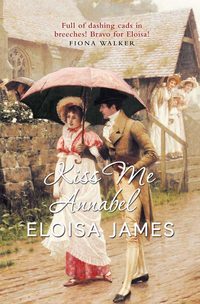
Czytaj książkę: «Kiss Me Annabel»
Kiss Me, Annabel
Eloisa James

This book is for Pam Spengler-Jaffee, My terrific PR person at HarperCollins. Thank you for giving eloisajames.com A million hits…
This Kiss is for you!
Table of Contents
Cover Page
Title Page
One
Two
Three
Four
Five
Six
Seven
Eight
Nine
Ten
Eleven
Twelve
Thirteen
Fourteen
Fifteen
Sixteen
Seventeen
Eighteen
Nineteen
Twenty
Twenty-one
Twenty-two
Twenty-three
Twenty-four
Twenty-five
Twenty-six
Twenty-seven
Twenty-eight
Twenty-nine
Thirty
Thirty-one
Thirty-two
Thirty-three
Thirty-four
Thirty-five
Thirty-six
A Note About Shrews, Coneys and Reading to Six-Year-Olds
Acknowledgements
About the Author
Praise
By the same author:
Copyright
About the Publisher
One
London
April, 1817
The day the Scotsman came to Lady Feddrington’s ball, Annabel’s sister decided to give him her virtue, and Annabel decided not to give him her hand in marriage.
In neither case had the Scotsman indicated a particular interest in undertaking such intimate activities with an Essex sister, but his participation was taken for granted. And, naturally, both of these decisions took place in the ladies’ retiring room, which is where everything of importance takes place at a ball.
It was in those middle hours, when the initial excitement has worn away and women have an uneasy feeling that their noses are shiny and their lips pale. Annabel peeked into the retiring room and found it empty. So she sat down before the large mirrored dressing table, and started trying to pin her unruly curls so they would stay above her shoulders for the rest of the evening. Her sister Imogen, Lady Maitland, plumped down beside her.
‘This ball is nothing more than a breeding ground for parasites,’ Imogen said, scowling at her reflection. ‘Lord Beekman has twice asked me to dance with him. As if I would even contemplate dancing with that plump toadlet. He should look lower…perhaps in the scullery.’
She looked magnificent, a few gleaming black curls falling to her shoulders, and the rest piled high on her head. Her eyes sparkled with the displeasure of receiving too much attention. In all, she had the magnificent rage of a young Helen of Troy, stolen by the Greeks and taken from her homeland.
It must be rather annoying, Annabel thought, to have nowhere to direct all that emotion except toward unwary gentlemen who do nothing more despicable than ask for a dance. ‘There is always the chance that no one has told the poor toadlet that Lady Maitland is such a very grand person.’ She said it lightly, since mourning had turned Imogen into a person whom none of them knew very well.
Imogen flashed her an impatient look, twitching one of her curls over her shoulder so that it nestled seductively on her bosom. ‘Don’t be a widgeon, Annabel. Beekman is interested in my fortune and nothing more.’
Annabel raised an eyebrow in the direction of Imogen’s virtually nonexistent bodice. ‘Nothing more?’
A sketch of a smile touched Imogen’s lips, one of the few Annabel had seen in recent months. Imogen had lost her husband the previous autumn, and after her first six months of mourning she had joined Annabel in London for the season. Currently she was amusing herself by shocking respectable matrons of the ton by flaunting a wardrobe full of mourning clothing cut in daring styles that left little of her figure to the imagination.
‘You have to expect attention,’ Annabel pointed out. ‘After all, you dressed for it.’ She let a little sarcasm creep into her tone.
‘Do you think that I should buy another of these gowns?’ Imogen asked, staring into the mirror. She gave a seductive roll of her shoulders and the bodice settled even lower on her chest. She was dressed in black faille, a perfectly respectable fabric for a widow. But the modiste had saved on fabric, for the bodice was nothing more than a few scraps of cloth, falling to a narrow silhouette that clung to every curve. The pièce de résistance was a trim of tiny white feathers around the bodice. The feathers nestled against Imogen’s breasts and made every man who glimpsed them throw caution to the wind.
‘No one has a need for more than one dress of that pattern,’ Annabel pointed out.
‘Madame Badeau has threatened to make another. She complains that she must sell two in order to justify her design. And I should not like to see another woman in this particular gown.’
‘That’s absurd,’ Annabel said. ‘Many women have gowns of the same design. No one will notice.’
‘Everyone notices what I wear,’ Imogen said, and one had to admit it was a perfect truth.
‘’Tis an indulgence to order another gown merely to allow it to languish in your wardrobe.’
Imogen shrugged. Her husband had died relatively penniless, but then his mother had fallen into a decline and died within a month of her son. Lady Clarice had left her private estate to her daughter- in-law, making Imogen one of the wealthiest widows in all England. ‘I’ll have the gown made up for you, then. You must promise to wear it only in the country, where no one of importance can see you.’
‘That gown will fall to my navel if I bend over, which hardly suits a debutante.’
‘You’re no ordinary debutante,’ Imogen jibed. ‘You’re older than me, and all of twenty-two, if you remember.’
Annabel counted to ten. Imogen was grieving. One simply had to wish that grieving didn’t make her so – so bloody-minded. ‘Shall we return to Lady Griselda?’ she said, rising and looking one last time at the glass.
Suddenly Imogen was at her shoulder, smiling penitently. ‘I’m sorry to be so tiresome. You’re the most beautiful woman at the ball, Annabel. Look at the two of us together! You’re glowing and I look like an old crow.’
Annabel grinned at that. ‘A crow you’re not.’ There was a similarity to their features: they both had slanting eyes and high cheekbones. But where Imogen’s hair was raven black, Annabel’s was the colour of honey. And where Imogen’s eyes flashed, Annabel knew quite well that her greatest strength was a melting invitation that men seemed unable to resist.
Imogen pulled another curl onto the curve of her breast. It looked rather odd, but Imogen’s temper was not something to risk lightly, and so Annabel held her tongue.
‘I’ve made up my mind to take a cicisbeo,’ Imogen said suddenly. ‘To hold off Beekman, if nothing else.’
‘What?’ Annabel said. ‘A what?’
‘A gallant,’ Imogen said impatiently. ‘A man to take me about.’
‘You’re thinking about marrying again?’ Annabel was truly surprised. To the best of her knowledge, Imogen was still dissolving into tears every night over her husband’s death.
‘Never,’ Imogen said. ‘You know that. But I don’t intend to let fools like Beekman spoil my enjoyment either.’ Their eyes met in the mirror. ‘I’m going to take Mayne. And I’m not talking about marriage.’
‘Mayne!’ Annabel gasped. ‘You can’t!’
‘Of course I can,’ Imogen said, looking amused. ‘There’s nothing to stop me from doing anything I wish. And I believe that I would like the Earl of Mayne.’
‘How can you even consider such an idea? He jilted our own sister, practically at the altar!’
‘Are you implying that Tess would be better off with Mayne than with Felton? She adores her husband,’ Imogen pointed out.
‘Of course not. But that doesn’t change the fact that Mayne deserted her!’
‘I have not forgotten that point.’
‘But for goodness’ sakes, why?’
Imogen cast her a scornful glance. ‘You have to ask?’
‘Punishment,’ Annabel guessed. ‘Don’t do it, Imogen.’
‘Why not?’ Imogen turned to the side and regarded her figure. It was exquisite in every curve. And every curve was visible. ‘I’m bored.’
Annabel saw a glint of cruelty in her sister’s eyes and caught her arm. ‘Don’t do it. I’ve no doubt you can make Mayne fall in love with you.’
Imogen’s teeth shone white when she smiled. ‘Neither have I.’
‘But you might fall in love with him as well.’
‘Inconceivable.’
Annabel didn’t really believe Imogen would love again either. She had encased herself in ice after her husband died, and it would take time to melt away.
‘Please,’ she said. ‘Please don’t do it, Imogen. I don’t care about Mayne, but it wouldn’t be good for you.’
‘Since you are nothing more than a maiden,’ Imogen said with her new, bitter smile, ‘you have no idea what would be good for me, at least as pertains to men. We can have this discussion once you have some experience of what it means to be a woman.’
Imogen was clearly longing for a pitched battle of the kind they used to have when they were children. But as Annabel opened her mouth to deliver a scathing retort, the door opened and their chaperone, Lady Griselda Willoughby, waltzed in. ‘Darlings!’ she trilled. ‘I have been looking everywhere for the two of you! The Duke of Clarence has arrived, and –’
Her words died as her eyes moved from Annabel’s furious face to Imogen’s rigid one. ‘Ah,’ she said, sitting down and adjusting her exquisite silk shawl around her shoulders, ‘you’re squabbling again. How very glad I am that I have only a brother to plague me.’
‘Your brother’, Imogen snapped, ‘is hardly anyone to desire as a family member. In fact, we were just talking of his manifold virtues. Or rather, the lack thereof.’
‘I have no doubt but that your assessment was correct,’ Griselda said serenely, ‘but it was a patently unpleasant comment, my dear. I notice that when you are angry your nose becomes quite thin…You might wish to think about that.’
Imogen’s nose flared magnificently. ‘Since I have no doubt but that you will wish to rebuke me as well, I might as well tell you that I have decided to take a cicisbeo!’
‘An excellent decision, my dear.’ Griselda opened a small fan and waved it lazily before her face. ‘I find men so useful. In a gown as narrow as the one you wear tonight, for example, one can hardly walk with ease. Perhaps you could choose a particularly strong man who can carry you about London.’
Annabel bit back a smile.
‘You may fun all you like,’ Imogen said through clenched teeth, ‘but let me be very clear about my decision. I have decided to take a lover, not a jumped-up version of a footman. And your brother Mayne is my primary candidate.’
‘Ah,’ Griselda said. ‘Well, likely it is wise to start with someone so very experienced in these situations. Mayne does tend toward married women rather than widows; my brother has a genius for avoiding any woman who might prove eligible for matrimony. But mayhap you can persuade him otherwise.’
‘I believe that I can,’ Imogen stated.
Griselda waved her fan meditatively. ‘An interesting choice lies ahead of you. Were I to take a lover, for example, I should wish to continue the affair beyond two weeks. My dear brother certainly has had many ladies on whom to practise, and yet he invariably drifts to another woman within the fortnight. Moreover, I myself would find the notion of being compared to the many beautiful women who had come before me unnerving, but I expect I am simply squeamish.’
Annabel grinned. Griselda looked a perfectly docile, perfectly feminine lady. And yet…
Imogen looked as if she were thinking. ‘Fine!’ she said finally. ‘I’ll take the Earl of Ardmore, then. Since he’s only been in London for a week or so, he can’t possibly compare me to anyone else.’
Annable blinked. ‘The Scottish earl?’
‘The very one.’ Imogen gathered up her reticule and shawl. ‘He’s not worth a penny, but his face can be his fortune, in this case.’ She caught her sister’s frown. ‘Oh, don’t be such a pinched ninny, Annabel. Believe me, the earl won’t get hurt.’
‘I agree,’ Griselda put in. ‘The man has a palpable air of danger about him. He won’t get hurt, Imogen. You will.’
‘Nonsense,’ Imogen said. ‘You’re simply trying to talk me out of a decision I’ve already made. I’m not willing to sit around in the corners, gossiping with dowagers for the next ten years.’ That was a direct insult to Griselda, who had lost her husband years ago and had (to Annabel’s knowledge) never entertained a thought either of a lover or a husband.
Griselda smiled sweetly and said, ‘No, I can see that you’re an entirely different kind of woman, my dear.’
Annabel winced, but Imogen didn’t notice. “Now I think on it, Ardmore is an altogether better choice than Mayne. We are countrymen, you know.’
‘Actually, that’s a reason not to distract him,’ Annabel had to point out. ‘We know how hard it is to live in an old rambling house in the north country without a penny to support it. The man has come to London to find a rich bride, not to have an affair with you.’
‘You’re a sentimentalist,’ Imogen said. ‘Ardmore can take care of himself. I certainly shan’t stop him from courting some silly miss, if he wishes. But if I have a cavalier servente, the fortune hunters will leave me alone. I shall just borrow him for a while. You’re not planning to marry him, are you?’
‘The thought never crossed my mind,’ Annabel said with something less than perfect truth. The Scotsman was absurdly handsome; a woman would have to be in her grave not to consider him as a consort. But Annabel meant to marry a rich man. And she meant to stay in England. ‘Are you considering him as a possible spouse?’
‘Certainly not. He’s lummox without a fortune. But he’s pretty, and he dresses so sombrely that he matches my clothing. Who could want more in a man?’
‘He doesn’t appear to be a man to fool,’ Griselda said, serious now.
‘If he needs to find a rich wife, you ought to be straightforward,’ Annabel added. ‘He may well think that you would consider matrimony.’
‘Pish,’ Imogen said. ‘The role of a hidebound moralist doesn’t suit either of you. Don’t be tedious.’ And she swept out of the room, closing the door behind her with a little more force than necessary.
‘Though it pains me to admit it,’ Griselda said meditatively, ‘I may have mishandled that situation. If your sister is determined to make a scandal, she would have done better to direct herself toward Mayne. At this point, it is almost a rite of a passage for young women to have a brief affaire with my brother, and so the ensuing scandal doesn’t really take fire.’
‘There’s something about Ardmore that makes me wonder if she can control him as easily as she thinks she can,’ Annabel said with a frown.
‘I would agree,’ Griselda said. ‘I haven’t exchanged a word with him, but he has little in common with the average English lord.’
Ardmore was a red-haired Scot, with a square jaw and broad shoulders. To Annabel’s mind, he was a world away from Griselda’s sleek brother.
‘No one seems to know much about the man,’ Griselda said. ‘Lady Ogilby told me that she had it from Mrs Mufford that he’s poor as a church mouse and came to London specifically to find a dowried bride.’
‘But didn’t Mrs Mufford spread that rumour about Clementina Lyffe running off with a footman?’
‘True,’ Griselda said. ‘And yet Clementina is happily married to her viscount and shows no propensity whatsoever to court the household staff. Lady Blechschmidt generally can scent a fortune hunter at fifty yards, and there was no sign of Ardmore at her soirée last night, which suggests he was not invited. I must ask her if she has any pertinent information.’
‘His absence from that particular event may simply indicate an intolerance for boredom,’ Annabel remarked.
‘Tush!’ Griselda said, laughing. ‘You know Lady Blechschmidt is a great acquaintance of mine. I must say, it is unusual for there to be such mystery about a man; if he were English we would know everything from his birth weight to his yearly income. Did you ever meet him when you lived in Scotland?’
‘Never. But Mrs Mufford’s speculation about his reasons for coming to London is likely true.’ Many a Scottish nobleman hung around her father’s stables, and they were all as empty in the pocket as her own viscount of a father. In fact, it was practically a requirement of nationality. One either remained poor or married a rich Englishman – as Imogen had done, as Tess had done and as she herself meant to do.
‘Ardmore doesn’t look the sort to be fooled by your sister,’ Griselda said.
Annabel hoped she was right. There was a brittleness behind Imogen’s artful exposure of her bosom that had little to do with desire.
Griselda rose. ‘Imogen must find her own way through her grief,’ she said. ‘There are women who have a hard time of it, and I’m afraid she’s one of them.’
Their eldest sister, Tess, kept saying that Imogen had to live her own life. And so had Annabel.
For a moment a smile touched Annabel’s lips. The only dowry she had was a horse, so she and the Scotsman were really two of a kind.
Scottish pennies, as it were.
Two
Lady Feddrington was in the grip of a passion for all things Egyptian, and since she had the means to indulge every whim, her ballroom resembled nothing so much as a storage house kept by tomb raiders. Flanking the large doors at one end were twenty-foot-high statues of some sort of a dog-human. Apparently they originally stood at the doors of an Egyptian temple.
‘At first I wasn’t certain that I quite liked them. Their expressions are not…nice,’ Lady Feddrington had told Annabel. ‘But now I’ve named them Humpty and Dumpty. I think of them rather like superior servants: so silent, and you can tell in a glance that they won’t drink to excess.’ She had giggled; Lady Feddrington was a rather silly woman.
But Annabel had to admit that from the vantage point of the other side of the room, Humpty and Dumpty looked magnificent. They gazed down on the dancers milling around their ankles with expressions that made the idea that they were servants laughable.
She pulled a gauzy piece of nothingness around her shoulders. It was pale gold, to match her dress, and embroidered with a curling series of ferns. Gold on gold and worth every penny. She threw a glance at those imposing Egyptian statues again. Surely they should be in a museum? They made the fluttering crowds around them look dissolute.
‘Anubis, god of the dead,’ a deep voice said. ‘Not the most propitious guardian for an occasion such as this.’
Even after having met him for only a moment, she knew Ardmore’s voice. Well, why shouldn’t she? She had grown up surrounded by that soft Scottish burr, though their father threatened to disown herself and her sisters if they used it. ‘They look like gods,’ she said. ‘Have you travelled to Egypt, my lord?’
‘Alas, no.’
She shouldn’t have even asked. She, if anyone, knew the life of an impoverished Scottish nobleman all too well. It involved hours spent trying to eke a living from tenants battered by cold and hunger, not pleasure trips up the Nile River.
He slipped a hand under her arm. ‘May I ask you to dance, or should I request the pleasure from your chaperone?’
She smiled up at him, one of her rarer smiles that didn’t bother to seduce, but just expressed companionship. ‘Neither is necessary,’ she said cheerfully. ‘I’m sure you can find someone more appropriate to dance with.’
He blinked at her, looking more like a burly labourer than an earl. She’d come to know quite a lot about earls – aye, and dukes and other lords too. Their chaperone, Lady Griselda, considered it her duty to point out every man within eyesight who carried a title. Mayne, Griselda’s brother, was a typical English lord: sleek and faintly dangerous, with slender fingers and exquisite manners. His hair fell in ordered waves that shone in the light, and he smelled as good as she herself did.
But this Scottish earl was another story. The earl’s red-brown hair fell in thick rumpled curls down his neck. His eyes were a clear green, lined with long lashes, and the out-of-doors sense he had about him translated into a kind of raw sensuality. While Mayne wore velvet and silk, Ardmore was plainly dressed in a costume of black. Black with a touch of white at the throat. No wonder Imogen thought he would complement her mourning attire.
‘Why do you refuse me?’ he asked, sounding surprised.
‘Because I grew up with lads like yourself,’ she said, letting a trace of a Scottish accent slip into her voice. Lad wasn’t the right word, not for this huge northerner who was so clearly a man, but that was the sense she meant. He could be a friend, but never a suitor. Although she could hardly explain to him that she meant to marry someone rich.
‘So you’ve taken a vow not to dance with anyone from your own homeland?’ he asked.
‘Something like that,’ she said. ‘But I could introduce you to a proper young lady, if you wish.’ She knew quite a few debutantes endowed with more-than-respectable dowries.
‘Does that mean that you would decline to marry me as well?’ he asked, a curious little smile playing around his mouth. ‘I would be happy to ask for your hand, if that would mean we could dance together.’
She grinned at his foolishness. ‘You’ll never find a bride if you go about behaving in such a way,’ she told him. ‘You must take your pursuit more seriously.’
‘I do take it seriously.’ He leaned against the wall and looked down at her so intently that her skin prickled. ‘Would you marry me, even if you won’t dance with me?’
You couldn’t help but like him. His eyes were as green as the ocean. ‘I certainly will not marry you,’ she said.
‘Ah,’ he said, sounding not terribly disappointed.
‘You cannot ask women to marry you whom you barely know,’ she added.
He didn’t seem to realise that it wasn’t entirely polite to lean against the wall in a lady’s presence, nor to watch her with lazy appreciation. Annabel felt a flash of sympathy. He would never be able to catch a rich bride at this rate! She should help him, if only because he was her countryman.
‘Why not?’ he asked. ‘Compatibility is not something one discovers after five encounters rather than one. One must make an educated guess.’
‘That’s just it: you know nothing of me!’
‘Not so,’ he said promptly. ‘Number one, you’re Scottish. Number two, you’re Scottish. And number three –’
‘I can guess,’ she said.
‘You’re beautiful,’ he finished, a fleeting smile crossing his face.
He had his arms crossed over his chest now and was smiling down at her like a great giant.
‘While I thank you for the compliment, I have to wonder why on earth you came to London to find a bride, given your first two requirements,’ Annabel said.
‘I came because I was told to do so,’ he replied.
Annabel didn’t need any further information. Everyone knew that rich brides were to be found in London, and poor ones in Scotland. The man was hoping that her finery meant she had a dowry to match.
‘You’re judging on appearances,’ she told him. ‘My only dowry is a horse, although, as I said, I’d be happy to introduce you to some appropriate young ladies.’
He opened his mouth, but at that moment Imogen appeared at her shoulder. ‘Darling,’ she said to Annabel, ‘I’ve been looking everywhere for you!’ Without pausing, she turned to the earl. ‘Lord Ardmore,’ she purred, ‘I am Lady Maitland. What a pleasure to meet you.’
Annabel watched as the earl bent over her sister’s hand. Imogen was looking as beautiful as any avenging goddess. She gave Ardmore a look that no man, especially a man in search of a dowry faced with a wealthy young widow, would consider resisting. In fact, it looked very much like one of Annabel’s own come-hither glances.
‘I have an unendurable longing to dance,’ Imogen said. ‘Will you please me, Lord Ardmore?’
Unendurable? But Ardmore wasn’t laughing; he was kissing Imogen’s hand again. Annabel gave up. The man would have to find his own way out of Imogen’s net. Imogen had always been thus: once she made up her mind, there was no stopping her. ‘I shall return to my chaperone,’ Annabel said, curtsying. ‘Lord Ardmore, it has been a pleasure.’
Lady Griselda was holding court in a corner of the room, their guardian sprawled beside her with a drink in his hand. Not that there was anything unusual in that; the Duke of Holbrook always had a drink. He came to meet Annabel when he saw her winding her way through the crowd.
Now that she had come to know a number of English nobility, she was more and more surprised by how unducal Rafe was. For one thing, he refused to go by his title. For another, he was as far from scented and curled and sartorially splendid as could be imagined. At least his valet managed to get him into a decent coat of blue superfine for the evening, but when he was at home he tended toward comfortable pantaloons and a threadworn white shirt.
‘Griselda’s driving me mad,’ he said without formality. ‘And if she doesn’t succeed, Imogen will finish me off. What the devil is she doing, dancing attendance on that Scottish fellow? I don’t even know the man.’
‘She’s decided that she wants a cicisbeo,’ Annabel told him.
‘Stuff and nonsense,’ Rafe muttered, running a hand through hair that was already wildly disarranged. ‘I can escort her wherever she needs to go.’
‘She’s being plagued by fortune hunters.’
‘For God’s sake, why’d she choose a penniless Scot to dance about with, then?’ Rafe bellowed, only belatedly glancing about him.
‘Perhaps she won’t care for him on further acquaintance,’ Annabel said, trying to see whether she could glimpse Lord Rosseter anywhere. At the moment Rosseter was her first choice for a spouse.
‘She’s making an ass of herself,’ Rafe said.
For some reason, Imogen’s antics always drove Rafe to distraction, especially since she’d returned to London and begun to order gowns that fit her like a second skin. But no matter how much he bellowed and raged, she merely smirked at him and said that widows could dress precisely as they wished.
‘Surely it’s not as bad as that,’ Annabel said absently, still searching the crowd for Rosseter.
She caught Lady Griselda’s eyes, who called: ‘Annabel! Do come here for a moment.’
Their chaperone was nothing like the dour old ladies who generally earned that label; she was as good-looking as the infamous, altar-deserting Earl of Mayne. It went without saying that none of them held her brother’s behaviour against Griselda; she had been devastated when Mayne galloped away from Rafe’s house approximately five minutes before he was due to marry Tess.
‘What on earth is Rafe bellowing about?’ Griselda inquired, without much real concern in her voice. ‘He’s turned all plum-coloured.’
‘Rafe is worried that Imogen is making an exhibition of herself,’ Annabel told her.
‘Already? She is a woman of her word.’
Annabel nodded over to the right. A waltz was playing, and the Earl of Ardmore was holding Imogen far too tightly. Or perhaps, Annabel thought fairly, Imogen was doing the holding. Whatever the impetus, Imogen swayed in his arms as if they were in the grip of a reckless passion.
‘Goodness me,’ Griselda said, fanning herself. ‘They’re quite a couple, aren’t they? All that black on black…Imogen certainly was correct about the aesthetics of choosing Ardmore as a partner.’
‘Nothing will come of it,’ Annabel assured her. ‘Imogen was just blustering. I’m sure of it.’ But the words died in her mouth as Imogen threw an arm around the earl’s neck and began caressing his hair in an outrageously intimate fashion.
‘She wants a scandal,’ Griselda said matter-of-factly. ‘The poor dear. Some widows do suffer through this sort of thing.’
She made it sound as if Imogen were coming down with a nasty cold.
‘Did you?’ Annabel asked.
‘Thankfully not,’ Griselda said with a little shiver. ‘But I do believe that Imogen’s feelings for Lord Maitland were far deeper than mine for dear Willoughby. Although,’ she added, ‘naturally I had all proper emotion for my husband.’
Imogen was smiling up at Ardmore, her eyes half closed as if – Well. Annabel looked away.
What Imogen wanted, Imogen took. She had loved Draven Maitland for years, and never mind the fact that he was betrothed to another woman. The moment Imogen had a chance, she somehow sprained her ankle in such a way that she had to convalesce in the Maitland household. That ankle injury was remarkably fortuitous. The next thing Annabel knew, her sister had eloped with Draven Maitland. In fact, given Imogen’s strength of will, Annabel rather thought that Ardmore might have to find and woo his bride in the next season.
‘Have you seen Lord Rosseter?’ she asked Griselda.
But Griselda was mesmerised – as doubtless were most of the respectable women in the room – by Imogen’s behaviour on the dance floor. ‘Imogen is not my duty,’ she said to herself, fanning her face madly.
Annabel looked back at her sister. Imogen could not have made her intentions to engage in a scandalous affair more clear. She was clinging to Ardmore as if she’d turned into an ivy plant.
‘Oh, Lord,’ Griselda moaned. Now Imogen was caressing Ardmore’s neck, for all the world as if she meant to pull his head down to hers.
Annabel’s elder sister Tess dropped into a chair beside them. ‘Can someone please explain to me why Imogen is behaving like such a wanton?’
‘Where have you been all evening?’ Annabel asked. ‘I thought I caught a glimpse of you and Felton earlier, but then I couldn’t find you.’
Tess ignored her question. ‘She may ruin herself with this behaviour! People will draw the conclusion that she is Ardmore’s mistress.’
‘And they’ll be correct,’ Griselda put in calmly. ‘How are you, my dear? You look blooming.’
But Tess just stared at Griselda. ‘Imogen has taken a lover? I knew she was distraught, but –’
‘She calls it taking a cicisbeo,’ Annabel put in.
On the dance floor Imogen was dancing thigh to thigh with the Scotsman, head thrown back in an attitude of sensual abandon.
‘We have to do something,’ Tess said grimly. ‘It’s one thing to take a cicisbeo, if that’s what she wants. But at this rate she’ll create such a frightful scandal that she won’t be invited to parties.’
‘Oh, she’s already beyond the pale on that front,’ Griselda said, a little too cheerfully for Annabel’s comfort. ‘Remember, she eloped with her first husband. And after this exhibition…Well, she’ll still be invited to the largest balls, of course.’
But Tess had raised her three younger sisters from the time their mother died, and she wasn’t going to resign herself to Imogen’s disgrace so easily. ‘That will not do,’ she stated. ‘I’ll just put it to her that –’
Annabel shook her head. ‘You are not the one to give advice. The two of you only reconciled a matter of weeks ago.’ Tess looked rebellious, so Annabel added firmly, ‘Not unless you wish to engage in another squabble with Imogen.’
‘It’s all so absurd,’ Tess muttered. ‘We never really quarrelled.’ Just then Lucius Felton came up, dropped a kiss on his wife’s hair, and winked at Annabel.
‘Give me a chance and I’ll scare up a reason to stop speaking to you myself,’ Annabel said, smiling at him. ‘All this marital affection is hard to stomach.’
‘Imogen apologised very prettily,’ Tess said. ‘But I still think her behaviour was remarkably unjustified.’
‘Your husband –’ Annabel began.
‘Is alive,’ Tess said, accepting the point. ‘But does that mean I have to allow my sister to ruin herself without saying a word?’
But Annabel had a twinge of sympathy with Imogen, seeing the way Lucius brought Tess’s hand to his lips before he left to bring her a glass of champagne.
‘Do you think that Ardmore is aware that Imogen has only just been widowed?’ Tess asked. ‘Perhaps you could appeal to his better self. Weren’t you just speaking to him?’
‘He has no idea that Imogen is my sister,’ Annabel said doubtfully. ‘I could –’
‘It wouldn’t make any difference,’ Griselda put in. ‘Imogen made it quite clear earlier in the evening that she fully intends to create a scandal, if not with this gentleman, then with my own dear brother. And frankly, if this is the way she intends to go about it, I’m grateful she didn’t choose Mayne. I still have fond hopes for a nephew at some point and my brother may have slept with most of the available women in the ton, but he’s never put on a public exhibition.’
Tess’s eyes narrowed. ‘She was considering Mayne?’
‘Yes, Mayne,’ Annabel confirmed. ‘I believe she had some quixotic idea of punishing him for leaving you at the altar.’
‘That’s foolish,’ Tess said. ‘Mayne punishes himself quite enough.’ She turned to Griselda. ‘Did he come tonight?’
‘Of course,’ Griselda said, startled. ‘He was just inside the gaming room, last time I looked. But –’
Tess was already gone, heading like an arrow to the room where the men sat around their cards, hoping their wives wouldn’t drag them onto the ballroom floor.
‘I was going to say,’ Griselda added, ‘that I believe he intended to leave for his club. I barely have a chance to see my own brother now that he has given up philandering. He won’t stay at a ball over a half hour.’
Annabel looked back at Imogen. Would this waltz never end?
But at that moment Rafe shouldered his way onto the floor. Before Annabel could take a breath, the red-haired Scotsman was bowing, and Rafe had swept Imogen away.
Imogen was as surprised as her sister. One moment she was gliding around the ballroom with Ardmore, thoroughly enjoying every scandalised glance directed at her, and the next she was jerked from his arms by her ex-guardian. ‘And just what do you think you’re doing?’ she demanded, holding her body as far from Rafe’s as was possible.
‘Saving your miserable little self,’ he snapped back. ‘Do you have any idea what a disgrace you’re making of yourself?’ Rafe’s hair was standing up on end and his normally grey-blue eyes were black with rage.
Imogen raised an eyebrow. ‘Just remind me again where your authority over me lies?’
‘What do you mean?’ He swung her into a brisk turn and began back up the ballroom floor.
‘What right have you to interrogate even the smallest aspect of my behaviour? I ceased to be your responsibility the moment I married Draven.’
‘I only wish that were the case. As I told you when you broached that ludicrous idea of renting a house, I consider myself still your guardian, and you’ll live with me until you marry again. Or grow old enough to govern yourself, whichever comes first.’
She smiled at him, a movement of her lips belied by her angry gaze. ‘This may surprise you, but I don’t agree with your assessment of my situation. I’m planning to set up my own establishment in the very near future.’
‘Over my dead body!’ Rafe snapped.
Imogen glared at him.
‘I don’t know what you’re playing at with Ardmore,’ Rafe said, ‘but you’re ruining yourself for nothing. The man is looking for a bride, not a flirtation with a silly widow with no plans to marry.’
Suddenly he looked sorry for her, as if his anger were draining away. The last thing Imogen wanted was sympathy from her drunken oaf of a guardian. ‘For nothing?’ she said, taunting him. ‘You must be blind. Ardmore’s shoulders, his eyes, his mouth…’ She gave a little shiver of supposed delight.
Which turned into something quite different, although it took her a moment to realise it. He was shaking her! Rafe had dropped her hand and given her a hard shake, as if she were a child in the midst of a tantrum. ‘How dare you!’ she gasped, feeling pins slide from her hair.
‘You’re lucky I don’t drag you out of here and lock you in your chambers,’ he snapped. ‘You deserve it.’
‘Because I find a man attractive?’
‘No! Because you’re a liar. You said you loved Maitland.’
She flinched. ‘Don’t you dare say that I didn’t.’
‘It’s a pretty way you’ve chosen to honour his memory,’ Rafe said flatly. He had dropped his hands from her shoulders.
A wash of shame tumbled over Imogen’s body. ‘You have no idea –’
‘No, none,’ he said. ‘And I don’t wish to know. If I ever have a widow, I certainly hope she doesn’t mourn me in your fashion.’
Imogen swallowed. Thankfully, they were at the end of the room, because she could feel the tears swelling in her throat. She turned on her heel without another word and walked through the door. Rafe came behind her, but she ignored him, heading blindly for the front door.
At the side of the room, Annabel sighed. Her little sister had always been passionate to a fault, and unfortunately Rafe, comfortable Rafe who liked everyone, had taken a sharp dislike to Imogen almost from the first. As the two of them left the room, the storm of gossiping voices around them reached a high cackle, like hens experiencing a visit from the neighbourhood fox.
‘If Rafe wanted her to marry that Scot,’ Griselda remarked, ‘he couldn’t have done more to force the match.’
‘She won’t marry Ardmore,’ Annabel said.
‘She may not have a choice,’ Griselda said darkly. ‘After Rafe put on such a paternal performance, Ardmore will likely guess that given a modicum of scandal, Rafe will force a marriage, and he could use her estate, if the tales are true.’
‘She won’t marry him,’ Annabel repeated. ‘Have you seen Rosseter tonight?’
Griselda’s eyes brightened. ‘Ah. All that land in Kent and no mother-in-law. I approve, my dear.’ Griselda was always to the point.
‘He’s a nice man,’ Annabel reminded her.
Her chaperone waved her hand. ‘If you believe that silence is golden.’
Annabel settled her scrap of gold silk around her shoulders. ‘I see nothing wrong with his lack of verbosity. I can talk enough for both of us, should the need arise.’
‘He’s dancing with Mrs Fulgens’s spotty daughter,’ Griselda said. ‘But have no fear. Rosseter is not a man to overlook imperfections, is he?’
Annabel looked in the direction of Griselda’s nod to find Rosseter leaving the ballroom floor. He wasn’t the sort of man who immediately struck you as handsome: certainly he was no big, burly man who tossed women around the ballroom as if they were bags of wheat. In his arms one floated around the floor. He had a narrow, pale face with a high forehead and grey eyes. He tended to look expressionless and rather detached; Annabel found that a refreshing change from the puppies who begged her for dances and sent her roses with rhyming poems attached.
Rosseter had sent her only one bouquet: a bunch of forget-menots. There was no poem, only a scrawled note: These match your eyes, I believe. There was something deliciously offhand about his note. She had made up her mind on the spot to marry him.
Now he dispensed with Daisy, as Griselda had predicted, and drifted in their direction. A second later he was bowing in front of Lady Griselda, kissing her hand and saying in his unemotional way that she was looking particularly lovely.
When he turned to Annabel he didn’t bother with a compliment, simply kissed the tips of her fingers. But there was a look in his eye that warmed her heart. ‘Madame Maisonnet?’ he asked, indicating her costume with one slim hand. ‘A superb choice, Miss Essex.’
Annabel smiled back. They didn’t speak as they danced. Why should they? As far as Annabel could tell – and she could always tell what men were thinking – they were in perfect harmony. Their marriage would be riven by neither tears nor jealousy. They would have beautiful children. He was extremely wealthy and so her lack of a dowry would not bother him. They would be kind to each other, and she could talk to herself if she lacked breakfast conversation.
For someone with as little tolerance for inane chitchat as she had, the prospect was entirely pleasing. In fact, the only drawback she could think of was that conversation with oneself held few surprises. Neither did Rosseter’s farewell to her that evening. ‘Miss Essex,’ he said, ‘would it be acceptable to you if I spoke to your guardian tomorrow morning?’ His hand was snow-white, slim and delicate as he pressed her fingers in a most gratifying manner.
‘That would make me quite happy, Lord Rosseter,’ Annabel murmured.
She was having trouble suppressing a grin. Finally – finally! – her heart’s desire was within reach. She had longed for this moment for years, ever since her father discovered that she had a gift for figures and promptly dumped the entire accounting of the estate in her lap. From the time she was thirteen years old, Annabel had spent her days bargaining with tradesmen, shedding tears over a ledger book that showed far more minuses than pluses, pleading with her father to sell the most expensive animals, begging him not to spend all their money at the track…
And was rewarded by his dislike.
But she had kept at it, well aware that her financial management was often the only thing between her sisters and true hunger, the only thing holding off the ruin of the stables her father held so dear.
Her father had called her Miss Prune. If she approached while he was standing with friends, he would roll his eyes at her. Sometimes he would take out a coin and toss it in her direction, and then joke with his friends that she kept him on a tighter string than the worst of wives. And she would always pick up the coin…bend down and pick it up because that was one coin saved from the huge maw of the stables. Saved for flour, or butter, or a beautiful hen for the supper table.
So she had turned to dreaming of the husband she would have someday. She had never bothered imagining his face: Lord Rosseter’s face was as acceptable as that of almost any wealthy Englishman. What she had imagined were sleeves clad in gleaming velvet, and cravats that were white as snow and made of the finest linen. The kind of clothes that were bought for beauty, not to last. Hands in that flawless state that screamed manual labour was unnecessary.
Rosseter’s hands would do perfectly.
Three
Grillon’s Hotel
After midnight
Ewan Poley, Earl of Ardmore, was fairly certain that he was obeying Father Armailhac’s instructions to the letter. ‘Go to London,’ he had said. ‘Dance with a pretty girl.’
‘And just what am I supposed to do with this pretty girl?’ Ewan had inquired.
‘Surely the spirit will move you,’ Father Armailhac had said. For a monk, he had a wicked twinkle at times.
And so far, Ewan had met a multitude of pretty girls. Due to his terrible memory, he couldn’t remember any of their names, but he reckoned he must have danced with half of London by now. Thanks to his title, he had been showered by invitations within a few days of his arrival; it seemed that the English were not quite so blasé about Scottish titles as was rumoured in the north country. Yet it seemed to him that Father Armailhac had meant he should meet a particular girl, one whom he could contemplating wooing and bringing back to Scotland.
He had no objection to marrying, although he couldn’t say he felt passionate enthusiasm for the idea. His mind slid easily from marriage to the long, clean rows of his stables, the golden fields of spring wheat just beginning to sprout. He could give this marrying business another fortnight. Then he would return home, married or no.
The black-haired lass he had danced with this evening seemed more than ready to hop before the altar. But what was her name? He couldn’t remember. She had clung to him like a limpet, which he didn’t care for much. Yet perhaps the lady was desperate, widowed as she was, and likely with naught more than a small dowry.
His manservant appeared at the door, a silver plate in his hand. Ewan might not be enjoying London much, but Glover was ecstatic. All his ambitions were fulfilled by being in the city, as he called it, during the season. ‘Your lordship, a card has arrived.’
‘At this hour? Just put it over there,’ Ewan said, nodding at the mantelpiece. It was crowded with cards and invitations from people he’d never heard of.
Glover bowed but didn’t move toward the fireplace. ‘Your lordship, this card is from the Duke of Holbrook. And’ – Glover lowered his voice to an awed whisper – ‘His Grace has condescended to wait.’
Ewan sighed. A duke. Perhaps the man was desperate to send one of his daughters off into the supposed wilds of Scotland. He’d figured out soon enough that the English thought of Scotland as a wilderness of crazed warriors and grim religious dissenters.
He glanced at his cravat in the mirror. Glover was brokenhearted at his refusal to change his customary black for the gaudy waistcoats Englishmen wore to balls. But he looked fine and, more importantly, Scottish. Scotsmen wore kilts if they felt the need for a little colour, even if they weren’t allowed to wear them in this country.
‘His Grace awaits you in the sitting room,’ Glover said.
‘Aye.’
‘If you’ll excuse the boldness, my lord,’ Glover said, hesitating.
Ewan raised an eyebrow. ‘Yes?’
‘A duke of the realm,’ Glover said, trembling with the excitement of it. ‘Try to avoid Scottish phrases such as aye. ‘Twill make an unpleasant impression on His Grace.’
‘I’m not marrying him,’ Ewan said, but then softened. ‘But thank you for the advice, Glover. I shall do my best to appear reasonably English.’ Not that he would ever wish to mimic an Englishman, not in a hundred years.
The duke was a messy sort, Ewan saw with some relief. In fact, the sort who would take no offense at an occasional aye. Ewan had already had several conversations with the perfumed, sleek type of English nobility, and he didn’t care for them. No more did they him.
This duke was dressed in clothes that looked comfortable rather than elegant. His stomach strained comfortably over the waist of his pantaloons, and as Ewan stood in the doorway of the room, his guest threw back a glass of brandy that Glover must have given him with all the enthusiasm of one of Ewan’s labourers greeting the evening.
‘Your Grace,’ Ewan said, entering the room. ‘This is indeed a pleasure.’
The duke straightened like a bloodhound and turned around. Ewan almost took a step back. Bloody hell, the man looked enraged. And now he remembered precisely where he’d met him before. If you could call it a meeting; the duke had snatched the black-haired lady from his arms and danced with her himself.
‘Do you know who I am?’ he said. His voice was as deep and burly as his figure.
‘According to your card, you are the Duke of Holbrook,’ Ewan observed. He moved over to the sideboard. ‘May I offer you another drink?’ He dropped the Your Grace part as it made him feel faintly servant-like.
‘I am the guardian of Lady Maitland,’ the man announced.
‘Quite so,’ Ewan murmured, pouring himself a stiff glass. ‘Well, I am the Earl of Ardmore, hailing from Aberdeenshire, if you were not already aware of the fact.’
‘Lady Maitland,’ Holbrook insisted. ‘Imogen Maitland.’
Imogen must be the black-haired charmer from the ballroom. ‘If I have offended you or the lady in any way, I offer my sincere apologies,’ Ewan said, striving for diplomacy.
‘Well, I should say you have!’ the duke huffed.
‘How?’ Ewan inquired. He kept his tone easy and even.
‘All London is talking of the two of you,’ Holbrook snapped. ‘Of your tasteless exhibition of waltzing.’
Ewan thought for a moment. He had two alternatives: to tell the truth, or to take responsibility. Honour demanded that he not reveal the fact that Holbrook’s ward had clung to him with all the expert passion of a Bird of Paradise. He was no fool: the black-haired Imogen was far less moved by his beauty than she had pretended to be. He caught some sort of emotion in her eyes, but it didn’t seem to be pure lust, even if that was the emotion that she was flaunting.
‘I apologise in every respect,’ he said finally. ‘I was bowled over by her beauty and I gather it led to my actions being interpreted in an unpleasant light.’
Holbrook narrowed his eyes. Ewan gazed back at him, wondering if all dukes in England were so undisciplined in their emotions and dress.
‘I’ll have that drink now,’ the duke said.
Ewan picked up his personal decanter and poured him a healthy glass. Holbrook had the distinct atmosphere of a man who enjoyed a good brandy, and Ewan had brought with him several flasks of the best aged whisky to be found in Scotland.
Holbrook took one large sip and then looked at Ewan in surprise. He sank into a couch and took another sip.
Ewan sat down opposite him. He could see that Holbrook understood exactly what he was drinking.
‘What is it?’ Holbrook said, his voice hushed.
‘An aged single malt,’ Ewan said. ‘A new process and one likely to change the whisky industry, to my mind.’
Holbrook took another sip and sat back, ‘Glen Garioch,’ he said dreamily. ‘Glen Garioch or – possibly – Tobermary.’
Ewan gave him a real grin this time. ‘Aye, Glen Garioch it is.’
‘Bliss,’ Holbrook said. ‘Almost, I could let a man who knew his whisky marry Imogen. Almost!’ he said, opening his eyes again.
‘I’ve no particular desire to marry her,’ Ewan said agreeably.
He realised his mistake when Holbrook’s eyebrows drew into a ferocious scowl.
‘Although I would consider myself immeasurably lucky to do so,’ Ewan added. ‘She is a lovely young woman.’
‘Rumour has it that you’re in England precisely to find a wife,’ the duke growled. But he was sipping his liquor again.
‘The rumour is correct,’ Ewan said. ‘But not necessarily your ward.’
‘Ah.’
They sat in silence for a while, enjoying the whisky.
‘I expect the truth of it is that Imogen threw herself at you, and you’re being too polite to tell me so to my face,’ the duke said as gloomily as was possible when one is holding a glass of ’83 whisky distilled by Glen Garioch.
‘Lady Maitland is an exquisite young woman. I’d be more than happy to marry her.’
The duke caught his eye, and then: ‘Damned if you don’t mean it. Don’t care who you marry, is that it?’
‘I take a reasonable interest in the subject,’ Ewan protested. ‘But I will admit that I’m rather anxious to return to my lands. The wheat is sprouting.’
The duke looked as if he had never heard the word sprout. ‘Are you telling me that you’re a farmer?’ he asked. ‘One of those gentlemen who dabble about with experimental methods. Turnip Townshend, wasn’t that his name?’
‘I’m not quite as engrossed as Mr Townshend,’ Ewan murmured, letting another sip of liquor burn its complex, golden way down his throat.
‘This is delicious,’ the duke said, clearly discarding a subject of little interest to him. ‘This whisky is utterly –’ he stopped. ‘Wheat? Do you have anything to do with whisky production, then?’
‘My tenants supply some grain for the distilleries in Speyside,’ Ewan said.
‘No wonder you know your drink so well.’ The duke seemed quite struck by this. ‘Been thinking about giving up the tipple,’ he said suddenly.
‘Indeed?’ Ewan had to admit that the duke was putting away the best whisky there was to be had in Scotland at a fantastic rate, and showing little signs of it. Perhaps he had fallen into the way of drinking too much.
‘But not tonight.’
Ewan decided the appropriate response to that revelation would be to pour the duke another generous portion, so he did so.
‘Your estate is in Aberdeenshire?’
Ewan nodded.
‘There’s a lovely horse up there,’ the duke said, thinking it over. ‘I haven’t seen him for a year or so, but –’
‘Warlock,’ Ewan put in. ‘He strained a fetlock last July.’
‘Exactly! Warlock. Belongs to a friend of yours, does he?’
‘I own Warlock,’ Ewan said.
Now the duke’s eyes were definitely warm. ‘Good man. Out of Pheasant, wasn’t he?’
‘Pheasant by way of Miraculous,’ Ewan said.
‘I don’t suppose you’re thinking of breeding his line, are you?’
‘I already have a yearling who’s showing definite possibilities.’
The duke had shed his sleepy, pleasant manner and was sitting bolt upright, looking more awake than Ewan had seen him, except perhaps at the ball when he was in such a rage. ‘I’ve three offspring of Patchem sitting in my stables, two mares and a colt. The daughters are my wards, and each one of them came with a horse for a dowry. Their father was a bit of a featherhead and he doesn’t seem to have thought carefully about the business. I was thinking of breeding the mares, since neither shows much racing ability.’
A horse for a dowry? He’d only heard of such a thing once, and that was from the golden-haired beauty at the ball. Who had told him to look elsewhere, because she only had a horse for a dowry. Apparently she didn’t think it important to note that the particular horse was from the line of Patchem.
‘I should like to see a horse with Warlock’s and Patchem’s bloodlines,’ he said.
They sat in comfortable silence for a few moments, the duke slumping back into his boneless, indolent stance.
‘You’ve gone about finding a wife the wrong way,’ Holbrook said, after a while.
‘I’ve gone to fourteen events in the last week,’ Ewan observed. ‘Four balls, a number of afternoon gatherings and one musicale. I did ask a young lady to marry me this evening, but she declined.’ He didn’t think it necessary to note that the woman was apparently one of Holbrook’s wards, not when the duke had only barely gotten over his annoyance at Ewan’s behaviour with another of those wards.
‘That’s not the way of it. These things are handled between men. The key is to figure out which woman you wish to marry before you go to the ballroom.’ The duke’s voice had just the slightest husky edge now, a golden burr of whisky. But all in all, Ewan thought he held his liquor better than any man he knew except old Lachlan McGregor, and McGregor had given his life to the practice.
‘I’ll take you along to my club,’ the duke continued. ‘We can have it all fixed up in a moment.’ He rose and Ewan was rather amazed to see that the man wasn’t even unsteady. ‘Not that you can have Imogen,’ he said with a sudden roar, ‘even if she does come with a mare for a dowry. We’ll do the horse breeding on the side.’
‘I wouldn’t think of it,’ Ewan said, looking around for the card case that Glover had brought for him. He didn’t find it, so he simply followed the duke out the door. The only sign that Holbrook had imbibed the better part of a flask was a certain talkativeness.
‘You see,’ the duke said in the carriage as they were trundling off to his club, ‘the poor girl lost her husband a mere six months ago. The man fell on the racetrack, racing one of his own horses: a yearling that should never have been put to the bridle.’
‘Aye,’ Ewan said. He’d heard that story somewhere, but as was often the case, the name of the rider eluded him.
‘Imogen had loved him for years.’ Holbrook was leaning back against the cushions, having no problem whatsoever keeping his balance as the carriage swung around corners and rumbled down cobblestone streets. ‘She picked him out when she was a mere nursling, and they ended up eloping. And then he died but a matter of weeks later.’
‘Weeks!’ Ewan said, struck by the misfortune of that. And then: ‘Of course, that would be Draven Maitland.’
‘The same.’
‘Ah,’ Ewan said. He had met young Maitland a few times, since the man used to race the Scottish cycle before returning to England for the English racing season. Maitland was a rash, foolish young man whom Ewan had rather disliked.
The duke took a little flagon out of his pocket and took a sip, but shook his head. ‘This is like drinking pisswater after that whisky of yours. At any rate, poor Imogen is not quite herself, due to the shock of the whole thing, as you can imagine.’
The carriage stopped in front of an imposing, pillared building. Ewan had no idea what part of the city they were in. ‘Aren’t these clubs for members only?’ he asked.
The duke waved his hand dismissively. ‘No one will question my bringing a guest in for a drink. I’ll put you up for membership, if you’d like. But it is a hell of an expense,’ he tossed over his shoulder. ‘Not worth the money, I should think.’
Ewan agreed with him. Surely men stewed in liquor all offered the same tedious company, and if it was their society he wished, the men in his local tavern would do.
The duke seemed to know precisely where he was going. They were greeted by a solemn-faced individual, who bowed deeply and intoned a welcome to ‘White’s’. Then the duke trundled past a few rooms that seemed to be filled with gamblers and finally arrived in a library.
It was a magnificent room. The few bits of wall that weren’t covered with books were papered in a deep crimson. There was a fire burning in a generous hearth, and comfortable chairs scattered about the room in groupings that offered intimacy. The duke didn’t hesitate. ‘Come,’ he threw over his shoulder, heading to a corner.
Four high-backed chairs were grouped with their backs to the room. In one of them was a scion of English nobility of just the sort that Ewan disliked. He had black curls tossed in one of those styles that Ewan had just figured out was a style, rather than the effect of an unexpected rain shower. And he was wearing a waistcoat of such riotously embroidered beauty that Glover would have grown weak at the knees. Ewan could only be glad that his manservant was not with him: the last thing he wanted was to find himself dressed in a garnet-coloured jacket, as if he were a man milliner.
Ewan saw with one glance that the gentleman seated next to the man milliner was a man of power. He had a face that bespoke the ability to move nations, if he wished. His very quietness radiated power and presence. Perhaps he was one of those royal dukes, although he had heard tell that the dukes were on the plump side.
‘I’ve brought along a Scottish earl,’ Holbrook said without ceremony. ‘Seems a decent fellow, and keeps a whisky in his chambers that’s full of the devil. Plus he’s the owner of Warlock, who won the Derby two years ago, if you remember. Ardmore, that sprig of fashion is Garret Langham, the Earl of Mayne. And this is Mr Lucius Felton. As for myself, I go by Rafe amongst friends.’
Without waiting for a response, he signalled to a footman. ‘Ask Penny if they have any aged Glen Garioch whisky in the house.’
‘They don’t,’ Ewan said, bowing to the gentlemen, who had stood up and were doing the pretty. ‘Aged malts aren’t exported for sale yet.’
The duke collapsed into a chair. ‘I suddenly have a deep interest in visiting our northern neighbours.’
Now that the Earl of Mayne was on his feet, Ewan could see immediately that the man was no man milliner, for all his deep red jacket seemed to catch the gleam of the firelight. He had tired eyes and a dissolute droop to his mouth, but he was a man to be reckoned with.
‘Ardmore,’ Mayne said. ‘It’s a pleasure.’ He had a strong handshake. ‘Didn’t I see you dancing at Lady Feddrington’s house?’
Darmowy fragment się skończył.