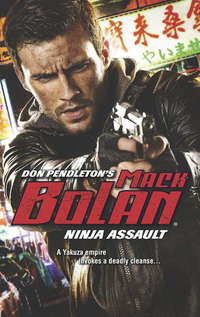
Czytaj książkę: «Ninja Assault»
LETHAL BARGAIN
A ninja attack in a Vegas casino leaves two billionaires dead, and all signs point to the Yakuza, a Japanese crime syndicate bent on infiltrating America’s legalized gambling industry. To cut the problem out at the root, Mack Bolan targets the gang’s Stateside web of legitimate businesses and vicious warriors, closing in fast on the Yakuza’s most ruthless clan.
But when the battle takes Bolan to Japan and he faces a quartet of elite killers, he realizes Vegas was just the tip of the iceberg. A cult-enthralled clan member has partnered with a corrupt Chinese general to bring about massive spiritual “cleansing”—in the form of a deadly toxic weapon. With millions of lives on the line, the Executioner isn’t playing the odds. He’s betting everything on his special brand of hellfire.
Bolan sprinted across the roof, heading for the fire escape.
A pistol cracked, and he heard the whisper of a bullet as it streaked past his cheek. One shooter was behind him when he turned, and Bolan saw another peeking from the rooftop access doorway. He sent the shooter spinning away with a 3-round burst, his white shirt spouting scarlet, then sent three more rounds to make the doorway peeper duck back out of sight.
With ammunition running low, he glanced over the parapet, saw no shooters prepared to pick him off as he descended and swung out onto the fire escape. Gripping the side rails with his hands and bracing the insteps of his shoes against them, Bolan slid down until he landed in a crouch fifty feet below.
Gunshots echoed above him, a reminder that he had no time to waste. Raising the MP5K’s muzzle, Bolan fired a burst and saw a face fly back.
His rented wheels waited for him half a block away.
Bolan ran.
Ninja Assault

Don Pendleton

Only the dead have seen the end of war.
—Plato
Human predators will never be eradicated. A new crop pops up when the old one is cut down. There is no cure for the plague of evil and avarice, but I can fight the symptoms when they surface, wherever they surface.
—Mack Bolan
For Captain William D. Swenson,
1st Battalion, 32nd Infantry Regiment
CONTENTS
Cover
Back Cover Text
Introduction
Title Page
Quotes
Dedication
PROLOGUE
CHAPTER ONE
CHAPTER TWO
CHAPTER THREE
CHAPTER FOUR
CHAPTER FIVE
CHAPTER SIX
CHAPTER SEVEN
CHAPTER EIGHT
CHAPTER NINE
CHAPTER TEN
CHAPTER ELEVEN
CHAPTER TWELVE
CHAPTER THIRTEEN
CHAPTER FOURTEEN
CHAPTER FIFTEEN
CHAPTER SIXTEEN
CHAPTER SEVENTEEN
CHAPTER EIGHTEEN
CHAPTER NINETEEN
CHAPTER TWENTY
CHAPTER TWENTY-ONE
CHAPTER TWENTY-TWO
EPILOGUE
Copyright
PROLOGUE
Atlantic City, New Jersey
Tommy Wolff leaned closer to the window, peering at his face and raising one manicured hand to prod the pouches underneath his ice-blue eyes. He’d chosen Kisdon lighting for the penthouse bathroom, fixtures planned with flattery in mind, but lights could only do so much.
Time for a touch-up there, he thought, and made a mental note to fit it in.
Not that the ladies waiting for him in the bedroom would object to pouchy eyes. They’d been well paid to service him, with cash and with cocaine. They’d do whatever Wolff required, as he required it, and they’d damn well like it.
Hell, why not? They hadn’t seen his schmeckel yet, and they were bound to be impressed.
The ladies always were. No work required in that department.
Wolff retreated from the mirror, taking in the long view of himself from neck to knees. His time spent in the private gym had paid off handsomely. At fifty-five, he now looked better than he had in twenty years, his stamina was better, and he rarely needed a Viagra boost to keep the ladies happy.
Almost never.
Tommy Wolff preferred his women young, and—he had a guy who double-checked IDs in order to protect him from a statutory rape charge. Wolff had enough to think about on any given day, with IRS leeches and spies from the state Casino Control Commission crawling up his ass. The very last thing that he needed was to wind up on TV, doing the perp walk over some sweet thing who’d lied about her age to get a little taste of power.
Okay, not a little taste. But, still.
Wolff took his new robe off its hook behind the bathroom door. Kimono was the proper term, he understood, a black silk number, knee-length, with those baggy sleeves that stopped short of his wrists and made him feel like he should trade it for a larger size. Across the shoulders, looping down around his right hip, an embroidered wolf was snapping at a frightened lamb.
He liked that image. Liked it very much indeed.
The robe—kimono—was a gift from one of Wolff’s new partners in Japan. They’d pooled resources to erect a new resort in Tokyo, where current law prohibited casino gambling, but with nudges in the right direction and strategic contributions to the major players, rules could always change. Meanwhile, there was pachinko, mahjong, and kōei kyōgi, betting on a list of “public sports” that covered racing horses, bicycles, speedboats and cars.
Wolff slipped on the kimono, nothing underneath except his tanned, taut flesh, and broke eye contact with the mirror. Too much self-examination could be bad for anyone.
He thought about the young women in his bedroom, high atop Nero’s Hotel-Casino, with its sweeping panorama of the boardwalk. “Caesar’s” had been taken, but he’d found a Roman emperor who suited him, regardless. Nucky Johnson never dreamed of anything like Nero’s when he ran Atlantic City for the syndicate, and it was all completely legal now.
Well, close enough.
The girls—one blonde, one redhead, one brunette—had suddenly gone quiet in the bedroom. Frowning, Wolff considered whether he had left them too much coke to play with in his absence, but he doubted it. Besides, if one of them had OD’d, he’d expect the others to be panicking.
“You little bitches better not be dozing off,” he muttered to himself. “You’ve got a long, hard night ahead of you.”
Longer than any of the three expected. Harder, too.
The schmeckel humor always made Wolff smile.
He lost the smile as he stepped through the bathroom doorway, turning toward the bed. It was the emperor size, imported from Ireland, forty-two square feet of padded playground on a hand-carved wooden frame, with satin sheets that had been white when Wolff went to the bathroom.
Why were they red now, and dripping on the carpet?
Wolff blinked, found two of the girls stretched out across the bed diagonally, side by side. It looked as if they’d been engaging in a little foreplay, but it hadn’t lasted long. The redhead, lying on her back, had one arm raised as if to shield her face. The other arm was…where, again?
Wolff felt the Lobster Thermidor and Provençal asparagus he’d eaten half an hour earlier trying to come back on him, but he kept it down with effort, taking in the gash below the redhead’s chin and shifting toward the nubile body sprawled beside her.
Someone had been more efficient with the brunette, taking off her head completely, propping it atop two pillows, wide blank eyes turned toward the bathroom doorway where Wolff stood. As far as he could tell, that was the only wound she’d suffered, but it had obviously done the job.
A mewling from his left brought Wolff around to face the blonde. She stood before him, naked as the day she’d come into the world but far from innocent, flanked by two men no taller than herself—say five foot six, if that—all dressed in black from head to toe.
Not black suits, mind you. These were some kind of commando costumes, maybe one piece, though Wolff couldn’t really tell. They both wore snug, formfitting hoods like ski masks, only thinner, that hid everything except their glinting eyes. And there was something odd about their shoes that took a second glance to recognize: split toes, of all things, which was new in Wolff’s experience.
But what he really focused on was the long sword each man held in his right hand. Katana they were called, as if it mattered now. Americans normally called them samurai swords.
“Jesus Christ.”
It came out as a whisper, barely audible even to Wolff as he spoke. The picture set before him clarified itself immediately, even if he still had trouble grasping its reality. He had a shitload of security downstairs to stop this kind of thing from happening, yet here he stood, confronting death times two.
Negotiation wouldn’t work. He knew that much instinctively. They’d come too far for that. Blood had been spilled, and only more blood could erase the problem.
Now, the only question: Was he fast enough?
Wolff kept a Glock 31 in the top nightstand drawer, to the right of his bed. It was chambered for .357 SIG rounds, loaded with Triton Quik-Shok bullets, and Wolff had practiced using it. There was no safety switch to fumble with in an emergency, just fifteen rounds in the magazine and one up the spout.
If he could reach the piece before one of the swordsmen got to him, Wolff thought he had a fighting chance.
Big if.
And standing there, considering it, only wasted precious time.
He bolted for the nightstand, heard a squeal behind him, from the blonde, and didn’t turn to watch her dying. Bimbos were a dime a dozen in AC, but Tommy Wolff was one in a million.
An endangered species, at the moment.
There was no time to circle the emperor bed, so Wolff clambered across it, mattress springing underneath his feet, trying to topple him. The dead girls lolled and rocked, the redhead’s one arm flopping as if reaching out to grab him by the ankle. Bloody satin squelched beneath his bare soles, slippery and treacherous. Wolff heard one of the men in black behind him, rushing toward him, and he vaulted toward the nightstand, stumbling on a bare, firm thigh and plunging headlong toward the finish line.
His forehead struck the nightstand’s edge, received a stunning gash that added Wolff’s blood to the mix, but he pushed past the pain and sudden dizziness, ripped at the drawer and pulled it free as he went down on to the floor. It banged against his chest, more pain, and Wolff upended it, dumping its contents on his torso, littering the black kimono.
Condoms. Moist towelettes. A vibrator.
The Glock.
Wolff grasped it, flung the empty nightstand drawer away from him, and raised the pistol as one of the black-clad swordsmen loomed above him. Finger on the trigger with its built-in safety, he was just about to fire when steel flashed, and a bolt of icy pain shot through his upraised arm.
Wolff saw his right hand flying, still clutching the Glock, and barked with startled laughter as his index finger clenched the trigger, firing one shot toward a limited edition of Picasso’s Buste de Femme au Chapeau Bleu, drilling the woman’s offset nose. All things considered, not a bad shot overall.
Wolff saw the sleek katana rising, flinging drops of crimson toward the ceiling, while his wrist pumped gouts and torrents of it. In the microseconds he had left to think about it, Tommy saw the story of his life written in blood.
For one last time, he’d gambled and he’d lost.
CHAPTER ONE
Atlantic City, Two Days Later
The boardwalk simmered, thronged with tourists on this summer afternoon. Mack Bolan didn’t mind the crowd, divided between gamblers seeking action and the families a person saw in any tourist town when school was out and vacation rolled around. Young couples held hands, sharing ice cream cones as if they were a promise of more intimate activities to come, while aged seniors passed with cans and shopping bags, regarding youth with envy.
Bolan, for his part, was wary.
Nothing special there, since he was always wary, anywhere he went.
That was the price of waking up each day in a hostile world.
Before Hurricane Sandy, the Atlantic City boardwalk had extended from Absecon Inlet in the north to Ventnor City, six and a half miles southward. Rampant nature had wiped out the promenade’s northern end, but the rest—built in 1870 and billed as the “Showplace of America”—had managed to survive unscathed. The vast casinos facing the North Atlantic had ignored that storm, as they’d ignored all other challenges from God and man since they were legalized, back in the 1970s.
AC had been the new Las Vegas in those days, and while the new had quickly faded, tourism declining with renovations in Las Vegas and erection of new gambling palaces in Connecticut, the boardwalk and its temples of mammon remained the city’s backbone and its throbbing, greedy heart. The flood of cash and service jobs had done little for the middle class, much less the residents of ghettos where resentment smoldered, ever ready to ignite.
Back in 2005, Forbes magazine had called Atlantic City “dangerous and depraved,” boasting a crime rate triple that of any other US city, double on the murder rate. While gross gambling revenue increased each year, the number of casino jobs declined.
AC had bet its future on the gaming tables. Some would say the town had lost its soul.
Of course, it hadn’t started in the seventies, by any means. That was the era when casinos had been legalized—controlled, in theory, by the guardians of civilized society. Supporters of the scheme had looked at Vegas, saw the neon and the bottom line without considering the downside, and had rushed ahead to claim their places at the trough. But vice had put down deep, abiding roots decades before a modern crop of architects had dreamed the Taj Mahal or the Borgata, run by men who settled scores with lead, instead of million-dollar lawsuits.
Atlantic City was the midwife to America’s crime syndicate, born on that very boardwalk, Bolan knew, during May of 1929, when every hood who mattered in the eastern half of the United States had come to hammer out their plans for the remaining years of Prohibition. Those who weren’t invited had been killed within a year or so, clearing the dead wood as a younger generation rose to claim its due.
Bolan was standing outside Nero’s when another tall man stopped beside him, frowning from the shadow of a gray fedora. “Penny for them,” said the new arrival.
“I keep watching out for Nucky Johnson.”
“Thompson.”
“Johnson,” Bolan said again. “They changed it for the TV series.”
“Ah. Wrong century, regardless,” Hal Brognola said.
They shook hands, old friends and combatants in a struggle that would outlast both of them. They knew the rules, expected no heavenly trumpets to declare their final victory and took it one day at a time.
“So, this is where it all went down,” Brognola said, tilting his head back, squinting at the sharp metallic gleam of penthouse windows high above, where seagulls wheeled and screamed.
“The Wolff thing,” Bolan said.
“None other. Four dead in the penthouse, three more from security before the hit team made it all the way upstairs.”
“Messy.”
“But quiet,” Brognola replied. “They knew what they were doing. Never fired a shot.”
“On CNN, they’re talking stab wounds.”
“Make that sword wounds, and you’ve got it right.”
Bolan had no response to that. He waited, knowing the big Fed would get around to it in his own time.
“You know much about Tommy Wolff?” Brognola asked.
“A younger version of The Donald or Steve Wynn. More cash than he could spend in twenty lifetimes.”
“And he didn’t even manage one.”
“I’m guessing that the Bureau and the state police are on it.”
“Absolutely,” Brognola agreed. “And getting nowhere.”
“Why’s that?”
“Well, for starters, Wolff and all the rest of them were killed by ninjas.”
“The real deal.”
“Looks like. Black tights and balaclavas, swords and split-toe shoes. It’s all on video.”
“So, no ID on any of the perps.”
“Not even close. They’ve got ICE working on it, too, the passport angle.”
“ICE” was Immigration and Customs Enforcement, part of the Homeland Security umbrella that had theoretically shielded America from foreign attacks since September 2011. In practice, Bolan knew, safety required much more than uniformed guards and a roster of alphabet agencies.
“They’re thinking Japanese, then?” Bolan asked. “Ninja originals?”
“Why not? We know they’re out there.”
Right. Bolan had faced some personally, once upon a time, and lived to tell about it. If he was allowed to tell. If anybody would believe it.
“So?”
“I sent a coded file to your smartphone, when you get a chance to take a look,” Brognola informed him. “Same password as usual.”
“You want to run the basics past me?”
“Abridged version, Wolff had been negotiating with a company in Tokyo to build a Nero’s Far East, matching this one, the joint he’s got—well, had—in Vegas, and the Nero’s San Juan, down in Puerto Rico.”
“There’s no legit casino gambling in Japan,” Bolan stated.
“Say he was hopeful, betting on a sea change.”
“Or he had some other kind of action in the works.”
“Or that.”
“Which was it?”
“All I hear, so far, is that he’d stepped on certain toes in Tokyo. The Sumiyoshi-kai, for starters.”
“Big toes, then.”
“And highly sensitive.”
The Sumiyoshi-kai was Japan’s second-largest Yakuza family, claiming some twenty thousand oath-bound members and at least that many hangers-on. As number two, they tried harder, chasing the larger, stronger Yamaguchi-gumi, while the Inagawa-kai snapped at their heels.
“Still, taking out a guy Wolff’s size, with his high profile…”
“Sends a very public message,” Brognola filled in for him.
“Why do I get the feeling this isn’t a one-off?” Bolan asked.
“Because you know your way around. Six months ago, out in LA, Merv Mendelbaum dropped out of sight. He hasn’t surfaced yet. The family’s been sitting on it, but they’re lawyered up and getting out the carving knives.”
“That’s Mendelbaum of Goldstone Entertainment?”
Brognola nodded. “Owner of casinos in Las Vegas, Reno, one up in New London and another in Biloxi.”
“So, coincidence?”
“Goldstone was also putting feelers out to Tokyo, feeling its way around the National Diet, schmoozing with the prime minister and leaders of his party.”
“More toes bruised,” Bolan surmised.
“The Yakuza likes things the way they are, most forms of gambling banned but readily available through outlets they control. They stand to lose a fortune—not a small one—from another US occupation.”
“What about their operations stateside?”
“They’d love to have a stake in gambling where it’s legal, if they don’t lose anything at home. Right now, they mostly smuggle methamphetamine and heroin into the States, and take guns home.”
Bolan knew that Japan’s gun control laws ranked among the world’s strictest. Police estimated there were 710,000 firearms in civilian hands, scattered among 128 million citizens—or one gun for every 180 Japanese. America, by contrast, had at least 270 million guns floating around the civilian population, one for every 1.2 men, women and children. The upshot was 32,000 gun deaths per year in the States, versus eleven annually in Japan.
Coincidence?
Unlikely.
Bolan brought his mind back to the topic on the table. “So, the Sumiyoshi-kai could benefit from taking out a few top men,” he said. “Keep US gaming corporations out of Tokyo and cause a power vacuum over here.”
“It cuts both ways,” Brognola said. “Just like a sword.”
“Suspects?”
“They’re listed in the file I sent you, but we don’t have any solid evidence. The Sumiyoshi-kai had kyodai—‘big brothers,’ similar to capos in the Mafia—both here and in Las Vegas. If the family killed Wolff and Mendelbaum, they’ll be the place to start.”
Brognola didn’t have to say the rest, but Bolan looked downrange. “What about carrying the fight back home?” he asked.
“It’s not my place to second-guess a soldier on the ground,” the big Fed said. “But obviously, if we have a chance to make the problem go away, at least for now…”
He let the sentence trail off, staring up at the casino. There was no need to explain what both of them already knew from long experience.
The predators would never be eradicated. Some defect within humankind itself produced a new crop every time the old one was cut down. Evil could be beaten down and held at bay, but it could never be extracted from the human genome. There was no cure, no inoculation, for the plague of avarice and cruelty that lurked behind the thin facade of “civilized” society.
No cure, perhaps, but he could fight the symptoms when and where they surfaced.
Starting now.
The file was waiting for him, just as Brognola had said.
Roughly two hundred years older than Sicily’s Mafia, Japan’s homegrown version of organized crime had arisen from a merger of two criminal classes: the bakuto, itinerant gamblers, and the tekiya, peddlers who furnished goods and services proscribed by feudal law. After resisting for a time, the Edo Dynasty had bowed to the realities of daily life, legitimized the syndicates and granted their leaders—known as oyabun, “fathers, or godfathers”—the right to carry short wakizashi swords, while the larger katanas were reserved for full-fledged samurai. The overall syndicate’s name, ya-ku-za, translated as “8-9-3,” a losing hand in Oicho-Kabu, the Japanese version of blackjack.
This day, the Yakuza consisted of some seventy-odd rival clans, fighting for turf in the shadow of Japan’s top three families. Only the Sumiyoshi-kai concerned Bolan as he began to scan Brognola’s file.
The outfit’s oyabun was Kazuo Takumi, based in Tokyo, which kept him near the seat of government and all the major economic action. Sixty-one years old, he’d earned his reputation the old-fashioned way, by wading in the blood of rivals, and had risen to the status of a recognized philanthropist whose generosity to charity was known throughout Japan. He held shares in a score of thriving companies and sat on several of their boards, ensuring that the firms he graced were never short of cheap materials or healthy profit margins.
The oyabun’s only son and heir apparent was Toi Takumi, something of a cipher in the file Brognola had provided. He had earned a playboy’s reputation in his early twenties, but now, approaching thirty, he had dropped out of the social scene and rarely showed his face in public.
Growing into his position as the next boss of the Sumiyoshi-kai, perhaps.
Or was it something else?
Atlantic City’s “big brother” was Noboru Machii, thirty-one, an ex-con who’d done time for smuggling methamphetamine before a key witness recanted and committed suicide—seppuku in the native tongue. That had blown the prosecution’s case, freed Machii on appeal and helped restore the honor of the dead man’s family—along with a substantial contribution to their bank account, supposedly the payoff from a life insurance policy that didn’t quibble over self-destruction in a righteous cause.
Now, Machii had a foothold on the boardwalk and was bound for bigger things, it seemed. If he could hand a piece of Tommy Wolff’s casino empire to the Sumiyoshi-kai, he would be well positioned for a top spot in the syndicate. Who could predict what might transpire when old Takumi finally cashed in his chips?
It was a gamble, right, and Machii had one strike against him, going in.
He didn’t know Bolan had dealt himself into the game.
CHAPTER TWO
Sunrise Enterprises, Atlantic City
The office complex wasn’t much to look at in comparison to the casinos standing tall along the boardwalk, one block closer to the ocean. Just four stories high, a drab rectangle painted beige, it gave no hint that anyone inside was tinkering with local history or planning to tap a vein of gold from the exalted gaming industry that kept Atlantic City on the map.
To spot those signs, a person had to look behind the stucco, maybe close one eye and make believe there was no weedy vacant lot next door, where homeless people had been known to light a bonfire on a winter’s night. A person had to know about Sunrise, and it was helpful if there was a team on tap like Hal Brognola’s crew at Stony Man, hidden within the Blue Ridge Mountains of Virginia, picking secrets from the cloud, thin air, wherever, and reviewing them until they all made sense.
In this case Sunrise Enterprises was a paper company, incorporated like so many others of its kind in Delaware, existing for the sole purpose of purchasing and selling stock in other companies. On paper, it was all strictly routine, aboveboard, and the company filed tax returns on time, paying its debts without complaint.
Look deeper, though, and Sunrise was an offshoot of another company, the G.E.A. Consortium, whose initials stood for Greater East Asia. It was just a fluke, perhaps, that during the 1930s and ’40s, Japan’s imperial masters had called their captured territory in the Far East and South Pacific the Greater East Asia Co-Prosperity Sphere.
Maybe.
Look deeper yet, and G.E.A. was owned by three middle-aged members of the Sumiyoshi-kai, including the family’s administrative officer, its legal adviser and its top accountant. Needless to say, they served at Kazuo Takumi’s pleasure and could be replaced at any time they ceased to please him.
Break it down. The drab four-story box was Takumi’s nerve center in Atlantic City. Strings were pulled inside those offices that ended human lives and had potential to disrupt the city’s—and, perhaps, the state’s—economy.
Bolan saw two approaches to the viper’s nest. He could obliterate it, salt the earth and scatter any stray survivors, or he could attempt a soft probe, look for opportunities to gain further intelligence and plan his final killing stroke accordingly.
On second thought, why not combine the two ideas?
One item in his bag of tricks was an infinity transmitter, designed to monitor conversations within a room through its telephone line, whether or not the phone itself was in use. Its name derived from the fact that phone line transmissions could be received at an infinite distance, unlike other bugs with a finite physical range.
But it still required that Bolan get inside to plant the bug.
And for that, he needed a diversion.
The internet provided a schematic drawing of the office block, showing him where and how to cut the building’s juice. There were battery-powered emergency lights on all floors, but severing the trunk line would deactivate security cameras found on all floors, while leaving the fire alarms live. If he could generate sufficient smoke to rout the office occupants, it all came down to a matter of time and nerve.
Sorting through his mobile arsenal Bolan selected weapons first. He wasn’t planning an attack, per se, but meant to be prepared for any unforeseen eventuality. An MP-5 K submachine gun fit the bill ideally—“K” for kurz, or “short,” in German, easily concealable even with a suppressor screwed on to its threaded muzzle. He would wear it on a shoulder sling, beneath a lightweight jacket, backed up by a Glock 17 that was lighter, easier to handle and loaded a higher-capacity magazine than the Beretta he had carried into countless other skirmishes.
For the diversion proper, Bolan chose four AN-M8 smoke grenades, each filled with nineteen ounces of Type C hexachloroethane—HC. Each cylindrical canister would emit thick white smoke for 105 to 150 seconds following ignition, enough to choke a four-story building’s ventilation ducts and keep any occupants scurrying for the nearest exit once fire alarms set them in motion.
Getting in and out before firefighters reached the scene was Bolan’s problem.
Make that getting in and out alive.
* * *
NOBORU MACHII FELT like celebrating. He had carried out the order from his oyabun without a hitch, had seen the two imported killers off, beginning their long flight back to Japan, and felt he had the local situation well under control. It was too early yet, of course, for a direct approach to Tommy Wolff’s estate, but Machii had his battery of lawyers hovering, gauging the time and monitoring every move by Wolff’s board of directors since the penthouse massacre, the night before last. As expected, there was posturing and jockeying for power, but Machii held the winning hand.
He’d spent the past eight months uncovering the secret sins of every member on the board at Wolff Consolidated. There were seven of them, and Machii knew them well, although they’d never met. In fact, he knew them better than their partners, wives and children did.
Machii knew that one of them collected child pornography and traveled once a year to Bangkok, where his indiscretions had been filmed. Another had been stealing from the company, a third selling insider knowledge to the firm’s competitors for half again his yearly salary. A fourth was what Americans presumed to call a “high-functioning” alcoholic, though he had not functioned well enough the night he struck and killed a homeless African-American with his Mercedes-Benz in Newark. No suspicion had attached to him so far, but that could change within an instant.
So it went, on down the line, with six of seven board members. The seventh was above reproach—a miracle, of sorts—but he could not prevail once Machii had secured a majority of the directors to support his takeover of Wolff Consolidated. In addition to the preservation of their guilty secrets, he would promise them secure positions and the standard golden parachutes in place.
As if a written contract could protect them when Machii tired of having them around.
He would have another kind of contract waiting for them then, and nothing any lawyer said would rescue adversaries of the Sumiyoshi-kai. Machii had taught Tommy Wolff that lesson, and if the dead man’s underlings refused to learn from his example, their deaths would be tantamount to suicide.
As far as celebrating went, however, it was premature. The prize was now within his grasp, but he had not secured it yet. Until the transfer of authority was finalized, Machii could not rightfully claim victory.
“How long shall we wait for the approach?” Tetsuya Watanabe asked.
Machii’s lieutenant was younger, still learning the art of patience. Left unchecked, he might have overplayed their hand, but he inevitably followed orders from his boss.
“After the funeral is soon enough,” Machii said. “A few more days will do no harm. If we approach them prematurely, they might panic and do something foolish.”
“I understand.”
Of course, Watanabe understood. The order had been simple and required no verbal answer, but he still observed the standard courtesy.
Noboru had another thought. “We should send flowers, yes? Preserve proper appearances, and—”
Suddenly, the lights went out. The air-conditioning gave a little gasp and died.
Machii swiveled toward his office window, with its view of the boardwalk casinos. Lights were blazing in the massive pleasure palaces, along the piers and on Atlantic Boulevard below. Rising from his chair, he told Watanabe, “It’s our building only. Find out what is wrong.”
“Yes, sir!” Watanabe was halfway to the office door when he acknowledged the command, already reaching for the knob. Beyond the door, the hallway’s emergency lights had kicked on, illuminating escape routes from the building in case of disaster.
A simple power failure that affected only Sunrise Enterprises?
It was possible, of course. And yet…
Machii reached into his desk’s top right-hand drawer, removed the SIG Sauer P250 pistol he kept ready there, and held it at his side. There was no need for him to check the weapon. It was fully loaded and ready to fire as soon as he depressed its double-action trigger. Its magazine held ten .45-caliber rounds, with one more in the chamber, enough to keep any prowlers at bay until his security team reached the office.
Machii was moving toward the panoramic office window when the fire alarm went off, making him flinch. The action was involuntary, barely noticeable even if he had not been alone, but it embarrassed him, regardless.
Fire?
It seemed unlikely, but it might explain the power cut. Instead of waiting in his office, he should—
Even as the thought took form, Machii smelled it: smoke. The scent was unmistakable.
Coming from where, exactly?
“Jesus!”
There was no one in the room to hear him curse or note his momentary loss of calm. With pistol still in hand, Machii went to find out what was happening and right the situation.
* * *
BOLAN HAD PARKED his rented car on Atlantic Avenue and locked it. As it was getting on toward closing time, he’d crossed through spotty traffic in the middle of the block and made his way along an alleyway behind Atlantic Avenue, past long ranks of commercial garbage Dumpsters bearing names of their respective pickup companies. He’d met no one along the way, except a stray cat that examined him in passing and decided that he wouldn’t make a meal.
At the rear of Sunrise Enterprises, Bolan found a fire escape. The lower portion of the ladder operated on a counterbalance system, wisely using nylon bushings and stainless-steel cables to ward off corrosion. When he jumped to grasp the lowest rung, that section of the ladder dropped to meet him, making no more noise than Bolan would expect from a bicycle passing through the alley.
Scrambling up the fire escape, bolt cutters dangling from his belt, the MP-5 K swinging underneath his right arm, Bolan checked each window that he passed. Some of the offices were empty, others occupied, but no one noticed him, bent to their work as if clock-watching at day’s end had been decreed a mortal sin.
Atop the roof, he found the junction box and used the bolt cutters to clip the padlock’s shackle. Once the small gray door was open, he could see the trunk line pumping power through the building, keeping it alive.
The bolt cutters had rubber grips, so there was no need for insulated gloves as Bolan spread the jaws to clasp the thick trunk line. One flex of his arms and shoulders, one brief shower of sparks, and twenty feet beyond the junction box, the building’s air conditioner shut down.
So far, so good.
Wasting no time, he crossed to stand over the air-conditioning unit, opened it and slit the silver wrapping on a large duct set into the roof. When that was open, Bolan took his smoke grenades in turn, removed their pins and dropped each of the four smoke bombs into the vent he had created with his blade. The unit wasn’t running to propel the smoke through lower ducts and vents, but each grenade contained enough HC to spread fumes through the topmost floor, at least.
And that was all that Bolan needed.
He approached the rooftop access door—no padlock on the outside there—and tried it. Locked, of course. With numbers running in his head, he stepped back from the door and raised his stubby SMG, firing a muffled 3-round burst into the steel door’s dead-bolt lock. Another moment and he was inside, descending steep stairs dimly illuminated by pale ceiling-mounted emergency lights.
Halfway there, Bolan removed a lightweight balaclava from his pocket, pulled it on and made a quick adjustment to permit clear, unobstructed vision. He had borrowed the idea from Tommy Wolff’s assassins, caught on video, and saw no reason why it shouldn’t work for him, if he was seen by anyone he wasn’t forced to kill.
Just plant the bug, he thought, but knew it might not be that simple. Nothing ever was, once battle had been joined.
Voices below made Bolan hesitate, but they were all retreating from the service stairs. No one would think of heading for the roof when they lost power. Down and out would be the drill, assisted by floor plans posted in offices and corridors, reminding people where to go in the event of an emergency.
He reached the bottom, peered around the corner and immediately saw the fire alarm wall unit to his left, within arm’s reach. Unseen, he grasped the unit’s pull-down handle, yanked it sharply, and was instantly rewarded with a clamor echoing throughout the building.
Sixty seconds, give or take, cleared out the fourth-floor hallway, even as the smoke from his grenades began to filter down through ceiling vents. Downrange, the last two visible employees reached a stairwell leading to the street below, pushed through its heavy door and disappeared.
Noboru Machii had a corner office at the far end of the hall, to Bolan’s right. Turning in that direction, Bolan double-timed to reach his destination, submachine gun gripped in one hand, while the other delved in a pocket and extracted the infinity device.
The clock was running now. Bolan could hear it in his head, louder than the insistent fire alarm.
The kyodai’s office, reeking of smoke, was vacant when Bolan got there, and a white haze was seeping from the ceiling vents. He left the door to the reception area wide open, as he’d found it, and moved on to penetrate Machii’s private sanctuary.
Empty.
Bolan went directly to the spacious desk, set down the bug he’d taken from his pocket and retrieved a small screwdriver. Within ten long seconds he’d removed the base plate from the telephone, surveyed the wiring and began the installation.
When he’d cut the trunk line on the building’s roof, it had no impact on phone service to the floors below. Landlines were powered by another system altogether, usable in blackouts, and he hadn’t touched their power conduit when he was turning off the lights at Sunrise Enterprises. He scanned the phone’s guts, finally wedging the infinity transmitter in beside the set’s digital answering machine. A simple clip job finished it, with no need to strip any wires and risk short-circuits sometime in the future. A few keystrokes on Bolan’s cell phone, and the bug went live, the arming signal cut before the desk set had a chance to ring.
He was finished, except for putting back the base plate. He had three screws set, was working on the fourth, when he heard voices coming down the corridor in his direction, speaking Japanese.
Unhappy voices, which was natural enough, and now he had to scoot.
Bolan tightened the fourth screw down as far as it would go and pocketed his screwdriver. He replaced the phone as he had found it, nothing out of place as he surveyed the desktop, making sure no traces of himself remained.
Now, out.
Machii’s office had a private washroom, and the washroom had its own connecting door to yet another room beyond, labeled as Storage on the floor plan he had memorized. That room, in turn, had its own exit to the corridor from which he’d entered the office. If his luck held, he could slip around behind whomever was approaching in a heated rush, and slip back to the roof while they were fuming in the office.
And if not, at least he might come out behind them. Give them a surprise.
Meeting opposition was a risk on any soft probe, always kept in mind, no matter how much preparation went into avoiding contact. With his work done, the transmitter live and waiting to broadcast whatever words were spoken in Machii’s office from now on, it wasn’t absolutely critical for Bolan to escape unseen.
But it was vital for him to escape alive.
The washroom door was shut when Bolan reached it, and he closed it tight behind him once he was inside. No dawdling in the john to eavesdrop on the Yakuza returning to the office. He was out the other door in seconds flat, and found that Storage meant a bedroom where Machii could sleep or party privately, with someone who had caught his fancy. There was no one in the boudoir, smoky now and ripe with HC’s tangy odor, and he crossed directly to the other door. Bolan paused there, ear pressed against the panel, listening.
And heard nothing.
Behind him, in the Machii’s private office, two men conversed, their words incomprehensible to Bolan. Taking full advantage of their evident preoccupation, he stepped out into the corridor—and found two young men gaping at him in surprise.
“Hakujin!” one declared.
“Supai!” the other snapped, as both reached for their holstered pistols.
Bolan didn’t need to speak the language to know that they had pegged him as an intruder. He had them beaten, going in. The MP-5 K sneezed two muted 3-round bursts from less than twenty feet, stitching the young men’s chests with 9 mm Parabellum hollow-point rounds, mangling their hearts and lungs, stopping those hearts before the guards knew they were dead. They fell together, but he didn’t stick around to see it, sprinting for the service staircase that would take him to the roof.
It was a judgment call. To reach the street without retracing his original approach meant running back the full length of the corridor and rushing down eight flights of stairs—two zigzag flights per floor—among Sunrise employees exiting in answer to the fire alarm. If he got past them all, that route would put him on Atlantic Avenue, busy with traffic and pedestrians. If someone brought him under fire out there, it could become a massacre.
Better to do the unexpected thing, descend via the fire escape and exit through the alley. Cornered there, if he ran out of luck, at least Bolan could fight without much fear of injuring civilians.
He was on the roof and sprinting for the fire escape when someone shouted from behind him. Next, a pistol cracked, and Bolan heard the whisper of the bullet as it flew past his cheek.
One shooter was behind him when he turned, and Bolan saw another peeking from the rooftop access doorway, clearly not as bold as the front-runner. Bolan sent the shooter spinning with a 3-round Parabellum burst, his white shirt spouting scarlet, then sent three more rounds to make the doorway peeper duck back out of sight.
Eighteen rounds remained in the MP-5 K’s magazine, and Bolan didn’t plan on using any more of them topside than he could help.
He still had no idea what might be waiting for him in the alley below.
He glanced over the parapet, saw no shooters prepared to pick him off as he descended, and swung out onto the fire escape. Taking the metal ladder rung by rung was slow. Instead, he gripped the side rails with his hands and braced the insteps of his shoes against them, sliding down until he struck the asphalt fifty feet below and landed in a crouch.
Above him, gunshots echoed. One round struck a commercial garbage bin to his right and spanged into the heaped-up garbage it contained. Another slapped into the pavement, closer, a reminder that he had no time to waste.
Raising the MP-5 K’s muzzle, Bolan chipped the concrete parapet above him with a parting burst and saw a face fly back, out of frame. He couldn’t rate that as a hit and didn’t care. His rented wheels, a Honda Civic, waited for him on Atlantic Avenue, no more than half a block away.
He ran.
The rooftop shooters would need time to reach the alley. As for soldiers on the inside, he’d already dealt with two and given any more something to think about. Assuming they had walkie-talkies for communicating, someone from the lobby could be on his case by now and waiting for him when he reached the sidewalk, but it was a chance he’d have to take.
The alley was a trap now; staying where he was meant death.
A brief pause at the alley’s mouth, tucking the MP-5 K out of sight beneath his jacket, hand still on its pistol grip through a slit pocket on his right, and Bolan cleared the sidewalk, glancing right and left as if it was a normal day, nothing to be concerned about. When no one called him out or gunned him down, he stepped off from the curb, jaywalking as if he did it every day, angling through traffic that, with any luck, would slow his pursuers.
Twenty feet from the Honda, Bolan palmed the keyless entry fob and released the driver’s door lock, instantly rewarded by a flash of taillights and a perky blipping sound. A moment later, he was at the wheel and gunning it, letting the taxi on his tail brake sharply, driver leaning on his horn and offering a one-finger salute, as Bolan pulled away from Sunrise Enterprises.
He could listen to the office bug right now, in theory, but he had more pressing matters on his mind—survival being foremost on the list—and Bolan figured that Noboru Machii wouldn’t spend the next few minutes in his office, strategizing with his men. There would be firefighters to deal with, and police, the problem of eliminating corpses in a hurry.
Something else he’d thought about, while planning his incursion: when Machii did begin to talk, the odds were good that he’d be speaking Japanese. While Bolan’s talents were diverse, he’d never had the opportunity to learn more than a smattering of Japanese. And that would have been a problem, if the superteam at Stony Man Farm hadn’t devised a program for his smartphone, offering real-time translated readouts from a list of major languages. The readout wasn’t perfect—something on the order of closed captioning on normal television—but he’d get the gist of what Machii said and go from there.
First, though, he had to get away. Find somewhere it was safe to sit and eavesdrop once his adversaries chilled a bit and had a chance to think.
Bolan checked his rearview, frowning as he saw a car behind him, weaving in and out of traffic, closing fast. Three shapes were inside the vehicle, maybe four, and while they might be office workers in a rush to get to happy hour, Bolan wasn’t taking anything for granted.
What he needed was a place to take the shooters, if they were shooters, and dispose of them without civilians getting in the way. The Ventnor City wetlands were behind him, too much trouble to reverse directions, and O’Donnell Memorial Park, five blocks ahead, would probably have too much foot traffic for him to risk a firefight.
What was left?
He thought of Chelsea Harbor, on Atlantic City’s other waterfront, three-quarters of a mile inland from the Atlantic and the boardwalk. There would be civilians, naturally—workmen, people going in and out of restaurants, whatever—but it sounded better than the obvious alternatives.
He reached South Dover Avenue, turned left against the lights and traffic, hoping there were no cops at the intersection to observe him. If the chase car wasn’t chasing him, he’d lose it there.
The matter was decided when the vehicle turned in Bolan’s rearview, clipped a motorcyclist and came charging after him.
Darmowy fragment się skończył.