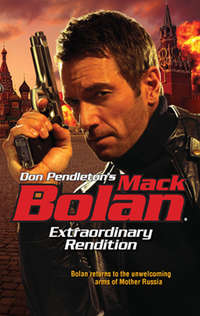
Czytaj książkę: «Extraordinary Rendition»
Brognola recognized Sokolov for what he was
The man was a player and a pawn. He armed the killers, but he also served them. And above him, shadowing his every move, were men and women who could take him off the board at any time. He lived because they found him useful for the advancement of their agendas.
The big Fed knew that removing Sokolov from circulation was a good thing. Putting him on public trial, revealing some of those he served might also benefit humanity. It wouldn’t stop the global arms trade or any of the slaughter that resulted from it, but it might slow the pace of killing. For a while.
If anyone could do the job, Mack Bolan was the man.
Extraordinary Rendition
Mack Bolan®
Don Pendleton

www.mirabooks.co.uk
It is ironical that in an age when we have prided ourselves on the intelligent care and teaching of children we have at the same time put them at the mercy of new and most terrible weapons of destruction.
—Pearl S. Buck
1892–1973
What America Means to Me
Gods are born and die, but the atom endures.
—Alexander Chase
1926–
Perspectives
Forget the old line about meddling in God’s domain. This time terrorists are meddling in mine. And they’ll regret it.
—Mack Bolan
For Private First Class Ross A. McGinnis
1st Platoon, C Company, 1st Battalion, 26th Infantry
God keep
CONTENTS
PROLOGUE
CHAPTER ONE
CHAPTER TWO
CHAPTER THREE
CHAPTER FOUR
CHAPTER FIVE
CHAPTER SIX
CHAPTER SEVEN
CHAPTER EIGHT
CHAPTER NINE
CHAPTER TEN
CHAPTER ELEVEN
CHAPTER TWELVE
CHAPTER THIRTEEN
CHAPTER FOURTEEN
CHAPTER FIFTEEN
CHAPTER SIXTEEN
CHAPTER SEVENTEEN
CHAPTER EIGHTEEN
CHAPTER NINETEEN
CHAPTER TWENTY
CHAPTER TWENTY-ONE
CHAPTER TWENTY-TWO
CHAPTER TWENTY-THREE
EPILOGUE
PROLOGUE
Kotlin Island, Gulf of Finland
Special Agent Robert Marx thought it was funny how things seemed to change but actually stayed the same. Staring across the dark, cold water of the gulf before him, he could see the bright lights of Saint Petersburg. Founded under its present name in 1703, the regal city had been renamed Petrograd in 1914, changed to Leningrad in 1924, then had become Saint Petersburg once more in 1991.
The more things changed, the more they stayed the same.
Take extraordinary rendition, for instance.
It was a fancy name for kidnapping, dreamed up by some Washington bureaucrat back in the eighties, a means of returning international fugitives to America for trial, even when they were sheltered by a hostile state. After 9/11 the phrase had morphed into a euphemism for shipping terrorist suspects off to friendly nations where “aggressive questioning” was commonplace.
Another euphemism. Why not call it torture?
Regardless, the pendulum had swung again, and the Justice Department was saving rendition for hard-case felons whose wealth and/or political connections placed them effectively beyond the law’s reach.
Scumbags like Gennady Sokolov.
For his sake, Special Agent Marx and seven other members of the FBI’s elite Hostage Rescue Team were standing in the icy early-morning darkness of Kotlin Island, twenty miles west of Saint Petersburg and a mile west of the Kronstadt seaport.
There were no hostages at risk this night. The mission was a basic find-and-snatch.
Extraordinary rendition.
Their target was a dacha built by Sokolov as a retreat from the daily grind of his murderous business. The team had helicoptered in from the mainland, and their chopper was waiting to take them back again, plus one. A charter jet was also standing by at Pulkovo II International Airport, eleven miles from downtown Saint Petersburg, with its flight plan to London on file.
From there, it was home to the States.
If they lived through the night.
Marx had handpicked his team, choosing only the best. He had two seasoned snipers, one packing a Remington M-40 A-1 .308 sniper rifle fitted with a Unertl target scope, and the other armed with a Barrett M-86 A-1 “light Fifty” in case they had to take out any armored cars. Chuck Osborne carried a Benelli M-4 Super 90 semiauto shotgun, for opening doors and flattening humans. Marx and the other four men on his team were armed with Heckler & Koch MP-5 SD-6 submachine guns, with retractable stocks, integrated suppressor and 3-round-burst trigger groups. As sidearms, all HRT members carried the “Bureau Model” Springfield Armory TRP-PRO in .45 caliber.
Good to go.
They’d waited two hours for Sokolov and his men to fall asleep. Now it was time to make the grab and get the hell off Kotlin, before they ran out of luck.
The snipers were deployed, already covering the grand three-story house, as Marx led his team through the dark toward their selected entry point. It might not be an easy snatch, considering the target, but they’d trained on a scale model of the house, built back at Quantico specially for their mission.
They were as ready as they’d ever be.
Marx led the way, as usual. He was his own point man, never asking any other member of the HRT to do a job he personally shunned. Another thirty yards or so, and they’d have cover from the dacha’s seven-car garage while they prepared for entry.
Just a little farther, and—
The night vanished around them in a blaze of metal halide lamps. A deep metallic voice demanded their immediate surrender, first in Russian, then in English.
Marx reacted while the faceless drone was midway through his spiel, raising his SMG and firing at the nearest bank of lights. His team responded instantly, blazing away to either side. Their submachine guns whispered, while the big Benelli shotgun thundered. From a distance, Marx’s snipers opened up, but they were short on living targets.
Half the halide lamps were dark and smoking when the muzzle-flashes started winking all around the FBI strike team. Marx staggered as a bullet struck his body armor, bruising his chest underneath the Kevlar vest. He shifted targets, firing at live enemies instead of floodlights now, seeing the mission go to hell and praying that he could still get his team out intact.
But two of them were down already, Jurecki and Zvirbulis—their two Russian-speakers—sprawled on the driveway’s pavement, deathly still. Marx didn’t want to see the pools of crimson spreading underneath their supine forms, steaming from contact with the frigid air.
Marx felt his magazine run dry and dropped it, reaching for a fresh one. He’d withdrawn the new mag halfway from its pouch on his tactical vest when a slug punched through his armpit, slipping past the armor, tumbling through his rib cage and right lung.
The shock of impact dropped Marx to the pavement. Numb fingers lost their grip on his SMG, and he heard it clatter out of reach. Around him, twitching, jerking, he could see the other members of his team dropping like shattered mannequins.
Maybe the snipers could escape in time and reach the waiting chopper. If they weren’t cut off on their retreat and—
Marx blinked as a shadow fell between him and the halide lamps that hadn’t been shot out. It took the last of his remaining strength to turn and face the weapon leveled at him.
“Goodbye, American,” the gunman said.
CHAPTER ONE
Moscow, Russia
Mack Bolan had the Beatles in his head, Paul and John singing “Back in the USSR” as his Aeroflot Airbus A330-200 circled in a holding pattern over Domodedovo International Airport.
But it wasn’t the USSR anymore. Now, it was the Russian Federation, totally divorced from all the cold-war crimes of communism, prosperous and overflowing with democracy for all.
Sure thing.
And if you bought that, there were time-share contracts on the Brooklyn Bridge that ought to make your eyes light up, big-time.
This wasn’t Bolan’s first visit to Russia, but familiarity didn’t relieve the tightening he felt inside, as if someone had found the winding stem to his internal clock and given it a sudden twist. Nerves wouldn’t show on Bolan’s face or in his mannerisms, but they registered their agitation in his gut and in his head.
Russia had always been the big, bad Bear when he was growing up, serving his country as a Green Beret, and moving on from there to wage a one-man war against the Mafia. Moscow, the Kremlin and the KGB—under its varied names—had lurked behind a number of the plots Bolan had privately unraveled, and had spawned a fair percentage of the threats he’d faced after his government created Stony Man Farm and its off-the-books response to terrorism.
Then, as if by magic, virtually overnight, that “evil empire” had been neutralized. Governments fell, the Berlin Wall came down and the Soviet Union shattered like crockery dropped on concrete.
Threat neutralized?
Hardly.
In some ways, from the global export of its vicious Mafiya to home-grown civil wars, continued spying and subversion, and free-floating swarms of ex-government agents peddling the tools of Armageddon, Mother Russia was more dangerous than ever.
And Bolan was going in to face the Bear unarmed.
Well, not the whole Bear, if his mission briefing had been accurate. More like a litter of rabid cubs, protecting a rogue wolverine.
Bolan broke that train. His enemies this time—like every other time—were men, not animals.
No other animal on Earth would kill thousands for profit. Or for pleasure.
The pilot’s disembodied voice informed him that their flight was cleared for landing. Finally.
Domodedovo was one of three airports serving Moscow, the others being Sheremetyevo International and Vnukovo International. Among them, the three handled forty-odd-million passengers per year. It should be relatively easy, in that crush, for one pseudo-Canadian to pass unnoticed on his way.
Should be.
Bolan had flown from Montreal to London with a Canadian passport in the name of Matthew Cooper. He was carrying sufficient ID to support that cover, including an Ontario driver’s license, Social Insurance card and functional platinum plastic. He also came prepared with Canadian currency.
So far, so good.
But Bolan wasn’t on the ground yet, hadn’t met his contact from the Federal Protective Service—FSB—Russia’s equivalent of the FBI.
So, what had changed?
Russian relations with America, perhaps. Depending on the day and hour when you turned on CNN to find out which world leaders were at odds with whom, and why. This week, it seemed, the Russians needed help and weren’t afraid to say so.
More or less.
But as for what Bolan would find waiting in Moscow, he would simply have to wait and see.
And not much longer now.
With an ungainly thump and snarl, the Airbus A330-200 touched down.
The Executioner was on the ground in Moscow, one more time.
YURI BAZHOV DISLIKED airports. He didn’t care for travel, generally, and he hated flying, but the main reason for his dislike of airports was their fetish for security. They teemed with uniforms and guns that he could see, while other police were undoubtedly lurking in plainclothes or hiding in back rooms and watching the concourse with closed-circuit cameras.
Bazhov stopped short of spitting on the floor, which would have drawn attention to himself. The last thing he needed, standing with a GSh-18 automatic pistol tucked under his belt at the small of his back, was for some cop or militiaman to stop and frisk him on vague suspicion.
The job had to be important, he supposed, although it didn’t sound like much. Taras Morozov didn’t send a six-man team out to the airport every day, with orders to collect a stranger flying in from Canada.
Not greet him, mind you. Just collect him.
Bazhov had to smile at that, though cautiously. Smiling for no good reason could draw notice, just the same as spitting on the floor. Most anything out of the ordinary could spell trouble, if you thought about it long enough.
Collect the stranger, he’d been told. Taras had given him a name and flight number, then placed him in charge of the collection team. Which was an honor in itself.
Collect could mean a hundred different things, but Taras had added one crucial proviso. Bazhov had to deliver the stranger alive. Not necessarily undamaged, but breathing and able to speak.
More specifically, to answer questions.
Bazhov wondered if he would be privileged to witness that interrogation. Certainly, he wouldn’t be in charge of it. The family had specialists for such occasions, legendary in their way. Kokorinov was probably the best—or worst—a cold man with no concept of remorse or mercy. Bashkirtseva favored power tools, but could be flexible. Nikulin was a savage, plain and simple.
Any one of them could teach Bazhov a thing or two, perhaps speed his advancement up through the ranks. Though, come to think of it, his choice to head up the collection team was quite a vote of confidence.
He needed to be certain that he didn’t fuck it up.
Bazhov squinted at the monitor, watching its list of flight arrivals and departures scroll across the screen. He suspected that he would need glasses soon, a damned embarrassment and scandal at his tender age of thirty-five, but he would put off the indignity as long as possible. The first person who made fun of him was dead.
According to the monitor, the flight from Montreal had landed more or less on time, a minor miracle for Domodedovo International. Bazhov couldn’t approach the gate where passengers deplaned—another security precaution—and he didn’t know whether his target had checked luggage in the belly of the plane. To cover every possibility, he had two men on standby at the baggage carousels, two more positioned where he could observe them from his present station, and his driver, on call, driving incessant loops around the terminal.
If anything went wrong with the collection, it wouldn’t be Yuri Bazhov’s fault.
But he would pay the price, regardless.
Such was life.
Bazhov saw passengers emerging from the corridor that served the various arrival gates, plodding along with the enthusiasm of dumb cattle entering an abattoir. A few cracked smiles on recognizing relatives or lovers who had come to greet them. Most kept their faces deadpan, as if it would cost them extra to reveal a trace of human feeling.
Bazhov felt his pulse kick up a notch when he picked out his target. He hadn’t been shown a photograph, but the description fit, albeit vaguely. More than anything, it was the target’s bearing that betrayed him.
Yuri Bazhov recognized a killer when he saw one.
After all, he owned a mirror, didn’t he?
SPOTTING A TAIL on foreign turf, particularly in a crowded public place that welcomed strangers by the thousand every hour, could be difficult, to say the least. In airports, where small hordes of people gathered, scanning faces of the new arrivals to pick out their loved ones, partners, rivals, even people they have never met but have been paid to greet, curious staring was routine. The rule, not the exception.
Bolan was on alert before he cleared the jetway fastened to the bulkhead of the Aeroflot Airbus. He had a likeness of his contact memorized, but there was always a chance of some last-minute substitution. People got sick or got dead. They got sidetracked and shuffled around on some bureaucrat’s whim. Whole operations got scuttled without any warning to agents at risk on the ground.
Bolan followed the flow of humanity past more arrival gates, following the multilingual signs directing passengers to immigration and passport control, to customs, baggage claim and ground transportation. His only baggage was a carry-on, and he was expecting a ride at the end of his hike through the concourse, but there was no mistaking the rest.
Bolan showed his passport to an immigration officer whose cropped hair, military uniform and plain face conspired to disguise her sex. She held the passport up beside his face, her eyes flicking back and forth between the photo and its living counterpart, then asked him the obligatory questions. Bolan answered truthfully that he didn’t intend to spend more than a week on Russian soil, and that he had no fixed address in mind.
“So, traveling?” she asked.
“That’s right.”
Frowning, the agent stamped his passport with a vehemence the task scarcely deserved, and passed him on to customs. There, a portly officer with triple chins pawed through the contents of his carry-on, presumably in search of contraband.
“No other bags?” he asked.
“That’s it,” Bolan replied.
“And if you need more clothes?”
“American Express.”
Apparently disgruntled at his failure to discover some incriminating bit of evidence, the agent scowled at Bolan’s passport stamp, then nodded him along to clear the station.
Thirty feet ahead of Bolan stood a wall of frosted glass, preventing those who gathered on the other side from seeing what went on at customs. Bits of faces showed each time the exit door opened and closed, but Bolan didn’t think his contact would be pushing up to head the line.
He cleared the doorway, with a hefty woman and her two unruly children close behind him. Bolan let them take the lead, converging on a thin, small-headed man whose pale face registered despair at the sight of them.
The joys of coming home.
Bolan was looking for his contact when he saw the skinhead on his left, leaning against a wall there, staring hard at Bolan’s face until their eyes met. Caught, be broke contact and made a show of checking out the other passengers, while muttering some comment to the collar of his leather jacket.
Glancing to his right, Bolan picked out another front man of the not-so-welcoming committee, nodding in response to something no one else could hear, hand raised to press an earpiece home.
Clumsy.
But in his present situation, Bolan thought, how good did his opponents really need to be?
“I THINK HE SPOTTED us!” Yuri Bazhov stated.
“So, he has eyes,” Evgeny Surikov replied, his voice a tinny sneer through Bazhov’s earpiece. “What’s the difference?”
Seething with anger yet afraid to make a spectacle in public, Bazhov hissed at the small microphone concealed on his lapel. “What do you think, idiot? That we should take him here, in front of everyone?”
“Why not?” Danil Perov chimed in.
Turning away from customs, Bazhov fell in step a dozen yards behind his target. “I don’t want the damned militia coming down on us,” he said into the microphone. “Whoever wants to be arrested, do it somewhere else. You can explain to Taras personally, if you don’t like following his orders.”
That silenced the bellyachers for now. Bazhov followed his man, still unsure where the stranger would lead him. The target carried a bag, but might have other luggage awaiting attention downstairs. Who flew to Moscow with a single bag, even if he was only staying for the night?
Who was this man? Why did he matter to the Family?
Nobody tells me anything, Bazhov thought, frowning to himself.
All right, the bosses didn’t owe him any explanation, but he should be told enough to let him do his job effectively and safely. What if this one was some kind of kung fu expert, for example? What if he was carrying a deadly virus in his blood or sputum? Bazhov and his men could wind up beaten to a pulp, infected with some damned thing that would kill them slowly.
Before it came to that, he’d use the GSh-18 and damn the consequences. But it was a last resort, and if he had to kill the stranger, Bazhov might consider saving one round for himself.
The target didn’t turn to see if anyone was following his path along the concourse. He played it cool, but Bazhov was convinced that he’d been spotted, maybe Surikov, as well. That made the job more difficult, but not impossible, by any means.
With odds of six to one, how could they lose him?
They took the escalator down toward the baggage claim and ground transportation area, and the other services designed to hasten new arrivals from the airport. Bazhov couldn’t help scowling as his target reached the bottom and turned left, away from the long bank of luggage carousels.
“No bags,” he told the microphone. “Repeat! No bags. Vasily, Pavel, come rejoin us.”
“On my way,” Vasily Radko answered.
“Coming,” Pavel Malevich replied.
Apparently, their target meant to hire a car. He had no less than half a dozen agencies to choose from, but he might have reservations with a car already standing by. In either case, they had to intercept him, before he vanished into city traffic.
Domodedovo International stood twenty-two miles from downtown Moscow. Call it a half-hour’s drive if nobody was speeding, drawing attention from traffic police. In the worst-case scenario, Bazhov could stop the mark’s car in transit, stage an accident if need be and lift him before the militia arrived.
Better to take him at the airport, though, perhaps in the garage where the hired cars were kept shiny-clean, with their dents and scratches inventoried for insurance purposes. There would be fewer witnesses, none likely to step forward and defend a stranger in the face of guns.
“Close in,” Bazhov commanded. “We will take him when he goes to fetch his car.”
ANZHELA PILKIN SMELLED the trap before she saw it closing on the stranger she had come to meet. She seemed to have a sixth sense for such things—so much so, if the truth be told, that fellow agents of the FSB sometimes referred to her as wed’ma.
Witch.
Unfortunately, she wasn’t a witch, only an FSB lieutenant who couldn’t work magic on a whim. She couldn’t twirl a wand and make the thugs who had staked out her contact disappear.
But in a pinch, she could draw her Yarygin PYa pistol and make them die.
Lieutenant Pilkin hoped it wouldn’t come to that. Her mission was covert, and her superiors would frown on gunplay at the airport. It was something they expected from Chicago, New York City—anywhere but Moscow, in the midst of a top-secret operation. Public killing that involved police would spoil the play.
And it would do no good for her career.
She watched the procession pass by, concealed behind a tourist information kiosk, shifting her position to prevent herself from being seen. It was impossible to say if the American now traveling as Matthew Cooper had discovered he was being followed. And while Pilkin hoped so—hoped that he wasn’t oblivious to such an obvious approach—she also dreaded what might happen if he tried to ditch the trackers on his own.
Pilkin visualized a free-for-all, fists flying, maybe weapons drawn, and what would happen next? When the militia came, what could she do?
Follow her contact to his holding cell, perhaps, and try to talk him out of custody? She might be able to pull rank on the militia, but to what end? Exposure of the man would automatically abort their mission, and she knew that her superiors likely wouldn’t permit a second effort.
So, whatever she attempted, it would have to be unauthorized and hidden from the brass at FSB headquarters.
She was on her own.
Pilkin watched the tall American bypass the sign directing him to the baggage claim and head off toward the bank of kiosks that dispensed hired cars. She knew he was expecting her to pick him up, which meant that his diversion was precisely that: a stall, either to locate her, throw off his enemies, or both.
Before the man she knew as Cooper cleared another thirty yards, Pilkin counted five men trailing him. They might have passed unnoticed in the flow of passengers, airport employees and assorted idlers, if she hadn’t been well trained and they had been more skillful.
Enemies came in all shapes, sizes and colors. Some were natural chameleons, while others stood out for their bearing, brutish looks, or quirks that give away their secrets. These five shared a common arrogance most often seen in the associates of the Russian Mafiya—and all of them were talking to themselves in turn, revealing to an educated watcher that they kept in touch by means of tiny two-way radios.
And they were armed. The bulges visible beneath some of their jackets told Pilkin that, and she assumed the ones whose weapons weren’t evident had simply dressed themselves more carefully. They passed a few militia officers along the way, but were ignored.
So much for tight airport security.
Anzhela Pilkin had a choice to make.
She could keep following her contact and his shadows, wait until they made a move and try to intervene, or she could leave the terminal and fetch her car. Be ready when he needed her.
The second course of action took some faith.
She had to trust that the mobsters were smart enough to bide their time and seek a place with fewer witnesses before they made a move. And she had to trust her contact to remain alive for several minutes on his own, away from Pilkin’s observant eyes.
She made her choice, broke off pursuit and started walking swiftly—nearly running—to the closest exit from the airport terminal.
WITH NO SIGN of his contact, Bolan had a choice to make. His basic options were to wait inside the airport terminal or leave it, but both choices had their built-in risks.
Waiting meant somehow dealing with the watchers who were trailing him. He’d counted three, but couldn’t tip his hand by dawdling along and sneaking peeks for any others who had joined them. Three was bad enough, with Bolan presently unarmed. A confrontation in the terminal would draw police, and that would be the end of his mission, whether he survived or not.
Leaving the terminal posed different risks. He could obtain a rental car with no great difficulty, but his shadows would most likely make their move when he went to collect it in some nearby parking lot or garage. Bolan assumed that some of them, at least, were armed. Whether their orders were to kill him on the spot or bring him out alive, when he resisted, one or more of them might snap.
And if he managed to survive that showdown, even take their weapons for himself, then what? He’d be adrift in Moscow, with its thirteen million people and no way of reaching his contact.
Who might or might not even be alive.
Bolan couldn’t approach the U.S. Embassy, since he was traveling as a Canadian. It wouldn’t help to reach the CIA’s station chief, since the Company had been frozen out of his mission. He had contacts, but only for potential “cleanup” jobs. Forget the Canadian consulate, too. Even if they agreed to send him “home,” his mission would have failed.
On the flip side, he couldn’t drop by FSB headquarters in Lubyanka Square and spill his story to a desk sergeant, either. The Russian side was worried about leaks of their own, keeping a tight lid on the operation. It was strictly need-to-know, or so he’d been informed, although the men now stalking him were living evidence that someone had to have spilled the beans.
The good news was that if he managed to clear the airport alive, he knew enough about his target to reach the man’s last known address. Bolan supposed that he could arm himself in Moscow, with an estimated 170,000 illegal guns in circulation, but what of it?
His mission didn’t call for an assassination. He’d been sent to find, extract and deliver one man to a team that would put him on ice and presumably ship him off somewhere for trial.
That end of it was not Bolan’s concern. But he’d been told, with heavy emphasis, that Washington required this guy alive. His showcase trial, apparently, was more important than the man himself or any of his crimes.
A message to the predators: no matter where you hide, you are within our reach.
As if they’d care and somehow magically reform.
Unless Bolan could bag his man and summon the extraction unit, none of that was happening.
He made his choice, passed by the car-rental kiosks and kept going, toward the nearest exit from the terminal. He would choose his ground, confront his enemies and see what happened next.
Outside, the sun was going down. The late afternoon was warm and humid, making Bolan’s shirt stick to his skin. Across six lanes of airport traffic, opposite his exit door, stood a tall parking garage. Hired cars were picked up and returned on the ground floor. The rest, Bolan supposed, was rented by the space to travelers or those on hand to meet them.
It would be as good a battleground as any.
He had one foot off the curb when a little gray sportster squealed to a stop in front of him, its right-front fender nearly grazing his shoe.
Behind the wheel, the face he had been watching for since his arrival snapped at him, “Get in, will you, while you still can!”
CHAPTER TWO
Washington, D.C., two days earlier
The International Spy Museum was located at 800 F Street Northwest, one block east of Ford’s Theater and one block north of FBI Headquarters, directly opposite the Smithsonian American Art Museum and the National Portrait Gallery. It occupied five buildings, renovated at a cost of forty million dollars, and had earned its keep with interest since it opened in July 2002.
The museum had no parking lot of its own, so Bolan left his rental in a commercial garage two blocks over and walked back, still early, enjoying the sunshine. Spring was being kind to Washington, so far.
He doubted that it would be kind to him.
Only a few museums in Washington charged entrance fees. The Spy Museum was one of them, collecting twenty dollars from adults and shaving off a buck for active-duty members of the military. Entry through a “controlled” checkpoint included receipt of cover profiles for each visitor, with instructions to memorize the details in five minutes flat. Fledgling spies received a simple “mission,” but weren’t required to complete it. Staff “police” stopped visitors at random, grilling them for details of their cover, adding just a hint of spice. For true enthusiasts, the interactive Operation Spy pavilion offered simulations that included detection and disarming of a nuclear device.
Bolan went through the motions and moved on, idling past some of the museum’s six hundred exhibits depicting the evolution of espionage from ancient Greece and Rome to the twenty-first century. At any other time, it would have piqued his interest, but he had a real-life mission of his own.
Or would have, very shortly.
Keeping an eye on the time, Bolan drifted toward the museum’s Spy City Café, a snack shop for guests whose budgets wouldn’t cover dining at the adjacent, upscale Zola Restaurant. He wasn’t hungry, but he planned on meeting someone there.
And his contact, as always, was punctual.
“The fish is red,” Hal Brognola said as he sidled up to Bolan.
“Guess I’ll have the chicken, then,” Bolan replied.
Brognola frowned and said, “That’s not the counter-sign.”
“Sorry. I must’ve missed the memo.”
“Jeez. You kids today.”
“If I’m a kid, that makes you—what? A yuppie?”
“God forbid. Let’s take a walk.”
They walked.
“I thought this place would suit us,” the big Fed remarked. “With everybody hyped on spies and role-playing, we ought to fit right in.”
“But are we being shadowed?” Bolan asked, half-teasing.
“Hell, who isn’t in this crazy town?”
Bolan resisted the impulse to look around for lurking watchers. Paranoia in a spy museum was no way to begin a mission.
“So, what’s up?” he asked.
Brognola led him to a room labeled The Secret History of History. A black-garbed ninja figure stood beside the door, arms poised as if to strike, defending upright panels filled with Japanese calligraphy. Beyond the threshold lay exhibits dedicated to some well-known spies, and others who had flown beneath the radar in their day.
Pausing before an exhibit devoted to Harriet Tubman and the Underground Railroad, Brognola asked, “Are you familiar with Gennady Sokolov?”
“By reputation,” Bolan said. “Papers call him the Merchant of Death.”
“And it fits,” said Brognola. “He’s ex-KGB, if there is such a thing. Retired as a major when the Soviet Union collapsed and went into private practice, selling anything and everything one group can use to kill another. Absolutely apolitical these days. He’s peddled arms, aircraft and military vehicles to everyone from Congo warlords to al Qaeda and the Taliban.”
“An equal-opportunity destroyer.”
“Anyone who pays can play,” Brognola said. “He’s supplied both government forces and rebels in fifteen African states that we’re sure of, plus others in Afghanistan and Pakistan, Colombia, the Philippines. He gets around.”
“And no one’s thought to rein him in?”
“Oh, sure. He’s got indictments coming out the old wazoo from Justice, Interpol, the Brits and Belgium, where he used to have a clearing house. You know the story, though. Filing a charge is one thing. Making an arrest and bringing him to trial is a whole other ball game.”
“I detect a note of bitterness.”
“Damn straight, you do. At one time, Sokolov had carte blanche from the Company and State to arm our so-called friends abroad. His cargo planes flew out of Florida, for Christ’s sake. Diplomatic cover, when he needed it. Of course, times change. Some of the mopes we armed ten years ago are enemies today. We’re taking hits from our own hardware, and it’s setting off alarms.”
“I’m not surprised,” said Bolan.
“Did you know that Sokolov did business with the UN for a while? And NATO? This is after his indictment, mind you. Even on the run, he’s still got friends he can tap for contracts in Iraq, Afghanistan and Sudan. Can you imagine that? Son of a bitch sells weapons to our private contractors, for hunting insurgents he’s armed to kill them. Talk about the candle burning at both ends.”
“Is he that hard to find?” Bolan asked.
“Just the opposite. Not hard at all. He lives in Russia, safe and sound. Their constitution bans extradition of any Russian citizen charged with acts that are legal in Russia itself.”
“Which includes selling arms under legal contracts.”
“Absolutely. They’ve done it for decades. So have we, the Brits, the French, Chinese—you name it. Hell, we’ve sponsored some of Sokolov’s transactions. In the Russian view, we’re just pissed off today because some of yesterday’s allies have jumped ship.”
“It doesn’t end there,” Bolan said.
“You got that right. Call it principle, machismo, whatever you like. The folks I report to aren’t letting it go. They’ve already tried once to extract Sokolov.”
“And missed him?” Bolan guessed.
“I wish that’s all it was. They lost eight guys from HRT. It damn near took an act of Congress just to get their bodies back.”
“So, he’s got tight security.”
“The best,” the big Fed said. “If that’s all it was.”
“You think someone on this side burned them?”
“I’m not pointing any fingers,” Brognola replied. “But any time the Bureau goes off campus, there’s a protocol for giving heads-up to the nearest chief of station for the Company. It helps with technical assistance and avoids stepping on any tender toes.”
“The whole new era of cooperation.”
“Don’t you love it? All the stupid backstabbing that came down from the Hoover-Langley feud supposedly got swept away with 9/11. The Company got back into domestic surveillance—assuming they ever got out—and Congress told everyone to play nice. Share the intel both ways, no more hoarding or disinformation between so-called allies.”
“Let me guess,” Bolan replied. “It isn’t working.”
“That depends on what you mean by working. After all the fretting and reshuffling, look at the twenty-two agencies lumped together in Homeland Security. You’ve got the Secret Service, Customs, Immigration, the Coast Guard, FEMA, the Border Patrol—even the Plant and Animal Inspection Service, for God’s sake. But who’s left out?”
“The Bureau and the Company?”
“Bingo! A minor oversight, okay? Leaving our two primary intelligence agencies on the outside, looking in. And if you think the falling towers made them start to love each other, guess again.”
“Business as usual,” Bolan observed.
“Or worse. Who doesn’t want a ton of money to fight terrorism? Spend it any way you like. Just get the job done.”
“Well…”
They’d drifted into an exhibit labeled “Spies Among Us,” laying out the history of espionage preceding World War II—or, at least, one version of it. Bolan saw no mention of the meeting at FBI Headquarters in November 1941, where J. Edgar Hoover had rejected warnings of an impending attack on Pearl Harbor and threw the informant out of his office.
“The problem arises,” Brognola said, “from conflict of interest. Let’s imagine Langley has an asset helping arm its clients in the field, while Bureau agents try to lock him up for arming terrorists. One side indicts, the other intervenes. It could get nasty.”
“Sokolov’s still dealing with the Company?”
“A rumor,” Brognola replied. “These things are written on the wind, you know. If there’s a document to prove it, I’d be very damned surprised.”
Bolan had never given any major thought to how his own missions were logged at Stony Man. He had assumed some record had to exist, suitably sanitized in the best interest of all concerned.
“And if the Bureau thinks the Company’s responsible for eight men down…”
“We’re talking cloak-and-dagger civil war,” Brognola said. “Aside from which, their boy’s still out there, dealing any damned thing he can get his hands on. Which, I’m told, included enough loose nukes to light up all our lives.”
“You want him taken out of circulation.”
“Not just taken out. Returned alive for trial.”
“That could turn out to be embarrassing,” Bolan suggested. “Airing all that dirty laundry in a courtroom won’t do much for either side’s prestige.”
“We’re the mechanics on this job,” Brognola said. “Or, rather, you are. Bring him back alive.”
“Or?”
“There’s no or on this one. We could always find a way to smoke him. Drop a smart bomb down his chimney Christmas Eve and claim that Santa farted on the fire. Whatever. Trial is deemed essential, PR-wise.”
“Terrific.”
“Should you meet our boy’s suppliers and customers, however, then the gloves are off. For them, not him. No one will think twice if they go down for the count.”
“You mean, no one in Wonderland.”
“That’s understood. Of course, their friends and family may take offense.”
“At least my hands aren’t tied.”
“Look at it this way,” Brognola suggested. “It’s an all-you-can-eat buffet, except for one small item in a doggie bag.”
“That makes it so much easier.”
“I’ve got the background information that you’ll need, and intel on your contact.”
“Someone from the Company?” Bolan asked.
“Better. From the FSB.”
“Outstanding. All I need now is a Cheshire cat.”
“Maybe you’ll find one as you go along.”
Brognola pulled a CD in its jewel case from an outer pocket of his coat and handed it to Bolan. The soldier palmed the gift, catching a small boy nearby watching from the shelter of his mother’s skirt. Wide-eyed and curious.
Bolan gave him a smile, raising a cautionary finger to his lips, and made the jewel case disappear.
“Who’s that?” Brognola asked.
“My backup,” Bolan said. “He kneecaps anyone who tries to follow me.”
“He’s built for it.”
“So, I’ll look over this and book a flight to…where, again?”
“Moscow. Our boy lives near Saint Petersburg, but he’s forever back and forth, tending to business.”
“With any luck,” Bolan said, “I can interrupt his cash flow.”
“Interrupt him altogether,” Brognola replied. “But gently, if you please.”
“My middle name.”
“Uh-huh.”
“We ought to talk about what happens to the target if it all goes sideways,” Bolan said. “How badly do you want him breathing, if I can’t deliver him intact?”
Brognola frowned. “The notion of your failing,” he replied, “has never crossed my mind.”
THAT WAS A LIE, of course. Brognola’s job at Justice—and at Stony Man—was to consider all the options anytime he put an asset in the field. Failure was always possible, no matter how much he abhorred the thought of it.
Mistakes were made. Luck turned. Men died.
Sometimes the wrong men died. And women, too.
Brognola didn’t like to think about that aspect of his job, but he was paid to think about it, to plan around it. Have another hole card tucked away when best-laid plans went south, sideways, or up the chimney in a puff of smoke.
False modesty aside, Brognola was the best in Washington at what he did, which, on the public record, was a paper-shuffling job at the Justice Building on Pennsylvania Avenue.
He weighed the price of failure in advance. His field agents were also friends, a lapse in strict professionalism occasioned by the circumstances of their meeting. Bolan and the rest had crossed Brognola’s path initially while he was with the FBI, assigned to bust the Mafia. He’d played within the rules in those days—to a point, at least, before he’d seen the Executioner in action, scoring wins with the direct, scorched-earth approach.
The rest was history. He’d known who to recruit when Stony Man was organized, and they’d been carrying the fight to human predators around the globe since then.
But not without a cost.
Sunlight enveloped Brognola as he emerged from the International Spy Museum. It stung his eyes and cued his sweat glands to resume their labor. Slipping on a pair of sunglasses, the big Fed focused hard on blocking out the names and faces of lost friends who jockeyed for position in his mind.
Go back to sleep, he warned them. I’ve got work to do.
And leaks to plug. Maybe.
It wouldn’t be the first time that a rivalry between competing federal agencies had drawn blood. In most such cases, wrists were slapped, someone was reassigned or quietly encouraged to retire. Charges were rarely filed. Brognola couldn’t think of anyone who’d actually gone to trial during his decades on the job.
Agents were jailed for bribery on rare occasions, or for selling secrets to a foreign power, but screwing with their rivals in the “sister” services was more or less a given.
Until someone bought the farm.
Brognola made himself a promise. If he found out someone in the Company—or any other branch of government—had sent eight G-men to their deaths in Russia, he would see the guilty parties punished. Off-the-books, if necessary.
Even if he had to do the job himself.
“Homeland security” was nothing but a joke—and a bad one, at that—if the people who’d sworn to uphold it spent all their time looking for ways to hamstring one another. They were worse than useless, in that case.
They were the enemy.
Brognola had spent his professional life negotiating red-tape jungles and negotiating labyrinths of office politics. He played the game as well as anyone in Washington.
But he was sick of it.
In peacetime, it was one thing. Call it busywork or personal amusement. Each department had a reputation and budget to protect—goals that could often be achieved more easily by undercutting so-called friends than going to the mat against real enemies.
But peace, such as it was, had ended when those hijacked planes hit the Twin Towers and the Pentagon. Like it or not, the country was at war, with no end in sight.
And in a war, you either pulled together…or you lost.
In wartime, those who helped the enemy were traitors.
And in Brognola’s world, traitors could expect no mercy.
As for Sokolov, the global death merchant, Brognola recognized the man for what he was. A player and a pawn. He armed the killers, but he also served them. And above him, shadowing his every move, were men and women who could take him off the board at any time. He lived because they found him useful for advancement of their various agendas.
Brognola, likewise, had masters watching him and breathing down his neck. Self-interest motivated them, like anybody else, and he could only hope that their needs in this instance coincided with some greater good.
Alive or dead, removing Sokolov from circulation was a good thing. Putting him on public trial, revealing those—or some of those—he’d served might also benefit humanity. It wouldn’t stop the global trade in arms or any of the slaughter that resulted from it, but it might slow down the pace of killing.
For a day or two.
Small favors, Brognola thought as he neared the entrance to his subway stop.
If anyone could do the job, Mack Bolan was the man.
BOLAN SAT in a drab motel room on I-495, better known as the Capital Beltway. His focus was the laptop humming softly on the smallish writing desk in front of him. Brognola’s CD-ROM was giving up its secrets, prepping him for Moscow and beyond.
First up were photos of Gennady Sokolov, with a detailed biography. Bolan surveyed the high points. Born in 1962, in what was now Turkmenistan. No record of his parents had survived, nor any hint of siblings. Sokolov had joined the Russian army at eighteen, had made the cut for Spetznaz—Russia’s special forces—eight months later, and had been a captain by the time he mustered out to join the KGB in 1984. Six years later, he had graduated from Moscow’s Soviet Military Institute of Foreign Languages, fluent in English, French, Spanish, German and Arabic, besides his native tongue. After the Soviet collapse, he was in business for himself.
And what a business it had been.
Over the past two decades, Sokolov had founded half a dozen cargo airlines, shipping military hardware out of La Paz; Miami; the United Arab Emirates; Liberia and Ostend, Belgium. From 1992 until the present, Sokolov had armed at least one side in every war of any consequence, and several dozen that had barely rated mention by the talking heads at CNN. He’d left his bloody tracks in Africa and Southeast Asia, in the Middle East, Latin America and Bosnia. In nations theoretically at peace, Sokolov’s weapons and explosives found their way to neo-fascists, would-be revolutionaries, ecoterrorists and mafiosi.
Sokolov had been arrested once, in Thailand, but had bribed his jailers to go deaf and blind while he escaped and caught a charter flight out of the country. That had been two years ago, and in the meantime Sokolov had spent most of his time in Mother Russia. Recent sightings reported from Damascus and Islamabad remained unconfirmed. No charges had—or would be—filed against him in the death of eight FBI agents who’d died far from home, in a failed bid to end his career.
The next face up on Bolan’s laptop monitor belonged to Ruslan Kozlov, a sixty-year-old colonel general in Russia’s ground forces. The CIA pegged Kozlov as Gennady Sokolov’s primary source of Russian “surplus” military hardware, up to and including stray nuclear warheads. There would be other rogue suppliers scattered far and wide around the globe, but Kozlov was the source closest to home.
The general’s face was bland, with full cheeks, gray eyes under snowy brows, and a flat, Slavic nose. He had led troops in Afghanistan, commanded Russian forces in the Chechen wars, and had reportedly given the order for Spetznaz to gas Moscow’s House of Culture theater in October 2002, after Chechen separatists seized the building with nine hundred hostages. The gas and subsequent Spetznaz assault had killed the forty-two terrorists and at least 129 hostages, injuring an estimated seven hundred others.
The last face up on Bolan’s screen belonged to his contact, Lieutenant Anzhela Pilkin of the FSB. It wouldn’t be the first time he’d worked with a Russian agent, when Washington’s interests overlapped Moscow’s, and while none had betrayed him so far, Bolan always felt as if he was waiting for the other boot to drop.
The lieutenant was thirty years old, auburn-haired, with a grim sort of beauty that might be less rigid in person. Five-seven and 130 pounds, well versed in martial arts and skilled with standard Russian firearms, bilingual in Russian and English. According to Brognola’s dossier, she’d joined the FSB five years earlier, after a stint with the military. She’d been promoted to sergeant in that post, after killing a Ukrainian gangster during a drug raid, and had polished off two more sent by the first thug’s boss to punish her. The boss, one Mikola Hunczak, had made the next attempt himself and currently resided in Moscow’s Mitinskoe Cemetery.
Overall, not bad.
Bolan assumed Lieutenant Pilkin would cooperate with him as ordered by her FSB superiors. But going in, he had no fix on what her orders might entail. When working with Russians—or with anyone outside the normal crew at Stony Man, for that matter—he always kept his guard up, conscious of the fact that while he went about his business, others might be marching in pursuit of separate agendas.
Why, for instance, would the FSB collaborate in Sokolov’s extraction, when the government refused to simply extradite him? Was there something to be gained, some face to save, by ordering covert removal? Who was in the know concerning Bolan’s mission? Who on the official side might still oppose him?
Colonel General Kozlov could supply an army on short notice to protect his business partner, if he wasn’t ordered to stand down. Smart money said that Sokolov would also have his share of allies in the Russian Mafiya, who might resent him being snatched and packed off to the States.
And, as the FBI had learned the hard way, Sokolov had to have his own hardforce of mercenaries, paid to keep him safe and sound in Moscow, or his dacha near Saint Petersburg.
Against those odds—and the military, whose officers would do their best to cage or kill him, if and when they were aware of Bolan’s presence in their homeland—he would pit his own skills and the still-untested talents of his FSB contact.
Two against how many? Dozens? Hundreds?
Situation normal for the Executioner.
He prepped the files and tapped a button on the laptop’s keyboard to erase Brognola’s disk. When that was done, he’d break it into half a dozen pieces, just in case. There was no point in taking chances yet, even before he caught his flight across the polar cap to Moscow.
There’d be time enough to risk his life tomorrow.
Every day beyond that would be icing on the cake.
Darmowy fragment się skończył.