Czytaj książkę: «Altered State»
“A report?” Brognola said. “I’d like to see it.”
“I misspoke. Call it a rumor, if you like.”
“I don’t like rumors,” the big Fed stated. “Who are these valued contractors?”
The black eyes pinned him. “Let’s cut the crap. State officially objects to any unauthorized Justice programs you may be running in Afghanistan. That comes from the top. I hope it’s clear enough for you.”
“It’s crystal clear,” Brognola said, rising to his feet. “I can assure you without fear of contradiction that Justice has no unauthorized programs running in Kabul, or anywhere else. And that comes from the top. Have a good one.”
Brognola felt them staring daggers at him as he left. He had a problem now, a leak, and he would have to deal with it before he and Bolan landed in a world of hurt.
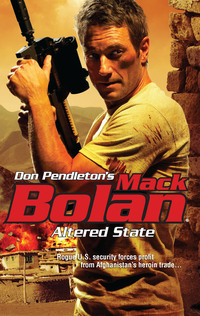
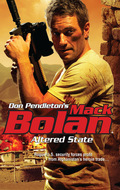
Altered State
Don Pendleton
Mack Bolan ®
 www.mirabooks.co.uk
We have to condemn publicly the very idea that some people have the right to repress others. In keeping silent about evil, in burying it so deep within us that no sign of it appears on the surface, we are implanting it, and it will rise up a thousandfold in the future. When we neither punish nor reproach evildoers…we are ripping the foundations of justice from beneath new generations.
—Alexander Solzhenitsyn
It’s time to reproach and punish evil, once and for all. Beginning here and now.
—Mack Bolan
For Corporal Jason L. Dunham, USMC
CONTENTS
PROLOGUE
CHAPTER ONE
CHAPTER TWO
CHAPTER THREE
CHAPTER FOUR
CHAPTER FIVE
CHAPTER SIX
CHAPTER SEVEN
CHAPTER EIGHT
CHAPTER NINE
CHAPTER TEN
CHAPTER ELEVEN
CHAPTER TWELVE
CHAPTER THIRTEEN
CHAPTER FOURTEEN
CHAPTER FIFTEEN
CHAPTER SIXTEEN
CHAPTER SEVENTEEN
CHAPTER EIGHTEEN
CHAPTER NINETEEN
CHAPTER TWENTY
CHAPTER TWENTY-ONE
EPILOGUE
PROLOGUE
Badghis Province, Northwestern Afghanistan
Black helicopters do exist.
After all the fervid speculation among UFO-watchers and conspiracy theorists, despite all the official denials and earnest assurances, unmarked whirlybirds of ill omen are seen on occasion.
And they always bear bad news.
The two aloft this morning, shortly after dawn, had lifted off from Murghab, heading northwest toward the border of Turkmenistan. They did not mean to cross the border, although such a violation of the law would not be out of character for anyone on board.
Their destination was a mountain village called Uzra, inhabited by peasants who had caused more trouble than their tiny lives were worth. This day, the men who called the shots were settling old accounts.
The black choppers were both Sikorsky UH-60L Black Hawks, each with a two-man crew and complement of twelve troops aboard, capable of cruising at 173 miles per hour with a top-end do-not-exceed speed of 222 mph. Their combat radius was 368 miles, but this morning’s jaunt covered only a fraction of that distance.
Each Black Hawk was armed—one with a door-mounted 7.62 mm M-60D machine gun, the other with an M-134 Minigun that spewed armor-piercing bullets from an electrically driven rotary breech at a rate of 4,000 rounds per minute.
Beyond that basic airborne armament, each member of the strike team carried either some variant of the M-16 assault rifle or a Mossberg 590-A1 12-gauge shotgun loaded with No. 4 buckshot—averaging seven hits per round on a man-size target at fifty yards. Most carried pistols of their own selection, chambered for 9 mm Parabellum or .45ACP, and all were packing grenades.
Just in case.
Most of the villagers in Uzra were awake and eating breakfast when the war birds fell upon them, dropping from the newly risen sun to skim at rooftop level, starting with a solid strafing run to soften up the target. The M-60D was brutally efficient, spitting death at a cyclic rate of 550 rounds per minute, but its stutter was eclipsed by the high-tech buzz of the Minigun shredding roofs, walls and bodies below.
Uzra was on the smallish side, for an Afghani village. Its population estimates waffled between 150 and 200 residents in winter, when the sheep stayed close to home. But this was spring, so an even hundred would be a closer count.
The inconvenience caused by Uzra’s citizens was out of all proportion to their numbers and position in Afghan society. Someone had not impressed them with their innate insignificance, and now they had to pay the price for stepping out of bounds.
Ten seconds, circling once around the place with weapons spraying in full-auto mode, turned Uzra into a chaotic shambles. Men, women and children ran or staggered from their riddled dwellings, seeking shelter they would never find, some of them dropping in their tracks to rise no more.
“That’s plenty,” said the strike team leader to his pilot. “Put us on the deck.”
Phase Two was mopping up and making sure that no one lived to profit from the lesson they had learned that morning.
Uzra, after all, was not a classroom.
It was an example.
Touchdown was a gentle bump in the midst of a dusty whirlwind whipped by the Black Hawk’s spinning rotors. Rising from his seat, the strike team leader faced his soldiers and reminded them, “No prisoners!”
They rushed past him toward the open bay, some snarling, others smiling as they jumped off into Hell on Earth.
CHAPTER ONE
Kabul, Afghanistan
Mack Bolan turned his rented car off Jadayi Maiwand, putting the Rudkhane-ye-Kabul River behind him as he entered the Old City, Sharh-e-Khone. He started looking for a place to park after he passed the giant Abnecina Hospital, aware that driving through the Old City without a guide could get him lost, despite the maps he carried.
It might even get him killed.
He found a fenced-in public parking lot, paid the young attendant one hundred Afghanis up front—about two dollars, U.S.—and received a numbered ticket in return. The young man smiled and seemed to wish him well as Bolan left the lot.
How did you say “good luck” in Dari or Pashto?
Bolan didn’t have a clue.
There’d been no time for him to study either of Afghanistan’s official languages, much less the other forty-five in use throughout the country. He would need a skilled interpreter and guide, which brought him to the heart of old Kabul, with soldiers in the streets.
Some of them were American, still hunting Taliban and terrorists nearly a decade after the invasion that was meant to punish those responsible for 9/11. Bolan had a diplomatic passport in his pocket that should answer any questions asked by U.S. soldiers who might stop him on the street.
As for the native military and police, if they tried to detain him, he would have a simple choice: either resist or bluff it out.
He definitely needed that interpreter.
The simple map of Sharh-e-Khone that he had memorized included streets and major landmarks, but it didn’t give the flavor of the Old City. It didn’t simmer with the tension Bolan felt around him, didn’t indicate the spots where bullets, fire and bomb fragments had scarred ancient walls.
Passing along the old wall that had once defended Kabul from its enemies outside, Bolan was conscious of the irony. This day, no matter which side you were on, the city’s enemies were all inside . Whether they strapped plastic explosives to their bodies or wore military uniforms, they were combatants in a struggle dating back, at least, to the Soviet invasion of the country in the latter 1970s.
Or should he take it further back, into the early nineteenth century, when British troops had made themselves at home here, in the midst of a society they never really understood? Where did the grim cycle of kill-or-be-killed have its roots?
Passing a line of busy market stalls, Bolan watched for tails, even as he was scouting for his next landmark along the route to locate his interpreter and guide.
The man he sought wasn’t supposed to be alone.
It was a two-for-one deal, this time, which compounded Bolan’s risk. Without even addressing trust issues, two contacts made it twice as likely that they would be followed to the meeting place. If Bolan’s guide was not under surveillance, then it stood to reason that the guide’s control—a DEA spook from the States—would be.
Bolan could only hope that one or both was smart enough to watch their backs and deal with anyone who tried to crash their rendezvous in Sharh-e-Khone.
In case they weren’t, he’d come prepared.
The pistol slung beneath his left arm was a Jericho 941, the simple but elegant Israeli-made 9 mm semiautomatic. It was slightly shorter than his usual Beretta, held one extra Parabellum round, and had its muzzle threaded for a sound suppressor.
Of course, the supressor was back in Bolan’s car, along with all the other martial hardware he’d acquired upon arrival, prior to seeking out his guide.
A soldier had to deal with first things first.
Now, as he passed a bank of aromatic food stalls, keeping track of each turn in his mind, he hoped the day that had begun with jet lag wouldn’t end with blood. A simple meeting and agreement to collaborate would suit him fine.
The killing would come soon enough.
It was, after all, his reason for being in Kabul to start with. The land that his country was making “safe for democracy” still had some serious problems. Negotiation might solve some of them. As for the rest…
Enter the Executioner.
“I WAS AFRAID HE MIGHT be late,” said Edris Barialy.
Deirdre Falk replied, “He isn’t late. Your watch is fast. Again.”
It was a challenge for him, working with a woman. Make that, working for a woman, since the slim brunette American was certainly in charge. She told him where to go and what to do, approved his weekly pay and judged when it was time for him to risk his life.
Like now.
As a strong Muslim—well, an adequate Muslim—Edris Barialy recognized the subordinate state of womankind established by God when He said, “Be” and created all things. Men were supposed to be the rulers of their homes and of the world, but things had changed a great deal in the world outside Afghanistan.
When Barialy had joined his first protest against the growing Afghan heroin trade, he had not expected covert contact from the American Drug Enforcement Administration. And when he accepted the DEA’s offer of part-time employment, using his freedom as a licensed tourist guide to gather intelligence on smugglers, he had not expected that his control officer would be female.
It was strange how things worked out sometimes.
Now here he stood in Sharh-e-Khone, waiting to meet yet another American. A specialist, as Deirdre Falk had described him.
But in what?
Nervous as he was about the meeting and whatever might ensue from it, Barialy had armed himself with a venerable Webley Mk IV .38/200 revolver. It weighed nearly three pounds and pulled down his slacks at the rear, where he wore it tucked under his belt, but Barialy felt better for having the gun close at hand.
He also prayed that he would not be called upon to use it.
Deirdre Falk carried a pistol, too, of course. Barialy had seen it but could not identify the weapon as to brand or caliber. It was some kind of automatic, presumably she had been trained to handle it.
Unlike Barialy himself.
He had served two years in the Afghan National Army, but his firearms training had been limited to practice with Kalashnikov assault rifles. After the basic course, he had been posted to a clerical position in Lashkar Gah, the capital of Helmand Province, and had never fired another shot.
Still, he knew guns as most Afghanis knew them, having grown up in a nation with one of the world’s highest concentrations of firearms per person—one gun for every two of Afghanistan’s twenty-three million citizens, according to estimates from Oxfam and Amnesty International. It had been simple to acquire the Webley and a stash of cartridges.
But as for using them, well, he would have to wait and see what happened next.
“Who is this man, again?” he asked.
“I told you,” Deirdre Falk replied.
“A specialist, I know,” Barialy said. “Could you be more specific?”
“Are you getting cold feet now?” she asked.
“I’m simply curious.”
“I’m told he’s someone who can cut red tape,” she said. “We’re blocked on this end, going nowhere. If he helps us break the jam, more power to him.”
Barialy understood and shared her natural frustration, but the “jam” she spoke of seemed to be, at least in part, a product of the very government that had dispatched her to Afghanistan. Could Barialy trust another agent from that government to set things right? Or would the specialist succeed only in making matters worse, perhaps increasing Barialy’s risk?
Give him a chance, he thought.
And then, the small voice in his head amended, But keep close watch over him.
And then, what, if it seemed that things were getting out of hand? Should he resign, break with the DEA? Or was that even possible?
At least he had the Webley, Barialy thought. And they had taken care not to be followed.
Still, in Kabul’s teeming streets it was impossible to guarantee security. For all he knew, the enemy might be observing them right now.
“I’ M GETTING BORED ,” Farid Humerya said. “They don’t do anything.”
“They brought us here,” Red Scanlon told him. “And they didn’t do it for the tourist thing. Keep watching.”
If the circumstances had been different, Farid Humerya might have told the rude American to do the job himself but Humerya had his orders.
Not from Scanlon and the pigs he served, although their interests coincided with the wishes of Humerya’s master. And Farid Humerya knew enough of life—and sudden death—to follow orders from the man he served.
He did not wish to think of the alternative.
“You think that they are meeting someone?” he asked Scanlon.
“Why else come down here, together?”
“We would know if they were seeing someone from the National Police or the Special Narcotics Force,” Humerya said.
Both agencies were riddled with corruption from top to bottom. They leaked information as if it was water poured into a sieve.
“Most likely,” Scanlon granted. “But we need to find out if it’s someone new.”
They sat watching their targets from a Toyota Prius, with two armed men in the backseat. Two other cars containing four men each—a Camry and a Volkswagen Passat—had the target zone boxed.
Despite their manufacture in Japan and Germany, the Toyotas and the VW were all emblazoned with maple leaf flags, marking them as “Canadian cars.” Imports from Canada were highly prized in Kabul, regardless of their original source or the fact that some had been refurbished after homeland accidents before finding their way to Afghanistan.
If their cars were mock-Canadian, the weapons carried in those cars were strictly Russian. Each man had an AKSU-74 assault rifle with folding metal stock and shortened 8.3-inch barrel, otherwise identical to the standard Kalashnikov assault rifle. The twelve of them together could fire 360 rounds without reloading, all within ten seconds.
And wouldn’t that cause bloody chaos in the Sharh-e-Khone?
“What shall we do if they are meeting someone?” Humerya inquired.
“See who it is, first,” Scanlon answered, none too patiently. “Identify them, if we can. Then make our move.”
“To capture them?”
“To do whatever’s necessary. Are you getting squeamish on me now?” the American asked.
“Of course not.”
It was an insulting question. Farid Humerya was certain he had slain more men than the American had ever dreamed of killing.
Then again, he might be wrong.
These grim-faced mercenaries were a breed apart. Like Humerya himself, they killed for money, but this lot also seemed to possess—or be possessed by—an evangelistic zeal. It seemed almost as if they thought their acts were sanctified he some exalted power beyond cash or earthly politics.
“Whatever happens,” Scanlon said, “we’ll have the edge.”
“I simply thought that with the soldiers all around, perhaps we ought to follow them and find a place less public.”
“It’s a thought,” Scanlon agreed. “But either way, we nip it in the bud. This bitch has caused too much trouble already.”
“Will eliminating her cause further problems for your people in the States?”
“That’s not my worry,” Scanlon answered. “And it’s sure as hell not yours.”
Humerya bore the rudeness, understanding that the arrogant American was simply following the dictates of his character. Coming from a culture fueled by sex and greed, he knew no better.
Which would not prevent Humerya from exacting sweet revenge, if the opportunity presented itself.
They were allies of convenience, which should never be confused with friends. Humerya had his orders to collaborate with Scanlon and the others while it served the purpose of Humerya’s masters. When the day came—and it would come—that the mercenaries served no further purpose in Afghanistan, the soil would drink their blood.
But in the meantime, he would watch and wait.
B OLAN KNEW THAT HE WAS getting close. His briefing on the ancient city had included detailed maps, plus satellite and ground-level photos of Kabul’s crowded streets. He recognized landmarks in passing, even if he couldn’t read their signs or tell exactly what trade they pursued.
The Sharh-e-Khone was a riot of colors and smells, the latter ranging from enticing aromas of food that made Bolan’s mouth water, to auto exhaust, raw sewage and a general musty odor of decay.
He could imagine the Crusaders marching—riding—through the very streets where he now walked, meeting the same looks of curiosity, suspicion or hostility that faced him now. The native clothing would have changed, at least a little, and the weapons that they used against him if their mood turned would be more advanced, but otherwise….
Bolan was well aware that many Muslims, in Afghanistan and elsewhere, still recalled the ancient conflict of religions during the Crusades, the same way many U.S. Southerners still brooded over stories of the Civil War. Throughout the Near East, though, grim memories of the Crusades were aggravated by a Western military presence—in Afghanistan, Iraq, Saudi Arabia—and by the saber-rattling on both sides that was too often cast in terms of Muslims versus Christians.
Bolan wasn’t a religious man, by any standard definition of the term, but he knew well enough how faith could bleed into fanaticism with a little push from pastors or imams who had agendas of their own and didn’t mind using their “flocks” as cannon fodder.
Not my problem, Bolan thought, as he drew closer to the designated meeting place.
Despite the setting, his primary targets on the present mission were Americans and self-styled Christians, not Afghani Muslims. Still, it was naive to think that he could pull it off without certain natives who collaborated in the traffic that was poisoning the West.
Come one, come all, he thought. And half smiled as he added to himself, But don’t come all at once.
More soldiers passed, in vehicles painted to match their desert cammo uniforms. They all wore sunglasses, and if they noticed Bolan, none gave any sign of it. Some of the natives watched them pass, scowling or showing poker faces, but the great majority ignored the military vehicle and men in uniform as if they had no substance.
In the long-term scheme of things, Bolan supposed, that was the truth.
He marked a pharmacy ahead and on his left, which meant that he had two more blocks to go. Aside from checking to make sure he wasn’t followed, Bolan now began to watch for indications of a trap.
The problem was, he wasn’t overly familiar with Kabul or its Old City, couldn’t tell whether its normal rhythm was disturbed or right on track. Cars raced and swerved along the narrow streets, parked anywhere they liked, apparently without regard to anything resembling traffic laws, and many of them bore anomalous decals that seemed to mark them as Canadian.
Another mystery.
Nearing the rendezvous, Bolan first checked the obvious. He saw no snipers on the nearby rooftops, no one leaning from an upstairs window with a rifle or an RPG launcher in hand. No one at street level displayed a weapon, and there was none of the war-torn country’s “secret” gun shops within view, where anyone could snatch an AK-47 off the rack.
So far, so good.
Bolan carried no photos of his contacts, but he’d memorized their faces prior to takeoff on his transatlantic flight. The native, his interpreter, was Edris Barialy, twenty-seven, an ex-soldier working undercover with the DEA.
The Yank, and Barialy’s boss—at least, in theory—Deirdre Falk, age thirty-five, with twelve years on the federal payroll. Bolan didn’t know where-all she’d served, but rookies who had never stained their hands with dirty work wouldn’t be posted to Afghanistan.
Well, not unless the brass in Washington was hoping they’d be killed or simply disappear.
Another dozen strides and Bolan had them spotted. They were standing just where he’d been told they’d be, outside a theater whose faded posters showed a wiry old man with a dragon. Bolan couldn’t tell if the old man was feeding the dragon or threatening it with a spear, and he couldn’t care less.
Showtime, he thought, and stepped into the street.
“T HIS COULD BE HIM ,” Deirdre Falk said. “I think it must be.”
Edris Barialy turned to face the same direction.
“Who?” he asked.
“How many Yanks do you see heading this way?” she inquired.
“Sorry.” And then, “But there’s another one.”
“Say what?”
“Across the—”
“Don’t point, damn it!” she snapped at him as he raised an arm. “Just tell me!”
And for Christ’s sake think!
“Across the intersection,” Barialy answered, sounding chastened. “In the black Toyota. I believe the passenger in the front seat may be American.”
Trying to seem as if she wasn’t searching for the car, Falk found it anyway, and even with the windshield glare she saw four men inside it. Sitting there and watching…what?
Had she been followed? Had the men trailed Barialy separately? Were they here for some entirely different reason, mere coincidence?
Falk didn’t like the feel of that, and now that she’d had time to scope him out, she thought the husky white man in the black Toyota’s shotgun seat most likely was American. She’d found that there was something in the Yankee attitude abroad that set Americans apart from Britons, Frenchmen and Scandinavians before they spoke out loud.
So, an American, a native driver, and two backseat friends she couldn’t really see.
So what?
Afghanistan was crawling with Americans, from servicemen and-women through a laundry list of spooks and law-enforcement officers, reporters and photographers, corporate people and their bodyguards—even some freaking tourists, if you could believe it.
Money-seekers, story-seekers, thrill-seekers, mixed up with warriors and manhunters. Afghanistan absorbed them all, and if some never made it home…well, what was life without a little risk?
The man she’d marked as their contact was one block out and closing fast, as Falk played catch-up with another quick scan of the scene. Behind her, parked outside a grocery across the street, a Volkswagen with four men in it sat, immobile, waiting patiently for God knew what.
Eight men, if they were working with the guys in the Toyota. And if any of them even knew Falk was alive.
Because she planned to stay that way, she would assume that they were enemies and act accordingly. But what, precisely, could she do?
The tall pedestrian, her maybe-contact, had closed the gap between them to a half-block now. She thought he had his eyes on her, although the mirrored aviator’s glasses made it hard to say for sure, but there was nothing she could do about it.
Wave him off? Ridiculous. If she was right about him, and he was her contact, she would just be marking him for anyone who hoped to take him out. And if he wasn’t there to meet her, nothing that she did or said would make sense to him anyway.
“There’s a Toyota,” Barialy said.
“Saw it the first time, thanks,” Falk answered.
“No. Another one.”
“Don’t point,” she snapped. “Just tell me.”
Barialy did, and there it was. A third car with four men inside, just sitting there, triangulating on the spot where she and Barialy stood. Thus making hash out of her futile hope that they were in the clear.
The tall, not-so-bad-looking stranger was almost on top of them. Falk hoped she wouldn’t spook him, reaching underneath her lightweight jacket for the Glock pistol that rode her hip.
“Matt Cooper,” the stranger said as he stopped in front of her.
Falk stared into his mirrored shades, ignored his outthrust hand and answered, “Pleased to meet you, Matt, but I’m afraid we’re in a world of hurt.”
“A RE YOU SURE ?” Bolan asked, shifting gears within a heartbeat.
“Sure as I can be, until they nail us. Three cars, four men each, triangulating.”
“You were followed, then,” he said. Not quite an accusation.
“They were here ahead of you,” she said. “So, yeah. Unless they got a tip somehow, they followed one or both of us.”
She didn’t try to dump it all on her companion, which showed class, but Bolan had no time to parse the etiquette of laying blame. It didn’t matter, at the moment, how twelve hostile men had found him.
All that mattered was evading or eliminating them.
“My ride’s a quarter mile behind me,” Bolan said. “Who’s got the closest wheels?”
“That’s me,” the DEA agent replied. “Four blocks, due north.”
“Past the VW,” he noted.
“Right.”
“Okay. We’ll let them earn their money. Are you packing?”
“Absolutely.”
Bolan shot a sidelong glance toward Edris Barialy. “You?” he asked.
“Me?”
“Are you armed?”
After a fleeting hesitation Barialy nodded, and caught the glare from his control agent. He blushed beneath his rich olive complexion.
“Right, then,” Bolan said. “Try to ignore them as we pass their car. If they get out, let me make the first move.”
“There are cops and soldiers all around the—” Falk began.
“None of them can help us now,” he interrupted her. “Our first priority is getting out of here, alive and in one piece.”
“Okay,” she said.
Her native sidekick bobbed his head in mute agreement.
Bolan led the way north, toward the waiting Volkswagen. He didn’t eyeball any of the men inside it, kept his scan of them peripheral and unobtrusive as he closed the gap, seeming to chat with Falk and Barialy about nothing in particular.
One of the men in the VW was talking on a cell phone, now, asking for orders or receiving them. Whatever happened in the next few seconds would depend upon those orders and the ultimate intent of the watchers.
If they’d been sent to take their prey alive, Bolan would have an edge. If they were simply triggermen, he’d have to put his trust in speed and hope that Falk, at least, could back his play effectively.
He put himself at curbside, with Falk on his left and Barialy beyond her, farthest removed from the street. Whatever broke within the next few seconds, Bolan was the front line of defense, trusting an agent he had never met before that day to watch his back.
Ten yards, and there was stirring in the Volkswagen, to Bolan’s right. As he drew level with the car, both doors came open on his side and two men heaved themselves out of the vehicle. Behind and beyond them, flowing traffic briefly blocked the driver and his starboard backseat passenger from exiting the VW.
A flash of metal told Bolan that one of his assailants had a weapon held against his right leg, not quite out of sight. The man was speaking to him now, Midwestern accent ruling out a Briton.
“Hey, you!”
Bolan drew the Jericho 941 as he turned, squeezing the pistol’s double-action trigger as he found his mark between the stranger’s eyes. The shot slammed home at point-blank range and snapped the dead man’s head back, shattered skull rebounding from the car’s door frame behind him as he fell.
The second target was Afghani, trying for a crouch and bringing up his automatic weapon as the Jericho swung toward him, already too late to save himself. Bolan’s next shot wasn’t precision-perfect, but it did the job, drilling his target’s cheek below the left eye, angling downward through the sinuses to clip his brain stem, heading off the mental signal to his trigger finger.
Bolan crouched and lunged, firing twice more into the Volkswagen. He caught the backseat gunner rising through a half-turn, punched a slug through his rib cage but knew it wasn’t lethal, even as the man dropped out of sight.
The driver fumbled with his weapon, tried to swivel in his seat, but found the steering wheel a deadly obstacle. The fourth round out of Bolan’s pistol struck him just below the right nostril, slamming the driver to his left and likely knocking him unconscious, even if it didn’t kill him.
Bolan spent a precious second scooping up the AKSU rifles that his first two enemies had dropped as they were dying, then straightened to find Falk and her Afghan agent gaping at him. Somewhere at his back, tires screeched on pavement, the Toyotas peeling out.
“We’re done here,” Bolan snapped. “Move out!”
CHAPTER TWO
They moved.
Bolan had no idea where he was going, but he ran as if his life depended on it, which it did. Deirdre Falk kept pace with him, Glock drawn and held in her right hand, while Edris Barialy lagged a step or two behind.
“Another block,” Falk told him. “Left on the side street.”
Bolan’s four shots had unleashed pandemonium around the Volkswagen, where he’d left two men dead without a doubt, two others badly wounded at the very least. So far, no shots had answered his, but growling engines and the cry of tortured rubber told him that pursuit was under way.
They reached the side street Falk had indicated, turned left into it, their weapons scattering pedestrians. Cars lined the curb on both sides of the street, narrowing two slim lanes to one and change, but Bolan didn’t have a clue which vehicle was Falk’s.
She solved the riddle for him when she palmed a key and pressed a button that unlocked the doors on a new Ford Focus that might have been silver or gray. In passing, Bolan noted that the agent’s car did not display a crimson maple leaf.
Falk threw herself into the driver’s seat, while Bolan claimed the backseat for himself and left Barialy to ride shotgun. If they got a running start, Bolan knew that the primary danger would come from behind, and his two liberated assault weapons gave him an edge for repelling attackers.
Unless they were trapped at the curb where they sat.
“We should go now,” he said as Falk revved the Ford’s L14 Zetec-E engine.
“We’re going!” she told him, reversing to butt her way clear of an old car parked too close behind them. “It’s damned tight in here.”
“And about to get tighter,” Bolan said as one of the Toyota chase cars swung into their street.
Bolan leveled one of his hot SMGs at the charger, but Falk spoiled his aim with a lurch that put the Ford in motion, barreling along the narrow street in a general northerly direction. Bolan kept the chase car in his view and saw its mate approaching seconds later, just as Falk cranked through another squealing turn.
The backseat of the Focus wasn’t coffin-tight, but it was cramped: four feet two inches wide, to Bolan’s six-foot-plus stature, with three feet, eight inches of head room. It was awkward for defense, but Bolan blessed the windows that gave him a clear 180-degree view of his unfolding battleground.
“Is this car registered to you?” he asked.
“Some kind of lease deal through a paper company,” Falk answered.
“So, you won’t mind if I make some alterations, then?”
She didn’t ask what Bolan had in mind, just shot a hard glance at him from the rearview mirror and replied, “Do what you gotta do.”
The lead Toyota was almost on top of them, its backup car running some thirty yards behind. Bolan wanted to get them off Falk’s tail—or, at the very least, to slow them down enough for Falk to try some fancy footwork, maybe lose them in the maze of Sharh-e-Khone without a higher body count.
He wasn’t squeamish, but every extra body added heat. Or would, if those he killed were men with influential friends.
“So, what’s the plan?” Falk asked him when they’d cleared another block.
“You drive,” Bolan replied. “I’ll shoot.”
And as he spoke he squeezed the AKSU’s trigger, shattering the Ford’s rear window into flying beads of safety glass.
“G ET AFTER THEM , goddamn it!”
“I am trying,” Farid Humerya stated.
“Then try harder! Christ! We’re losing them!”
Red Scanlon might have said that he’d seen everything during his years of soldiering, but he’d been startled—make that shocked—when the tall stranger shot his four men just like that.
Bam-bam-bam-bam.
Four up, four down.
Scanlon knew two of them were dead, for sure. He’d seen the head shots strike, and there was no mistaking how their bodies dropped like puppets with their strings cut. That was brain death, even if their hearts and lungs kept pumping for a few more minutes. On the other two, he wasn’t positive, but they were down and showed no signs of rising as the Prius passed them, following the Camry that was closer to the shooting scene.
The bastard was quick and cool, Scanlon would give him that. Most shooters hesitated for at least a fraction of a heartbeat in a face-to-face encounter, and some of them—especially Americans—were still hung up on John Wayne etiquette, giving the other guy a chance before they drew and fired.
Fuck that.
Scanlon had stayed alive this long by shooting first and generally not bothering with any questions afterward. Somebody threatened him, or seemed about to, and he hit them with a terminal preemptive strike.
When in doubt, take ’em out.
The men he’d handpicked for this job all had the same philosophy, all had sufficient notches on their guns to qualify as shooters and survivors, but the stranger had dropped four of them like it was nothing, cutting Scanlon’s force by thirty-three percent in something like two seconds flat.
That was embarrassing.
It simply couldn’t be allowed to go unpunished.
“There!” he snapped. “They’ve got a car now!”
“Yes, I see it,” Humerya said.
“Shit! What’s Eddie doing?”
Eddie Franks being his second in command for what had been envisioned as a relatively simple job. Follow the bitch from DEA, using a GPS tracking device that one of Scanlon’s men had planted in or on her car, find out who she was meeting and take care of them.
Easy.
With twelve men on the job, it should’ve been like swatting gnats with a sledgehammer.
Now the whole damned thing had blown up in his face, and Scanlon had begun to worry that he couldn’t make it right.
Scanlon was leaning forward in his seat, willing Humerya and their car to greater speed along the narrow crowded street, when someone in Deirdre Falk’s car opened fire on Eddie Franks’s Camry with an automatic weapon. Scanlon couldn’t actually see it, but the rattling sound of a Kalashnikov was unmistakable.
Humerya seemed to flinch at the first sound of gunfire, then stomped on the Toyota’s accelerator to compensate for his flicker of weakness. The Prius surged forward, sideswiping an aged pedestrian and leaving him sprawled in their wake, his packages scattered from curb to curb.
“Closer!” Scanlon barked at his driver. “Get me a shot!”
But that meant two lanes, at the very least, and Humerya couldn’t widen Kabul’s streets, regardless of his skill behind the wheel.
Humerya didn’t answer Scanlon, but he kept his foot down, speeding on in hot pursuit of the Camry and Deirdre Falk’s Ford. Whether he’d ever catch them was a question Humerya couldn’t answer at the moment.
But he knew one thing beyond a shadow of a doubt.
He couldn’t go back and report that he had failed, until he had exhausted every trick at his command.
T HE FIRST BLAST from Matt Cooper’s automatic rifle sounded like one of those 20 mm Gatling guns, inside the narrow confines of the vehicle. Deirdre Falk wished for earplugs but had none at hand, so she focused on driving the Ford like a bat out of hell.
She checked the rearview, trying to see if Cooper had scored any hits, but the chase cars were weaving as much as they could between vehicles parked on each side of the street, while the point car’s shotgun rider tried to aim a weapon through his open window.
Cooper fired again, but Falk had to focus her gaze on the roadway ahead. She felt more than saw Barialy crouch in his seat to her right, his hideout revolver now clutched in his lap.
“Don’t shoot yourself with that,” she chided. “And for God’s sake, don’t shoot me .”
“I won’t,” he promised, and forced a nervous laugh that could have been incipient hysteria.
Another burst from Cooper, as she made a sharp right turn and watched startled pedestrians scramble for safety. They would soon be leaving the Old City, roaring into the Chindawol district one of Kabul’s poorest neighborhoods, where overcrowding and horrendous sanitation made cholera outbreaks a daily fact of life.
“Where are we going?” she asked Cooper, speaking to the rearview between bursts of autofire from the back window.
“You tell me,” he countered.
“Not the office,” she replied, thinking aloud. “And sure as hell not to the Ministry of Justice.”
“No,” he granted, and unleashed another short burst from his stolen SMG.
“We need to lose these guys and ditch this car, then find another one,” she said.
“And pick up mine,” he added. “All my gear is in the trunk.”
“We’re rolling into Chindawol,” she told him. “That’s a big-time slum, and Rika Khana is another one, just over Jadayi Maiwand. We won’t find any decent rides there, but if we can dump these turkeys without winding up on foot, I know where we can make the switch.”
“I’ll do my best,” Cooper replied, and fired another 4- or 5-round burst at their pursuers.
“Listen, Edris,” Falk said to the man huddled beside her. “If we have to leave the car and separate, don’t go back to your flat. Hear me? Somebody may be watching it.”
“I hear you,” Barialy said.
“And don’t go wandering around the streets with that thing in your hand,” she added.
“I am not a fool,” he answered.
“Who told you to bring it with you, anyway?”
“Perhaps I had a premonition that we would be killed,” the slim Afghan replied.
“Hilarious. You doing stand-up now?”
“Excuse me?”
“Never mind. Forget it. Just be careful where you’re pointing that antique.”
The city’s odor changed as they drove into Chindawol, from market stalls and roasting meat to sewage and despair. The streets and sidewalks were as crowded as before, but not with vehicles, since virtually no one in the district could afford to buy a car or keep it running.
“What I need,” Bolan announced, “is combat stretch.”
“Say what?” Falk asked.
“Some room to move,” he said. “At least to turn the car around, instead of leading a parade all over town.”
“We’ve got some waste ground coming up,” Falk said. “If we drive into it, I can’t swear we’ll get out again.”
Bolan considered that for something like a second and a half, then told her, “Try it, anyway.”
“Okay. It’s a half mile up ahead.”
The rearview showed her Cooper switching auto weapons as the first ran out of ammunition. Thirty rounds left, she surmised, and they were back to pistols. Against six or eight Kalashnikovs.
Better to end it while they had a chance.
If they still had a chance.
One last stand, coming up.
Falk focused on the road again, watching for vacant lots ahead and praying that she hadn’t missed her turn.
S CANLON HAD TRIED a long shot through his open window, knowing it was risky, but he couldn’t pull it off. It wasn’t shooting with his left hand that defeated him—he’d trained himself to become nearly ambidextrous with weapons—but the weaving, rocking motion of his car and the obstruction of the Camry traveling in front of him.
Last thing I freaking need, he thought, is shooting Eddie or one of his people.
Scanlon ducked back inside the Prius, spitting road grit or some kind of garbage that was thrown up by the two cars running hot and fast ahead of him. He didn’t even want to think about the garbage that was dumped in Kabul’s gutters every day, or how a person actually inhaled tiny particles of everything he smelled.
It was enough to make him envy the people who lived in plastic bubbles, isolated from the outside world until something broke down and they died like fish out of water, gasping for air.
Another burst of AK fire erupted from the DEA Ford, and this time Scanlon nearly mastered the involuntary flinch that came with it. They’re not shooting at me, he reminded himself. It’s on Eddie.
But still…
The bastards would be shooting at him, if they had a chance, and if anything happened to Eddie, Scanlon’s ass was next on the line.
“I need a better angle,” he announced, already knowing that his driver couldn’t manage it. The streets of Chindawol were so damned narrow, shops and housing crowded on both sides, that vehicles could only pass each other by mounting the sidewalk and threatening lives.
And even then, he knew it wouldn’t be enough. There’d still be people in his way—at least, until the Prius flattened them—and he’d still have a moving target.
Need to stop that, he decided.
Scanlon palmed his cell phone, hit Eddie’s number on speed dial, waited through two agonizing rings, then started barking orders as soon as he made the connection.
“Take out the driver!” he snapped. “If you can’t do that, blow the tires!”
He cut the link before Eddie could answer or object that he was trying. Trying was a lame excuse that losers used to cover up inadequacy. So far, it hadn’t lodged in his vocabulary.
A woman chose that moment, God knew why, to dart in front of the Toyota. Scanlon felt a surge of panic as her clothing fanned across the windshield, momentarily blinding him and his driver. Farid Humerya dealt with it efficiently, giving the wheel a little twist that jigged the car from left to right and dumped her at the curb.
It seemed to energize the driver, somehow, and Humerya put his full weight on the gas pedal, running up close behind the Camry.
If the lead car crashed now, could they stop in time?
Scanlon clutched the AKSU in his lap and offered silent prayers to a long-forgotten God.
T HE PROBLEM WITH A RUNNING firefight was, of course, the running. Moving while you fired shots at a target that was also moving, maybe even shooting back, could spoil the most experienced marksman’s aim. Throw in civilians by the dozen, ambling around downrange, and it became a soldier’s nightmare.
“How much longer to that waste ground?” Bolan asked his driver.
“One block,” Falk replied. “I see it now.”
“Pull off, if you can, and turn around. We’ll make them come to us.”
“Okay,” she said. “But if we get stuck—”
“First things first,” he interrupted her.
“Got it.”
And Bolan’s first thing was one more attempt to slow the leading chase car’s progress. Lining up his sights before the Camry’s shotgun rider could unload on him, Bolan pumped three rounds through the Toyota’s radiator.
“Here we go!” Falk warned, and then the Ford was swerving to her left, jumping a broken curb of sorts and bouncing over the topography of a large vacant lot.
Bolan had no idea if shops and houses once had stood there, or if it was undeveloped all along, nor did he care. His eyes picked out the mounds of rubbish dumped by passersby and neighbors, some still smoldering where they’d been set afire the previous night or by sometime in the recent past.
It was a little glimpse of hell on Earth, and kids were playing there, or maybe hunting rats. They scattered as the Ford snarled toward them, with the Camry losing speed now in pursuit, a Prius bringing up the rear.
Bolan kept watching while he could, as Falk raced halfway across the lot, then worked wheel and brake through a sliding 180 that placed them between two looming piles of garbage, facing back the way they’d come through clouds of settling dust. He saw the Toyotas separate, one going right, the other limping to his left before it stalled. Doors opened, gunners spilled out.
Bolan did likewise, warning Falk and Barialy, “Use whatever cover you can find.”
With Barialy’s nerve untested and his skill unknown, Bolan treated the odds as four to one. It could be worse.
Would Bolan’s enemies be edgy, since he’d dropped one-third of them in nothing flat, before they’d fired a shot? Or would it make them more determined to exact revenge? He could have tossed a coin on that one, but there wasn’t time.
Bolan went to his left, saw Barialy trailing Falk off to the right, around the other garbage Matterhorn, and wished them well. His pile of cast-off junk was ten or twelve feet high, which seemed to be the norm. It smelled of dust and something rotten that he couldn’t place, offhand.
Gunshots rang out behind him, but he couldn’t focus on that now, much less retreat to help Falk and her agent. They were on their own, while Bolan faced the Camry’s crew.
He heard one of them coming for him. Or was it only one? Footsteps on loose dirt could deceive the ear, and Bolan tried his hand at mind-reading, hoping that he could reason out what his opponents would do next.
Split up and flank the garbage pile from both sides? Send a man to check the Ford, and then circle around behind Bolan or Falk? The one thing he was reasonably sure they wouldn’t do was scale the garbage piles, going for higher ground.
Two men suddenly appeared in front of him, both swarthy Afghanis, looking startled. Bolan fired on instinct, from the hip, and caught the nearest shooter with a rising 3-round burst to the chest. The guy went down, while his companion bolted, ducking out of sight and shouting what could only be a warning in some language Bolan didn’t recognize.
Damn it!
Now he would have to track the others down, while they were hunting him.
And hope that this time Death was on his side.
R ED S CANLON LET THE OTHERS go ahead of him. He wasn’t frightened, but he wasn’t crazy, either. He had paid Farid Humerya and the others for their services that day, and so far all they’d done was ride through Kabul.
It was time they earned their money.
He’d been quick enough to see the Ford’s three occupants bail out, knew two of them by sight but still had no name for the third. With any luck, he would be taking ID from the stranger’s corpse before much longer, and he could deliver it to headquarters for further research.
Any thought of bringing Falk and her companions in alive had vanished when the unknown shooter took out four of Scanlon’s men, then tried to do the same with Eddie Franks and his three backups. Falk and her Afghani stooge would have been killed, in any case, but now all three had to die without being subjected to interrogation.
Never mind.
By killing them, Scanlon would either cauterize the threat or, at the very least, require his boss’s enemies to start again from scratch, inserting new players into Kabul. And when the new players arrived, they would find Scanlon and his people waiting for them.
There was too much money on the table to permit the DEA’s fumbling investigation to proceed. Perhaps he should have killed Falk earlier—it was debated at the time, then shelved in favor of approaching her superiors with bribes—and next time Scanlon would be ready.
Even if he had to act alone.
But he’d take care of this mess first.
Gunfire, away beyond two mounds of garbage to his right, distracted Scanlon from the hunt for all of two heartbeats. He never lost focus completely—he was too good at his job for that to happen—but he had to wonder whether Franks had met the enemy or if his men were firing at shadows.
Scanlon lost sight of Farid Humerya as his driver moved around the garbage heap, scuttling after the point men Scanlon had dispatched ahead of them. He almost called Humerya back, then bit his tongue.
The more the merrier, if they ran into trouble.
And, as if in answer to his thoughts, there came a rapid pop-pop-pop of pistol fire. Nine-millimeter, by the sound of it, but swiftly joined by something heavier, maybe a .45. A strangled cry of pain raised Scanlon’s hackles as he waited for Kalashnikovs to answer the challenge.
And heard nothing.
Three down, that quickly? Was it even possible?
Hell, yes, he thought. In combat, damn near anything was possible.
Scanlon reviewed his options, listening to autofiring from the second, farther garbage heap, and made his choice. Someone had to survive this fucked-up set and carry word to headquarters, or it was all in vain.
Cursing and flushed with shame, he turned and ran back toward his car.
B OLAN MIGHT HAVE chased his three remaining enemies around the garbage heap all afternoon, but the retreating shooters met someone who put steel in their backbones, snapping orders at them in a fair approximation of demonic rage.
“Where do you think you’re going, damn it?” stormed the unseen man in charge. “Both of you get your yellow asses back in there and fight!”
It could have been a trick to stall him, keep him waiting while they circled to his rear and came up on his blind side, but he didn’t think so. There’d been too much anger in the loud, commanding American voice. If that was fake, the speaker ought to take home an acting award for Best Performance by a Heavy Under Fire.
So, Bolan waited. Kneeling in the shadow of the refuse mountain, hard against it on his right, he sighted down the barrel of second hot Kalashnikov and covered the approach that was their only way to reach him from the front. He counted the seconds, feeling sweat bead on his forehead and begin the slow crawl downward toward unblinking eyes.
Two of them came at him together. Bolan recognized the leader as the one who got away, and saw that he was none too thrilled about returning to the fight. His leading adversary clutched an AK in a white-knuckled death grip. The second in line was almost duck-walking, crouched to present the smallest possible target.
Bolan gave the first one two rounds through the chest, punching him back into his waddling companion. Both fell together, the live one struggling to extricate himself from the other’s deadweight. Bolan waited until he’d almost reached his feet again, raising his gun, then shot him in the neck, with one more through the face to make it stick.
And now, a cautious rush to find the one who gave the orders, wondering if he would stand and fight or cut and run. Would pride outweigh the man’s survival instincts when it counted?
Bolan heard the sound of heavy footsteps crunching toward him, froze in place and had his shot lined up before the husky target stepped into his line of fire. The face and accent of his speech made him American, though Bolan couldn’t place where he’d been born and raised.
No matter. He was dying here.
A 3-round burst surprised the mercenary, dropped him on his backside in the dust with an amazed expression on his face. He clearly hadn’t planned to die that afternoon, but now he had no choice.
It took a moment for the dead man to collapse backward, and by the time he’d managed it, Bolan could hear an engine revving on the far side of the garbage mountain. Snatching up the merc’s AKSU, he ran around the pile and was in time to see the Prius barrel across the waste ground, toward the street.
Bolan fired after it, peppered the trunk and took out half of the rear window, but the car kept going. He had missed the driver, and a sharp left turn at the next intersection put his target out of range.
“I missed him, too,” Falk said, approaching with her Glock in hand.
“And I,” Barialy added, sounding glum.
“It was his lucky day,” Bolan replied. “And ours, too.”
“He’ll report back to the man,” Falk said.
“No doubt,” Bolan replied. “While he’s running, we can ditch the Ford, pick up another ride. And then, we need to talk.”
Darmowy fragment się skończył.