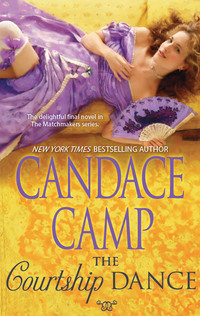
Czytaj książkę: «The Courtship Dance»
Praise for the novels of New York Times bestselling author
CANDACE CAMP
“Delightful…. Camp is firmly at home here, enlivening the romantic quest between her engaging lovers with a set of believable and colorful secondaries.”
—Publishers Weekly on The Wedding Challenge
“Camp delivers another beautifully written charmer, sure to please fans of historicals, with enough modern appeal to pull in some contemporary romance readers.”
—Publishers Weekly on The Marriage Wager
“Lively and energetic secondaries round out the formidable leads, and…assuring readers a surprise ending well worth waiting for.”
—Publishers Weekly on The Bridal Quest
“A beautifully crafted, poignant love story.”
—Romantic Times BOOKreviews on The Wedding Challenge
“The talented Camp has deftly mixed romance and intrigue to create another highly enjoyable Regency romance.”
—Booklist on An Independent Woman
“A clever mystery adds intrigue to this lively and gently humorous tale, which simmers with well-handled sexual tension.”
—Library Journal on A Dangerous Man
“A smart, fun-filled romp.”
—Publishers Weekly on Impetuous
The Courtship Dance
Candace Camp
 www.millsandboon.co.uk
MILLS & BOON
Before you start reading, why not sign up?
Thank you for downloading this Mills & Boon book. If you want to hear about exclusive discounts, special offers and competitions, sign up to our email newsletter today!
SIGN ME UP!
Or simply visit
signup.millsandboon.co.uk
Mills & Boon emails are completely free to receive and you can unsubscribe at any time via the link in any email we send you.
CONTENTS
CHAPTER ONE
CHAPTER TWO
CHAPTER THREE
CHAPTER FOUR
CHAPTER FIVE
CHAPTER SIX
CHAPTER SEVEN
CHAPTER EIGHT
CHAPTER NINE
CHAPTER TEN
CHAPTER ELEVEN
CHAPTER TWELVE
CHAPTER THIRTEEN
CHAPTER FOURTEEN
CHAPTER FIFTEEN
CHAPTER SIXTEEN
CHAPTER SEVENTEEN
CHAPTER EIGHTEEN
CHAPTER NINETEEN
EPILOGUE
CHAPTER ONE
NO ONE WOULD have guessed from the way Lady Francesca Haughston moved through the Whittington ballroom that she was making the opening moves of her campaign. She strolled along in her usual manner, pausing to compliment a dress here or flirt with one of her many admirers there. She smiled and talked and plied her fan deftly, a vision in ice-blue silk, her blond hair falling in a cascade of curls from an upswept knot. But all the while, her dark blue eyes were looking for her prey.
It had been almost a month since she had vowed to herself to find a wife for the Duke of Rochford, and tonight she intended to set her plan in motion. She had made all her preparations. She had studied the young unmarried women of the ton, and through careful research and observation, she had managed to whittle the number down to just three whom she felt suitable for Sinclair.
All three of the young ladies would be here this evening, she was certain. The Whittington ball was one of the highlights of the Season, and, short of dire illness, any marriageable young lady would attend. Moreover, the odds were that the duke would be there, as well, which meant that Francesca could set her scheme in motion. It was time she began, she knew—past time. She had not really needed three weeks to sort out the possible brides for Rochford. There was only a rather small number of girls who could qualify to become his duchess.
But for some reason, ever since Callie’s wedding, Francesca had been beset by ennui, curiously reluctant to pay calls or attend parties or the theater. Even her good friend Sir Lucien had commented on her sudden preference for staying at home. She was not sure of the reason for it; everything just suddenly seemed dull and scarcely worth the effort. She had felt, in fact, a trifle blue-deviled—a result, she had decided, of the fact that Callie, who had been living with Francesca while they sorted out a husband for her, was now married and gone. Without Callie’s cheerful voice and fetching smile, Francesca’s house was too empty.
Still, she reminded herself, she had vowed to make up for the wrong she had done to Callie’s brother, Sinclair, fifteen long years ago. It was impossible to right matters, of course, but she could at least do the duke the favor of finding him a suitable bride. It was, after all, the thing at which she was most skilled. So she had come to this party tonight determined to begin the long dance of courtship on his behalf.
She strolled along the perimeter of the grand ballroom, a huge affair painted all in white and gold, floored with oak planks the color of honey, and lit by three glittering cascades of crystal chandeliers. Several gold stands of thick white beeswax candles provided more light, as did the gold-and-white sconces along the walls. All this brilliance was softened by the huge bouquets of crimson roses and peonies standing in vases against the walls, and twining in garlands up the banister of the magnificent staircase to the second floor. It was an elegant room, worthy of a palace, and it was rumored that only the formal ballroom made Lady Whittington willing to remain in this enormous and antiquated old mansion situated unfashionably outside Mayfair.
Francesca threaded through the crowd to the staircase, intending to use the vantage point of the second-floor railing to locate the young women she was seeking in the massive ballroom below. It was fitting, she thought, as she began to climb the curving stairs, that she should begin her campaign at the Whittingtons’ ball. It had been here, after all, that she had ended things with the Duke of Rochford fifteen years ago. It had been here that her world had come crashing down.
The flowers had all been white that night, she remembered, masses of roses, peonies, camellias and sweet-scented gardenias, accented by glossy greenery trailing from the high vases. It had been a night of heady triumph for Francesca—she had made her debut only weeks before, and she was the undisputed Beauty of the Season. Men had flocked around her, flirting and begging for a dance, making extravagant declarations of love and paying flowery compliments. And all the while she had hugged her secret to herself, giddy with love and excitement—until the footman had slipped a note into her hand.
Now Francesca reached the second floor and took her place at the railing, where she could gaze down at the swirling dancers below. Things were much the same, she thought, as they had been that night so long ago. The dresses had been different, of course, the colors of the walls and the decorations changed. But the glamour, the excitement, the hopes and intrigues, had not altered. Francesca gazed out at the crowd without really seeing them, remembering instead the past.
“Is the party so grim?” a light, familiar voice said at her side.
Francesca turned and smiled at the blond woman. “Irene. How good to see you.”
Lady Irene Radbourne was a striking woman with thick, curling blond hair and unusual golden eyes. At twenty-seven years old, she had been a spinster—and determined to remain one—until last autumn, when Francesca, searching for a suitable spouse for the Earl of Radbourne, had realized that Irene was the perfect match for him. The two women had spent their lives in much the same circle, so she had known the blunt, opinionated Lady Irene for years, but the two of them had not been friends until they had spent two weeks together at the Radbourne estate as Francesca sought to match the rough Lord Gideon to a well-bred wife. Now Francesca counted Irene as one of her closest friends.
Irene looked out over the multicolored crowd of dancers. “Is the new crop of marriageable young ladies so dismal?”
Francesca shrugged. Though she and Irene had maintained a genteel silence regarding the matter, Francesca suspected Irene had guessed that her matchmaking efforts were more a question of survival than amusement.
“Indeed, I have not really given them much attention. I have been quite lazy since Callie’s wedding, I fear.”
Irene regarded her shrewdly. “You are distressed, are you not? Is there aught that I can do?”
Francesca shook her head. “’Tis nothing, really. I am just remembering…a time long past. Another party here.” She forced a smile, the charming dimple in her cheek appearing. “Where is Lord Gideon?”
In the six months the couple had been married, it was rare to see Irene without Gideon by her side. The pair had suited each other even better than Francesca had guessed; it seemed as if their love grew with each passing day.
Irene let out a little giggle. “He was waylaid by his great-aunt as we came in.”
“Lady Odelia?” Francesca asked, appalled. “Good Gad, is she here?” She glanced around apprehensively.
“We are safe here,” Irene assured her. “I do not think she will climb the stairs. That is why I fled to the balcony as soon as I stepped out of the cloakroom and saw that she had cornered Gideon.”
“And left him there?” Francesca asked, chuckling. “For shame, Lady Radbourne. What about your vows?”
“My wedding vows made no mention of Great-Aunt Odelia, I assure you,” Irene retorted, grinning. “I did feel a twinge of guilt, but I reminded myself that Gideon is a strong man, feared by many.”
“Even the bravest quail before Lady Odelia, however. I remember once when Rochford himself sneaked out the back door and went ’round to the stables when he saw her carriage out front, leaving my mother and me with his grandmother to face her.”
Irene let out a burst of laughter. “I should like to have seen that. I shall have to tease him about that the next time we meet.”
“How is the duke?” Francesca asked casually, not looking at Irene. “Have you seen him lately?”
Irene glanced at her. “A week or so ago. We went to the theater together. He and Gideon are now friends, as well as cousins. But surely you have seen Rochford, as well.”
Francesca shrugged. “Only rarely since Callie’s wedding. It was his sister who was my friend, really, not Rochford.”
The truth was that Francesca had been avoiding the duke since his sister’s wedding. The guilty knowledge of how she had wronged him had weighed on her, and every time she had run into him, she had been pierced with guilt anew. She knew that she should tell him what she had found out, that she should apologize for her actions. It was craven of her not to.
Yet she could not do it; her insides chilled whenever she thought of confessing and begging his pardon. They had at least achieved a kind of peace with each other after all these years. Not friendship, exactly, but some thing close to it. What if she told him and it brought back his anger? She deserved that anger, she supposed, but her stomach twisted at the idea. So she had taken to avoiding Rochford whenever possible, staying away from a party if she thought he would attend it, and when she did see him, taking care not to go near him. If they came face-to-face, as had happened once or twice, she had been stiff and awkward, escaping as soon as possible.
Of course, that must end if she was to have any success finding a wife for the man. She could scarcely bring him together with one of his prospective brides if she continued to avoid him.
“Callie told me that Rochford had been unfair to you,” Irene began carefully.
“Unfair?” Francesca glanced at her, startled. “No. How was he unfair?”
“I know not,” Irene admitted. “Something to do with Lord Bromwell courting Callie, I gathered.”
“Oh, that.” Francesca dismissed the idea with a flick of her hand. “The duke had reason to be concerned. Brom’s sister had certainly poisoned him against Rochford, but…” She shrugged expressively. “There was little I could do once they fell in love, in any case, and Rochford realized it afterwards. I am not so tender a female as to wither under a rebuke.”
Francesca glanced out again over the crowd, and Irene followed her gaze.
“Who do you seek?” Irene asked after a moment.
“What? Oh. No one.”
Irene’s eyebrows lifted. “You are most diligent in looking for no one.”
Francesca had difficulty dissembling with Irene. Something about Irene’s forthright manner seemed to call forth an equal candor in her. She hesitated now, then admitted, “I was hoping to see Lady Althea Robart.”
“Althea?” Irene repeated in surprise. “Whatever for?”
Francesca could not help but chuckle. “You dislike the woman?”
Irene shrugged. “Dislike is too strong a word. She simply is not company I would choose to keep. Too high in the instep for me.”
Francesca nodded. The lady did seem a bit stiff. But she was not sure that pride would necessarily be a detriment to a future duchess. “I do not know her well.”
“Nor I,” Irene agreed.
“What about Damaris Burke?”
“The daughter of Lord Burke?” Irene asked. “The diplomat?”
Francesca nodded. “Exactly.”
Irene thought for a moment, then shrugged. “I cannot say, really. I have never moved in government circles.”
“She seems quite pleasant.”
“Smooth,” Irene agreed. “What one would expect, I suppose, from a woman who holds diplomatic parties.” She glanced at her friend curiously. “Why are you asking? Do not tell me they have asked your help in seeking a husband.”
“No,” Francesca told her quickly. “They have not. I was just…considering them.”
“Ah, then it is a gentleman who has sought your help?” Irene guessed.
“Not really. I have been thinking. On my own, as it were.”
“Now you have completely aroused my curiosity. You are matchmaking for someone who has not even asked you? Is this another wager with the duke?”
Francesca blushed. “Oh. No, nothing like that. I had thought—well, there was someone I wronged once, and I had been looking to make it up to him.”
“By finding him a wife?” Irene asked. “There are a number of men who would not thank you for that favor. Who is the man?”
Francesca studied the woman next to her. Of all her friends, Irene knew the most about her. Though Francesca had never confided in her about her own past, Irene’s father had been a friend of Francesca’s late husband, so no doubt Irene suspected how little happiness Francesca had found in her marriage, and Francesca had never felt it necessary to maintain a pretense to Irene that she had missed Andrew in the five years since his death. She had never told anyone about what had happened between her and Rochford so long ago, but she suddenly found herself wanting to confide in Irene.
“Is he the reason for your melancholy?” Irene persisted.
“I think that is caused by the rapid approach of my birthday,” Francesca replied lightly, but then she sighed and said, “And a little by having hurt him when he did not deserve it. I am very sorry for what I did.”
Irene frowned. “I cannot imagine that you could have done anything so terrible.”
“I think he might differ with you,” Francesca responded. She looked into her friend’s eyes, warm with sympathy. “No one must know this—not even Lord Gideon, for he knows the man.”
Irene’s brows went up, and Francesca saw understanding dawn in the other woman’s clear golden eyes. “The duke? You are talking about Rochford?”
Francesca sighed. “I should have known that you would guess. Yes, it is Rochford, but you must promise me that you will not tell anyone.”
“Of course. I promise. Not even Gideon. But, Francesca, I don’t understand. Rochford is your friend. What great wrong could you have done him?”
Francesca hesitated. Her heart felt like lead within her chest, the long-dead sorrow hanging there still. “I broke off our engagement.”
Irene stared. “I knew there was something between you!” she exclaimed softly. “I just was not sure exactly what it had been. But I have never heard of this. I don’t understand. It must have been a huge scandal.”
“No.” Francesca shook her head. “There was no scandal. Our engagement was secret.”
“Secret? That scarcely sounds like the duke.”
“Oh, there was nothing havey-cavey about it,” Francesca assured her. “Rochford was always quite proper. He—he told me that he did not want me to be locked into an engagement during my first Season. It was the summer I made my come-out, you see. He said that I might change my mind once I had had a Season. I knew that I would not, but…well, you know the duke. He always allows for every contingency. And he thought me flighty, no doubt.”
“You were young,” Irene said.
Francesca shrugged. “Yes. But more than that—I have never been, will never be, a weighty sort.” She flashed a smile at her companion. “A ‘butterfly’ is the way he described me.”
“So you did not suit, then?”
“No, it was not that. Rochford was content enough, I think. He expressed no displeasure, at least. And I—” She paused, her eyes seeing a different time, a faint smile hovering on her lips. “I was desperately in love with him—as only an eighteen-year-old girl can be.”
Irene wrinkled her brow. “Then what happened?”
“Daphne happened,” Francesca replied grimly.
“Daphne! Lady Swithington?” Irene stared at her. “Lord Bromwell’s sister?”
Francesca nodded. “Yes. She was the source of the trouble between Rochford and Brom, the reason Rochford was so set against him becoming Callie’s husband. I was not the only one fooled by Daphne’s lies. Her brother believed, as well, that Rochford and Daphne were having an affair.”
“Oh, no! Francesca…” Irene laid her hand on her friend’s arm, sympathy warm on her face. “You thought she was his mistress?”
“Not at first. She told me straight out that she was, but I refused to believe her. I knew Rochford. Or I thought I knew him. I was aware that he did not love me as I loved him, but I believed he was too honorable a man to marry one woman and keep another as a mistress. But then, one evening—in this very house, in fact—I discovered that I was wrong. A footman brought me a note as I finished a dance. It said that if I went to the conservatory, I would find something interesting.”
“Oh, dear.”
“Yes. Oh, dear. I thought the duke had sent me the note. I imagined that he had some sort of surprise for me, something romantic, perhaps. He had given me a pair of sapphire earrings the week before, saying that they were the best he could find, though they could not match the brilliance of my eyes.” She let out a sound, half laugh, half sigh. “Goodness, how long ago that seems.”
“Do you have the earrings still?” Irene asked.
“Of course. They were beautiful. I did not wear them, but I could not get rid of them. I offered them back to him afterwards, of course, but he refused, with the blackest look.”
“I presume you found him and Lady Daphne in flagrante?” Irene went on.
Francesca nodded. She remembered how she had felt, so brimming with love and eagerness, as she had hurried through the wide halls toward the conservatory. She had hoped that Rochford had found a way to steal some time alone with her. It had been even more difficult here in the city than it had been at home, surrounded as they were not only by chaperones, but all the ton, as well. Such a secluded tryst was not like him, of course; he was always supremely careful of her honor, unwilling to engage in any behavior that might damage her reputation. But perhaps, she had thought, tonight passion had carried him away, and the idea had sent a delicious shiver through her.
Francesca had not been able to quite imagine what it would be like to see Sinclair burn with passion. The duke was such a cool and elegant sort, ever unflappable in the face of the most major crisis, and correct to a fault. But there had been a time or two when he had kissed her, when his lips had pressed harder into hers and his skin had flamed in such a way that her own nerves had begun to jangle inside her, and she had wondered if something hotter, harder, stronger, boiled inside him, as well. He had always pulled away quickly, of course, but Francesca had seen a flash of something in his eyes—something hot and almost frightening, but in a somehow delicious way.
“I went into the conservatory,” Francesca recalled now. “I said his name. Sinclair was at the far end of the room, and there were some orange trees between us. He started toward me, and I saw that his ascot was in disarray, his hair mussed. I did not understand at first, but then I heard a noise, and I looked beyond him. Daphne had come out from behind the trees, as well. Her dress was unfastened down the front to the waist.”
Unconsciously, Francesca’s face hardened as she remembered the moment. Daphne’s hair had been partially undone, straggling around her face in tangled curls. Her flimsy chemise had been unlaced, and her full white breasts had spilled flagrantly out, almost completely uncovered. She had smiled at Francesca like the cat that had just gotten into the cream. And Francesca had shattered inside.
“When I saw them, I realized what a fool I had been. I had not been so deluded that I believed that Rochford was madly in love with me. He had, after all, pointed out to me all the very practical reasons why he and I were a good match. He had not spouted declarations of love or written odes to my smile or any such foolishness. But I believed that he cared for me. I had been sure that he would never harm me or treat me with anything but respect. And I had known that I would be such a good wife to him, make him so happy, that someday he would come to love me as much as I loved him.”
“Instead he had been bedding down with Lady Daphne while he was engaged to you.”
“Yes. Well, no, not really. It was all a lie. But I did not know that at the time, and I could not bear what I believed to be true. No doubt there are other women who would have ignored it, reasoning that they would still be his duchess, even if another had his heart. But I could not. I broke it off with him.”
“But in fact Daphne had arranged that little scene and sent you the note?”
“Yes. She told me at Callie’s wedding that it had all been a lie. He had not slept with her, just as he swore to me then that he had not. I did not believe him when he tried to tell me that, of course. I refused to listen to him. And afterwards, when he called on me, I would not see him.”
“And that is why you married Lord Haughston?” Irene asked shrewdly.
Francesca nodded. “He was everything that Rochford was not—full of romantic words and extravagant gestures. I was his stars, his moon, he told me.” She gave a little grimace. “His words were like balm to my wounded heart. This, I told myself, was what love was really like. So I married him. Our honeymoon was not yet over before I realized what a mistake I had made.”
“I’m so sorry.” Irene slipped her hand into Francesca’s and squeezed.
“Well, ’tis long past now,” Francesca replied, and forced a little smile.
“I can scarcely believe that Lady Daphne admitted that she had lied to you.”
“It was not done with any good will, I can assure you. I think she wanted me to realize what an idiot I had been. I am sure she hoped I would regret throwing away my chance to be a duchess.”
“And, instead, of course, what you regretted was having misjudged Rochford. The hurt you did to him.”
Francesca admitted, “His pride must have suffered greatly. He would have hated having his honor impugned, even though he knew he was not at fault.”
“Oh, Francesca…what a terrible thing. Certainly he was not the only one hurt.”
“No. But at least I was at fault. One could say I deserved what happened to me. I was the one who believed her lies. I was the one who would not listen to the truth when he told it to me. But Sinclair had done nothing wrong.”
“And you think finding the duke a wife will set this right?” Irene asked.
Francesca recognized the skepticism in her friend’s tone. “I know it cannot make up for what I did. But I fear that… What if it is because of me that Rochford has never married?” She colored a little. “I am not saying that I think his heart was forever broken. I do not rate myself so high as to think no other woman could take my place. But I fear that I led him to mistrust women so much that he has not wanted to marry. He was already used to being alone, I think, and it was easier, perhaps, for him to live that way. Sinclair came into his title at such an early age, and he had already learned that people courted his favor simply because of his title and wealth. I think that is one of the things he found appealing about marrying me—we had known each other since we were children, and I was not in awe of him. I knew him for himself, not for his title or anything else. But then, when I did not believe him, when I acted in a way that must have seemed a betrayal to him, I fear that he became even more distant and distrustful.”
“That may be, but if he does not want to marry…”
“But he must. He knows that as well as I do. He is the Duke of Rochford. He must have an heir, someone to inherit the title and estate. Rochford is far too responsible not to realize that. I will simply be helping him to do what he knows must be done.” She threw an impish grin at her companion. “And you, more than anyone else, cannot deny that I am adept at bringing to the altar even those who profess a determination not to wed.”
Irene acknowledged her words with a wry smile. “I will admit that you are expert at joining even the wariest together. However, I cannot help but wonder how the duke will take to this plan.”
“Oh, I do not intend for him to know about it,” Francesca responded blithely. “That is why you must not tell even Gideon about this. I am sure that Rochford would consider it a great interference on my part and would order me to stop it, so I have no intention of giving him that opportunity.”
Irene nodded, looking amused. “It should not be difficult to find women eager to wed the duke. He is the most eligible bachelor in the country.”
“True. I am certain that any number would wish to become his wife, but not just anyone will do. I had to find the right woman for him, which has proven to be a more difficult task than I had expected. But, then, Rochford is deserving of only an extraordinary woman, so it is no wonder that there are not many of them about.”
“Althea and Damaris are two of them, I gather. Who else have you picked out for him?”
“I have narrowed the field to three. Besides Damaris and Althea, there is only Lady Caroline Wyatt. I must talk to the three of them tonight and decide on how to throw each of them together with the duke.”
“What if he doesn’t like any of them?” Irene asked.
Francesca shrugged. “Then I shall have to find others. Someone is bound to suit him.”
“Perhaps I am being obtuse,” Irene began, “but it seems to me that the best candidate would be you.”
“Me?” Francesca cast a startled glance at her.
“Yes, you. After all, you are the one woman whom we are certain Rochford would want to marry, given that he has already asked you once. If you were to tell him you had discovered the lie, that you were sorry for not believing him…”
“No. No,” Francesca said, looking flustered. “That is impossible. I am almost thirty-four, far too long in the tooth to be a suitable bride for the duke. I shall, of course, apologize to him and confess how stupid and wrong I was. I must. But the two of us—no, that is long in the past.”
“Really?”
“Yes. Really. Pray do not give me that disbelieving look. I am certain of this. You know that I am done with marriage. And even if I were not, it has been too long, and too much has happened between us. He could never forgive me for breaking it off with him—not to that extent. Rochford is a very proud man. And whatever feeling he might have had for me once, by now it is long dead. It has been fifteen years, after all. I do not still love him. Even less would he harbor any love for the woman who rejected him. Why, for ages he scarcely even spoke to me. It has only been in the past few years that we have been something like friends again.”
“Well, if you are certain…?”
“I am.”
Irene shrugged. “Then what do you intend to do?”
“I…ah! There is Lady Althea.” Francesca had spotted her quarry standing beyond the dancers, chatting with another woman. “I shall start with her. I think that I may chat with her a bit, maybe plan an outing together. Then I can arrange it so that Rochford makes up one of our party.”
“If that is your plan, it seems that fortune has smiled on you,” Irene told her, nodding toward another part of the ballroom. “Rochford just walked in.”
“He did?” Francesca’s heart sped up a bit, and she turned to look in the direction her friend indicated.
It was Rochford, all right, effortlessly elegant in formal black and white, and easily the most handsome man in the room. His thick black hair was cut into an artfully casual style that many copied but few could achieve, and his lean, tall figure was perfectly suited for the close-fitting trousers and jacket that were the current fashion. There was nothing ostentatious about him—the only decoration he wore was a stickpin anchoring his cravat, the head of which was an onyx as dark as his eyes—yet no one, seeing him, would have thought him anything less than an aristocrat.
Francesca’s hand tightened on her fan as she watched him glance about the room. Every time she had seen him lately, she had felt this same roiling mixture of emotions. It had been years since she had felt this way, so jittery and filled with trepidation, yet strangely excited, as well. Daphne’s words, she reflected, had opened some sort of door on the past, letting in a whole host of feelings that she had thought time and experience had worn away.
It was entirely foolish, she realized. Knowing, as she did now, that Rochford had not been unfaithful to her made no real difference in her life. Nothing had changed because of it, and nothing would. Yet she could not deny the little spurt of joy it aroused in her whenever she saw him. He had never belonged to Daphne; his firm, well-cut mouth had not kissed her, nor whispered in her ear. His hands had not caressed her or showered her with jewels. The mental pictures that had tortured her fifteen years ago had been entirely false, and she could not help but be glad of it.
Francesca turned away, suddenly busy with her gloves and fan, smoothing down the front of her skirt. “I must tell him,” she said softly.
She knew that she could not be at ease around him again until she had revealed what she had learned and apologized for not trusting or believing him. And, clearly, she could not match him with a wife if she could not even be around him without going into a fit of nerves. She must tell him…but how?
“I think that you are about to get your chance,” Irene told her dryly.
“What?” Francesca looked up.
And there, climbing the stairs toward them, was the Duke of Rochford.
CHAPTER TWO
FRANCESCA FROZE, aware of a craven impulse to flee. But she could not, of course. Rochford was looking straight at her. She could not turn away without being rude. Besides, Irene was right: this was her opportunity to explain everything to him.
So she stood her ground and smiled as the duke approached them.
“Lady Haughston. Lady Radbourne,” he greeted them, sketching a bow.
“Rochford. How nice to see you,” Francesca replied.
“It has been a long time. I have seen you at few parties.”
She might have known that he would notice. Rochford rarely missed anything. “I…have been resting a bit since Callie’s wedding.”
“Have you been ill?” He frowned.
“Oh. No. No, not at all. Um…” Francesca sighed inwardly. Hardly two sentences spoken, and already she was floundering.
She found it the most difficult thing to lie to Rochford. Even the most innocuous social lie that she might blithely relate to anyone else seemed to curdle and die on her tongue when she was faced with his dark gaze. She felt sometimes as though his eyes could look deep inside her, see to the very depths of her soul.
She glanced away from those eyes now as she went on. “I was not ill, merely…tired. The Season can grow somewhat wearying, even to me.”
She had the distinct feeling that he did not believe her. He studied her for one long moment more, then gracefully replied, “None would know it, I assure you. You are as radiant as always.”
Francesca acknowledged his compliment with a gracious nod, and he turned toward Irene. “As do you, my lady. Marriage seems to suit you.”
“It does,” she admitted, sounding faintly surprised.
“Is Radbourne here this evening?” he asked. “I am surprised not to find him by your side.”
“That is because Irene deserted him,” Francesca put in, grinning.
“’Tis true,” Irene agreed. “I abandoned him to Lady Pencully’s clutches and fled like a coward for the stairs.”
“Good Gad, is Aunt Odelia here?” he asked, casting an alarmed glance toward the ballroom below.
“Yes, but she will not climb the stairs,” Francesca replied. “So long as you stay up here, you are safe.”
“I would not be so sure. The woman seems to have become positively reinvigorated since her eightieth birthday ball,” Rochford responded.
Irene glanced over at Francesca, then said lightly, “I suppose I had better play the good wife and go rescue Gideon before his patience grows too thin and he says something to her that he will later regret.”
Francesca quelled the spurt of panic that rose in her at her friend’s departure. She had conversed with the duke hundreds of times; it was absurd that it should suddenly seem so awkward.
“How is the duchess?” she asked once Irene had left, for want of anything better to say.
“Grandmother is well and enjoying Bath. She keeps threatening to come for at least a few weeks of the Season, but I think she will not. She is too relieved at no longer having to do her duty by chaperoning Callie.”
Francesca nodded. That seemed to be the end of that topic. She shifted nervously and glanced out over the ballroom again. She had to tell him, she knew. She could not continue in this way, being shy and uncomfortable around him. Over the past few years, she had become accustomed to having him as something of a friend again. She looked forward to conversing with him at parties; it was always enlivening to bandy words with him, and his wit made even the most boring gathering tolerable. And she could count on him for a waltz, which meant that at least one dance of the evening would be effortless, like floating around the floor.
She had to make amends. She had to confess and ask his forgiveness, no matter how much the thought of it frightened her.
She glanced up and found him watching her, his dark eyes thoughtful. He knew, she thought; the man was simply too discerning. He knew that there was something wrong with her. With them.
“Perhaps you would care to take a stroll with me,” he told her, offering her his arm. “I understand that the Whittingtons’ gallery is quite enjoyable.”
“Yes. Of course. That sounds quite pleasant.”
Francesca placed her hand upon his arm and walked with him through the double doors into the long hallway running along one side of the Whittington mansion. The gallery was hung with portraits of ancestors and a variety of other subjects, including a favorite hunter or dog of one Whittington or another throughout the centuries. They strolled along, now and then glancing at the pictures, but with little real interest. There was no one else about, and their steps echoed hollowly on the polished parquet floor. Silence stretched between them, growing deeper and more awkward with each passing moment.
Finally Rochford said, “Have I offended you past remedying?”
“What?” Startled, Francesca’s eyes flew to his face. “What do you mean?”
He stopped and turned to face her. His expression was solemn, his straight black eyebrows drawn together harshly. “I mean that while ’tis true that I have seen you at few parties in the past weeks, you have been at some of them—and whenever you saw me, you immediately turned and disappeared into the crowd. And if, by chance, you came upon me unexpectedly, with no way to avoid the encounter, you seized the first opportunity to make your excuses and leave. I can only assume that you have not forgiven me for what I said to you that day, when I found out that Bromwell had been courting Callie.”
“No!” Francesca protested, laying a hand earnestly upon his arm. “That is not true. I did not blame you. Truly I did not. I… Perhaps you were a bit harsh. But you apologized. And, clearly, you had reason to be concerned. But I could not betray Callie’s trust, and she had the right to choose her own future.”
“Yes. I know. She is quite independent.” He sighed. “I realize that you had little choice, and I had no reason to expect you to be able to control my sister. God knows, I had poor enough luck at it. And once I was over my anger, I knew I was in the wrong. I apologized, and I thought you had accepted my apology. But then you began hiding from me.”
“No, truly…” Francesca told him. “I did accept your apology, and I am not angry with you about what you said. I have seen your temper a time or two before, you know.”
“Then why are you upset with me?” he asked. “Even at Callie’s wedding, I saw you but little.” He stopped abruptly, then asked, “Was it because of that scene at the hunting lodge? Because I—” He hesitated.
“Because you knocked your sister’s future husband to the floor?” Francesca asked, a smile hovering at the corners of her lips. “Because the two of you were brawling through the parlour, knocking vases off tables and overturning chairs?”
Rochford started to protest, then stopped, his own mouth twitching into a small smile. “Well…yes. Because I was acting like a ruffian. And making a general fool of myself.”
“My dear Duke,” Francesca drawled, laughter glimmering in her eyes, “whyever should I have taken exception to that?”
He let out a short laugh. “Well, at least you have the good grace not to say that it is nothing unusual. Although I might point out that while I may have been a ruffian, at least I was not telling enormous clankers, as were some of us.” He shot her a droll look.
“Clankers!” Francesca tapped his arm lightly with her fan, scarcely noticing that the awkwardness had fallen away from them and she was bantering with him once again in a carefree way. “You are most unjust, sir.”
“Come, now, you cannot deny that you were…shall we say, most inventive that morning?”
“Someone had to bring that mess into some order,” she shot back. “Else we would all have been in a pretty predicament.”
“I know.” His face sobered, and he reached out, surprising her, and took her hand. “I know how much you did for Callie that day. You earned my undying gratitude for your ‘inventiveness.’ And your kind heart. Callie would have been embroiled in a serious scandal if it were not for you.”
Francesca felt her cheeks growing warm under his steady regard, and she glanced away. “There is no need to thank me. Indeed, I am quite fond of Callie. She is much like a sister to me.”
It occurred to her then that her words had been unfortunate, and she blushed even harder. Would Rochford think her presumptuous? Or assume that she was reminding him of the fact that they had nearly become man and wife?
Francesca turned and continued walking. Her hand was curled so tightly around her fan that the sticks were digging into her flesh. Rochford fell in beside her, and for a moment they walked in silence. She could feel him watching her. He knew something was wrong. She was only making it worse and prolonging her own anxiety.
“I have to apologize to you,” she blurted out suddenly.
“Excuse me?” he asked, surprise clear in his voice.
She stopped and turned to him, steeling herself to look up into his face. “I wronged you. Fifteen years ago, when we—” She stopped, feeling as though her throat was closing up on her.
He stiffened slightly, the puzzlement on his face turning to a slight wariness. “When we were engaged?” he finished for her.
Francesca nodded. She found she could not hold his gaze, after all, and she glanced away. “I— At Callie’s wedding, Lady Swithington told me—she said she lied about the two of you. That there was never anything between you.”
When he said nothing, Francesca squared her shoulders and forced herself to look back up at him. His face was still, his gaze shuttered, and she knew no more of what he was thinking or feeling than she had when she was turned away from him.
She swallowed and went on. “I was wrong. I accused you unjustly. I should have listened to you, heard you out. And I—I wanted you to know that I am sorry for what I said to you, for what I did.”
“Well…” He half turned from her, then swung back. “I see.” He was silent for a moment longer, then said, “I am afraid I don’t know what to say.”
“I don’t know that there is anything to say,” Francesca admitted, and they turned and began to stroll back the way they had come. “There is nothing to be done. It is all long over. But I could not feel easy without telling you how wrong I was. I don’t expect you to forgive me. But I wanted you to know that I learned the truth, and that I am sorry for misjudging you. I should have known your character better.”
“You were very young,” he replied mildly.
“Yes, but that is not an adequate excuse, surely.”
“I daresay.”
Francesca cast a sidelong glance at the duke. She had worried that when she told him, he would slice her with a cold, acerbic remark. Or that his eyes would light with fury, and he would storm at her or stalk away. She had not considered that her confession might render him speechless.
They walked through the double doors leading into the upper level of the ballroom and stopped, turning toward each other awkwardly. Francesca’s heart hammered in her chest. She did not want to simply part from him this way, unsure of what he thought and felt, not knowing if he was seething inside or simply relieved to know that she no longer believed him a cad. She could not bear it, she thought, if her confession resulted in the ruination of the delicate friendship they had built over the years.
Impulsively, she asked, “Shall we dance?”
He smiled faintly. “Yes, why don’t we?”
He extended his arm to her, and they started down the curving staircase.
A waltz struck up just as they reached the floor, and Rochford swept her into his arms and out to join the dancers. Something fluttered inside her, soft and insistent, and she was suddenly uncertain and nervous, yet almost giddy, as well. She had danced with the duke many times over the course of the past few years, but somehow, in this moment, it felt different, even new. It felt…almost as it had years before.
She was very aware of the strength of his arms encircling her, his warmth, the smell of his cologne mingled with that faint, indefinable scent that was his alone. She remembered how it had been that Boxing Day, at the ball he had given at Dancy Park, when he had taken her into his arms for a waltz, and she had looked up at him and realized that the girlish infatuation she had felt for him for years was something much more. Gazing into the depths of his dark eyes, she had known that she was hopelessly, madly in love with the man. She had been dizzy with excitement, her entire body tingling with awareness of him. He had gazed back down at her and smiled, and in that moment, heat had burst inside her like a sun.
Staring up at him now, Francesca felt color rush to her cheeks at the memory. He looked so much the same; if anything, the years had only added to his handsomeness, the faint lines at the corners of his eyes softening the sharp planes and angles that could make his face appear cold. He had always looked a bit like a pirate, she thought, with his black eyes and black hair, and the high swooping line of his cheekbones. Or at least he appeared that way when his straight black brows drew together, or when he turned his level, icy stare on one. At those moments he seemed a trifle dangerous.
But when he smiled, it was a different matter altogether. His face lit up and his eyes warmed, and his mouth curved in a most inviting way. It was almost impossible not to smile back at him at such a moment, and, indeed, it made one want to do something to bring that smile out again.
She glanced away quickly, embarrassed at the direction of her thoughts. She hoped that he had not seen her blush or had any idea what had brought it about. It was absurd, of course, for her to be nervous or eager. And even more laughable for her thoughts to go skittering to juvenile maunderings about his good looks or appealing smile. She was long past such feelings—for Rochford or anyone else. Whatever girlish love she had felt for the man had died many years ago, burned away by long nights of sleepless anguish, drowned in a sea of tears.
She cast about for some topic to bridge the silence. “Have you heard from Callie?”
“I have had a letter from her. Very brief, I might add. ‘Paris is beautiful. Bromwell is wonderful. Looking forward to Italy.’”
Francesca chuckled. “Surely ’twas not quite so short as that.”
“Oh, no, there was a bit more description of Paris. But all in all, it was a model of brevity. Their plan is to return to London in another week—if, of course, they do not decide to extend the honeymoon.”
“Well, at least it sounds as if she is happy.”
“Yes. I believe she is. Against everything I would ever have thought, Bromwell apparently loves her.”
“It must be lonely for you without her.”
“The house is a trifle quiet,” Rochford admitted with a faint smile. “But I have kept busy.” He raised an eyebrow at her. “What about you?”
“Have I kept busy? Or have I been lonely without Callie?”
“Either. Both. She was with you more than she was at home the last two months before she married.”
“That is true. And I have found that I miss her,” Francesca admitted. “Callie is…well, her leaving creates a larger hole in one’s life than I would have imagined.”
“Perhaps you should take another young lady under your wing,” Rochford suggested. “I have seen a number of women here tonight who could do with an application of your expert touch.”
“Ah, but none of them has asked for my help. It is a bit rude, you know, to offer one’s opinion, unasked, on how another can be improved.”
“I suppose it would be. Although one cannot help but wish that you might say something to Lady Livermore.”
Francesca stifled a giggle, following the direction of Rochford’s eyes to where Lady Livermore was dancing with her cousin. She was wearing her favorite color, a strong puce that would show to advantage on very few women. Lady Livermore was not among them. The color would have been bad enough in itself, but Lady Livermore was of the opinion that if something was good, then more of it was even better. Ruffles festooned the neckline of her dress and the bottom of the skirt, billowing out beneath the scalloped hemline of her over-dress. Even the short puffed sleeves carried two rows of ruffles. Silk rosettes marked the upward points of the scallops, each one centered by a pearl, with a swag of pearls stretching from point to point. A pearl-trimmed toque of matching color sat atop her head.
“Lady Livermore, I fear, is unlikely to change,” Francesca told him. She paused for a moment, then said, “Do you know Lady Althea?”
Francesca could have bitten her tongue as soon as she said it. How could she have blurted that out so clumsily?
“Robart’s daughter?” the duke asked in a surprised tone. “Do you think that she needs help finding a husband?”
“Oh, no! Goodness.” Francesca let out a little laugh. “I am sure Lady Althea has no need for any help from me. I just saw her dancing with Sir Cornelius, that’s all.” She paused, then went on. “I am sure that she has no lack of suitors. She is quite attractive, don’t you think?”
“Yes,” Rochford answered. “I suppose she is.”
“And accomplished, too. She plays the piano quite well.”
“Yes, she does. I have heard her play.”
“Have you? She is much admired, I understand.”
“No doubt.”
Francesca was aware of a distinct spurt of annoyance at his reply. She was not sure why the duke’s agreeable admissions of Lady Althea’s excellence irritated her. After all, her job would be much easier if Rochford already found the woman appealing. And surely she was not so vain herself that she could not bear to hear another woman praised. Still, she found it hard not to respond sharply, even though she herself had raised the subject.
She turned the conversation to something else, but later, when the music ended, she subtly maneuvered Rochford into walking off the dance floor in the direction that Lady Althea and her partner had taken. She was lucky enough that Sir Cornelius was taking his leave of the lady as they approached.
“Lady Althea,” Francesca greeted her with apparent pleasure. “How nice to see you. It has been an age since we have met, I vow. You know the Duke of Rochford, do you not?”
Lady Althea offered them a measured smile. “Yes, of course. A pleasure to see you, sir.”
Rochford bowed over her hand, assuring her politely that the pleasure was all his, as Francesca cast an assessing eye over the woman. Lady Althea was tall and slim, and her white silk ball gown was tasteful, if somewhat lacking in dash in Francesca’s opinion. And if her lips were a bit too thin and her face a trifle long for real beauty, she did have a wealth of dark brown hair, and her brown eyes were large and lined with thick, dark lashes. Many men, Francesca was sure, would call her pretty.
She cast a sideways glance at Rochford, wondering if he numbered among those men.
Lady Althea inquired politely after Rochford’s grandmother and Francesca’s parents, then moved on to compliment Callie’s wedding. It was the sort of polite chitchat in which Francesca had engaged for much of her life, as had Lady Althea and Rochford, and they were able to spend several minutes talking about almost nothing at all.
When they had finished praising Lady Whittington’s ball—perhaps her finest, in Lady Althea’s opinion—as well as commiserating over the sad state of Lady Althea’s mother’s nerves, which had kept her in bed tonight instead of attending this event, they moved on to the latest play at Drury Lane, which, as it turned out, none of them had actually seen.
“Why, we must go!” Francesca exclaimed, looking at Lady Althea.
The other woman seemed faintly surprised, but replied only, “Yes, certainly. That sounds quite pleasant.”
Francesca beamed. “And we shall press the duke to take us.” She turned toward Rochford expectantly.
His eyes, too, widened a trifle, but he said evenly, “Of course. It would be my privilege to escort two such lovely ladies to the theater.”
“Wonderful.” Francesca glanced back at Althea, who, she noticed, appeared more eager about the invitation now that the duke was attached to the expedition. “Let us set a night, then. Tuesday, shall we say?”
The other two agreed, and Francesca favored them with a smile. She had, she knew, ridden roughshod over them. She was customarily more deft in her maneuverings than she had been tonight. She was not sure why she had been clumsier than usual, but at least neither of the others looked disgruntled or suspicious.
She made a few more minutes of small talk, then slipped away, leaving Rochford with Althea. She made her way across the room, greeting some and pausing to chat with others. She should have felt a sense of triumph, she knew. She had finally set her plan in motion.
But, in truth, all she felt was the beginning of a headache.
She paused and glanced around her. She saw Irene in the distance, and a moment later she spotted Sir Lucien on the dance floor. She could make her way to Irene or wait for Sir Lucien—or, indeed, she could find half a dozen others to talk to, and there were any number of men who would doubtless ask her for a dance.
However, she found herself unwilling to do any of those things. Her temples were beginning to pound, and she felt bored and curiously deflated. All she really wanted, she reflected, was to go home.
Pleading a headache, which for once was real, she bade good-night to her hostess and went outside to her carriage. The vehicle was ten years old and growing somewhat shabby, but it felt good to be in it, snugly away from the music and lights, and the noise of a multitude of people chattering.
FENTON, HER BUTLER, was surprised to see her home so early, and immediately hovered over her solicitously. “Are you well, my lady? Have you caught a chill?”
The man had been her butler for over fourteen years; she had hired him soon after she and Lord Haughston were married. He was intensely loyal, as all her servants were. There had been many times when she had been unable to pay their wages, but Fenton had never grumbled—and she felt sure he had made quick work of any servant who did.
Francesca smiled at the man now. “No. I am fine. Just a bit of a headache.”
Upstairs, she faced the same quizzing from her maid, Maisie, who immediately took down Francesca’s hair and brushed it out, whisked off her dress and helped her into her nightclothes, then bustled out of the room to fetch lavender water to ease her headache. Before long Francesca found herself ensconced in her bed, pillows fluffed behind her, a handkerchief soaked in lavender water stretched across her forehead and the kerosene lamp beside her bed turned to its lowest glow.
With a sigh, Francesca closed her eyes. She was not sleepy. The hour was far earlier than she was accustomed to retiring. And, in truth, the headache had eased as soon as she returned home and let down her hair. Unfortunately, the gloom that had touched her at the ball seemed to have settled in.
She was not a woman who dwelled upon her misfortunes. When her husband had died five years ago, leaving her with little but this town house in London, one of the few things that had not been entailed with his estate, she had not sat about twisting her hands and bemoaning her fate. She had done her best to marshal her resources and pay off his debts, reducing her own expenses to the bare minimum. She had closed off part of the house and reduced the staff, then proceeded to gradually sell her silver and gold plate, and even her own jewelry. She had also quickly learned to practice economy, turning and refurbishing her old gowns rather than buying new ones, and wearing her slippers until the soles wore through.
Even so, it had become apparent that such economies and her small jointure were not enough to support her and even a small staff for any length of time. Most women in her position would have sought a new husband, but after her experience with the first one, Francesca had been determined not to embark on that course again. Without a marriage to finance her, she knew, the expected course would be to retire to her father’s house, now her brother’s, to live as a dependent relative for the rest of her life.
Instead, she had cast about for some means of bringing in more income. There were no jobs for ladies, of course, except for something like a companion or a governess. Neither of those held the slightest appeal for Francesca, and, indeed, she was sure that no one would have hired her for either one. The skills she possessed—impeccable taste, an eye for the fashions that complemented one’s looks rather than taking away from them, a thorough knowledge of the London social scene, the ability to flirt to exactly the right degree, as well as to enliven even the dullest party or most uncomfortable situation—were not the sorts of things that would make one money.
However, it occurred to her, after yet another society matron begged her help in bringing off an unpopular daughter’s Season, that her skills were quite useful in the primary occupation of the mamas of the ton—securing a good marriage for their unmarried daughters. Few could better guide a naive young girl through the treacherous waters of the Season, and none were as adept in finding the perfect dress or accessory to flatter a figure or diminish a fault, or the most becoming hairstyle for any sort of face. Patience, tact and a ready sense of humor had helped her through an unhappy marriage, as well as fifteen years as one of the leaders of the beau monde, an always-perilous position. Surely those qualities could be used to successfully steer a young woman into a good marriage—even, if she was lucky, into love.
Francesca had been matchmaking for three years now—always under the genteel guise of doing a favor for a friend, of course—and she had managed, if not to live well, at least to get by. She was able to keep food on the table and pay a small staff, as well as heat the house in the winter—as long as she kept many of the larger, draftier rooms closed off. And given the amount of business she was able to bring dressmakers and millinery shops, she was often given a dress that had been ordered but not picked up, or allowed to buy a frock or hat at a considerable discount.
It was not the life she had dreamed of as a young girl, certainly, and she spent far more time than she cared to think of worrying about whether she would be able to pay her bills. But at least she was able to live on her own, as independent as any lady could be if she hoped to be respectable. Her mother, she knew, would have been shocked if she had known about Francesca’s secret occupation—as would a number of other members of society. Perhaps what she did was not genteel, but, frankly, she found it satisfying to take those without a sense of style and turn them into fashionable and attractive young ladies, and it was always pleasing to help a couple find each other.
All in all, she was quite content with her life. Or, at least, she had been. But over the last few weeks she had been aware of a feeling of dissatisfaction, a certain ennui. She had even at times been…well, lonely.
That was absurd, of course, because her social calendar was invariably full. She had invitations for every night of the week, often more than one a night. Every day brought a steady round of callers, both male and female. She never wanted for a dance partner or an escort. If she had been alone often during the past few weeks, that had been of her own accord. She had not really wanted to go out much or see anyone.
She missed Callie, she knew. She had grown quite accustomed to having the girl around, and the house seemed emptier without her, just as she had told the duke. And, she had to admit, she was also suffering remorse and guilt about the terrible mistake she had made so many years ago. She would have been less than human, she supposed, if she had not considered how different her life would have been if she had not broken off her engagement.
Certainly, if she had married Rochford, she would not now be spending her days worrying about how she was to keep food on the table or whether an old dress could be restyled yet again. But far more than the material benefits, she had to wonder if she might not have lived a happy life with him.
What if she had been married to a man of honor rather than a libertine? What might have happened if she had married the man she truly loved? She remembered the dizzying excitement she had felt when she was with Rochford back then, the glow that had filled her every time he smiled at her…the way she had tingled all over when he kissed her.
Darmowy fragment się skończył.