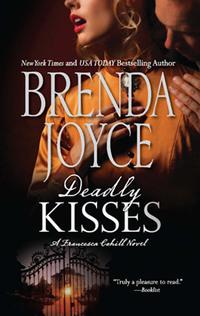
Czytaj książkę: «A Francesca Cahill Novel»
Praise for Brenda Joyce’s Deadly series
“Joyce’s latest ‘deadly’ romance is truly a pleasure to read, given its involving plot, intriguing characters and the magic that occurs as the reader becomes immersed in another time and place.”
—Booklist on Deadly Kisses
“If this is your introduction to Francesca Cahill, you’ll be just as hooked on the series as longtime fans. Joyce skillfully pulls you into her characters’ tangled lives as they pursue a killer. The ‘Deadlies’ keep you coming back for more because you care about the people and you can sink your teeth into their complicated lives as they twist and turn with mystery.”
—RT Book Reviews on Deadly Kisses
“As Francesca searches for clues and struggles with her complicated feelings for two different men, readers will follow her from turn-of-the-century New York’s immigrant tenements to its wealthiest mansions. Fans of Joyce’s Deadly romances will find the seventh in the series to be another entertaining blend of danger and desire.”
—Booklist on Deadly Illusions
“Just when you think you have it all figured out, Joyce turns it all around, leaving you with a cliff-hanger, and eager for Francesca’s next adventure.”
—RT Book Reviews on Deadly Illusions
“Joyce excels at creating twists and turns in her characters’ personal lives.”
—Publishers Weekly
“An elegant blend of mystery and romance simmering with sexual tension.”
—Booklist on Deadly Promise
“The steamy revelations…are genuinely intriguing, and just enough of them are left unresolved at the book’s end to leave readers waiting eagerly for the series’ next installment.”
—Publishers Weekly on Deadly Love
BRENDA JOYCE
DEADLY KISSES

MILLS & BOON
Before you start reading, why not sign up?
Thank you for downloading this Mills & Boon book. If you want to hear about exclusive discounts, special offers and competitions, sign up to our email newsletter today!
SIGN ME UP!
Or simply visit
signup.millsandboon.co.uk
Mills & Boon emails are completely free to receive and you can unsubscribe at any time via the link in any email we send you.
This novel is dedicated to my sister, Jamie.
I miss you.
Jamie Lee Allen
1965–2005
Courageous in life.
Forever in Peace.
CONTENTS
CHAPTER ONE
CHAPTER TWO
CHAPTER THREE
CHAPTER FOUR
CHAPTER FIVE
CHAPTER SIX
CHAPTER SEVEN
CHAPTER EIGHT
CHAPTER NINE
CHAPTER TEN
CHAPTER ELEVEN
CHAPTER TWELVE
CHAPTER THIRTEEN
CHAPTER FOURTEEN
CHAPTER FIFTEEN
CHAPTER SIXTEEN
CHAPTER SEVENTEEN
CHAPTER EIGHTEEN
CHAPTER NINETEEN
CHAPTER TWENTY
CHAPTER ONE
Monday, June 2, 1902,
New York City—Before Midnight
“FRANCESCA, I THINK IT’S wonderful that you have volunteered to chair the Ladies Citizen Union Funds Committee,” Julia Van Wyck Cahill remarked, handing off her ruby-red velvet mantle to the doorman. Slim, beautiful and elegant, and wearing a very famous ruby pendant that had belonged to a Hapsburg princess, she stood with her daughter in the front hall of their Fifth Avenue home, beaming with pleasure.
Francesca, however, was preoccupied. She handed off her own light wrap, a turquoise satin to match her evening gown. “Mama, I did not quite volunteer. I do believe you and Mrs. Astor decided among yourselves to make me cochair.”
Julia’s blue eyes widened as she feigned innocent ignorance. “Darling! Whatever makes you say that? My dear, you are the youngest lady to ever chair the committee, and I know you will be superb, Francesca—you always are.”
In truth, Francesca did not really mind being named the chair, as her current investigation was so routine. A neighbor had realized that certain items in her attics were missing, including several valuable family heirlooms, and having read all about Francesca’s last case in the city’s numerous newspapers, she had requested Francesca’s sleuthing services. Francesca was almost certain that Mrs. Canning’s son-in-law was the thief.
“It is a good cause and someone has to raise funds for the party.” Francesca sighed. “I simply wish you had asked me first if I had the time to give the position all of the effort and attention it deserves.”
Julia took her arm. “I’m sorry, dear. Of course, I should have asked.”
Francesca knew very well what her mother was about. Julia was a great society hostess, and she had been aghast by Francesca’s new profession. Even with Francesca’s success, she remained opposed to her daughter’s involvement in any investigation, although she seemed relieved that Francesca finally had a case that was neither life threatening nor scandalous in nature. Francesca knew her mother wanted her so preoccupied with fundraising for the Citizens Union that she would have time for nothing else other than her fiancé.
At the thought of Calder Hart, her heart skipped uncontrollably. But then, Hart had that effect on her, from the time they had first met, when she had refused to admit her attraction to and fascination with such a notorious man. He was one of the city’s wealthiest millionaires, yet he had come from humble beginnings, born out of wedlock on the city’s poverty-stricken Lower East Side. Until recently, in spite of his reputation as a womanizer, he had been considered the greatest catch in town, with almost every socialite vying for his attention for their debutante daughters. Hart, however, preferred to attach himself to infamous courtesans and divorcées, shying away from any serious involvement. Francesca still had to pinch herself from time to time, in order to realize that it was real—she, Francesca Cahill, who owned an equally notorious reputation as an eccentric, a bluestocking and a sleuth, had somehow snagged Calder Hart. These days, when she walked into a supper party or a ball, knives were sharpened and daggers were drawn behind her back. Once, the whispers and gossip had hurt her feelings; now she rather enjoyed the attention. But then, usually Hart was at her side, whispering in her ear, reminding her to revel in the limelight.
All was not perfect, however. Her father was dead set against Hart. An entire month had gone by since Andrew Cahill had broken off their engagement and he did not seem any closer to coming around, never mind that Francesca’s mother was so angry she refused to speak to him unless it was absolutely necessary. In fact, Julia continued to gloat about the engagement to her society friends, as if it had not been terminated.
Francesca had come to realize she could not imagine a future without Hart in it, and she was determined to win Andrew over to their cause. Her father was one of the great progressive thinkers and leaders in the city. He was also a great humanitarian, and Francesca admired him immensely. She could not imagine eloping behind his back, although she and Hart had discussed it. This was the first time in her life that she had not been able to gain her way with her father.
Hart had suggested they not push Andrew Cahill just now. Calder was out of town right now, and Francesca missed him terribly.
As if reading her daughter’s mind, Julia said softly, “When will Calder return to the city, Francesca?”
“In a day or two, Mama. He is in Boston, tending to his business affairs.” Hart’s fortune had been amassed through shipping, insurance and the railroads. He was also a world-renowned art collector, with one of the most extensive and valuable privately owned collections in America.
Several months ago, Hart had commissioned her portrait and Francesca had been hugely flattered. The portrait had been a nude, and she had been daring enough to pose for it. Last month, the painting had been completed—and it had also been stolen. With Francesca too upset to think clearly enough to investigate the theft, Hart had put private investigators on the case. But there had been no leads; it was as if the portrait had vanished into thin air. If it ever surfaced publicly, Francesca knew she was finished. She had quite a few enemies, although many of them were now in prison.
Francesca did not want to worry about the missing portrait now. Instead, she thought about her reunion with Hart. She could barely wait to be in his arms, being soundly and thoroughly kissed. “Mama, I am going to bed. It was a pleasant evening,” she said, kissing her cheek.
“Yes, it was, wasn’t it?” Julia seemed pleased.
Andrew Cahill stepped into the spacious front hall, having been outside giving instructions to the coachman for the next morning. Francesca smiled at her father as he handed off his top hat, white gloves and scarf. Dressed in his tuxedo, he was a short man with a rotund build and excessive side whiskers. “Papa? Did you enjoy the affair tonight?” Her sister, every bit as successful a society hostess as Julia, had held a charity supper to raise funds for the vast new public library, soon to be erected on Fifth Avenue and Forty-Second street. There had been a hundred guests, with champagne, caviar, dinner, dessert and dancing, all in the ballroom of the Waldorf-Astoria Hotel.
“Of course I did,” Andrew said, his expression somber. “It is a fine cause and I look forward to the day the library opens. Francesca, I should like to talk to you in the study before you retire for the night.”
Francesca tensed. “Papa, can’t it wait?” she began. She had the dreadful feeling he was going to talk to her about Hart, a subject they had carefully avoided for an entire month. Unless he had changed his mind about them, Francesca did not want to hear whatever her father had to say.
“I think we have gone on at great odds for long enough,” he said firmly.
Francesca knew that tone. She waited while he kissed Julia’s cheek, bidding her good-night. Then Francesca and Andrew started through the front hall, arm in arm. All of the servants had discreetly vanished, and their heels clicked on the black-and-white marble floors.
“I believe Hart is back in town.”
Francesca was dismayed. “No, Papa, he is not due back for at least another day, and probably he will not be back until Wednesday.”
“Ben Garret saw him this afternoon crossing the street,” Andrew said curtly. And finally he softened. “Or he thought he did. We had lunch and he mentioned your engagement.”
There was no mistaking her father’s intended subject now. They paused on the threshold of his study, a large library with wood-paneled walls; high, pale green ceilings; hundreds of books, most political or philosophical in nature; electric lights; and the family’s single telephone. Beneath the emerald-green marble mantle a small fire crackled in the fireplace.
“Papa, you broke off our engagement,” Francesca said softly. But she twisted the huge diamond engagement ring which she still wore, refusing to take it off.
Andrew regarded her unhappily. “I intended to break it off, but your mother has openly defied me, gleefully telling everyone we meet about your engagement. In private, she won’t even speak to me!” he exclaimed. “And do you think I am blind? I see the ring you continue to wear!”
Francesca flushed. “Calder gave me the ring, Papa, and it is a token of his admiration and respect. I simply cannot part with it.”
He sighed heavily and walked over to the fireplace, staring down at the flames. “I could tell you stories until I was blue in the face about gullible young women falling for handsome rakes. But like each and every one of those young, naive women, you would not listen to me. You would think you are different, that you are the one to finally capture the cad’s heart.”
Francesca went and stood besides him nervously. “Unlike all those other cads, Hart has never suggested that I have captured his heart. But he has told me how much he admires and respects me, how dearly he needs my friendship, and how well he thinks we suit.”
“So you are not marrying for love?” Andrew asked skeptically. “You are marrying for respect, for friendship?”
Francesca gave him a look. “I love Calder. I have never been so in love. He has a good side, Papa, one that quite contradicts his selfish reputation. And while he says he does not believe in love, he is very fond of me. I wish you could believe that! I think we suit.”
“I never said he was not fond of you. I believe he cares for you. Why else would he want to marry you? He hardly needs your money—he is as rich as Hades! But I cannot approve when I know with all of my being that he will hurt you terribly one day. A man like that will eventually stray.”
Francesca turned away, trembling. Hart had promised her undying loyalty and fidelity. He claimed he was tired of the life he had thus far led, and while Francesca believed him, she could not help but be afraid that the day might come when his head would be turned by a woman far more beautiful than she was. In fact, such a possibility was her single greatest fear.
“Papa, I hate being at odds with you. I know all of your arguments. We both know he has been a cad when it comes to women—just as you know I am the first woman he has ever asked to marry. Why can’t you give him the benefit of the doubt? If I am making a mistake, isn’t it mine to make?”
He faced her fully and clasped both of her hands. “I am so proud of you. You are so beautiful, so caring and so committed to humanity, Francesca. While I do wish your new profession was not so dangerous, you have saved many lives and brought justice to those who desperately needed it. You and Hart have nothing in common!” he exclaimed. “I understand that he has turned your head, but what about a dozen years from now? You have dedicated your life to easing the pain and the burdens of others less fortunate that yourself. Hart is the most selfish man I know. Passion will not ensure a successful marriage, Francesca, not for the long term.”
She pulled away. “That is unfair! You are judging Hart based solely on his reputation. You do not even know him, Papa. He has been nothing but noble to me. If you cast stones at him, Papa, then you cast them at me, too. Please, please trust me now.”
He appeared ready to weep. “Francesca, you have been too kind and trusting since you were a small child, bringing home stray dogs and cats. I keep thinking that Hart is another stray, a man with no real advocates. Are you certain that you really wish to rescue him this way?”
Francesca knew she was Hart’s only genuine friend—he had admitted it. But surely, surely she wasn’t rescuing him as she had all of those strays? If her feelings weren’t love, then Francesca did not know what they could be. “If I am rescuing him, I cannot help my self. Papa, you know that I have never been accepted in society, not until this engagement. Mama’s friends and their daughters always saw me as an eccentric, and they never even tried to make me a part of their circle. Has it ever occurred to you that Hart is rescuing me?”
Andrew looked at her with surprise.
She held up her hand and the huge diamond there caught the room’s lights and flashed. “It feels so right, Papa, being with him. And not because of passion, but because he has become my dearest and best friend. I am begging you to give him another chance. Please. Because you love me, give Calder one more chance to prove himself to you.”
He stared for a long moment. Francesca stood very still, praying he would agree.
“I have treated you as an equal your entire life,” he said slowly. “And even though my heart is telling me not to do so, I surrender. You are a brilliant young woman, and I am hoping that you will come to your senses before it is too late. But until then, I will give Hart another chance—as long as you wait a year before you marry.”
“A year!” Francesca gasped, her pleasure dissolving.
“A year,” Andrew returned calmly. “I know that seems like a long time, Francesca, but it is nothing when you think of a commitment made for the rest of your life. If you still feel this way next June, I will give you my blessing.”
Francesca forced her dismay aside and managed a smile. “Thank you, Papa. Thank you so much.” She hugged him hard.
He tilted up her chin. “I have always been proud of your independent thinking,” he said with a sigh. “I have been wrong to think I could dictate to you after allowing you a lifetime of independence.”
She softened. “I am who I am because of you, Papa. I owe you everything.” She kissed his cheek, suddenly lighthearted. If she could control her lustful nature—or convince Hart to take her to bed before they were married—maybe waiting to marry wasn’t such a bad thing. The year would give Andrew enough time to really get to know and like Hart. “Good night, Papa.” Francesca stepped into the hall.
“Miss?” Her personal maid, Betty, appeared at the far end of the corridor. In her hand was an envelope.
Francesca was surprised to see her. “Betty, why didn’t you go to bed? I told you, I do not mind.” She saw no reason for Betty to wait up for her. Other young ladies might be incapable of getting out of their gowns, but she could manage quite easily and hardly needed a servant to help.
Betty, who was Francesca’s own age, smiled at her. “Oh, miss, it is so hard to get those buttons opened by yourself! And it’s my work to take care of you. Besides, this come for you, and the cabbie who brought it said it was urgent, miss, terribly so.”
As it was almost midnight, Francesca was intrigued. She took the small envelope, noting its premier quality. It was addressed to her at her Fifth Avenue home, but bore no sender’s name. “A cabdriver brought this?”
“Yes, miss.”
Francesca unsealed the envelope and pulled out a small parchment. The note was brief and handwritten.
Francesca, I am in desperate need. Please come to Daisy’s.
Rose
FRANCESCA LEANED FORWARD eagerly in the hansom cab she had hired. Stealing out of the house at the midnight hour had been easily accomplished, with her father still in the library and her mother upstairs and presumably in bed. The doorman, Robert, had pretended not to see her escape—but then, she gave him a weekly gratuity to ensure that he look the other way at such times.
After leaving the house, she had walked to the prestigious Metropolitan Club, but a block south of the Cahill home. There, she had merely waited for a gentleman to arrive at the club. Traffic was light, as it was a Monday night, but this was New York City, and eventually a hansom had paused before the club’s imposing entrance to discharge his fare. Not wanting to be recognized, Francesca had bowed her head as a gentleman walked past her, but she knew he stared, as genuine ladies did not travel about the city at such an hour alone.
Francesca clung to the safety strap, straining to glimpse Daisy Jones’s residence as her cab rumbled toward it. She simply could not imagine what Rose could want.
Daisy Jones was Hart’s ex-mistress, and one of the most beautiful women Francesca had ever seen. When they first met, she had also been one of the city’s most expensive and sought-after prostitutes. Francesca had been on a case at the time, working closely with Calder’s half brother, Rick Bragg, the city’s police commissioner. In fact, at that time she barely knew Hart—and had thought she was in love with Rick.
Francesca had not been surprised when she had learned of the liaison between them. She understood why Hart would want to keep such a woman. In fact, she and Daisy had become rather friendly during that investigation—but any friendship had vanished when Hart had asked Francesca to marry him. Jilted, Daisy had not been pleased.
The large Georgian mansion appeared in her view. Daisy continued to reside in the house Hart had bought for her, as part of a six-month commitment he had promised her and was honoring. Francesca thought, but was not sure, that Rose was now living there, too. Rose was Daisy’s dearest friend—and she had been her lover, before Daisy had left her for Hart.
The hansom had stopped. Francesca reached for her purse, noting that the entire house was dark, except for the outside light and two upstairs windows. Alarm bells went off in her mind. Even at such a late hour, a few lights should remain on inside on the ground floor.
Francesca paid the driver, thanking him, and stepped down to the curb. She paused to stare closely at the square brick house as he pulled away. There was no sign of movement, but then, at this hour that was not unusual. Uncertain of what to expect, she pushed open the iron gate and started up the brick path leading to the house. The gardens in front were lush and well tended and Francesca cautiously scanned them. Her nerves were on end, she realized, and she almost expected someone to jump out at her from behind a shrub or bush.
Just as she was about to silently reassure herself, she noticed that the front door was open.
Francesca halted, fully alert now. Suddenly, she thought about her mad dash from home. She had not bothered to go upstairs to retrieve her gun, a candle or any of the other useful items she habitually kept in her purse. She made a mental note to never leave home without her pistol again.
Francesca glanced inside the house. The front hall was cast in black shadow. She slowly pushed the front door open fully, the hairs on her nape prickling, and stepped in.
She had a very bad feeling, oh yes. Where was Daisy? Where was Rose? Where were the servants? Francesca moved quietly to the wall, groping for the side table she knew was there. Pressing against it, she strained to listen.
Had a mouse crept across the floor, she would have heard it, for the house was so achingly silent. She desperately wanted to turn on a gas lamp, but she restrained herself. Francesca waited another moment for her eyes to adjust to the darkness and then she crept forward.
A dining room was ahead and to her right. Francesca opened the doors, wincing as the hinges groaned, but the large room was dark and vacant. She did not bother to shut the doors but quickly crossed the hall, glancing nervously at the wide, sweeping staircase as she passed it. The closest door was to the smaller of two adjoining salons. Francesca pushed it open. As she had thought, that room also appeared to be empty.
She paused, swept back to another time when she had stood in that room, her ear pressed to the door that adjoined the larger salon, spying upon Hart and Daisy. She had barely known Calder, but even then his appeal had been powerful and seductive; even then, she had been drawn to him as a moth to a flame. That day, she had been audacious enough to watch Hart make love to his mistress. Such an intrusion on their privacy was shameful, and Francesca knew it. Still, she had been incapable of stopping herself.
She shook the recollection off. That had been months ago, before she had ever been in Hart’s arms, before Hart had cast Daisy aside—before she and Daisy had become enemies and rivals.
None of that mattered. If Daisy or Rose were in trouble, Francesca intended to help. She left the salon the way she had come in. The moment she stepped back into the hall, she heard a deep, choking sound.
She was not alone.
Francesca froze. She stared at the wide staircase facing her, straining to hear. The guttural noise came again, and this time, she felt certain it was a woman.
The noise had not come from upstairs, but beyond the staircase, somewhere in the back of the house. Francesca wished she had a weapon.
Throwing all caution to the wind, Francesca rushed past the staircase. “Daisy? Rose?”
And now she saw a flickering light, as if cast by a candle, coming from a small room just ahead. The door was widely open and she quickly discerned that it was a study, with a vacant desk, a sofa and chair. Francesca rushed to the threshold and cried out.
Rose was sitting on the floor, hunched over a woman whose platinum hair could only belong to Daisy. Rose was moaning, the sounds deep and low and filled with grief.
Surely Daisy was only hurt! Francesca ran forward and saw that Rose held her friend in her arms. Daisy was in a pale satin supper gown, covered with brilliantly, shockingly red blood. Francesca dropped to her knees and finally saw Daisy’s beautiful face—and her wide, blue, sightless eyes.
Daisy was dead.
Rose moaned, rocking her again and again.
Francesca was in shock. From the look of her dress, Daisy had been murdered, perhaps with a knife. Horror began as she realized the extent of the wounds on Daisy’s chest.
Who would want her dead, and why? Francesca recalled the last time she had seen Daisy. She and Rose had appeared at the funeral for Kate Sullivan, a murder victim from Francesca’s most recent investigation. There had been no reason for her to attend, except one: to taunt Francesca. She had been hostile and bitter, and she had clearly wanted Hart back. She had done her best to cause tension between Hart and Francesca, and she had wittingly played upon all of Francesca’s insecurities.
That day, outside of the church, she and Daisy had exchanged harsh words. Although Francesca could not remember the exact conversation, she knew she had been upset and dismayed, precisely as Daisy had planned.
But dear God, though Daisy had maliciously done her best to hurt both Francesca and Hart, she had not deserved this.
The questions returned. Who would do this—and why?
Francesca knelt. Rose had not stopped rocking her friend, weeping now in silent grief. Francesca reached out, grasping her arm. “Rose,” she gasped. “I am so sorry!”
Rose froze, slowly looking up. Her green eyes were glazed with misery and tears. She shook her head, unable to speak.
Francesca quickly closed Daisy’s eyes, shivering as she did so. Daisy was impossibly fair, blue-eyed, with platinum hair, her skin the color of alabaster. Delicate and petite, she had a sensuous grace that could only be inherent, never achieved. Now her small bosom was a mass of bloody, gaping flesh. Francesca would never become accustomed to death, and especially not violent death.
She stood, shaking, and decided against turning on more lights. The murder had been a brutal one. Rose did not need to be confronted with the extent of Daisy’s wounds. Francesca took a soft cashmere throw from the sofa, feeling ill, very much so. She inhaled raggedly for control.
“I will find out who did this,” she whispered, aching for Rose now.
Rose looked up accusingly. “Don’t pretend that you care! We both know you hated her because Hart took care of her. I know you hated her for ever having been in Hart’s bed!”
Francesca, still holding the throw, shook her head. She felt a tear tracking down her cheek. “You’re wrong. I do care. I care very much. Daisy did not deserve this. No one deserves this!” She approached and laid a hand on the brunette’s shoulder. “Please. Leave her now. Come, Rose, please.”
Rose shook her head, choking, hugging Daisy more tightly. She was as dark, voluptuous and tall as Daisy was fair, slender and petite. Now she was covered with her friend’s blood.
“I need to go to the police,” Francesca said, thinking of Rick Bragg.
Francesca needed him now. They made an excellent team—they had solved a half a dozen dangerous and difficult cases together, and he remained her good friend. It was late, but he had to be summoned immediately. Together they would find Daisy’s killer.
Hart’s dark, smoldering image came to mind. He might not have ever loved Daisy, but how would he react to the news of her murder? Francesca realized she would be the one to tell him of the death of his former mistress, and un fortunately, she would have to do so the moment he returned home.
“The police?” Rose’s voice was scathing and bitter. “We need to find Daisy’s murderer! I am hiring you, to find the killer, Francesca. Forget those leatherheads! They won’t give a damn about Daisy,” she said, and she began to weep all over again.
Francesca nodded, but her instincts warned her not to take on Rose as a client. She took the opportunity to kneel and cover Daisy’s brutally disfigured body with the throw, then somehow she pulled Rose to her feet, putting her arm around her. “Please, come sit down in the salon,” she said, wanting very much to get Rose out of the room.
But Rose balked. “No. I am not leaving her alone like this!”
Francesca quickly knelt and pulled the throw over Daisy’s face. “I do need to get the police. There has been a murder, and they must be notified. But I don’t want to leave you here alone, Rose.”
Rose sat abruptly on the sofa, her face collapsing into tears again. “Who would do this? And why? Oh, God why?”
Francesca sat besides her, her mind beginning to function fully again. She had received Rose’s note a good half an hour ago, a few moments before midnight. Betty had said the note had been dropped off at the house just a few minutes before they arrived home. The trip uptown from Daisy’s house was thirty minutes in light traffic, so Rose had sent the note around eleven-thirty. “Rose? Can you answer a few questions?”
Rose looked up. “Are you going to find her killer? The police won’t care. I don’t trust those flies.”
Francesca hesitated, recalling Daisy’s hostility the last time they had spoken, and Rose’s own hatred of Hart for taking Daisy away from her. But how could she refuse Rose, who had loved Daisy so? “Yes. Yes, Rose, I will take the case.”
“You will take the case, even though you hated her?”
“I didn’t hate her, Rose. I was afraid of her.”
Rose jerked, meeting Francesca’s gaze. Slowly, she said, “All right. What do you want to know?”
“What happened here tonight? When did you find her?”
Rose swallowed. “I don’t know. I was out for the evening. When I got here, the house was dark, I knew some thing was wrong! I called for her, but she didn’t answer.” Rose stopped, for out in the hall, a soft bump had sounded.
Stiffening, Francesca looked at the open door, as did Rose. The hall beyond was lost in shadow and she saw nothing. But she had heard a noise—someone was present.
Francesca stood. “Where are the servants?”
“The butler sleeps in his room behind the kitchens, as does the maid. The housekeeper goes home at five.” Rose was ashen and wide-eyed now.
“Did you go below stairs when you came home?”
Rose shook her head. “No. I was about to go upstairs when I saw the light coming from this room.” Her mouth trembled and she glanced at Daisy’s covered body. She inhaled, clearly fighting more tears.
“Wait here,” Francesca said. She glanced at the desk, saw a letter opener and took it. Then she changed her mind, putting it back and taking a crystal paperweight instead. After what had been done to Daisy, she did not think she could stab anyone. Clutching the paperweight, she left the study. The corridor outside remained dark and every blond hair on her nape prickled with dread and fear.
Someone was lurking in the corridor leading to the kitchen and servants’ quarters. But it would make little sense for that someone to be the killer, who must have long since fled. It was probably just a servant.
On the other hand, murderers often defied every possible assumption one might make about them.
Francesca took a deep breath for courage, once more wishing she had her gun, and she started forward, trying to make as little noise as possible. She heard footsteps approaching—each footfall slow and cautious. She froze.
Her grip on the paperweight tightened. She debated turning to flee, but in a moment whoever was beyond her would appear and see her. Instead, she pressed against the wall, waiting. The shadowy form of a man appeared, carrying a candle. He saw her against the wall, halted in midstride and lifted the candle higher.
Francesca was illuminated—but so was he.
Standing there in the hall was her fiancé.
CHAPTER TWO
Tuesday, June 3, 1902—12:45 a.m.
FRANCESCA WAS DISBELIEVING. Hart was the very last person she had expected to see. What was he doing in the city?
And then she saw the dark stain on Hart’s white shirt, where his suit jacket was unbuttoned. “Calder?”
He hurried toward her, his own surprise fading. “Francesca!” he exclaimed, and his expression changed, becoming displeased. “Why am I not surprised to find you here?”
“Are you hurt?” she demanded, but the beginnings of a terrible fear had crept into her mind. Somehow, she knew the blood was Daisy’s. She stiffened, staring up at his dark, handsome face.
“I’m not hurt.” He took her arm, as if to steady her. “Daisy is dead, Francesca.”
She met his probing regard, her mind scrambling to sort through the confusion. “I know.”
“The blood is hers, Francesca, not mine. I found her in the study. She had been stabbed.”
Their eyes met. All of Francesca’s shock suddenly vanished. He was supposed to be in Boston. When had he returned to town and why hadn’t he called her? What was he doing here at Daisy’s, in the kitchen and servants’ quarters? Given the blood on the front of his shirt, he had held Daisy, too, the way Rose had. Some thing sharp and distasteful filled her: dread. “Calder, Rose said she found Daisy. In fact, she sent me a note asking me to come here.”
“When I arrived, Rose wasn’t here.” His regard held hers. “I found Daisy on the floor of the study, very much alone.” He looked away from her now. His composure was usually rock solid, but Francesca saw that he was struggling to maintain it. “She was already dead.”
Francesca swallowed, feeling ill. “You checked for a pulse?”
He met her gaze. “Yes.”
Francesca felt as if she were interrogating a suspect. Of course, that was not the case. “When did you arrive here, Calder?”
His look was sharp. “I left my home around eleven,” he said. Then, softly, with warning, he added, “I do not want you involved, Francesca.”
Francesca’s tension rose. She was already involved, because Daisy had once been Hart’s mistress, because she had once been Francesca’s friend and because she had recently been her rival.
“Francesca,” he said, his tone pointed, and he took her wrist.
She looked into his eyes. “Daisy is dead, Hart. She has been murdered. I think we are both involved.”
He turned away, but not before Francesca saw the anguish in his eyes. She was shocked. Had she imagined it, or did Calder have some feelings for Daisy still, after all of this time?
He slowly faced her. “You are staring.” His tone had softened and his hand slipped to her palm. “Francesca, I am also in shock. We had better summon the police.”
Her heart raced with painful force. If she had seen anguish in his eyes, it was now gone. He seemed grim, but not grief-stricken. Of course he would be distraught that a woman he had once known intimately was dead. “Calder, what are you doing here?”
He hesitated, his expression hardening. “I finished my affairs in Boston earlier than expected. I arrived at Grand Central at a quarter to seven this evening.” He met her gaze directly. “After I found Daisy, I decided to look for the killer. I was about to do so when Rose came into the house. She was not wearing any wrap—clearly she had just stepped out. I hid. She went directly to the study, Francesca, directly to Daisy. I followed her. She was not surprised to see Daisy murdered.”
Francesca’s mind raced. Calder had not answered her question. He had not told her why he was at Daisy’s in the first place. Any affairs that remained between him and Daisy were of a financial nature. Such concerns could have waited. It was well after midnight now.
If he had left his uptown home at eleven, he would have arrived at Daisy’s perhaps an hour ago. What had he been doing in the house for all of that time? Her pulse quickened with fear. She did not have to be thinking all that clearly now to know that Hart could be in trouble with the law. “And then what happened?”
“I left her and went to search the house.” He released his hand from hers and tilted up her chin. “You’re upset. I am, as well. We’ll get through this, Francesca.”
Francesca tried to smile at him and was fairly certain she had failed. “Of course we will. But Daisy is dead, Calder. As malicious as she was toward me, toward us—she did not deserve to die, and certainly not so violently.”
His face tightened and something dark and deep flared in his eyes. “No. As much trouble as she caused us recently, she did not deserve to die.”
Suddenly Francesca recalled that day last month out side of the church. After taunting her, Daisy had walked away. Hart had come outside, the memorial service over. He had been grim and resolute, and he had told her in no uncertain words not to worry.
I will take care of Daisy. Those had been his exact words. Now Francesca felt a surge of fear and she tried to think if anyone might have overheard his statement. Of course, Calder hadn’t meant he would murder Daisy; he had meant he would make sure that she no longer bothered either one of them. But Daisy had been his mistress until a few months ago, and he continued to support her financially. Francesca had investigated enough crimes of passion to know that Hart should be kept out of this case. “Calder, you should leave right now. I will find a roundsman and alert Bragg. Did any one else see you? Did Rose see you?”
He gave her an odd look. Softly, he said, “Are you trying to protect me, Francesca?”
She stiffened, but that single look caused her heart to skip. “Very well, I confess. Yes, I want to protect you. You should stay as far away from this house and the murder scene as possible.” It crossed her still-dazed mind that she would have to lie to the police, if no one was to know that Calder had been at Daisy’s that night. She didn’t know how she would manage telling such a lie to Rick Bragg.
Hart’s eyes smoldered. “I already spoke to Homer, the butler, and the housemaid. They are in their quarters, where I told them to remain. They both know I am here. I don’t think Rose saw me. I found Daisy murdered, Francesca—I didn’t murder her myself.”
He was angry and she knew it. Quickly she took his hand but he shook her off. “Hart! I know you didn’t kill her!” Of that, she had no doubt. “But you were here on the night of her death. You could be implicated.” Francesca hoped that the coroner would discover that Daisy had been killed before a quarter to seven that evening.
“You don’t need to protect me, Francesca,” he said. “Besides, half the city knows I have been keeping her. I cannot deny our relationship. But remember, Rose was here before me.”
“That is your word against hers.” Francesca rubbed her temples, which throbbed. No good was going to come of this. A crystal ball could not have been clearer! If she did not find another suspect, and quickly, the police were going to consider Hart a prime suspect. She looked up and found him regarding her steadily, his gaze far too intent.
Suddenly he softened. He reached out and touched her cheek. “Why are we arguing? You don’t need to protect me, Francesca, as I have done nothing wrong. And I have been fending for myself since I was a small boy, stealing scraps of food on the streets. And I have missed you,” he added even more softly, and his tone was impossible to resist.
“I have missed you, too,” she whispered shakily, moving into his arms as he reached out to her. She stood there, still grieving yet overcome with relief, pressed against his hard, powerful body. This was where she most wanted to be. Something terrible would come of this case, she just knew it. She was afraid for him, for her, for them both. But as afraid as she was, she had never loved him more.
Hart held her silently for a long moment, and she felt his strong heart begin to increase its beat. Her own pulse could not help but skip and dance when she was in his arms. Francesca lifted her face.
He touched her lips with his, once, twice, three times.
Beneath the gentle brushing, Francesca sensed his urgency and need. In response, as always, a fire roared to life in her veins. Their eyes met and held. Then Hart stepped back. “We should respect the dead,” he said seriously.
“Yes, we should.” Francesca folded her arms across her chest and gave herself a moment to refocus. “Rose is with…the body.”
“Rose,” he repeated. “Could she have murdered the woman she loved? Might she have already been here when I arrived? When did she send you this note, Francesca?”
Francesca could not imagine Rose killing her best friend, but she would consider it, of course. “The note arrived at my home before midnight. Let’s estimate that it arrived by a quarter to the hour. Rose wrote and sent the note around eleven or shortly thereafter. She was undoubtedly sending me the note, which came by cab, when you walked in.” It crossed her mind that most of the suspicion could be directed at Rose. “She found the body before you did. She was first on the scene.”
He stared for a moment. “I have never trusted Rose. Why did she send for you, of all people? There was no love lost between any of us.”
Francesca hesitated.
“Let me guess,” he said sarcastically. “She wants you to find the killer?”
Francesca bit her lip. “Calder,” she began, deter mined to head him off at the pass. Even though he was always supportive of her investigations and proud of her success in them, she knew why he did not want her on this particular case—and the reason was Daisy. “This is a crime of passion. I do not think it will be hard to find the killer. From what I saw,” she added, an image of Daisy’s mutilated chest coming to mind, “someone stabbed Daisy repeatedly in a fit of anger.”
“You cannot predict the nature of this investigation!” Hart exclaimed. “Do not mistake me now, Francesca, this is one case where I do not want you involved.” His look was uncompromising.
“But I am involved. She was your ex-mistress and I am your fiancée.” Francesca tried to be firm and gentle at once.
He made an angry sound and took her arm. “I am asking you, this one single time, to leave the investigation of Daisy’s murder alone.”
That terrible feeling of dread rose swiftly up again. Francesca stole a look at Hart’s angry expression, her heart sinking. Now was clearly not the time to tell him that nothing and no one—not even Hart—could stop her from finding Daisy’s killer. But why did he want her off the case so badly? Surely he had nothing to hide, not from her.
“This is too personal for us both,” Hart said in a calmer tone, as if that explained his reasoning, but it explained nothing at all.
“Yes, it is personal for us both,” Francesca said noncommittally. She was aware of the exasperated look he cast at her, but now she was wondering about Rose. She had yet to ask her exactly when she had found Daisy. Given the extent of her grief, it was possible she had sat with her dead friend for quite some time before writing Francesca the note. One fact was clear—Daisy had been murdered before eleven or half past eleven p.m., when Rose had sent Francesca the note.
Together, they moved toward the study, where the candle continued to flicker. As they approached, Francesca’s steps slowed, as did Hart’s. His grasp on her hand tightened, but with reassurance, not warning. Francesca glanced at him and he tried to smile at her, but the curve of his firm mouth could not extinguish the sadness in his dark navy blue eyes.
He was far more upset than he was letting on, she thought with dismay. God, what if he still had feelings for Daisy? Could she possibly manage that, when Daisy had always felt like a threat to her relationship?
Rose was now sitting on the sofa, curled up like a child, her knees to her chest, the dark green evening gown she wore stained with blood. Daisy remained on the floor, covered from head to toe with the throw. Hearing their footsteps, Rose looked up.
She shot to her feet, pointing, her hand shaking. “You! I should have known! You goddamned bastard! You killed her!”
Police Commissioner Accused of Dereliction of Duty
Commissioner Bragg Fails Reformers
Civic Leaders Outraged with Police Policy
IN DISGUST, RICK BRAGG swept all three newspapers from his desk, cradling his head in his hands. His head ached and he was impossibly tired. He had never felt more worn, and that had nothing to do with the fact that the grandfather clock in the hall had just chimed a single time, indicating it was one in the morning. Right now, he almost regretted accepting the mayor’s appointment, an appointment that had initially been filled with excitement and hope. He was the first police commissioner since Teddy Roosevelt to attempt the monumental mission of reforming the city’s notoriously corrupt police force. But the hottest issue of the day was his undoing, especially as the mayor had tied his hands behind his back, refusing to allow him to do his job as he wished to do it.
Bragg sighed and reached for his bourbon. Mayor Low was already afraid of the vast German vote and had decided to ask the police not to enforce the blue laws, which required the closing of saloons on the Sabbath. Yet every reform group in the city was in favor of such closings. But after a series of crackdowns, Tammany Hall had made it a point to stir up as much trouble for Bragg and his force as possible. The German workers of the city were in an up roar, demanding their rights in protests and petitions. Afraid of losing reelection, Low had told Bragg to back off.
Low was good for the city. He was a man dedicated to social and political reform and he was courageous enough to oppose Tammany Hall. He was also Bragg’s boss. There was no way Rick could refuse his orders, even if it meant compromising his own oath to uphold and obey the law.
He could please no one now. The reformers, led by the clergy and the city’s progressive-minded elites, wanted his head and his resignation. So did half of his own force, due to the internal shake up he had inflicted these past five months, reassigning officers left and right to break up the rings of graft and bribery that manacled the city in a web of corruption and lies. Low had made it clear that he wished for Rick to continue on; given the circumstances, he was pleased with the internal cleanup of the force. Rick hadn’t really been considering resignation, but sometimes, on an endless day like this one, it crossed his mind.
He was never at home, and his family had never needed him more.
He drank, finishing the bourbon and pouring another one. His family. Images of his beautiful wife and the two little girls they had decided to adopt filled his mind. Who was he fooling? He had finished all the urgent paperwork an hour or two ago and had chosen to linger over the damn dailies, with their accusatory headlines, because he was afraid to go upstairs.
He was afraid to go to the bedroom he shared with his wife, afraid to go to their bed.
He leaned his face on his hands, closing his eyes, so tired he thought he could fall asleep at his desk. And it wasn’t the job, it wasn’t the corruption, it wasn’t the politics—it was the impossible personal and private dilemma he found himself in. How much longer could he go on this way?
He had become a stranger to his family, a stranger to the little girls who needed him—a stranger to his wife.
And she wanted it that way.
He stood abruptly, terribly torn. A part of him was ruthlessly determined to go up those stairs, climb into her bed and simply hold her, even though he would find her stiff with tension, pretending to be asleep. When he reached for her, he knew she would turn away, refusing to allow him any opportunity for comfort or intimacy. And he could not blame her.
Leigh Anne had said she did not hold him responsible for the accident that had caused her to lose the use of her legs, but he blamed himself—and knew that, deep down, she blamed him, too.
Once, he had thought their marriage over. Years before the accident, soon after they were first married. She had left him to travel in Europe and he had hated her passionately. Now, too late, he had faced the extent of his passion. He still loved her and he always had. But it had become painfully obvious that she no longer cared in return. He knew what he should do. He should give her the freedom she clearly wanted, but how could he? Who would take care of her if he did so? And what about the girls? If he left Leigh Anne, it would mean the loss of his family.
His heart seemed to crack apart at the thought.
He stared at the dark, empty fireplace. The past flashed before his eyes—the moment he had first laid eyes on Leigh Anne, which was when he had fallen in love. Their wedding, and her happiness then. His sudden, unexpected decision to leave his profitable career to perform legal services for the poor and inopportune. Her unhappiness had followed, for he had turned his back on a sizable income and worked eighty-hour weeks instead. Finally, there was her betrayal. She had simply left him, walking out on their marriage. Too late, he wished he had never taken that damn employment, or that he had begged her to return.
But he hadn’t. And four years of separation had limped by, until the night Francesca Cahill had come into his life.
He smiled, but his sadness increased. He wondered what would have happened if Leigh Anne had never returned to him. He still cared deeply for Francesca and he always would. Once, they had been on the verge of falling in love, but that seemed like a lifetime ago. Now he was committed to his wife and children—and Francesca was committed to his half brother. His smile vanished. Hart would break her heart. He knew it the way he knew that Leigh Anne wanted him to leave. He had not a single doubt, and the day Hart hurt her, he would break him.
A sharp knocking sounded on the front door.
Bragg was relieved, as he hated thinking about Francesca with Hart. It was terribly late, so the call could only be police business—an emergency. Bragg grabbed his suit jacket from the back of his chair and hurried down the narrow hall of the modest Victorian brownstone he leased.
A roundsman stood there with a lantern, his expression alert. Bragg was already shrugging on his jacket. “What is it?” He did not know the young officer who faced him.
“Sir, there has been a murder. Inspector Newman thinks you might want to meet him at HQ, immediately.”
He was tense, and glad of the distraction. This could only be dire, indeed. “Who is the victim?” He stepped outside, closing the front door behind him. The early June night was cool, but not unpleasant.
“A woman. Her name is Miss Daisy Jones, sir.”
An instant passed as he assimilated this stunning fact—Hart’s mistress had been murdered. “Newman is at headquarters? He is not at the murder scene?”
“No, sir. There are some officers at the scene, but he has several witnesses to speak with, sir. He asked me to tell you that he is interviewing Calder Hart and Miss Cahill as we speak.”
Bragg tripped. For one moment, he was in disbelief. Hart was at HQ—with Francesca. And he simply knew that no good could come of this case.
FRANCESCA SAT BESIDE HART at the long, scarred wood table in the conference room of police headquarters. The room was on the second floor, just a door down from Bragg’s office. Inspector Newman, a rotund and pleasant man with graying hair with whom Francesca had worked many times, sat facing them, holding a notepad, and wearing his most professional demeanor. Francesca knew that was on her account, as he was very aware of her close relationship with Bragg.
Francesca had already heard Hart’s story on the short ride from Daisy’s to Mulberry Street, when they had had a chance to speak. Now she watched him closely, carefully listening to his every word. She could not help herself, for she had learned on her numerous past investigations to check and recheck every detail. Witnesses often confused facts and events; perpetrators often deliberately misled the police. Of course, she was not suspicious of Hart and she expected him to keep his facts straight, and although his expression was deadpan, his tone calm, she was certain now that he was very distressed by the evening’s events.
“I left the train depot a few minutes before 7:00 p.m. As I was not expected, I took a cab home. Traffic was heavy and it was a good hour before I reached the house. An hour later I found a note from Daisy on my desk.”
Which meant he had found her note at 9:00 p.m., approximately, Francesca thought.
“And what did her note say?” Newman asked.
“She wished to speak with me the moment I returned home and said it was very urgent.” Hart’s impassive expression never changed, but sitting beside him, Francesca could feel the tension coiled up in him. She could not help herself, and she reached out to cover his hand with her own. He glanced at her with a slight smile that failed to reach his gold-flecked eyes.
“And do you have any clue as to what could be so urgent?” Newman asked.
Hart did not hesitate. “I felt certain the matter was a financial one.”
Newman glanced at Francesca, his cheeks becoming a bit pink.
Francesca was willing to let him off the hook. “I am well aware of the fact, Inspector, that Daisy was Calder’s mistress.”
He blushed. “I am sorry, Miss Cahill, to bring up such a delicate subject. You spoke as if the affair had ended?”
“It ended the day Francesca agreed to become my wife,” Hart said flatly. “The morning of February 24.”
Francesca looked at him in real surprise. He recalled the exact date she had accepted his proposal? He turned to smile at her, when Rick Bragg walked purposefully into the room.
Francesca leapt to her feet, very relieved to see him. Calder’s half brother was a very handsome man, but the two men shared little resemblance. Bragg had tawny hair and a golden complexion, as did most of the Bragg men, while Hart was as dark as midnight. He glanced between Francesca and Hart as he approached them, his expression grim. Hart’s face settled into an unreadable, emotionless mask.
Francesca was aware of the new currents of tension swirling in the room as she clasped both of Rick’s hands. “I am so glad you are here! Calder was just giving his statement, Rick. Of course, you know that Daisy is dead.”
“So I have been told,” he said, kissing her cheek. “Are you all right?”
She nodded. “Yes, of course. But Rose is devastated.” She hesitated, then dared to add, “Calder is upset, too.”
Rick clearly did not believe that. “What are you doing here, Francesca? You are a witness to the murder?”
“Not really,” Francesca said quickly. She realized Bragg had not released her hands and that Hart watched them like a hawk. She gently disengaged herself. “Rose found the body and sent a note, asking me for help. It appears that Rose discovered Daisy first, and that Calder found her while Rose was sending me the note. When I got to the house, Rose was with Daisy and Calder was looking for the killer. He had just spoken with some of the staff.”
Bragg turned to Hart. “Don’t let me interrupt your statement.”
Hart shrugged as if he had not a care in the world.
Bragg leaned over Newman’s shoulder and scanned his notes. As he did so, Newman said, “He received a note from Daisy requesting a meeting, sir. That would have been about nine o’clock.”
Bragg nodded, straightening. His aloof gaze met Hart’s. “So you rushed off to meet your mistress?”
Hart sent him a cold, unpleasant smile. “You know damn well I broke off the affair when I became engaged to Francesca.”
Newman looked startled. He said, “Sir, she was living in Mr. Hart’s house.”
“I am aware of that. So, you rushed off to meet Daisy as she requested?” Bragg asked again.
Francesca walked over to stand beside Hart, dismayed that Bragg had instantly gone on an attack. Hart, who remained sitting rather indolently, did not give any sign of being shaken. “No, I did not rush off anywhere. It had been a long day and I had a drink, perhaps two. It was some time later when I decided to call on Daisy and conclude whatever affairs were bothering her.”
Bragg made a mocking sound. “And those affairs were?”
“I assumed they were financial matters,” Hart said, slowly rising to his feet, “as the only connection left between me and Daisy was financial. I continued to support her—we had a verbal contract, and it did not expire until mid-July. But you know all of that, don’t you, Rick?”
Bragg stared and Hart stared back. Then Bragg glanced at Francesca. “I find it highly unlikely that you just returned to town and went to see Daisy to discuss a few bills.”
“I don’t care what you think,” Hart said, finally appearing annoyed. “I never have and I never will.”
Bragg looked ready to explode—or arrest him. Smiling tightly, he said, “Considering your mistress has been murdered, I think you had better start to care what I think.”
Hart smiled as tightly, and for one moment, Francesca thought he was about to smash his fist in Bragg’s face.
Francesca hated the hostility between the two brothers. She gripped Hart’s arm. “A terrible murder has been committed,” she said tersely. “There is no point in the both of you going at each other’s throats. We need to find Daisy’s killer. We owe her that.”
Bragg gave her an undecipherable look and walked away, running his hand through his hair. Hart faced her, his rigid expression softening. “You don’t need to be here right now,” he said.
Francesca gaped. “Of course I do!” she cried. She could not tell him, not in front of Newman and Bragg, how worried she was about his apparent involvement. “When we go home, we will go home together,” she whispered.
Before Hart could object, Bragg returned to them, apparently having recovered his composure. “Let’s leave the subject of why you went to see Daisy aside for the moment. Walk me through what happened when you arrived.”
Some of Hart’s tension eased. “I left the house around half past eleven, I think. When I arrived at her home, I saw that there were no lights on downstairs. No one answered the knocker, and that was odd. I did not have a good feeling at this point. So I tried the door, found it unlocked and walked in.”
Francesca could not breathe and her heart raced. The mental note she had made earlier was glaring at her now. Hart had said he had left home at eleven, not half past. Was he deliberately misleading Bragg and the police, or had he, like most witnesses, made an innocent factual error? And she wondered again, if he had really left home at 11:00 p.m., what had he been doing for nearly an entire hour in that house? Was that why he was misleading the police?
Almost as if he were a mind reader, he turned to Francesca. “What time did you get there?”
She hesitated, her instincts rising up now. She did not want to lie, but she desperately wanted to protect Hart.
“Francesca?”
She wet her lips. “Before midnight,” she lied. “I imagine it was just a few minutes after Hart.” She could barely believe that she was lying to a man she had once loved and still cared so deeply for.
Bragg rubbed his jaw. “Calder?”
“I found Daisy shortly after I first walked in,” he said, not looking at Francesca now. “It appeared as if she had been stabbed in the chest, many times. No one could survive such an attack, but I did check for her pulse.” He spoke very calmly, as if they were discussing the next day’s weather, but he was gripping the back of the chair he had been sitting in and his knuckles were white.
Darmowy fragment się skończył.