Czytaj książkę: «The Sharpe Series»
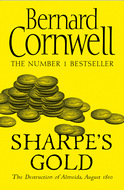
SHARPE’S
GOLD
Richard Sharpe and the Destruction of
Almeida, August 1810
BERNARD CORNWELL

Copyright

An imprint of HarperCollinsPublishers
1 London Bridge Street
London SE1 9GF
www.harpercollins.co.uk
First published in Great Britain by Collins 1981
Copyright © Rifleman Productions Ltd 1981
Cover design by Holly Macdonald © HarperCollinsPublishers Ltd 2019
Cover image © Hoberman/UIG/Bridgeman Images
Bernard Cornwell asserts the moral right to be identified as the author of this work
A catalogue record for this book is available from the British Library
This novel is entirely a work of fiction. The names, characters and incidents portrayed in it are the work of the author’s imagination. Any resemblance to actual persons, living or dead, events or localities is entirely coincidental.
All rights reserved under International and Pan-American Copyright Conventions. By payment of the required fees, you have been granted the non-exclusive, non-transferable right to access and read the text of this ebook on-screen. No part of this text may be reproduced, transmitted, downloaded, decompiled, reverse engineered, or stored in or introduced into any information storage and retrieval system, in any form or by any means, whether electronic or mechanical, now known or hereinafter invented, without the express written permission of HarperCollins.
Ebook Edition © July 2009 ISBN: 9780007338672
Version: 2019-12-13
This book is for
Andrew Gardner
with much gratitude
‘The insubordinate, sarcastic and oversexed Sharpe returns … Cornwell delivers the usual mix of strategy and strength – classic battle scenes and plenty of fisticuffs’
Daily Mirror
For a soldier I listed, to grow great in fame.
And be shot at for sixpence a day.
CHARLES DIBDIN 1745 – 1814
Contents
Cover
Title Page
Copyright
Dedication
Epigraph
Map
Chapter One
Chapter Two
Chapter Three
Chapter Four
Chapter Five
Chapter Six
Chapter Seven
Chapter Eight
Chapter Nine
Chapter Ten
Chapter Eleven
Chapter Twelve
Chapter Thirteen
Chapter Fourteen
Chapter Fifteen
Chapter Sixteen
Chapter Seventeen
Chapter Eighteen
Chapter Nineteen
Chapter Twenty
Chapter Twenty-One
Chapter Twenty-Two
Chapter Twenty-Three
Chapter Twenty-Four
Epilogue
Historical Note
Sharpe’s Story
Keep Reading …
About the Author
The SHARPE Series (in chronological order)
The SHARPE Series (in order of publication)
Also by Bernard Cornwell
About the Publisher

CHAPTER ONE

The war was lost; not finished, but lost. Everyone knew it, from Generals of Division to the whores of Lisbon: that the British were trapped, trussed, ready for cooking, and all Europe waited for the master chef himself, Bonaparte, to cross the mountains and put his finishing touch to the roast. Then, to add insult to imminent defeat, it seemed that the small British army was not worthy of the great Bonaparte’s attention. The war was lost.
Spain had fallen. The last Spanish armies had gone, butchered into the history books, and all that was left was the fortress harbour of Cádiz and the peasants who fought the guerrilla, the ‘little war’. They fought with Spanish knives and British guns, with ambush and terror, till the French troops loathed and feared the Spanish people. But the little war was not the war, and that, everyone said, was lost.
Captain Richard Sharpe, once of His Majesty’s 95th Rifles, now Captain of the Light Company of the South Essex Regiment, did not think that the war was lost, although, despite that, he was in a foul mood, morose and irritable. Rain had fallen since dawn and had turned the dust of the road’s surface into slick, slippery mud and made his Rifleman’s uniform clammy and uncomfortable. He marched in solitary silence, listening to his men chatter, and Lieutenant Robert Knowles and Sergeant Patrick Harper, who both would normally have sought his company, let him alone. Lieutenant Knowles had commented on Sharpe’s mood, but the huge Irish Sergeant had shaken his head.
‘There’s no chance of cheering him up, sir. He likes being miserable, so he does, and the bastard will get over it.’
Knowles shrugged. He rather disapproved of a Sergeant calling a Captain a ‘bastard’, but there was no point in protesting. The Sergeant would look innocent and assure Knowles that the Captain’s parents had never married, which was true, and anyway Patrick Harper had fought beside Sharpe for years and had a friendship with the Captain that Knowles rather envied. It had taken Knowles months to understand the friendship, which was not, as many officers thought, based on the fact that Sharpe had once been a private soldier, marching and fighting in the ranks, and now, elevated to the glories of the officers’ mess, still sought out the company of the lower ranks. ‘Once a peasant, always a peasant,’ an officer had sneered, and Sharpe had heard, looked at the man, and Knowles had seen the fear come under the impact of those chilling, mocking eyes. Besides, Sharpe and Harper did not spend off-duty time together; the difference in rank made that impossible. But still, behind the formal relationship, Knowles saw the friendship. Both were big men, the Irishman hugely strong, and both confident in their abilities. Knowles could never imagine either out of uniform. It was as if they had been born to the job and it was on the battlefield, where most men thought nervously of their own survival, that Sharpe and Harper came together in an uncanny understanding. It was almost, Knowles thought, as if they were at home on a battlefield, and he envied them.
He looked up at the sky, at the low clouds touching the hilltops either side of the road. ‘Bloody weather.’
‘Back home, sir, we’d call this a fine day!’ Harper grinned at Knowles, the rain dripping off his shako, and then turned to look at the Company, who followed the fast-marching figure of Sharpe. They were straggling a little, slipping on the road, and Harper raised his voice. ‘Come on, you Protestant scum! The war’s not waiting for you!’
He grinned at them as he shouted, proud they had outmarched the rest of the Regiment, and happy that, at last, the South Essex was marching north to where the summer’s battles would be fought. Patrick Harper had heard the rumours – everyone had – of the French armies and their new commander, but Patrick Harper did not intend to lose any sleep over the future even though the South Essex was pitifully under strength. Replacements had sailed from Portsmouth in March, but the convoy had been hit by a storm, and, weeks later, rumours came of hundreds of bodies washed ashore on the southern Biscay beaches, and now the Regiment must fight with less than half its proper number. Harper did not mind. At Talavera the army had been outnumbered two to one, and tonight, in the town of Celorico, where the army was gathering, there would be women in the streets and wine in the shops. Life could be a lot worse for a lad from Donegal, and Patrick Harper began whistling.
Sharpe heard the whistling and checked his impulse to snap at the Sergeant, recognizing it as pure irritation, but he was annoyed by Harper’s customary equanimity. Sharpe did not believe the rumours of defeat, because, to a soldier, defeat was unthinkable. It was something that happened to the enemy. Yet Sharpe despised himself because, like a walking nightmare, the remorseless logic of numbers was haunting him. Defeat was in the air, whether he believed it or not, and as the thought came to him again he marched even faster, as if the aching pace could obliterate the pessimism. But at least, at long last, they were doing something. Since Talavera the Regiment had patrolled the bleak southern border between Spain and Portugal, and it had been a long, boring winter. The sun had risen and set, the Regiment had trained, they had watched the empty hills, and there had been too much leisure, too much softness. The officers had found a discarded French cavalryman’s breastplate and used it as a shaving bowl, and to his disgust Sharpe had found himself taking the luxury of hot water in a bowl as a normal daily occurrence! And weddings. Twenty alone in the last three months, so that, miles behind, the other nine companies of the South Essex were leading a motley procession of women and children, wives and whores, like a travelling fairground. But now, at last, in an unseasonably wet summer, they were marching north, to where the French attack would come, and where the doubts and fears would be banished in action.
The road reached a crest, revealing a shallow valley with a small village at its centre. There were cavalry in the village, presumably summoned north, like the South Essex, and as Sharpe saw the mass of horses, he let his irritation escape by spitting on the road. Bloody cavalry, with their airs and graces, their undisguised condescension to the infantry, but then he saw the uniforms of the dismounted riders and felt ashamed of his reaction. The men wore the blue of the King’s German Legion, and Sharpe respected the Germans. They were fellow professionals, and Sharpe, above everything else, was a professional soldier. He had to be. He had no money to buy promotion, and his future lay only in his skill and experience. There was plenty of experience. He had been a soldier for seventeen of his thirty-three years, first as a Private, then a Sergeant, then the dizzy jump to officer’s rank, and all the promotions had been earned on battlefields. He had fought in Flanders, in India, and now in the Peninsula, and he knew that should peace arrive the army would drop him like a red-hot bullet. It was only in war that they needed professionals like himself, like Harper, like the tough Germans who fought France in Britain’s army.
He halted the Company in the village street under the curious gaze of the cavalrymen. One of them, an officer, hitched his curved sabre off the ground and walked over to Sharpe. ‘Captain?’ The cavalryman made it a question because Sharpe’s only signs of rank were the faded scarlet sash and the sword.
Sharpe nodded. ‘Captain Sharpe. South Essex.’
The German officer’s eyebrows went up; his face split into a smile. ‘Captain Sharpe! Talavera!’ He pumped Sharpe’s hand, clapped him on the shoulder, then turned to shout at his men. The blue-coated cavalry grinned at Sharpe, nodded at him. They had all heard of him: the man who had captured the French Eagle at Talavera.
Sharpe jerked his head towards Patrick Harper and the Company. ‘Don’t forget Sergeant Harper, and the Company. We were all there.’
The German beamed at the Light Company. ‘It was well done!’ He clicked his heels to Sharpe and gave the slightest nod. ‘Lossow. Captain Lossow at your service. You going to Celorico?’ The German’s English was accented but good. His men, Sharpe knew, would probably speak no English.
Sharpe nodded again. ‘And you?’
Lossow shook his head. ‘The Coa. Patrolling. The enemy are getting close, so there will be fighting.’ He sounded pleased and Sharpe envied the cavalry. What fighting there was to be had was all taking place along the steep banks of the river Coa and not at Celorico. Lossow laughed. ‘This time we get an Eagle, yes?’
Sharpe wished him luck. If any cavalry regiment were likely to break apart a French battalion, it would be the Germans. The English cavalry were brave enough, well mounted, but with no discipline. English horsemen grew bored with patrols, with picquet duty, and dreamed only of the blood-curdling charge, swords high, that left their horses blown and the men scattered and vulnerable. Sharpe, like all infantry in the army, preferred the Germans because they knew their job and did it well.
Lossow grinned at the compliment. He was a squarefaced man, with a pleasant and ready smile and eyes that looked out shrewdly from the web of lines traced on his face by staring too long at the enemy-held horizons. ‘Oh, one more thing, Captain. The bloody provosts are in the village.’ The phrase came awkwardly from Lossow’s lips, as if he did not usually use English swearwords except to describe the provosts, for whom any other language’s curse would be inadequate.
Sharpe thanked him and turned to the Company. ‘You heard Captain Lossow! There are provosts here. So keep your thieving hands to yourselves. Understand?’ They understood. No one wanted to be hung on the spot for being caught looting. ‘We stop for ten minutes. Dismiss them, Sergeant.’
The Germans left, cloaked against the rain, and Sharpe walked up the only street towards the church. It was a miserable village, poor and deserted, and the cottage doors swung emptily. The inhabitants had gone south and west, as the Portuguese government had ordered. When the French advanced they would find no crops, no animals, wells filled with stones or poisoned with dead sheep: a land of hunger and thirst.
Patrick Harper, sensing that Sharpe’s mood had lightened after the meeting with Lossow, fell into step beside his Captain. ‘Nothing here to loot, sir.’
Sharpe glanced at the men stooping into the cottages. ‘They’ll find something.’
The provosts were beside the church, three of them, mounted on black horses and standing like highwaymen waiting for a plump coach. Their equipment was new, their faces burned red, and Sharpe guessed they were fresh out from England, though why the Horse Guards sent provosts instead of fighting soldiers was a mystery. He nodded civilly to them. ‘Good morning.’
One of the three, with an officer’s sword jutting from beneath his cloak, nodded back. He seemed, like all of his kind, to be suspicious of any friendly gesture. He looked at their green Riflemen’s jackets. ‘There aren’t supposed to be any Riflemen in this area.’
Sharpe let the accusation go unanswered. If the provost thought they were deserters, then the provost was a fool. Deserters did not travel the open road in daylight, or wear uniforms, or stroll casually up to provosts. Sharpe and Harper, like the other eighteen Riflemen in the Company, had kept their old uniforms out of pride, preferring the dark green to the red of the line battalions.
The provost’s eyes flicked between the two men. ‘You have orders?’
‘The General wants to see us, sir.’ Harper spoke cheerfully.
A tiny smile came and went on the provost’s face. ‘You mean Lord Wellington wants to see you?’
‘As a matter of fact, yes.’
Sharpe’s voice had a warning in it, but the provost seemed oblivious. He was looking Sharpe up and down, letting his suspicions show. Sharpe’s appearance was extraordinary. The green jacket, faded and torn, was worn over French cavalry overalls. On his feet were tall leather boots that had originally been bought in Paris by a Colonel of Napoleon’s Imperial Guard. On his back, like most of his men, he carried a French pack, made of ox hide, and on his shoulder, though he was an officer, he slung a rifle. The officer’s epaulettes had gone, leaving broken stitches, and the scarlet sash was stained and faded. Even Sharpe’s sword, his other badge of rank, was irregular. As an officer of a Light Company he should have carried the curved sabre of the British Light Cavalry, but Richard Sharpe preferred the sword of the Heavy Cavalry, straight-bladed and ill balanced. Cavalrymen hated it; they claimed its weight made it impossible to parry swiftly, but Sharpe was six feet tall and strong enough to wield the thirty-five inches of ponderous steel with deceptive ease.
The provost officer was unsettled. ‘What’s your Regiment?’
‘We’re the Light of the South Essex.’ Sharpe made his tone friendly.
The provost responded by spurring his horse forward so he could see down the street and watch Sharpe’s men. There was no immediately apparent reason to hang anyone, so he looked back at the two men and his eyes stopped, with surprise, when they reached Harper’s shoulder. The Irishman, with four inches more height than Sharpe, was a daunting sight at the best of times, but his weapons were even more irregular than Sharpe’s big sword. Slung with his rifle was a brute of a gun – a seven-barrelled, squat menace. The provost pointed. ‘What’s that?’
‘Seven-barrelled gun, sir.’ Harper’s voice was full of pride in his new weapon.
‘Where did you get it?’
‘Christmas present, sir.’
Sharpe grinned. It had been a present, given at Christmas time, from Sharpe to his Sergeant, but it was obvious that the provost, with his two silent companions, did not believe it. He was still staring at the gun, one of Henry Nock’s less successful inventions, and Sharpe realized that the provost had probably never seen one before. Only a few hundred had ever been made, for the Navy, and at the time it had seemed like a good idea. Seven barrels, each twenty inches long, were all fired by the same flintlock, and it was thought that sailors, perched precariously in the fighting tops, could wreak havoc by firing the seven barrels down on to the enemy’s crowded decks. One thing had been overlooked. Seven half-inch barrels fired together made a fearful discharge, like a small cannon’s, that not only wreaked havoc but also broke the shoulder of any man who pulled the trigger. Only Harper, in Sharpe’s acquaintance, had the brute strength to use the gun, and even the Irishman, in trying it out, had been astonished by the crashing recoil as the seven bullets spread from the flaming muzzles.
The provost sniffed. ‘A Christmas present.’
‘I gave it to him,’ Sharpe said.
‘And you are?’
‘Captain Richard Sharpe. South Essex. You?’
The provost stiffened. ‘Lieutenant Ayres, sir.’ The last word was spoken reluctantly.
‘And where are you going, Lieutenant Ayres?’
Sharpe was annoyed by the man’s suspicions, by the pointless display of his power, and he edged his questions with a touch of venom. Sharpe carried on his back the scars of a flogging that had been caused by just such an officer as this: Captain Morris, a supercilious bully, with his flattering familiar, Sergeant Hakeswill. Sharpe carried the memory along with the scars and a promise that one day he would revenge himself on both men. Morris, he knew, was stationed in Dublin; Hakeswill was God knows where, but one day, Sharpe promised himself, he would find him. But for now it was this young puppy with more power than sense. ‘Where, Lieutenant?’
‘Celorico, sir.’
‘Then have a good journey, Lieutenant.’
Ayres nodded. ‘I’ll look round first, sir. If you don’t mind.’
Sharpe watched the three men ride down the street, the rain beading the wide, black rumps of the horses. ‘I hope you’re right, Sergeant.’
‘Right, sir?’
‘That there’s nothing to loot.’
The thought struck both together, a single instinct for trouble, and they began running. Sharpe pulled his whistle from the small holster on his crossbelt and blew the long blasts that were usually reserved for the battlefield when the Light Company was strung out in a loose skirmish line, the enemy was pressing close, and the officers and Sergeants whistled the men back to rally and re-form under the shelter of the Battalion. The provosts heard the whistle blasts, put spurs to their horses, and swerved between two low cottages to search the yards as Sharpe’s men tumbled from doorways and grumbled into ranks.
Harper pulled up in front of the Company. ‘Packs on!’
There was a shout from behind the cottages. Sharpe turned. Lieutenant Knowles was at his elbow.
‘What’s happening, sir?’
‘Provost trouble. Bastards are throwing their weight around.’
They were determined, he knew, to find something, and as Sharpe’s eyes went down his ranks he had a sinking feeling that Lieutenant Ayres had succeeded. There should have been forty-eight men, three Sergeants, and the two officers, but one man was missing: Private Batten. Private bloody Batten, who was dragged by his hair from between the cottages by a triumphant provost.
‘A looter, sir. Caught in the act.’ Ayres was smiling.
Batten, who grumbled incessantly, who moaned if it rained and made a fuss when it stopped because the sun was in his eyes. Private Batten, a one-man destroyer of flintlocks, who thought the whole world was conspiring to annoy him, and who now stood flinching beneath the grasp of one of Ayres’s men. If there were any one member of the Company whom Sharpe would gladly have hanged, it would be Batten, but he was damned if any provost was going to do it for him.
Sharpe looked up at Ayres. ‘What was he looting, Lieutenant?’
‘This.’
Ayres held up a scrawny chicken as if it were the Crown of England. Its neck had been well wrung, but the legs still jerked and scrabbled at the air. Sharpe felt the anger come inside him, not at the provosts but at Batten.
‘I’ll deal with him, Lieutenant.’ Batten cringed away from his Captain.
Ayres shook his head. ‘You misunderstand, sir.’ He was talking with silky condescension. ‘Looters are hung, sir. On the spot, sir. As an example to others.’
There was a muttering from the Company, broken by Harper’s bellowed order for silence. Batten’s eyes flicked left and right as if looking for an escape from this latest example of the world’s injustice. Sharpe snapped at him. ‘Batten!’
‘Sir?’
‘Where did you find the chicken?’
‘It was in the field, sir. Honest.’ He winced as his hair was pulled. ‘It was a wild chicken, sir.’
There was a rustle of laughter from the ranks that Harper let go. Ayres snorted. ‘A wild chicken. Dangerous beasts, eh, sir? He’s lying. I found him in the cottage.’
Sharpe believed him, but he was not going to give up. ‘Who lives in the cottage, Lieutenant?’
Ayres raised an eyebrow. ‘Really, sir, I have not exchanged cards with every slum in Portugal.’ He turned to his men. ‘String him up.’
‘Lieutenant Ayres.’ The tone of Sharpe’s voice stopped any movement in the street. ‘How do you know the cottage is inhabited?’
‘Look for yourself.’
‘Sir.’
Ayres swallowed. ‘Sir.’
Sharpe raised his voice. ‘Are there people there, Lieutenant?’
‘No, sir. But it’s lived in.’
‘How do you know? The village is deserted. You can’t steal a chicken from nobody.’
Ayres thought about his reply. The village was deserted, the inhabitants gone away from the French attack, but absence was not a relinquishing of ownership. He shook his head. ‘The chicken is Portuguese property, sir.’ He turned again. ‘Hang him!’
‘Halt!’ Sharpe bellowed and again movement stopped. ‘You’re not going to hang him, so just go your way.’
Ayres swivelled back to Sharpe. ‘He was caught redhanded and the bastard will hang. Your men are probably a pack of bloody thieves and they need an example and, by God, they will get one!’ He raised himself in his stirrups and shouted at the Company. ‘You will see him hang! And if you steal, then you will hang too!’
A click interrupted him. He looked down and the anger in his face was replaced by astonishment. Sharpe held his Baker rifle, cocked, so that the barrel was pointing at Ayres.
‘Let him go, Lieutenant.’
‘Have you gone mad?’
Ayres had gone white, had sagged back into his saddle. Sergeant Harper, instinctively, came and stood beside Sharpe and ignored the hand that waved him away. Ayres stared at the two men. Both tall, both with hard, fighters’ faces, and a memory tickled at him. He looked at Sharpe, at the face that appeared to have a perpetually mocking expression, caused by the scar that ran down the right cheek, and he suddenly remembered. Wild chickens, bird-catchers! The South Essex Light Company. Were these the two men who had captured the Eagle? Who had hacked their way into a French regiment and come out with the standard? He could believe it.
Sharpe watched the Lieutenant’s eyes waver and knew that he had won, but it was a victory that would cost him dearly. The army did not look kindly on men who held rifles on provosts, even empty rifles.
Ayres pushed Batten forward. ‘Have your thief, Captain. We shall meet again.’
Sharpe lowered the rifle. Ayres waited until Batten was clear of the horses, then wrenched the reins and led his men towards Celorico. ‘You’ll hear from me!’ His words were flung back. Sharpe could sense the trouble like a boiling, black cloud on the horizon. He turned to Batten.
‘Did you steal that bloody hen?’
‘Yes, sir.’ Batten flapped a hand after the provost. ‘He took it, sir.’ He made it sound unfair.
‘I wish he’d bloody taken you. I wish he’d bloody spread your guts across the bloody landscape.’ Batten backed away from Sharpe’s anger. ‘What are the bloody rules, Batten?’
The eyes blinked at Sharpe. ‘Rules, sir?’
‘You know the bloody rules. Tell me.’
The army issued regulations that were inches thick, but Sharpe gave his men three rules. They were simple, they worked, and if broken the men knew they could expect punishment. Batten cleared his throat.
‘To fight well, sir. Not to get drunk without permission, sir. And –’
‘Go on.’
‘Not to steal, sir, except from the enemy or when starving, sir.’
‘Were you starving?’
Batten clearly wanted to say he was, but there were still two days’ rations in every man’s haversack. ‘No, sir.’
Sharpe hit him, all his frustration pouring into one fist that slammed Batten’s chest, winded him, and knocked him gasping into the wet road. ‘You’re a bloody fool, Batten, a cringing, miserable, whoreson, slimy fool.’ He turned away from the man, whose musket had fallen into the mud. ‘Company! March!’
They marched behind the tall Rifleman as Batten picked himself up, brushed ineffectively at the water that had flowed into the lock of his gun, and then shambled after the Company. He pushed himself into his file and muttered at his silent companions. ‘He’s not supposed to hit me.’
‘Shut your mouth, Batten!’ Harper’s voice was as harsh as his Captain’s. ‘You know the rules. Would you rather be kicking your useless heels now?’
The Sergeant shouted at the Company to pick up their feet, bellowed the steps at them, and all the time he wondered what faced Sharpe now. A complaint from that bloody provost would mean an enquiry and probably a court-martial. And all for the miserable Batten, a failed horse-coper, whom Harper would gladly have killed himself. Lieutenant Knowles seemed to share Harper’s thoughts, for he fell in step beside the Irishman and looked at him with a troubled face. ‘All for one chicken, Sergeant?’
Harper looked down at the young Lieutenant. ‘I doubt it, sir.’ He turned to the ranks. ‘Daniel!’
Hagman, one of the Riflemen, broke ranks and fell in beside the Sergeant. He was the oldest man in the Company, in his forties, but the best marksman. A Cheshireman, raised as a poacher, Hagman could shoot the buttons off a French General’s coat at three hundred yards. ‘Sarge?’
‘How many chickens were there?’
Hagman flashed his toothless grin, glanced at the Company, then up at Harper. The Sergeant was a fair man, never demanding more than a fair share. ‘Dozen, Sarge.’
Harper looked at Knowles. ‘There you are, sir. At least sixteen wild chickens there. Probably twenty. God knows what they were doing there, why the owners didn’t take them.’
‘Difficult to catch, sir, chickens.’ Hagman chuckled. ‘That all, Sarge?’
Harper grinned down at the Rifleman. ‘A leg each for the officers, Daniel. And not the stringy ones.’
Hagman glanced at Knowles. ‘Very good, sir. Leg each.’ He went back to the ranks.
Knowles chuckled to himself. A leg each for the officers meant a good breast for the Sergeant, chicken broth for everyone, and nothing for Private Batten. And for Sharpe? Knowles felt his spirits drop. The war was lost, it was still raining, and tomorrow Captain Richard Sharpe would be in provost trouble, real trouble, right up to his sabre-scarred neck.
CHAPTER TWO
If anyone needed a symbol of impending defeat, then the Church of São Paolo in Celorico, the temporary headquarters of the South Essex, offered it in full. Sharpe stood in the choir watching the priest whitewash a gorgeous rood-screen. The screen was made of solid silver, ancient and intricate, a gift from some long-forgotten parishioner whose family’s faces were those of the grieving women and disciples who stared up at the crucifix. The priest, standing on a trestle, dripping thick lime paint down his cassock, looked from Sharpe to the screen, and shrugged.
‘It took three months to clean off last time.’
‘Last time?’
‘When the French left.’ The priest sounded bitter and he dabbed angrily with the bristles at the delicate traceries. ‘If they knew it was silver they would carve it into pieces and take it away.’ He splashed the nailed, hanging figure with a slap of paint and then, as if in apology, moved the brush to his left hand so that his right could sketch a perfunctory sign of the cross on his spattered gown.
‘Perhaps they won’t get this far.’
It sounded unconvincing, even to Sharpe, and the priest did not bother to reply. He just gave a humourless laugh and dipped the brush into his bucket. They know, thought Sharpe; they all know that the French are coming and the British falling back. The priest made him feel guilty, as if he were personally betraying the town and its inhabitants, and he moved down the church into the darkness by the main door where the Battalion’s commissariat officer was supervising the piling of fresh baked bread for the evening rations.
The door banged open, letting in the late-afternoon sunlight, and Lawford, dressed in his glittering best uniform, beckoned at Sharpe. ‘Ready?’
‘Yes, sir.’
Major Forrest was waiting outside and he smiled nervously at Sharpe. ‘Don’t worry, Richard.’
‘Worry?’ Lieutenant Colonel the Honourable William Lawford was angry. ‘He should damned well worry.’ He looked Sharpe up and down. ‘Is that the best you can do?’
Sharpe fingered the tear in his sleeve. ‘It’s all I’ve got, sir.’
‘All? What about that new uniform! Good Lord, Richard, you look like a tramp.’
‘Uniform’s in Lisbon, sir. In store. Light Companies should travel light.’
Lawford snorted. ‘And they shouldn’t threaten provosts with rifles either. Come on, we don’t want to be late.’ He crammed the tricorne hat on to his head and returned the salute of the two sentries who had listened, amused, to his outburst.
Sharpe held up his hand. ‘One moment, sir.’ He brushed an imaginary speck of dust from the gold regimental badge that the Colonel wore on his white diagonal sash. It was a new badge, commissioned by Lawford after Talavera, and showed an eagle in chains – a message to the world that the South Essex was the only regiment in the Peninsula that had captured a French standard. Sharpe stood back satisfied. ‘That’s better, sir.’
Lawford took the hint, and smiled. ‘You’re a bastard, Sharpe. Just because you captured an Eagle doesn’t mean you can do what you like.’
‘While just because some idiot is dressed up as a provost, I suppose, means that he can?’
‘Yes,’ Lawford said. ‘It does. Come on.’
It was strange, Sharpe thought, how Lawford was the sum of all he disliked about privilege and wealth, yet he liked Lawford and was content to serve him. They were the same age, thirty-three, but Lawford had always been an officer, had never worried about promotion, because he could afford the next step, and never concerned himself where the next year’s money would come from. Seven years ago, Lawford had been a Lieutenant and Richard Sharpe his Sergeant, both fighting the Mahrattas in India, and the Sergeant had kept the officer alive in the dungeons of the Tippoo Sultan. In return, Lawford taught the Sergeant to read and write and thus qualified him for a commission if ever he were foolish enough to perform some act of bravery on a battlefield that could hoist a man from the ranks into the officers’ exalted company.
Sharpe followed Lawford through the crowded streets towards Wellington’s headquarters, and seeing the Colonel’s exquisite uniform and expensive accoutrements, he wondered where they would be in another seven years. Lawford was ambitious, as was Sharpe, but the Colonel had the birth and the money for great things. He’ll be a general, Sharpe thought, and he grinned because he knew that Lawford would still need him or someone like him. Sharpe was Lawford’s eyes and his ears, his professional soldier, the man who could read the faces of the failed criminals, drunks, and desperate men who had somehow become the best infantry in the world. And more than that, Sharpe could read the ground, could read the enemy, and Lawford, for whom the army was a means to a glorious and exalted end, relied on his ex-Sergeant’s instinct and talent. Lawford, Sharpe decided, had done well in the last year. He had taken over an embittered, brutalized, and frightened Regiment and turned them into a unit as good as any battalion in the line. Sharpe’s Eagle had helped. It had wiped out the stain of Valdelacasa, where the South Essex, under Sir Henry Simmerson, had lost a colour and their pride; but it was not just the Eagle. Lawford, with his politician’s instincts, had trusted the men while he worked them hard, had given them back their confidence. And the badge, which every man wore on his shako, shared the glory of Talavera with every soldier in the Regiment.
Lawford led them through the press of officers and townspeople. Major Forrest kept glancing at Sharpe with an avuncular smile that made him look, more than ever, like a kindly country vicar dressed as a soldier for the village pageant. He tried to reassure Sharpe. ‘It won’t come to a court-martial, Richard; it can’t! You’ll probably have to apologize, or something, and it will all blow over.’
Sharpe shook his head. ‘I won’t bloody apologize, sir.’
Lawford stopped and turned round, his finger pushed into Sharpe’s chest. ‘If you are ordered to apologize, Richard Sharpe, you will damned well apologize. You will grovel, squirm, cringe and toady to order. Do you understand?’
Sharpe clicked the heels of his tall French boots. ‘Sir!’
Lawford exploded in rare anger. ‘Christ Almighty, Richard, don’t you bloody understand? This is a general-court-martial offence. Ayres has screamed his head off to the Provost Marshal and the Provost Marshal has screamed to the General that the authority of the provost must not be undermined. And the General, Mr Sharpe, is rather sympathetic to that point of view.’ Lawford’s passion had attracted a small crowd of interested spectators. His anger faded as suddenly as it had erupted, but he still jabbed his finger into Sharpe’s chest. ‘The General wants more provosts, not fewer, and he is understandably not happy with the thought that Captain Richard Sharpe is declaring open season on them.’
‘Yes, sir.’
Lawford was not placated by Sharpe’s crestfallen expression, which the Colonel suspected was not motivated by true regret. ‘And do not think, Captain Sharpe, that just because the General ordered us here he will look kindly on your action. He’s saved your miserable skin often enough in the past and he may not be of a mind to do it again. Understand?’
There was a burst of applause from a group of cavalry officers standing by a wine shop. Lawford shot them a withering look and strode on, followed by someone’s ironic mimicry of the bugle call for the full charge. Sharpe followed. Lawford could be right. The General had summoned the South Essex, no one knew why, and Sharpe had hoped that it was for some special task, something to wipe out the memory of the winter’s boredom. But the scene with Lieutenant Ayres could change that for Sharpe, condemn him to a court-martial, to a future far more dreary even than patrol work on an empty border.
Four ox-carts stood outside Wellington’s headquarters, another reminder that the army would move soon, but otherwise everything was peaceful. The only unusual object was a tall mast that jutted from the roof of the house, topped by a crosspiece, from which hung four tarred sheep bladders. Sharpe looked at them curiously. This was the first time he had seen the new telegraph and he wished that it was working so that he could watch the black, inflated bladders running up and down on their ropes and sending messages, via other similar stations, to the far-off fortress of Almeida and to the troops guarding the river Coa. The system had been copied from the Royal Navy and sailors had been sent to man the telegraph. Each letter of the alphabet had its own arrangement of the four black bags, and common words, like ‘regiment’, ‘enemy’, and ‘general’, were abbreviated to a single display that could be seen, miles away, through a huge naval telescope. Sharpe had heard that a message could travel twenty miles in less than ten minutes and he wondered, as they came close to the two bored sentries guarding the General’s headquarters, what other modern devices would be thrown up by the necessity of the long war against Napoleon.
He forgot the telegraph as they stepped into the cool hallway of the house and he felt a twinge of fear at the coming interview. In a curious fashion his career had been linked to Wellington. They had shared battlefields in Flanders, India, and now in the Peninsula, and in his pack Sharpe carried a telescope that had been a present from the General. There was a small, curved, brass plate let into the walnut tube and on it was inscribed IN GRATITUDE. AW. SEPTEMBER 23RD, 1803. Sir Arthur Wellesley believed that Sergeant Sharpe had saved his life, though Sharpe, if he was honest, could remember little of the event except that the General’s horse had been piked and the Indian bayonets and curved tulwars were coming forward and what else did a Sergeant do except get in the way and fight back? That had been the battle of Assaye, a bastard of a fight, and Sharpe had watched his officers die in the shot from the ornate guns and, his blood up, he had taken the survivors on and the enemy had been beaten. Only just, by God, but victory was victory. After that he was made into an officer, dressed up like a prize bull, and the same man who had rewarded him then must decide his fate now.
‘His Lordship will see you now.’ A suave young Major smiled at them through the door as though they had been invited for tea. It had been a year since Sharpe had seen Wellington, but nothing had changed: still the table covered with papers, the same blue eyes that gave nothing away above the beak of a nose, and the handsome mouth that was grudging with a smile. Sharpe was glad there were no provosts in the room so at least he would not have to grovel in front of the General, but even so he felt apprehensive of this quiet man’s anger and he watched, cautiously, as the quill pen was laid down and the expressionless eyes looked up at him. There was no recognition in them.
‘Did you threaten Lieutenant Ayres with a rifle, Captain Sharpe?’ There was the faintest stress on the ‘Captain’.
‘Yes, sir.’
Wellington nodded. He looked tired. He stood up and moved to the window, peering through as though expecting something. There was silence in the room, broken only by the jingle of chains and rumbling of wheels as a battery of artillery drove by in the street. It struck Sharpe that the General was on edge. Wellington turned back to him.
‘Do you know, Captain Sharpe, the damage it does our cause if our soldiers thieve or rape?’ His voice was scathingly quiet.
‘Yes, sir.’
‘I hope you do, Captain Sharpe, I hope you do.’ He sat down again. ‘Our enemies are encouraged to steal because that is the only way they can be fed. The result is that they are hated wherever they march. I spend money – my God, how much money – on providing rations and transport and buying food from the populace so that our soldiers have no need to steal. We do this so they will be welcomed by the local people and helped by them. Do you understand?’
Sharpe wished the lecture would end. ‘Yes, sir.’
There was suddenly a strange noise overhead, a shuffling and rattling, and Wellington’s eyes shot to the ceiling as if he could read what the noise might mean. It occurred to Sharpe that the telegraph was working, the inflated bladders running up and down the ropes, bringing a coded message from the troops facing the French. The General listened for a few seconds, then dropped his face to Sharpe again. ‘Your gazette has not yet been ratified.’
There were few things the General could have said more calculated to worry Sharpe. Officially he was still a Lieutenant, only a Lieutenant, and his Captaincy had been awarded by a gazette from Wellington a year ago. If the Horse Guards in Whitehall did not approve, and he knew they usually rejected such irregular promotions, then he was soon to be a Lieutenant again. He said nothing as Wellington watched him. If this were a warning shot, then he would take it in silence.
The General sighed, picked up a piece of paper, put it down again. ‘The soldier has been punished?’
‘Yes, sir.’ He thought of Batten, winded, on the ground.
‘Then do not, pray, let it happen again. Not even, Captain Sharpe, to wild chickens.’
My God, thought Sharpe, he knows everything that happens in this army. There was silence. Was that the end of it? No court-martial? No apology? He coughed and Wellington looked up.
‘Yes?’
‘I was expecting more, sir. Court-martials and drumheads.’
Sharpe heard Lawford stir in embarrassment but the General did not seem worried. He stood up and used one of his few, thin smiles.
‘I would quite happily, Captain Sharpe, string up you and that damned Sergeant. But I suspect we need you. What do you think of our chances this summer?’
Again there was silence. The change of tack had taken them all by surprise. Lawford cleared his throat. ‘There’s clearly some concern, my lord, about the intentions of the enemy and our response.’
Another wintry smile. ‘The enemy intend to push us into the sea, and soon. How do we respond?’ Wellington, it occurred to Sharpe, was using up time. He was waiting for something or someone.
Lawford was feeling uncomfortable. The question was one he would rather hear answered by the General. ‘Bring them to battle, sir?’
‘Thirty thousand troops, plus twenty-five thousand untried Portuguese, against three hundred and fifty thousand men?’
Wellington let the figures hang in the air like the dust that shifted silently in the slanting sunlight over his desk. Overhead the feet of the men operating the telegraph still shuffled. The figures, Sharpe knew, were unfair. Masséna needed thousands of those men to contain the Guerrilleros, the partisans, but even so the disparity in numbers was appalling. Wellington sniffed. There was a knock on the door.
‘Come in.’
‘Sir.’
The Major who had shown them into the room handed a slip of paper to the General, who read it, closed his eyes momentarily, and sighed.
‘The rest of the message is still coming?’
‘Yes, sir. But the gist is there.’
The Major left and Wellington leaned back in his chair. The news had been bad, Sharpe could tell, but not, perhaps, unexpected. He remembered that Wellington had once said that running a campaign was like driving a team of horses with a rope harness. The ropes kept breaking and all a General could do was tie a knot and keep going. A rope was unravelling, here and now, an important one, and Sharpe watched the fingers drum on the edge of the table. The eyes came up to Sharpe again, flicked to Lawford.
‘Colonel?’
‘Sir?’
‘I am borrowing Captain Sharpe from you, and his Company. I doubt whether I need them for more than one month.’
‘Yes, my lord.’ Lawford looked at Sharpe and shrugged.
Wellington stood again. He seemed to be relieved, as if a decision had been made. ‘The war is not lost, gentlemen, though I know my confidence is not universally shared.’ He sounded bitter, angry with the defeatists whose letters home were quoted in the newspapers. ‘We may bring the French to battle, and if we do we will win.’ Sharpe never doubted it. Of all Britain’s generals this was the only one who knew how to beat the French. ‘If we win we will only delay their advance.’ He opened a map, stared at it blankly, and let it snap shut again into a roll. ‘No, gentlemen, our survival depends on something else. Something that you, Captain Sharpe, must bring me. Must, do you hear? Must.’
Sharpe had never heard the General so insistent. ‘Yes, sir.’
Lawford coughed. ‘And if he fails, my lord?’
The wintry smile again. ‘He had better not.’ He looked at Sharpe. ‘You are not the only card in my hand, Mr Sharpe, but you are … important. There are things happening, gentlemen, that this army does not know about. If it did it would be generally more optimistic.’ He sat down again, leaving them mystified. Sharpe suspected the mystification was on purpose. He was spreading some counter-rumours to the defeatists, and that, too, was part of a general’s job. He looked up again. ‘You are now under my orders, Captain Sharpe. Your men must be ready to march this night. They must not be encumbered with wives or unnecessary baggage, and they must have full ammunition.’
‘Yes, sir.’
‘And you will be back here in one hour. You have two tasks to perform.’
Sharpe wondered if he was to be told what they were. ‘Sir?’
‘First, Mr Sharpe, you will receive your orders. Not from me but from an old companion of yours.’ Wellington saw Sharpe’s quizzical look. ‘Major Hogan.’
Sharpe’s face betrayed his pleasure. Hogan, the engineer, the quiet Irishman who was a friend, whose sense Sharpe had leaned on in the difficult days leading to Talavera. Wellington saw the pleasure and tried to puncture it. ‘But before that, Mr Sharpe, you will apologize to Lieutenant Ayres.’ He watched for Sharpe’s reaction.
‘But of course, sir. I had always planned to.’ Sharpe looked shocked at the thought that he might ever have contemplated another course of action and, through his innocently wide eyes, wondered if he saw a flicker of amusement behind the General’s cold, blue gaze.
Wellington looked away, to Lawford, and with his usual disarming speed suddenly became affable. ‘You’re well, Colonel?’
‘Thank you, sir. Yes.’ Lawford beamed with pleasure. He had served on Wellington’s staff, knew the General well.
‘Join me for dinner tonight. The usual time.’ The General looked at Forrest. ‘And you, Major?’
‘My pleasure, sir.’
‘Good.’ The eyes flicked at Sharpe. ‘Captain Sharpe will be too busy, I fear.’ He nodded a dismissal. ‘Good day, gentlemen.’
Outside the headquarters the bugles sounded the evening and the sun sank in magnificent crimson. Inside the quiet room the General paused a moment before plunging back into the paperwork that must be done before the dinner of roast mutton. Hogan, he thought, was right. If a miracle were needed to save the campaign, and it was, then the rogue he had just seen was the best man for the job. More than a rogue: a fighter, and a man who looked on failure as unthinkable. But a rogue, thought Wellington, a damned rogue all the same.
CHAPTER THREE
Sharpe had spent the hour between leaving and returning to Wellington’s headquarters conjuring all kinds of quixotic answers to the mystery of what he was supposed to bring back to the General. Perhaps, he had thought as he stirred the Company into activity, it would be a new French secret weapon, something like the British Colonel Congreve’s rocket system, of which there were so many tales but so little evidence. Or, more fanciful still, perhaps the British had secretly offered refuge to Napoleon’s divorced Josephine, who might have smuggled herself to Spain to become a pawn in the high politics of the war. He was still wondering as he was shown into a large room of the headquarters, to find a reception committee, formal and strained, flanking a wretchedly embarrassed Lieutenant Ayres.
The unctuous young Major smiled at Sharpe as though he were a valued and expected guest. ‘Ah, Captain Sharpe. You know the Provost Marshal, you’ve met Lieutenant Ayres, and this is Colonel Williams. Gentlemen?’ The Major made a delicate gesture as if inviting them all to sit down and take a glass of sherry. It seemed that Colonel Williams, plump and red-veined, was deputed to do the talking.
‘Disgraceful, Sharpe. Disgraceful!’
Sharpe stared a fraction of an inch over Williams’s head and stopped himself from blinking. It was a useful way of discomfiting people, and, sure enough, Williams wavered from the apparent gaze and made a helpless gesture towards Lieutenant Ayres.
‘You imperilled his authority, overstepped your own. A disgrace!’
‘Yes, sir. I apologize!’
‘What?’ Williams seemed surprised at Sharpe’s sudden apology. Lieutenant Ayres was squirming with uneasiness, while the Provost Marshal seemed impatient to get the charade done. Williams cleared his throat, seemed to want his pound of flesh. ‘You apologize?’
‘Yes, sir. Unreservedly, sir. Terrible disgrace, sir. I utterly apologize, sir, regret my part very much, sir, as I’m sure Lieutenant Ayres does his.’
Ayres, startled by a sudden smile from Sharpe, nodded hastily and agreed. ‘I do, sir. I do.’
Williams whirled on his unfortunate Lieutenant. ‘What do you have to regret, Ayres? You mean there’s more to this than I thought?’
The Provost Marshal sighed and scraped a boot on the floor. ‘I think the purpose of this meeting is over, gentlemen, and I have work to do.’ He looked at Sharpe. ‘Thank you, Captain, for your apology. We’ll leave you.’
As they left, Sharpe could hear Colonel Williams interrogating Ayres as to why he should have any regrets, and Sharpe let a grin show on his face which widened into a broad smile as the door opened once more and Michael Hogan came into the room. The small Irishman shut the door carefully and smiled at Sharpe.
‘As graceful an apology as I expected from you. How are you?’
They shook hands, pleasure on both their faces. The war, it turned out, was treating Hogan well. An engineer, he had been transferred to Wellington’s staff, and promoted. He spoke Portuguese and Spanish, and added to those skills was a common sense that was rare. Sharpe raised his eyebrows at Hogan’s elegant, new uniform.
‘So what do you do here?’
‘A bit of this and the other.’ Hogan beamed at him, paused, then sneezed violently. ‘Christ and St Patrick! Bloody Irish Blackguard!’
Sharpe looked puzzled and Hogan held out his snuff-box. ‘Can’t get Scotch Rappee here, only Irish Blackguard. It’s like sniffing grapeshot straight up the nostrils.’
‘Give it up.’
Hogan laughed. ‘I’ve tried; I can’t.’ His eyes watered as another sneeze gathered force. ‘God in heaven!’
‘So what do you do?’
Hogan wiped a tear from his cheek. ‘Not so very much, Richard. I sort of find things out, about the enemy, you understand. And draw maps. Things like that. We call it “intelligence”, but it’s a fancy word for knowing a bit about the other fellow. And I have some duties in Lisbon.’ He waved a deprecating hand. ‘I get by.’
Lisbon, where Josefina was. The thought struck Hogan as it came to Sharpe, and the small Irishman smiled and answered the unspoken question. ‘Aye, she’s well.’
Josefina, whom Sharpe had loved so briefly, for whom he had killed, and who had left him for a cavalry officer. He still thought of her, remembered the few nights, but this was no time or place for that kind of memory. He pushed the thought of her away, the jealousy he had for Captain Claud Hardy, and changed the subject.
‘So what is this thing that I must bring back for the General?’
Hogan leaned back. ‘Nervos belli, pecuniam infinitam.’
‘You know I don’t speak Spanish.’
Hogan gave a gentle smile. ‘Latin, Richard, Latin. Your education was sadly overlooked. Cicero said it: “The sinews of war are unlimited money.”’
‘Money?’
‘Gold, to be precise. Bucketfuls of gold. A King’s bloody ransom, my dear Richard, and we want it. No, more than we want it, we need it. Without it –’ He did not finish the sentence, but just shrugged instead.
‘You’re joking, surely!’
Hogan carefully lit another candle – the light beyond the windows was fading fast – and spoke quietly. ‘I wish I was. We’ve run out of money. You wouldn’t believe it, but there it is. Eighty-five million pounds is the war budget this year – can you imagine it? – and we’ve run out.’
‘Run out?’
Hogan gave another shrug. ‘A new government in London, bloody English, demanding accounts. We’re paying all Portugal’s expenses, arming half the Spanish nation, and now we need it.’ He stressed the ‘we’. ‘It’s what, I think, you would call a local embarrassment. We need some money fast, in a matter of days. We could force it out of London in a couple of months, but that will be too long. We need it now.’
‘And if not?’
‘If not, Richard, the French will be in Lisbon and not all the money in the world will make any difference.’ He smiled. ‘So you go and get the money.’
‘I go and get the money.’ Sharpe grinned at the Irishman. ‘How? Steal it?’
‘Shall we say “borrow”?’ Hogan’s voice was serious. Sharpe said nothing and the Irishman sighed, leaned back. ‘There is a problem, Richard, which is that the gold belongs to the Spanish government, in a manner of speaking.’
‘What manner?’
Hogan shrugged. ‘Who knows where the government is? Is it in Madrid, with the French? Or in Cádiz?’
‘And where’s the gold? Paris?’
Hogan gave a tired smile. ‘Not quite that far. Two days’ march.’ His voice became formal, reciting instructions. ‘You leave tonight, march to Almeida. The crossing of the Coa is guarded by the Sixtieth; they’re expecting you. In Almeida you meet Major Kearsey. From then on you are under his orders. We expect you to take no longer than one week, and should you need help, which pray God you do not, here is all you’re going to get.’
He pushed a piece of paper over the table. Sharpe unfolded it. Captain Sharpe is directed by my orders and all Officers of the Allied Armies are requested and instructed to offer Captain Sharpe any assistance he may require. The signature was a simple Wellington.
‘There’s no mention of gold?’ Sharpe had expected elucidation at this meeting. He seemed to find only more mysteries.
‘We didn’t think it wise to tell too many people about a great pile of gold that’s looking for an owner. It sort of encourages greed, if you follow me.’
A moth flew crazy circles round the candle flames. Sharpe heard dogs barking in the town, the tramping of horses in the stables behind the headquarters.
‘So how much gold?’
‘Kearsey will tell you. It can be carried.’
‘Christ Almighty! Can’t you tell me anything?’
Hogan smiled. ‘Not much. I’ll tell you this much, though.’ He leaned back, locked his fingers behind his head. ‘The war’s going bad, Richard. It’s not our fault. We need men, guns, horses, powder, everything. The enemy gets stronger. But there’s only one thing can save us now, and that’s this money.’
‘Why?’
‘I can’t tell you.’ Hogan sighed, pained by hiding something from a trusted friend. ‘We have something that is secret, Richard, and it must stay that way.’ He waved down an interruption. ‘It’s the biggest damned secret I’ve ever seen, and we don’t want anyone to know – anyone. You’ll know in the end, I promise you; everyone will. But for the moment, get the gold; pay for the secret.’
They had marched at midnight. Hogan had waved them farewell, and now with the dawn bleaching the sky the Light Company was climbing the gorge of the river Coa towards the fortress town of Almeida. A shadowy picquet had waved them across the narrow, high bridge that spanned the river, and it had seemed to Sharpe, in that moment, that he was marching into the unknown. The road from the river zigzagged up the side of the gorge. Jagged rocks loomed over the path; the creeping dawn showed a savage landscape half hidden by mist from the water. The men were silent, saving their breath for the steep road.
Almeida, a mile or so ahead, was like an island in French territory. It was a Portuguese fortress town, manned by the Portuguese army under British leaders, but the countryside around was in French hands. Soon, Sharpe knew, the French would have to take Almeida by siege, batter their way through its famous walls, storm the breach, drown the island in blood so they could march safely towards Lisbon. The sentries on the bridge had stamped their feet and waved at the dark hills. ‘No patrols yesterday. You should be all right.’
The Light Company were not worried by the French. If Richard Sharpe wanted to lead them to Paris they would go, blindly confident that he would see them through, and they had grinned when he had told them they were to march behind the enemy patrols, across the Coa, across the river Agueda – for Hogan had known that much – and then back again. But something in Sharpe’s voice had been wrong; no one had said anything, but the knowledge was there that the Captain was worried. Harper had picked it up. He had marched alongside Sharpe as the road dropped towards the Coa, its surface still sticky from the rain.
‘What’s the problem, sir?’
‘There isn’t one.’ Sharpe’s tone had shut off the conversation, but he was remembering Hogan’s final words. Sharpe had been pushing and probing, trying for information that Hogan was not giving. ‘Why us? It sounds like a job for cavalry.’
Hogan nodded. ‘The cavalry tried, and failed. Kearsey says the country’s not good for horses.’
Darmowy fragment się skończył.