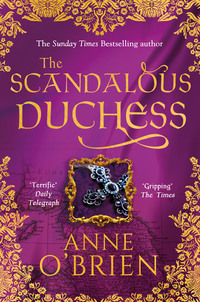
Czytaj książkę: «The Scandalous Duchess»
Praise for the author
ANNE
O’BRIEN
‘An absolutely gripping tale that is both superbly written and meticulously researched’
—The Sun
‘The characters are larger than life…and the author a compulsive storyteller. A little fictional embroidery has been worked into history, but the bones of the book are true.’
—Sunday Express
‘This book has everything–royalty, scandal, fascinating historical politics and, ultimately, the shaping of the woman who founded the Tudors.’
—Cosmopolitan
‘O’Brien has excellent control over the historical material and a rich sense of characterisation, making for a fascinating and surprisingly female-focused look at one of the most turbulent periods of English history.’
—Publishers Weekly
‘Better than Philippa Gregory’
—The Bookseller
‘Another excellent read from the ever-reliable Anne O’Brien. Strong characters and a great setting make this highly recommended.’
—The Bookbag
‘Anne O’Brien is fast becoming one of Britain’s most popular and talented writers of medieval novels. ’
—Lancashire Evening Post
‘A must-read for any historical fiction fan’
—The Examiner
‘Brings the origins of the most famous royal dynasty to vibrant life’
—Candis
‘I was keen to see if this book…lived up to the hype— which it did.’
—Woman
Also by
ANNE O’BRIEN
THE SHADOW QUEEN
THE QUEEN’S CHOICE
THE KING’S SISTER
THE SCANDALOUS DUCHESS
THE FORBIDDEN QUEEN
THE KING’S CONCUBINE
DEVIL’S CONSORT
VIRGIN WIDOW
The Scandalous Duchess
Anne O’Brien

ISBN: 978-1-472-01039-1
THE SCANDALOUS DUCHESS
© 2014 Anne O’Brien
Published in Great Britain 2014
by HQ, an imprint of HarperCollinsPublishers Ltd 1 London Bridge Street, London, SE1 9GF
All rights reserved including the right of reproduction in whole or in part in any form. This edition is published by arrangement with Harlequin Books S.A.
This is a work of fiction. Names, characters, places, locations and incidents are purely fictional and bear no relationship to any real life individuals, living or dead, or to any actual places, business establishments, locations, events or incidents. Any resemblance is entirely coincidental.
By payment of the required fees, you are granted the non-exclusive, non-transferable right and licence to download and install this e-book on your personal computer, tablet computer, smart phone or other electronic reading device only (each a “Licensed Device”) and to access, display and read the text of this e-book on-screen on your Licensed Device. Except to the extent any of these acts shall be permitted pursuant to any mandatory provision of applicable law but no further, no part of this e-book or its text or images may be reproduced, transmitted, distributed, translated, converted or adapted for use on another file format, communicated to the public, downloaded, decompiled, reverse engineered, or stored in or introduced into any information storage and retrieval system, in any form or by any means, whether electronic or mechanical, now known or hereinafter invented, without the express written permission of publisher.
Version: 2019-04-12
To George, who for a whole year tolerated having to play second fiddle to John of Lancaster, but knows that he always remains my hero.
ACKNOWLEDGEMENTS
All my thanks to my agent, Jane Judd, whose love of history is as strong as my own. Her support and encouragement for me and the courageous women of the Middle Ages continues to be invaluable.
To Sally Williamson at HQ whose empathy with what I wish to say about my characters is beyond price. To her and to all the staff at HQ, without whose advice and professional commitment the real Katherine Swynford would never have emerged from the mists of the past.
To Helen Bowden and all at Orphans Press, without whom my website would not exist and who create professional masterpieces out of the rough drafts of genealogy and maps I push in their direction.


‘…he [John, Duke of Lancaster] was blinded by desire, fearing neither God nor shame amongst men.’
Knighton’s Chronicle 1337-1396
‘…a she-devil and enchantress…’
The Anonimalle Chronicle 1333-1381
‘…an unspeakable concubine…’
Thomas Walsingham’s Chronicon Angliae
Table of Contents
Cover
Praise
Also by ANNE O’BRIEN
Title Page
Copyright
Dedication
ACKNOWLEDGEMENTS
Epigraph
Prologue
Chapter One
Chapter Two
Chapter Three
Chapter Four
Chapter Five
Chapter Six
Chapter Seven
Chapter Eight
Chapter Nine
Chapter Ten
Chapter Eleven
Chapter Twelve
Chapter Thirteen
Chapter Fourteen
Chapter Fifteen
Chapter Sixteen
Chapter Seventeen
Chapter Eighteen
Chapter Nineteen
Chapter Twenty
Chapter Twenty-One
Chapter Twenty-Two
Epilogue
Extract
AUTHOR NOTE
Read all about it…
MORE ABOUT THIS BOOK
About the Publisher
Prologue 
January 1372: The Manor of Kettlethorpe, Lincolnshire
The water that had swamped the courtyard overnight, thanks to a sudden storm, soaked into my shoes. And then my stockings. I hitched my skirts, scowling at the floating debris around me. Even the chickens, isolated on a pile of wood in the corner, looked morose.
‘Who left that harness out?’ I demanded, seeing the coils of leather black and dripping on the hook beside the stable door. My servants, few as they were, had gone to ground, and since nothing could be done until the rain actually stopped, I squelched under cover again.
Kettlethorpe. My young son’s inheritance, and a poor one at that. The burden of it, since my husband’s recent death and the administration of the estate not yet settled, fell on my shoulders. I flexed them, my sodden, mud-daubed cloak lying unpleasantly around my throat. The shadow of a lively rodent caught my eye as it vanished behind the buttery screen.
‘What do I do?’ I asked aloud, then winced at the crack of despair in my voice.
There was no one to give me advice.
I imagined what Queen Philippa might have said to me. Raised by her, educated by her at the English court, the wife of King Edward the Third had been my model of perfect womanhood: a woman without physical comeliness, but with a beauty of soul that outmatched any I knew.
‘Duty, Katherine!’ she would have said. ‘It is for you to carry the burdens. You are twenty-two years old and Lady of Kettlethorpe. When you wed Sir Hugh Swynford you took on the responsibility of your position. You will not abandon it when your feet are wet and rats scurry around your ankles. That is not how I raised you. You have the tenacity to make something of Kettlethorpe, and you will.’
I sighed, the tenacity at a low ebb, even though I admitted the truth of her knowledge of me. No, of course I would not abandon it. That was not my way, for the Queen’s principles had been lodged firmly in my heart. What I did not have was the financial resource to improve my lot.
Despondent, I stepped to the centre of my hall where a fire burned with smouldering reluctance, and turned slowly round, pushing my hood back to my shoulders. The walls were running wet in places. The haze of smoke that never cleared tainted everything with acrid stench, for which there was no remedy that I could afford. I could not even think of installing a wall chimney.
‘God will give you his grace, and the Virgin her compassion. Go to your prie-dieu, Katherine.’ Queen Philippa again, framing my face with her hands as she imparted to me her own rigorous strength.
Certainly I would go to my knees before this day was out—was not the Blessed Virgin my solace in all adversity? But on this occasion I needed coin as much as the Virgin’s blessings. I rubbed my hands together, regretting the abrasions, the ugly burn on my wrist where one of the torches, flaring, had caught me unawares. Once my hands had been soft, my nails perfectly pared. Once my gown pleased me with the soft rustle of silk damask rather than the roughness of this coarse wool, the only cloth fit for the tasks that fell to me. Silk skirts did not sit well with wringing the neck of a scrawny fowl for dinner.
I sighed a little.
Once I had been honoured, chosen as a damsel in Duchess Blanche of Lancaster’s household. I covered my face with my hands, shutting out the images of that pampered life of luxury at The Savoy Palace, for here, around me, was the reality of my present existence. At The Savoy I never had to sweep up the evidence left by a pair of doves roosting in the rafters overnight and now shuffling into wakefulness. Now I clapped my hands, frightening them into flight and further fouling of the floor.
There was one remedy, of course, to all this destitution. Duchess Blanche was dead these past three years, but the Duke had a new wife. Would there not be a place for me there, where I might earn enough to put all to rights? Where I might, in ducal employ once again, acquire sufficient money to ensure a better home for my son to inherit?
Why not? Why should I not return to the world I knew and loved? Surely, given my previous experience, there was some role that I could fulfil. Queen Philippa would have sanctioned it as an eminently practical decision for me to make in the circumstances.
I flapped my hands to disperse the smoke and a few downy feathers that still hung in the air and marched across to the stairs, to climb to my private chamber where I cast aside the heavy cloak. Lifting the lid of my coffer, I sifted through the layers of court dress, the fragile cloth sadly marked with moth and mildew however careful my attention with lavender and sage leaves, and lifted out a much treasured mirror. Opening the ivory case, dull with disuse, I wiped the moisture from the glass on my bodice and looked.
I pursed my lips.
‘Who are you, Katherine de Roet?’ I asked.
Katherine de Swynford now, of course, married and widowed. Suddenly distracted, I turned my head. Children’s voices, raised in sharp complaint, sliced through the silence, but then dissolved into laughter, and I returned to my critical survey. I considered my hair, tightly braided and pinned, dark gold with damp, and dishevelled where the pins had come adrift under my hood. Darker brows took my eye. Once I might have plucked them into perfection, but no more. A rounded face, with soft cheeks and soft lips, a little indented at the corners with my present excess of emotion. A generous mouth, quick to smile, yet any softness there was belied by a direct stare. I raised my brows a little. No one would accuse me of shyness nor, brought up as I was in the strictest canons of propriety, of frivolity, yet I enjoyed all the comfort that wealth and consequence could bring, and to which I no longer had access.
And I wished with all my heart that I enjoyed that consequence again.
It was not a plain face that looked back at me. True, such enhancements as I might have worn at court were entirely absent. Indeed, it could have been, I decided, the face of one of my kitchen maids with that suspicion of dust along the edge of my jaw where I had rubbed at it with my sleeve. The mirror was misted again, and I polished it on my hip. They said I was beautiful. That I had the look of my late mother whom I had never known. Perhaps I was, although I thought my sister had more claims to beauty than I.
What was I looking for? What had driven me to resort to my mirror? Not the symmetry of my features, but to discover the woman behind them. I tilted my chin, considering what I might see.
Honesty, I hoped. Courage, to seize the opportunity to make more of my life. Not least a determination to live as I had been raised, with integrity and good judgement. That was what I hoped to see.
And perhaps I did see it, as well as the duty to my family name and honour to the Blessed Virgin that had marked every step of my life.
So I would go to The Savoy. I would petition the Duke in the name of my previous service to Duchess Blanche, accepting that I must relinquish my pride for I had a goodly measure of it—but I would do it, for my own sake as well as that of my children. If honesty was strong in me, I must accept that life in a desolate fastness, stretching out changelessly to the end of my days, filled me with dismay, whereas life within the royal court and ducal household with friends from the past beckoned with seductive fingers.
I smiled at the prospect, yet felt my pleasure fade. Replacing the mirror in my coffer, sifting through the words that had slipped through my mind, my heart fell a little at the sheer weight of them. Integrity. Restraint. Respectability. That was to be my life. That was what I knew. I would conduct myself as a respectable widow, unless I was fortunate, one day, to wed again. Queen Philippa would be proud of my strength of will to accomplish it.
My hands, in the act of closing my coffer, paused on the open lid of it, as if reluctant to shut away that reflection of the woman behind the familiar features. How dull, how colourless my chosen life sounded, as even-textured and familiarly unexciting as a line of plainchant. And how prim and prudish the woman who would live it. Was this me? Was this really what I wanted? It was as if I had decided to exist in shades of black and grey and religious observance, when energy, with sly enthusiasm, was surging though my whole body, opening up pictures in my mind of how it would be to sing and dance again, to be courted, to flirt, to exchange kisses in the company of a handsome man who desired me.
Perhaps this was the real Katherine de Swynford, lively and frivolous, thoroughly pleasure-loving, rather than a staid widow who looked for nothing in life but allowing the beads of her rosary to slide through her fingers as she petitioned the Virgin’s grace for herself and her children. The sheer thrill of returning to The Savoy, to a position in the Lancaster household, glowed even brighter in my mind.
And then, as if summoned by my delight, there was the image of the Duke of Lancaster himself, standing in my chamber with the light behind him, as clear as if he were really there, as the sun creates a fantasy when shining through raindrops.
Impressively tall. Impressively proud. Impressively everything.
I considered him in my mind’s eye: Duke John of Lancaster, a man I had known all my life, a man whom I admired. Admired. Yes—that was it, for was it not admiration? A man of wealth and power and striking appearance, the Duke attracted high regard and vilification in equal measure from those who crossed his path. Would I wish to live once again within his forceful presence? Well, why should I not? I might be overawed, overwhelmed by the extent of his authority and the sheer magnetism of his charisma, but I knew him for a man of unfailing chivalry too. He would not cast me adrift. Returning to The Savoy held no fears for me.
Opening my eyes, finding the bright image dispelled, I closed the coffer and locked it, before walking to my open door with a light heart despite my wet stockings, and called down the stairs to my steward.
‘Master Ingoldsby! A moment of your time, if you will.’
And enjoyed a shiver of excitement, such as I had not experienced for too long. I had more important tasks for my steward to supervise than sweeping up after my doves. I was going to The Savoy.
I realised that I was smiling again.
Chapter One
January 1372: The Savoy Palace, London
It was like a proclamation of royal decree. A command complete with banners, heralds and fanfare. Every muscle in my body tightened, my breath whistled in my throat on a sharp inhalation, and I was no longer smiling. I was not smiling at all.
His voice was impeccably courteous, but the words he uttered sliced through all the bother that had occupied my mind for the past two months with the precision of a rapier. I could not believe what he had just said to me. This Plantagenet prince, so unconsciously dramatic on this winter’s morning, had just carelessly shaken the ground on which I stood.
Yet was he carelessly unthinking? I looked at his face, to find his gaze direct and deliberate, enough to cause an awareness to run along my spine. No, he was not thoughtless at all. He had uttered exactly the notion that had come into his mind.
For my part, I had not foreseen any outcome of this nature. How would I?
And no, it was not like a rapier thrust at all, which would be clean and sharp and precise. This was more like a blast of hellfire. All my previous worries, trivial and domestic as they were now presented to me, all my confidence in my ability to cloak my thoughts in careful restraint, paled into insignificance beside the inherent danger in those chosen words, cast at my feet like a handful of baleful gems.
Cast there by John Plantagenet, royal prince, Duke of Lancaster.
My audience with the Duke, until this verbal cataclysm, had been much as I expected, as I had hoped. He welcomed me with all his customary grace. Had we not been acquainted for many years, since I had been raised from my days as a very youthful Katherine de Roet in the household of Queen Philippa, his lady mother? Our paths had crossed; we had shared meals and festivities. I had been a member of the royal household, held in high regard and affection, both as a child and as damsel to the Duke’s wife, Duchess Blanche. I was assured that whatever the outcome of my plea, the Duke would put me at my ease.
I rose from that first deeply formal curtsy when he had entered his audience chamber. Eyes downcast, breath shallow with nerves—for however well regarded I might be, if he refused I did not know where I would apply for succour—I made my request. It was hard to ask for charity, however gracious and generous the reputation of the benefactor.
‘Lady Katherine.’
‘Yes, my lord. I am grateful.’
His soft boots, the edge, gold-embroidered and exquisitely dagged, of his thigh-length robe, appropriate for some court function in heavily figured damask, came within the range of my vision, and I glanced up, momentarily alerted by a rough timbre in his speaking my name. Nor was the Duke’s expression any more encouraging. His straight brows were level, hinting at a frown, his lips tight-pressed, causing my heart to flutter against my ribs. He was going to refuse me after all. There was no position for me here. By tomorrow I would be back on the road to the fasts of Lincolnshire with nothing to show for my long journey. He would tell me kindly, but he would refuse me.
But then, as he caught some anxiety in my expression, he was smiling.
‘Don’t look so anxious, Lady Katherine. You never used to. Did you think I would turn you from my door?’
The roughness was smoothed away as he touched my arm, a fleeting pressure. My heart’s flutter became a thud.
‘Thank you, my lord,’ I murmured.
‘I cannot express my sadness for your husband’s death.’
‘Thank you, my lord,’ I repeated.
There was nothing else for me to say that would not overwhelm me with one difficult emotion or another. My husband was dead a mere two months, somewhere in the battlefields of Aquitaine.
‘I valued Sir Hugh’s services greatly.’ The Duke paused. ‘And yours have been inestimable. For you, Katherine,’ he lapsed into the more familiar, abandoning the title that had come with my marriage, ‘there will always be a position here.’ And then, with gentleness: ‘Your place in the Duchess Blanche’s household earned you great merit. You must come to us again.’
Relief spread through me, sweet as honey. I sighed imperceptibly. All the fears that had pinioned my mind in recent weeks so that I could not think, could not plan, could not envisage the future, fell away. I would no longer be dependent on the limited revenues from the Swynford estates at Kettlethorpe and Coleby. I would have money to spend on critical refurbishments. My children would lack for nothing.
‘Thank you, my lord,’ I said for the third time in as many minutes. I seemed to have lost the capacity to form any other response, and for a moment I was touched with a pale amusement. I had not been known for lack of conversation. ‘Forgive me,’ I said. ‘I cannot tell you how much that will mean to me.’
‘Is Kettlethorpe very bad?’ he asked. He knew my situation.
‘You have no idea, my lord.’
And with the relief I raised my eyes to his, to discover that he was watching me closely, so that I felt the blood rise to heat my cheeks, and my relief became overlaid with a layer of uncertainty. Perhaps he was waiting for a more effusive sign of my gratitude. After all, I had no claim on him, no tie of duty or blood. Some would say he had done quite enough for me and my family.
Could it be that he thought me unfit for the position I sought? Damsels in royal households were chosen for their elegance and beauty as much as for their practical skills, women worthy in appearance and demeanour to serve the lady. I had done my best. My dark robes were as fine as I could make them, with no remnant of Lincolnshire mud. As for my hands and face, all that could be seen in the all-enveloping shrouding, I had applied the contents of my stillroom with fervour to remedy the effect of Kettlethorpe’s demands. I did not think the Duke would judge me too harshly, knowing my circumstances. And yet his eye had the fierce focus of a raptor.
To deflect the appraisal I launched into what I thought he wanted from me.
‘I cannot express my thanks enough, my lord. I feared for my children, living in hardship. I thought I should not come to you, because although I no longer have a claim on your generosity, Hugh was in your service, and you were good enough to stand godfather to my daughter Blanche. I knew that you would want Hugh’s son, Thomas, to do well in the world, and before God, there is little to give him anything but the most slender of incomes from the Swynford estates. Thomas is still so young and I have not the experience to manage the land well—or the money to do it, of course…’
My words dried. A minute ago I had been impossibly tongue-tied: now I was ridiculously garrulous. Had he not said that he would employ me? My problems were at an end and I could be at peace, but my heart continued to bound like a squirrel caught in a trap as the huntsman approached with a predatory gleam in his eye.
I thought that there might be such a gleam in the royal Duke’s eye, then chided myself. Most likely it was nothing but a shaft of light through the glazed windows, or simply amusement at my lapse into trivialities.
‘Forgive me, my lord,’ I found myself saying yet again. His reply was plain. ‘You have asked pardon enough, my lady. You did right to come to me. I will arrange that you take up a position as damsel in my wife’s household.’
He hesitated, the pause drawing out to fill the room. There was no doubt that he was frowning. Apprehension built again, a wad of sheep’s wool to dry my throat.
‘No,’ he said. The harshness of his tone unnerved me. ‘That is not what I want…’ And stretching out a hand towards me, he added: ‘I had forgotten how very beautiful you are. Your face has a grace, a translucent loveliness beyond my recall. And if you deigned to smile at me once in a while, it would illuminate every corner of the room.’
Which robbed me of the ability either to smile or to make any coherent response at all. Not understanding why the Duke should flatter me so highly—or was it flattery?—simply hearing the denial of what he had offered barely a minute ago, I took an uneasy step back, rejecting the thought that he might actually expect me to place my hand in his, and replied to the least shocking part of his speech.
‘Forgive me for being importunate, my lord.’ I forced my voice to remain uninflected. ‘I should leave. Until you have decided where I might be of service. Perhaps at some point in the future. I am sure that with the coming of drier weather in spring the problems of Kettlethorpe will not seem so overwhelming.’
I closed my lips, angry that I had been drawn into such a show of weakness. I would not beg. I would not make more excuses. It not being in my nature to ask again where I had been refused, I curtsied, a brisk farewell. ‘I am grateful that you received me, my lord.’ I turned to walk towards the door, pondering at this strange outcome. The Duke did not have the name for being a man who played fast and loose with the sensibilities of his dependents.
‘Don’t leave, Katherine.’
It was not a request. Suddenly it was very personal, and I halted.
‘Don’t go.’
I looked back over my shoulder but did not turn, my soul thought to depart from that room and the humiliating refusal he had just handed to me.
‘But you said that you did not wish to arrange a position for me, my lord.’
‘No, I don’t.’
‘Then what do you want, my lord?’
An inappropriately peremptory question perhaps, but by now I admitted to profound irritation. His dark hair might lay feathered against brow and cheek, curling immaculately against his neck; his elegant figure might express the epitome of earthly authority; he might be the proudest man I knew; yet he was still a man, prone to strange moments of inconsistency. And, as if to prove me right, he spoke the words that undermined every tenet I had been raised to honour.
‘I don’t want you as governess to my children. I don’t want you as damsel for my wife. I want you. I want you for my own.’
He did not attempt to moderate his voice to any degree, a voice used to issuing commands on a battlefield, in the cut and thrust of Parliament or in fiery debate with merchants over the extortionate level of taxes. The words reached me, with perfect clarity in their meaning.
‘I want you, Lady Katherine de Swynford.’
Now, slowly, every sense suspended in shock, I turned to face him, unable to lower my gaze from his.
‘I want you.’ He strode forward, and before I could thrust them behind my back he had clasped my hands in his. ‘Do you understand what I am saying? I want to kiss you, and I don’t mean a formal salute to your undoubtedly pretty fingertips.’ Which he instantly executed with neat precision. ‘I want to take you to my bed.’
Those fingertips lay nerveless in his clasp, my lips parted, but no words issued. Every sense, every feeling, seemed to be frozen in shock. In outrage when he raised one hand as if he would touch my cheek. I stiffened, anticipating what must surely be a caress. Then he simply ran his fingers along the edge of my veil, putting to rights its elegant fall. And I exhaled slowly, until he demanded:
‘I think you are not averse to me?’ He made of it a question. ‘Katherine…’ There was the exhalation, the familiar impatience that I recognised so well, but his voice and face were as smooth as the silk I had once worn, as I had hoped to wear again. ‘Will you come to me? You are a widow, owing loyalty to no man. You are without a protector. Will you give yourself into my keeping and allow me the honour of being your lover?’
Now I looked at him in sheer disbelief. John of Lancaster, the perfect knight, the most honourable and chivalrous of King Edward the Third’s sons, newly wed to Constanza of Castile a matter of months ago. And I, at twenty-two years widowed and of good repute, raised by his royal mother to uphold all the precepts of piety and virtuous dignity. And he was asking me if I would be his leman.
‘You stir my loins, Katherine de Swynford.’
Well, that pronouncement I could not mistake. The words slammed into my understanding. Was the Duke exerting some droit de seigneur, demanding my compliance? I did not wait the length of a breath to consider and select a reply; there was only one word I could say.
‘No.’ It was as flat a denial as I could summon.
‘Is that a considered refusal?’
‘Yes. My answer is no.’
‘Why not?’
I flushed. His brows indicated that he was surprised. ‘No,’ I repeated. ‘I don’t need to consider it.’ And bracing myself, for John of Lancaster had a chancy temper, I added, in case he had not taken my meaning: ‘My answer is without qualification. No, my lord, I will not. How could you ask it of me?’ I tugged my hands from his, thinking that perhaps I should escape before the torrent was released.
It was too late.
The Plantagenet prince lifted his chin as if he could not envisage a refusal, and then as I tensed against the verbal assault that would assuredly fall on my head, he gave a shout of laughter that reverberated from the walls.
Which was inexplicable. Was he mocking me? I bridled.
‘I see nothing to laugh at,’ I remarked coldly.
On which he stopped to draw in a breath, his eyes still gleaming with whatever it was that had moved him to a show of mirth.
‘You have a way with words, Lady Katherine.’
‘Because I said no?’
‘Exactly. I could not possibly mistake your sentiments, could I?’ He seized my hand again, and before I could stop him, saluted my fingers with a perfect propriety, at the same time as he executed a courtly bow.
‘I will have to make do with that after all,’ he observed, running his thumb across my fingertips.
‘And that is all I will offer you, my lord,’ I responded. That my hand tingled was not to be considered.
The Duke laughed again, but briefly. Whatever humour he had discovered in my predicament, or his own, had fled.
‘It seems that I have been too previous in my request. Now it is my turn to ask pardon. Forgive my insensitivity.’ He paused, his expression grave, the tendons of his jaw stark. And then a gleam appeared in his eye as he added: ‘But I should warn you, Lady Katherine. I will not be denied. It is not in my nature to accept so determined a rebuttal.’
And as he strode from the audience chamber, as his footsteps faded, as he crossed the antechamber beyond and took the stairs to the upper floor, I was left to wonder if I had imagined the whole unnerving incident. But when I heard his final parting shot, delivered to me and echoing from the well of the stairs, there could be no denying his meaning. There was no misinterpretation on my part of the whole of that inexplicable episode. His final words, which had floated back to me as clearly as if he had been standing in the room, had been quite as unambiguous as all the rest.
I sank down where he had left me, onto a stool that had been pushed with its companion against one of the walls. Hands clasped together, so tightly that my knuckles showed white against my dark skirts, I stared at the tapestry on the facing wall, a masterpiece in silk and wool.
Of all the tapestries in the superbly appointed Savoy palace, why did it have to be this one, with its frivolous portrayal of courtly love, a lady and her lover languishing in a field of blossoms beneath a flowering tree, while silky rabbits frolicked at their feet. He held a hawk on his fist; her arms were entwined around his neck, her hair mingling with his as he reclined in her arms. His stitched eyes were admiring; her red lips were full of longing. I imagined they were not wed, or in any way concerned about the sinfulness of their relationship. They looked untrammelled by any pious demands on their virtuous behaviour.
‘I wager you would share your lover’s bed without any holy water sprinkled over you,’ I informed the red-haired wanton, crossly.
I thought that she smirked as I imagined her reply. ‘And would you be prepared to languish in the arms of a lover, Katherine de Swynford?’
I most certainly would not. I was no Alice Perrers, infamous royal mistress, who shared the King’s bed with bold impunity, careless of the vilification. My behaviour must be beyond criticism. I must be able to kneel at my prie-dieu or before my priest with a clean heart. How could the Duke have so demeaned himself, and me, to offer me such an outrageous position? I was no wanton.
I want to kiss you.
He had had the temerity to make such a request of me, clad as I was in full widow’s weeds from chin to toe to indicate my deepest mourning. If my dark robes had not heralded my state to the whole world, the all-enclosing wimple and long veil should have been as obvious as a slap in the face to any man with ulterior motives. I was no loose harlot, willing to accept any position offered at court to secure my future comforts.
Flexing my fingers, I smoothed the black cloth over my knees. Hugh had been dead so short a time, struck down in the Duke’s own service in Aquitaine. Did the Duke think I would soil my husband’s memory by leaping into his bed—or that of any man—at the first opportunity? I could not comprehend any action of mine in the past to give him the opinion that I would care so little for my reputation, or for God’s judgement on what would be a blatant act of adultery.
Adultery.
The harsh judgement shivered over me and as my outrage built, I pondered all I knew of the Duke. A prince with a reputation for high-minded courtesy and chivalry, he had adored his first wife, Blanche, and was plunged into desolation by her untimely death three years before. He would never have strayed from her side. And now he had a new wife, a marriage of three months’ standing, and the prospect of a new child and a new kingdom to rule if he could enforce Constanza’s claim to Castile in his own right. A man of ambition, the Duke would do nothing to jeopardise the authority in that distant kingdom if he wore its crown. He would not take a mistress within three months of bedding a new wife.
It was all beyond sense. The Duke of Lancaster was not the mindlessly pretty, disreputable young man of the tapestry whose sole concern was dalliance.
And yet, at the same time I was forced to acknowledge that the puissant Duke of Lancaster, raised in royal indulgence from his cradle, was the possessor of a will as strong as cold steel. I will not be denied, he had said. It is not in my nature to accept so determined a rebuttal.
It was an uncomfortable thought.
And my next proved to be an even more disconcerting companion.
Was the fault mine? Had I, however inadvertently, however cleverly cautious I had considered myself to be, encouraged the Duke to think that I would welcome so impious a request? I could not imagine that I had dropped so careless a word, made so flirtatious a gesture, just as I was certain that I had never led him to believe that I would step so far beyond seemly behaviour. Inappropriate desires and longings, even if I had them, were to be held under restraint and confessed only before the priest.
I cast my mind back over the three years since I had left the household on Duchess Blanche’s death, when we had all been deluged in mourning black, overwrought with grief. The only occasion on which I had seen the Duke was two years ago at the interment of Queen Philippa in Westminster Abbey, when he had pinned a mourning brooch to my bodice. Hardly an occasion for unseemly flirtation.
So perhaps I had misconstrued the whole of the past hour, making my present tumbling concerns entirely irrelevant. But of course, I had not misconstrued it. I would have been witless to put a wrong interpretation on his parting shot
And I don’t like you in widow’s weeds, he had informed me from a distance. They don’t become you. If I were your lover I would clothe you in silk and cloth of gold.
No, I was under no delusion about that: so intimate, so personal a comment on how I looked, what I wore and how he would remedy it. What right had he, when custom demanded that I wear mourning for a year? Vanity—assuredly a sin—lit a little flame of anger, as I spread out my skirts, disliking the weight of them in the voluminous amount of material, fretting that my wimple and veils leached colour from my skin. I knew I did not look my best, and was woman enough to regret it.
But how dare he remark on it?
And why had he laughed at my refusal?
I was furiously unsettled, for my future was still dependent on the Duke. He had not yet made an answer to my request. Had he changed his mind entirely in the face of my flat rejection?
With a swish of my hated widow’s weeds I turned my back on the couple deliriously in love, wishing the smug lover buried under his blossoms, and strode off to return to normality and the company of those I knew, a household for whom I had a deep affection. A good bout of common sense and feminine gossip would do the trick. As for the lovers, the cunning rabbits would soon eat up the blossoms—and then where would they be?
I made my way to the royal nurseries.
Feeling an urge to knock on a door that I would once have walked through without a second thought, I resisted. Opening it, I walked through. How familiar the scene was: nurse and chambermaid, governess and damsel and sempstress, all intent on the burden of care of the three precious Lancaster children. Once as damsel to Duchess Blanche I had been one of this number, and would wish to be so again. There, at their lessons, were three little girls, two of them with royal blood, all much grown since I last set eyes on them: the ducal daughters, Philippa and Elizabeth at eleven and eight years, eyes trained seriously on their psalters—although it had to be said that Philippa showed more concentration than her sister who cradled a tabby kitten on her lap—while Henry—how he had grown!—all of four years old now, stood at the side of a lady who was engaged in explaining to him the illustrations in a book. And then there was the third little girl, whose age I knew precisely…
For a moment I simply stood and watched the scene in all its busyness, my heart so overburdened with love that tears welled. It had been an emotional day, one way or another. I swallowed and took another step.
‘Good day, my lady.’
I curtsied.
The lady with the book looked up, expression arrested between irritation and then gradual recognition. The book was slowly closed and placed out of Henry’s reach. The lady exhaled slowly.
‘Katherine, as I live and breathe…’
Which caused me to smile, it being a well-recognised expression on Lady Alice’s lips, whilst Alyne, wife of Edward Gerberge, one of the Duke’s squires, surged across the room towards me. It brought all eyes to my face in a mix of pleasure and curiosity. Philippa smiled. Elizabeth barely remembered me, Henry certainly did not. As for the other child…
My eyes on the little girl’s bright face, I curtsied again to Lady Alice. ‘My lady, forgive my intrusion.’
‘Nonsense!’
Lady Alice was on her feet, and then I was enclosed in female arms, patted and fussed over, Alyne relieving me of my cloak and gloves, before both found the words to commiserate.
‘I recall the day you were wed,’ Lady Alice said and sighed. ‘Hugh was a good man—and I expect a good husband to you. But for the wife of a professional soldier, life can be very difficult.’
And I found that, prompted by such solicitous expressions, I was weeping at last, for Hugh and for myself.
‘Forgive me, Lady Alice…’ I could not seem to stop the tears falling endlessly, all the tears I had been unable to shed.
Alice FitzAlan, Lady Wake, merely poured a cup of ale and, as Alyne wiped away my tears, pushed me to sit in her own chair, handed me the ale and dissuaded Henry, gently but deliberately, from climbing into my lap.
At last I laughed and sniffed, but my eyes were for the third little girl who had come to stand at my knee, her hand now grasping my skirts. She was seven years old, almost eight now. I knew exactly, for this was Blanche, my eldest daughter, honoured with the position of damsel to the Duke’s daughters. My lovely Blanche, named for the Duchess in whose service I had been when she was born.
Abandoning the cup of ale, I swept her up in my arms and kissed her.
‘My daughter,’ I said, touching her face. ‘My little Blanche—not so little now. Have you forgotten me?’
For a moment she hesitated, as if reflecting on the matter in her solemn way, then Blanche buried her face against my neck. My tears threatened to begin all over again.
‘She is a credit to you,’ Lady Alice remarked in her cool manner.
‘One day she will marry well,’ Alyne added. ‘She is very pretty, like her mother.’
I took Blanche’s face between my hands, kissing her cheeks, tucking away her curls beneath her linen cap. It was true she looked like me. Her hair was the same rich burnished gold as mine, the colour of autumn wheat ripened under a hot sun, but her features still had the soft unformed edges of childhood.
‘And can you read and write yet?’ I asked her.
‘Yes, madam,’ she replied with quaint confidence. Then reached up to whisper in my ear: ‘Better than the Lady Elizabeth. She does not try. She likes the kitten more.’
For a moment it surprised me, that Hugh’s death seemed not to have touched her to any degree, but then she has seen so little of him in her short life. She would barely recall him, and on this day of our happy reunion I would not burden her with his death.
‘Damsels should not tell tales about their mistresses,’ I whispered back.
‘I know that!’ she replied, her clear voice ringing out. ‘But it is true. It is not a secret.’
I hid my smile
‘Is that true, Elizabeth?’ I asked. ‘That you do not work hard at your lessons?’
Elizabeth considered me. ‘Sometimes I do. I have learned to dance and sing.’ There was a roguish twinkle in her eye—when had she acquired that? And she promptly demonstrated by tucking the kitten under her arm and executing a succession of childishly uncoordinated steps across the room to my side. But one day she would be elegant.
‘And you, Philippa?’ I asked.
‘I always do my best,’ she assured me, smiling so that her face lit as if with a candle within. She would be beautiful one day. ‘You are right welcome, Lady Katherine. We have missed you here. If you returned to us, Elizabeth would mind her books again.’
I laughed, all my tears and previous anger forgotten. I had come home. It was good to laugh again
‘Will you return to us?’ Alyne asked. ‘Now that you are alone?’
‘I had hoped so,’ I replied uncertainly.
‘Have you spoken with Lord John?’ Lady Alice asked.
‘Yes.’ I could feel my cheeks heat, and attempted to hide it by kissing Blanche’s still-escaping curls.
‘The income from Kettlethorpe was never great,’ Lady Alice mused.
‘No, and it’s no better now,’ I admitted with a sigh. ‘And without Hugh’s soldiering…’
‘Lord John will be generous.’ Lady Alice patted my hand as if I were one of her charges.
I was not so sure. I had refused what he had offered me, out of hand, generous or no. And if my present companions knew what that offer had been, they would not now be welcoming me back like a long-lost sister. Lady Alice, governess to the ducal children, was cousin to the Duke and a lady of high principle, strong on morality, firm on good manners. I suspected that she would banish me from the room, if not from The Savoy.
It behoved me to keep my own council.
Chapter Two
There was a commotion at the door, an exchange of words in male accents, and then the Duke entered the chamber where, on the morning following my arrival at The Savoy, the children learned their catechism, Lady Alice cast her eagle eye over all and I stitched at a length of linen in the window embrasure. His immediate awareness of me, conspicuous in his glance alighting on my face, made my belly clench and my heart thump beneath the mourning black that he did not like. It was in my cowardly mind to keep my eye on my work, as if stitching the border of an altar cloth would save me from humiliation.
Would he offer me the position I needed? Or would he continue to pursue the startling proposal of the previous day?
Not in public, he won’t, I castigated myself. You are a fool, Katherine!
And indeed there was no need for my fears for it became self-evident, as his regard moved rapidly on from me to the other occupants of the room, that my worries were not his priority.
This morning there were matters of higher business to attend to. The Duke was uncharacteristically brusque, with a line between his brows, even though he found time to smile at the children, kiss the cheek of Philippa and Elizabeth and brush his hand over Henry’s already tousled hair. The smile was, it had to be said, a bleak affair. I rose to my feet, putting aside the sewing, and, with Lady Alice and Alyne, made the requisite curtsy.
‘I will be away.’ His attention was for Lady Alice. ‘I leave the children in your care, Alice, as ever.’
He was dressed for travel in wool and leather, the metal plates of his brigandine masked in fine velvet. In such a garment he was not travelling far.
‘Is it bad news, John?’ Lady Alice asked.
‘It could be better.’ It was impossible to mistake the grimace. ‘My brother Edward’s health does not improve and the King is…’ The Duke shrugged.
We all knew of this terrible cause for concern. The Prince, heir to the throne and with a reputation second to none on the battlefield, was come home from affairs in Aquitaine, gravely ill, and his son, Richard, no older than Henry. Lionel, the King’s second son, was dead in Antwerp these last three years. King Edward’s own powers had waned in the months since Queen Philippa’s death. Suddenly the smooth security of the royal inheritance was under attack: it was not a good prospect for England to have both King and heir ailing and the future king so small a child. Which left the Duke in a delicate situation.
Some said he had his own ambitions for the English crown, for no man of sense would place a wager on the longevity of either the King or the Prince. If the worse came to the worst, better an able man at thirty-two years and in his prime to wear the crown than a child of fewer years than fingers of one hand.
Looking at him now, at the authority inherent in his stance from his ordered hair to the fine leather of his boots, I wondered where his ambitions did lie. I did not know.
‘The situation in Aquitaine and Gascony rests on a knife-edge,’ he continued, as if picking up my thoughts. ‘The progress of the English troops, without direct leadership—it’s not good. I’m going to Kennington to talk with the Prince. I’ll need to stay if it’s decided that I lead an expedition. We badly need a victory against France, and it may be that Parliament must be summoned to finance such a lengthy campaign. It will not be popular, even though a victory’s in everyone’s mind…’
He was already moving towards the door, as if the burden of these decisions was driving him into action.
‘I’ll send word when I know my future movements.’
So, after shaking my world into disorder, he would leave without making any decision about me. My mind leaped crossly with indecision.
I really need to know where I stand.
It is not appropriate for you to trouble him with your inconsequential needs when the government of England rests on his shoulders.
I followed him to the door.
‘My lord?’
He turned his head, his hand on the latch.
‘Lady Katherine.’ Impatient to be gone, yet as he took in my appearance not without a glint in his eye. ‘Still garbed like a winter raven, I see.’
‘And, as a widow, will continue to be until the year of my mourning is ended,’ I replied tartly.
‘As you will, lady.’
Oh, he was preoccupied, and I bristled beneath my widow’s black. If the royal duke had been suffering yesterday from a blast of inappropriate lust for my person, it had been a remarkably short-lived one. Which was hardly flattering to me.
‘Lady Katherine…?’ His brows flattened. ‘My time is precious.’
So I asked him one question. The one question that had troubled me, to which I needed to have the answer. Not why he had impugned my honour. Not if he would consider a position for me—a respectable position—in the household of his new duchess, or even an inferior position in one of his other establishments. But the question that had teased my female interest.
‘My lord, why did you laugh at me yesterday? Was it all a piece of mockery?’
For if he had been amused, perhaps his intent had been to disconcert me, simply to see what a respectable widow, given the chance to become an unrespectable whore, would say. I could not believe him guilty of such dishonour, yet there had to be a reason that I could not see.
‘Did my discomfiture amuse you?’ I repeated.
He seemed to consider this for an inordinate length of time. Then, when his stare had disconcerted me so that my cheeks were flushed the pink of summer eglantine: ‘Amuse me?’ He shook his head, his mouth settling in a wry twist. ‘I was not amused at all.’ There was no laughter in him today, rather a lick of temper.
‘You laughed at me, my lord.’
‘Then I must ask your pardon, Lady Katherine.’ It did not sound like an apology. ‘If it was laughter, it was because it seemed to me impossible that it should happen twice in a lifetime.’
‘What should? What should not happen twice?’ I asked, as confused as ever, refusing to be intimidated by that penetrating regard.
His hand fell from the latch and he turned to face me fully as he lowered his voice. At least he had the consideration to do that.
‘That the woman at whose feet I would kneel in knightly adoration should refuse me outright.’
‘My lord…!’
I simply did not know how to respond as, cursed with fair skin, my face flamed even brighter. I was saved from further embarrassment only when William Parr pushed open the door to appear behind the Duke’s shoulder.
‘Your escort is ready, my lord,’ the squire advised.
‘One moment, if you will.’
But Will Parr, well used to the Duke’s manner, persisted. ‘Forgive me, my lord. A message has just been delivered, that the King too will travel to Kennington. He requests that you accompany him.’
‘Of course. I’ll come now.’
He held out his hand to me, the jewels stitched on the cuff of his glove glinting, leaving me with no response but to put my hand there on the costly leather. With a curt little bow, he touched his lips to my fingers.
‘It would be unforgivable of me to make you an object of mockery, Madame de Swynford. What it would please me to do is to put the light back into your eyes.’
And then I was left staring at his back.
He had made no decision on my future at all, and I had not asked him. How could I when he had clearly pushed me to the back of his busy mind? It might be a superbly romantic conception to serve me unto death, but only when the Duke considered that he had the time to encompass it.
We took the children to watch the departure from the steps that led down from the Great Hall into the inner courtyard. Since the Duke would travel by road to Westminster and then on from there to the Prince’s palace at Kennington south of the Thames, rather than travelling by river the whole way, the great portcullis had been raised. The gates were opened and the courtyard thronged with horses and liveried servants in the Lancaster colours of blue and white. I lifted Henry in my arms so that he could see the Duke swing into the saddle of his favourite bay stallion. The escort fell into formation.
Without doubt, even his critics must acknowledge that he was superb, that he wore the power that had been his from birth with smooth ownership, as elegantly as he wore the livery chain on his breast, and just as arrogantly, as now, when he raised his chin, lifting his hand in a peremptory gesture to summon one of his henchmen who moved smartly to obey. Too arrogant for many. The Duke made as many enemies as friends.
‘Did Duchess Blanche refuse to wed Lord John?’ I asked Lady Alice. It was time that I sought enlightenment from the best source. She would know, as a cousin to both the Duke and Blanche of Lancaster. I thought my query innocuous enough.
‘So they say.’ Lady Alice glanced in my direction but without suspicion.
‘I did not know. I was too young, I suppose.’
I had been sent, by Queen Philippa, to take up a position in Duchess Blanche’s household in the months following her marriage to the Duke, when I was barely ten years old. If there had been gossip, I had not understood the implications.
A blast of the horn from John Tyas, the herald suitably puffed-up in Lancaster livery, a nod from the Duke and they rode out, stillness finally settling round us. So Blanche had initially repulsed him. But the Duke had obviously refused to take no for an answer from the woman he had loved. He had persisted, wooed her and won her.
But why had he placed me beside Duchess Blanche? He clearly did not love me in the same overwhelming manner. Lust, perhaps. Were not all men subject to bouts of uncontrolled desire?
‘Why would any woman refuse to wed him?’ Lady Alice mused, picking up the conversation as if there had been no hiatus—something she often did. ‘It seems to me that he has every prerequisite for a husband. Exceptional features, grace, nobility, courtesy…as well as wealth and royal blood and all that implies.’ There appeared the faintest sneer on her lips. ‘Constanza of Castile was quick to take up the offer.’
‘So why did she?’
‘Because Constanza wants the Duke to win back Castile for her and—’
‘Not Constanza. Why did Lady Blanche refuse?’
‘Who’s to say?’ Lady Alice grasped Elizabeth’s hand, to prevent an attempt at escape. ‘It’s said the Duke fell in love with her when they were both children, and he remained true until the day she died.’
I knew that. I remembered her death, with the Duke at her bedside, stricken with grief. I remembered him at her lying-in-state in St Albans Abbey when he could do nothing but stare blindly at the seated wooden effigy of the Duchess, clad in robes of state, the painted face uncannily lifelike.
‘It was a day of heartbreak for everyone,’ I murmured. I had adored Duchess Blanche. Did not everyone who knew her?
‘I think perhaps Blanche did not believe him, when he first declared his love,’ Lady Alice continued. ‘She thought it was no more than a comfortable childhood friendship on his part, and she wanted more. She made him wait, and woo her in style. And then, when she was certain of his affections, she said yes, for she loved him, without any doubt…’
‘Is it useful to make a man wait?’ Alyne asked.
‘Why not? If his love is true…’ Lady Alice said.
‘I have no experience of it.’ Alyne sighed dolefully.
‘Nor I.’ Like Alyne’s, my own marriage had been arranged. I had not had the choice to refuse or keep Hugh dangling on a bodice-lace as Blanche had done with the Duke. How empowering it must be to be so certain of the love of the man held close in your own heart. So certain that not even a self-imposed absence could destroy it.
If I had loved Duchess Blanche, I had envied her too.
Lady Alice sighed, nostalgia making lines across her brow. ‘They were the perfect couple. How tragic that she should die so young.’ The lines deepened. ‘We’ll see what Constanza of Castile is made of. Will she be able to win his affection, do you suppose?’
‘Perhaps she already has,’ I suggested. ‘She carries his child.’
‘We’ll see…’
I looked round, counting the number of nursemaids who hovered in the background, ready for any demand on their services should Lady Alice or Alyne call on them. The children were well served, well educated under Lady Alice’s hand. The new Duchess would bring her own women from Castile. How could I possibly think there would be a place for me here? And as things stood it would be better for me if I were not…
I made my decision. I would return to Kettlethorpe, a most sensible course of action that would shield me from any future enticement. The Duke would build a new marriage with his foreign bride, he would forget me—had he not already done so?—and I would be free to oversee the construction of the best memorial I could accomplish for Hugh. I would administer his estates to the best of my ability so that my son might inherit a property of some value.
I nodded, my mind made up. It was a good end to my visit. An entirely suitable end.
I wished I felt more enthusiastic about it. I wished I could tear those words from my thoughts but they clung there, like stubborn autumn leaves resisting all the efforts of a winter gale to scatter them.
…the woman at whose feet I would kneel…
Such sentiments might be those the Duke recalled from the initial days of his wooing of lovely Blanche to be his wife. He had loved Blanche. He did not love me. Such sentiments had nothing to do with me, who would be no better than a court whore if I complied.
I took the first opportunity offered to travel north—running away, if I were honest. With my maid, my groom and a manservant from Kettlethorpe who served as protection, I joined up with a group of hardy pilgrims intent on journeying to pray at the tomb of St John of Beverley. It was not the season for pilgrimages, the winter days being short and the weather chancy, but the air was clear and crisp, the ground hard with frost and the road surfaces better than the soft mire of spring.
I was pleased to be on the move. Lady Alice begged me to stay, not understanding my determination, but to what end? I thought it best to be absent when the Duke returned and his new lady was ensconced at The Savoy.
We travelled slowly and steadily, putting up at inns as we followed the straight line of Ermine Street, the old Roman road, before turning east at Newark along Fosse Way. Now the scenery, the flat open expanses, became familiar to me, and when we crossed the Trent—looking innocent between its icy banks but the cause of many of my problems at Kettlethorpe—I knew that I was almost home. And there was the vast bulk of the cathedral at Lincoln, the two magnificent towers emerging out of the distance like a ship looming out of mist at sea.
Not far now. I ought to be making a stop at Coleby but the depredations of winter made me keep to my track. Kettlethorpe would not be much better, but the state of Coleby would utterly depress my spirits. Suddenly I could not reach home quickly enough.
On that final morning, before I turned north from Lincoln, I fell in with one of the pilgrims who urged her horse alongside mine. I had taken note of her, although she preferred to converse with the menfolk. Loud and lively, her good humour was infectious on the long days and she was quick to sing and laugh. Broad of hip and shoulder, broad of feature too, her colourful garments proclaimed her perennial optimism, as did her hat, round and large as a serving platter to shelter her from sun and rain. I envied her confidence, her high spirits.
Mistress Saxby, a cheerful flirt and incorrigible gossip.
She settled beside me, the pilgrim’s badges, mementoes of her many travels, jangling where they had been pinned to her cloak. I smiled warily. Her talk could be bawdy and she was not quick to take the hint to go away, but surprising me, her voice was low and respectful of my mood. She bent her head to look at me, her sharp eyes, grey as quartz, darting over my face. She made me uncommonly nervous.
‘You look sad, mistress.’
It interested me that she had noticed. ‘Not inordinately,’ I replied. I did not want to converse about my worries with this worldly woman.
‘In fact, you have looked in poor humour since we left London,’ she remarked, in no manner put off. ‘Why is that?’
And so, since I must: ‘I have just left my daughter—in London. It was hard to say farewell. She’s seven years old.’
It had been hard indeed, but I had kept a smile in place, pinning memories of her farewell kisses in my mind.
‘It’s young to leave a child. A girl child…’
I detected a hint of criticism, and was quick to respond. ‘She’s in the Lancaster household. A damsel to the two daughters. I was there too until the death of Duchess Blanche.’
Mistress Saxby nodded comfortably. ‘Then she’ll not lack for aught. You should give thanks, mistress.’
She made me feel ungrateful of the blessings that had fallen on me.
‘Are you a widow?’ she asked, gesturing to my black skirts.
‘Yes. Almost three months ago. He was fighting in Aquitaine for the Duke.’
‘Ah. A soldier.’
‘I don’t know whether he was killed in battle or brought low by disease.’ My companion did not need to know that he was a knight and a landowner.
‘Disease is a terrible thing,’ she mused solemnly. ‘Last year my own husband took sick and died within the week. Look at the Prince, God save him. He’s not long for this world, you mark my words. We’ll say a rosary for him at Lincoln.’ Her squirrel-gaze held mine. ‘You’re young to be a widow, mistress. How old did you say you were?’
I hadn’t, but I recognised a practised talent for acquiring information. ‘Twenty-two years,’ I said, smiling at the success of the technique.
‘You’ll wed again. Or perhaps you have a sweetheart already? Unless it was a love match between the pair of you and you’re still in mourning.’ I flushed at the implication that my emotions were so flighty. Mistress Saxby chuckled. ‘I see you have!’
‘No. I have no time for such things. Nor will I.’ My reply was as sharp as her stare. ‘I have two children at home who need my care. And my husband’s estates…’
Mistress Saxby tossed her head, the veil attached to her hat dislodged from its neat folds. ‘Your children will grow and move away. Your land will bring cold comfort. You need a man in your bed.’
I took a breath. ‘That’s the last thing I need,’ I remarked.
It was as if I had not spoken. ‘Your youth will be gone and forgotten before you know it. Without your pretty face, how will you attract a husband? You’ll be a lonely old woman.’
‘Do you speak from experience?’ I retorted, but she took no ill-humour from my sharpness.
‘Not so. I have had three husbands. And more than one…admirer, shall we say. I am a widow at present, but I have my eye on a likely man.’ Mistress Saxby pursed her lips at the prospect of the man in question. ‘Are you courted?’
Was I?
I would like to put the light back into your eyes…
‘Yes,’ I said, lured into indiscretion before I could stop myself.
‘Is he a worthy man?’
‘Too good for me.’
‘Nonsense. No man is too good for a good woman.’ She slid a glance over me, her smile widening. ‘Do I suppose it is not marriage he offers?’
And I found myself replying to her catechism. ‘No.’
‘Is he wed?’
‘Yes.’
‘Do they live together?’
‘They spent Christmas together in Dorset at Kingston Lacy.’ That much I knew. ‘She travels to London to join him. She carries their first child.’
Mistress Saxby’s ample lips became a thin line as she contemplated. ‘It doesn’t sound too hopeful. I’d be wary of him, if I were you. Conflicting loyalties make for difficulties. But the question is: do you like him?’
I shook my head, turned my face away.
‘If you wish to keep your own counsel, it’s your choice.’
This made me feel churlish. ‘How do I know if I can trust him?’ I asked this worldly woman.
‘Has he given you a gift?’ I shook my head. ‘If he does it shows he has designs on your respectability.’
‘Oh.’ I thought about this. Not that any gift had been offered. ‘So I should refuse any such gift?’
Her eye gleamed. ‘I’d not say that. I’d say accept any gift he makes you.’ The gleam brightened to a twinkle as if she had been the recipient of many gifts in her past life. ‘It may well be that it is the sign of a true regard, if he is willing to spend money on you and he matches the gift well to your inclination. And before you argue that it is too particular, the great Capellanus says—have you read Capellanus?—well, he says that a woman who is loved may freely accept from her lover a mirror or a girdle or a pair of gloves.’
‘So if he gives me a gift of a mirror he loves me true?’ I found myself smiling.
‘Of course.’ But her answering smile was sly. ‘Unless he merely wishes to lure you into his bed. Only you can tell. You need to balance the good against the bad in any relationship, mistress. But I’d say take him, if you would. I have taken a lover, and enjoyed the experience.’
I thought about this too. I could well imagine, as I took in the expanse of her comfortable figure, assessing the quality of her enveloping cloak and her stocky grey palfrey. She was not without means.
‘And sin?’ I asked bluntly, startling even myself. ‘What about sin? What about adultery, if I take this man to my bed?’
‘Sin!’ She brushed the word away as if it were a troublesome gnat. ‘Will God punish us for snatching at happiness in a world that brings a woman precious little of it? I say not. I live a good life, I give charity to the starving, I confess my sins and find absolution. Would God begrudge me a kiss or the warm arms of a man on a cold night? I’m too old to look for marriage, I think. Now you’ll be an object of admiration and desire. You’re comely, and doubtless fertile, mistress.’
And Mistress Saxby raised her harsh voice—much like the raucous jays that hopped along the hedgerows—in song.
‘Love is soft and love is sweet, and speaks in accents fair;
Love is mighty agony, and love is mighty care:
Love is utmost ecstasy and love is keen to dare,
Love is wretched misery: to live with, it’s despair…’
She leaned to nudge me with a knowing elbow.
‘But to live without it is even worse,’ she added in an aside accompanied by an arch look.
I was sorry to see her go at Lincoln.
‘I need to offer a prayer for inflammation of the knees,’ she said with a roguish wink. ‘And other bits of me. I’ll not be able to go on pilgrimages for ever.’ The badges on her cloak glinted in the cold light. ‘Make the most of your youth, my girl. You’ll regret it if you don’t.’ With broad fingers, surprisingly agile, she unpinned one of her badges showing the Virgin seated in Majesty under a canopy, with the Christ child in her arms. ‘Take this. One of my better ones—pewter rather than lead—can’t afford the silver. From Our Lady’s Shrine at Walsingham. She’ll keep you safe.’
Mistress Saxby patted my hand as her face grew sombre. ‘If you do take this man, what I would say is: beware of the wife. It’s easy to be carried away by the glamour of stolen kisses, but a wife can make your life a misery. Take my word for it.’
‘I have no intention of crossing the path of his wife.’
Mistress Saxby’s sharply cynical smile returned.
‘As you wish, mistress, as you wish. Depends how fervent his kisses are, I’d say. Or how bottomless his purse!’
A hitch of her broad shoulders and she was gone, but her advice occupied my mind, all the way to Kettlethorpe. And then I abandoned it, because what Mistress Saxby might choose to do with her life was not for the Lady of Kettlethorpe. Besides, there was no choice for me to make. The Duke, in typical Plantagenet manner, had swept me aside as if I were no more than a young hound under his feet. Something much desired in one instance could become a matter for boredom in the blink of an eye.
Chapter Three
The rank poverty of Kettlethorpe settled over me in a desolation, as thick and dark as one of the boiled blood puddings that my cook was too keen on stirring up. Three thousand acres my son held here, and all of it either sand or stone or thick forest. Of good soil there was none; the land was incapable of producing anything other than a poor yield of hay, flax or hemp, and the meadows flooded regularly. Ruinous was the only word to come to mind as the mean houses came into view. The village looked run down, grim with deprivation, and so did my manor.
No surprise then that Hugh had sold his soldiering skills. Not that life as a soldier was anything but his first preference. If it was a choice of riding off to war or tilling the land, farming came a long way second, even if it meant being absent from me for most of our short married life. I considered, not for the first time, how I had managed to conceive three children. But I had, and they were my blessing.
For a moment the hall was silent except from the drip of water into a wooden bucket and the distant irritable bark of a dog. Then a rush of feet, followed by an authoritarian voice. I opened my arms, and into them fell Margaret, growing awkwardly at six years, and Thomas who at four had more noisy energy than he could control. I kissed Margaret, as self-contained as Blanche, and hugged Thomas until he squirmed for release. Hugh’s heir. Hugh’s pride and joy and hope for the future.
And there was Agnes Bonsergeant, my own nurse, who had come with me to Kettlethorpe, and did not mince her words as she clasped her hands on my shoulders and kissed my cheeks.
‘I thought we might not see you for a little while yet. You were not offered a position with the new Duchess then?’
‘No.’ Stripping off my gloves enabled me to hide my expression.
‘Why not?’
I sighed silently, hoping she did not notice. ‘The Duke was busy. The Prince is ill, the King fading.’
‘Nothing new in that. I thought that he might have valued your service—his wife carrying a child and all. Nothing like a mother with healthy children to give good advice. I’d have snapped you up.’
‘So I hoped. Her own childhood nurse attends her. And her sister travels with her. Why would she need more?’
I did not want to answer any more questions.
‘Still…you look pale, Katherine.’
‘Tired, that’s all,’ I admitted, allowing Margaret to pull me into the private chamber.
‘And Blanche? How is my little Blanche?’ Agnes asked, collecting up Thomas with an experienced arm.
‘Well. They are all well. Lady Alice sends her best wishes to you and wishes a fine husband on you.’ I sank onto a settle by the fire. ‘It’s good to be home.’
Agnes grunted at the suggestion of a husband, fine or otherwise. ‘We have some problems.’
I raised my brows. ‘Some wine first, I think. Then the bad news.’
And while I drank, Agnes told me of the leaking roof, the pest that had affected the chickens, the poor quality wood, and lack of it, set aside for burning. We were short of ale, the last delivery being sour. A request that the road over towards Coleby should be improved at my expense—the list went on.
‘It’s not good,’ I said.
‘Nor is this place good for your health. Or the children’s. You could go into Lincoln. Hire a house there for the winter.’
‘I have no money to be spent on hiring houses. If I have no money to mend the roof, or pay to bring Hugh’s body home, I have no right to squander what I have where it is not necessary.’ I watched Thomas. We had given him a wooden sword for a New Year gift, which he wielded with dangerous vigour. Would he choose to be a soldier like Hugh? ‘How would I forgive myself if I had nothing to give Thomas but a worn-down inheritance, and me sitting in luxury in Lincoln?’
‘Hardly in luxury…’
‘We must do what we can. I suppose the roof is the first priority.’
‘A position at court would have solved the problem.’
‘But I haven’t got one,’ I snapped, then immediately regretted it when Agnes scowled as if I were an ill-mannered child. ‘I ask pardon, Agnes. I am more weary than I thought.’ Then on impulse: ‘Mistress Saxby said I should take a man to my bed.’
‘Did she now. And who is Mistress Saxby?’
‘A pilgrim with a practical turn of mind.’
‘A man would double your problems, some would say!’
And at last I laughed. She was doubtless right. Agnes had never married nor ever would. Her opinion of Hugh had not been high.
‘I have not come home empty-handed,’ I announced before Agnes could consider asking me if I had any particular man in mind. And from my saddle bag I brought sweetmeats for Margaret and Thomas, a length of fine wool of a serviceable dark blue, well wrapped in leather for Agnes.
‘From Lady Alice. She thinks we live in dire penury. I think she assessed the value of the clothes on my back and found them wanting.’
‘She would be right. Did she give you anything?’
‘No.’
I kept the pilgrim’s badge in my scrip, even when I had considered pinning it to Margaret’s bodice. I would keep it for myself, a memento of a very female heart-to-heart.
‘And how was Lord John?’ Agnes asked as, much later, we sat at supper, an unappetising array of pottage and beans and a brace of duck. ‘Apart from being busy.’
‘Why?’ I was immediately on guard.
‘Because he is the only member of the household you have not talked of.’
It was a jolt, but I forced myself to smile, my muscles to relax as I considered my reply, finding a need to dissemble. Agnes of the suspicious mind was watching me. With an arm around her shoulders, I hugged her close. She was very dear to me.
‘Conspicuous,’ I remarked. A word that barely did justice to the Duke’s eye-catching quality, but it would satisfy Agnes. ‘When is he ever not?’
And just as enigmatic, I could have added, but didn’t. Agnes’s eye would have become even more searching. Meanwhile, the Duke’s disturbing assertions continued to echo in my mind like the clang of the passing bell.
‘Visitors, my lady. And by the look of them, they’ve travelled far.’
‘It’s not the Duke of Lancaster, is it?’ I asked caustically.
Master Ingoldsby looked puzzled. ‘Why no, mistress. I’d not say so. Did we expect his lordship?’
I squeezed his arm, sorry to have taken advantage of his limitations. Grey of hair, his face deeply lined, Master Ingoldsby’s years were catching up with him. ‘No, we did not. I doubt he’ll find a path to my door.’
The Duke’s carnal desire for me had died a permanent death. It must be something of a relief to both of us.
I was in the cellars, bewailing the contaminated hams—the roofleaked here also—and assessing the barrels of inferior ale, when Master Ingoldsby came to hover at my shoulder. I left the hams and ale willingly, and went out into the courtyard, tucking the loose strands of my hair beneath my hood, considering whether it might be my sister Philippa. I did not think so. Life in the country did not suit my sister, a town mouse, born and bred.
And no it was not. The sound of horses’ hooves greeted me and the lumbering creak and groan of a heavy wagon on the road, and as I walked out past the gatehouse, I saw that the wagon had an escort of men, without armour or livery to help my identification, but well-mounted with an impressive array of weapons. As Lady of Kettlethorpe I would have to offer them hospitality. I wondered if my cook could stretch our supper of mutton collops and a dish of salt cod to accommodate another half-dozen mouths. Something, I supposed, could be achieved with bread, eggs and a hearty pottage, as I walked towards the man who had already dismounted and was pulling off his hood as he bowed. His expression was severe, his carriage upright, and I thought he had the look of a soldier despite his advancing years.
‘Lady Katherine de Swynford…’
‘Sir?’
The man inclined his head. ‘I am instructed to deliver this to you.’ He raised his chin in the direction of the wagon. ‘I am Nicholas Graves, my lady. A soldier by profession.’
The ever-present nerves in my belly settled, assuaged by his courtesy. ‘What is it?’ I asked.
Intrigued, I walked to the wagon, expecting I knew not what as he drew back the heavy canvas cover.
‘Oh!’
It took me a moment to acknowledge what I saw. A large linen-wrapped bundle of what would be pieces of armour and mail, another swathed roll of knightly weapons. A worn travelling coffer. A smaller box with a lock. And over all was draped a banner. A sea of silver, divided by the slash of a black chevron, three snarling boars heads in gold, teeth and tongues gleaming through the wear and tear of warfare.
The possessions and accoutrements of a knight on military service.
My attention was drawn back to the box with the locked lid. Someone had carved a chevron and three boars’ heads on it, rough but recognisable. It was the small size of it…and as truth struck home at last, my knees buckled and I found myself clinging to the side of the wagon. Then Agnes was beside me, an arm around my shoulder, and Master Ingoldsby had a grip of my arm.
‘I was ordered to arrange to conduct Sir Hugh’s possessions home, my lady,’ the soldier said.
‘Hugh…’ I whispered.
‘Yes, my lady.’ He looked at me as if he expected me to collapse at his feet, but I was made of sterner stuff than that.
‘How did he die?’ I asked as the driver climbed from his seat and began to unload the wrapped pieces of armour. My voice seemed faint to my ears and far away. I was shivering uncontrollably, but it was not the cold of the little wind that had picked up.
‘Dysentery, my lady,’ he replied laconically. ‘He was too ill to travel home in September. We thought he was growing stronger—but he failed. In November.’
‘Yes, I knew it was November. I was told.’ I frowned at the fiercely grinning boars’ heads, hating their vigour. ‘But I did not arrange this. I cannot pay.’ Now I heard the panic in my voice. I had visions of these sad remnants being taken away from me, because I did not have the coin to pay the driver of the wagon or the escort. Where would I find the money for this? I felt Agnes shift her grip and her hands closed tighter on my shoulders.
‘There is no need for your concern. It is all paid for, my lady.’
‘Who paid for it? Who arranged it?’
‘My lord arranged it.’
I shook my head. I could not seem to take my eyes from the battered gauntlet that had slid from its wrapping and lay, fingers curled upwards.
‘The Duke arranged it all. I serve him, my lady. The Duke of Lancaster.’ As if he was addressing a want-wit. ‘And I am instructed to give you these.’ He pushed into my hand two leather bags, one large and one small, and two folded letters.
I blinked as I exhaled slowly. So this was the Duke’s doing.
‘Sir Hugh’s body was too…’ Master Graves began, then bit off his words. ‘Given the circumstances—well, it was decided to bring only his heart back here to England.’
‘Yes…’
‘My lady…?’ I became aware of my steward looking to me for orders. I must think about the Duke of Lancaster’s gift to me, but not now. Not yet.
‘If one of your men could take the…the heart to the church, sir,’ I said, pointing to where the tower of the little church of St Peter and St Paul could be seen behind a stand of trees. And to Master Ingoldsby: ‘And these men need ale, if we can find any fit to drink. Then food.’
How superbly practical I had become as a warmth bloomed in my belly that Hugh’s heart had been brought home. It was enough, and what he would have wanted. Later I would open the other packages brought by Master Graves. Later I would read the two letters. Then I would supervise the cleaning, repair and storing of Hugh’s armour, which would one day belong to Thomas.
And I would, of necessity, consider the implications of such generosity from the Duke, for it was no light matter. Such open-handedness would put me under an obligation.
For no reason that I could fathom, Mistress Saxby of the wide hips and wider hat swayed flirtatiously into my mind. A lady might accept a mirror or a girdle from her lover. Or even a pair of gloves, for they were symbols of a true affection.
What if the impatient lover gave the gift of the husband’s heart? The Duke had restored the only remnant of my dead husband to me, with the money to assure a tomb of some magnificence. The Duke had given far more than a passing thought to what I would most desire. Where did a dead husband’s heart weigh in Mistress Saxby’s assessment?
I had no idea. For a moment I wished she was there in her jingling pilgrim’s garb to advise me.
I knew that would not serve. Any decision I made must be on my own conscience.
The larger leather purse hardly needed investigation. I could tell by its weight that it contained a sum of money sufficient to inter Hugh with honour. I pushed it aside. It meant much to me to be able to pay for an effigy on Hugh’s tomb at the hand of a true craftsman, but it was the demands of the living, not the dead, that drew my eye. Lingering in the hall, I addressed the letter that I considered to be the more innocent of the pair, carrying it to a cresset, my nose wrinkling at the stench of hot fat. The wick needed trimming. It was all a far cry from the fine wax candles of The Savoy.
And there it was. What I had hoped for.
To Lady Katherine de Swynford,
Monseigneur de Lancaster has expressed a wish for your attendance and future service at The Savoy. It is expected that the Duchess of Lancaster, Constanza, Queen of Castile, will make her entry into London in the second week in February. As a valued member of Duchess Blanche’s household, and in recognition of Sir Hugh Swynford’s valuable contribution in
Aquitaine as Monseigneur de Lancaster’s retainer, a place is offered to you in the household of the Duchess Constanza.
Your remuneration will be generous.
We expect to see you forthwith.
It had the pompous tone of a demand rather than a request, much as I would expect from Sir Thomas Hungerford, the Lancaster steward who exercised his authority over all the ducal properties in the south, but my heart leaped, and I was smiling as my eye ran down to the less formal hand, added at the bottom. Lady Alice had applied her own brand of entreaty.
Do come, Katherine. With your knowledge of the dangers of childbirth and your experience in the rearing of young children, you will be invaluable to the new Duchess who seems to be fragile in her pregnancy. Her journey from Dorset has been uncommonly slow. We will judge her calibre when she arrives.
It is expected that your sister Philippa will also return as part of the household since her husband has been dispatched abroad.
It is anticipated that you will bring your children with you.
We expect to be settled at Hertford.
I look to you and your sister to support me against the influx of Castilians. Do you by any chance speak Castilian?
Quite like old times, I think. I look forward to your coming…
Alice had signed her name.
I folded the page and pushed it into the bodice of my overgown, my face warm with pleasure. A position again. A welcome. A generous income to bolster the rents from Kettlethorpe. Perhaps the ever-flooding Fossdyke would be put to rights at last and my neighbours would not glower as I rode past.
I would see Blanche, reunite all my children, install myself with Alyne and Lady Alice. I swept Thomas up into my arms, already on my way to my inner chamber, but then my steps slowed and reality checked my delight. Here was danger. I had made my refusal of the Duke’s demand succinctly clear, but if I returned to The Savoy, into Duchess Constanza’s household, was that not my being complicit in placing myself back within the Duke’s power? Was I not opening myself to a situation that would be a moral insult to both myself and his new wife?
I had wanted this position so badly, yet now all was changed, all my initial naïve pleasure dimmed. I came to a halt halfway up the stairs, furious with the absent Duke, who, I suspected, had answered to no one since the day of his birth. I was not responsible for his arrogant invitation. I was the innocent party, I was not complicit. I had said no. The Duke was under no illusions about my thoughts on this. He might have a claim on my loyalty, he might pay me for service to his wife, but there it would end.
I was perfectly entitled to make my dignified return to The Savoy, on my own terms.
But there was the other folded page and a soft leather bag, small enough to fit into my palm, with a seal on the parchment that was the Duke’s own with the leopards of England quartered with the fleur-de-lis of France.
Open it! I ordered. You are making more of this than need be. It cannot possibly make your obligation to him greater than it already is. Read it!
Instead, I tucked both items into my bodice, where the letter proceeded to burn a hole against my breast and the pouch nestled until it seemed to be a weight on my soul. I could barely resist opening it, even though I knew with certainty that if I did, if I read what must be a personal missive from the Duke, then it would be opening a dangerous window. Better that I consign them both to the flames in my bedchamber.
But I destroyed neither. Instead, dispatching Thomas to Agnes’s care, I wrapped a cloak around me, strapped on a pair of patterns and made my way to the church, squelching through the puddles and wondering if I had lost my senses. Once there I walked down the aisle towards the final resting place of the earthly remains of Hugh Swynford.
Replenishing the candles, re-lighting them, I knelt by the little casket, where one day a fine effigy would stand, and prayed first for the repose of Hugh’s soul. He would have been thirty-two years old, the same age as the Duke.
Looking over my shoulder to ensure that I was alone, I began to explain.
‘I am going to Hertford. I am to have a place in Duchess Constanza’s household. She is the Duke’s new wife, the Castilian Queen. You would not have known about this alliance with Castile—or perhaps you did before you…well!’ I took a breath. Speaking to the dead was foolish perhaps, but I felt a need to do it. ‘I know that is what you would want for me. Have we not always served the royal family? I will take the children with me. But I will not neglect my role here. They already call me the Lady of Kettlethorpe, did you know? I am proud of that and I hope you are too.’ I paused for a moment, trying hard to concentrate. ‘I swear I will preserve your inheritance for your son. Thomas is growing well. His education under Lady Alice’s eye will be of the best. I expect he will become a page and learn all he needs to know about being a good knight. I give thanks for it.’
The letter against my heart almost vibrated with an urgency.
‘I am grateful to the Duke for his generosity. He remembers you with affection.’
I closed my fingers over the cloth of my bodice so that the parchment of the letter crackled. The package felt hard and uneven, its composite parts moving one against the other.
‘It will be good to reunite the children,’ I said. ‘I have missed Blanche.’
I retrieved the letter.
‘Master Ingoldsby will look after everything while I am away. The meadows have flooded again.’
I broke the seal and opened it, smoothing the creases.
‘I don’t have the money to clear out the Fossdyke. Not yet—but perhaps I can do it when I am remunerated. I will try to do my best…’
My words dried and I sank back on my heels and read. Strikingly formal, it was not of any great length. My heart beating in my ears, I read, my eye skimming over the first brief paragraph. It was as if he were standing beside me, with a similar irritation to my own, colouring his choice of words, which were abrupt.
To Madame Katherine de Swynford,
I had hoped that you would remain at The Savoy until my return from Kennington but you found a need to return to Lincolnshire. Perhaps the fault was mine, that circumstances prevented me from making your situation clear. I remedy that now, by the hand of Sir Thomas.
That was good, was it not? Rather sharp and caustic, even a thread of criticism that my precipitate departure had necessitated this letter. My heart steadied.
There was a space on the single page and then:
As for the rest that stands between us, I have no regret in voicing it. The matter is not closed. I live in hope that you will reconsider your refusal. I should warn you that it will be my life’s quest to win you for my own. Your anxieties reached out to my notions of chivalry and honour, demanding that I come to your aid, but it was your infinite beauty, finely drawn through grief and the burden you carry, that smote at my senses. Your image remains with me still, even in your absence, as if I carried a painted icon against my heart. It is beyond my fathoming, but you are ever present, instilling me with your radiance. I need to see you again.
I send you this trifle as a symbol of my regard for your welfare, of both body and soul.
I am, and will always be, despite your expressed qualms, yours to command.
My future happiness, for good or ill, rests with you.
There was another little space. And then:
Darmowy fragment się skończył.