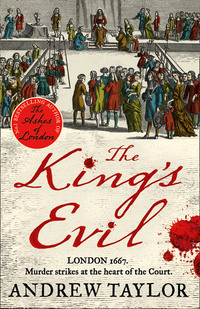
Czytaj książkę: «The King’s Evil»


Copyright
Published by HarperCollinsPublishers Ltd
1 London Bridge Street
London SE1 9GF
www.harpercollins.co.uk
First published in Great Britain by HarperCollins Publishers 2019
Copyright © Andrew Taylor 2019
Cover design © HarperCollinsPublishers Ltd 2020
Cover illustrations © Heritage Image Partnership Ltd/Alamy Stock Photo and Shutterstock.com
Andrew Taylor asserts the moral right to be identified as the author of this work.
Prelims show image of Clarendon House © Antiqua Print Gallery/Alamy Stock Photo
A catalogue copy of this book is available from the British Library.
This novel is entirely a work of fiction. The names, characters and incidents portrayed in it are the work of the author’s imagination. Any resemblance to actual persons, living or dead, events or localities is entirely coincidental.
All rights reserved under International and Pan-American Copyright Conventions. By payment of the required fees, you have been granted the non-exclusive, non-transferable right to access and read the text of this e-book on screen. No part of this text may be reproduced, transmitted, down-loaded, decompiled, reverse engineered, or stored in or introduced into any information storage and retrieval system, in any form or by any means, whether electronic or mechanical, now known or hereinafter invented, without the express written permission of HarperCollins.
Source ISBN: 9780008119188
Ebook Edition © April 2019 ISBN: 9780008119171
Version: 2019-12-12
Dedication
For Caroline

Epigraph
To that soft Charm, that Spell, that Magick Bough,
That high Enchantment I betake me now:
And to that Hand (the Branch of Heavens faire Tree)
I kneele for help: O! lay that hand on me,
Adored Cesar! and my Faith is such,
I shall be heal’d, if that my King but touch.
The Evill is not Yours: my sorrow sings,
Mine is the Evill, but the Cure, the KINGS.
Robert Herrick, ‘To the King, to cure the Evill’
(Hesperides, 1648)
Praise for The King’s Evil
‘A masterclass in writing for the genre’
Ann Cleeves, author of the Shetland and Vera Stanhope series
‘An absolute treat from start to finish – a hugely engaging, atmospheric historical thriller’
Antonia Hodgson, author of The Devil in the Marshalsea
‘This is a novelist of consummate skill at the absolute peak of his power’
Manda Scott, author of A Treachery of Spies
‘Taylor’s mantelpiece already groans under awards … and this latest is as striking as anything he has written’
Financial Times, Crime Books of the Year
‘Few historical novelists write with more authority and a greater sense of authenticity than Andrew Taylor’
Sunday Times
‘This is historical crime fiction at its dazzling best’
Guardian
‘Vivid and compelling’
Observer
‘A novel filled with intrigue, duplicity, scandal and betrayal, whose author now vies with another master of the genre, C. J. Sansom’
Spectator
‘Glorious’
Sunday Express
‘Another fine outing from one of the best historical novelists around’
Sunday Times
Praise for Andrew Taylor
‘If you like C. J. Sansom, or Hilary Mantel, you’ll love Andrew Taylor’
Peter James
‘Effortlessly authentic … gripping … moving and believable. An excellent work’
C. J. Sansom
‘A breathtakingly ambitious picture of an era’
Financial Times
‘This is how historical crime should be written, with rich authenticity underpinning a twisting plot’
The Times
‘One of the most reliably enjoyable of historical novelists’
Sunday Times
‘Taylor brings the 17th century to life so vividly that one can almost smell it’
Guardian
‘Once again, Taylor combines his detailed research with a deviously twist-laden storyline’
Observer
‘This is terrific stuff: intelligent, engrossing and … wonderfully plausible’
Daily Telegraph
‘Thrilling … Gripping, fast-moving and credible’
Spectator
‘Finely wrought and solidly researched … The novel’s plot is fiendishly complex’
Sunday Telegraph
Contents
Cover
Title Page
Copyright
Dedication
Epigraph
Praise for The King’s Evil
Praise for Andrew Taylor
The Main Characters
The Royal Family
Chapter One
Chapter Two
Chapter Three
Chapter Four
Chapter Five
Chapter Six
Chapter Seven
Chapter Eight
Chapter Nine
Chapter Ten
Chapter Eleven
Chapter Twelve
Chapter Thirteen
Chapter Fourteen
Chapter Fifteen
Chapter Sixteen
Chapter Seventeen
Chapter Eighteen
Chapter Nineteen
Chapter Twenty
Chapter Twenty-One
Chapter Twenty-Two
Chapter Twenty-Three
Chapter Twenty-Four
Chapter Twenty-Five
Chapter Twenty-Six
Chapter Twenty-Seven
Chapter Twenty-Eight
Chapter Twenty-Nine
Chapter Thirty
Chapter Thirty-One
Chapter Thirty-Two
Chapter Thirty-Three
Chapter Thirty-Four
Chapter Thirty-Five
Chapter Thirty-Six
Chapter Thirty-Seven
Chapter Thirty-Eight
Chapter Thirty-Nine
Chapter Forty
Chapter Forty-One
Chapter Forty-Two
Chapter Forty-Three
Chapter Forty-Four
Chapter Forty-Five
Chapter Forty-Six
Chapter Forty-Seven
Chapter Forty-Eight
Chapter Forty-Nine
Chapter Fifty
Chapter Fifty-One
Chapter Fifty-Two
Chapter Fifty-Three
Chapter Fifty-Four
Chapter Fifty-Five
Chapter Fifty-Six
Chapter Fifty-Seven
Keep Reading …
About the Author
By the same Author
About the Publisher
THE MAIN CHARACTERS

Infirmary Close, The Savoy
James Marwood, clerk to Joseph Williamson, and to the Board of Red Cloth
Margaret and Sam Witherdine, his servants
The Drawing Office, Henrietta Street
Simon Hakesby, surveyor and architect
‘Jane Hakesby’, his maid, formerly known as Catherine Lovett
Brennan, his draughtsman
Whitehall
King Charles II
James, Duke of York, his brother
Joseph Williamson, Undersecretary of State to Lord Arlington
William Chiffinch, Keeper of the King’s Private Closet
George Villiers, second Duke of Buckingham
John Knight, the King’s Surgeon General
Clarendon House
Edward Hyde, Earl of Clarendon, the former Lord Chancellor of England
George Milcote, a gentleman of his household
Matthew Gorse, a servant
Others
Olivia, Lady Quincy, formerly Mistress Alderley
Stephen, her footboy
Mr Turner, a lawyer, of Barnard’s Inn
Mr Veal, of London
Roger, his servant
Rev Dr Burbrough, of Cambridge
Rev Richard Warley, of Cambridge
Mistress Warley, his grandmother
Frances, a child
Mr Mangot, of Woor Green
Israel Halmore, a refugee
THE ROYAL FAMILY

CHAPTER ONE
HE COULD NOT help himself. In one fluid movement, he stepped back, twisting to present his side to the enemy. His right leg was slightly bent at the knee, the foot pointing towards danger. In that instant, he was perfectly poised, as his fencing master had taught him, ready to thrust in tierce, ready to spit the devil before him like a fowl for the roasting.
As he moved, he heard a sharp intake of breath, not his own. His right foot was on solid ground. But the left (‘at right angles to the body, monsieur, for stability and strength’) was floating in the air.
‘God’s—’
In that same instant, he stared at the figure in front of him. Dusk was pouring through the grimy windows of the basement like a noxious vapour. He wanted to beg for help. No words came.
He flung out his arms in front of him in a violent attempt to restore his balance. His fingers stretched, groping for a hand to pull him back. Steel clattered on stone.
He fell with no more choice in the matter than a poleaxed ox. His head slammed against the coping. Pain dazzled him. He cried out. His arms and legs flailed as he fell. The damp, unyielding masonry grazed his fingers.
Nothing to hold. Nothing to—
His shoulder jarred against stone. The water hit him. The wintry chill cancelled all pain and drove the breath from his body. He opened his mouth to cry out, to breathe. The cold flooded his lungs. He choked.
Fiery agonies stabbed his chest. He sank. He had always feared water, had never learned to swim. His hands scraped against unyielding stone. His boots filled, dragging his legs down.
His head broke free. He gulped a mouthful of air. Far above him, he glimpsed the shadowy outline of a head and shoulders.
‘Help me,’ he cried. ‘For the—’
But the words drowned as his body sank again and the water sealed him into its embrace. The purest in London, that’s what her ladyship claimed. His fingernails scrabbled against the stone, trying to prise out the mortar to find handholds. His limbs were leaden. The pain in his chest grew worse and worse. It was impossible that such agony could exist.
Despair paralysed him. Here was an eternity of suffering. Here at last was hell.
The pain retreated. He was no longer cold, but pleasantly warm. Slowly, it seemed, every sensation vanished, leaving behind only a blessed sense of peace.
So this, he thought, this is—
CHAPTER TWO
One Day Earlier
ON FRIDAY, I was watching the King healing the sick in the Banqueting House at Whitehall.
‘Don’t look round,’ Lady Quincy said softly.
At the sound of her voice, something twisted in my chest. I had met her last year, in the aftermath of the Great Fire, during an episode of my life I preferred not to dwell on, which had left her a widow. She was a few years older than me, and there was something about her that drew my eyes towards her. Before I could stop myself, I turned my head. She was staring at her gloved hands. Her hat had a wide brim and a veil concealed her face. She was standing beside me. She had brought someone with her, but I could not get a clear view. Someone small, though. A child? A dwarf?
‘Pretend it’s the ceremony that interests you,’ she murmured. ‘Not me. Or I shall have to go.’
We were on the balcony, and the entire sweep of the hall was laid out before us. My eyes went back to the King. In this place, the largest and by far the grandest apartment in the palace of Whitehall, Charles II was seated on his throne below a canopy of state, with the royal arms above, flanked by crowds of courtiers and surpliced clergymen, including his personal confessor, the Clerk of the Closet. His face was calm and very serious. I wondered whether he could ever forget that his father had once stepped through the tall window halfway down the hall on to the scaffold outside, where a masked executioner had been waiting for him with his axe. As a child, I had been in the crowd that had watched as the old king’s head was struck from his body.
‘Say nothing,’ Lady Quincy said. ‘Listen.’
The Yeomen of the Guard marshalled the crowds in the body of the hall, their scarlet uniforms bright among the duller colours worn by most of the sufferers and their attendants. Many of the courtiers held handkerchiefs to their noses, because ill people did not smell agreeable.
‘I’ve a warning,’ she went on. ‘Not for you. For someone we shan’t name.’
I watched the sick. Most of them had visible swellings, great goitres that bulged from their necks or distorted their features. They suffered from scrofula, the disease which blighted so many lives, and which was popularly known as the King’s Evil, because the King’s healing hands had the power to cure it. There were at least two hundred sufferers in the hall below.
‘I had a visitor on Wednesday.’ Lady Quincy’s voice was even softer than before. The hairs lifted on the back of my neck. ‘My stepson, Edward Alderley.’
One of the royal surgeons led them up, one by one, to kneel before the King. Some were lame, hobbling on crutches or carried by their friends. There were men, women and children. There were richly dressed gentlemen, tradesmen’s wives, peasants and artisans and beggars. All were equal in the sight of God.
There was a reading going on below, something interminable from the Prayer Book; I couldn’t distinguish the words.
‘Edward was in good spirits,’ she went on. ‘Full of himself, almost as he used to be when his father was alive. Prosperous as well, or so he would have me believe.’ There was silence, apart from sounds of the shifting crowd below and the distant gabble of the reading. Then: ‘Do you still know where to find his cousin Catherine? Just nod or shake your head.’
I nodded. The last time I had seen Edward Alderley, he had struck me as an arrogant boor, and I knew his cousin would not welcome his reappearance in her life.
‘Good. Will you take a message to her from me?’
‘Yes,’ I said.
‘He told me that he knows where she is hiding. He said it was a great secret, and I would know everything soon.’ Lady Quincy paused. ‘When he has his revenge for what she did to him. He said that he and his friends would see Catherine Lovett dead and he would dance on her grave.’
‘His friends? What friends?’
She shrugged and was silent.
I was surprised that anyone might want to make a friend of Edward Alderley. He was a bully and a braggart, with a dead traitor for a father. After his father’s disgrace last year, Lady Quincy had lost no time in reverting to the name and title she had used when married to her first husband.
In the hall below, the King was stroking the neck of the kneeling patient with his long fingers, while someone in the crowd was weeping and the clergyman was praying in an inaudible monotone. The King’s face was grave, and his heavy features gave him an air of melancholy. He was staring over the head of the kneeling woman. It seemed that he was looking up at me.
‘Do you think Alderley was telling the truth?’ I said.
Lady Quincy stirred beside me, and her arm brushed mine, just for an instant. ‘He came to …’ There was a pause, as if she needed a moment to decide what to say. ‘He came in the hope of impressing me, perhaps. Or … Or to make me afraid of him.’
‘Afraid?’ I looked towards her again, but her face was still invisible. ‘You? Why should you be afraid of him?’
‘Warn Catherine for me,’ she said, ignoring the question. ‘Promise me you will, and as soon as you can. I don’t want her death on my conscience.’
‘I promise.’
‘I believe Edward would kill her himself if he could.’ She paused, and then abruptly changed the subject. ‘I shall listen to the sermon at St Olave’s on Sunday morning. Do you know it? In Hart Street, on the corner of Seething Lane.’
I nodded. It was not far from the Tower, one of the few churches in the walled city that had survived the Great Fire.
‘Will you meet me there? Not in the church but afterwards – wait outside in a hackney. I wish to be discreet.’
‘Very well.’ I felt a stab of excitement. ‘May I ask why?’
But she had already turned away. She slipped through the crowd towards the door, followed by her small attendant, who I now saw was a lad with dark hair, presumably her footboy though he wasn’t wearing her livery. He was wrapped in a high-collared cloak that was too big for him.
Disappointment washed over me as Lady Quincy passed through the doorway to the stairs. The footboy followed his mistress. In the doorway he glanced back, and I saw that the lad was an African.
After Lady Quincy and her attendant had gone, I waited for a few minutes to avoid the risk of our meeting by accident. I left the balcony and went down to the Pebbled Court behind the Banqueting House. The sky was grey and the cobbles were slick with rain.
The public areas of the palace were packed, as they always were when the King was healing. The sufferers did not come alone: their family and friends came too, partly to support them and partly to see the miracle of the royal touch. It was unusual to have a big public healing ceremony in September, but the demand had been so great that the King had ordered it. Charles II was a shrewd man who knew the importance of reminding his subjects of the divine right of kings. What better way of demonstrating that God had anointed him to rule over them than by the miracle of the royal touch?
I crossed to the opposite corner of the court, passed through a doorway and went up to the Privy Gallery. Mr Chiffinch was waiting in the room where the Board of Red Cloth held its quarterly meetings; I was clerk to the board, and he was one of the commissioners. He was alone, because the other commissioners had already gone to dinner. He was sitting by the window with a bottle of wine at his elbow. He was a well-fleshed man whose red face gave a misleading impression of good nature.
In his quiet way, Chiffinch wielded more power than most men, for he was Keeper of the King’s Private Closet and the Page of the Backstairs, which meant that he controlled private access to the King. It was he who had told me to wait on the balcony in the Banqueting Hall until Lady Quincy approached me; he had said it was by the King’s order, and that the King relied on my discretion. He had also said that I was to do whatever her ladyship commanded.
‘Well,’ he said. ‘What did she want?’
‘I’m not permitted to say, sir.’
He shrugged, irritated but clearly unsurprised by my answer. He disliked being in a state of ignorance; the King did not tell him everything. ‘You didn’t attract attention, I hope?’
‘I believe not, sir.’
‘I’ll tell you this, Marwood: if you put a foot wrong in this business, whatever it is, we shall make sure you regret it. The King does not care for those who fail him. And he’s not in a forgiving mood at present, as my Lord Clarendon is learning to his cost.’
I bowed. A few weeks earlier, the King had removed Lord Clarendon, his oldest adviser, from the office of Lord Chancellor in one of the greatest political upheavals since the Restoration of the monarchy seven years before. But removing Clarendon from office had not made him politically insignificant. His daughter was married to Charles II’s own brother, the Duke of York. Since the King had no legitimate children, and Queen Catherine was unlikely to give him any, the Duke was his brother’s heir presumptive. Moreover, the next heirs in the line of succession were Clarendon’s grandchildren, the five-year-old Princess Mary and her infant sister, Anne. If the King were to die, then Clarendon might well become even more politically powerful than he had been before.
‘These are dangerous times,’ Chiffinch went on. ‘Great men rise and fall, and the little people are dragged up and down behind them. If my Lord Clarendon can fall, then anyone can. But of course a man can rise, as well as fall.’ He paused to refill his glass, and then went on in a softer voice: ‘The more I know, the better I can serve the King. It would be better for him, and for you, if you confided in me.’
‘Forgive me, sir. I cannot.’ I suspected that he was looking for a way to destroy the King’s trust in me.
‘It’s curious, though,’ Chiffinch went on, staring at the contents of his glass. ‘I wonder why my lady wanted to meet you in the Banqueting House of all places, at one of the healing ceremonies. She so rarely comes to Whitehall these days. Which is understandable enough. It takes more than a change of name to make people forget that she was once married to that bankrupt cheat Henry Alderley.’
I said nothing. Edward Alderley’s father had committed a far worse crime than steal other people’s money, though few people other than the King and myself were aware of that. I had done the King good service at the time of Henry Alderley’s death, which was when I had also had dealings with Lady Quincy. I kept my mouth shut afterwards, which was why he trusted me now.
Chiffinch looked up, and I saw the flash of malice in his eyes. ‘Did Lady Quincy get a good look at you, Marwood? Did she see what’s happened to you since she last saw you?’ He turned his head and spat into the empty fireplace. ‘It must have come as quite a shock. You’re not such a pretty boy now, are you?’
CHAPTER THREE
LATE ON FRIDAY afternoon, the rain dashed against the big windows of the Drawing Office at the sign of the Rose in Henrietta Street. It had grown steadily heavier all day, whipped up by a stiff, westerly wind. If it grew much darker they would need to light the candles.
Apart from the rain, the only sounds were the scratching of Mr Hakesby’s pen and the occasional creak of a floorboard, when Brennan, the draughtsman, shifted his weight from one foot to another. He was working on the detailed elevations for the Dragon Yard development by Cheapside, which was the main commission that Mr Hakesby had in hand at present.
Catherine Lovett was standing at a slope placed at right angles to one of the windows. Her neck and shoulders ached. She had spent the last half-hour working on another job. She was inking in the quantities and materials in a panel at one side of the plan for one of the new warehouses by the docks.
The careful, mechanical lettering was dull work, and the warehouse was a plain, uninteresting building, but Cat was thinking of something quite different – the garden pavilion project at Clarendon House, where she and Mr Hakesby had been working this morning. Mr Milcote had visited them to discuss the basement partition. Milcote was acting for his lordship in the matter, and she could not help thinking that their lives would be much more pleasant if all their clients were as agreeable and straightforward as that gentleman.
She rubbed her eyes and stretched. As she was dipping the pen in the ink, there was a tap at the door. She laid the pen aside and went to answer the knock. That was another of her more tiresome duties, along with keeping the fire going, sweeping and scrubbing the floor, filling inkwells and sharpening pens.
Cat found the porter’s boy on the landing, holding out a letter. It was addressed to Mr Hakesby in an untidy scrawl. She took it over to him. He was sitting huddled over the fire, though it was not a cold day, with a board resting over the arms of his chair so he had a surface for writing and drawing, when his hands were steady enough.
Hakesby broke the seal and unfolded the letter. It trembled in his liver-spotted hands. There was another letter inside. He frowned and gave it to her. Her name – or rather the name she used in Henrietta Street, Mistress Jane Hakesby – was written on it in the same hand as the outer enclosure.
‘What is this?’ Hakesby said, his voice petulant. ‘There’s nothing for me here. Do you know anything of this?’
Brennan looked up. He had sharp hearing and sharp wits.
‘No, sir,’ she said in a low voice.
She concealed her irritation with Hakesby, for he was increasingly peremptory with her now that he had a double reason to expect her obedience. She opened the letter and scanned its contents.
I must see you. I shall be in the New Exchange tomorrow afternoon, at about six o’clock. Look for me at Mr Kneller’s, the lace merchant in the upper gallery. Destroy this.
The note was unsigned and undated. But there was only one person who could have written it. She dropped the paper into the glowing heart of the fire.
‘Jane!’ snapped Mr Hakesby. ‘Take it out at once. Who’s it from? Let me see.’
It was too late. The flames licked the corner of the paper and then danced along one side. The letter blackened. For an instant, Cat saw one word – ‘destroy’ – but then the paper crumpled and fluttered and settled among the embers.
CHAPTER FOUR
ON SATURDAY AFTERNOON, as chance would have it, I was kept later than I had expected at Whitehall. There was a crisis in the office. Much to Chiffinch’s irritation, I spent the majority of my time working under Mr Williamson, the Undersecretary to Lord Arlington, the Secretary of State for the South and one of the King’s most powerful ministers. Mr Williamson’s responsibilities included the publication of the London Gazette, the government’s newspaper. Under his direction, I shouldered much of the day-to-day burden of editing the material, seeing it through the press and ensuring it reached its readers.
In London, the Gazette’s distribution relied heavily on a group of women who carried the newspapers to the taverns and coffee houses of the city, and also delivered them to the carriers who took them the length and breadth of the kingdom. Over the last few weeks there had been problems of late delivery or even no delivery at all. These were probably due to the usual causes of death, disease, drunkenness and simple unreliability. There was also the fact that we paid the women a pittance, which was often weeks in arrears. But Lord Arlington wasn’t interested in the reasons. He blamed Williamson for the failure, and Williamson blamed me.
When at last I was able to leave the office, I took a boat from the public stairs at Whitehall – fortunately the tide was on the ebb – and went by water to Charing Cross. The sun was low in the sky, slanting through a gap in the clouds.
Outside the New Exchange, the Strand was packed with waiting coaches and sedan chairs, reducing the flow of traffic in both directions to fitful trickles. Aggrieved drivers struggled towards the City or upriver to Whitehall or past the Royal Mews towards Hyde Park. Those on foot were making better speed.
The clocks were already striking six as I entered the building. Since the lamentable fire last year, which had destroyed the shops of Cheapside, the old Royal Exchange in the City and so much else, the New Exchange was busier than ever. The world came here to buy and sell. Everything the heart could desire, the proud boast went, could be found under one roof. You could purchase all the luxuries of the globe without having to get your feet muddy, your clothes wet, or your ears assaulted by the vulgar cries of the street.
I forced myself to slow down – people sauntered in the New Exchange: to hurry was to draw attention. The shops were arranged in long lines that faced each other on two floors. I made my way to the stairs. The upper galleries were even busier than those on the ground floor.
Mr Kneller’s shop was larger than most and equipped with a wide mullioned window, the better to allow customers to inspect the wares for sale. Much of his stock was imported from France and the Low Countries.
I hesitated on the threshold. The last of the sunlight slanted through the panes in broad stripes that brought to life the silks and lace in its path. The shop was thronged with people, men and women; the air was heavy with perfume, and filled with the murmur of voices and the rustle of skirts. The proprietor’s wife, a pretty woman of about thirty, was showing a delicate spray of lace to a richly dressed gentleman with a face like a horse. The gentleman was more interested in her than in her lace. For an instant her eyes flickered towards me and then returned to her customer.
‘You like the look of her, don’t you?’
My head jerked to the left. Cat was at my elbow, looking up at me. She wore a light cloak and a hat that shaded most of her face.
‘Nonsense,’ I said, instantly defensive. ‘I was looking for you.’
‘You’re a liar, sir,’ she said. ‘Like all men.’
CHAPTER FIVE
CAT ALLOWED MARWOOD to lead her to a quieter corner, partly shielded from the rest of the shop by the projecting counter on which the apprentices were laying out the larger pieces of lace. She had last seen him three or four months ago. She glanced surreptitiously at him, and found he was doing the same to her.
He looked more prosperous than before, and somehow older. He was wearing a new periwig, finer and more luxuriant than his old one. His face was plumper – the last time she had seen him, pain and laudanum had sharpened his features.
It was important to be natural: they were a man and a woman idling away an hour in the New Exchange, enjoying the pleasures of shopping. She took up a piece of lace. ‘Is this Bohemian work, I wonder?’
‘I need to talk to you,’ he muttered. ‘It’s urgent.’
‘Yes. And while you do, we need to look as if we are here to look at lace.’
She glanced up at Marwood’s face, tilting her head to have a better view of the left side of his neck. To her surprise, he gave her a sardonic but not unfriendly look.
‘Well?’ he said. ‘How do you find me?’
‘Better. As far as I can see, that is. Your wig and your collar hide the worst of it.’
He shrugged, dismissing his disfigurement, dismissing the memory of what the fire had done to him. He said softly: ‘Your aunt talked to me about you.’
Cat’s eyes widened. She raised her voice. ‘Come to the window, sir, and let me see this piece properly.’
They stood in the embrasure. The lace spilled over her arm like a frosted spider’s web. She held it to the glass and pretended to examine it.
‘Lady Quincy?’ she said. ‘What does she want, after all this time? I’m surprised she still has an interest in me. She did nothing for me when she was married to my uncle, and when we lived under the same roof, nothing when I most needed help.’
‘She wants to help you now.’
‘I’m sure she told you that, sir.’ Cat felt irritation rising like bile inside her. ‘But then you would believe anything she says. You always had a – what shall we call it? A tenderness for her.’
‘I don’t know what you’re talking about,’ he said coldly. He bent down, bringing his lips closer to her ear. ‘Your cousin Edward Alderley called on her,’ he said slowly. ‘He told her that he has discovered where you are hiding. He plans to have you brought to the gallows.’
‘Perhaps my cousin was lying,’ she said. Marwood was growing angry, she thought, which pleased her. ‘Edward never let truth get in his way.’
‘You can’t take that chance. She believed he was telling the truth. There’s still a warrant out for your arrest on a charge of treason, on the grounds that you aided and abetted your father, a Regicide. It’s never been withdrawn.’
‘But what could I do?’ she said. ‘He was my father, whatever he had done. Besides, I had as little to do with him as I could.’
‘Alderley also told Lady Quincy that he has powerful friends, and they will help him destroy you.’
‘I thought no one would give Edward the time of day after my uncle’s disgrace.’
‘It appears you were wrong,’ he said. ‘Lady Quincy believed him, and she wanted to warn you, from the goodness of her heart.’
‘Goodness? From my Aunt Quincy?’
‘You should leave Henrietta Street. At least for a time. It’s not safe.’
She flared up: ‘Why should I run away from Edward? I’ve had enough running.’
Marwood glanced at the nearest apprentice, who had heard this. He moved nearer to Cat, turning and shielding her. ‘For your safety.’
‘I’ll tell you something.’ She touched his sleeve. ‘Do you know what my cousin did to me?’
‘Yes, of course – he helped his father cheat you of your fortune, and he attacked you and—’
‘He raped me.’
‘What?’ Marwood stared aghast at her. ‘I don’t understand.’
‘What’s there to understand? In his father’s house, he came to my bedchamber by night. He took me by force. Is that plain enough for you, sir?’ She lowered her voice. ‘That’s why I took out his eye and ran away from Barnabas Place. I thought I had killed him when I stabbed him. I wish to God I had.’
The apprentice advanced and gave a little cough. ‘Sir – mistress – may I show you some more pieces? We have some particularly delicate work newly brought from Antwerp.’
‘Not now,’ Marwood said.
‘Sir, I can promise you—’
‘Leave us,’ Cat said, raising her voice. ‘Go.’
The sounds of the shop died away. Half the customers were staring openly at them. So was the shopkeeper’s pretty wife.
‘Later,’ Marwood said to the apprentice.
He took Cat’s arm and marched her out of the shop. So much for their attempts to be inconspicuous, Cat thought. She said nothing as he led her to the stairs and down to the ground floor. The movement made the curls of his periwig swing away from his face. For an instant she glimpsed what remained of his left ear.
When they reached the street, Marwood turned abruptly towards her.
‘Why didn’t you tell me what that damned knave did to you?’ he said.
‘Why should I have done? What’s it to you?’
He tightened his lips but said nothing. The last of the sun had gone. Grey clouds blanketed the city.
‘One day,’ Cat went on, in a dull voice as if mentioning a future event of no importance to her, ‘one day, I shall kill my cousin.’
‘Don’t be foolish. What would that achieve except bring you to the gallows, which is exactly what he wants?’
‘You forget yourself. You have no right to tell me what I may or may not do.’
Marwood looked away from her. ‘In any event, we must assume, for your own safety, that Alderley has found you again. That means you must leave Mr Hakesby, leave Henrietta Street. Even better, leave London for a while.’
‘I can’t.’
‘You must.’
She shook her head. ‘There’s too much work to do. Mr Hakesby depends on me. I have a meeting with one of our clients in less than an hour. I must go. Besides—’
‘If it’s a question of money, I can help. I’ve brought five pounds with me.’
That was generous, and the offer touched her.
‘You don’t understand, sir,’ she said, in a gentler voice. ‘If I need money, I shall ask Mr Hakesby. I’m betrothed to him. He will soon be my husband.’
After a good week at the Drawing Office, measured by the entries that Cat made into Mr Hakesby’s accounts, they had fallen into the habit of supping together on Saturday evening. Hakesby was careful with money but not ungenerous. There was plenty of work at present, as half of London had turned into a building site after the Fire.
Hakesby was a creature of habit, which was why he always entertained Cat and Brennan in a private room at the Lamb in Wych Street. The tavern was a shabby place, but the people of the house knew him: they valued his custom and treated his habitual ague, however bad it was, as nothing out of the way. Usually these were cheerful occasions when even Mr Hakesby allowed himself to take a glass or two of wine, though it tended to make his symptoms worse.
A few months ago, Cat would not have believed it possible that she would spend an evening in Brennan’s company. At the start of their acquaintance, she had disliked intensely both the fact that Brennan had dared to court her affections and the manner in which he had approached this impossible task. But she had dealt with that, and so had he, and she had come to respect his skill as a draughtsman, his reliability and his kindness to Mr Hakesby.
Brennan had come to Henrietta Street armed with a glowing letter of recommendation from Dr Wren, and time had justified the praise. Hakesby paid him a regular wage now, rather than using him as a piece worker. Someone, she suspected, was looking after him, perhaps the motherly young woman who worked in the pastry cook’s in Bedford Street.
On this evening, they supped later than usual, at nearer nine o’clock than eight. It was not a cold evening, but Cat was chilled to the bone. It was hard to concentrate on what the men were saying. The thought of her cousin Edward kept forcing itself into her mind. She wondered if she could ever be happy again.
At first, Hakesby and Brennan failed to notice her silence. Both of them were elated, partly from wine and partly because Hakesby had received an unexpected stage payment for the Clarendon House commission, which had allowed him to pay Brennan a bonus. Despite his political troubles, Lord Clarendon remained an influential client, the sort who led where others followed. Hakesby had been concerned about the work on the pavilion, as her ladyship, who had taken such a particular interest in it, had recently died. There was also the fact that his lordship was not only in disgrace at court but rumoured to be short of money. Nevertheless, the payment had been made. They probably had Mr Milcote to thank for that.
As the meal went on, however, Cat noticed that Hakesby was shooting worried glances at her. He was growing more and more dependent on her, she knew, and that could only increase as his ague worsened. Their marriage was fixed for the end of October; next month, they would start to call the bans. The marriage was to be a private affair in the new-built church in Covent Garden.
‘The building is a pure Inigo Jones design,’ Hakesby had said with satisfaction. ‘Not one of those crumbling medieval hotchpotches the Papists built.’
After supper, as they were going downstairs to the street, he touched Cat’s arm and said quietly, ‘Are you well? Are you sickening?’
‘No, sir. It is nothing, a woman’s matter.’
Hakesby shied away from her, turning to take Brennan’s arm. In the street, he said he would not take a chair back to his lodgings; he felt perfectly capable of walking. Brennan and Cat exchanged glances, silently accepting the necessity of accompanying him. The three of them walked slowly towards Three Cocks Yard off the Strand, where Hakesby lodged on the first floor of one of the new houses. Brennan took him into the yard and up to the house, while Cat herself lingered in the Strand.
Brennan was only gone for a moment or two. When he returned they walked back the way they had come. She would have been content to go by herself – in the past year, she had learned to cope with the streets. She always carried a knife, and was not afraid to show it. But it would make Hakesby unhappy if she walked alone after dark, so she accepted Brennan’s company. Walking back with her to Henrietta Street did not take him far out of his way.
‘What’s amiss?’ he said as they passed St Clement Danes. ‘You hardly said a word during supper.’
‘Nothing,’ she said automatically. Then she came to a sudden decision and changed her mind. ‘No. That’s not true. I – I have a difficulty. I need to go away for a while. And no one must know where I am. Even Mr Hakesby.’
‘Why?’
‘I can’t tell you.’
‘Where will you go?’
‘I don’t know.’
‘You can’t be so foolish,’ he said. ‘Is it something to do with that letter you had?’
She nodded. ‘It’s urgent. I must go, and the sooner the better.’
They walked past Somerset House. The Savoy, where Marwood lived, was not far away to the west and she pulled up her cloak to shield her face.
Brennan misinterpreted the action. ‘Do you think someone might be following you?’
‘Perhaps.’
A solitary woman always attracted attention, she thought, usually the wrong kind.
‘Would you – would you need comfort?’ Brennan said.
She stared at him, her anger flaring up. ‘What?’
‘If there were somewhere you could hide, I mean,’ he said hastily. ‘But somewhere the conditions were mean and poor, where they weren’t suitable for … you.’
‘Why?’
‘I know somewhere you could go for a week or two, longer maybe. It wouldn’t cost much.’
‘As long as I was safe, I wouldn’t need a featherbed. Or a maid to wait on me. If that’s what you mean.’
‘In that case,’ he said, ‘I have a notion that might help.’ He hesitated. ‘Though what I have in mind would hardly be fitting for one such as you. But no one would find you there. No one would even think to look there.’
‘Where is this?’
‘A few miles outside London. It’s a refugee camp, and it’s on my uncle’s land. He used to farm it, but everything’s gone to wrack and ruin since his son died.’
CHAPTER SIX
WHEN CAT AND I had gone our separate ways, I walked down the Strand to the Savoy. My house was here, in Infirmary Close, which lay deep in the warren of crumbling buildings that made up the former palace and its immediate surroundings. The Savoy was still owned by the Crown, though its precincts were given up to a variety of purposes. I was lucky to have even a small house to myself – lodgings of any sort were in short supply, especially since the destruction of so much of London in the Great Fire. My master Mr Williamson had spoken on my behalf to the clerk who handled these royal leases.
I was not in the best of tempers. When my manservant, Sam, let me into the house and took my cloak, I swore at him for his clumsiness, though in truth he was as graceful as a man with only one whole leg can be, and more nimble than many with two of them.
Margaret, his wife, brought me my supper. She lingered by the table as I began to eat. ‘Your pardon, sir, but is it the Gazette women that’s troubling you? My friend Dorcas says they’re all at sixes and sevens and she’s worked off her feet.’
I felt ashamed of my ill humour to the servants, who were hardly in a position to answer back if they wanted to keep their places. I said, in a gentler voice than before, ‘That and other things.’
‘It’s only that perhaps I could help. If you need someone to do a few rounds for a week or so, then I will, if you permit me. Or I could share Dorcas’s load. I’ve done it before.’
It was a kind offer. Margaret had been one of the newspaper’s distributors before she came to work for me, and she was still friendly with several of the women she had worked with. She knew the routine. I also knew that she had disliked the work intensely, for the younger, more comely women often attracted unwanted attentions.
‘Thank you,’ I said. ‘But I need you here.’
I dismissed her. In a way it was useful that Margaret and Sam should think that I was out of sorts because of problems with the Gazette. Better that than the truth.
Afterwards I sat by the window, which looked out over roofs and walls. Slowly the daylight slipped away from the evening while I thought about Catherine Lovett and her ingratitude. Couldn’t the woman understand that I was trying to save her life? Why was she so headstrong? Why so foolish? Or was I the fool to put myself out on her behalf for no good reason whatsoever?
I worked myself up to a sullen rage and encouraged my sense of ill-usage to burn steadily within me. What had really upset me was the knowledge that Edward Alderley had raped Cat. And also the fact that she had betrothed herself to Simon Hakesby, a man old enough to be her father, possibly her grandfather.
I should have felt an abstract outrage that Alderley had forced himself on an unmarried cousin living under his father’s roof. As for the betrothal, I should have felt an equally abstract pleasure for Hakesby and Cat, for he would bring her security and she would bring him the vigour of a young woman.
But there was nothing abstract about my outrage. The very thought of these things made me feel inexplicably injured. So, desperate for a diversion, I fell to thinking of my Lady Quincy instead, though I found little consolation there. Tomorrow I would see her again, but I could not begin to understand why she wanted me to collect her from church in a hackney. Was it to do with her stepson, Edward Alderley, and the warning she had asked me to pass on to Cat? The possibility unsettled me. I wanted nothing further to do with Edward Alderley in this world or the next.
Something else unsettled me: the thought of seeing Lady Quincy again. Despite the difference in our stations, I had desired her once. It had been folly then, and it would be worse than folly now. Besides, as Chiffinch had reminded me, who could desire a man like me?
Darmowy fragment się skończył.