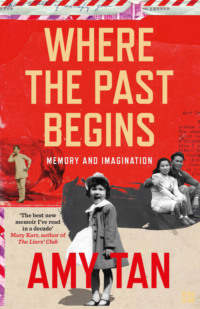
Czytaj książkę: «Where the Past Begins: A Writer’s Memoir»


Copyright
4th Estate
An imprint of HarperCollinsPublishers
1 London Bridge Street
London SE1 9GF
www.4thEstate.co.uk
This eBook first published in Great Britain by 4th Estate in 2017
First published in the United States by Ecco, an imprint of HarperCollinsPublishers, in 2017
Copyright © 2017 by Amy Tan
Cover illustration by Michelle Thompson. Images by kind permission of the author.
‘One of the Butterflies’ by W. S. Merwin taken from The Shadow of Sirius (Bloodaxe Books, 2008) and reproduced by permission of Bloodaxe Books.
www.bloodaxebooks.com
‘The Breaker of Combs’ was first published in Zyzzyva, October 2016.
‘The Unfurling of Leaves’ was first published in Allure magazine, November 2005, titled as ‘A Natural Woman.’
Amy Tan asserts the moral right to be identified as the author of this work
A catalogue record for this book is available from the British Library
All rights reserved under International and Pan-American Copyright Conventions. By payment of the required fees, you have been granted the non-exclusive, non-transferable right to access and read the text of this e-book on-screen. No part of this text may be reproduced, transmitted, down-loaded, decompiled, reverse engineered, or stored in or introduced into any information storage and retrieval system, in any form or by any means, whether electronic or mechanical, now known or hereinafter invented, without the express written permission of HarperCollins
Source ISBN: 9780007585571
Ebook Edition © November 2018 ISBN: 9780007585564
Version: 2018-09-25
Dedication
For Daniel Halpern,
suddenly and finally,
our book.

Slipstream
[From the journal]
2012
You think you are oceans apart when it is really only a slipstream that you fell into by accident or inattention.
CONTENTS
Cover
Title Page
Copyright
Dedication
Introduction – Where the Past Begins
PROLOGUE – The Breaker of Combs
I. IMAGINATION
CHAPTER ONE – A Leaky Imagination
CHAPTER TWO – Music as Muse
Quirk – Souvenir from a Dream
CHAPTER THREE – Hidden Genius
Interlude – Reorientation: Homer, Alaska
II. MEMORY IN EMOTION
CHAPTER FOUR – Genuine Emotions
CHAPTER FIVE – The Feeling of What It Felt Like When It Happened
Quirk – A Mere Mortal at Age Twenty-Five
Quirk – A Mere Mortal at Age Twenty-Six
Quirk – How to Change Fate: Step 1
III. RETRIEVING THE PAST
Interlude – The Unfurling of Leaves
Interlude – The Auntie of the Woman Who Lost Her Mind
CHAPTER SIX – Unstoppable
Quirk – Time and Distance: Age Twenty-Four
Quirk – Time and Distance: Age Fifty
Quirk – Time and Distance: Age Sixty
IV. UNKNOWN ENDINGS
CHAPTER SEVEN – The Darkest Moment of My Life
Quirk – Nipping Dog
CHAPTER EIGHT – The Father I Did Not Know
Quirk – Reliable Witness
V. READING AND WRITING
Interlude – I Am the Author of This Novel
CHAPTER NINE – How I Learned to Read
Quirk – Splayed Poem: The Road
Quirk – Eidolons
CHAPTER TEN – Letters to the Editor
CHAPTER ELEVEN – Letters in English
Quirk – Why Write?
VI. LANGUAGE
CHAPTER TWELVE – Language: A Love Story
Quirk – Intestinal Fortitude
CHAPTER THIRTEEN – Principles of Linguistics
Epilogue – Companions in the House
Acknowledgments
About the Author
Also by Amy Tan
About the Publisher
INTRODUCTION
WHERE THE PAST BEGINS
In my office is a time capsule: seven large clear plastic bins safeguarding frozen moments in time, a past that began before my birth. During the writing of this book, I delved into the contents—memorabilia, letters, photos, and the like—and what I found had the force of glaciers calving. They reconfigured memories of my mother and father.
Among the evidence were my parents’ student visas to the United States, letters from the U.S. Department of Justice regarding their deportation, as well as an application for citizenship. I found artifacts of life’s rites of passage: wedding announcements, followed soon by birth announcements, baby albums with tiny black handprints and downy locks of hair; yearly diaries; the annual Christmas letters with complaints and boasts about the children; floral-themed birthday and anniversary cards; a list of twenty-two people who had given floral contributions for my father’s funeral; and condolence cards bearing illustrations of crosses, olive trees, and dusk at the Garden of Gethsemane. There was also a draft of a surprising mature-sounding letter that I had written to serve as the template my mother could copy to thank people for their sympathy.
Perhaps the most moving discoveries were the letters to me from my mother and the letters to my mother from me. She had saved mine and I had saved hers, even the angry ones, which is proof of love’s resilience. In another box, I found artifacts of our family’s hard work: my mother’s ESL essay on becoming an immigrant and her nursing school homework; my father’s thesis, sermons, and his homework for a graduate class in electrical engineering; my grade school essays and my brother Peter’s history compositions; the report cards of Peter, John, and me, from kindergarten through high school, as well as my father’s college records. In different files, I recovered my father’s and mother’s death certificates. I haven’t come across Peter’s yet, but I found a photo of him in a casket, his sixty-pound body covered by a high school letterman jacket, but with nothing to conceal the mutilation of his head by surgeries and an autopsy. So now I have to ask myself: What kind of sentimentality drove me to keep that?
Actually, I never throw away photos, unless they are blurry. All of them, even the horrific ones, are an existential record of my life. Even the molecules of dust in the boxes are part and parcel of who I am—so goes the extreme rationale of a packrat, that and the certainty that treasure is buried in the debris. In my case, I don’t care for dust, but I did find much to treasure.
To be honest, I have discarded photos of people I would never want to be reminded of again, a number that, alas, has grown over the years to eleven or twelve. The longer I live the more blurry photos I’ve accumulated, along with a few sucker punches from people I once trusted and who did the equivalent of knocking me down to be first in line at the ice-cream truck. Age confers this simple wisdom: Don’t expose yourself to malarial mosquitoes. Don’t expose yourself to assholes. As it turns out, throwing away photos of assholes does not remove them from consciousness. Memory, in fact, gives you no choice over which moments you can erase, and it is annoyingly persistent in retaining the most painful ones. It is extraordinarily faithful in recording the most hideous details, and it will recall them for you in the future with moments that are even only vaguely similar.
With only those exceptions, I have kept all the photos. The problem is, I no longer recognize the faces of many—not the girl in the pool with me, or three out of the four women at a clothes-swap party. Nor those people having dinner at my house. Then again, I have met hundreds of thousands of people in my sixty-five years. Some of them may have even been important in my life. Yet, without conscious choice on my part, my brain has let a lot of moments slide over the cliff. While writing this memoir, I was conscious that much of what I think I remember is inaccurate, guessed at, or biased by experiences that came later. If I were to write this same book five years from now, I would likely describe some of the events differently, either because of a change of perspective or worsening memory—or even because new evidence has come to light. That is exactly what happened while writing this book. I had to revise often as more discoveries appeared.
I used to think photographs were more accurate than bare memory because they capture moments as they were, making them indisputable. They are like hard facts, whereas aging memory is impressionistic and selective in details, much like fiction is. But now, having gone through the archives, I realize that photos also distort what is really being captured. To get the best shot, the messiness is shoved to the side, the weedy yard is out of the shot. The images are also missing context: the reason why some are missing, what happened before and after, who likes or dislikes whom, if anyone is unhappy to be there. When they heard “cheese,” they uniformly stared at the camera’s mechanical eye, and put on the happy mask, leaving a viewer fifty years later to assume everyone had a grand time. I keep in mind the caveat that I should question what I see and what is not seen. I use the photos to trigger a complement of emotional memories. I use a magnifying glass to look closely at details in the black-and-white images in sizes popular in the 1940s and 1950s—squares ranging from one and a half to three and a half inches. They document a progression of Easter Sundays after church and the annual mauling of Christmas presents, which were laid underneath scraggly trees or artificial ones, in old apartments or new tract homes. Some of these photos refuted what I had believed was true, for example, that our family owned no children’s books, except one, Chinese Fairy Tales, illustrated by an artist who made the characters look like George Chakiris and Natalie Wood from West Side Story. A photo of me at age three shows otherwise: I am mesmerized by the words and pictures in a book spread open in my lap. In other photos of that same day, there is evidence of presents of similar size waiting to be ripped open. I had not known this when I wrote the piece “How I Learned to Read.” But it all makes sense that I would have been given books by family friends, if not by my parents. As a writer, I’m glad to know that my grubby little paws were all over those pages.
I came across many photos of me from the ages of one to five looking flirtatiously photogenic: perched in the crook of a tree, looking up from a wading pool, holding a cup with two hands, giving myself a hug, or grinning at the bottom of a playground slide. My father was an amateur photographer with a prized Rollei camera. He was no doubt giving me suggestions on how to arrange myself, praising me for remaining still, and telling me how pretty I looked, words I would have taken as a reward of love not given to my mother or brothers.
The oldest and rarest photos are in large-format albums. After seventy years, the glue has flaked off the bindings and the rusty rivets have lost their heads. The paper corner brackets that held the photos in place have fallen off, and the photos lie loose between thick black pages. Some of the studio photos taken over a hundred years ago are the size of postage stamps, which was why I did not realize they were of my grandmother until six years ago, when I placed a magnifying loupe over the sepia images.
One album holds photos my father took of my mother when they became secret lovers in Tianjin in 1945. He had arranged an artful collage: a large photo of my mother is in the center and smaller ones of himself surround her, as if to say that she is the center of his universe. My father also took many photos of Peter, the firstborn. I found multiple copies of the same photos, suggesting he sent them to friends or handed them out at church. My younger brother, John, received short shrift. Very few are of him alone.
By the early 1960s, my father stopped taking artfully posed photos with his Rollei. He switched to a Brownie camera for snapshots at birthday parties or when relatives or family friends came a long distance to visit us. There are fewer photos of my brothers and me when we were no longer cute and huggable; our limbs had elongated and turned knobby and our faces were sweaty, pimply, and darkened by the sun. In one, I am wearing white cat’s-eye glasses. My hairstyle looks like an explosion of black snakes, the aftermath of a novice beautician’s first attempt at giving a perm. My nose is bulbous, my cheeks are balloons, and my legs are thick and shapeless. That was how I saw myself. I browse through more images, seeking clues of the start of illness in our family. In one of the last photos of my father, he appears to have aged a great deal in just one year. His face looks tired and puffy. He has lost half of his eyebrows, which makes him look less vivid. After he died, there were few posed photos, not even for Lou’s and my wedding, aside from a dozen snapshots taken by friends and family members with disposable cameras. How lucky I am that my father, the amateur photographer with his prized Rollei camera, left behind such a rich pictorial history of our family.
In another bin, I found my first attempts at fiction writing, starting at the age of thirty-three. I saw layers of abandoned novels from over the last twenty-seven years, distressing pages I had not looked at since the awful day when I knew in the hollow of my gut that the novel was dead and that no further revisions or advancement of the narrative would save it. I had long since gotten over being heartsick about them. Nowadays, I let go of pages much more easily. That’s a necessary part of finding a story. Yet I had my trepidations about rereading those abandoned pages. When I did, I saw again the flaws that doomed them. But I was also happy to remember those fictional places where I had lived for months or years, while sitting long hours at my desk. I was still interested in the characters and their personalities. There is much in these stories I am still fond of. I never lost them. They are there, but just for me.
I took out a random assortment of childhood memorabilia and felt fond and strange emotions handling these objects that had once meant so much. I was aware that my fingerprints overlay those I had left as a child. There was residue of who I was in these objects. I was the girl who secretly wanted to be an artist. At eleven, the drawing of my cat lying on her back was the best I had ever done. At twelve, the best was a portrait of my cat soon after she was killed. I saved my brother’s scrawled science project notes on the care, feeding, breeding, and deaths of his guinea pigs. I kept his Willie Mays baseball mitt, which is no longer pliable. I kept two naked dolls with articulated joints whose eyes open and close, but not in synchrony, giving them a drunken cock-eyed expression. I remembered why I kept the pink WHILE YOU WERE OUT message slip on which the high school secretary had written that my brother Peter was doing well after brain surgery. I thought then that if I threw it away, he would die. So I kept it, but he died anyway.
This past year, while examining the contents of those boxes—the photos, letters, memorabilia, and toys—I was gratified to learn that many of my childhood memories were largely correct. In many cases, they returned more fully understood. But there were also shocking discoveries about my mother and father, including a little white lie they told me when I was six, which hugely affected my self-esteem throughout childhood and even into adulthood. The discoveries arranged themselves into patterns, magnetically drawn, it seemed, to what was related. They include artifacts of expectations and ambition, flaws and failings, catastrophes and the ruins of hope, perseverance and the raw tenderness of love. This was the emotional pulse that ran through my life and made me the particular writer that I am. I am not the subject matter of mothers and daughters or Chinese culture or immigrant experience that most people cite as my domain. I am a writer compelled by a subconscious neediness to know, which is different from a need to know. The latter can be satisfied with information. The former is a perpetual state of uncertainty and a tether to the past.
The original idea for this book had nothing to do with excavating artifacts or writing about the past. My editor and publisher, Daniel Halpern, had suggested an interim book between novels, based on some of the thousands of e-mails I bombarded him with during the writing of The Valley of Amazement. I thought it was a bad idea, but he convinced me otherwise with reasons I no longer recall but likely included words any writer would like to hear over a glass of wine: “compelling,” “insightful,” “easy to pull together.” I plowed into the e-mails to see what might be usable. The earliest were the e-mails we exchanged after we met for the first time over drinks to discuss the possibility of working together on my next novel. My e-mails were not carefully composed. They were dashed off with free-form spontaneity, a mix of rambling thoughts off the top of my head, anecdotes of the day, and updates on my dogs and perfect husband. In contrast, Dan’s e-mails were thoughtful and more focused on my concerns, although they also included notes about Moroccan cuisine. He sometimes responded to my offhand remarks with too much care, thinking I had expressed serious wringing of my soul. After six months of wading through our e-mails, I knew I had been right from the start. This was a bad idea for a book. The e-mails would not add up to an insightful book on anything to do with writing. It could serve as a paean to procrastination. I now faced writing a real book.
Unlike those e-mails, I could not write whatever came to mind for a book and consider it good enough to show. Normally, it would take me a week to produce a page that I felt was good enough to keep. Upon rewriting the book, that page and those surrounding it would be cut. While crafting my sentences, I would be aware that an editor expects that a submitted manuscript will be clean, polished pages. [ed. note: Not this editor.] My awareness of this fact would lead me to revise endlessly and self-consciously, steamrollering over characters and the freshness of scenes until they were flat and moribund. That had been a major reason each novel had taken longer to finish. After a year of trying a mushy bunch of other ideas, I finally came up with a plan. What had enabled me to write those thousands of e-mails was spontaneity. If I applied that to writing a book, I would be able to finish quickly. I would not think too far ahead about what to write; I would simply write wherever my thoughts went that day and allow for impulse, missteps, and excess. Revision and excision could happen later. To ensure spontaneity, I made a pact with my editor: I would turn in a piece, fifteen to twenty-five pages every week, no excuses. [ed. note: I should add, I told my author that any pages beyond the required fifteen would not go as a credit for the next installment. We also agreed on some vocabulary that could not be used during the march toward completion. They were: chapter, essay, memoir (which became my secret), finished manuscript, the new book, and deadline. The pieces of prose became known as cantos, harmless enough when writing prose.] Since I would have no time to revise, Dan would need to understand that he would receive true rough drafts, written off the top of my head, and thus, they would contain the traits of bad writing, garbled thoughts, and clichés. To minimize self-consciousness, I asked that Dan not provide comments, good or bad, unless he thought I was veering seriously off track and writing a book he would be insane to publish. [ed. note: Which I have never done.]
What editor would not be happy to be the enforcer of such a plan? What sane writer would not later realize that schedule to be ulcerating and impossible? [ed. note: Honestly, it didn’t seem that onerous to me.]
Even so, I did not miss a deadline, except one. The last. [ed. note: Technically, she was always a day late, using the excuse of PST, to protest her PTSD.] It was the Monday after the 2016 presidential election, and I felt lost, unable to focus. For the last piece, I chose the only subject that was relevant to me at the moment: the election and how my father would have voted. When I finished, I had both a book and an ulcer.
I wrote more than what is in this book. Free-form spontaneity had given rise to a potluck of topics and tone. Some were fun, like my relationship to wildlife and, in particular, a terrestrial pest from Queensland, Australia, a newly identified species of leech, Chtonobdella tanae, that bears my name. I also wrote a piece on the magnificent short story writer Mavis Gallant, our conversations over ten years of lunches and dinners in Paris, the last one spent in her apartment, where I read aloud to her for hours after a lunch of blinis and smoked salmon. I also considered using a few pages of cartoons—doodles drawn when I was bored at a conference—which I called “a graphic memoir of my self-esteem.” In the end, as the shape of the book emerged, Dan and I agreed on the ones I should keep. I had only one concern: what remains might give readers the misperception that I am cloistered in a lightless room with buckets of tearful reverie. There is reverie, but the room is surrounded by windows and is so bright I have to wear sunscreen when I write.
Since this is an unintended memoir, I thought it would be appropriate to include writings from my journals. I gleaned entries that reflect the spontaneity and seeming randomness of ideas that characterize how I think. They are also in keeping with the nature of the other pieces in this book. I call the longer, anecdotal entries from my journals “interludes.” I call the shorter entries “quirks.” They are quirky thoughts from the top of the head, or quirky things I have seen or heard, or quirky remnants of dreams. For writers, quirks are amulets to wonder over, and some have enough strangeness in them to become stories.
I added two other pieces that reflect fairy-tale qualities of the fiction I loved to read as a child. They are taken from the heartbreaking bin of abandoned novels. Both are prologues. The first, “The Breaker of Combs,” has become this book’s prologue. It captures the mythic past I grew up with and broke from before returning to it as a writer. The second, “Language: A Love Story,” takes flight from my earlier obsession with linguistics when I was a college student. I got as far as a doctoral program before I realized that academia had killed my excitement for linguistics and had instilled anxiety over how to distinguish myself from the other doctoral students. The linguistic principles cited in this rhapsody are likely out-of-date and incorrect. But I have kept it pretty much as I drafted it twenty-five years ago. I had a special interest in Manchu at the time, a near-extinct language with a wonderfully imagistic and onomatopoeic lexicon. It, too, carries the essence of myth, having once been the language of the Manchus that ruled China. The language was already headed to extinction before the Qing was overthrown in 1911. While revising this prologue for this memoir, I learned from an amateur genealogist that my DNA suggested the possibility of a Manchu ancestor. Of course it does. The Manchu of my book is also the Manchu of my past. Imagination is enough to make it so. You just have to look back. The title of this memoir, Where the Past Begins, comes from the last line of that story. Dan suggested it. I had not even remembered writing it.
Although I gave up on the idea of a whole book of e-mails between my editor and me, I realized their relevance to this book while writing a piece about my mother’s letters. In personal letters, my mother expressed herself differently. She began with events of the day and would then relate a particular situation, which led her to question what had actually happened. That eventually led to tangents, then a looping curlicue line of further thoughts, until she was galloping toward obsession. Only the end of a sheet of paper brought her written thoughts to a halt. I recognize that I do the same in my e-mails, except there is no limit imposed by a sheet of paper. I realized also that e-mails are different because they lend themselves to confession, philosophizing, profanity, and vulnerability. They are intimate because they are not words that would be said to many. They require trust and familiarity. In other words, these e-mails contain the attributes of memoir. Dan’s original suggestion [ed. note: She is referring to the imposed exercise, I believe.] gave birth to this book.
I am intermittently aghast that everything I have written will actually be an open book. I am contradictory in my need for privacy to write about what is private. That was why I had wavered over whether to include the e-mails. But when I told a number of writer friends what the original premise for this book had been, they all said they would have liked to read that book. Believe me, no one could have endured a whole book of them. [ed. note: I did.] But I have selected enough to show the beginning of a writer-editor relationship and the ensuing conversation over the book I was trying to write.
If you have ever wondered how messed up a writer’s drafts can be, you’ll find consolation or encouragement in reading “Letters to the Editor.” If you have ever wondered how writers and editors work together, these e-mails would not be the best example. I don’t think most writers would have dropped in on their new editor as often as I did to chitchat by e-mail about any old thing, including the loss of my mind that had once enabled me to write. Most editors would not have answered rambling e-mails with such diplomacy and kindness when the obvious answer to each e-mail should have been a firm suggestion that I cease using my fingers to tap out e-mails and apply them to finishing my much-delayed novel. He always made it seem like he would be happy to know more about what was on my mind.
For inspiration, patience, and guidance, I dedicate this book to my editor, Daniel Halpern.
PROLOGUE
THE BREAKER OF COMBS
An Outtake from an Abandoned Novel
My aunties once told me a story about the Breaker of Combs, an old woman who everyone shunned, except during the worst kind of tragedies. That’s when she was asked to break the comb of a ghost who was loved too much: a baby boy or a faithful husband, a scholar son, or a beautiful fiancée.
One family we knew called her when the wife hanged herself with the length of her own hair. Her daughter, who was to be married that year into a good family, discovered her mother’s body and cut her down. Then the family found them both, mother and daughter, one dead, one clinging, both with their eyes popped open. My aunties said long after the mother was buried, the girl wandered around the house with her tongue hanging out, gagging with grief.
When the Breaker of Combs arrived, she told the father to bring out the dead woman’s comb, the one the daughter had used to sweep through her mother’s hair every night. The old woman inspected the comb, a fine piece of golden jade, with many sharp teeth and the body of two phoenixes for a handle.
“As everyone knows,” began the old woman, “when a daughter combs her mother’s hair, she receives through its roots all her mother’s mistakes and sorrows.”
Then the old woman passed the comb over the girl’s head three times, and wiped it clean on a long white cloth. She tied the cloth into three large knots and commanded the girl with the hanging tongue to unravel them one by one.
When the first knot was undone, the Breaker of Combs cried, “We have loosened the girl’s connection to her mother’s past.” When the crying girl untied the second knot, the woman said, “We have let go of the mother’s connection to her daughter’s present.” When the third knot was undone, the Breaker of Combs announced, “Now the dead woman has no ties to this girl in this world or the next.” And as the girl began to wail loudly, the old woman laid the jade comb on the open cloth, picked up a stone hammer, and broke the comb into many pieces.
The girl instantly became quiet, all her grief shattered forever, just like that. Her grateful family sent the old woman away with one gold ingot and several extra coins, begging her never to speak of this tragedy again.
That was all my aunties told me, but that’s not the end of the story. I heard what really happened. That young girl took the jagged pieces of the comb and cut off her own long hair, short as a boy’s. Then she ran away, joined the Communists, and never combed her hair again.

CHAPTER ONE
A LEAKY IMAGINATION
From an early age, I believed I had an extra amount of imagination. I did not come up with that assessment on my own. Many people had told me that. They said I had artistic imagination because I could draw a cat that looked like a cat and a horse that looked like a horse. They praised me for drawing a house with a door that was proportional to the people who stood next to it. They admired the tree next to the house, its thick trunk and smaller branches populated with tiny green leaves. They thought I was creative for putting a bird in the tree. People stared at my drawings, shook their heads, and said I had a wonderful imagination.
At first I wondered why others could not do what came naturally to me. All you had to do was draw what was there in front of your eyes, be it a real cat or a cat in a photo, and after you had drawn it a number of times, it was easy to draw it from memory. I was so good at drawing that by age twelve I was asked by my piano teacher to give his eight-year-old daughter drawing lessons in exchange for my piano lessons. I probably gave the girl instructions like these: The eyes should be drawn in the middle, between the nose, and not on the forehead the way you have it. Just draw it the way it is.

Fufu, drawn by me at age twelve.
I later learned that a good eye is not the same as a good imagination. My high school art teacher, an artist himself, wrote that conclusion on my final semester report card: “Has admirable drawing abilities but lacks imagination or drive, which are necessary to a deeper creative level.” The comment was sharply wounding at the time. He did not say I needed to use more of my imagination. He simply said I lacked it—that and depth.
After my last year in high school, I did nothing further with my artistic inclinations, save the occasional sketch and doodle. I do know that had I continued, I would not have gone in the direction of abstract art. Even today, I am often puzzled by abstract art—those ten-foot-high paintings with a minimal dot of color or squiggles. At museums, my husband and I turn to each other and jokingly utter the words of cultural philistines: “And they call that art!” I now remember there were several afternoons in class when my art teacher instructed us to create a drawing using only colored shapes. Whatever I did, that was likely what sealed his opinion that I had no imagination or depth, at least not for the complexities of abstract art, which I now recall was the kind of art he made.
I recently took up drawing again when I joined a monthly nature journaling class, which has as much of an emphasis on journaling as plein air sketching. I began by drawing birds. Once again, I heard the same compliments from friends and family: that I have a good eye. I can draw a bird that looks like a bird. This time, however, I recognized that my abilities stop there. I can draw a likeness, but I can’t easily create backgrounds more complicated than a branch with a few leaves. I can’t add a new context—falling buildings or a melting ice cap—or anything else that would enable the figurative drawing to represent an idea, say, global warming through the iris of a raven. As it turned out, everyone in the class had a good eye and a number of them were especially skilled and also imaginative. Our teacher, a naturalist artist and author, told us anyone can learn to draw, a view I’ve heard expressed by numerous artists since then. You can acquire techniques—like how to block out the shape of your subject, to use the negative space around a figure to see its shape, to use shading to represent the anatomical structure of birds, amphibians, and large mammals. You can play with a mix of watercolors, gouache, and graphite. You can get by perfectly well with just a pencil and journal book, or you can feed your artistic needs by draining your savings account buying mechanical pencils, blending tools, gel pens, a set of twelve soft and hard graphite pencils, a good brand of watercolor pencils, then an even better brand of watercolor pencils, an embossing tool, watercolor brushes, watercolor brushes with built-in reservoirs, sketchbooks and then really good sketchbooks, zoom and macro binoculars, a spotting scope, a field research bag for carrying your sketch kit, plus a portable stool for sitting in the field for hours. You have to practice daily to make certain skills intuitive—for instance, foreshortening and shadows related to the direction of the light. You need the right shape of the whole creature before you draw an eye. I can’t help it, though—I like to draw the eye early on and correct it later. I like that the bird is eyeing me suspiciously as I draw it.
Now that I’ve been drawing every day, I have come to realize the larger reason I was not destined to be an artist. It has to do with what does not happen when I draw. I’ve never experienced a sudden shivery spine-to-brain revelation that what I have drawn is a record of who I am. I don’t mix watercolor paints and think about my changing amalgam of beliefs, confusion, and fears. I don’t do shading with thoughts about death and its growing shadow as the predicted number of actuarial years left to me grows smaller. When I view a bird from an angle instead of in profile, I don’t think of the mistaken views I have held. With practice, I will become better at drawing the eye of a bird or its feet, but I can’t practice having an unexpected reckoning of my soul. All that I have mentioned—what does not happen when I draw—does occur when I write. They occurred in the earliest short stories I wrote when I was thirty-three. Then, as now, they are revelations—ones that are painful, exhilarating, transformative, and lasting in their effects. In my writing, I recognize myself.
Drawing will continue to grow as a pleasurable activity. I enjoy the practice and patience it requires. I love the sensuous feel of graphite sliding across paper. I was excited by my discovery two days ago that watercolors are not flat swashes of pigment; they create mottling, shading, and other interesting effects that suggest texture and depth. I am delighted by the final outcome. Is it a good likeness? Does it show signs of life? I was humored by my childish pride when someone on Facebook made a comment on my first watercolor of a coot, a bird with a white bill and black body: “You did a good job of capturing its essence.” She knew it was a coot.
I have also found ways in which nature journaling is very much like fiction writing. It requires me to be curious, observant, and inquisitive. I have to continuously wonder over what I am seeing and remove the usual assumptions. Wonderment has always been my habit, even before I knew I was a writer. It still is today. When I was on Robben Island in South Africa, for example, I noticed four orange-eyed oystercatchers on the shore, evenly spaced and perfectly aligned. They simultaneously dipped their beaks into the sand, looked at us, then dipped again—all with the precision of an avian troupe of Radio City Rockettes. What was going on? I mused over the possibilities, some of them rather far-fetched—that this was similar to the instinct that “birds of a feather flock together,” and by acting as a regiment with identical movements, they can be attentive to important incongruities in their environment, say, an osprey, or a bunch of gawking tourists with cameras clicking. Or perhaps it was a parasite or virus that caused some sort of zombie bird syndrome, similar to the zombie ants I saw in Papua whose brains sprouted a foaming parasitic fungus, which directed the ants to attach themselves to an ideally located leaf on the forest floor until the brain bursts forth with spores that would create a new generation of zombie ant masters. The next time I see this synchronized behavior, I will wonder again and come up with more guesses. When I do nature sketching, I am trying to represent what I see, what is true to a particular species of bird and its behavior. My observations and questions have to do with what might be factually true, which I could discover only by asking an ornithologist. But in writing fiction, the truth I seek is not a factual or scientific truth. It has to do with human nature, which is tied to my nature. It is about those things that are not apparent on the surface. When I set out to write a story, I am feeling my way through a question, often a moral one, and attempting to find a way to capture all its facets and conundrums. I don’t want an absolute answer. When writing fiction, I am trying to put down what feels true. Even though the story may not ostensibly be mine, it contains knowledge based on my personal history. It is my experiences that have coalesced into a situation that holds sad irony or horrific clarity. I want to bring forth what I cannot see, what is not there, or is there but nearly indiscernible because the million pieces that make up its whole are scattered all over the place, and extend from past into present. While writing I allow my brain to circumnavigate all the possibilities, but I am not confined to one conclusion. No truth is permanent. Irony is not an intractable fact. Imagination is fluid in flowing to any alluvial ditch of emotions, personal idiosyncrasies, or memories that appear when the flood subsides.
If my curiosity is innate, it has been greatly enhanced by involuntary apprenticeship to my mother and her school of wonderment. She questioned everything, from fishy odors to fishy explanations, both of which pointed to a faulty character. She saw significance in coincidences, and coincidences in just about any juxtaposition of events. On one occasion, it was my saying a word—so ordinary I can’t recall what it was—at the same time that the head of a rose in a vase fell off its stem. My mother stared at me and said, “Are you my mother?” My grandmother had killed herself in 1925, and the idea that I was her reincarnation made me queasy. I insisted I wasn’t her mother, yet I wondered if I might be. How would a person know who she had been in a past life? You don’t journey from one lifetime to the next with luggage tags. “You don’t have to hide,” my mother said. She continued to give me odd looks throughout the day. “Why you say you bored?” she asked at one point. “My mother said that, too.” She wondered aloud if I was her karmic punishment for not showing her mother enough concern. My mother’s brand of wonderment combined curiosity, nosiness, hypothesis, loose opinion, suspicion, seeing what you believe, and seeking what you hope, including miracles, and the reincarnation of your mother into the form of your bad American daughter.
Coincidences abound in my life as well. Just an hour ago, as I was writing the above paragraph, my keyboard switched midsentence to writing only in Chinese characters. I cannot read or write Chinese. My immediate reaction was “hackers,” and not “karmic retribution.” I checked for signs of illegal log-ins, changed my password, reconfigured my settings, printed out current drafts, and rebooted my computer. After a hair-raising forty-five minutes, my computer was once again a monolingual speaker of English. I still don’t know why the unwanted translation happened. But I do allow it might have been a little joke played on me by my mother. I would have preferred something less exciting, like a beheaded rose.
Nature sketching will remain an important part of my life and not simply because of the wonderment it inspires. It allows me to regard imperfection as normal. Fiction writing, on the other hand, does not allow me to ever feel satisfied with what I’ve done. If I thought to myself that a draft of anything I wrote was “good enough,” let alone, “great,” that would be the sign of a neurological disorder (one of my mother’s early signs of Alzheimer’s disease was her lack of concern over an increasing number of dings and dents on her car). When I draw, however, I allow myself to be as sloppy as I want. If I draw birds that are too large and clumsy to fit onto the limits of the paper, I buy a bigger drawing pad. When the next drawing is too big for the new pad, I cut off the crown or tail or wings, and it need not be in an artistic fashion. I once gave a curlew an overly curved bill so that it would fit on the page. It made the curlew look like it had gotten its bill stuck in an electrical socket. I have drawn many free-form arrangements of feathers that would never enable a non-helium-propelled bird to fly. I once unintentionally drew the optical illusion of a branch passing in front of a bird and exiting from behind. I see the imperfections and laugh. They’re hilarious. I post my drawings on the Nature Journal Facebook page. I show them to my husband and friends. I foist them on strangers with the eagerness of a woman showing off photos of her scowling grandkids. I am the girl I was in kindergarten who said to my parents: “Look what I did.”
I might even show my drawings to my former art teacher. He and I maintain a yearly Christmas correspondence that includes updates on our health, the books we’ve read, and the museums we’ve visited. I’ll send him a drawing or two and remind him about the comment he made on my report card when I was seventeen. I’ll tell him I’m glad I failed to become an artist.

Fresno, 1952: The poor minister, his frugal wife, and growing family.
At the age of eight, I learned I had a knack for writing, one with financial benefits. I had written an essay on the assigned topic “What the Library Means to Me” and won in the elementary school division. The prize was an ivory and gold tone transistor radio. There was a reason I won. I wrote what I knew the librarians and supporters of a new library wanted to hear: I was a little kid who loved to read, that I loved the library so much I had donated my life savings (eighteen cents) so that a new library could be built. I knew to mention my age and the amount of my estate. I already had very good intuitions about what pleased people, that is, I knew how to be calculating.
Yet there is something in that library essay that I would later recognize as an early glimmer of my imagination and my disposition as a writer. It lies in sentences from the middle of the essay: “These books seem to open many windows in my little room. I can see many wonderful things outside.” That was the sign: rooms and windows as a metaphor for freedom and imagination, one being the condition for the other. And there was also the fact that I liked to be alone in my little room. Throughout childhood, my little room—or rather, the little rooms of many successive houses from birth to seventeen—became my escape hatch from my parents’ criticism, where I was safe from scrutiny. I was in a time machine propelled by the force of a story, and I could be gone for hours having adventures with newly sprung skills—breathing underwater with a goddess, answering riddles posted by sages disguised as bearded beggars, riding bareback on a pony across the plains, or enduring cold and starvation in an orphanage. Gruel was delicious, like Chinese rice porridge. I found companionship in Jane Eyre, a girl who was independent minded and brave enough to tell her hypocritical aunt that she was unkind and would go to hell. Jane Eyre taught me that loneliness had more to do with being misunderstood than being alone.
Throughout most of my school years, I submitted to expectations and gave the appearance that I had conformed. I was a compliant writer, dutifully putting forth what I thought teachers and professors wanted to read. In grade school, good writing was largely directed to punctuation, spelling, grammar, and penmanship. The words and sentences with errors were circled in red. I tended toward sloppiness and the second-language learning errors of my mother’s speech—“I love to go school.” Only a few essays received any comments other than “Watch your spelling.” I unearthed a report card from the seventh grade, which showed that my lowest grade was for English and the next lowest was for Spanish. (I’m glad to report that these grades did not dissuade me from receiving my B.A. in English and M.A. in linguistics.) In college, I wrote essays according to what I knew my professors wanted to read: themes on social class and the cultural shape of the ideal, or the impossibility of avoiding moral complicity as a soldier in battle. I once deviated from the formula for an essay on Hemingway’s The Sun Also Rises, which I disliked for reasons I can no longer remember. But I vividly recall the professor sitting on the edge of his desk, facing the class, and reading aloud my essay, without identifying me as the writer. He delivered each sentence in a mocking tone and would pause at the end of each paragraph to refute what I had said. He angrily concluded, “This student knows nothing about great literature and has no right to criticize one of our greatest American writers.” Thereafter, I did not write essays that offered a true opinion of what I had thought of any book. I became a facile writer, a compliant one. Based on that criterion, I wrote well.
After I quit my doctoral program in linguistics, I seldom wrote much beyond reports on children I had evaluated for speech and language delays. On occasion, I penned gloomy thoughts, a page or two in loose-leaf binders, some in a journal book. A few years ago, I found some of those outpourings. They had the same kind of glimmerings I had found in my library essay—the metaphors. They were not remarkable; in fact, some were overworked or reaching. But I was excited to see that they contained two common characteristics: dark emotion and a reference to a recent experience. I had used those metaphors at age twenty-five, when I felt I was still young but world-weary. I was impatient to be done with mistakes and bright promises. I wanted to acquire a few wrinkles to show I was not a baby-faced innocent. My worries were too numerous to keep track of on two hands—my fear that I was not suited to the job I had taken, my preoccupation with the recent murder of a friend, the expectations of marriage, my mother’s constant crises, our financial hardship, and much more, which combined with my inability to articulate what I needed emotionally. When I tried, I was hyperbolic. After a trip to the beach, I wrote in my journal that I was like a sea anemone that retracted when poked and was unable to differentiate between what was benign and what intended to do me harm. After taking photos at a party on the anniversary of my friend’s murder, I grew despondent thinking about the flat surface of my existence; nothing stood out as better or more meaningful. I wrote that my life was “like a series of Polaroid snapshots, those stopped-time, one-dimensional images on chemically altered paper that served as the stand-in for tragic and trivial moments alike.” I later wrote that I was wasting my time doing things that were as aimless as shooting silver balls in a Pachinko machine, and for a reward of more silver balls, which I could use to play endlessly in a simulacrum of success. And then I bemoaned my use of metaphor as a bad habit and avoidance problem. Why couldn’t I say what I needed instead of being the martyr of cooperation?
My emotions today are not as dark as those of a twenty-five-year-old. But the metaphors still consist of a similar mix of moods and recent experience. They do not follow the definition of metaphors learned in school—one thing being similar to another based on traits, like size or movement. They are not like those packaged homilies, e.g., the early bird gets the worm. Instead, they are often linked to personal history, and some of those autobiographic metaphors are ones that only I would understand. They arise spontaneously and contain an arc of experience. In effect, they are always about change between moments, not about a single moment, and often about a state of flux that leads to emotional understanding of something from my past. Those that are clearly linked to personal history could be described as autobiographic metaphor. Here’s an experience taken from my journal, which I have not yet used for its metaphoric imagery, but which is rich enough to produce one.
I was swimming in open water, eye to eye with a twenty-five-foot-long whale shark on my right, within touching distance, so close I could see the velvety details of the white spots on its taupe body. As I drifted back to admire the pattern, I felt a light tap on my back and thought I might have bumped into Duncan or Lou until I saw a wall of spots loom up on my left, and all at once I found myself cradled in the small wedge between the velvety bodies of two behemoths. I was so euphoric over the magnificence of what the three of us had created—a primordial womb, a secret place—that I never considered I might have been instantly crushed between them until the sharks slowly swam past me and disappeared into the fathomless deep blue of open water, leaving me alone and unprotected.
In rereading this anecdote, I recognize the emotions as those I have felt with infatuation during my youth. I recall being attuned to every detail of my lover, feeling the euphoria of our specialness, being unmindful of danger, until I was left suspended with uncertainty over the safety of my heart. Of course, the two experiences—infatuation and whale sharks—differ greatly in the actual degree of danger. The chances that you will get hurt are extremely high with infatuation and they are unlikely with sharks, as I discovered after swimming with them for five days. They remained curious and extraordinarily gentle. One was considerate enough to wait for me whenever I tired and could not swim fast enough to keep up.
The best metaphors appear unexpectedly out of the deep blue by means of intuition and my infatuation with nuance.
When I wrote my first short story, I used the image of a gardenia. The story concerned a woman who was struggling to understand the sudden death of her husband. It was heavily influenced by my own emotional experiences with the sequential deaths of my older brother, Peter, and my father. When my brother died, flowers arrived at our house, offerings of condolences in the form of carnations, chrysanthemums, roses, asters, lilies, and gardenias. My father had been the guest minister of many churches, and their clergy as well as the church members had all prayed for the needed miracle. Their floral outpouring of sympathy lined our kitchen counter and dining room table. Some were set on our coffee table in the living room. A similar variety of flowers arrived at our house when my father died six months later. I recall the colorful array of flowers and their mingled scent. I remember thinking about the cost of all those flowers. My parents rarely bought flowers. They were an unnecessary extravagance. The condolence flowers wilted within the week, but we kept them until the petals fell off and the stems rotted and smelled like dead flesh. Life is fleeting. You can’t hang on to it. That was the meaning of those flowers.
I had once thought gardenias were the best flowers. They had a heavy perfume, creamy white petals, and thick glossy leaves. A wristlet of gardenias was the coveted flower of high school proms. But after my brother’s funeral, I no longer liked gardenias. Their beauty and scent belied their purpose as the messenger of grief. When gardenias arrived after my father died, the smell was nauseating.
In my story “Gardenias,” I used the imagery of a room choked full of gardenias. The dark green leaves were viewed as stiff and sharp enough to cut tender skin. Their heads bowed as they died and the creamy white petals turned brown at the edges and curled like the fingers of corpses. That was indeed the image I had of them, which was why the smell of them had become as repulsive. They were the same odor of the rotted stems, the odor of dead bodies. Those flowers became the imagery of grief I could not express as a teenager hiding in my room. In the end, my metaphor broke under the burden of meaning so much that I had to abandon the story. But the heart of it—the nature of grief—remains mine.
I read an article today on the findings of a study on visual imagery, which gave me an insight on why I like to both draw and write. MRI imaging was done on the brains of twenty-one art students and twenty-four nonartists as they drew a likeness of an object before them. The findings showed that the artists’ brains were clearly different, the most interesting being a greater density of gray matter in the precuneus of the parietal lobe, where visual mental imagery is processed. The researchers said no conclusions could be drawn as to whether the extra padding of gray matter was present at birth. But, if that was the case, it would suggest that some degree of artistic skills are innate. The scientists affirmed that exposure to art activities most certainly plays a role, as does the “environment”—for example, having an art teacher who says you have a good imagination. So now I wonder: Did my drawing proclivities in childhood increase my aptitude for the visual and emotional imagery I would later use in my writing? If I draw a bird a day, can I increase the gray matter in the precuneus and further enrich my metaphoric brain? With age, the normal brain loses cells at a faster clip, taking with it the names of common gizmos, the items you were supposed to buy the next time you were at the pharmacy, and the best way to get from your house to that place where you’re going to do the you-know and that’s why you can’t be late. I would like to sock away extra stores of gray matter for a rainy day.
The study made me realize something about the way I write. When I see a visual image in my mind as a scene, I try to capture it in words. The process shares some similarity to drawing a bird. I look at what I imagine, I sketch it out in my story, and I do constant revisions as I try to capture it more clearly. The imagery I see is somewhat like looking through a virtual reality headset, in which I can turn myself 360 degrees to have a complete sense of the visual imagery around me. That imagery may be incomplete at first. The lawn has been planted, but the flowers haven’t bloomed. I need mosquitoes to show up before it feels real. I put myself in the imagery and I walk through rooms, sit in the garden, and stroll down the streets. I look at every detail of rooms I imagine. If it is not there, I conjure it up. I inhabit the room and experience the noises, smells, and personal details. I work toward emotional verisimilitude in all the details of experience—the way it happened, even though this is something that in reality has never happened. The “good eye” that enables me to draw the likeness of a cat is the “mind’s eye” that enables me to write a scene based on the imagery in my head. I sense the good eye and the mind’s eye are linked. I don’t have to wait for scientific research to tell me whether that’s true.

Drawing of a crossbill eating grit inspired by a photo by ornithologist and friend Bruce Beehler.
Darmowy fragment się skończył.